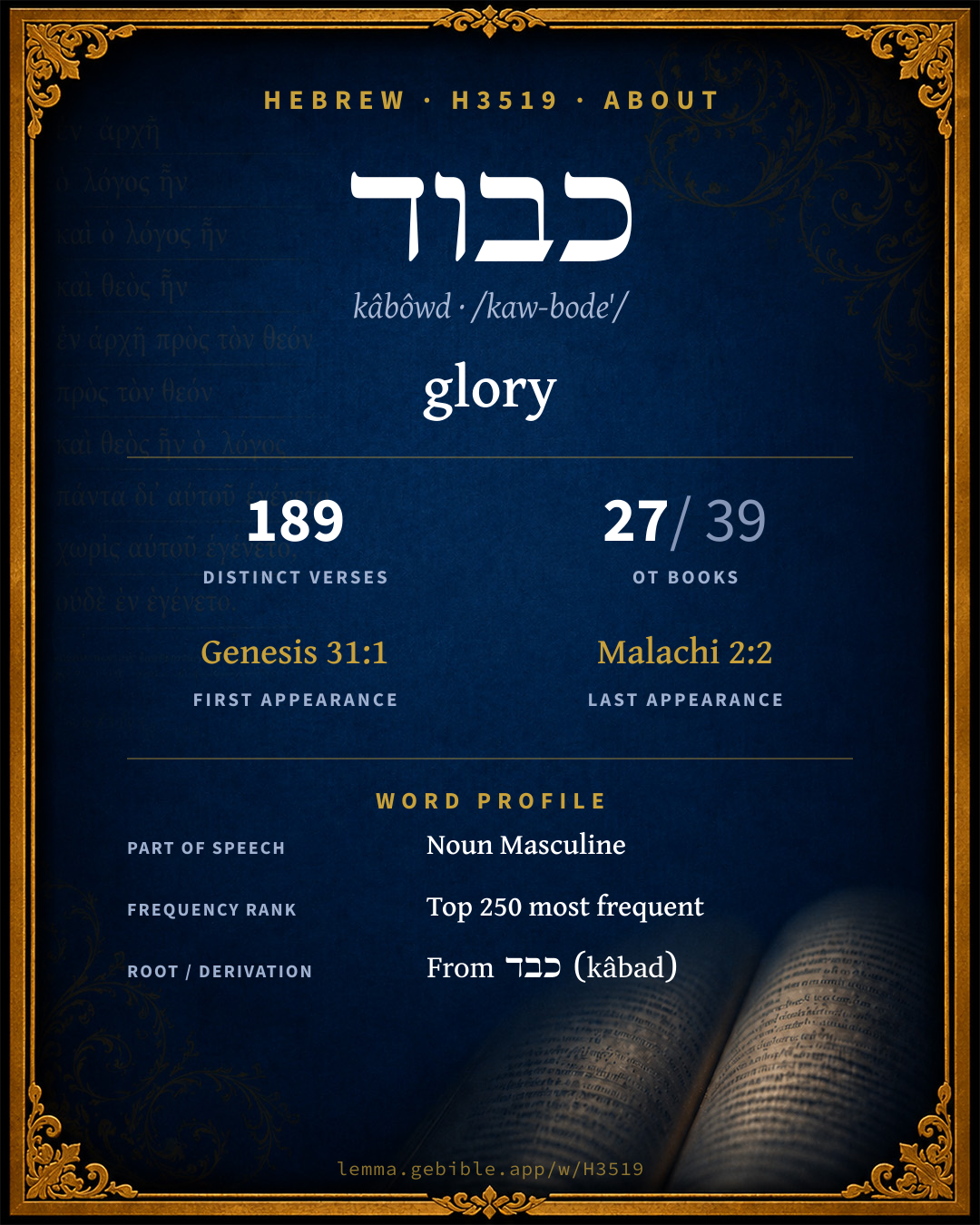
כָּבוֹד
glory
also: honour, glorious, abundance fuller range ↓
Full lexicon entry — Brown-Driver-Briggs (BDB)
From Brown-Driver-Briggs (BDB)
Where this word appears
See every Absolute-state word in the Hebrew Bible →
Grammar key — what these labels mean
Part of speech
- Noun
- A naming word — a person, place, thing, or idea.
Noun type
- Common
- A common noun — a general class of person, place, or thing (“king,” “city,” “water”), not a specific name.
State
- Construct
- A noun bound to a following noun in a possessive / “of” relationship (the construct chain).
- Absolute
- The independent form of a noun, not bound to a following word.
Gender
- Both
- Attested as both masculine and feminine.
Number
- Singular
- One.
2 verses where H3519 appears in the Construct state in the Book of Jeremiah. Filtered view — show all forms. Click any verse to open its interlinear word-by-word view. Verse text shown in the World English Bible for context — . Each verse’s Hebrew form is shown with its reference; the English is not keyword-highlighted, since the data carries no word-level English alignment. Use “Compare translations” on any verse to read it across multiple English versions. This concordance covers the Hebrew Bible; Septuagint (Greek Old Testament) occurrences are not indexed here.
Jeremiah
- Jeremiah 2:11 כְּבוֹד֖/וֹ n c bs cs + sfx pers 3ms Has a nation changed [its] gods, which yet are no gods? but my people have changed their glory for that which does not profit.
- Jeremiah 14:21 כְבוֹדֶ֑/ךָ n c bs cs + sfx pers 2ms Do not abhor [us], for your name's sake; do not disgrace the throne of your glory: remember, don't break your covenant with us.
About this entry
At a glance — auto-summarized from this page’s data, not written by a person. Every figure links to its source below. This summary describes the numbers; it doesn’t interpret them.
“glory” is the headline sense of the Hebrew noun כבוד (kâbôwd). “honour” is the historic King James Version rendering; modern versions use “glory.” See the renderings breakdown. With 189 verses in 27 books, it is a common word in the Hebrew Bible. It concentrates in Psalms, which alone accounts for 25% of its uses. Not a single-sense word: its full sense range also takes in “honour”, “glorious”, and “abundance”. The sections below give every sense, occurrence, and version rendering.
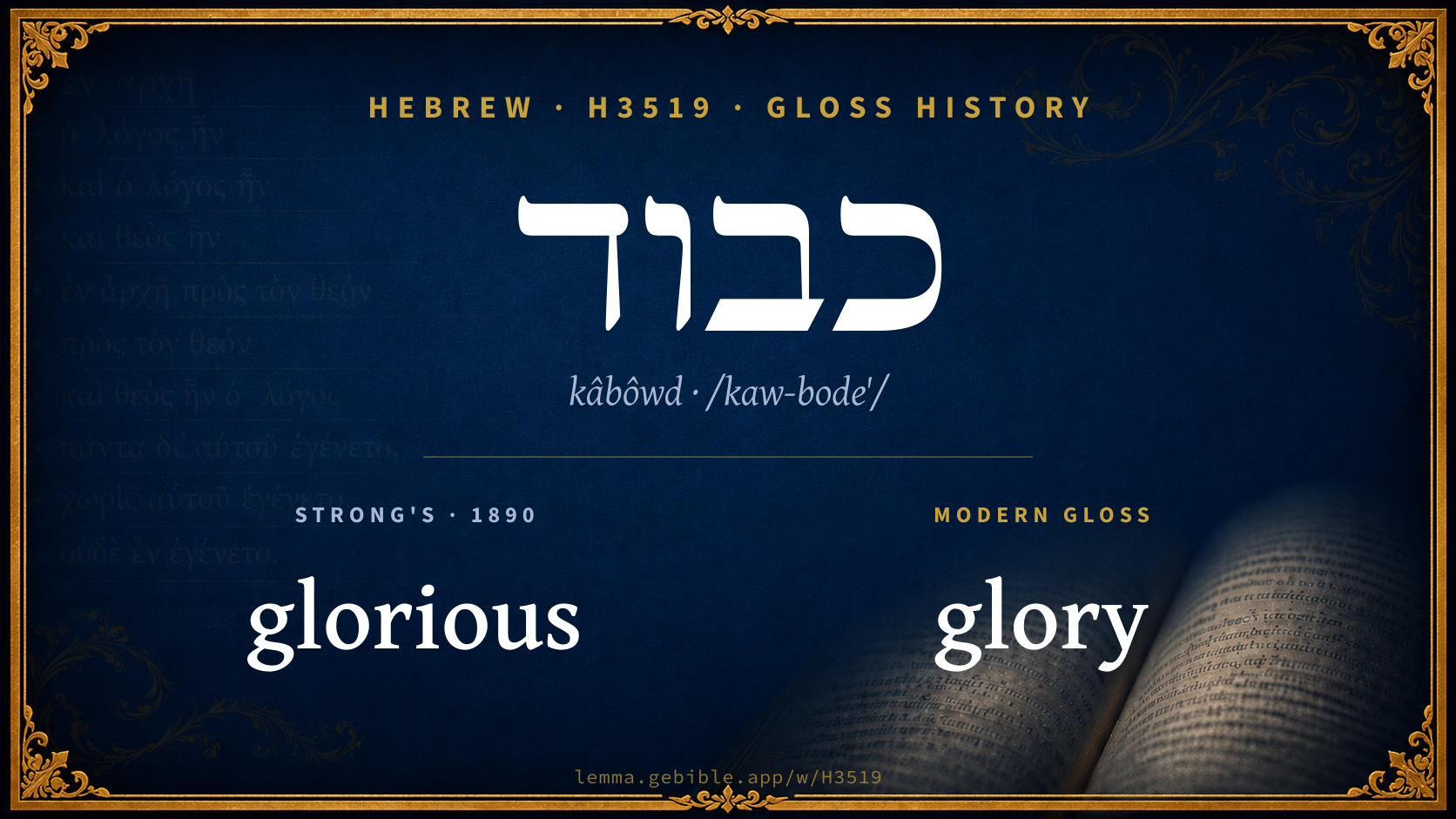
Gloss history
Strong's 1890 vs modern scholarship
About this word
Strong's H3519 catalogs a Hebrew word from the Hebrew Old Testament.
These counts are not copied from any lexicon or concordance. They are computed here, from the morphology-tagged Hebrew Old Testament. What Lemma adds →
- 189
- distinct verses
- The word appears in 189 distinct verses.
- 27 / 39
- OT books
- The word appears in 27 of 39 Old Testament books.
- #239
- by frequency
- Top 250 most frequent Hebrew words (rank 239 of 8,640 Hebrew words by occurrence).
View all 189 occurrences in the concordance →
By section of the Old Testament
By traditional corpus
Conventional, traditional groupings — biblical authorship is debated, so this is a traditional corpus grouping, not an authorship claim. Each share is this word’s portion of its verses in that division of the Hebrew canon. Each figure is a share of the word’s 189 distinct verses.
- Writings (Ketuvim) 87 verses · 46%
- Prophets (Nevi'im) 78 verses · 41%
- Torah (Pentateuch) 24 verses · 13%
How translations render this word
Counts come from each version’s own published word-to-Strong’s tagging or interlinear alignment — an approximate guide to how each version renders this word, not a word-level alignment the data otherwise carries. Because each total is that version’s own tagged count, the per-version totals vary from one another and need not match the appearance or distinct-verse counts above. These counts may also differ from a printed concordance because Lemma counts each distinctly tagged rendering and does not collapse phrase taggings into a single head-word total. This is a fixed set of word-tagged versions (KJV, ASV, BSB, ULT) and does not change with the reading translation you choose elsewhere. Each version’s license is shown beside its name below (and on Sources).
BDB lists this Strong’s number as 2 distinct words (homographs). Each count above pools all of them and is not split by sense — see the Senses section below. A low-frequency rendering may belong to a different one of those words, not the primary meaning.
- King James Version†: Glory 125×, Honour 27×, Behold the glory 6×
- American Standard Version†: Glory 117×, Honor 23×, And 6×
- Berean Standard Bible†: Glory 118×, Honor 27×, Glorious 13×
- unfoldingWord Literal Text†: Glory 105×, Glory of 53×, Honor 23×
King James Version Public Domain
Renders H3519 across 200† tagged occurrences — most commonly:
Plus 29 renderings that appear only once — usually multi-word phrases or single function words the recovered tagging swept in, not distinct renderings.
American Standard Version Public Domain
Renders H3519 across 202† tagged occurrences — most commonly:
Plus 39 renderings that appear only once — usually multi-word phrases or single function words the recovered tagging swept in, not distinct renderings.
Berean Standard Bible Public Domain
Renders H3519 across 198† tagged occurrences — most commonly:
Plus 25 renderings that appear only once — usually multi-word phrases or single function words the recovered tagging swept in, not distinct renderings. Not rendered by a distinct English word in 2 further occurrences.
unfoldingWord Literal Text CC BY-SA 4.0
Renders H3519 across 207† tagged occurrences — most commonly:
Plus 13 renderings that appear only once — usually multi-word phrases or single function words the recovered tagging swept in, not distinct renderings.
12 senses and sub-senses in the full BDB
What do BDB’s symbols mean?
BDB uses these scholarly abbreviations:
| Symbol | Meaning |
|---|---|
| 𝔊 | the Septuagint (the ancient Greek translation, LXX) |
| 𝔙 | the Vulgate (the Latin translation) |
| 𝔖 | the Syriac version (the Peshitta) |
| 𝔗 | the Targum (the Aramaic translation) |
| ψ | the Psalms |
| √ | root (the underlying root or stem) |
| ‖ | parallel passage (a synonymous or contrasted parallel) |
| † | the dagger: every passage where the word occurs is cited |
The 12 senses and sub-senses the full Brown-Driver-Briggs lexicon distinguishes for this word, in lexicon order (not ranked by frequency), with BDB’s own verbatim wording and sub-sense lettering. Shown in Hebrew script with BDB’s own scholarly abbreviations. The condensed entry is in the Lexicon Entry tab. See also the Forms in the corpus table below.
כבוד I glorious, only fs. כְּבוּדָּ֯ה, of a bed Ez 23
כבוד II
- 1. abundance, riches Gn 31:1 (J), Is 10:3; 61:6; 66:11, 12 Na 2:10 ψ 49:17, 18. e.g. Genesis 31:1
- 2. honour, splendour, glory, of external condition and circumstances:
- a. of men: of Joseph in Egypt Gn 45:13 (E); of Job Jb 19:9; 29:20; of Ephraim Ho 9:11, Samaria Ho 10:5; עֹשֶׁר וְכָכוֹד wealth and splendour 1 Ch 29:12, 28; 2 Ch 17:5; 18:1; 32:27; Pr 3:16; 8:18; 22:4; עשֶׁר (וּ)נְכָסִים וְכ׳ 2 Ch 1:11, 12 = גם ע׳ גם כ׳ 1 K 3:13, Ec 6:2; ‖ עשֶׁר Pr 11:16; man was crowned with כ׳ וְהָדָר at his creation, ψ 8:6; the king is given כ׳ ‖ הוֹד וְהָדָר ψ 21:6. e.g. Genesis 45:13
- b. of things, כ׳ עָשְׁרוֹ Est 5:11 splendour of his wealth, of a throne 1 S 2:8 (poem), Is 22:23; Je 14:21; 17:12; a kingdom Est 1:4; chariots Is 22:18; priestly robes Ex 28:2, 40 (P); Lebanon Is 35:2; 60:13; forest Is 10:18 (fig. of royal might); trees Ez 31:18; temple Hg 2:3, 9; restored holy land ψ 84:12 Is 4:2, 5; Jerus. Is 62:2. e.g. Esther 5:11
- c. of God, glory, (1) in historic theophanies: to Moses Ex 33:18, 22 (J); ‖ אֹתֹת Nu 14:22 (JE); ‖ גָּדְלוֹ Dt 5:21. P uses כ׳ יהוה for theophanies of the Exodus Ex 16:7, 10; 24:16, 17; 40:34, 35; Lv 9:6, 23; Nu 14:10; 16:19; 17:7; 2:6, cf. 2 Ch 5:14 = 1 K 8:11, 2 Ch 7:1, 2, 3; so Ezek., Ez 1:28; 3:12, 23; 10:4(×2), 18; 11:23; 43:4, 5; 44:4; with the variation כ׳ אֱלֹהֵי יִשְׂרָאֵל Ez 8:4; 9:3; 10:19; 11:22; 43:2, and הַכָּבוֹד Ez 3:23; the sacred tent was sanctified by the Glory Ex 29:43 (P), and the temple was מְקוֹם מִשְׁכַּן כ׳ ψ 26:8; when the ark was captured, the Glory went into exile from Israel 1 S 4:21, 22. (2) in historic and ideal manifestations to the pious mind Yahweh’s name is a name of glory ψ 72:19 Ne 9:5; his eyes of glory Is 3:8; in the temple his glory is seen ψ 63:3; it is על השׁמים ψ 113:4; על כל הארץ ψ 57:6, 12; in a thunderstorm he is אֵל הַכָּבוֹד ψ 29:3; his glory is לְעוֹלָם ψ 104:31; it is great ψ 138:5; above all the earth ψ 108:6; the whole earth is full of it Is 6:3; the heavens are declaring כְּבוֹד אֵל ψ 19:2; with reference to the divine reign כּ׳ הֲדַר מַלְכוּתוֹ, ψ 145:12; הֲדַר כ׳ הוֹדֶ֑ךָ ψ 145:5. (3) he is מֶלֶךְ הַכָּבוֹד ψ 24:7, 8, 9, 10(×2); he will appear in his glory ψ 102:17, his glory will be revealed in a march through the wilderness to the holy land Is 40:5, the land will see it Is 35:2, shine with it Ez 43:2, and it will dwell in the land ψ 85:10; it will be to the rearward of Israel Is 58:8; it will arise and be seen upon Jerusalem Is 60:1, 2; Yahweh will be the glory in the midst of her Zc 2:9; the temple will be filled with it Hg 2:7; the earth will be filled with a knowledge of it Hb 2:14, and with it Nu 14:21 (JE) ψ 72:19; it will be declared among the nations and all will see it Is 66:18, 19(×2) ψ 97:6 and peoples and kings revere it ψ 102:16 Is 59:19; י׳ will reign before his elders in glory Is 24:23; the resting-place of the Messiah will be כָּבוֹד Is 11:10. e.g. Exodus 33:18
- 3. honour, dignity of position מנע מִכּ׳ withhold from honour Nu 24:11 (E); ירד מִכּ׳ descend from Je 48:18; שׁלח אחר כ׳ send after Zc 2:12; רוּם בכ׳ ψ 112:9; שׁכב בכ׳ Is 14:18; תמך כ׳ Pr 29:23; יַרְבֶּה כ׳ Dn 11:39; לקח כ׳ take me to honour ψ 73:24; not becoming to fools Ps 26:1; לפני כ׳ ענוה before honour (goeth) humility Pr 15:33; 18:12; antithesis קלון Ho 4:7; Hb 2:16; Pr 3:35, קִיקָלוֹן Hb 2:16; כָּבוֹד is used as collective, of honoured men, dignitaries, nobility כבוד ישׂראל Mi 1:15; elsewhere as cstr. before various nations or with sfs. only Is 5:13; 8:7; 10:16; 16:14; 17:3, 4; 21:16; 22:24. e.g. Numbers 24:11
- 4. honour, reputation, of character, of man וְלֹא־לְךָ לְכ׳ 2 Ch 26:18 neither will it be for thine honour; ‖ חכמה Ec 10:1; צדקה Pr 21:21; antith. כְּלִמָּה ψ 4:3; וְחֵקֶר כְּבֹדָם כָּבוֹד Pr 25:27 and searching out of their glory is (not) glory כ׳ לאישׂ Pr 20:3; כ׳ אֱלֹהִים הַסְתֵּר דָּבָר וכ׳ מְלָכִים חֲקֹר דָּבָר Pr 25:2 the honour of God is to conceal a thing, but the honour of kings is to search out a thing. e.g. 2 Chronicles 26:18
- 5. my honour, poet. of the seat of honour in the inner man, the noblest part of man ‖ נפשׁי Gn 49:6 (poem) ψ 7:6; לִבִּי ψ 16:9 108:2; it is called upon to זמּר ψ 30:13 (read כְּבוֹדִי for כָּבוֹד); עוּרָה ψ 57:9. e.g. Genesis 49:6
- 6. honour, reverence, glory, as due to one or ascribed to one:
- a. of men, due to a father Mal 1:6; honour done to David by Nathan’s prophecy 1 Ch 17:18; עשׂה כ׳ לְ 2 Ch 32:33 do honour to; נתן כ׳ לְ Pr 26:8; ‖ ישׁע ψ 62:8. e.g. Malachi 1:6
- b. of God, כְּבוֹדִי the honour due to me (Yahweh) Is 42:8; 43:7; 48:11 כ׳ שְׁמֶ֑ךָ ψ 79:9; נתן כ׳ לְ 1 S 6:5 Je 13:16 Mal 2:2 ψ 115:1; שׂים כ׳ לְ Jos 7:19 (J), Is 42:12; שׂים כ׳ תהלתוֹ ψ 66:2; יהב כ׳ ועז לְ ψ 29:1; 96:7 = 1 Ch 16:28; יהב כ׳ שְׁמוֹ לְ ψ 29:2; 96:8 = 1 Ch 16:29; זמּר כ׳ שְׁמוֹ ψ 66:2; ספּר כבודו בגוים ψ 96:3 = 1 Ch 16:24; אמר כ׳ מלכותך ψ 145:11; נתן כבודי בגוים Ez 39:21; אֹמֵר כָּבוֹד ψ 29:9 say Glory; יַעְלְזוּ בְּכ׳ exult with (ascriptions of) glory ψ 149:5. e.g. Isaiah 42:8
- 7. glory as the object of honour, reverence and glorifying, כְּבוֹדִי ψ 3:4 my glory (the one whom I glorify); כְּבוֹדָם ψ 106:20 their glory; כְּבוֹדוֹ Je 2:11. e.g. Psalms 3:4
Senses from the full Brown-Driver-Briggs lexicon (Brown, Driver, Briggs; Oxford 1906 — public domain), digitized via Sefaria, supplemented by the OpenScriptures HebrewLexicon (CC BY 4.0). Full attribution on Sources.
Word origin
I. adj. glorious, only fs. כְּבוּדָּ֯ה, of a bed Ez 23:41; a queen in bridal array ψ 45:14; ψ 45:14 belongs to II. כָּבוֹד 2; cstr. as Ges§ 141 d; v. also כֹּל 1 a end. cf. כְּבוּדָּ֯ה n.f. infr.
II. n.m. Is 60:1 and †f. Gn 49:6 abundance, honour, glory;—כ׳ Jos 7:19 + 70 times; כָּבֹד Gn 31:1 Na 2:10; cstr. כְּבוֹד Ex 16:7 + 62 times; כְּבֹד Pr 25:2(×2); sf. כְּבוֹדִי Gn 45:13 + 17 times; כְּבֹדִי Gn 49:6 + 3 times; + 40 times sfs.—
— Brown-Driver-Briggs (Oxford 1906, public domain), digitized via Sefaria, supplemented by the OpenScriptures HebrewLexicon (CC BY 4.0). See Sources.
Derived from כבד (kâbad) (H3513) — to be heavy.
Jastrow Dictionary
A second Hebrew/Aramaic lexicon for comparison, covering Aramaic and post-biblical (Talmudic, Targumic, Midrashic) usage that the biblical-Hebrew BDB does not. Matched by lemma rather than by Strong’s number, so a lemma may carry more than one Jastrow headword (shown separately below), and the entries cover usage well beyond the Bible.
כָּבוֹד
- 1. importance. Arakh. 18ᵃ ולידון בכְבוֹדוֹ (Ar. בכבידו) and that the value of a limb be judged according to its importance (vitality); ib. 4ᵇ; B. Mets. 114ᵃ
- 2. honor, respect; dignity. Ber. 19ᵇ, a. e., v. חָלַק. Ib. משום כְּבוֹד מלכים on account of the respect due to royalty. Ib.; Men. 37ᵇ גדול כְּ׳ הבריות וכ׳ human dignity (in proper appearance) is very important, for it may even suspend a Biblical law. Ber. l. c. ואינו לפי כְבוֹרוֹ and it is not becoming his dignity (to drive an ass). Sot. 13ᵃ הניחו לו כְּבוֹדוֹ במלכים יותר וכ׳ let him alone, the honor shown to him (Jacob) by princes is higher than that by private men. Ib. נהגו בהן כ׳ they treated them with respect. Ned. 39ᵇ בכְבוֹדִי לא מחיתם בכְ׳ וכ׳ as long as My honor was concerned, you did not interfere, and when the honor of a human being is at stake &c. Ab. IV, 12 יהי כְ׳ תלמידך וכ׳ let the honor of thy pupil be as dear to thee as thine own, and thy fellow student’s honor as that of thy teacher; a. v. fr.—כסא הכ׳, v. כִּסֵּא. מחל על כבודו to forego due honors, v. מָחַל.
כִּבּוּד
- , v. sub. כִּיבּ׳.
A Dictionary of the Targumim, the Talmud Babli and Yerushalmi, and the Midrashic Literature (Marcus Jastrow; London, Luzac, 1903) — Public Domain. Digitized via Sefaria. Digitized via Sefaria. Full attribution on Sources.
Forms in the corpus
The 108 distinct written forms H3519 takes in the Hebrew Bible, most frequent first — each parse links to that state’s occurrences in the concordance. Hebrew forms include their vowel points and cantillation, so a single lemma takes many written forms.
The 60 most common forms are shown; 48 rarer forms follow in the full concordance.
Same root — word family
Other BDB entries built from the same root as H3519, grouped by Strong’s listed origin. These share a root / origin per the lexicon — not necessarily a shared meaning. Each links to that word’s own entry.
Derives from
Shares the same root
Compare all same-root words → Showing 4 of 5 — not the complete family. They share a root, not necessarily a meaning.
Septuagint verse parallels
This word appears in 183 verses that also exist in the Greek Old Testament (Septuagint), out of the 189 Hebrew verses it occurs in. You can read those verses in Greek by switching the Old Testament edition to the Septuagint.
Read these verses in the Septuagint
- Genesis 31:1
- Exodus 16:7
- Leviticus 9:6
- Numbers 14:10
- Deuteronomy 5:24
- Joshua 7:19
- 1 Samuel 2:8
- 1 Kings 3:13
- 1 Chronicles 16:28
- 2 Chronicles 1:11
- Esther 1:4
- Job 19:9
This is a verse-level parallel only — the same verses exist in both the Hebrew and Greek Old Testaments. No word-level Hebrew↔Greek correspondence is claimed: the data carries no such alignment, so no Greek word is shown as this Hebrew word’s translation. Coverage is not total — the Septuagint omits the deuterocanon and renumbers the Psalms, so some Hebrew verses have no direct Greek parallel.