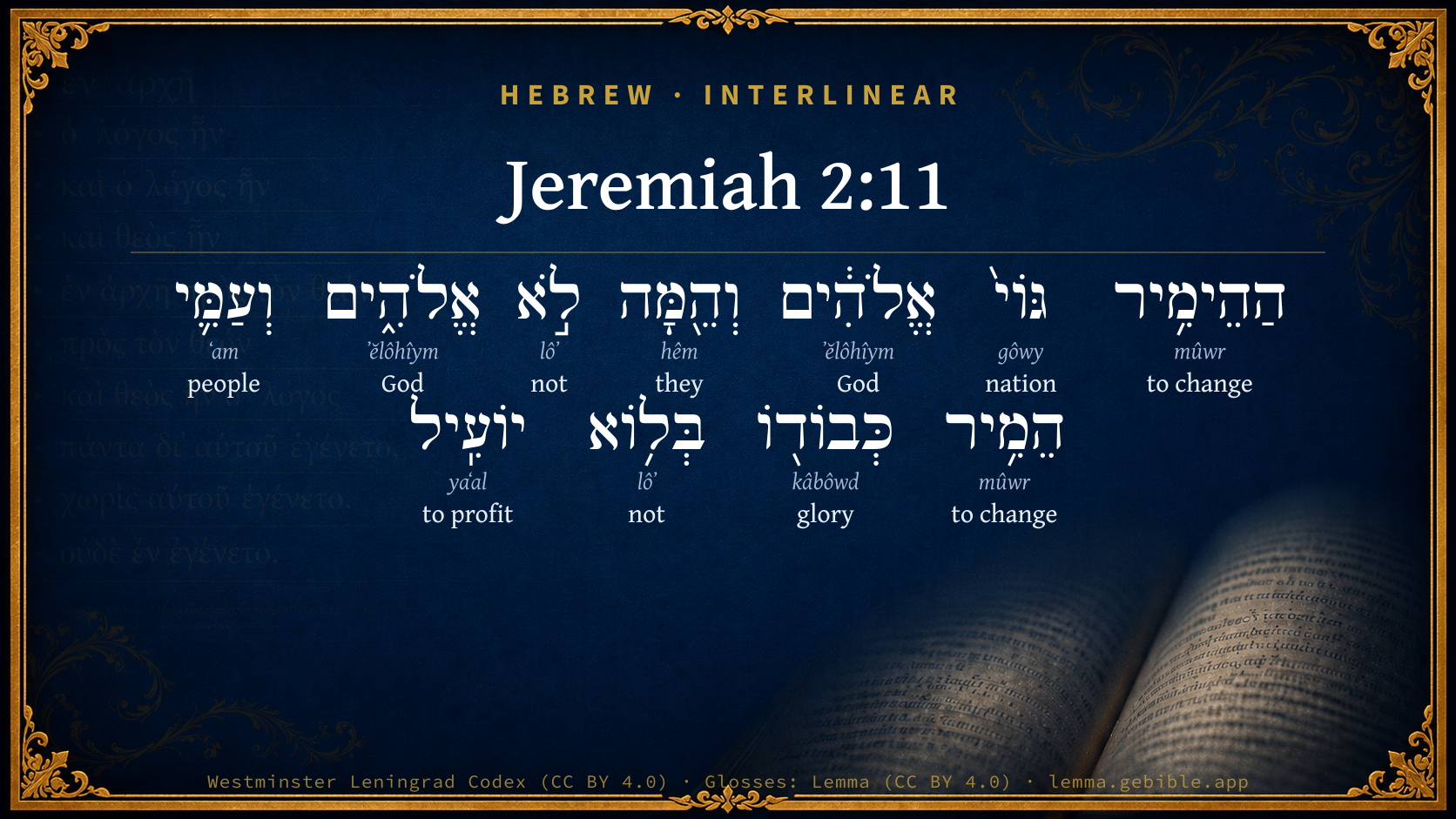
Jeremiah 2:11

Hebrew (Westminster Leningrad Codex) Jeremiah 2:11 appears in the Hebrew Old Testament. The text above is from the Westminster Leningrad Codex. Each word links to its Strong’s number, a concise gloss, and parsing drawn from the Open Scriptures Hebrew Bible morphology. Click any word for its full Brown-Driver-Briggs (BDB) entry.
Download image
Cite this verse

Jeremiah 2:11 (World English Bible). Public Domain. Lemma interlinear Bible study tool, https://lemma.gebible.app/v/jeremiah/2/11.

Show BibTeX & RIS
BibTeX
RIS
English Translation
Has a nation changed [its] gods, which yet are no gods? but my people have changed their glory for that which does not profit.
World English Bible · Public Domain
Download a study sheet

One document with this verse’s original text, its word-by-word gloss line, the meaning frame, cross-references with their text, attributed commentary, and full source and license credits — printable, and it pastes into notes with its structure intact.

This verse Autodidact and up

Study sheet (.html) Plain text (.txt)

A passage Seminary Student

Up to 50 verses in one chapter. A passage sheet keeps up to 6 commentary sources and 12 cross-references per verse, in the order this page ranks them, and says so on the sheet whenever that leaves anything out. Ask for a single verse and you get the Autodidact verse sheet above.

Everything on this page stays free to read, with no account — the sheet is a download of what is already on screen, not access to it.

Want to remove ads? Support Godless Engineer
Compare translations 3

The same verse in 3 English versions, stacked beneath the original-language interlinear above. Click any original word for its lexicon entry.

Each is an independent rendering of the whole verse — the interlinear is not word-aligned to these translations.

Highlighted words mark where these versions differ — a whole-verse word diff, not a word-by-word alignment.

  • World English Bible Public Domain
    Has a nation changed [its] gods, which yet are no gods? but my people have changed their glory for that which does not profit.
  • King James Version Public Domain
    Hath a nation changed their gods, which are yet no gods? but my people have changed their glory for that which doth not profit.
  • unfoldingWord Literal Text CC BY-SA 4.0
    Has a nation exchanged gods, though they not gods? But my people have exchanged their glory for does not profit.

unfoldingWord Literal Text — © unfoldingWord, licensed CC BY-SA 4.0. Word-aligned USFM3 via Door43 (git.door43.org/unfoldingWord/en_ult).

Versions to compare (up to 4)

3 of 4 selected

Show all 18 translations

Every available English version of this verse, each an independent rendering of the whole verse.

  • World English Bible Public Domain
    Has a nation changed [its] gods, which yet are no gods? but my people have changed their glory for that which does not profit.
  • Berean Standard Bible Public Domain
    Has a nation ever changed its gods, though they are no gods at all? Yet My people have exchanged their Glory for useless idols.
  • Majority Standard Bible Public Domain
    Has a nation ever changed its gods? (Yet they are not gods at all.) But My people have exchanged their Glory for useless idols.
  • King James Version Public Domain
    Hath a nation changed their gods, which are yet no gods? but my people have changed their glory for that which doth not profit.
  • American Standard Version (1901) Public Domain
    Hath a nation changed `its' gods, which yet are no gods? but my people have changed their glory for that which doth not profit.
  • Revised Version (1885) Public Domain
    Hath a nation changed their gods, which yet are no gods? but my people have changed their glory for that which doth not profit.
  • Geneva Bible (1599) Public Domain
    Hath any nation changed their gods, which yet are no gods? but my people haue chaged their glorie, for that which doeth not profite.
  • Douay-Rheims (1899) Public Domain
    If a nation hath changed their gods, and indeed they are not gods,: but my people have changed their glory into an idol.
  • Young's Literal Translation Public Domain
    Hath a nation changed gods? (And they `are' no gods!) And My people hath changed its honour For that which doth not profit.
  • Literal Standard Version CC BY-SA 4.0
    Has a nation changed gods? (And they [are] no gods!) And My people has changed its glory || For that which does not profit.
  • Unlocked Literal Bible CC BY-SA 4.0
    Has a nation exchanged gods, even though they were not gods? But my people have exchanged their glory for what cannot help them.
  • unfoldingWord Literal Text CC BY-SA 4.0
    Has a nation exchanged gods, though they not gods? But my people have exchanged their glory for does not profit.
  • Darby Bible Public Domain
    Hath a nation changed [its] gods? and they are no gods; -- but my people have changed their glory for that which doth not profit.
  • World Messianic Bible Public Domain
    Has a nation changed its gods, which really are no gods? But my people have changed their glory for that which doesn’t profit.
  • Webster's Bible Public Domain
    Hath a nation changed their gods, which are yet no gods? but my people have changed their glory for that which doth not profit.
  • Free Bible Version CC BY-SA 4.0
    Has a nation ever changed its gods? —even though they're not gods at all! Yet my people have traded their glorious God for worthless idols.
  • Bible in Basic English Public Domain
    Has any nation ever made a change in their gods, though they are no gods? but my people have given up their glory in exchange for what is of no profit.
  • JPS Tanakh (1917) Public Domain
    Hath a nation changed its gods, which yet are no gods? But My people hath changed its glory for that which doth not profit.

Literal Standard Version (2020), Covenant Press — licensed CC BY-SA 4.0. Text via the HelloAO Bible API (eBible.org). Unlocked Literal Bible (unfoldingWord) — licensed CC BY-SA 4.0. Text via the HelloAO Bible API (eBible.org). unfoldingWord Literal Text — © unfoldingWord, licensed CC BY-SA 4.0. Word-aligned USFM3 via Door43 (git.door43.org/unfoldingWord/en_ult). Free Bible Version, Dr. Jonathan Gallagher — licensed CC BY-SA 4.0. Text via the HelloAO Bible API (eBible.org).

Word by word

More ways to search: Search by grammar → Find every occurrence → Compare this word →

Practice this passage: Drill this verse → Learn its vocabulary →

הַהֵימִ֥יר
mûwr
H4171
“to change”
Particle, Interrogative + Verb, Hiphil, Perfect, 3rd Person, Masculine, Singular
Part of Speech
Particle + Verb
Stem
Hiphil
Form
Perfect
Person
3rd Person
Gender
Masculine
Number
Singular
Full BDB Definition

Origin: a primitive root

TWOT: 1164

to change, exchange - (Niphal) to be changed - (Hiphil) - to change, alter - to exchange
  1. גּוֹי֙ gôwy H1471 “nation” Noun, Common, Masculine, Singular, Absolute
  2. אֱלֹהִ֔ים ʼĕlôhîym H430 “God(s)” Noun, Common, Masculine, Plural, Absolute
  3. וְהֵ֖מָּה hêm H1992 “and · they” Conjunction + Pronoun, Personal, 3rd Person, Masculine, Plural
  4. לֹ֣א lôʼ H3808 “not” Particle, Negative
  5. אֱלֹהִ֑ים ʼĕlôhîym H430 “God(s)” Noun, Common, Masculine, Plural, Absolute
  6. וְעַמִּ֛י ʻam H5971 “and · people · my” Conjunction + Noun, Common, Masculine, Singular, Construct + Suffix, Personal, 1st Person, Common, Singular
  7. הֵמִ֥יר mûwr H4171 “to change” Verb, Hiphil, Perfect, 3rd Person, Masculine, Singular
  8. כְּבוֹד֖וֹ kâbôwd H3519 “glory · his” Noun, Common, Both, Singular, Construct + Suffix, Personal, 3rd Person, Masculine, Singular
  9. בְּל֥וֹא lôʼ H3808 “in/at · not” Preposition + Particle, Negative
  10. יוֹעִֽיל yaʻal H3276 “to profit” Verb, Hiphil, Imperfect, 3rd Person, Masculine, Singular

About this verse

These counts appear in no published source. They are computed here, from the morphology-tagged text and Lemma’s own curated glosses. What Lemma adds →

11
words
8
distinct lemmas
Prophets
section

Notable vocabulary

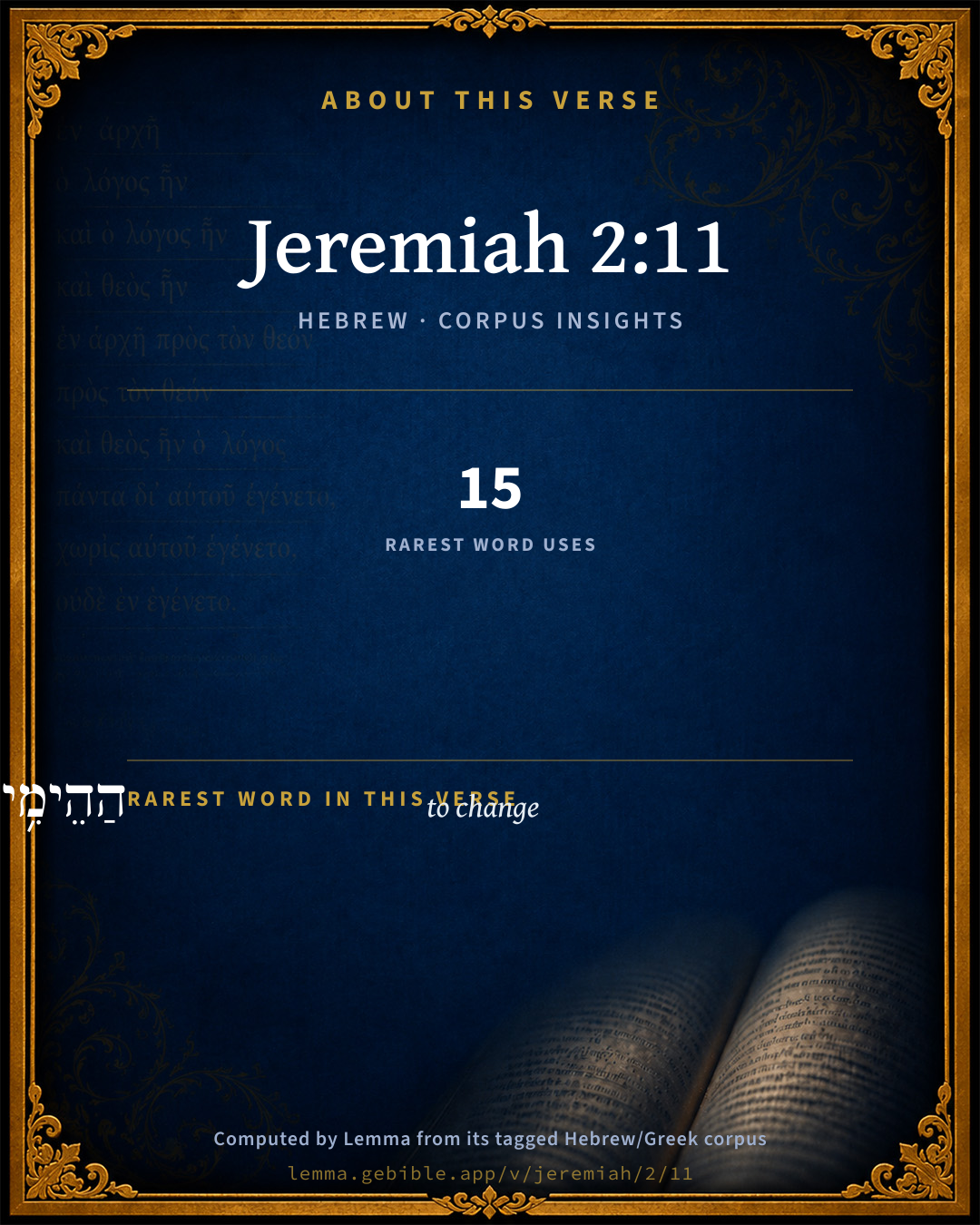
The rarest word here is הַהֵימִ֥יר to change H4171 — appearing just 15 times in the whole Hebrew Bible.

Shared distinctive vocabulary

הַהֵימִ֥יר to change H4171 occurs in 10 verses of the Hebrew Bible. Also found in:

Grammatical profile

  • 3 verbs
  • 5 nouns
  • 1 pronoun
  • 2 particles

Verb forms

  • הַהֵימִ֥יר Hiphil · Perfect
  • הֵמִ֥יר Hiphil · Perfect
  • יוֹעִֽיל Hiphil · Imperfect

Repetition

Words recur within this verse — often emphatic in Hebrew:

  • הַהֵימִ֥יר to change H4171 ×2
  • אֱלֹהִ֔ים God H430 ×2
  • לֹ֣א not H3808 ×2

Cross-references

12

Topical passages linked to Jeremiah 2:11 in the Treasury of Scripture Knowledge — connected by theme and wording, ordered by reader-vote popularity; previews shown in the World English Bible.

  • Romans 1:23 and traded the glory of the incorruptible God for the likeness of an image of corruptible man, and of birds, and four-footed animals, and creeping things.
  • Isaiah 37:19 and have cast their gods into the fire: for they were no gods, but the work of men's hands, wood and stone; therefore they have destroyed them.
  • Psalms 106:20 Thus they exchanged their glory For an image of a bull that eats grass.
  • Jeremiah 16:20 Shall a man make to himself gods, which yet are no gods?
  • Micah 4:5 Indeed all the nations may walk in the name of their gods; But we will walk in the name of Yahweh our God forever and ever.
  • Psalms 115:4 Their idols are silver and gold, The work of men's hands.
  • Jeremiah 2:8 The priests didn't say, Where is Yahweh? and those who handle the law didn't know me: the rulers also transgressed against me, and the prophets prophesied by Baal, and walked after things that do not profit.
  • 1 Corinthians 8:4 Therefore concerning the eating of things sacrificed to idols, we know that no idol is anything in the world, and that there is no other God but one.
  • Deuteronomy 33:29 Happy are you, Israel: Who is like you, a people saved by Yahweh, The shield of your help, The sword of your excellency! Your enemies shall submit themselves to you; You shall tread on their high places.
  • Psalms 3:3 But you, Yahweh, are a shield around me, My glory, and the one who lifts up my head.
  • Jeremiah 2:5 thus says Yahweh, What unrighteousness have your fathers found in me, that they have gone far from me, and have walked after vanity, and are become vain?
  • 1 Peter 1:18 knowing that you were redeemed, not with corruptible things, with silver or gold, from the useless way of life handed down from your fathers,

Cross-references courtesy of OpenBible.info (CC BY 4.0).

Hebrew and Greek witnesses Masoretic Hebrew ↔ Greek Septuagint

The same verse in the two great witnesses to the Old Testament, shown verse-for-verse.

These are two independent witnesses, not word-aligned to each other, and the Septuagint is shown in lemma (dictionary) form.

Hebrew Jeremiah 2:11 Masoretic · Westminster Leningrad Codex

הַהֵימִ֥יר גּוֹי֙ אֱלֹהִ֔ים וְהֵ֖מָּה לֹ֣א אֱלֹהִ֑ים וְעַמִּ֛י הֵמִ֥יר כְּבוֹד֖וֹ בְּל֥וֹא יוֹעִֽיל

Has a nation changed [its] gods, which yet are no gods? but my people have changed their glory for that which does not profit.

World English Bible · Public Domain

Greek LXX Structure differs

In the Septuagint, Jeremiah is about an eighth shorter than the Hebrew and arranges its material differently — the Oracles Against the Nations (Hebrew chapters 46–51) appear in the middle of the Greek book, after 25:13. Because the chapter and verse boundaries do not line up, a verse-for-verse comparison with the Hebrew is not shown.

A verse-for-verse comparison isn’t shown here because the chapters and verses don’t line up. Switch to the LXX edition with the MT / LXX toggle above to read the Greek directly.

Hebrew: Westminster Leningrad Codex (CC BY 4.0). Greek: Septuagint (public domain); English from a public-domain English Septuagint. How the Septuagint differs from the Hebrew →

Targum (Aramaic paraphrase)

1

The Targum is the ancient Jewish Aramaic paraphrase of the Hebrew Scriptures — an interpretive translation, not the Hebrew text itself. Onkelos (literal) and Pseudo-Jonathan (expansive) render the Torah, and Jonathan the Prophets. Coverage is partial: where no permissively-licensed English translation exists for a verse, only the Aramaic is shown. This is verse-level text, not a word-by-word alignment to the Hebrew.

  1. Targum Jonathan Prophets (Joshua–Malachi)
    הָא עַמְמַיָא לָא שְׁבָקוּ פּוּלְחַן טַעֲוָתָא וְאִינוּן טַעֲוָן דְלֵית בְּהוֹן צְרוֹךְ וְעַמִי שְׁבָקוּ פּוּלְחָנִי דִי בְּדִילֵיהּ אֲנָא מַיְתִי עֲלֵיהוֹן יְקָרָא וַאֲזָלוּ בָּתַר דְלָא יֶהְנוּן לְהוֹן:

    (no public-domain English translation for this verse)

    Targum Jonathan — Aramaic: “Mikraot Gedolot” (public domain). English: “Sefaria Community Translation” (CC0 1.0 (public-domain dedication)); “London "Chaldee Paraphrase," 1871” (public domain). Text via Sefaria.

Commentary

Notes on Jeremiah 2:11 from classic Christian and Jewish commentators (each source and its license shown beneath its notes). The classic Christian expositions comment on the surrounding passage and are grouped to its opening verse, so a note may address several verses; the Jewish commentaries on the Tanakh (Rashi and others) are per-verse, so they appear only where the commentator wrote on this verse.

Lemma curates 59 commentaries, every one of them public domain or Creative Commons licensed, each selected and text-cleaned for this edition rather than reprinted as found. About our sources →

Trapp's Complete Commentary

John Trapp

Jer 2:11 Hath a nation changed [their] gods, which [are] yet no gods? but my people have changed their glory for [that which] doth not profit.

Ver. 11. Hath a nation changed their gods?] No; they are too pertinacious in their superstitions. Xenophon saith it was an oracle of Apollo, that those gods are rightly worshipped which were delivered them by their ancestors; and this he greatly applaudeth. Cicero also saith, that no reason shall ever prevail with him to relinquish the religion of his forefathers. That monarch of Morocco told an English ambassador, that he had lately read St Paul, and that he disliked nothing in him but this, that he had changed his religion. {a}

Which yet are no gods.] Sed hominum figmenta et ludibria daemonum. But are the invention of men and mockery of demons. When Hercules came into a temple, and found the image or statue of Adonis in it, he pulled it down with this expression, Certe nil sacri es, Sure thou art no god; the like may be said of all idols.

But my people have changed their glory,] i.e., Their God, of whom they might glory, saying, {as Deu 32:31} "Their rock is not as our rock, our enemies themselves being judges."

{a} Heyl., Cosmography.

John Trapp, A Commentary or Exposition upon All the Books of the Old and New Testament (1647–1656) — public domain. Text from a community e-Sword module.

MacLaren's Expositions of Holy Scripture

Alexander MacLaren

Jeremiah

STIFF-NECKED IDOLATERS AND PLIABLE CHRISTIANS

Jer 2:11.

The obstinacy of the adherents of idolatry is in striking contrast with Israel’s continual tendency to forsake Jehovah. It reads a scarcely less forcible lesson to many nominal and even to some real Christians.

I. That contrast carries with it a disclosure of the respective origins of the two kinds of Religion.

The strangeness of the contrasted conduct is intensified when we take into account the tremendous contrast between the two Objects of worship. Israel’s God was Israel’s ‘Glory’; the idol-worshipper bowed down before ‘that which doth not profit,’ and yet no experience of God could bind His fickle worshippers to Him, and no experience of the impotence of the idol could shake its votaries’ devotion. They cried and were not heard. They toiled and had no results. They broke their teeth on ‘that which is not bread,’ and filled their mouths with gritty ashes that mocked them with a semblance of nourishment and left them with empty stomachs and excoriated gums, yet by some strange hallucination they clung to ‘vanities,’ while Israel was always hankering after opportunity to desert Jehovah. The stage of civilisation partly accounts for the strange fascination of idolatry over the Israelites. But the deeper solution lies in the fact that the one religion rises from the hearts of men, corresponds to their moral condition, and is largely moulded by their lower nature; while the other is from above, corresponds, indeed, with the best and deepest longings and needs of souls, but contravenes many of their most clamant wishes, and necessarily sets before them a standard high and difficult to reach. Men make their gods in their own image, and are conscious of no rebuke nor stimulus to loftier living when they gaze on them. The God of Revelation bids men remake themselves in His image, and that command requires endless effort. The average man has to put a strain on his intellect in order to rise to the apprehension of God, and a still more unwelcome strain on his moral nature to rise to the imitation of God. No wonder, then, if the dwellers on the low levels should cleave to them, and the pilgrims to the heights should often weary of their toil and be distressed with the difficulty of breathing the thin air up there, and should give up climbing and drop down to the flats once more.

II. That contrast carries with it a rebuke.

Many voices echo the prophet’s contrast nowadays. Our travelling countrymen, especially those of them who have no great love for earnest religion, are in the habit of drawing disparaging contrasts between Buddhists, Brahmins, Mohammedans, any worshippers of other gods and Christians. One may not uncharitably suspect that a more earnest Christianity would not please these critics much better than does the tepid sort, and that the pictures they draw both of heathenism and of Christianity are coloured by their likes and dislikes. But it is well to learn from an enemy, and caricatures may often be useful in calling attention to features which would escape notice but for exaggeration. So we may profit by even the ill-natured and distorted likenesses of ourselves as contrasted with the adherents of other religions which so many ‘liberal-minded’ writers of travels delight to supply.

Think, then, of the rebuke which the obstinate adherence of idolaters to their idols gives to the slack hold which so many professing Christians have on their religion.

Think of the way in which these lower religions pervade the whole life of their worshippers, and of how partial is the sway over a little territory of life and conduct which Christianity has in many of its adherents. The absorption in worship shown by Mohammedans, who will spread their prayer carpets anywhere and perform their drill of prayers without embarrassment or distraction in the sight of a crowd, or the rapt ‘devotion’ of fakirs, are held up as a rebuke to us ‘Christians’ who are ashamed to be caught praying. One may observe, in mitigation, that the worship which is of the heart is naturally more sensitive to surrounding distractions than that which is a matter of posturing and repetition by rote. But there still remains substance enough in the contrast to point a sharp arrow of rebuke.

And there is no denying that in these ‘heathen’ religions, religion is intertwined with every act of life in a fashion which may well put to shame many of us. Remember how Paul had to deal at length with the duty of the Corinthians in view of the way in which every meal was a sacrifice to some god, and how the same permeation of life with religion is found in all these ‘false faiths.’ The octopus has coiled its tentacles round the whole body of its victim. Bad and sad and mad as idolatry is, it reads a rebuke to many of us, who keep life and religion quite apart, and lock up our Christianity in our pews with our prayer-books and hymnaries.

Think of the material sacrifices made by idolaters, in costly offerings, in painful self-tortures, and in many other ways, and the niggardliness and self-indulgence of so many so-called Christians.

III. The contrast suggests the greatness of the power which can overcome even such obstinate adherence to idols.

There is one, and only one, solvent for that rock-like obstinacy-the Gospel. The other religions have seldom attempted to encroach on each other’s territory, and where they have, their instrument of conversion has generally been the sword. The Gospel has met and mastered them all. It, and it only, has had power to draw men to itself out of every faith. The ancient gods who bewitched Israel, the gods of Greece, the gods of our own ancestors, the gods of the islands of the South Seas, lie huddled together, in undistinguished heaps, like corpses on a battlefield, and the deities of India and the East are wounded and slowly bleeding out their lives. ‘Bel boweth down, Nebo stoopeth, the idols are upon the beasts,’ all packed up, as it were, and ready to be carried off.

The rate of progress in dethroning them varies with the varying national conditions. It is easier to cut a tunnel through chalk than through quartz.

IV. That contrast carries with it a call for Christian effort to spread the conquering Gospel.

Alexander MacLaren, Expositions of Holy Scripture (1904–1910) — public domain. Text from a community e-Sword module.

Tyndale Open Study Notes

Tyndale Open Resources

2:11 No pagan nation traded its gods for those of another nation. Although the pagan nations generally worshiped the same nature deities (by different names), each nation essentially remained loyal to its own gods. Israel’s disloyalty is thus highlighted.

Tyndale Open Study Notes — © Tyndale Open Resources, licensed CC BY-SA 4.0. Text via the HelloAO Bible API.

Geneva Bible (1599)

Geneva Bible translators

That is, God which is their glory, and who maketh them glorious above all other people, reproving the Jews that they were less diligent to serve the true God, than were the idolaters to honor their vanities.

Meaning, the idols which were their destruction, Ps. 106:36.

Geneva Bible (1599) marginal notes — public domain. Text via Bolls.life.

Jamieson, Fausset & Brown

Robert Jamieson, A. R. Fausset & David Brown

glory--Jehovah, the glory of Israel (Psa 106:20; Rom 1:23). The Shekinah, or cloud resting on the sanctuary, was the symbol of "the glory of the Lord" (Kg1 8:11; compare Rom 9:4). The golden calf was intended as an image of the true God (compare Exo 32:4-5), yet it is called an "idol" (Act 7:41). It (like Roman Catholic images) was a violation of the second commandment, as the heathen multiplying of gods is a violation of the first.

not profit-- (Jer 2:8).

Jamieson, Fausset & Brown — Commentary Critical and Explanatory on the Whole Bible (1871) — public domain (CC PDM 1.0). Text via the HelloAO Bible API.

John Calvin's Commentaries

Hence he says, Yea, pass over unto the islands; and then he adds, see whether there is a thing like this; that is, such a monstrous and execrable thing can nowhere be found. An explanation follows, No nation has changed its gods, and yet they are no gods; that is, religion among all nations continues the same, so that they do not now and then change their gods, but worship those who have been as it were handed down to them by their fathers. And yet, he says, they are no gods If it had been only said, that no nation has changed its gods, the impiety of Israel would not have been so grievously exposed; but the Prophet takes it for granted, that all the nations were deceived and led away after fictitious gods, and yet remained constant in their delusions. Now, God does not set this forth as a virtue; he does not mean that the constancy of the nations was worthy of praise in not departing from their own superstitions; but, compared with the conduct of the chosen people, this constancy might however appear as laudable. We hence see that the whole is to be thus read connectively, — “Though no nation worships the true God, yet religion remains unchangeable among them all; and yet ye have perfidiously forsaken me, and you have not forsaken a mere phantom, but your glory.”

He sets here the favor of God in opposition to the delusions of false gods, when he says, My people have changed their own glory For the people knew, not only through the teaching of the law, but also by sure evidences, that God was their glory; and yet they departed from him. It is then the same as though Jeremiah had said, that all the nations would condemn the Israelites at the last day, because their very persistency in error would prove the greater wickedness of the Jews, inasmuch as they were apostates from the true God, and from that God who had so clearly manifested to them his power.

Now, if one asks, whether religion has been changed by any of the nations? First, we know that this principle prevailed everywhere, — that there was to be no innovation in the substance of religion: and Xenophon highly commends this oracle of Apollo, — that those gods were rightly worshipped who have been received by tradition from ancestors. The devil had thus bewitched all nations, — “No novelty can please God; but be ye content with the usual custom which has descended to you from your forefathers.” This principle then was held by the Greeks and the Asiatics, and also by Europeans. It was therefore for the most part true what the Prophet says here: and we know that when a comparison is made, it is enough if the illustration is for the most part, επὶ τὸ πολὺ, as Aristotle says, confirmed by custom and constant practice. We hence see that the charge of levity against the Jews was not unsuitably brought by Jeremiah, when he said, that no nation had changed its gods, but that God had been forsaken by his people whose glory he was; that is, to whom he had given abundant reasons for glorying.

John Calvin's Commentaries (1540-1563) — public domain. Text from the Calvin Translation Society English edition (1840s-50s) via the Christian Classics Ethereal Library (ccel.org). Calvin's coverage is partial (roughly two-thirds of the Bible); uncommented books and verses are honest gaps, never fabricated. The 19th-century editor's footnotes and remarks are omitted so the notes are faithfully Calvin's own voice.

Ellicott's Commentary for English Readers

(11) Hath a nation . . .—Emphatically a heathen “nation,” as contrasted with the “people” of Jehovah. They were faithful to their false gods; Israel was unfaithful to the true. The words “changed their glory” find an echo in Rom_1:23, though here they express the thought that the worship of Jehovah was the true glory of Israel as a people, and that they had wilfully abandoned it.

A Bible Commentary for English Readers, edited by Charles John Ellicott (1878–1897) — public domain. Text from a community e-Sword module.

The Cambridge Bible for Schools and Colleges

gen. ed. J. J. S. Perowne

11. a nation] i.e. a heathen nation.

which yet are no gods] Therefore it need not have occasioned surprise, if their worshippers had at some time deserted them. Heathen nations are loyal to their gods, unreal though they be. For reference to the question whether Jeremiah was a ‘speculative,’ or only a practical, monotheist, see Intr. ii. § 3 (a).

their glory] Jehovah, Whose very nature is glory, makes that glory known to Israel as His chosen people, and gives them a share in it. Cp. Deu_10:21; also 1Sa_4:21; Psa_106:20.

be horribly afraid] lit. shudder, bristle with horror.

The Cambridge Bible for Schools and Colleges (gen. ed. J. J. S. Perowne; Cambridge University Press, 1878–1918) — public domain. Text from a community e-Sword module.

John Gill's Exposition

Be astonished, O ye heavens, at this,.... Meaning either the angels in heaven, or the heavens themselves, by a personification:

and be horribly afraid, be ye very desolate, saith the Lord; all which may be signified by storms and tempests, by thunder and lightning, and by the sun's withdrawing its light. This is said to aggravate the wickedness committed, as if the heavens blushed and were ashamed, and were confounded and amazed at it; and as if, on account of it, the Jews deserved not the benefit of the heavens, and the orbs in them.

John Gill's Exposition of the Whole Bible (1746–1763) — public domain (CC PDM 1.0). Text via the HelloAO Bible API.

Albert Barnes' Notes on the Bible

A nation - A Gentile nation, in strong antithesis to people, the appellation of Israel.

Their glory - Though the worship of the one true God is a nation’s greatest glory, yet it is irksome because it puts a constraint on human passions.

That which doth not profit - Israel had exchanged the prosperity which was God’s reward of obedience for the calamities which resulted from idol-worship.

Albert Barnes' Notes on the Bible (1834–1885) — public domain. Text from a community e-Sword/MySword module.

Haydock's Catholic Bible Commentary

Glory; the true God and his ark, Psalm iii. 4., and 1 Kings iv. 21.

George Leo Haydock (1774–1849), Haydock's Catholic Family Bible and Commentary, 1859 edition — public domain. Excludes Psalms (Douay-Rheims chapter numbering differs from Protestant) and Deuterocanonical books (Catholic canon only).

Matthew Poole's English Annotations

Hath a nation changed their gods? q.d. No, they are unmovable and fixed to their idols, although they are false gods; what they receive from their fathers they tenaciously hold.

Their glory, viz. the true God, who was their glory; a metonymy of the adjunct, Psa 106:20; and who always did them good, giving them cause to glory in him, and to make their boast of him.

For that which doth not profit; for those which never did or can do them good, that have no essence or power; but of whom they must necessarily be ashamed, as Jer 2:26.

Matthew Poole's English Annotations on the Holy Bible (1683–1685) — public domain. Text from a community e-Sword/MySword module.

Whedon's Commentary on the Bible

Daniel D. Whedon

11. Changed — הימיר. It is best to regard this as from an ayin-vav root, and not as identical in its root with “boast yourselves,” in Isa_61:1.

Gods — Our Authorized Version misses the full force of the original.

Hath a nation changed… gods, which are yet no gods — What so extraordinary as to change gods? And yet the matter is not fairly illustrated by an appeal to experience, for the gods of the nations are not gods. The prophet opposes to glory not its exact antithesis, shame, but that which doth not profit, perhaps as pointing the contrast more sharply.

Daniel D. Whedon (gen. ed.), Commentary on the Old and New Testaments (1874–1909) — public domain. Text from a community e-Sword module.

The Pulpit Commentary

Hath a nation changed their gods? Has any heathen nation ever changed its idol-god for another? The prophet clearly implies a negative answer; and yet it must be admitted that the adoption of a new religion, under the pressure of conquest or a higher foreign civilization is not an unknown phenomenon in the ancient world. Glory; i.e. source of all outward prosperity. (comp. Psa_3:3, "my Glory, and the Lifter up Of my head Religion was, in fact, the root of national life in antiquity; contrast our own division between the sacred and the secular Jehovah elsewhere receives the title "the Pride of Israel Authorized Version, rather weakly, "the Excellency of Israel". (Amo_8:7 Hos_5:5. Comp. the parallel passages, Psa_106:20 Rom_1:23)

The Pulpit Commentary (1880–1919), ed. H.D.M. Spence-Jones & Joseph S. Exell — public domain. Text from a community e-Sword module.

John Wesley's Explanatory Notes

Their glory - The true God, who was their glory; and who always did them good, giving them cause to glory in him.

John Wesley, Explanatory Notes Upon the Whole Bible (1754–1765) — public domain. Text via the GEBible commentary corpus.

Rashi

Rabbi Shlomo Yitzchaki (Rashi)

for what does not avail For an idol that does not avail.

Rashi on the Tanakh — English translations: “The Judaica Press complete Tanach with Rashi, translated by A. J. Rosenberg” (CC BY 4.0); “Pentateuch with Rashi's commentary by M. Rosenbaum and A.M. Silbermann, 1929-1934” (public domain); “The Metsudah Tanach series, Lakewood, N.J” (CC BY 4.0); and “The Book of Joshua, Metsudah Publications, 1997” (CC BY 4.0). Text via Sefaria.

Lesson kit

Teaching starters — assembled from the data on this page, not authored interpretation. Every prompt links to the verse data it draws on. Edit before teaching.

Jeremiah, in the Prophets, opens this verse with 11 words (8 distinct Hebrew lemmas). Its most distinctive word is mûwr (“to change”). A historical commentator’s framing appears above. Read the whole chapter for the surrounding context.

Discussion questions

  1. The word mûwr carries the sense “to change.” How does it shape the verse?
  2. How does Leviticus 27:10, which shares the word «to change», read alongside this verse?
  3. What does the repetition of “to change” (2× in this one verse) do in this verse?
  4. The translations on this page render this verse differently — a whole-verse word diff, not a word-by-word alignment. What might account for the different wordings?
  5. «הַהֵימִ֥יר» is a Hiphil Perfect verb. How does that grammatical form shape the action described?
  6. Compare how Trapp's Complete Commentary and MacLaren's Expositions of Holy Scripture read this verse. Where do they agree or differ?

Things to notice

  • These translations choose different wording for 6 words in this verse.
  • “to change” occurs 2× in this single verse.
  • 8 distinct Hebrew lemmas span 11 words in this verse.

Reading settings

Reading text

Shown beneath each verse's original-language words.

Old Testament
Old Testament edition

Read the OT as the Masoretic Hebrew (MT) or the Greek Septuagint (LXX).

English shown for the Greek Septuagint (in the Hebrew ↔ Greek comparison).

Comparing translations? Open the Compare panel on any verse page to stack up to four side by side.