
Ecclesiastes 6:2

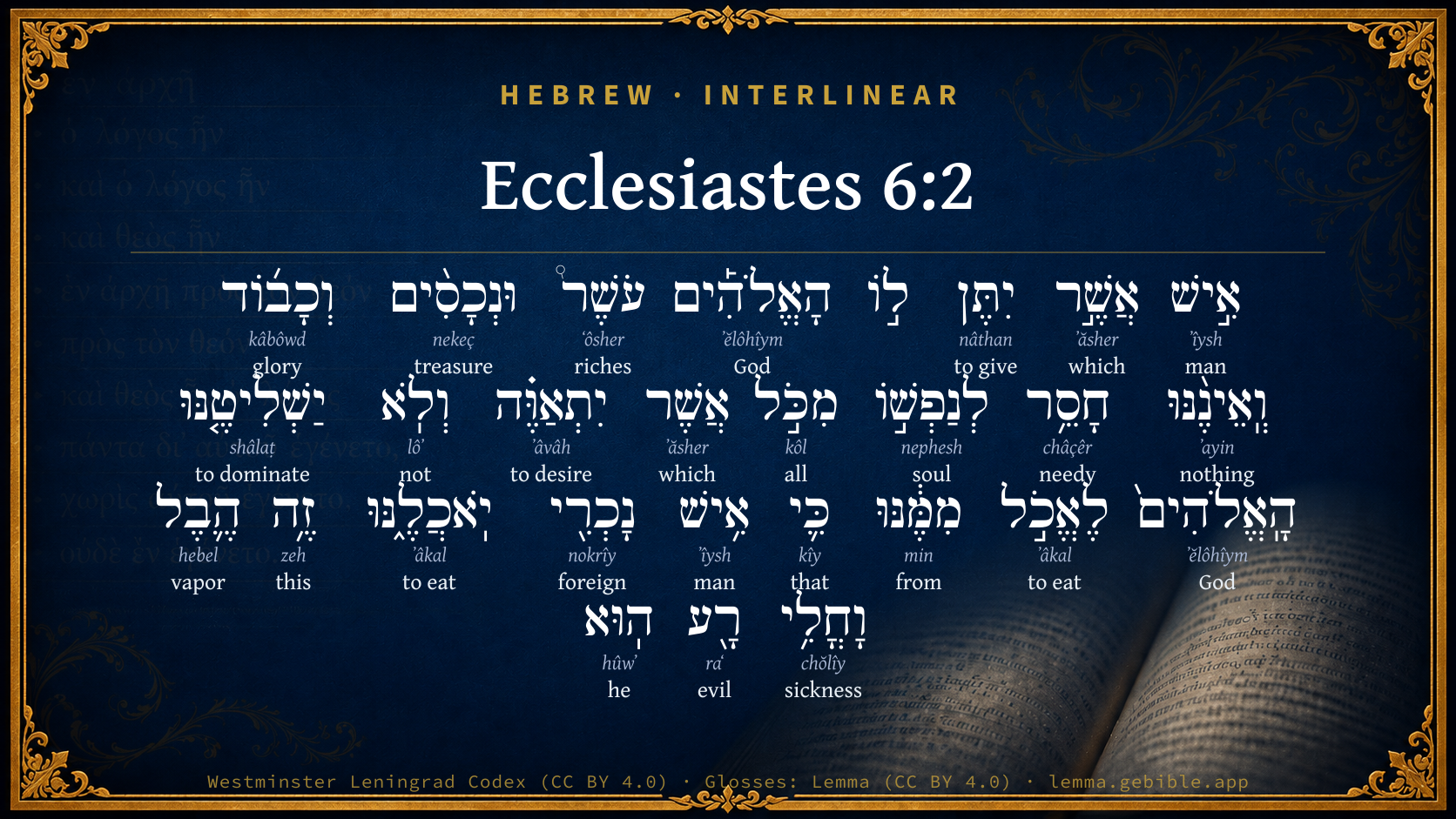
Hebrew (Westminster Leningrad Codex) Ecclesiastes 6:2 appears in the Hebrew Old Testament. The text above is from the Westminster Leningrad Codex. Each word links to its Strong’s number, a concise gloss, and parsing drawn from the Open Scriptures Hebrew Bible morphology. Click any word for its full Brown-Driver-Briggs (BDB) entry.
Download image
Cite this verse

Ecclesiastes 6:2 (World English Bible). Public Domain. Lemma interlinear Bible study tool, https://lemma.gebible.app/v/ecclesiastes/6/2.

Show BibTeX & RIS
BibTeX
RIS
English Translation
a man to whom God gives riches, wealth, and honor, so that he lacks nothing for his soul of all that he desires, yet God gives him no power to eat of it, but an alien eats it. This is vanity, and it is an evil disease.
World English Bible · Public Domain
Download a study sheet

One document with this verse’s original text, its word-by-word gloss line, the meaning frame, cross-references with their text, attributed commentary, and full source and license credits — printable, and it pastes into notes with its structure intact.

This verse Autodidact and up

Study sheet (.html) Plain text (.txt)

A passage Seminary Student

Up to 50 verses in one chapter. A passage sheet keeps up to 6 commentary sources and 12 cross-references per verse, in the order this page ranks them, and says so on the sheet whenever that leaves anything out. Ask for a single verse and you get the Autodidact verse sheet above.

Everything on this page stays free to read, with no account — the sheet is a download of what is already on screen, not access to it.

Want to remove ads? Support Godless Engineer
Compare translations 3

The same verse in 3 English versions, stacked beneath the original-language interlinear above. Click any original word for its lexicon entry.

Each is an independent rendering of the whole verse — the interlinear is not word-aligned to these translations.

Highlighted words mark where these versions differ — a whole-verse word diff, not a word-by-word alignment.

  • World English Bible Public Domain
    a man to whom God gives riches, wealth, and honor, so that he lacks nothing for his soul of all that he desires, yet God gives him no power to eat of it, but an alien eats it. This is vanity, and it is an evil disease.
  • King James Version Public Domain
    A man to whom God hath given riches, wealth, and honour, so that he wanteth nothing for his soul of all that he desireth, yet God giveth him not power to eat thereof, but a stranger eateth it: this is vanity, and it is an evil disease.
  • unfoldingWord Literal Text CC BY-SA 4.0
    A person who the God gives to him wealth and possessions and honor, so he is not lacking for his soul from anything that he desires, but the God does not enable him to eat from it; instead, a nonnative person will eat it—this vapor, and it a sickening misfortune.

unfoldingWord Literal Text — © unfoldingWord, licensed CC BY-SA 4.0. Word-aligned USFM3 via Door43 (git.door43.org/unfoldingWord/en_ult).

Versions to compare (up to 4)

3 of 4 selected

Show all 18 translations

Every available English version of this verse, each an independent rendering of the whole verse.

  • World English Bible Public Domain
    a man to whom God gives riches, wealth, and honor, so that he lacks nothing for his soul of all that he desires, yet God gives him no power to eat of it, but an alien eats it. This is vanity, and it is an evil disease.
  • Berean Standard Bible Public Domain
    God gives a man riches, wealth, and honor, so that he lacks nothing his heart desires; but God does not allow him to enjoy them. Instead, a stranger will enjoy them. This is futile and a grievous affliction.
  • Majority Standard Bible Public Domain
    God gives a man riches, wealth, and honor, so that he lacks nothing his heart desires; but God does not allow him to enjoy them. Instead, a stranger will enjoy them. This is futile and a grievous affliction.
  • King James Version Public Domain
    A man to whom God hath given riches, wealth, and honour, so that he wanteth nothing for his soul of all that he desireth, yet God giveth him not power to eat thereof, but a stranger eateth it: this is vanity, and it is an evil disease.
  • American Standard Version (1901) Public Domain
    a man to whom God giveth riches, wealth, and honor, so that he lacketh nothing for his soul of all that he desireth, yet God giveth him not power to eat thereof, but an alien eateth it; this is vanity, and it is an evil disease.
  • Revised Version (1885) Public Domain
    a man to whom God giveth riches, wealth, and honour, so that he lacketh nothing for his soul of all that he desireth, yet God giveth him not power to eat thereof, but a stranger eateth it; this is vanity, and it is an evil disease.
  • Geneva Bible (1599) Public Domain
    A man to whom God hath giuen riches and treasures and honour, and he wanteth nothing for his soule of all that it desireth: but God giueth him not power to eate thereof, but a strange man shall eate it vp: this is vanitie, and this is an euill sicknesse.
  • Douay-Rheims (1899) Public Domain
    A man to whom God hath given riches, and substance, and honour, and his soul wanteth nothing of all that he desireth: yet God doth not give him power to eat thereof, but a stranger shall eat it up. This is vanity and a great misery.
  • Young's Literal Translation Public Domain
    A man to whom God giveth wealth, and riches, and honour, and there is no lack to his soul of all that he desireth, and God giveth him not power to eat of it, but a stranger eateth it; this `is' vanity, and it `is' an evil disease.
  • Literal Standard Version CC BY-SA 4.0
    A man to whom God gives wealth, and riches, and honor, and there is no lack to his soul of all that he desires, and God does not give him power to eat of it, but a stranger eats it; this [is] vanity, and it [is] an evil disease.
  • Unlocked Literal Bible CC BY-SA 4.0
    God might give riches, wealth, and honor to a man so that he lacks nothing that he desires for himself, but then God gives him no ability to enjoy it. Instead, someone else uses his things. This is vapor, an evil affliction.
  • unfoldingWord Literal Text CC BY-SA 4.0
    A person who the God gives to him wealth and possessions and honor, so he is not lacking for his soul from anything that he desires, but the God does not enable him to eat from it; instead, a nonnative person will eat it—this vapor, and it a sickening misfortune.
  • Darby Bible Public Domain
    one to whom God giveth riches, wealth, and honour, and he wanteth nothing for his soul of all that he desireth, yet God giveth him not power to eat thereof, but a stranger eateth it: this is vanity, and a sore evil.
  • World Messianic Bible Public Domain
    a man to whom God gives riches, wealth, and honor, so that he lacks nothing for his soul of all that he desires, yet God gives him no power to eat of it, but an alien eats it. This is vanity, and it is an evil disease.
  • Webster's Bible Public Domain
    A man to whom God hath given riches, wealth, and honor, so that he wanteth nothing for his soul of all that he desireth, yet God giveth him not power to eat of it, but a stranger eateth it: this is vanity, and it is an evil disease.
  • Free Bible Version CC BY-SA 4.0
    God gives wealth, possessions, and honor to someone. They have everything they want. But God doesn't let them enjoy what they have. Instead somebody else does! This is hard to fathom, and is truly evil.
  • Bible in Basic English Public Domain
    A man to whom God gives money, wealth, and honour so that he has all his desires but God does not give him the power to have joy of it, and a strange man takes it. This is to no purpose and an evil disease.
  • JPS Tanakh (1917) Public Domain
    a man to whom God giveth riches, wealth, and honour, so that he wanteth nothing for his soul of all that he desireth, yet God giveth him not power to eat thereof, but a stranger eateth it; this is vanity, and it is an evil disease.

Literal Standard Version (2020), Covenant Press — licensed CC BY-SA 4.0. Text via the HelloAO Bible API (eBible.org). Unlocked Literal Bible (unfoldingWord) — licensed CC BY-SA 4.0. Text via the HelloAO Bible API (eBible.org). unfoldingWord Literal Text — © unfoldingWord, licensed CC BY-SA 4.0. Word-aligned USFM3 via Door43 (git.door43.org/unfoldingWord/en_ult). Free Bible Version, Dr. Jonathan Gallagher — licensed CC BY-SA 4.0. Text via the HelloAO Bible API (eBible.org).

Word by word

More ways to search: Search by grammar → Find every occurrence → Compare this word →

Practice this passage: Drill this verse → Learn its vocabulary →

וּנְכָסִ֨ים
nekeç
H5233
“and · treasures”
Conjunction + Noun, Common, Masculine, Plural, Absolute
Part of Speech
Conjunction + Noun
Type
Common
Gender
Masculine
Number
Plural
State
Absolute
Full BDB Definition

Origin: from an unused root meaning to accumulate

TWOT: 1367

riches, treasures
  1. אִ֣ישׁ ʼîysh H376 “man” Noun, Common, Masculine, Singular, Absolute
  2. אֲשֶׁ֣ר ʼăsher H834 “which” Particle, Relative
  3. יִתֶּן nâthan H5414 “to give” Verb, Qal, Imperfect, 3rd Person, Masculine, Singular
  4. הָאֱלֹהִ֡ים ʼĕlôhîym H430 “the · God(s)” Particle, Definite Article + Noun, Common, Masculine, Plural, Absolute
  5. עֹשֶׁר֩ ʻôsher H6239 “riches” Noun, Common, Masculine, Singular, Absolute
  6. וְכָב֜וֹד kâbôwd H3519 “and · glory” Conjunction + Noun, Common, Both, Singular, Absolute
  7. וְֽאֵינֶ֨נּוּ ʼayin H369 “and · nothing · him” Conjunction + Particle, Negative + Suffix, Personal, 3rd Person, Masculine, Singular
  8. חָסֵ֥ר châçêr H2638 “needy” Adjective, Adjective, Masculine, Singular, Absolute
  9. לְנַפְשׁ֣וֹ nephesh H5315 “to/for · soul · his” Preposition + Noun, Common, Both, Singular, Construct + Suffix, Personal, 3rd Person, Masculine, Singular
  10. מִכֹּ֣ל kôl H3605 “from · all” Preposition + Noun, Common, Masculine, Singular, Absolute
  11. אֲשֶׁר ʼăsher H834 “which” Particle, Relative
  12. יִתְאַוֶּ֗ה ʼâvâh H183 “to desire” Verb, Hithpael, Imperfect, 3rd Person, Masculine, Singular
  13. וְלֹֽא lôʼ H3808 “and · not” Conjunction + Particle, Negative
  14. יַשְׁלִיטֶ֤נּוּ shâlaṭ H7980 “to dominate · him” Verb, Hiphil, Imperfect, 3rd Person, Masculine, Singular + Suffix, Personal, 3rd Person, Masculine, Singular
  15. הָֽאֱלֹהִים֙ ʼĕlôhîym H430 “the · God(s)” Particle, Definite Article + Noun, Common, Masculine, Plural, Absolute
  16. לֶאֱכֹ֣ל ʼâkal H398 “to eat” Preposition + Verb, Qal, Infinitive Construct
  17. מִמֶּ֔נּוּ min H4480 “from · us” Preposition + Suffix, Personal, 1st Person, Common, Plural
  18. כִּ֛י kîy H3588 “that” Conjunction
  19. אִ֥ישׁ ʼîysh H376 “man” Noun, Common, Masculine, Singular, Absolute
  20. נָכְרִ֖י nokrîy H5237 “foreign” Adjective, Adjective, Masculine, Singular, Absolute
  21. יֹֽאכֲלֶ֑נּוּ ʼâkal H398 “to eat · him” Verb, Qal, Imperfect, 3rd Person, Masculine, Singular + Suffix, Personal, 3rd Person, Masculine, Singular
  22. זֶ֥ה zeh H2088 “this” Pronoun, Demonstrative, Masculine, Singular
  23. הֶ֛בֶל hebel H1892 “vapor” Noun, Common, Masculine, Singular, Absolute
  24. וָחֳלִ֥י chŏlîy H2483 “and · sickness” Conjunction + Noun, Common, Masculine, Singular, Absolute
  25. רָ֖ע raʻ H7451 “evil” Adjective, Adjective, Masculine, Singular, Absolute
  26. הֽוּא hûwʼ H1931 “he” Pronoun, Personal, 3rd Person, Masculine, Singular

About this verse

These counts appear in no published source. They are computed here, from the morphology-tagged text and Lemma’s own curated glosses. What Lemma adds →

28
words
23
distinct lemmas
Wisdom
section

Notable vocabulary

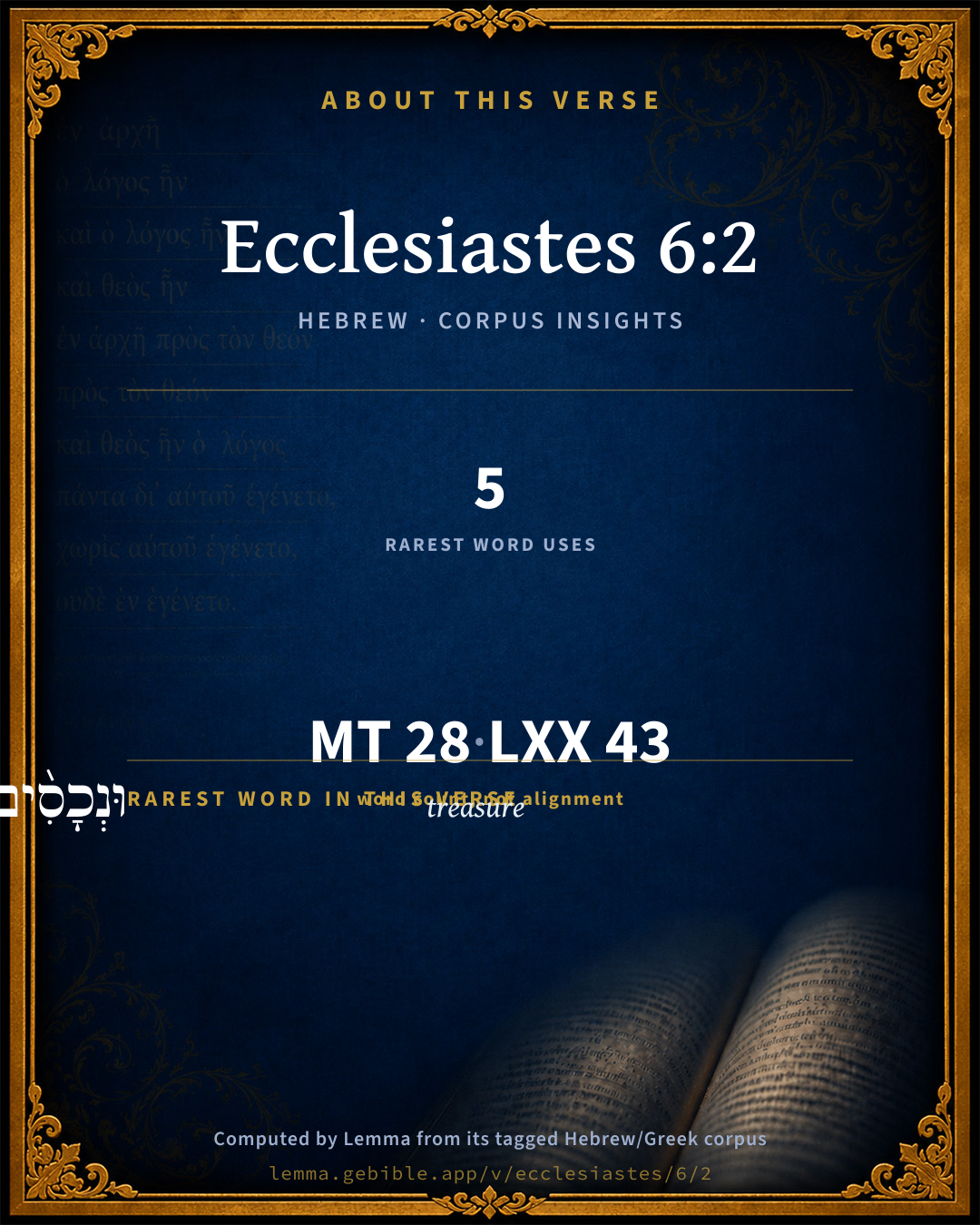
The rarest word here is וּנְכָסִ֨ים treasure H5233 — appearing just 5 times in the whole Hebrew Bible.

Shared distinctive vocabulary

וּנְכָסִ֨ים treasure H5233 occurs in 5 verses of the Hebrew Bible. Also found in:

Grammatical profile

  • 5 verbs
  • 11 nouns
  • 3 adjectives
  • 2 pronouns
  • 2 prepositions
  • 1 conjunction
  • 4 particles

Verb forms

  • יִתֶּן Qal · Imperfect
  • יִתְאַוֶּ֗ה Hithpael · Imperfect
  • יַשְׁלִיטֶ֤נּוּ Hiphil · Imperfect
  • לֶאֱכֹ֣ל Qal · Infinitive Construct
  • יֹֽאכֲלֶ֑נּוּ Qal · Imperfect

Repetition

Words recur within this verse — often emphatic in Hebrew:

  • אִ֣ישׁ man H376 ×2
  • הָאֱלֹהִ֡ים God H430 ×2
  • לֶאֱכֹ֣ל to eat H398 ×2
  • אֲשֶׁ֣ר which H834 ×2

Hebrew & Septuagint length

In English translation the verse runs 47 words from the Hebrew and 50 from the Septuagint (LXX English) — closely comparable.

A rough comparison of the two English renderings, which tokenize alike — not a word-level alignment.

Word counts can differ between the Hebrew and the Greek without any difference in meaning — e.g. the Hebrew direct-object marker אֵת has no separate Greek word, and Greek often adds the article ὁ.

In the original languages it is 28 Hebrew tokens and 43 Greek tokens — but the two are counted differently (Hebrew bundles its prefixes and suffixes into one token; the Greek is in lemma form), so that isn’t a like-for-like length.

Cross-references

21

Topical passages linked to Ecclesiastes 6:2 in the Treasury of Scripture Knowledge — connected by theme and wording, ordered by reader-vote popularity; previews shown in the World English Bible.

  • Ecclesiastes 5:19 Every man also to whom God has given riches and wealth, and has given him power to eat of it, and to take his portion, and to rejoice in his labor--this is the gift of God.
  • Psalms 17:14 From men by your hand, Yahweh, From men of the world, whose portion is in this life. You fill the belly of your cherished ones. Your sons have plenty, And they store up wealth for their children.
  • Psalms 73:7 Their eyes bulge with fat. Their minds pass the limits of conceit.
  • 1 Kings 3:13 I have also given you that which you have not asked, both riches and honor, so that there shall not be any among the kings like you, all your days.
  • Lamentations 5:2 Our inheritance is turned to strangers, Our houses to aliens.
  • Job 21:9–15 Their houses are safe from fear, Neither is the rod of God upon them.
  • Psalms 39:6 "Surely every man walks like a shadow. Surely they busy themselves in vain. He heaps up, and doesn't know who shall gather.
  • Daniel 5:18 You king, the Most High God gave Nebuchadnezzar your father the kingdom, and greatness, and glory, and majesty:
  • Luke 12:19–20 I will tell my soul, "Soul, you have many goods laid up for many years. Take your ease, eat, drink, be merry."'
  • Deuteronomy 8:7–10 For Yahweh your God brings you into a good land, a land of brooks of water, of springs and springs, flowing forth in valleys and hills;
  • Deuteronomy 28:33 The fruit of your ground, and all your labors, shall a nation which you don't know eat up; and you shall be only oppressed and crushed always;
  • Deuteronomy 28:43 The foreigner who is in the midst of you shall mount up above you higher and higher; and you shall come down lower and lower.
  • Judges 18:10 When you go, you shall come to a people secure, and the land is large; for God has given it into your hand, a place where there is no want of anything that is in the earth.
  • 1 Chronicles 29:25 Yahweh magnified Solomon exceedingly in the sight of all Israel, and bestowed on him such royal majesty as had not been on any king before him in Israel.
  • 1 Chronicles 29:28 He died in a good old age, full of days, riches, and honor: and Solomon his son reigned in his place.
  • 2 Chronicles 1:11 God said to Solomon, Because this was in your heart, and you have not asked riches, wealth, or honor, nor the life of those who hate you, neither yet have asked long life; but have asked wisdom and knowledge for yourself, that you may judge my people, over whom I have made you king:
  • Ecclesiastes 2:4–10 I made myself great works. I built myself houses. I planted myself vineyards.
  • Ecclesiastes 4:4 Then I saw all the labor and achievement that is the envy of a man's neighbor. This also is vanity and a striving after wind.
  • Ecclesiastes 4:8 There is one who is alone, and he has neither son nor brother. There is no end to all of his labor, neither are his eyes satisfied with wealth. For whom then, do I labor, and deprive my soul of enjoyment? This also is vanity, yes, it is a miserable business.
  • Hosea 7:9 Strangers have devoured his strength, And he doesn't realize it. Indeed, gray hairs are here and there on him, And he doesn't realize it.
  • Ecclesiastes 5:16 This also is a grievous evil, that in all points as he came, so shall he go. And what profit does he have who labors for the wind?

Cross-references courtesy of OpenBible.info (CC BY 4.0).

Hebrew and Greek witnesses Masoretic Hebrew ↔ Greek Septuagint

The same verse in the two great witnesses to the Old Testament, shown verse-for-verse.

These are two independent witnesses, not word-aligned to each other, and the Septuagint is shown in lemma (dictionary) form.

Hebrew Ecclesiastes 6:2 Masoretic · Westminster Leningrad Codex

אִ֣ישׁ אֲשֶׁ֣ר יִתֶּן ל֣וֹ הָאֱלֹהִ֡ים עֹשֶׁר֩ וּנְכָסִ֨ים וְכָב֜וֹד וְֽאֵינֶ֨נּוּ חָסֵ֥ר לְנַפְשׁ֣וֹ מִכֹּ֣ל אֲשֶׁר יִתְאַוֶּ֗ה וְלֹֽא יַשְׁלִיטֶ֤נּוּ הָֽאֱלֹהִים֙ לֶאֱכֹ֣ל מִמֶּ֔נּוּ כִּ֛י אִ֥ישׁ נָכְרִ֖י יֹֽאכֲלֶ֑נּוּ זֶ֥ה הֶ֛בֶל וָחֳלִ֥י רָ֖ע הֽוּא

a man to whom God gives riches, wealth, and honor, so that he lacks nothing for his soul of all that he desires, yet God gives him no power to eat of it, but an alien eats it. This is vanity, and it is an evil disease.

World English Bible · Public Domain

Greek LXX Ecclesiastes 6:2 Septuagint · lemma form

ἀνήρ ὅς δίδωμι αὐτός ὁ θεός πλοῦτος καί ὑποἄρχω καί δόξα καί οὐ εἰμί ὑστερέω ὁ ψυχή αὐτός ἀπό πᾶς ὅς ἐπιθυμέω καί οὐ ἐξουσιάζω αὐτός ὁ θεός ὁ ἐσθίω ἀπό αὐτός ὅτι ἀνήρ ξένος ἐσθίω αὐτός οὗτος ματαιότης καί ἀρρωστία πονηρός εἰμί

a man to whom God shall give wealth, and substance, and honor, and he wants nothing for his soul of all things that he shall desire, yet God shall not give him power to eat of it, for a stranger shall devour it: this is vanity, and an evil infirmity.

LXX2012 (modern English Septuagint) · Public Domain

On this verse, Keil & Delitzsch discusses the Septuagint’s reading. Read the note in Commentary ↓

Hebrew: Westminster Leningrad Codex (CC BY 4.0). Greek: Septuagint (public domain); English from LXX2012 (modern English Septuagint) (Public Domain). How the Septuagint differs from the Hebrew →

Commentary

Notes on Ecclesiastes 6:2 from classic Christian and Jewish commentators (each source and its license shown beneath its notes). The classic Christian expositions comment on the surrounding passage and are grouped to its opening verse, so a note may address several verses; the Jewish commentaries on the Tanakh (Rashi and others) are per-verse, so they appear only where the commentator wrote on this verse.

Lemma curates 59 commentaries, every one of them public domain or Creative Commons licensed, each selected and text-cleaned for this edition rather than reprinted as found. About our sources →

Trapp's Complete Commentary

John Trapp

Ecc 6:2 A man to whom God hath given riches, wealth, and honour, so that he wanteth nothing for his soul of all that he desireth, yet God giveth him not power to eat thereof, but a stranger eateth it: this [is] vanity, and it [is] an evil disease.

Ver. 2. So that he wanteth nothing.] Nothing but everything, because he dare not make use of anything almost, but is tantalised by his own baseness. He famisheth at a full feast, he starveth at a fireside. And this is often repeated in this book, because it can never enough be observed and abhorred.

Yet God giveth him not power to eat thereof,] i.e., He withholdeth his grace from him, that he cannot use it to his comfort. Herein he is like a stag that hath great horns, but no courage to use them; or rather like an ass loaded with gold and victuals, but feeding upon thistles. Pray we, therefore, that God would together with riches, "give us all things richly to enjoy." {1Ti 6:17} Vel mihi da clavem, vel mihi tolle feram. Either give me the key, saith one, or take away the lock. The Greeks describe a good householder to be κτητικον, φυλακτικον, κοσμητικον των υπαρχοντων, και χρηστικον, a good husband, as in getting, keeping and setting out what he hath to the best, so in making good use of it, for his own and others’ behoof and benefit.

But a stranger eats it.] God so providing that if one will not, another shall; that if the owner will not eat, but sit piddling or sparing, a stranger, and perhaps an enemy, shall take away. That if men will not serve God with cheerfulness in the abundance of all things, they should fast another while, and be forced to serve their enemies in hunger and thirst and nakedness; and by the want of all be taught the worth of them, carendo quam fruendo {Deu 28:15-68}

John Trapp, A Commentary or Exposition upon All the Books of the Old and New Testament (1647–1656) — public domain. Text from a community e-Sword module.

Keil & Delitzsch

C. F. Keil & F. Delitzsch

To עשׁר וּנך, as at Ch2 1:11, וך and honour is added as a third thing. What follows we do not translate: "and there is nothing wanting ... ;" for that איננּוּ with the pleonastic suff. may mean: "there is not," is not to be proved from Gen 39:9, thus: and he spares not for his soul (lxx καὶ οὐκ κ.τ.λ) what he always desires. חסר is adj. in the sense of wanting, lacking, as at Sa1 21:1-15 :16; Kg1 11:22; Pro 12:9. לנפשׁו, "for his soul," i.e., his person, is = the synon. לעצמו found in the later usage of the language; מן (different from the min, Ecc 4:8) is, as at Gen 6:2, partitive. The נכרי, to whom this considerable estate, satisfying every wish, finally comes, is certainly not the legal heir (for that he enters into possession, in spite of the uncertainty of his moral character, Ecc 2:19, would be in itself nothing less than a misfortune, yet perfectly in order, Ecc 5:13 [14]), but some stranger without any just claim, not directly a foreigner (Heiligst.), but, as Burger explains: talis qui proprie nullum habet jus in bona ejus cui נכרי dicitur (cf. נכריּה of the unmarried wife in the Book of Proverbs).

That wealth without enjoyment is nothing but vanity and an evil disease, the author now shows by introducing another historical figure, and thereby showing that life without enjoyment is worse than never to have come into existence at all:

Keil & Delitzsch — Biblical Commentary on the Old Testament (1861–1891) — public domain (CC PDM 1.0). Text via the HelloAO Bible API. (Old Testament only.)

Geneva Bible (1599)

Geneva Bible translators

He showeth that it is the plague of God when the rich man hath not a liberal heart to use his riches.

Geneva Bible (1599) marginal notes — public domain. Text via Bolls.life.

Jamieson, Fausset & Brown

Robert Jamieson, A. R. Fausset & David Brown

for his soul--that is, his enjoyment.

God giveth him not power to eat--This distinguishes him from the "rich" man in Ecc 5:19. "God hath given" distinguishes him also from the man who got his wealth by "oppression" (Ecc 5:8, Ecc 5:10).

stranger--those not akin, nay, even hostile to him (Jer 51:51; Lam 5:2; Hos 7:9). He seems to have it in his "power" to do as he will with his wealth, but an unseen power gives him up to his own avarice: God wills that he should toil for "a stranger" (Ecc 2:26), who has found favor in God's sight.

Jamieson, Fausset & Brown — Commentary Critical and Explanatory on the Whole Bible (1871) — public domain (CC PDM 1.0). Text via the HelloAO Bible API.

Adam Clarke's Commentary

Verse 2. A man to whom God hath given riches] A man may possess much earthly goods, and yet enjoy nothing of them. Possession and fruition are not necessarily joined together; and this is also among the vanities of life. It is worthy of remark, that it belongs to God as much to give the power to enjoy as it does to give the earthly blessings. A wise heathen saw this: -

Di tibi divitias dederant, artemque fruendi.

HOR. Ep. lib. i., ep. 4, ver. 7.

"The gods had given thee riches, and the art

to enjoy them."

Adam Clarke's Commentary on the Bible (1810–1826) — public domain. Text from a community e-Sword/MySword module.

Ellicott's Commentary for English Readers

(2) Riches, wealth, and honour.—The three words are used together regarding Solomon (2Ch_1:11).

A Bible Commentary for English Readers, edited by Charles John Ellicott (1878–1897) — public domain. Text from a community e-Sword module.

John Gill's Exposition

A man to whom God hath given riches, wealth, and honour,.... By "riches" may be meant gold and silver, things which a covetous man is never satisfied with; and by "wealth", cattle, with which farms and fields are stocked: the wealth of men, especially in former times, and in the eastern countries, lay very much in these, as did the wealth of Abraham and Job, Gen 13:2; and all these, as they are reckoned glorious and honourable in themselves; so they create honour and glory among men, and raise to high and honourable places; and these, as they go, they are usually put together, and are called by the name of honour and glory itself; see Pro 3:16. And they are all the gifts of God, which he either as blessings bestows upon men, or suffers men to attain unto, though a curse may go along with them; which is the case here, for no man whatever is possessed of them but by the will of God or his divine permission; see Ch1 29:12; and which a man may, and sometimes has, such a plentiful portion of;

so that he wanteth nothing for his soul of all that he desireth: he has not only for the supply of his wants, what is necessary for his daily use and service, but even what is for delight and pleasure; yea, as much as he could reasonably wish for; nay, more than heart could wish, Psa 73:7;

yet God giveth him not power to eat thereof; the Targum adds, "because of his sin"; either he takes it away from him, he making no use of it; or his appetite is taken away, that he has no desire to it; or rather he has no heart to enjoy what he has, and scarce any part of it; not to eat and drink, and wear suitably to his circumstances, but grudges whatever he lays out on his back or belly, or in housekeeping in his family; for though God gives him a large substance, yet not a heart to make use of it, without which he cannot enjoy it; and therefore it would have been as good, or better for him, to have been without it; see Ecc 5:19;

but a stranger eateth it; the Syriac version adds, "after him"; enjoys it, not only a part of it, but the whole; one that is not akin to him, and perhaps was never known by him; and yet, by one means or another, either in a lawful or unlawful way, comes into the possession of all he has; this has been always reckoned a great unhappiness, Lam 5:2. Hence it follows,

this is vanity, and it is an evil disease; it is a vain thing to be possessed of great substance, and not enjoy anything of it in a comfortable way, through the sin of covetousness; which is a spiritual disease, and a very bad one; very prejudicial to the soul, and the state of it, and is rarely cured. Juvenal (w) calls it frenzy and madness for a man to live poor, that be may die rich; he is like the ass that Crassus Agelastus saw, loaded with figs, and eating thorns.

(w) "Cum furor dubius", &c. Satyr. 14. v. 136. exposed by Persius, Sat. 6. v. 69, &c. "unge puer caules", &c.

John Gill's Exposition of the Whole Bible (1746–1763) — public domain (CC PDM 1.0). Text via the HelloAO Bible API.

Haydock's Catholic Bible Commentary

Thereof. "Di tibi divitias dederunt artemque fruendi." (Horace, i. Ep. 4.) --- The proper use of riches is rare. (Calmet) --- Misery. Riches do not make people happy. (Worthington)

George Leo Haydock (1774–1849), Haydock's Catholic Family Bible and Commentary, 1859 edition — public domain. Excludes Psalms (Douay-Rheims chapter numbering differs from Protestant) and Deuterocanonical books (Catholic canon only).

Matthew Poole's English Annotations

Wealth; all sorts of riches, as gold and silver, cattle and lands, &c.

Of all that he desireth; which he doth or can reasonably desire.

Giveth him not power to eat; either because they are suddenly taken away from him by the hand and curse of God, and given to others; or because God gives him up to a base and covetous mind, which is both a sin and a place. Thereof, i.e. any considerable part of it; whereas the stranger eateth not thereof, but it, i.e. all of it; devoureth it all in an instant.

Matthew Poole's English Annotations on the Holy Bible (1683–1685) — public domain. Text from a community e-Sword/MySword module.

Whedon's Commentary on the Bible

Daniel D. Whedon

2. A man to whom God hath given riches — Grammar requires us to supply the word, Behold, or, There is, before “a man.”

Honour — This word, seeing it follows the sense of to eat, might better be given as in some other passages, abundance. The case is not rare of one successful in making great accumulations, who still, from some dyspeptic weakness of body, or some morbid penurious narrowness of mind, cannot bless his soul by indulgence in his copious stores. All his wealth goes to strangers. The preceding chapter gave us the case of a man who had a son and nothing to give him — this is of one who has riches, but no son and heir. Eastern men, as may be seen in the instance of Abraham, felt it a deep calamity that their estates should go to —

“An unlineal hand,

No son of [theirs] succeeding.”

Abraham was sad at having no son, though his heir would be his tried and good servant Eliezer. A nice point is made by the terms, (referring to the master,) to eat thereof, that is, using care and prudence, so as to amass, while the stranger eateth it, that is, recklessly uses it up.

Evil disease is not a bad rendering — an “evil” utterly out of harmony with nature.

Daniel D. Whedon (gen. ed.), Commentary on the Old and New Testaments (1874–1909) — public domain. Text from a community e-Sword module.

The Pulpit Commentary

A man to whom God hath given riches, wealth, and honor. This is the evil to which reference is made. Two of the words hero given, "riches" and "honor," are those used by God in blessing Solomon in the vision at Gibeon; (1Ki_3:13) but all three are employed in the parallel passage. (2Ch_1:11) So that he wanteth nothing for his soul of all that he desireth. "His soul" is the man himself, his personality, as Psa_49:19. So in the parable (Luk_12:19) the rich fool says to his soul, "Soul, thou hast much goods laid up for many years." In the supposed case the man is able to procure for himself everything which he wants; has no occasion to deny himself the gratification of any rising desire. All this comes from God"s bounty; but something more is wanted to bring happiness. Yet God giveth him not power to eat thereof. "To eat" is used in a metaphorical sense for "to enjoy," take advantage of, make due use of. (see on Ecc_2:24) The ability to enjoy all these good things is wanting, either from discontent, or moroseness, or sickness, or as a punishment for secret sin. But a stranger eateth it. The "stranger" is not the legal heir, but an alien to the possessor"s blood, neither relation nor even necessarily a friend. For a childless Oriental to adopt an heir is a common custom at the present day. The wish to continue a family, to leave a name and inheritance to children"s children, was very strong among the Hebrews all the stronger as the life beyond the grave was dimly apprehended. Abraham expressed this feeling when he sadly cried, "I go childless, and he that shall be possessor of my house is Dammesek Eliezer". (Gen_15:2) The evils are two that this great fortune brings no happiness to its possessor, and that it passes to one who is nothing to him. An evil disease; arjrJwstia ponhra, Septuagint, an evil as bad as the diseases spoken of in Deu_28:27, Deu_28:28.

The Pulpit Commentary (1880–1919), ed. H.D.M. Spence-Jones & Joseph S. Exell — public domain. Text from a community e-Sword module.

John Wesley's Explanatory Notes

Riches - All sorts of riches. To eat - Because God gives him up to a base and covetous mind.

John Wesley, Explanatory Notes Upon the Whole Bible (1754–1765) — public domain. Text via the GEBible commentary corpus.

Rashi

Rabbi Shlomo Yitzchaki (Rashi)

riches and property According to its simple explanation, it should be interpreted as its apparent meaning.

and God gives him no power to eat of it that he should rejoice in his portion to find satisfaction in his riches, for he strives to oppress and to accumulate much wealth, as it is said (Hab. 2: 5): “and he is like death and shall never be sated,” and God will also not give him power to perform charity, to eat therefrom in the future, but a strange man will take that money and perform charity with it and derive benefit therefrom. The Midrash Aggadah (Ecc. Rabbah, Yerushalmi Horayoth 3:5) [explains it as referring] to words of Torah.

riches and property and honor Bible, Mishnah, and Aggadah.

gives him no power Since he did not achieve [knowledge of] Gemara, he consequently has no benefit therefrom in any practical instruction.

but a strange man eats it This is the one versed in Gemara.

Rashi on the Tanakh — English translations: “The Judaica Press complete Tanach with Rashi, translated by A. J. Rosenberg” (CC BY 4.0); “Pentateuch with Rashi's commentary by M. Rosenbaum and A.M. Silbermann, 1929-1934” (public domain); “The Metsudah Tanach series, Lakewood, N.J” (CC BY 4.0); and “The Book of Joshua, Metsudah Publications, 1997” (CC BY 4.0). Text via Sefaria.

Lesson kit

Teaching starters — assembled from the data on this page, not authored interpretation. Every prompt links to the verse data it draws on. Edit before teaching.

Ecclesiastes, in the Wisdom, opens this verse with 28 words (23 distinct Hebrew lemmas). Its most distinctive word is nekeç (“treasure”). A historical commentator’s framing appears above. Read the whole chapter for the surrounding context.

Discussion questions

  1. How does “treasure” (nekeç) shape what this verse is saying?
  2. Joshua 22:8 shares the word «treasure» with this verse. How do the two illuminate each other?
  3. “man” occurs 2× in this one verse. What is the effect of the repetition?
  4. These translations render this verse differently; the difference is in the English rendering, not the original. What questions does that raise?
  5. The verb «יִתֶּן» is Qal Imperfect. How does its form color the action?
  6. Reading how Trapp's Complete Commentary and Keil & Delitzsch read this verse, where do the two commentators agree and where do they part?

Things to notice

Reading settings

Reading text

Shown beneath each verse's original-language words.

Old Testament
Old Testament edition

Read the OT as the Masoretic Hebrew (MT) or the Greek Septuagint (LXX).

English shown for the Greek Septuagint (in the Hebrew ↔ Greek comparison).

Comparing translations? Open the Compare panel on any verse page to stack up to four side by side.