
Psalms 24:8

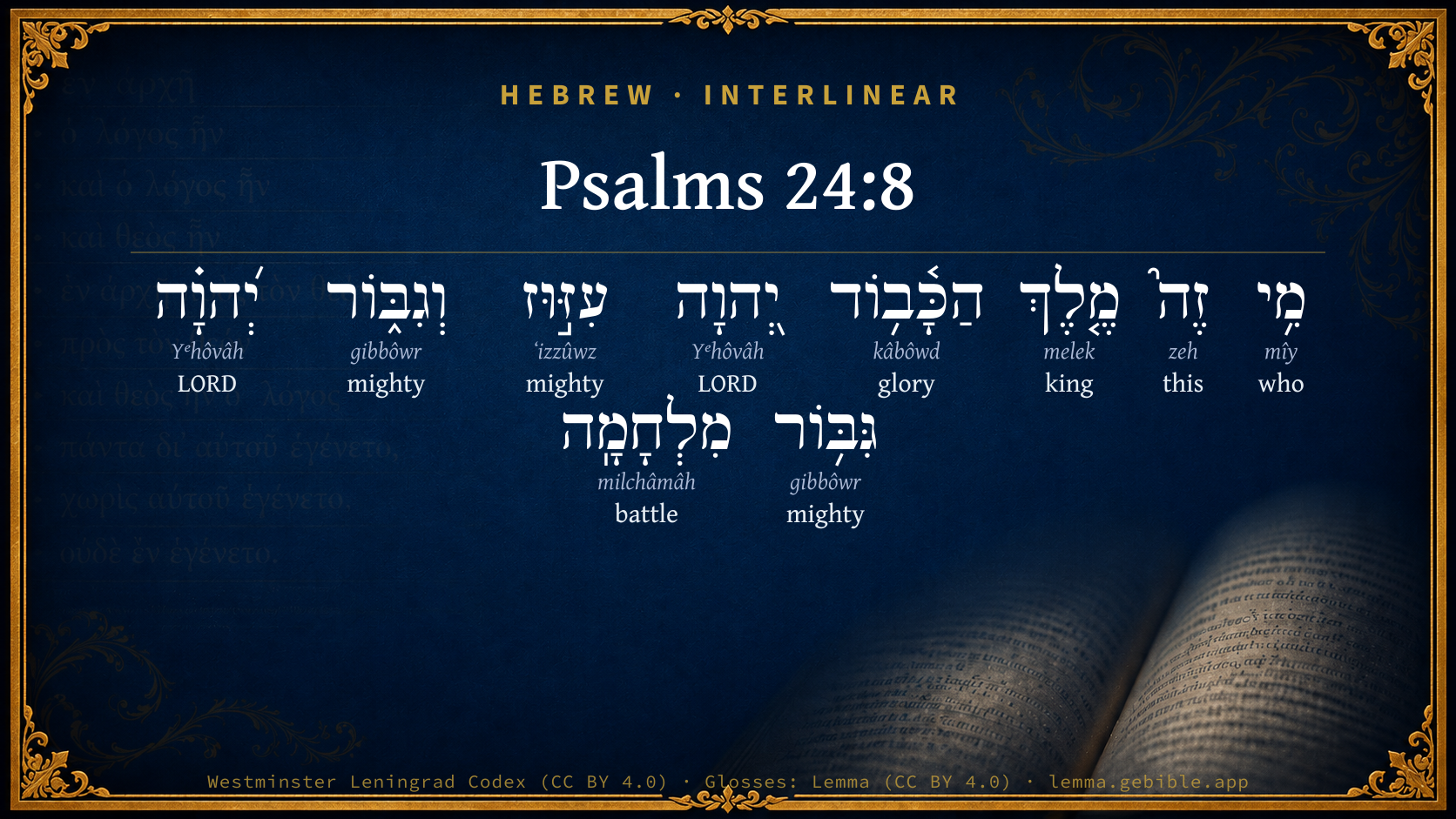
Hebrew (Westminster Leningrad Codex) Psalms 24:8 appears in the Hebrew Old Testament. The text above is from the Westminster Leningrad Codex. Each word links to its Strong’s number, a concise gloss, and parsing drawn from the Open Scriptures Hebrew Bible morphology. Click any word for its full Brown-Driver-Briggs (BDB) entry.
Download image
Cite this verse

Psalms 24:8 (World English Bible). Public Domain. Lemma interlinear Bible study tool, https://lemma.gebible.app/v/psalms/24/8.

Show BibTeX & RIS
BibTeX
RIS
English Translation
Who is the King of glory? Yahweh strong and mighty, Yahweh mighty in battle.
World English Bible · Public Domain
Highlights
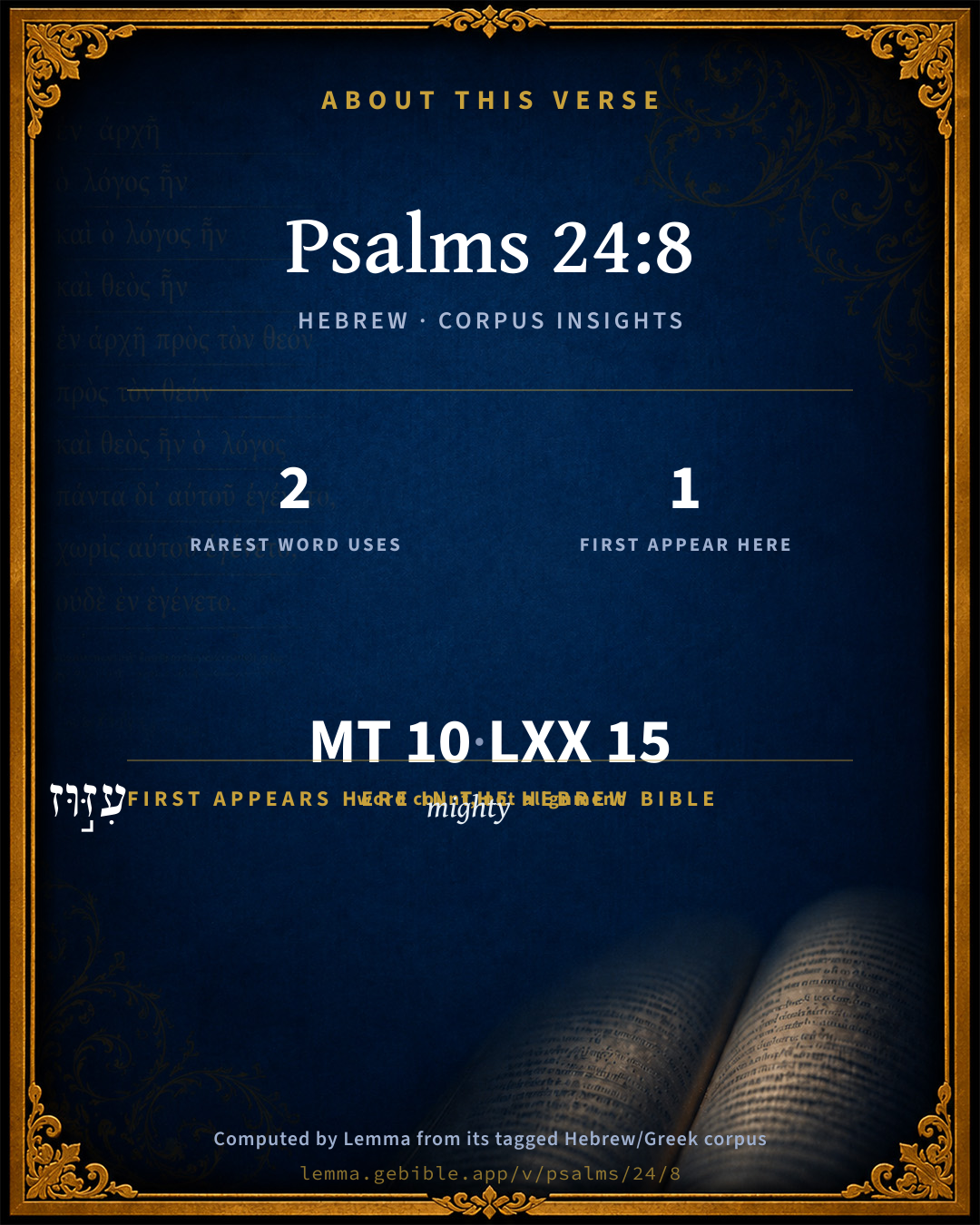
  • 1 first appearance in the Hebrew Bible
Full analysis ↓
Download a study sheet

One document with this verse’s original text, its word-by-word gloss line, the meaning frame, cross-references with their text, attributed commentary, and full source and license credits — printable, and it pastes into notes with its structure intact.

This verse Autodidact and up

Study sheet (.html) Plain text (.txt)

A passage Seminary Student

Up to 50 verses in one chapter. A passage sheet keeps up to 6 commentary sources and 12 cross-references per verse, in the order this page ranks them, and says so on the sheet whenever that leaves anything out. Ask for a single verse and you get the Autodidact verse sheet above.

Everything on this page stays free to read, with no account — the sheet is a download of what is already on screen, not access to it.

Want to remove ads? Support Godless Engineer
Compare translations 3

The same verse in 3 English versions, stacked beneath the original-language interlinear above. Click any original word for its lexicon entry.

Each is an independent rendering of the whole verse — the interlinear is not word-aligned to these translations.

Highlighted words mark where these versions differ — a whole-verse word diff, not a word-by-word alignment.

  • World English Bible Public Domain
    Who is the King of glory? Yahweh strong and mighty, Yahweh mighty in battle.
  • King James Version Public Domain
    Who is this King of glory? The LORD strong and mighty, the LORD mighty in battle.
  • unfoldingWord Literal Text CC BY-SA 4.0
    Who this King of Glory? Yahweh, strong and mighty; Yahweh, mighty in battle.

unfoldingWord Literal Text — © unfoldingWord, licensed CC BY-SA 4.0. Word-aligned USFM3 via Door43 (git.door43.org/unfoldingWord/en_ult).

Versions to compare (up to 4)

3 of 4 selected

Show all 18 translations

Every available English version of this verse, each an independent rendering of the whole verse.

  • World English Bible Public Domain
    Who is the King of glory? Yahweh strong and mighty, Yahweh mighty in battle.
  • Berean Standard Bible Public Domain
    Who is this King of Glory? The LORD strong and mighty, the LORD mighty in battle.
  • Majority Standard Bible Public Domain
    Who is this King of Glory? The LORD strong and mighty, the LORD mighty in battle.
  • King James Version Public Domain
    Who is this King of glory? The LORD strong and mighty, the LORD mighty in battle.
  • American Standard Version (1901) Public Domain
    Who is the King of glory? Jehovah strong and mighty, Jehovah mighty in battle.
  • Revised Version (1885) Public Domain
    Who is the King of glory? The LORD strong and mighty, the LORD mighty in battle.
  • Geneva Bible (1599) Public Domain
    Who is this King of glorie? the Lord, strong and mightie, euen the Lord mightie in battell.
  • Douay-Rheims (1899) Public Domain
    Who is this King of Glory? the Lord who is strong and mighty: the Lord mighty in battle.
  • Young's Literal Translation Public Domain
    Who `is' this -- `the king of glory?' Jehovah -- strong and mighty, Jehovah, the mighty in battle.
  • Literal Standard Version CC BY-SA 4.0
    Who [is] this—“the King of Glory?” YHWH—strong and mighty, || YHWH, the mighty in battle.
  • Unlocked Literal Bible CC BY-SA 4.0
    Who is this King of glory? Yahweh, strong and mighty; Yahweh, mighty in battle.
  • unfoldingWord Literal Text CC BY-SA 4.0
    Who this King of Glory? Yahweh, strong and mighty; Yahweh, mighty in battle.
  • Darby Bible Public Domain
    Who is this King of glory? Jehovah strong and mighty, Jehovah mighty in battle.
  • World Messianic Bible Public Domain
    Who is the King of glory? The LORD strong and mighty, the LORD mighty in battle.
  • Webster's Bible Public Domain
    Who is this King of glory? the LORD strong and mighty, the LORD mighty in battle.
  • Free Bible Version CC BY-SA 4.0
    Who is this King of glory? The Lord, strong and powerful, mighty in battle.
  • Bible in Basic English Public Domain
    Who is the King of glory? The Lord of strength and power, the Lord strong in war.
  • JPS Tanakh (1917) Public Domain
    'Who is the King of glory?' 'The LORD strong and mighty, the LORD mighty in battle.'

Literal Standard Version (2020), Covenant Press — licensed CC BY-SA 4.0. Text via the HelloAO Bible API (eBible.org). Unlocked Literal Bible (unfoldingWord) — licensed CC BY-SA 4.0. Text via the HelloAO Bible API (eBible.org). unfoldingWord Literal Text — © unfoldingWord, licensed CC BY-SA 4.0. Word-aligned USFM3 via Door43 (git.door43.org/unfoldingWord/en_ult). Free Bible Version, Dr. Jonathan Gallagher — licensed CC BY-SA 4.0. Text via the HelloAO Bible API (eBible.org).

Word by word

More ways to search: Search by grammar → Find every occurrence → Compare this word →

Practice this passage: Drill this verse → Learn its vocabulary →

About this verse

These counts appear in no published source. They are computed here, from the morphology-tagged text and Lemma’s own curated glosses. What Lemma adds →

10
words
8
distinct lemmas
Wisdom
section

Notable vocabulary

The rarest word here is עִזּ֣וּז mighty H5808 — appearing just 2 times in the whole Hebrew Bible.

First appearance in Scripture

This word makes its first canonical appearance in the Hebrew Bible here:

  • עִזּ֣וּז mighty H5808

Shared distinctive vocabulary

עִזּ֣וּז mighty H5808 occurs in 2 verses of the Hebrew Bible. Also found in:

Grammatical profile

  • 5 nouns
  • 3 adjectives
  • 1 pronoun
  • 1 particle

Repetition

Words recur within this verse — often emphatic in Hebrew:

  • יְ֭הוָה LORD H3068 ×2
  • וְגִבּ֑וֹר mighty H1368 ×2

Hebrew & Septuagint length

In English translation the verse runs 14 words from the Hebrew and 16 from the Septuagint (LXX English) — closely comparable.

A rough comparison of the two English renderings, which tokenize alike — not a word-level alignment.

Word counts can differ between the Hebrew and the Greek without any difference in meaning — e.g. the Hebrew direct-object marker אֵת has no separate Greek word, and Greek often adds the article ὁ.

In the original languages it is 10 Hebrew tokens and 15 Greek tokens — but the two are counted differently (Hebrew bundles its prefixes and suffixes into one token; the Greek is in lemma form), so that isn’t a like-for-like length.

Cross-references

11

Topical passages linked to Psalms 24:8 in the Treasury of Scripture Knowledge — connected by theme and wording, ordered by reader-vote popularity; previews shown in the World English Bible.

  • Exodus 15:3 Yahweh is a man of war. Yahweh is his name.
  • Revelation 19:11–21 I saw the heaven opened, and behold, a white horse, and he who sat on it is called Faithful and True. In righteousness he judges and makes war.
  • Revelation 6:2 And behold, a white horse, and he who sat on it had a bow. A crown was given to him, and he came forth conquering, and to conquer.
  • Psalms 45:3–6 Gird your sword on your thigh, mighty one: Your splendor and your majesty.
  • Isaiah 63:1–6 Who is this who comes from Edom, with dyed garments from Bozrah? this who is glorious in his clothing, marching in the greatness of his strength? I who speak in righteousness, mighty to save.
  • Colossians 2:15 having stripped the principalities and the powers, he made a show of them openly, triumphing over them in it.
  • Psalms 93:1 Yahweh reigns! He is clothed with majesty! Yahweh is armed with strength. The world also is established. It can't be moved.
  • Isaiah 9:6 For to us a child is born, to us a son is given; and the government shall be on his shoulder: and his name shall be called Wonderful, Counselor, Mighty God, Everlasting Father, Prince of Peace.
  • Psalms 50:1 The Mighty One, God, Yahweh, speaks, And calls the earth from sunrise to sunset.
  • Psalms 76:3–6 There he broke the flaming arrows of the bow, The shield, and the sword, and the weapons of war. Selah.
  • Isaiah 19:24–25 In that day shall Israel be the third with Egypt and with Assyria, a blessing in the midst of the earth;

Cross-references courtesy of OpenBible.info (CC BY 4.0).

Hebrew and Greek witnesses Masoretic Hebrew ↔ Greek Septuagint

The same verse in the two great witnesses to the Old Testament, shown verse-for-verse.

You’re reading Greek Psalm 23 (Hebrew Psalm 24). The Septuagint counts the superscription, so verse numbers can differ from the Hebrew — chapter-level alignment, not verse-by-verse. Numbering follows Rahlfs.

These are two independent witnesses, not word-aligned to each other, and the Septuagint is shown in lemma (dictionary) form.

Hebrew Psalms 24:8 Masoretic · Westminster Leningrad Codex

מִ֥י זֶה֮ מֶ֤לֶךְ הַכָּ֫ב֥וֹד יְ֭הוָה עִזּ֣וּז וְגִבּ֑וֹר יְ֝הוָ֗ה גִּבּ֥וֹר מִלְחָמָֽה

Who is the King of glory? Yahweh strong and mighty, Yahweh mighty in battle.

World English Bible · Public Domain

Greek LXX Greek Psalm 23:8 Septuagint · lemma form

τίς εἰμί οὗτος ὁ βασιλεύς ὁ δόξα κύριος κραταιός καί δυνατός κύριος δυνατός ἐν πόλεμος

Who is this king of Glory? the Lord strong and mighty, the Lord mighty in battle.

LXX2012 (modern English Septuagint) · Public Domain

Hebrew: Westminster Leningrad Codex (CC BY 4.0). Greek: Septuagint (public domain); English from LXX2012 (modern English Septuagint) (Public Domain). How the Septuagint differs from the Hebrew →

Commentary

Notes on Psalms 24:8 from classic Christian and Jewish commentators (each source and its license shown beneath its notes). The classic Christian expositions comment on the surrounding passage and are grouped to its opening verse, so a note may address several verses; the Jewish commentaries on the Tanakh (Rashi and others) are per-verse, so they appear only where the commentator wrote on this verse.

Lemma curates 59 commentaries, every one of them public domain or Creative Commons licensed, each selected and text-cleaned for this edition rather than reprinted as found. About our sources →

Trapp's Complete Commentary

John Trapp

Psa 24:8 Who [is] this King of glory? The LORD strong and mighty, the LORD mighty in battle.

Ver. 8. Who is this King of glory?] The gates are brought in as asking this question, saith R. David. This is the angels’ admiration at the coming in of Christ’s humanity into heaven, saith Diodati. Rather, it is the question of the faithful concerning the person of their King, whom they hereby resist not: but for their further confirmation, desire to be better informed of him, and his never adored enough excellencies.

The Lord strong] Jehovah the essentiator, the eternal God; the most mighty and puissant warrior; who, if he do but arise only, his enemies are scattered, and all that hate him fly before him, Psa 68:1.

John Trapp, A Commentary or Exposition upon All the Books of the Old and New Testament (1647–1656) — public domain. Text from a community e-Sword module.

The Biblical Illustrator

Joseph S. Exell

Psa_24:8

Who is this King of glory.

The King of glory

In the old days, when the king of England wished to enter the city of London through Temple Bar, the gate being closed against him, the herald advanced and demanded entrance. Open the gate, shouted the herald. Who is there? questioned a voice from within. The king of England! answered the herald. The gate was at once opened, and the king passed, amid the acclamations of the people. But the custom was an old one, and stretched back perhaps thousands of years before England was known under that name. Jesus is our King of glory. He is our Lord, strong and mighty in battle We may apply it very fitly to Christs ascension to heaven after His life and suffering and death and resurrection here on the earth. When Christ came to be born in Bethlehem He put aside the glory which He had before the world was, and, though He was rich, for our sakes He became poor. As one of the old preachers said, Christ has gone to heaven as a victor; leading sin, Satan, death, hell, and all His enemies in triumph at His chariot wheels. Christ went back to heaven after the mightiest battle ever fought in the universe, and went back triumphant over sin and death. We might properly apply these words to the coming of Christ, to the life of man, and to the civilisation of the world. Christ has been taking possession of the life of mankind. He is King of glory in modern civilisation. In spite of all the wickedness there is in the world, it has already come about that the most dominant personality in it is Christ. Christ has possessed and become King of glory in the very counting of the years in modern centuries. Christ has knocked at the gates of the world of art, and He is the King of glory in it. Go back and look at the works of the great masters and you will see that they are pictures of the Christ. And when, in modern times, has the world of art and modern invention in illustration been so stirred as in Tissots Life of Christ in Art? Christ has knocked at the door of literature, and He is the King of glory in the literature of the world. Where there is one book written against Christ there are a hundred thousand books written to illustrate His teaching or impress the lessons of His life. We may apply it also with great appropriateness to the door of our hearts. (L. A. Banks, D. D.)

The Biblical Illustrator, edited by Joseph S. Exell (c. 1880s–1900s) — public domain. Text from a community e-Sword module.

Joseph Benson's Commentary

Psa 24:8. Who is the King of glory? — What is the cause of this imperious call? And why? Or, for whom must those gates be opened in so solemn and extraordinary a manner? The answer is, The Lord strong and mighty, &c. — As if he had said, He is no ordinary person, no other than Jehovah, who hath given so many proofs of his almightiness, who hath subdued all his enemies, and is now returned in triumph.

Joseph Benson's Commentary on the Old and New Testaments (1811–1818) — public domain. Text from a community e-Sword module.

J. A. Alexander on Psalms

Joseph Addison Alexander

8. (Psa 24:8) Who is this, the king of glory? Jehovah strong and mighty, Jehovah mighty in battle (or a mighty warrior). The supposition of alternate or responsive choirs is as unnecessary here as in Psa 24:4 above. It is the case, so common in all animated speech and composition, of a speaker asking a question simply for the purpose of answering it himself. As if he had said, "Do you ask who this king of glory is? It is the Lord," etc. The common version, Who is this king of glory? does not fully convey the force of the original, the sense of which is, "who is this (of whom you speak as) the king of glory?" The word translated mighty, although properly an adjective, is continually used as a noun substantive, and is the nearest equivalent in Hebrew to the classical term hero. But the simple majesty of David's language would be marred in a translation by the use of this word, and still more by that of the combination, martial or military hero, in the other clause. The idea, both in this and other places, is borrowed from the Song of Moses, Exo 15:3.

Joseph Addison Alexander, The Psalms Translated and Explained (1850) — public domain. Text from a community e-Sword module.

Adam Clarke's Commentary

Verse 8. Who is this King of glory?] This is the answer of those who are within. Who is this glorious King, for whom ye demand entrance? To which they reply: -

The Lord strong and mighty, the Lord mighty in battle.] It is Jehovah, who is come to set up his abode in his imperial city: He who has conquered his enemies, and brought salvation to Israel. To make the matter still more solemn, and give those without an opportunity of describing more particularly this glorious Personage, those within hesitate to obey the first summons: and then it is repeated, Ps 24:9.

Lift up your heads, O ye gates; even lift them up, ye everlasting doors; and the King of glory shall come in.] To which a more particular question is proposed: - Who is HE, THIS King of glory? To which an answer is given that admitted of no reply. The Lord of hosts - he who is coming with innumerable armies, He is this King of glory. On which, we may suppose, the portcullis was lifted up, the gates thrown open, and the whole cavalcade admitted. This verse seems to have been spoken before the ark appeared: Who is this (זה zeh) King of glory? when its coming was merely announced. In the tenth verse the form is a little altered, because the ark, the symbol of the Divine Presence, had then arrived. Who is He, (מי הוא mi hu,) this King of glory? Here He is, to answer for himself. "The Lord is in his holy temple; let all the earth keep silence before him."

Though this Psalm has all the appearance of being an unfinished piece, yet there is a vast deal of dignity and majesty in it; and the demands from without, the questions from those within, and the answers to those questions, partake of the true sublime; where nature, dignity, and simplicity, are very judiciously mingled together. The whole procedure is natural, the language dignified, and the questions and answers full of simplicity and elevated sentiments.

Several, both among ancients and moderns, have thought this Psalm speaks of the resurrection of our Lord, and is thus to be understood. It is easy to apply it in this way: Jesus has conquered sin, Satan, and death, by dying. He now rises from the dead; and, as a mighty Conqueror, claims an entrance into the realms of glory, the kingdom which he has purchased by his blood; there to appear ever in the presence of God for us, to which he purposes to raise finally the innumerable hosts of his followers; for in reference to these, He is the Lord of hosts; and, in reference to his victory, He is the Lord mighty in battle.

ANALYSIS OF THE TWENTY-FOURTH PSALM

The subject of this Psalm is Christ, called the King of glory, Ps 24:7, and it has two parts: -

I. The first concerns Christ's lordship, which is, in general, over the whole world, Ps 24:1-2; but in particular, over the Church, Ps 24:3-7.

II. An exhortation to all men to receive Christ for their King.

I. The first part of this Psalm shows that God is King of all the world; but in this kingdom he has two kinds of subjects -

1. Either all men in general: "For the earth is the Lord's, and all that therein is; the compass of the world, and they that dwell therein." And for this he gives a reason, from the creation of it. He ought to have the dominion of it, and all in it: "For he hath founded it upon the seas, and established it upon the floods."

2. But all are not his subjects in the same way. There are a people whom he has called to be his subjects in another manner. There is a mountain which he hath sanctified and chosen above all other hills to make the seat of his kingdom, viz., the Church; and over them that live in it he is in a more peculiar manner said to be Lord, than of the whole earth; and these are more properly called his servants and subjects. And yet among these there is a difference too, for some only profess to be his servants, and call him Lord, as hypocrites; there are some others that are his servants really and truly. And that this difference may be taken notice of, the prophet asks, Quis? "WHO shall ascend into the hill of the Lord?" And "WHO shall stand in his holy place?" As if he should say, Not quisquis; it is not every one; for infidels are not so much as in the Church. Hypocrites, howsoever in the Church, are not true members of the mystical Church; and some who come to the hill of the Lord, yet stand not in his holy place; for many believe only for a season, and few continue faithful unto death.

3. That it may then be truly known who they are over whom he is truly Rex gloriae, "the King of glory," the prophet gives us their character, and sets down three distinctive notes by which they may be known: -

1. Cleanness of hands: "He that hath clenn hands;" a caede furto, c. is free from all external wicked actions. For the hand is οργανον οργανων, the organ of the organs.

2. Purity of heart. For external purity is not enough, except the heart, the fountain of our actions, be clean.

3. Truth of the tongue. Is not guilty of lies and perjuries. "He that hath clean hands and a pure heart; who hath not lifted up his soul unto vanity, nor sworn deceitfully." After the prophet has given the character by which you may know the man, he assigns his reward, and ends with an acclamation. 1. This is he that "shall receive the blessing from the Lord, and righteousness (i.e., justification) from the God of his salvation." 2. "This is the generation of them that seek thee;" that is, these are the people of God: let others boast themselves, and please themselves as they list, yet these are the godly party; these are they "that seek thy face, O God of Jacob."

II. The second part is considered by some as an exhortation to all men, especially princes, nobles, and magistrates, that they receive, acknowledge, and worship Christ, as King.

1. Lift up your heads, O ye gates; that is, as some understand it - O ye princes that sit in the gates, lift up your heads and hearts to him, that the King of glory may come in.

2. To which good counsel the prophet brings in the princes asking this question: "Who is this King of glory!" to which he answers, "The Lord strong and mighty, the Lord mighty in battle." One who is able to bruise you to atoms with his iron rod, and will do so if you reject him. And that the exhortation may pierce the deeper, he doubles both it and the answer.

After all, the most natural meaning is that which is given in the notes: from which we may infer: -

1. That the regal city is in no state of safety, if it have not the ark of the Lord.

2. That the ark - even the purest form of sound words in devotion, is nothing, unless they who minister and worship have clean hands and pure hearts, endeavouring to worship God in spirit and in truth.

3. That where the right faith is professed, and the worshippers act according to its dictates, there is the presence and the continual indwelling of God: "Lift up your heads, O ye gates - and the King of glory shall come in."

Adam Clarke's Commentary on the Bible (1810–1826) — public domain. Text from a community e-Sword/MySword module.

John Calvin's Commentaries

8. Who is this King of glory? etc The praises by which the power of God is here magnified are intended to tell the Jews that he did not sit idle in his temple, but took up his abode in it, in order to show himself ready to succor his people. It is to be observed, that there is great weight both in the interrogation, and in the repetition of the same sentence. The prophet assumes the person of one who wonders thereby to express with greater effect that God comes armed with invincible power to maintain and save his people, and to keep the faithful in safety under his shadow. We have already said, that when God is spoken of as dwelling in the temple, it is not to be understood as if his infinite and incomprehensible essence had been shut up or confined within it; but that he was present there by his power and grace, as is implied in the promise which he made to Moses,

“In all places where I record my name, I will come unto thee, and I will bless thee,” (Exodus 20:24.)

That this was no vain and empty promise, but that God truly dwelt in the midst of the people, is what the faithful experienced who sought him not superstitiously, as if he had been fixed to the temple, but made use of the temple and of the service which was performed in it for elevating their hearts to heaven. The amount of what is stated is, that whenever the people should call upon God in the temple, it would manifestly appear, from the effect which would follow, that the ark of the covenant was not a vain and an illusory symbol of the presence of God, because he would always stretch forth his omnipotent arm for the defense and protection of his people. The repetition teaches us that true believers cannot be too constant and diligent in meditation on this subject. The Son of God, clothed with our flesh, has now shown himself to be King of glory and Lord of hosts, and he is not entered into his temple only by shadows and figures, but really and in very deed, that he may dwell in the midst of us. There is, therefore, nothing to hinder us from boasting that we shall be invincible by his power. Mount Sion, it is true, is not at this day the place appointed for the sanctuary, and the ark of the covenant is no longer the image or representation of God dwelling between the cherubim; but as we have this privilege in common with the fathers, that, by the preaching of the word and the sacraments, we may be united to God, it becomes us to use these helps with reverence; for if we despise them by a detestable pride, God cannot but at length utterly withdraw himself from us.

John Calvin's Commentaries (1540-1563) — public domain. Text from the Calvin Translation Society English edition (1840s-50s) via the Christian Classics Ethereal Library (ccel.org). Calvin's coverage is partial (roughly two-thirds of the Bible); uncommented books and verses are honest gaps, never fabricated. The 19th-century editor's footnotes and remarks are omitted so the notes are faithfully Calvin's own voice.

Ellicott's Commentary for English Readers

(8) Who . . .—But the claim is not unchallenged. The old heathen gates will not at once recognise the new-comer’s right of admission.

The Lord strong and mighty.—But it is the right of conquest—

“Jehovah, the strong, the mighty, Jehovah, mighty in battle.”

A Bible Commentary for English Readers, edited by Charles John Ellicott (1878–1897) — public domain. Text from a community e-Sword module.

The Cambridge Bible for Schools and Colleges

gen. ed. J. J. S. Perowne

8. Who is the King of glory? may be merely a rhetorical question; but it is far more poetical to suppose that the gates, or the warders, are represented as challenging the comer’s right to enter. The choir’s response recalls the opening words of the Song of Moses (Exo_15:2-3), “Jah is my strength and song … Jehovah is a man of war:” while the title King reflects its closing words (Exo_15:18); “Jehovah shall be King for ever and ever.” He is now proclaimed as the Victor, who comes as He had purposed, to take His kingdom.

The Cambridge Bible for Schools and Colleges (gen. ed. J. J. S. Perowne; Cambridge University Press, 1878–1918) — public domain. Text from a community e-Sword module.

John Gill's Exposition

Who is this King of glory?.... Which question is put by the church, or particular believers; not through ignorance, as the daughters of Jerusalem, Sol 5:9; or the Pharisees, when Christ made his public entrance into Jerusalem, Mat 21:10; much less in pride and haughtiness, in scorn and derision, as Pharaoh, Exo 5:1; and the Capernaites, Joh 6:42; but as wondering at the glories and excellencies of his person, and as desirous of knowing more of him. The answer to the question is,

the Lord strong and mighty: he whose name alone is Jehovah; the most high in all the earth; the everlasting I AM; Jehovah our righteousness; the mighty God, even the Almighty; the Son of Man, whom God has made strong for himself: his strength and might have been seen in the creation of all things out of nothing, in upholding all things by his power, in the redemption of his people, in the resurrection of himself, in dispossessing the strong man armed out of the hearts of his chosen ones, in the government of his church, and the care of all his saints, and in keeping them from a final and total falling away. From the first of these words, which is only here used, Mars, because of his strength, has the name of Azizus; which name of his Julian (o) makes mention of; and very probably Hesus, also a deity of the ancient Gauls, spoken of by the poet (p), and by Lactantius (q); but to none does it belong as to our Jehovah;

the Lord mighty in battle; as he was when he was up on the cross; when he made an end of sin, spoiled principalities and powers; abolished death, and destroyed him that had the power of it; and as he will be at the last day, when the kings of the earth shall make war with him, and he shall overcome them; when the beast and false prophet shall be taken, and cast alive into the lake of fire; and the remnant shall be slain with the sword of his mouth; see Rev 17:14; and who is now the Captain of salvation to his people, their Leader and Commander; who furnishes them with weapons of warfare, which are mighty through God; who teaches their hands to war, and their fingers to fight the good fight of faith; and makes them more than conquerors, through himself, that has loved them.

(o) Orat. 4. in solem, p. 281. (p) "Teutates horrensque feris altaribus Hesus". Lucan. (q) De Fals. Relig. l. 1. c. 31.

John Gill's Exposition of the Whole Bible (1746–1763) — public domain (CC PDM 1.0). Text via the HelloAO Bible API.

Albert Barnes' Notes on the Bible

Who is this King of glory? - This is probably the response of a portion of the choir of singers. The answer is found in the other part of the verse.

The Lord strong and mighty - Yahweh, strong and mighty - describing Him by His most exalted attributes as a God of power. This is in accordance with the idea in Psa 24:1-2, where He is represented as the Creator and the Proprietor of all the earth. Perhaps, also, there is an allusion to the fact that He is mighty, as distinguished from idols which have no power.

The Lord mighty in battle - Who displays His power eminently in overthrowing hostile armies; perhaps in allusion to the victories which had been won when His people were animated in war by the presence of the ark in the midst of their armies, and when the victory could be properly traced to the fact that the ark, the symbol of the divine presence, was with them, and when, therefore, the victory would be properly ascribed to Yahweh himself.

Albert Barnes' Notes on the Bible (1834–1885) — public domain. Text from a community e-Sword/MySword module.

Matthew Poole's English Annotations

This seems to be a prolepsis, or removal of an objection. You will say, What is the cause of this imperious call? and why or for whom must those gates be opened in so solemn and extraordinary a manner?

The Lord strong and mighty: this contains an answer to the question; He is no ordinary person, no meaner and no other than Jehovah, who hath given so many proofs of his almightiness, who hath subdued all his enemies, and is now returned in triumph. Here is in this and the foregoing verse a sacred dialogue between several persons. And some suppose that the sacred musicians, which attended upon the service of the ark and tabernacle, and were doubtless employed in this solemnity, 2Sa 5:5, were divided into two choirs, whereof one spake the former, and the other the latter verse.

Matthew Poole's English Annotations on the Holy Bible (1683–1685) — public domain. Text from a community e-Sword/MySword module.

The Treasury of David

Charles H. Spurgeon

Ver. 8. The watchers at the gate hearing the song look over the battlements and ask, Who is this King of glory? A question full of meaning and worthy of the meditations of eternity. Who is he in person, nature, character, office and work? What is his pedigree? What his rank and what his race? The answer given in a mighty wave of music is, The Lord strong and mighty, the Lord mighty in battle. We know the might of Jesus by the battles which he has fought, the victories which he has won over sin, and death, and hell, and we clap our hands as we see him leading captivity captive in the majesty of his strength. Oh for a heart to sing his praises! Mighty hero, be thou crowned for ever King of kings and Lord of lords.

Ver. 8. Who is the King of glory? Christ in two respects is the King of glory. 1. For that all honour and glory belongs properly to himhis is "the kingdom, the power, and the glory" Mt 6:13, called in this regard, "The Lord of glory." 1Co 2:8. 2. For that Christ maketh us partakers of his glory, termed in this respect our glorious Lord Jesus. Jas 2:1. If the Lord of hosts, strong and mighty in battle, be the King of glory, then Christ (having conquered all his enemies, and made them his footstool, triumphing over death, and the devil which is the founder of death, and sin which is the sting of death, and the grave which is the prison of death, and hell itself which is the proper dominion of the devil and death) is doubtless in himself, "the King of glory." And for as much as he died for our sins, and is risen again for our justification, and is ascended on high to give gifts unto menin this life grace, in the next glory what is he less than a King of glory towards us, of whom and through whom alone we find that fight his battles are delivered from the hands of all that hate us, and so made victors 1Co 15:57, yea, "more than conquerors." Ro 8:37. John Boys.

Ver. 8. The Lord strong and mighty. Strong and mighty in subduing all adversaries; and overcoming death and the devil who had the power of death. Ludolphus, quoted by Isaac Williams.

Ver. 8. The mighty Hero. His pedigree, his power, his battles, his victories.

Psalms 24:9*

Charles H. Spurgeon's The Treasury of David (1869–1885) — public domain. Psalms only. Text from a community e-Sword/MySword module.

The Pulpit Commentary

Who is this King of glory? The other half of the choir, acting as keepers of the doors, inquires, as if ignorant of the motive and character of the procession, "Who is this King of glory? who is it to whom ye give this high-sounding appellation, and to whom ye require us to open? And the reply follows from the previous speakers. The Lord strong and mighty, the Lord mighty in battle. It is Jehovah, the Strong and Mighty One-strong in himself, mighty in his acts, mighty especially in battle; whom ye may therefore be glad to receive among you as your Defence. It is this King for whom we demand admission.

The Pulpit Commentary (1880–1919), ed. H.D.M. Spence-Jones & Joseph S. Exell — public domain. Text from a community e-Sword module.

John Wesley's Explanatory Notes

The Lord - He is no ordinary person, no other than Jehovah, who hath given so many proofs of his almightiness, who hath subdued all his enemies, and is now returned in triumph.

John Wesley, Explanatory Notes Upon the Whole Bible (1754–1765) — public domain. Text via the GEBible commentary corpus.

Radak

Rabbi David Kimhi (Radak)

Who is the King of Glory? – as if the gates were asking, Who is the King of Glory? And the reply:

The Lord strong and mighty, The Lord mighty in battle: – And he uses these adjectives because the ark used to go out with them in battle, and they were victorious over their enemies by its aid.

Radak on the Tanakh — English translations: “Sefaria Community Translation” (CC0 1.0 (public-domain dedication)); “Eliyahu Munk, HaChut Hameshulash” (CC BY 4.0); “Rabbi Mike Feuer, Jerusalem Anthology” (CC BY 4.0); and “R. David Kimhi on the first book of Psalms, Translated by R.G. Finch, London, 1919” (public domain). Text via Sefaria.

Lesson kit

Teaching starters — assembled from the data on this page, not authored interpretation. Every prompt links to the verse data it draws on. Edit before teaching.

Psalms, in the Wisdom, opens this verse with 10 words (8 distinct Hebrew lemmas). Its most distinctive word is ʻizzûwz (“mighty”). A historical commentator’s framing appears above. Read the whole chapter for the surrounding context.

Discussion questions

  1. How does “mighty” (ʻizzûwz) shape what this verse is saying?
  2. The word “mighty” first appears here in Scripture. What is being introduced at this debut?
  3. Isaiah 43:17 shares the word «mighty» with this verse. How do the two illuminate each other?
  4. “LORD” occurs 2× in this one verse. What is the effect of the repetition?
  5. These translations render this verse differently. What is at stake in choosing one wording over another?
  6. Reading how Trapp's Complete Commentary and The Biblical Illustrator read this verse, where do the two commentators agree and where do they part?

Things to notice

Reading settings

Reading text

Shown beneath each verse's original-language words.

Old Testament
Old Testament edition

Read the OT as the Masoretic Hebrew (MT) or the Greek Septuagint (LXX).

English shown for the Greek Septuagint (in the Hebrew ↔ Greek comparison).

Comparing translations? Open the Compare panel on any verse page to stack up to four side by side.