Leviticus 9:6

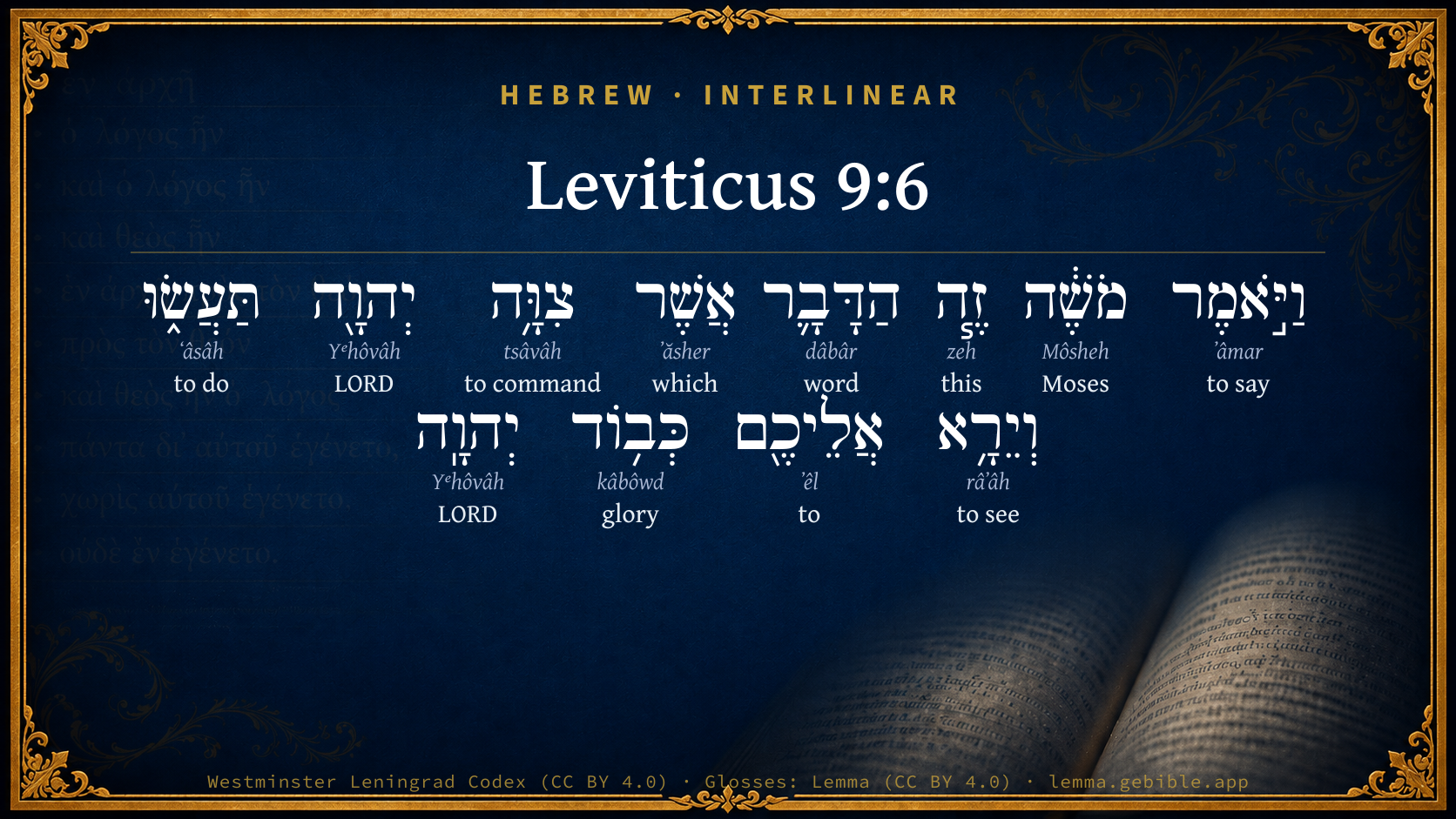
Hebrew (Westminster Leningrad Codex) Leviticus 9:6 appears in the Hebrew Old Testament. The text above is from the Westminster Leningrad Codex. Each word links to its Strong’s number, a concise gloss, and parsing drawn from the Open Scriptures Hebrew Bible morphology. Click any word for its full Brown-Driver-Briggs (BDB) entry.
Download image
Cite this verse

Leviticus 9:6 (World English Bible). Public Domain. Lemma interlinear Bible study tool, https://lemma.gebible.app/v/leviticus/9/6.

Show BibTeX & RIS
BibTeX
RIS
English Translation
Moses said, "This is the thing which Yahweh commanded that you should do: and the glory of Yahweh shall appear to you."
World English Bible · Public Domain
Download a study sheet

One document with this verse’s original text, its word-by-word gloss line, the meaning frame, cross-references with their text, attributed commentary, and full source and license credits — printable, and it pastes into notes with its structure intact.

This verse Autodidact and up

Study sheet (.html) Plain text (.txt)

A passage Seminary Student

Up to 50 verses in one chapter. A passage sheet keeps up to 6 commentary sources and 12 cross-references per verse, in the order this page ranks them, and says so on the sheet whenever that leaves anything out. Ask for a single verse and you get the Autodidact verse sheet above.

Everything on this page stays free to read, with no account — the sheet is a download of what is already on screen, not access to it.

Want to remove ads? Support Godless Engineer
Compare translations 3

The same verse in 3 English versions, stacked beneath the original-language interlinear above. Click any original word for its lexicon entry.

Each is an independent rendering of the whole verse — the interlinear is not word-aligned to these translations.

Highlighted words mark where these versions differ — a whole-verse word diff, not a word-by-word alignment.

  • World English Bible Public Domain
    Moses said, "This is the thing which Yahweh commanded that you should do: and the glory of Yahweh shall appear to you."
  • King James Version Public Domain
    And Moses said, This is the thing which the LORD commanded that ye should do: and the glory of the LORD shall appear unto you.
  • unfoldingWord Literal Text CC BY-SA 4.0
    And Moses said, “This the thing that Yahweh commanded you will do, and the glory of Yahweh will appear to you.”

unfoldingWord Literal Text — © unfoldingWord, licensed CC BY-SA 4.0. Word-aligned USFM3 via Door43 (git.door43.org/unfoldingWord/en_ult).

Versions to compare (up to 4)

3 of 4 selected

Show all 18 translations

Every available English version of this verse, each an independent rendering of the whole verse.

  • World English Bible Public Domain
    Moses said, "This is the thing which Yahweh commanded that you should do: and the glory of Yahweh shall appear to you."
  • Berean Standard Bible Public Domain
    And Moses said, “This is what the LORD has commanded you to do, so that the glory of the LORD may appear to you.”
  • Majority Standard Bible Public Domain
    And Moses said, “This is what the LORD has commanded you to do, so that the glory of the LORD may appear to you.”
  • King James Version Public Domain
    And Moses said, This is the thing which the LORD commanded that ye should do: and the glory of the LORD shall appear unto you.
  • American Standard Version (1901) Public Domain
    And Moses said, This is the thing which Jehovah commanded that ye should do: and the glory of Jehovah shall appear unto you.
  • Revised Version (1885) Public Domain
    And Moses said, This is the thing which the LORD commanded that ye should do: and the glory of the LORD shall appear unto you.
  • Geneva Bible (1599) Public Domain
    (For Moses had sayde, This is the thing, which the Lord commanded that ye should do, and the glory of the Lord shall appeare vnto you)
  • Douay-Rheims (1899) Public Domain
    Moses said: This is the word, which the Lord hath commanded: do it, and his glory will appear to you.
  • Young's Literal Translation Public Domain
    and Moses saith, `This `is' the thing which Jehovah hath commanded; do `it', and the honour of Jehovah doth appear unto you.'
  • Literal Standard Version CC BY-SA 4.0
    and Moses says, “This [is] the thing which YHWH has commanded; do [it], and the glory of YHWH appears to you.”
  • Unlocked Literal Bible CC BY-SA 4.0
    Then Moses said, “This is what Yahweh commanded you to do, so that his glory may appear to you.”
  • unfoldingWord Literal Text CC BY-SA 4.0
    And Moses said, “This the thing that Yahweh commanded you will do, and the glory of Yahweh will appear to you.”
  • Darby Bible Public Domain
    And Moses said, This is the thing which Jehovah has commanded that ye should do; and the glory of Jehovah shall appear to you.
  • World Messianic Bible Public Domain
    Moses said, “This is the thing which the LORD commanded that you should do; and the LORD’s glory shall appear to you.”
  • Webster's Bible Public Domain
    And Moses said, This is the thing which the LORD commanded that ye should do: and the glory of the LORD shall appear to you.
  • Free Bible Version CC BY-SA 4.0
    Moses said, “This is what the Lord ordered me to tell you to do, so that you may see his glory.”
  • Bible in Basic English Public Domain
    And Moses said, This is what the Lord has said you are to do; and you will see the glory of the Lord.
  • JPS Tanakh (1917) Public Domain
    And Moses said: 'This is the thing which the LORD commanded that ye should do; that the glory of the LORD may appear unto you.'

Literal Standard Version (2020), Covenant Press — licensed CC BY-SA 4.0. Text via the HelloAO Bible API (eBible.org). Unlocked Literal Bible (unfoldingWord) — licensed CC BY-SA 4.0. Text via the HelloAO Bible API (eBible.org). unfoldingWord Literal Text — © unfoldingWord, licensed CC BY-SA 4.0. Word-aligned USFM3 via Door43 (git.door43.org/unfoldingWord/en_ult). Free Bible Version, Dr. Jonathan Gallagher — licensed CC BY-SA 4.0. Text via the HelloAO Bible API (eBible.org).

Word by word

More ways to search: Search by grammar → Find every occurrence → Compare this word →

Practice this passage: Drill this verse → Learn its vocabulary →

כְּב֥וֹד
kâbôwd
H3519
“glory of”
Noun, Common, Both, Singular, Construct
Part of Speech
Noun
Type
Common
Gender
Both
Number
Singular
State
Construct
Full BDB Definition

Origin: from H3513

TWOT: 943d , 943e

glory, honour, glorious, abundance - abundance, riches - honour, splendour, glory - honour, dignity - honour, reputation - honour, reverence, glory - glory
  1. וַיֹּ֣אמֶר ʼâmar H559 “and · to say” Conjunction + Verb, Qal, Sequential Imperfect, 3rd Person, Masculine, Singular
  2. מֹשֶׁ֔ה Môsheh H4872 “Moses” Noun, Proper
  3. זֶ֧ה zeh H2088 “this” Pronoun, Demonstrative, Masculine, Singular
  4. הַדָּבָ֛ר dâbâr H1697 “the · word” Particle, Definite Article + Noun, Common, Masculine, Singular, Absolute
  5. אֲשֶׁר ʼăsher H834 “which” Particle, Relative
  6. צִוָּ֥ה tsâvâh H6680 “to command” Verb, Piel, Perfect, 3rd Person, Masculine, Singular
  7. יְהוָ֖ה Yᵉhôvâh H3068 “LORD” Noun, Proper
  8. תַּעֲשׂ֑וּ ʻâsâh H6213 “to do” Verb, Qal, Imperfect, 2nd Person, Masculine, Plural
  9. וְיֵרָ֥א râʼâh H7200 “and · to see” Conjunction + Verb, Niphal, Jussive, 3rd Person, Masculine, Singular
  10. אֲלֵיכֶ֖ם ʼêl H413 “to · you” Preposition + Suffix, Personal, 2nd Person, Masculine, Plural
  11. יְהוָֽה Yᵉhôvâh H3068 “LORD” Noun, Proper

About this verse

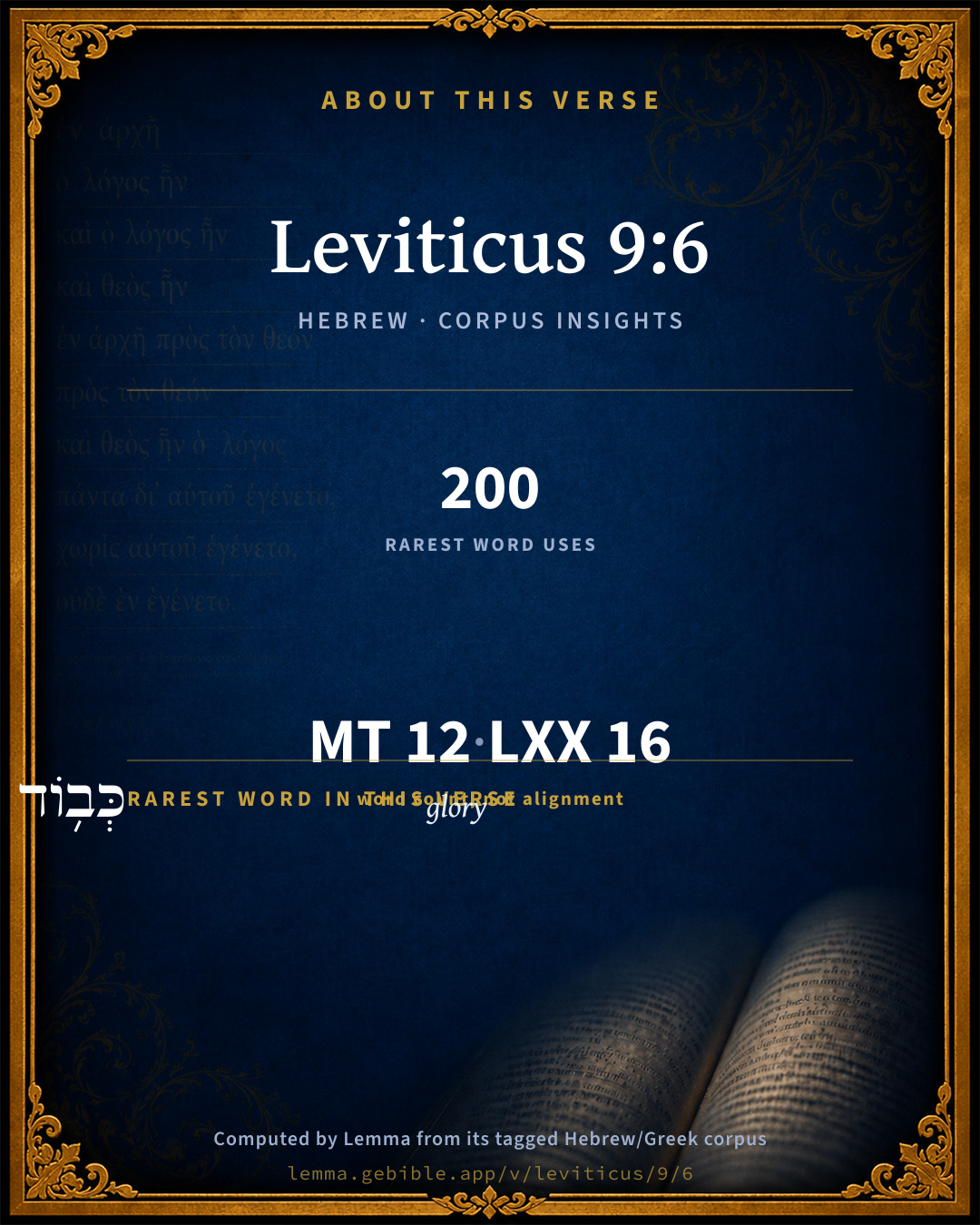
These counts appear in no published source. They are computed here, from the morphology-tagged text and Lemma’s own curated glosses. What Lemma adds →

12
words
11
distinct lemmas
Pentateuch
section

Grammatical profile

  • 4 verbs
  • 5 nouns
  • 1 pronoun
  • 1 preposition
  • 1 particle

Verb forms

  • וַיֹּ֣אמֶר Qal · Sequential Imperfect
  • צִוָּ֥ה Piel · Perfect
  • תַּעֲשׂ֑וּ Qal · Imperfect
  • וְיֵרָ֥א Niphal · Jussive

Repetition

A word recurs within this verse — often emphatic in Hebrew:

  • יְהוָ֖ה LORD H3068 ×2

Hebrew & Septuagint length

In English translation the verse runs 22 words from the Hebrew and 24 from the Septuagint (LXX English) — closely comparable.

A rough comparison of the two English renderings, which tokenize alike — not a word-level alignment.

Word counts can differ between the Hebrew and the Greek without any difference in meaning — e.g. the Hebrew direct-object marker אֵת has no separate Greek word, and Greek often adds the article ὁ.

In the original languages it is 12 Hebrew tokens and 16 Greek tokens — but the two are counted differently (Hebrew bundles its prefixes and suffixes into one token; the Greek is in lemma form), so that isn’t a like-for-like length.

Cross-references

7

Topical passages linked to Leviticus 9:6 in the Treasury of Scripture Knowledge — connected by theme and wording, ordered by reader-vote popularity; previews shown in the World English Bible.

  • Leviticus 9:23 Moses and Aaron went into the Tent of Meeting, and came out, and blessed the people: and the glory of Yahweh appeared to all the people.
  • Exodus 24:16 The glory of Yahweh settled on Mount Sinai, and the cloud covered it six days. The seventh day he called to Moses out of the midst of the cloud.
  • Ezekiel 43:2 Behold, the glory of the God of Israel came from the way of the east: and his voice was like the sound of many waters; and the earth shined with his glory.
  • 2 Chronicles 5:13–14 it happened, when the trumpeters and singers were as one, to make one sound to be heard in praising and thanking Yahweh; and when they lifted up their voice with the trumpets and cymbals and instruments of music, and praised Yahweh, [saying], For he is good; for his loving kindness endures forever; that then the house was filled with a cloud, even the house of Yahweh,
  • Exodus 16:10 It happened, as Aaron spoke to the whole congregation of the children of Israel, that they looked toward the wilderness, and, behold, the glory of Yahweh appeared in the cloud.
  • Exodus 40:34–35 Then the cloud covered the tent of meeting, and the glory of Yahweh filled the tent.
  • 1 Kings 8:10–12 It came to pass, when the priests were come out of the holy place, that the cloud filled the house of Yahweh,

Cross-references courtesy of OpenBible.info (CC BY 4.0).

Hebrew and Greek witnesses Masoretic Hebrew ↔ Greek Septuagint

The same verse in the two great witnesses to the Old Testament, shown verse-for-verse.

These are two independent witnesses, not word-aligned to each other, and the Septuagint is shown in lemma (dictionary) form.

Hebrew Leviticus 9:6 Masoretic · Westminster Leningrad Codex

וַיֹּ֣אמֶר מֹשֶׁ֔ה זֶ֧ה הַדָּבָ֛ר אֲשֶׁר צִוָּ֥ה יְהוָ֖ה תַּעֲשׂ֑וּ וְיֵרָ֥א אֲלֵיכֶ֖ם כְּב֥וֹד יְהוָֽה

Moses said, "This is the thing which Yahweh commanded that you should do: and the glory of Yahweh shall appear to you."

World English Bible · Public Domain

Greek LXX Leviticus 9:6 Septuagint · lemma form

καί εἶπον μωυσῆς οὗτος ὁ ῥῆμα ὅς εἶπον κύριος ποιέω καί ὁράω ἐν σύ δόξα κύριος

And Moses said, This is the thing which the Lord has spoken; do it, and the glory of the Lord shall appear among you.

LXX2012 (modern English Septuagint) · Public Domain

Hebrew: Westminster Leningrad Codex (CC BY 4.0). Greek: Septuagint (public domain); English from LXX2012 (modern English Septuagint) (Public Domain). How the Septuagint differs from the Hebrew →

Targum (Aramaic paraphrase)

2

The Targum is the ancient Jewish Aramaic paraphrase of the Hebrew Scriptures — an interpretive translation, not the Hebrew text itself. Onkelos (literal) and Pseudo-Jonathan (expansive) render the Torah, and Jonathan the Prophets. Coverage is partial: where no permissively-licensed English translation exists for a verse, only the Aramaic is shown. This is verse-level text, not a word-by-word alignment to the Hebrew.

  1. Targum Onkelos Torah (Genesis–Deuteronomy)
    וַאֲמַר מֹשֶׁה דֵין פִּתְגָמָא דִי פַקִיד יְיָ תַּעְבְּדוּן וְיִתְגְלִי לְכוֹן יְקָרָא דַיְיָ

    (no public-domain English translation for this verse)

    Targum Onkelos — Aramaic: “Onkelos Genesis” (public domain); “Onkelos Exodus” (public domain); “Onkelos Leviticus” (public domain); “Onkelos Numbers” (public domain); “Onkelos Deuteronomy” (public domain). English: “Sefaria Community Translation” (CC0 1.0 (public-domain dedication)); “J.W. Etheridge. The Targums of Onkelos and Jonathan Ben Uzziel on the Pentateuch. London: Longmans, Green, 1862” (public domain). Text via Sefaria.

  2. Targum Pseudo-Jonathan Torah (Genesis–Deuteronomy)
    וַאֲמַר משֶׁה דֵין פִּתְגָמָא דְתַעַבְדוּן אַעַבְּרוּ יַת יִצְרָא בִּישָׁא מִן לִבְּכוֹן וּמִן יַד יִתְגְלֵי לְכוֹן אִיקַר שְׁכִינְתָּא דַיְיָ

    And Mosheh said, This is the thing which you must do. Put away the imagination of evil from your hearts, and there will speedily (at once) be revealed to you the glory of the Shekinah of the Lord.

    Targum Pseudo-Jonathan — Aramaic: “Targum Jonathan on Genesis” (public domain); “Targum Jonathan on Exodus” (public domain); “Targum Jonathan on Leviticus” (public domain); “Targum Jonathan on Numbers” (public domain); “Targum Jonathan on Deuteronomy” (public domain). English: “The Targum of Jonathan ben Uzziel, trans. J. W. Etheridge, London, 1862” (public domain). Text via Sefaria.

Commentary

Notes on Leviticus 9:6 from classic Christian and Jewish commentators (each source and its license shown beneath its notes). The classic Christian expositions comment on the surrounding passage and are grouped to its opening verse, so a note may address several verses; the Jewish commentaries on the Tanakh (Rashi and others) are per-verse, so they appear only where the commentator wrote on this verse.

Lemma curates 59 commentaries, every one of them public domain or Creative Commons licensed, each selected and text-cleaned for this edition rather than reprinted as found. About our sources →

Trapp's Complete Commentary

John Trapp

Lev 9:6 And Moses said, This [is] the thing which the LORD commanded that ye should do: and the glory of the LORD shall appear unto you.

Ver. 6. And the glory of the Lord shall appear unto you.] So shall it one day to us: yea, we shall be like him, and appear with him in glory; and must therefore purify ourselves, as God is pure. {1Jn 3:2-3}

John Trapp, A Commentary or Exposition upon All the Books of the Old and New Testament (1647–1656) — public domain. Text from a community e-Sword module.

Joseph Benson's Commentary

Lev 9:6-7. The glory of the Lord — The glorious manifestation of God’s powerful and gracious presence. Go and offer — Moses had hitherto sacrificed, but now he resigns his work to Aaron, and actually gives him that commission which from God he had received for him. For thyself and for the people — The order is very observable; first for thyself, otherwise thou art unfit to do it for the people. Hereby God would teach us, both the deficiency of this priesthood, and how important it is that God’s ministers should be in the favour of God themselves, that their ministrations might be acceptable to God, and profitable to the people.

Joseph Benson's Commentary on the Old and New Testaments (1811–1818) — public domain. Text from a community e-Sword module.

Tyndale Open Study Notes

Tyndale Open Resources

9:6 Just as holiness describes God’s person and nature, the glory of the Lord tangibly expresses his power and majesty (see Ezek 1:28; 10:4). His glory was revealed on Mount Sinai (Exod 24:16), at the dedication of the Tabernacle (Exod 40:34-35), and in Solomon’s Temple (1 Kgs 8:11; 2 Chr 7:1). Yet it remained as vast as the heavens (Ps 19:1). The New Testament speaks of Christ’s glory as the image of God (2 Cor 4:4), who manifested God’s glory to the world (John 1:14). He was glorified in his death and resurrection (John 17:1-5). See also Exod 24:15-17.

Tyndale Open Study Notes — © Tyndale Open Resources, licensed CC BY-SA 4.0. Text via the HelloAO Bible API.

Adam Clarke's Commentary

Verse 6. And the glory of the Lord shall appear] God shall give the most sensible signs of his presence among you; this he did in general by the cloud on the tabernacle, but in this case the particular proof was the fire that came out from before the Lord, and consumed the burnt-offering; see Le 9:23-24.

Adam Clarke's Commentary on the Bible (1810–1826) — public domain. Text from a community e-Sword/MySword module.

Ellicott's Commentary for English Readers

(6) And Moses said.—As the people now stood assembled in the court and around it, Moses explained to them the import of the ritual which they were about to witness in the presence of the Lord.

A Bible Commentary for English Readers, edited by Charles John Ellicott (1878–1897) — public domain. Text from a community e-Sword module.

The Cambridge Bible for Schools and Colleges

gen. ed. J. J. S. Perowne

6. This is the thing] as in Lev_8:5. To bring the sacrifices prescribed in Lev_9:2-4 is the thing which the Lord commanded.

The Cambridge Bible for Schools and Colleges (gen. ed. J. J. S. Perowne; Cambridge University Press, 1878–1918) — public domain. Text from a community e-Sword module.

John Gill's Exposition

This is the thing which the Lord commanded that ye should do,.... Namely, what they had done, bring the creatures and things for sacrifice they had:

and the glory of the Lord shall appear unto you; either Christ, the brightness of his Father's glory, in an human form, as a presage of his future incarnation, as he frequently did; or some more than ordinary refulgence of glory breaking out of the holy of holies, where God had now taken up his dwelling between the cherubim; or, as Aben Ezra explains it, the fire that should go out from him, and consume the sacrifice, which would be a demonstration of his presence with them, and of his acceptance of the sacrifice.

John Gill's Exposition of the Whole Bible (1746–1763) — public domain (CC PDM 1.0). Text via the HelloAO Bible API.

Matthew Poole's English Annotations

The glorious manifestation of God’s powerful and gracious presence, Lev 9:24. Compare Exo 24:16,17; 40:34,35; Eze 43:2.

Matthew Poole's English Annotations on the Holy Bible (1683–1685) — public domain. Text from a community e-Sword/MySword module.

John Wesley's Explanatory Notes

The glory of the Lord - The glorious manifestation of God's powerful and gracious presence.

John Wesley, Explanatory Notes Upon the Whole Bible (1754–1765) — public domain. Text via the GEBible commentary corpus.

Keil & Delitzsch

C. F. Keil & F. Delitzsch

After everything had been prepared for the solemn ceremony, Moses made known to the assembled people what Jehovah had commanded them to do in order that His glory might appear (see at Exo 16:10). Aaron was to offer the sacrifices that had been brought for the reconciliation of himself and the nation.

Keil & Delitzsch — Biblical Commentary on the Old Testament (1861–1891) — public domain (CC PDM 1.0). Text via the HelloAO Bible API. (Old Testament only.)

unfoldingWord translationNotes

Door43 World Missions Community

commanded you to do

Here "you" refers to the people of Israel. (See: Forms of You)

so that his glory may appear to you

Here "glory" represents the presence of Yahweh. AT: "so that he may show you the glory of his presence" (See: Metonymy)

make atonement for yourself and for the people ... offer the sacrifice for the people to make atonement for them

These are two different sacrifices. The first sacrifice is to atone for the sins of the high priest. When the high priest sins it also makes the people guilty (See: Leviticus 4:3). The second sacrifice is to atone of the sins the people themselves commit.

translationWords

Moses

Yahweh

command

glory

Aaron

altar

sin offering

burnt offering

atonement

people group

unfoldingWord translationNotes — © Distant Shores Media and the Door43 World Missions Community, licensed CC BY-SA 4.0. Source: git.door43.org/Door43/en_tn.

Lesson kit

Teaching starters — assembled from the data on this page, not authored interpretation. Every prompt links to the verse data it draws on. Edit before teaching.

Leviticus, in the Pentateuch, opens this verse with 12 words (11 distinct Hebrew lemmas). Its most distinctive word is kâbôwd (“glory”). A historical commentator’s framing appears above. Read the whole chapter for the surrounding context.

Discussion questions

  1. The word kâbôwd carries the sense “glory.” How does it shape the verse?
  2. How does Leviticus 9:23, which shares this passage’s theme, read alongside this verse?
  3. What does the repetition of “LORD” (2× in this one verse) do in this verse?
  4. The translations on this page render this verse differently — a whole-verse word diff, not a word-by-word alignment. What might account for the different wordings?
  5. «וַיֹּ֣אמֶר» is a Qal Sequential Imperfect verb. How does that grammatical form shape the action described?
  6. Compare how Trapp's Complete Commentary and Joseph Benson's Commentary read this verse. Where do they agree or differ?

Things to notice

Reading settings

Reading text

Shown beneath each verse's original-language words.

Old Testament
Old Testament edition

Read the OT as the Masoretic Hebrew (MT) or the Greek Septuagint (LXX).

English shown for the Greek Septuagint (in the Hebrew ↔ Greek comparison).

Comparing translations? Open the Compare panel on any verse page to stack up to four side by side.