Ezekiel 39:21

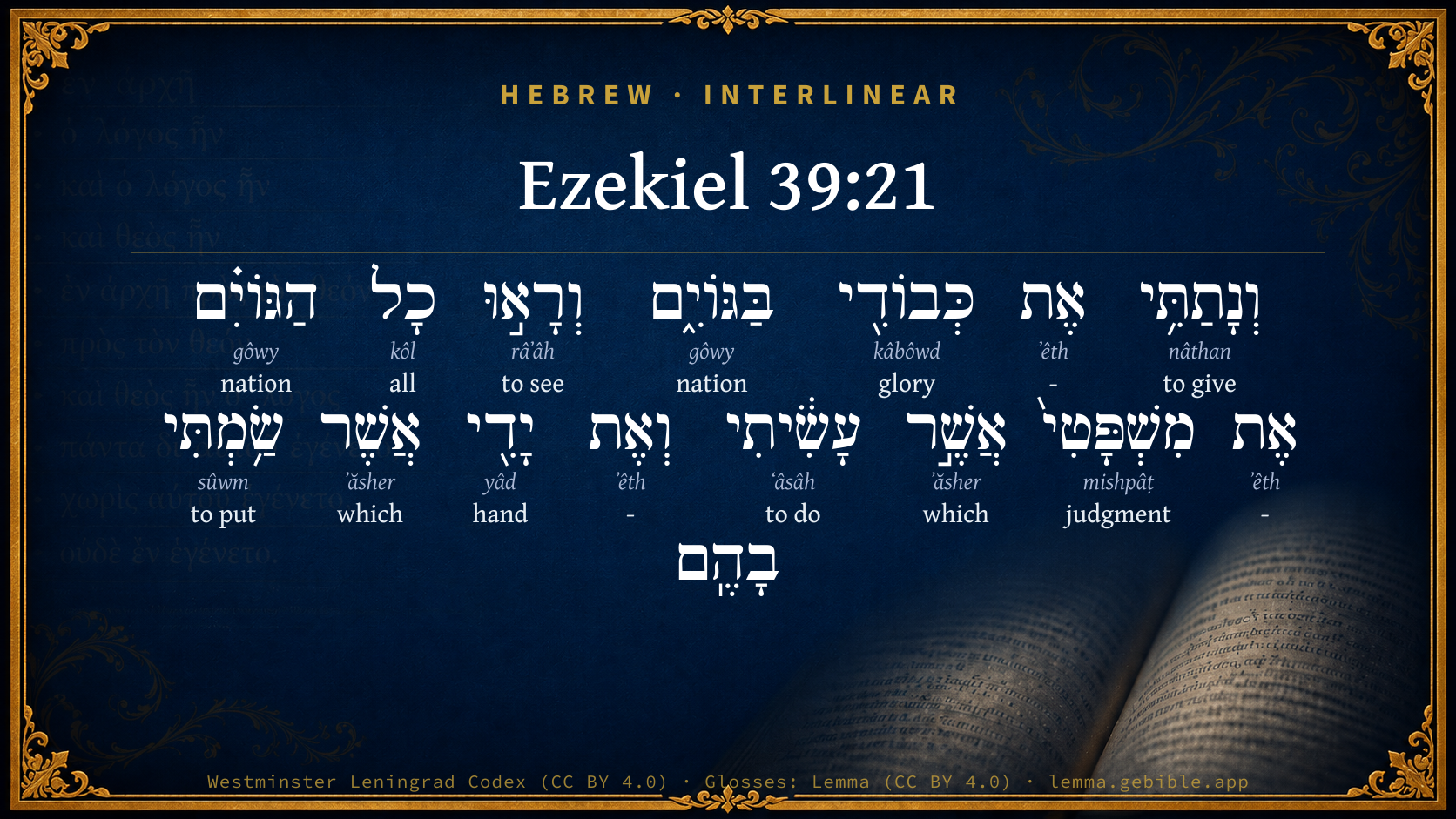
Hebrew (Westminster Leningrad Codex) Ezekiel 39:21 appears in the Hebrew Old Testament. The text above is from the Westminster Leningrad Codex. Each word links to its Strong’s number, a concise gloss, and parsing drawn from the Open Scriptures Hebrew Bible morphology. Click any word for its full Brown-Driver-Briggs (BDB) entry.
Download image
Cite this verse

Ezekiel 39:21 (World English Bible). Public Domain. Lemma interlinear Bible study tool, https://lemma.gebible.app/v/ezekiel/39/21.

Show BibTeX & RIS
BibTeX
RIS
English Translation
I will set my glory among the nations; and all the nations shall see my judgment that I have executed, and my hand that I have laid on them.
World English Bible · Public Domain
Download a study sheet

One document with this verse’s original text, its word-by-word gloss line, the meaning frame, cross-references with their text, attributed commentary, and full source and license credits — printable, and it pastes into notes with its structure intact.

This verse Autodidact and up

Study sheet (.html) Plain text (.txt)

A passage Seminary Student

Up to 50 verses in one chapter. A passage sheet keeps up to 6 commentary sources and 12 cross-references per verse, in the order this page ranks them, and says so on the sheet whenever that leaves anything out. Ask for a single verse and you get the Autodidact verse sheet above.

Everything on this page stays free to read, with no account — the sheet is a download of what is already on screen, not access to it.

Want to remove ads? Support Godless Engineer
Compare translations 3

The same verse in 3 English versions, stacked beneath the original-language interlinear above. Click any original word for its lexicon entry.

Each is an independent rendering of the whole verse — the interlinear is not word-aligned to these translations.

Highlighted words mark where these versions differ — a whole-verse word diff, not a word-by-word alignment.

  • World English Bible Public Domain
    I will set my glory among the nations; and all the nations shall see my judgment that I have executed, and my hand that I have laid on them.
  • King James Version Public Domain
    And I will set my glory among the heathen, and all the heathen shall see my judgment that I have executed, and my hand that I have laid upon them.
  • unfoldingWord Literal Text CC BY-SA 4.0
    I will set my glory among the nations, and all the nations will see my judgment that I perform and my hand that I have set against them.

unfoldingWord Literal Text — © unfoldingWord, licensed CC BY-SA 4.0. Word-aligned USFM3 via Door43 (git.door43.org/unfoldingWord/en_ult).

Versions to compare (up to 4)

3 of 4 selected

Show all 18 translations

Every available English version of this verse, each an independent rendering of the whole verse.

  • World English Bible Public Domain
    I will set my glory among the nations; and all the nations shall see my judgment that I have executed, and my hand that I have laid on them.
  • Berean Standard Bible Public Domain
    I will display My glory among the nations, and all the nations will see the judgment that I execute and the hand that I lay upon them.
  • Majority Standard Bible Public Domain
    I will display My glory among the nations, and all the nations will see the judgment that I execute and the hand that I lay upon them.
  • King James Version Public Domain
    And I will set my glory among the heathen, and all the heathen shall see my judgment that I have executed, and my hand that I have laid upon them.
  • American Standard Version (1901) Public Domain
    And I will set my glory among the nations; and all the nations shall see my judgment that I have executed, and my hand that I have laid upon them.
  • Revised Version (1885) Public Domain
    And I will set my glory among the nations, and all the nations shall see my judgment that I have executed, and my hand that I have laid upon them.
  • Geneva Bible (1599) Public Domain
    And I wil set my glory among the heathe, and all the heathen shall see my iudgement, that I haue executed, and mine hand, which I haue layed vpon them.
  • Douay-Rheims (1899) Public Domain
    And I will set my glory among the nations: and all nations shall see my judgment that I have executed, and my hand that I have laid upon them.
  • Young's Literal Translation Public Domain
    And I have given My honour among nations, And seen have all the nations My Judgment that I have done, And My hand that I have laid on them.
  • Literal Standard Version CC BY-SA 4.0
    And I have given My glory among nations, || And all the nations have seen My judgment that I have done, || And My hand that I have laid on them.
  • Unlocked Literal Bible CC BY-SA 4.0
    I will set my glory among the nations, and all the nations will see my judgment that I perform and my hand that I have set against them.
  • unfoldingWord Literal Text CC BY-SA 4.0
    I will set my glory among the nations, and all the nations will see my judgment that I perform and my hand that I have set against them.
  • Darby Bible Public Domain
    And I will set my glory among the nations, and all the nations shall see my judgment which I have executed, and my hand which I have laid upon them.
  • World Messianic Bible Public Domain
    “I will set my glory among the nations. Then all the nations will see my judgment that I have executed, and my hand that I have laid on them.
  • Webster's Bible Public Domain
    And I will set my glory among the heathen, and all the heathen shall see my judgment that I have executed, and my hand that I have laid upon them.
  • Free Bible Version CC BY-SA 4.0
    I will reveal my glory to the other nations, and all of them will see the punishment I hand out to them.
  • Bible in Basic English Public Domain
    And I will put my glory among the nations, and all the nations will see my punishments which I have put into effect, and my hand which I have put on them.
  • JPS Tanakh (1917) Public Domain
    And I will set My glory among the nations, and all the nations shall see My judgment that I have executed, and My hand that I have laid upon them.

Literal Standard Version (2020), Covenant Press — licensed CC BY-SA 4.0. Text via the HelloAO Bible API (eBible.org). Unlocked Literal Bible (unfoldingWord) — licensed CC BY-SA 4.0. Text via the HelloAO Bible API (eBible.org). unfoldingWord Literal Text — © unfoldingWord, licensed CC BY-SA 4.0. Word-aligned USFM3 via Door43 (git.door43.org/unfoldingWord/en_ult). Free Bible Version, Dr. Jonathan Gallagher — licensed CC BY-SA 4.0. Text via the HelloAO Bible API (eBible.org).

Word by word

More ways to search: Search by grammar → Find every occurrence → Compare this word →

Practice this passage: Drill this verse → Learn its vocabulary →

כְּבוֹדִ֖י
kâbôwd
H3519
“glory · my”
Noun, Common, Both, Singular, Construct + Suffix, Personal, 1st Person, Common, Singular
Part of Speech
Noun
Type
Common
Gender
Both
Number
Singular
State
Construct
Full BDB Definition

Origin: from H3513

TWOT: 943d , 943e

glory, honour, glorious, abundance - abundance, riches - honour, splendour, glory - honour, dignity - honour, reputation - honour, reverence, glory - glory
  1. וְנָתַתִּ֥י nâthan H5414 “and · to give” Conjunction + Verb, Qal, Sequential Perfect, 1st Person, Common, Singular
  2. אֶת ʼêth H853 “-” Particle, Direct Object
  3. בַּגּוֹיִ֑ם gôwy H1471 “in/at the · nations” Preposition, Determined + Noun, Common, Masculine, Plural, Absolute
  4. וְרָא֣וּ râʼâh H7200 “and · to see” Conjunction + Verb, Qal, Sequential Perfect, 3rd Person, Common, Plural
  5. כָל kôl H3605 “all of” Noun, Common, Masculine, Singular, Construct
  6. הַגּוֹיִ֗ם gôwy H1471 “the · nations” Particle, Definite Article + Noun, Common, Masculine, Plural, Absolute
  7. אֶת ʼêth H853 “-” Particle, Direct Object
  8. מִשְׁפָּטִי֙ mishpâṭ H4941 “judgment · my” Noun, Common, Masculine, Singular, Construct + Suffix, Personal, 1st Person, Common, Singular
  9. אֲשֶׁ֣ר ʼăsher H834 “which” Particle, Relative
  10. עָשִׂ֔יתִי ʻâsâh H6213 “to do” Verb, Qal, Perfect, 1st Person, Common, Singular
  11. וְאֶת ʼêth H853 “and · -” Conjunction + Particle, Direct Object
  12. יָדִ֖י yâd H3027 “hand · my” Noun, Common, Both, Singular, Construct + Suffix, Personal, 1st Person, Common, Singular
  13. אֲשֶׁר ʼăsher H834 “which” Particle, Relative
  14. שַׂ֥מְתִּי sûwm H7760 “to put” Verb, Qal, Perfect, 1st Person, Common, Singular

About this verse

These counts appear in no published source. They are computed here, from the morphology-tagged text and Lemma’s own curated glosses. What Lemma adds →

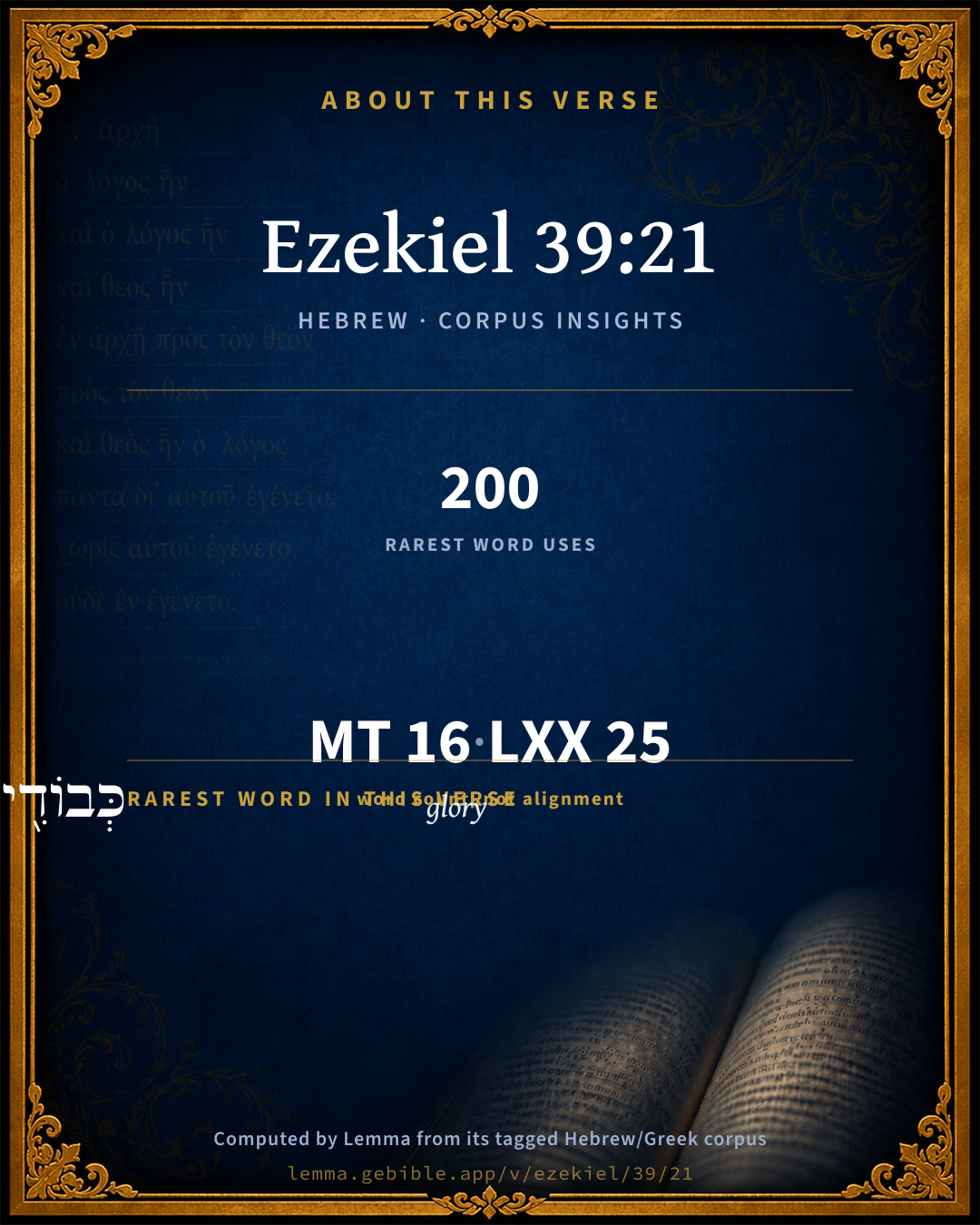
16
words
11
distinct lemmas
Prophets
section

Grammatical profile

  • 4 verbs
  • 6 nouns
  • 1 preposition
  • 5 particles

Verb forms

  • וְנָתַתִּ֥י Qal · Sequential Perfect
  • וְרָא֣וּ Qal · Sequential Perfect
  • עָשִׂ֔יתִי Qal · Perfect
  • שַׂ֥מְתִּי Qal · Perfect

Repetition

Words recur within this verse — often emphatic in Hebrew:

  • בַּגּוֹיִ֑ם nation H1471 ×2
  • אֲשֶׁ֣ר which H834 ×2

Hebrew & Septuagint length

In English translation the verse runs 29 words from the Hebrew and 29 from the Septuagint (LXX English) — the same length.

A rough comparison of the two English renderings, which tokenize alike — not a word-level alignment.

Word counts can differ between the Hebrew and the Greek without any difference in meaning — e.g. the Hebrew direct-object marker אֵת has no separate Greek word, and Greek often adds the article ὁ.

In the original languages it is 16 Hebrew tokens and 25 Greek tokens — but the two are counted differently (Hebrew bundles its prefixes and suffixes into one token; the Greek is in lemma form), so that isn’t a like-for-like length.

Cross-references

15

Topical passages linked to Ezekiel 39:21 in the Treasury of Scripture Knowledge — connected by theme and wording, ordered by reader-vote popularity; previews shown in the World English Bible.

  • Exodus 9:16 but indeed for this cause I have made you stand: to show you my power, and that my name may be declared throughout all the earth;
  • Isaiah 37:20 Now therefore, Yahweh our God, save us from his hand, that all the kingdoms of the earth may know that you are Yahweh, even you only.
  • Ezekiel 36:23 I will sanctify my great name, which has been profaned among the nations, which you have profaned in the midst of them; and the nations shall know that I am Yahweh, says the Lord Yahweh, when I shall be sanctified in you before their eyes.
  • Ezekiel 38:16 and you shall come up against my people Israel, as a cloud to cover the land: it shall happen in the latter days, that I will bring you against my land, that the nations may know me, when I shall be sanctified in you, Gog, before their eyes.
  • Ezekiel 38:23 I will magnify myself, and sanctify myself, and I will make myself known in the eyes of many nations; and they shall know that I am Yahweh.
  • Exodus 7:4 But Pharaoh will not listen to you, and I will lay my hand on Egypt, and bring forth my hosts, my people the children of Israel, out of the land of Egypt by great judgments.
  • Exodus 8:19 Then the magicians said to Pharaoh, "This is the finger of God:" and Pharaoh's heart was hardened, and he didn't listen to them; as Yahweh had spoken.
  • Exodus 14:4 I will harden Pharaoh's heart, and he will follow after them; and I will get honor over Pharaoh, and over all his host; and the Egyptians shall know that I am Yahweh." They did so.
  • 1 Samuel 5:7 When the men of Ashdod saw that it was so, they said, The ark of the God of Israel shall not abide with us; for his hand is sore on us, and on Dagon our god.
  • 1 Samuel 5:11 They sent therefore and gathered together all the lords of the Philistines, and they said, Send away the ark of the God of Israel, and let it go again to its own place, that it not kill us and our people. For there was a deadly confusion throughout all the city; the hand of God was very heavy there.
  • 1 Samuel 6:9 Behold; if it goes up by the way of its own border to Beth-shemesh, then he has done us this great evil: but if not, then we shall know that it is not his hand that struck us; it was a chance that happened to us."
  • Isaiah 26:11 Yahweh, your hand is lifted up, yet they don't see: but they shall see [your] zeal for the people, and be disappointed; yes, fire shall devour your adversaries.
  • Ezekiel 39:13 Yes, all the people of the land shall bury them; and it shall be to them a renown in the day that I shall be glorified, says the Lord Yahweh.
  • Malachi 1:11 For from the rising of the sun even to the going down of the same, my name is great among the nations, and in every place incense will be offered to my name, and a pure offering: for my name is great among the nations," says Yahweh of Hosts.
  • Psalms 32:4 For day and night your hand was heavy on me. My strength was sapped in the heat of summer. Selah.

Cross-references courtesy of OpenBible.info (CC BY 4.0).

Hebrew and Greek witnesses Masoretic Hebrew ↔ Greek Septuagint

The same verse in the two great witnesses to the Old Testament, shown verse-for-verse.

These are two independent witnesses, not word-aligned to each other, and the Septuagint is shown in lemma (dictionary) form.

Hebrew Ezekiel 39:21 Masoretic · Westminster Leningrad Codex

וְנָתַתִּ֥י אֶת כְּבוֹדִ֖י בַּגּוֹיִ֑ם וְרָא֣וּ כָל הַגּוֹיִ֗ם אֶת מִשְׁפָּטִי֙ אֲשֶׁ֣ר עָשִׂ֔יתִי וְאֶת יָדִ֖י אֲשֶׁר שַׂ֥מְתִּי בָהֶֽם

I will set my glory among the nations; and all the nations shall see my judgment that I have executed, and my hand that I have laid on them.

World English Bible · Public Domain

Greek LXX Ezekiel 39:21 Septuagint · lemma form

καί δίδωμι ὁ δόξα ἐγώ ἐν σύ καί ὁράω πᾶς ὁ ἔθνος ὁ κρίσις ἐγώ ὅς ποιέω καί ὁ χείρ ἐγώ ὅς ἐπιἄγω ἐπί αὐτός

And I will set my glory among you, and all the nations shall see my judgment which I have wrought, and my hand which I have brought upon them.

LXX2012 (modern English Septuagint) · Public Domain

Hebrew: Westminster Leningrad Codex (CC BY 4.0). Greek: Septuagint (public domain); English from LXX2012 (modern English Septuagint) (Public Domain). How the Septuagint differs from the Hebrew →

Targum (Aramaic paraphrase)

1

The Targum is the ancient Jewish Aramaic paraphrase of the Hebrew Scriptures — an interpretive translation, not the Hebrew text itself. Onkelos (literal) and Pseudo-Jonathan (expansive) render the Torah, and Jonathan the Prophets. Coverage is partial: where no permissively-licensed English translation exists for a verse, only the Aramaic is shown. This is verse-level text, not a word-by-word alignment to the Hebrew.

  1. Targum Jonathan Prophets (Joshua–Malachi)
    וְאֶתֵּן יַת יְקָרִי בְּעַמְמַיָא וְיֶחֱזוּן כָּל עַמְמַיָא יַת פּוּרְעֲנוּתִי דַעֲבָדַת וְיַת גְבוּרְתִּי דְשַׁוֵיתִי בְהוֹן:

    (no public-domain English translation for this verse)

    Targum Jonathan — Aramaic: “Mikraot Gedolot” (public domain). English: “Sefaria Community Translation” (CC0 1.0 (public-domain dedication)); “London "Chaldee Paraphrase," 1871” (public domain). Text via Sefaria.

Commentary

Notes on Ezekiel 39:21 from classic Christian and Jewish commentators (each source and its license shown beneath its notes). The classic Christian expositions comment on the surrounding passage and are grouped to its opening verse, so a note may address several verses; the Jewish commentaries on the Tanakh (Rashi and others) are per-verse, so they appear only where the commentator wrote on this verse.

Lemma curates 59 commentaries, every one of them public domain or Creative Commons licensed, each selected and text-cleaned for this edition rather than reprinted as found. About our sources →

Trapp's Complete Commentary

John Trapp

Eze 39:21 And I will set my glory among the heathen, and all the heathen shall see my judgment that I have executed, and my hand that I have laid upon them.

Ver. 21. And all the heathen shall see my judgment.] Antiochus did so, and Maximinus the emperor, and other tyrants, when seized upon by such judgments of God as they could neither avoid nor abide.

John Trapp, A Commentary or Exposition upon All the Books of the Old and New Testament (1647–1656) — public domain. Text from a community e-Sword module.

Whedon's Commentary on the Bible

Daniel D. Whedon

21-24. This awful judgment shall indubitably prove, both to the heathen in the farthest limits of the south (Eze_39:6; Eze_39:21) and to the Israelites (Eze_39:22), that the former defeats of God’s chosen people were due wholly to their own sin and uncleanness (Eze_39:23-24; compare Eze_39:12; Eze_39:15). They shall know Jehovah as the one who is all powerful, who protects the righteous and punishes the wicked.

Daniel D. Whedon (gen. ed.), Commentary on the Old and New Testaments (1874–1909) — public domain. Text from a community e-Sword module.

Keil & Delitzsch

C. F. Keil & F. Delitzsch

The Result of this Judgment, and the Concluding Promise

Eze 39:21. Then will I display my glory among the nations, and all nations shall see my judgment which I shall execute, and my hand which I shall lay upon them. Eze 39:22. And the house of Israel shall know that I am Jehovah their God from this day and forward. Eze 39:23. And the nations shall know that because of their wickedness the house of Israel went into captivity; because they have been unfaithful toward me, I hid my face from them, and gave them into the hand of their oppressors, so that they all fell by the sword. Eze 39:24. According to their uncleanness, and according to their transgressions, I dealt with them, and hid my face from them. Eze 39:25. Therefore thus saith the Lord Jehovah, Now will I bring back the captivity of Jacob, and have pity upon all the house of Israel, and be jealous for my holy name. Eze 39:26. Then will they bear their reproach and all their faithlessness which they have committed toward me when they dwell in their land in security, and no one alarms them; Eze 39:27. When I bring them back out of the nations, and gather them out of the lands of their enemies, and sanctify myself upon them before the eyes of the many nations. Eze 39:28. And they will know that I, Jehovah, am their God, when I have driven them out to the nations, and then bring them together again into their land, and leave none of them there any more. Eze 39:29. And I will not hide my face from them any more, because I have poured out my Spirit upon the house of Israel, is the saying of the Lord Jehovah. - The terrible judgment upon Gog will have this twofold effect as a revelation of the glory of God - first, Israel will know that the Lord is, and will always continue to be, its God (Eze 39:22); secondly, the heathen will know that He gave Israel into their power, and thrust it out of its own land, not from weakness, but to punish it for its faithless apostasy (Eze 39:23 and Eze 39:24; compare Eze 36:17.). עשׂה אתם (Eze 39:24), as in Eze 7:27, etc. But because this was the purpose of the Lord with His judgments, He will now bring back the captives of Israel, and have compassion upon all His people. This turn of the prophecy in Eze 39:25 serves to introduce the promise to Israel with which the prophecy concerning Gog and the whole series of prophecies, contained in Eze 35:1 onwards, are brought to a close (Eze 39:25-29). This promise reverts in 'עתּה אשׁיב וגו to the prophet's own time, to which Ezekiel had already gone back by mentioning the carrying away of Israel in Eze 39:23 and Eze 39:24. The restoration of the captives of Jacob commences with the liberation of Israel from the Babylonian exile, but is not to be restricted to this. It embraces all the deliverances which Israel will experience from the termination of the Babylonian exile till its final gathering out of the nations on the conversion of the remnant which is still hardened and scattered. לכן, therefore, sc. because God will prove Himself to be holy in the sight of the heathen nations by means of the judgment, and will make known to them that He has punished Israel solely on account of its sins, and therefore will He restore His people and renew it by His Spirit (Eze 39:29). - In what the jealousy of God for His holy name consists is evident from v.7, and still more plainly from Eze 36:22-23, namely, in the fact that by means of the judgment He manifests Himself as the holy God. ונשׂוּ is not to be altered into ונשׁוּ, "they will forget," as Dathe and Hitzig propose, but is a defective spelling for ונשׂאוּ (like מלוּ for מלאוּ in Eze 28:16): they will bear their reproach. The thought is the same as in Eze 16:54 and Eze 16:61, where the bearing of reproach is explained as signifying their being ashamed of their sins and their consequences, and feeling disgust thereat. They will feel this shame when the Lord grants them lasting peace in their own land. Raschi has correctly explained it thus: "When I shall have done them good, and not rewarded them as their iniquity deserved, they will be filled with shame, so that they will not dare to lift up their face." - Eze 39:27 is only a further expansion of Eze 39:26. For the fact itself, compare Eze 36:23-24; Eze 20:41, etc. And not only will Israel then be ashamed of its sins, but (Eze 39:28, Eze 39:29) it will also know that Jehovah is its God from henceforth and for ever, as was affirmed in Eze 39:22, when He shall fully restore to their own land the people that was thrust into exile, and withdraw His favour from it no more, because He has poured out His Spirit upon it, and thereby perfectly sanctified it as His own people (cf. Eze 36:27).

The promise with which the prophecy concerning the destruction of Gog is brought to a close, namely, that in this judgment all nations shall see the glory of God, and all Israel shall know that henceforth Jehovah will be their God, and will no more hide His face from them, serves to confirm the substance of the threat of punishment; inasmuch as it also teaches that, in the destruction of Gog and his gathering of peoples, the last attack of the heathen world-power upon the kingdom of God will be judged and overthrown, so that from that time forth the people of God will no more have to fear a foe who can disturb its peace and its blessedness in the everlasting possession of the inheritance given to it by the Lord. Gog is not only depicted as the last foe, whom the Lord Himself entices for the purpose of destroying him by miracles of His almighty power (Eze 38:3-4, Eze 38:19-22), by the fact that his appearance is assigned to the end of the times, when all Israel is gathered out of the nations and brought back out of the lands, and dwells in secure repose in the open and unfortified towns of its own land (Eze 38:8, Eze 38:11-12); but this may also be inferred from the fact that the gathering of peoples led by Gog against Israel belongs to the heathen nations living on the borders of the known world,since this points to a time when not only will the ancient foes of the kingdom of God, whose destruction was predicted in Ezekiel 25-32, have departed from the stage of history and perished, but the boundaries of Israel will also stretch far beyond the limits of Palestine, to the vicinity of these hordes of peoples at the remotest extremities on the north, the east, and the south of the globe. - So much may be gathered from the contents of our prophecy in relation to its historical fulfilment. But in order to determine with greater precision what is the heathen power thus rising up in Gog of Magog against the kingdom of God, we mut take into consideration the passage in the Apocalypse (Rev 20:8 and Rev 20:9), where our prophecy is resumed. Into this, however, we will not further enter till after the exposition of Ezekiel 40-48, when we shall take up the question as to the historical realization of the new temple and kingdom of God which Ezekiel saw.

Keil & Delitzsch — Biblical Commentary on the Old Testament (1861–1891) — public domain (CC PDM 1.0). Text via the HelloAO Bible API. (Old Testament only.)

Tyndale Open Study Notes

Tyndale Open Resources

39:21-24 The Lord will demonstrate his glory in all of history. He did so through the punishment of Israel during their exile because of their defilement and their sins.

Tyndale Open Study Notes — © Tyndale Open Resources, licensed CC BY-SA 4.0. Text via the HelloAO Bible API.

Ellicott's Commentary for English Readers

(21) My glory among the heathen.—In this and the following verse the ultimate effect of the Divine judgments in the world is spoken of, and then, in Eze_39:23-24, this is applied to the present captivity of Israel. But the effect is too far-reaching to be limited to the latter, and the kingdom of God was never so established among the restored exiles, either by external triumphs over their enemies or by its internal development in the hearts of men, that the Divine glory was generally recognised among the heathen. In the time foretold the judgments shall be of such a character that all shall perceive that they are from God. Yet it must not be forgotten that the restoration from the exile was one step, and an important one, in the course of events leading to this end.

A Bible Commentary for English Readers, edited by Charles John Ellicott (1878–1897) — public domain. Text from a community e-Sword module.

The Cambridge Bible for Schools and Colleges

gen. ed. J. J. S. Perowne

21. The great discomfiture of Gog will reveal Jehovah’s power to the nations. None but God alone could deal so wonderfully. Cf. Eze_38:16; Eze_38:23.

The Cambridge Bible for Schools and Colleges (gen. ed. J. J. S. Perowne; Cambridge University Press, 1878–1918) — public domain. Text from a community e-Sword module.

John Gill's Exposition

And I will set my glory among the Heathen,.... The glory of his divine perfections, particularly his power and his goodness, in destroying the enemies of his people, and saving them; which will be set in a clear point of view to the Heathen, that they cannot but observe it; and this is the ultimate end of this strange event, as it is of all that the Lord does, even his own glory, subordinate to which is his people's good:

and all the Heathen shall see my judgment that I have executed, and my hand that I have laid upon them; his vengeance and power, as the Targum; the punishment inflicted by his mighty hand on Gog and his army: these Heathens are the Pagan kingdoms of China, &c. and of Tartary, Persia, and the whole Turkish dominions, being Mahometan, which are no better than Heathen; these will be converted to the Christian religion, in consequence of this event; for this will be the passing away of the Turkish woe, which will make way for the sounding of the seventh trumpet; and when these kingdoms will become Christ's, and way be made for the kings of the east to come over to him, Rev 11:14.

John Gill's Exposition of the Whole Bible (1746–1763) — public domain (CC PDM 1.0). Text via the HelloAO Bible API.

Matthew Poole's English Annotations

I will set, I will advance and continue, my glory; the glory of power, justice, and wisdom against enemies, and of power, mercy, and faithfulness, with wisdom, toward his people.

The heathen, among whom my name was evil spoken of; they eclipsed, but God will clear up his glory.

The heathen, that are either in Gog’s army, or in the countries to which the news shall come,

shall see, not be able to deny or doubt, my judgment; the punishment just and from heaven, called God’s

hand laid upon them.

Matthew Poole's English Annotations on the Holy Bible (1683–1685) — public domain. Text from a community e-Sword/MySword module.

The Pulpit Commentary

Verses 21-29 record the impression Gog"s overthrow should make upon both Israel and the heathen.

God"s glory among the heathen.

I GOD IS CONCERNED FOR HIS GLORY AMONG THE HEATHEN. It may be a light thing to us that his Name is unknown or dishonored among the heathen; but it is no light matter m the sight of God. He does not confine his gaze to the little spot of light where he is recognized and loved. He is the Creator of the universe, and he is concerned with what happens everywhere throughout his dominion. Consider why he desires his glory to be spread among the heathen.

1. For its own sake. God cares for his glory and desires to be glorified. Such a conception applied to a man would suggest selfishness. This is not the case with God, because his glory resides in his goodness. The spread of his glory is the vindication of righteousness. The eternal claims of holiness demand assertion. To suppress them is to give the victory to sin; to spread the glory of God is to assert them.

2. For the sake of the heathen. Ignorance of God"s glory is their loss. To know God is life eternal. It is for the supreme good of men that they should understand their heavenly Father. "Acquaint now thyself with him, and be at peace". (Job_22:21)

II GOD HAS MEANS FOR SPREADING HIS GLORY AMONG THE HEATHEN.

1. In judgments. This seems to be the method suggested in the chapter now under consideration. The restoration of Israel and the accompanying overthrow of her enemies will strike dismay into the host of the enemy, and so impress them with the might and majesty of the true God. This is a fearful process in the eyes of the heathen, and yet it is educational, and may help to lead them out of superstition and foolish opposition to wiser ways. God arrests the careless now by his judgments.

2. In the gospel. When the gospel is preached to the heathen God"s glory is revealed among them surely the happier method of making it known. This was already foreshadowed in Old Testament times. (Isa_52:15) It was in part accomplished by the labors of St. Paul. Now, we must ever bear in mind that this is God"s work. Though human agents preach the gospel, God himself shows forth his glory in his truth. He too awakens the souls of the hearers by his Spirit. All perception of the glory of God comes from his own revelation of himself.

III CHRISTIANS SHOULD TAKE PART IN SPREADING GOD"S GLORY AMONG THE HEATHEN. We sometimes hear missionary enterprises described as quixotic schemes of amiable fanatic, and so-called practical people tell us that we had much better spend our money and our energies in endeavoring to better the condition of the poor of our own cities. "These ought ye to have done, and not to leave the other undone". (Mat_23:23) It is Christ"s command that his gospel should be preached to all people, and whether our wisdom commend the command or not, if we are true Christians it is our plain duty to render unquestioning obedience. (Mat_28:19) But the heathen need the knowledge of the truth of Christ. Experience proves that the most ignorant and the most cultivated can both receive it and profit by it. There is no more practical work than that of wise labor in the missionary field. It is the bounden duty of all Christians to support it. The Church that has no missionary spirit is not Christian, for it has not the Spirit of Christ.

Vers. 21-29God"s revelation of himself a fount of blessing.

Ignorance of God and strength of animal appetite are the two primal founts of ungodliness. Animal appetite is, in order of time, the first source of vice; but as the understanding opens to receive knowledge, this source of evil may be checked. To this end God deigns to make himself known. A clear vision of God is a strong antidote to evil propensity. Faith in God is the great regenerative principle. Therefore, through the procession of the ages, God has been revealing his qualities and excellences to our race. From this passage we learn

I THAT GOD REVEALS HIMSELF AS THE ACTIVE RULER IN HUMAN AFFAIRS. Such men in Chaldea as had faith in their idols would attribute the prosperity of their kingdom and their success in war to the power of their deities. Others, and probably the larger portion, would conclude that military fortunes were matters of chance, and that the gods took little, if any, interest in the affairs of men. Human industry, sagacity, and courage, these seemed then, as now, the main factors in success. The general impression was that the gods lived in remote serenity, sublimely indifferent to the needs and strifes of men. Unbelief, violence, and stoicism followed. Our God took pains to dispel this mistake. The living God takes a Fatherly interest in every man in his personal, domestic, and national concerns. Not a hair of his head can be touched without the cognizance of God. He administers joy and sorrow, success and disappointment, with judicious care. The God of heaven manifests a friendly activity in all human affairs, as great as if this globe were the sole object of his care. "In all our afflictions he is afflicted.

II THAT GOD REVEALS HIMSELF AS THE REAL FOUNT OF ALL BLESSING. It Was God"s endeavor to make it clear to the world that Israel"s prosperity was Jehovah"s gift; that Israel"s exile was the effect of Jehovah"s anger. When Israel escaped from Egyptian bondage, plainly it was by the interposition of Jehovah. Their successful march through the desert was due to the leadership of God. Their triumphal march through Canaan was widely attributed to the personal power of Jehovah. As often as they loyally served him he smiled upon their fields and gave them prolific harvests. As often as they forsook him disaster befell them. If they asked his guidance he directed them in the choice of a King. From his hand they had personal liberty, just laws, beneficent government, agricultural plenty, national security, and the joys of ennobling religion. He taught their "hands to war, their fingers to fight." Unless the Hebrews were as blind as a doorpost, they must have perceived that every good they had came from the liberal hand of Jehovah. To them he was the Fountain of life.

III THAT GOD REVEALS HIMSELF TO THE WORLD AS THE WORKER OF RIGHTEOUSNESS. "The heathen shall know that the house of Israel went into captivity for their iniquity." We must never lose sight of the fact that God had raised up Israel specially to reveal to the world the righteousness of God. The Hebrews were ordained to educate the world in the truths and principles of righteousness. They were appointed to be par excellence a moral people, a nation in whom conscience was highly developed. The gods of paganism were renowned for strength and for cunning. The idea of righteousness they had not deified. Hence Jehovah was concerned to be known as essential purity. To him sin is intolerable the root of all discord and all misery. The exile was no haphazard. It was Divine punishment for grievous sin. Defeat in war was the rod of God"s righteous anger. Hence also the Jewish subjugation would not be permanent. The element of life was in the people still; and, as soon as repentance and moral renovation appeared, return to independence and to Palestine followed. It was a moral discipline.

IV THAT PREVIOUS REVELATIONS OF GOD WERE PREPARATORY TO THE GREAT REVELATION OF HIS GRACE. "Therefore thus saith the Lord, Now will I have mercy upon the whole house of Israel, and will be jealous for my holy Name." The glory of God is his compassion pure, unstinted, self-sacrificing love. To Moses, who craved to see God"s glory, the responding voice proclaimed, "The Lord God, merciful and gracious." Micah asked, in profound surprise, "Who is a God like unto thee?" In what respect did he mean? In the splendors of his kingly state? In the might of his arm? In the range of his government? Nay. "Who is a God like unto thee, that pardoneth iniquity, transgression, and sin?" Herein lies the central excellence of Jehovah, viz. that, providing for the violated interests of justice by his own suffering, he freely forgives, renovates, and uplifts the guilty sons of men. Men have not seen the full significance of his Name, nor conjectured the dazzling radiance of his goodness, until they have seen his mercy seen him as the Healer of the fallen. But his mercy is a righteous mercy. Whom he pardons, he purifies. Righteousness is the foundation on which he erects the magnificent structure of his grace. So far as we know at present, this is the climax of his self-revelations.

V THAT THE PERPETUAL ENJOYMENT OF HIS FAVOR IS GUARANTEED BY THE GIFT OF HIS SPIRIT. "Neither will I hide my face any more from them; for I have poured out my Spirit upon the house of Israel, saith the Lord God." The possession of prosperity and blessing outside a man depends upon the state of feeling and desire within a man. And a right state of mind Godward is secured to the genuine Israelite by the indwelling of God"s mighty Spirit. If men cannot withstand temptation in their native and unaided state, God will not leave them to themselves. As the supreme culmination of all blessing, God will impart himself to humble, suppliant men. He will weave his own Spirit into our spirit. He will unite himself with us by indissoluble bonds will pour his life into the empty channels of our nature. His great salvation is first internal, then external. We cannot miss our highest destiny if God, by his Spirit, be within us. Then, surely, we have the highest guarantee of safety, elevation, and noble joy. We shall be renovated in the very root-principles of our nature, molded into a higher life by the silent workmanship of his Spirit. His mercy will never forsake us. D.

Vers. 21-29God his own Interpreter.

The final result of this great conflict between Gog and the people of Jehovah will prove to be that God"s Name is hallowed as it never was before. There had been great misconstruction of his ways and mistake as to his purpose, but all should be made clear.

I GOD MUCH MISUNDERSTOOD. How seriously and sadly God has been and is misunderstood is seen in the facts that

(1) his very existence has been denied;

(2) he has been mistaken for a blind, unintelligent Force, without any knowledge or character;

(3) his unity has been disregarded, and his manifold activities referred to a plurality of heavenly powers;

(4) he has been believed to Be occupied with himself and indifferent to the conduct and the character of his children;

(5) he has been represented as partial, or as malevolent, or as unrelentingly and inconsiderately severe, or as simply good-natured without any concern for the righteousness of his rule and the moral integrity of his subjects, or as tied and bound by the laws which he has instituted, so as to be wholly unable to interpose in the affairs of men.

II GOD IMPERFECTLY EXPLAINED. Many, indeed, have been the interpreters who have undertaken to "justify the ways of God to men;" and very unsatisfactory have their explanations been. They may have given a measure of comfort to a few and for a brief time. But as the world has moved on, and "the thoughts of men have widened," most of these solutions have gone their way, and given place to others which in their turn have been exploded and have disappeared.

III GOD INTERPRETING HIMSELF. Cowper"s line is true enough

God"s his own Interpreter.

He does make plain that which was inexplicable and perplexing. Thus we find that (vers. 21-24) the heathen nations were in time made to see that the Jews were not taken captive by them because (as they once ignorantly supposed) Jehovah was unable to protect them, but because he was determined to punish them for their transgressions. And we find further (vers. 28, 29) that Israel at length understood that he who sent them into captivity and then brought them forth therefrom was in very deed and truth "the Lord their God," whom they should serve, and in whose service they would find security and peace. We find ourselves perplexed by many insoluble problems; serious difficulties respecting our own human life, and the dealings of our Divine Father with ourselves; more serious difficulty and perhaps distressing darkness as to God"s government of the human world. We wonder why he permitted this and that; why he does not act when and how we should expect that he would; how he can be both just and kind when such and such things are as they are and as they ought not to be, etc. Let us:

1. Remember that in the light of the present we can understand much of the once-mysterious past.

2. Be assured that in the light of the future we shall perfectly understand that which is troubling and even burdening us now. God will interpret himself, as he has been doing all through the ages of human history. We shall see one day what we now believe, that "all his paths are mercy and truth. C.

The Pulpit Commentary (1880–1919), ed. H.D.M. Spence-Jones & Joseph S. Exell — public domain. Text from a community e-Sword module.

John Wesley's Explanatory Notes

All the heathen - In the countries to which the news shall come.

John Wesley, Explanatory Notes Upon the Whole Bible (1754–1765) — public domain. Text via the GEBible commentary corpus.

Kretzmann's Popular Commentary

Paul E. Kretzmann

The Effect of God’s Judgment

v. 21. And I will set My glory among the heathen, by carrying out this judgment upon Gog, representative of all the hostile forces of the earth, and all the heathen shall see My judgment that I have executed, and My band that I have laid upon them, they are bound to see the heavy hand of God’s punishment, unable to deny His sovereign interference.

v. 22. So the house of Israel, as a second result of the Lord’s judgment upon the enemies of His spiritual Israel, shall know that I am the Lord, their God, from that day and forward, the interposition of the Lord in their interest strengthening their confidence in Him.

v. 23. And the heathen shall know that the house of Israel, here chiefly representative of the Church of God in the Old Testament, went into captivity for their iniquity, not because the enemies, in their own power, overcame them; because they trespassed against Me, therefore hid I My face from them, withdrawing His merciful and almighty presence from them, and gave them into the hand of their enemies, so that their captivity at that time, and all the evils which befall them at any time, are the punishments of the Lord; so fell they all by the sword.

v. 24. According to their uncleanness, that of their idolatry, of their rebellion against the God of the covenant, and according to their transgressions, the wickedness of their perfidious acts, have I done unto them, treating them as they deserved, and hid My face from them. It was not Israel’s helplessness that delivered Israel into the hands of the enemies, but the judgment of God upon a disloyal people. The enemies, therefore, were not to take the credit for the present situation for themselves; for God had brought it about in order to carry out his plans regarding those who belonged to His people in truth.

v. 25. Therefore, thus saith the Lord God, Now will I bring again the captivity of Jacob, in restoring His people from the calamity of the exile, and have mercy upon the whole house of Israel, to all those who truly were members of His own people, who in simple faith placed their confidence in Him, and will be jealous for My holy name, which, as a result of the misfortunes that had come upon His people, was in danger of being blasphemed,

v. 26. after that they have borne their shame and all their trespasses whereby they have trespassed against Me, namely, by being thoroughly ashamed of their former unfaithfulness and idolatry, by loathing themselves for their perfidiousness, when they dwelt safely in their land and none made them afraid. Eze 16:54-61. That is the effect which the realization of God’s unmerited goodness has upon the repentant sinner: it causes him to be all the more conscious of his own unworthiness.

v. 27. When I have brought them again from the people, from the countries where they were living in exile, and gathered them out of their enemies’ lands, and am sanctified in them in the sight of many nations, who would be bound to acknowledge the power of the one true God and yield him the respect due Him,

v. 28. then shall they know that I am the Lord, their God, the true Israelites once more accepting Him as the God of the covenant, as the God of their salvation, which caused them to be led into captivity among the heathen, namely, with the express intention of bringing them to a realization of their foolishness and of their helplessness when they forsook Him; but I have gathered them unto their own land and have left none of them any more there. This applies to all those who were Israelites in truth, not only to those who actually returned to Canaan and took an active part in establishing the true worship, but also to those who remained in foreign lands, but were believers in the true God; for the latter had free access to their native land and to the Temple at Jerusalem as their spiritual dwelling-place.

v. 29. Neither will I hide My face any more from them, from those who are His children by faith in the Redeemer; for I have poured out My Spirit upon the house of Israel, saith the Lord God. It is the Spirit of God who works conversion in the Old Testament as well as in the New. Without his illumination no member of Israel could believe in time coming Messiah and without His power no person at time present time can believe in the Redeemer. Cf 2Co 1:23; Eph 1:14; Php 1:6.

Paul E. Kretzmann, Popular Commentary of the Bible (1921–1924) — public domain. Text from a community e-Sword module.

unfoldingWord translationNotes

Door43 World Missions Community

Connecting Statement:

Yahweh gives Ezekiel a message about what will happen to Israel.

I will set my glory among the nations

Yahweh speaks of his glory as if he will place it in the middle of the nations where they can see it. AT: "I will make the nations see my glory" (See: Metaphor)

my judgment that I perform and my hand that I have set against them

Both of these phrases refer to the punishment that Yahweh will inflict upon Israel and are repeated for emphasis. They can be combined into a single phrase. AT: "the way that I will judge them" (See: Doublet)

my hand

Here the metonym "hand" refers to Yahweh's power that he uses to bring punishment. (See: Metonymy)

against them

"against Gog and his great army"

The house of Israel

The word "house" is a metonym for the family that lives in the house, in this case the Israelites, the descendants of Jacob over many years. See how you translated this in Ezekiel 3:1. AT: "the Israelites" or "the Israelite people group" (See: Metonymy)

translationWords

glory

nation

judge

hand

God

unfoldingWord translationNotes — © Distant Shores Media and the Door43 World Missions Community, licensed CC BY-SA 4.0. Source: git.door43.org/Door43/en_tn.

Rashi

Rabbi Shlomo Yitzchaki (Rashi)

My judgment [Heb. מִשְׁפָּטִי,] My retribution, justize in Old French, judgment, punishment.

Rashi on the Tanakh — English translations: “The Judaica Press complete Tanach with Rashi, translated by A. J. Rosenberg” (CC BY 4.0); “Pentateuch with Rashi's commentary by M. Rosenbaum and A.M. Silbermann, 1929-1934” (public domain); “The Metsudah Tanach series, Lakewood, N.J” (CC BY 4.0); and “The Book of Joshua, Metsudah Publications, 1997” (CC BY 4.0). Text via Sefaria.

Lesson kit

Teaching starters — assembled from the data on this page, not authored interpretation. Every prompt links to the verse data it draws on. Edit before teaching.

Ezekiel, in the Prophets, opens this verse with 16 words (11 distinct Hebrew lemmas). Its most distinctive word is kâbôwd (“glory”). A historical commentator’s framing appears above. Read the whole chapter for the surrounding context.

Discussion questions

  1. How does “glory” (kâbôwd) shape what this verse is saying?
  2. Exodus 9:16 shares this passage’s theme. How do the two illuminate each other?
  3. “nation” occurs 2× in this one verse. What is the effect of the repetition?
  4. These translations render this verse differently; the difference is in the English rendering, not the original. What questions does that raise?
  5. The verb «וְנָתַתִּ֥י» is Qal Sequential Perfect. How does its form color the action?
  6. Reading how Trapp's Complete Commentary and Whedon's Commentary on the Bible read this verse, where do the two commentators agree and where do they part?

Things to notice

Reading settings

Reading text

Shown beneath each verse's original-language words.

Old Testament
Old Testament edition

Read the OT as the Masoretic Hebrew (MT) or the Greek Septuagint (LXX).

English shown for the Greek Septuagint (in the Hebrew ↔ Greek comparison).

Comparing translations? Open the Compare panel on any verse page to stack up to four side by side.