
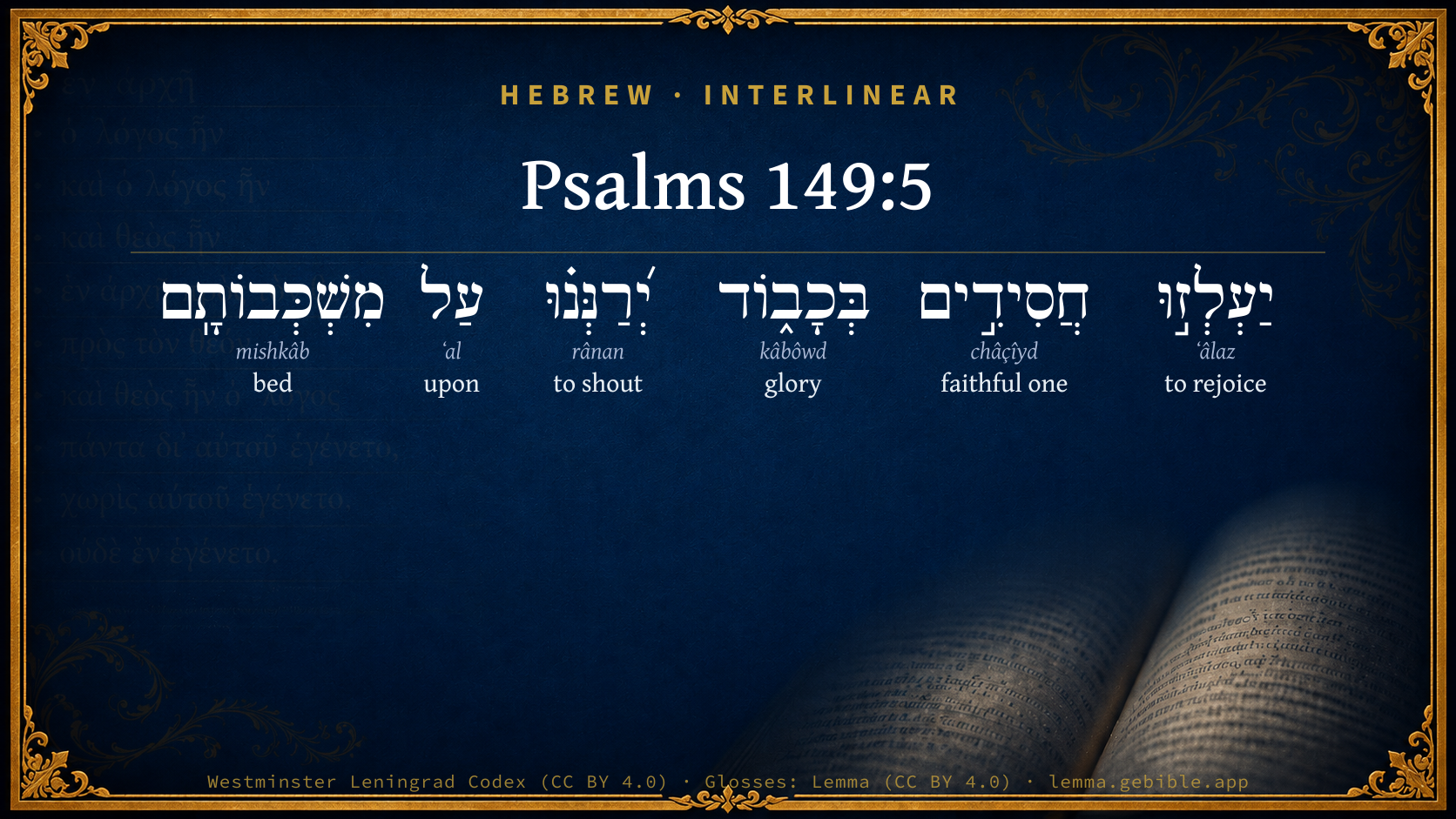
Psalms 149:5

Hebrew (Westminster Leningrad Codex) Psalms 149:5 appears in the Hebrew Old Testament. The text above is from the Westminster Leningrad Codex. Each word links to its Strong’s number, a concise gloss, and parsing drawn from the Open Scriptures Hebrew Bible morphology. Click any word for its full Brown-Driver-Briggs (BDB) entry.
Download image
Cite this verse

Psalms 149:5 (World English Bible). Public Domain. Lemma interlinear Bible study tool, https://lemma.gebible.app/v/psalms/149/5.

Show BibTeX & RIS
BibTeX
RIS
English Translation
Let the saints rejoice in honor. Let them sing for joy on their beds.
World English Bible · Public Domain
Download a study sheet

One document with this verse’s original text, its word-by-word gloss line, the meaning frame, cross-references with their text, attributed commentary, and full source and license credits — printable, and it pastes into notes with its structure intact.

This verse Autodidact and up

Study sheet (.html) Plain text (.txt)

A passage Seminary Student

Up to 50 verses in one chapter. A passage sheet keeps up to 6 commentary sources and 12 cross-references per verse, in the order this page ranks them, and says so on the sheet whenever that leaves anything out. Ask for a single verse and you get the Autodidact verse sheet above.

Everything on this page stays free to read, with no account — the sheet is a download of what is already on screen, not access to it.

Want to remove ads? Support Godless Engineer
Compare translations 3

The same verse in 3 English versions, stacked beneath the original-language interlinear above. Click any original word for its lexicon entry.

Each is an independent rendering of the whole verse — the interlinear is not word-aligned to these translations.

Highlighted words mark where these versions differ — a whole-verse word diff, not a word-by-word alignment.

  • World English Bible Public Domain
    Let the saints rejoice in honor. Let them sing for joy on their beds.
  • King James Version Public Domain
    Let the saints be joyful in glory: let them sing aloud upon their beds.
  • unfoldingWord Literal Text CC BY-SA 4.0
    Let the faithful exult in glory; let them sing joyfully on their beds.

unfoldingWord Literal Text — © unfoldingWord, licensed CC BY-SA 4.0. Word-aligned USFM3 via Door43 (git.door43.org/unfoldingWord/en_ult).

Versions to compare (up to 4)

3 of 4 selected

Show all 17 translations

Every available English version of this verse, each an independent rendering of the whole verse.

  • World English Bible Public Domain
    Let the saints rejoice in honor. Let them sing for joy on their beds.
  • Berean Standard Bible Public Domain
    Let the saints exult in glory; let them shout for joy upon their beds.
  • Majority Standard Bible Public Domain
    Let the saints exult in glory; let them shout for joy upon their beds.
  • King James Version Public Domain
    Let the saints be joyful in glory: let them sing aloud upon their beds.
  • American Standard Version (1901) Public Domain
    Let the saints exult in glory: Let them sing for joy upon their beds.
  • Revised Version (1885) Public Domain
    Let the saints exult in glory: let them sing for joy upon their beds.
  • Geneva Bible (1599) Public Domain
    Let ye Saints be ioyfull with glorie: let them sing loud vpon their beddes.
  • Young's Literal Translation Public Domain
    Exult do saints in honour, They sing aloud on their beds.
  • Literal Standard Version CC BY-SA 4.0
    Saints exult in glory, || They sing aloud on their beds.
  • Unlocked Literal Bible CC BY-SA 4.0
    Let the godly rejoice in victory; let them sing for joy on their beds.
  • unfoldingWord Literal Text CC BY-SA 4.0
    Let the faithful exult in glory; let them sing joyfully on their beds.
  • Darby Bible Public Domain
    Let the godly exult in glory; let them shout for joy upon their beds.
  • World Messianic Bible Public Domain
    Let the holy ones rejoice in honor. Let them sing for joy on their beds.
  • Webster's Bible Public Domain
    Let the saints be joyful in glory: let them sing aloud upon their beds.
  • Free Bible Version CC BY-SA 4.0
    Let the faithful celebrate how he honors them; let them sing happily even from their beds.
  • Bible in Basic English Public Domain
    Let the saints have joy and glory: let them give cries of joy on their beds.
  • JPS Tanakh (1917) Public Domain
    Let the saints exult in glory; let them sing for joy upon their beds.

Literal Standard Version (2020), Covenant Press — licensed CC BY-SA 4.0. Text via the HelloAO Bible API (eBible.org). Unlocked Literal Bible (unfoldingWord) — licensed CC BY-SA 4.0. Text via the HelloAO Bible API (eBible.org). unfoldingWord Literal Text — © unfoldingWord, licensed CC BY-SA 4.0. Word-aligned USFM3 via Door43 (git.door43.org/unfoldingWord/en_ult). Free Bible Version, Dr. Jonathan Gallagher — licensed CC BY-SA 4.0. Text via the HelloAO Bible API (eBible.org).

Word by word

More ways to search: Search by grammar → Find every occurrence → Compare this word →

Practice this passage: Drill this verse → Learn its vocabulary →

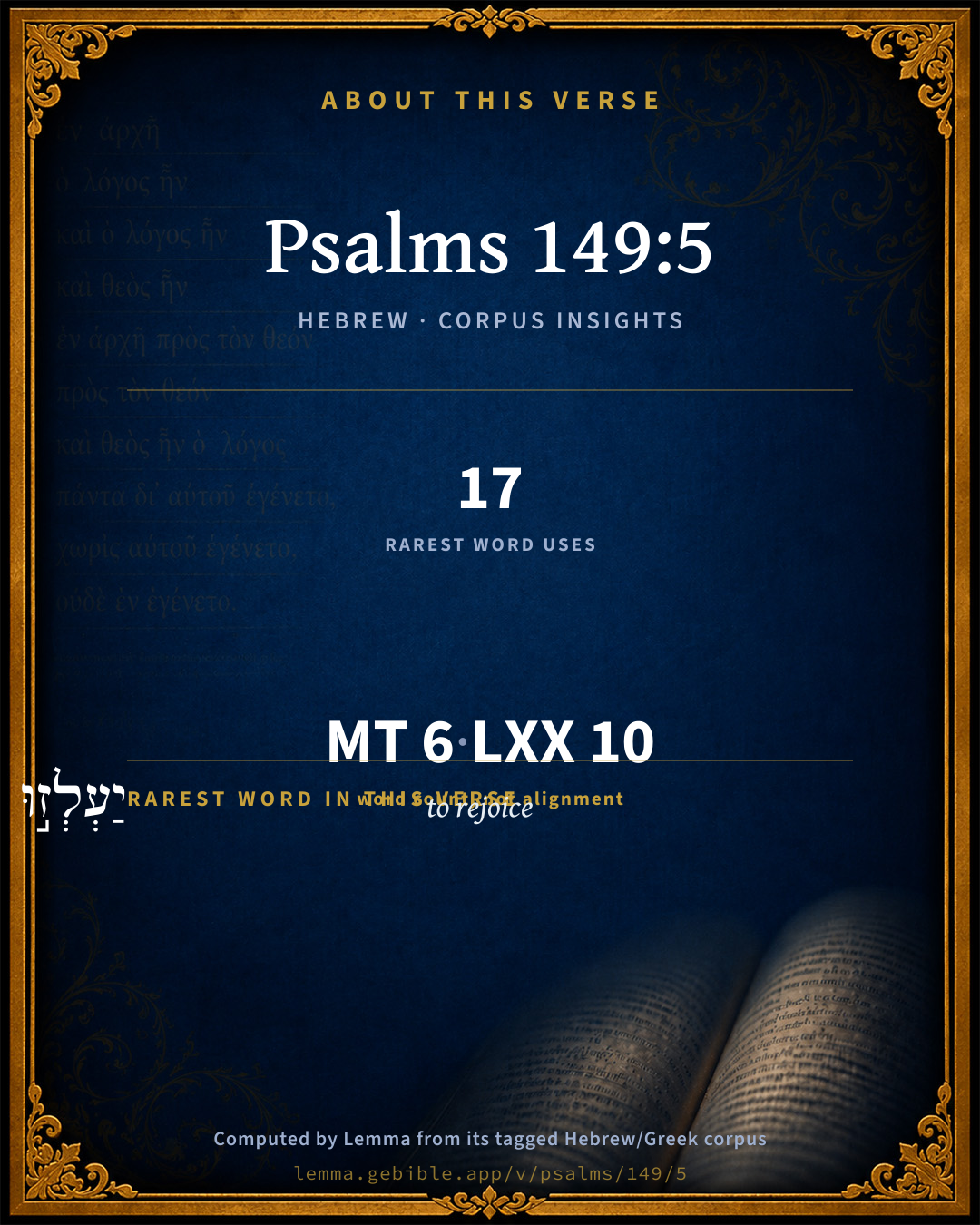
About this verse

These counts appear in no published source. They are computed here, from the morphology-tagged text and Lemma’s own curated glosses. What Lemma adds →

6
words
6
distinct lemmas
Wisdom
section

Notable vocabulary

The rarest word here is יַעְלְז֣וּ to rejoice H5937 — appearing just 17 times in the whole Hebrew Bible.

Shared distinctive vocabulary

יַעְלְז֣וּ to rejoice H5937 occurs in 16 verses of the Hebrew Bible. Also found in:

Grammatical profile

  • 2 verbs
  • 2 nouns
  • 1 adjective
  • 1 preposition

Verb forms

  • יַעְלְז֣וּ Qal · Imperfect
  • יְ֝רַנְּנ֗וּ Piel · Imperfect

Hebrew & Septuagint length

In English translation the verse runs 14 words from the Hebrew and 12 from the Septuagint (LXX English) — closely comparable.

A rough comparison of the two English renderings, which tokenize alike — not a word-level alignment.

Word counts can differ between the Hebrew and the Greek without any difference in meaning — e.g. the Hebrew direct-object marker אֵת has no separate Greek word, and Greek often adds the article ὁ.

In the original languages it is 6 Hebrew tokens and 10 Greek tokens — but the two are counted differently (Hebrew bundles its prefixes and suffixes into one token; the Greek is in lemma form), so that isn’t a like-for-like length.

Cross-references

10

Topical passages linked to Psalms 149:5 in the Treasury of Scripture Knowledge — connected by theme and wording, ordered by reader-vote popularity; previews shown in the World English Bible.

  • Job 35:10 But none says, 'Where is God my Maker, Who gives songs in the night,
  • Psalms 42:8 Yahweh will command his loving kindness in the daytime. In the night his song shall be with me: A prayer to the God of my life.
  • 1 Peter 1:8 whom not having known you love; in whom, though now you don't see him, yet believing, you rejoice greatly with joy unspeakable and full of glory--
  • Psalms 118:15 The voice of rejoicing and salvation is in the tents of the righteous. "The right hand of Yahweh does valiantly.
  • Psalms 145:10 All your works will give thanks to you, Yahweh. Your saints will extol you.
  • Psalms 23:1 Yahweh is my shepherd: I shall lack nothing.
  • Psalms 63:5–6 My soul shall be satisfied as with the richest food. My mouth shall praise you with joyful lips,
  • Psalms 92:2 To proclaim your loving kindness in the morning, And your faithfulness every night,
  • Psalms 132:16 Her priests I will also clothe with salvation. Her saints will shout aloud for joy.
  • Romans 5:2 through whom we also have our access by faith into this grace in which we stand. We rejoice in hope of the glory of God.

Cross-references courtesy of OpenBible.info (CC BY 4.0).

Hebrew and Greek witnesses Masoretic Hebrew ↔ Greek Septuagint

The same verse in the two great witnesses to the Old Testament, shown verse-for-verse.

You’re reading Greek Psalm 149 (Hebrew Psalm 149). The Septuagint counts the superscription, so verse numbers can differ from the Hebrew — chapter-level alignment, not verse-by-verse. Numbering follows Rahlfs.

These are two independent witnesses, not word-aligned to each other, and the Septuagint is shown in lemma (dictionary) form.

Hebrew Psalms 149:5 Masoretic · Westminster Leningrad Codex

יַעְלְז֣וּ חֲסִידִ֣ים בְּכָב֑וֹד יְ֝רַנְּנ֗וּ עַל מִשְׁכְּבוֹתָֽם

Let the saints rejoice in honor. Let them sing for joy on their beds.

World English Bible · Public Domain

Greek LXX Greek Psalm 149:5 Septuagint · lemma form

καυχάομαι ὅσιος ἐν δόξα καί ἀγαλλιάομαι ἐπί ὁ κοίτη αὐτός

The saints shall rejoice in glory; and shall exult on their beds.

LXX2012 (modern English Septuagint) · Public Domain

Hebrew: Westminster Leningrad Codex (CC BY 4.0). Greek: Septuagint (public domain); English from LXX2012 (modern English Septuagint) (Public Domain). How the Septuagint differs from the Hebrew →

Commentary

Notes on Psalms 149:5 from classic Christian and Jewish commentators (each source and its license shown beneath its notes). The classic Christian expositions comment on the surrounding passage and are grouped to its opening verse, so a note may address several verses; the Jewish commentaries on the Tanakh (Rashi and others) are per-verse, so they appear only where the commentator wrote on this verse.

Lemma curates 59 commentaries, every one of them public domain or Creative Commons licensed, each selected and text-cleaned for this edition rather than reprinted as found. About our sources →

Trapp's Complete Commentary

John Trapp

Psa 149:5 Let the saints be joyful in glory: let them sing aloud upon their beds.

Ver. 5. Let the saints be joyful in glory] i.e. In their glorious estate by Christ, notwithstanding their present poverty. "Let the brother of low degree rejoice (or glory) in that he is exalted," Jas 1:9.

Let them sing aloud upon their beds] How hard soever; as Philpot and his fellow sufferers did. when they roused in the straw. Jacob had never more sweet intercourse with God than when his head lay upon the hard stone, at Bethel. Some by "beds" here understand the temples and schools. Confer Isa 57:1-2 Others render it, Ovabunt de cubilibus suis, They shall sing aloud for their beds, that is, for their sweet and solid tranquillity.

John Trapp, A Commentary or Exposition upon All the Books of the Old and New Testament (1647–1656) — public domain. Text from a community e-Sword module.

The Biblical Illustrator

Joseph S. Exell

Psa_149:5

Let the saints be joyful in glory.

The saints in glory

I. Their name. Saints.

1. Because they are separated. Not the world, or the god of this world, but the God who made and redeemed them, is their Master and Lord; Gods service is their service; Gods will is their law; Gods Word is their rule.

2. Because they are sanctified. By the belief of the truth as it is in Jesus their eyes are turned away from viewing vanities, and are turned towards holy objects of contemplation.

II. Their honour. In glory.

1. The state of glory. Heaven--eternal rest, but not inaction.

2. The place of glory. The holy city is all glorious, having the glory of God, within, above, and around. Its sky is ever cloudless, its light is ever clear, its sun never sets, and its day never ends.

3. The society of glory.

4. An eternity of glory.

III. Their joyfulness.

1. Wholly joyful.

2. All joyful.

3. Ever joyful. (G. Robson.)

Hallelujah

Once, when the seraphic Samuel Rutherford was preaching, he came ere long to speak on the high praises of the Lord Jesus Christ. That was a theme upon which he was at home, and when he reached that point, and had spoken a little upon it, the Duke of Argyle, who was in the congregation, cried out, Now you are on the right strain, man; hold on to that.

I. Some reasons for praise.

1. The delight of God in His people--their prayers, and their praises.

2. The beauty He puts upon His people. This text may be read in three different ways. First, as in our version, He will beautify the meek with salvation! Next, He will beautify the afflicted with deliverance. Hear that, you afflicted ones; jot it down for your comfort. And, next, He will beautify the meek with victory. The men that cannot fight shall be beautified with victory. When the fighting men and those that stood up for their own rights will find themselves covered with shame, He will beautify the meek with victory.

II. Special phases of praise.

1. Glorying in God. By anticipation and by foretaste we have already obtained the life eternal, therefore, let the saints be joyful in glory. I cannot get up to that, says one. Try. At any rate, get as far as this: wherever there is grace there will be glory. Grace is the egg, and glory is the hatching of it. Grace is the seed, and glory is the plant that comes out of it. Having the egg and the seed, we have practically and virtually the glory; therefore, Let the saints be joyful in glory.

2. The next special kind of praise is joy in special circumstances: Let them sing aloud upon their beds.

(1) This is a message for the time of sickness. Praise the Lord when you are ill; sing to His glory when you cannot sleep; sing when the head aches, for that is the highest kind of praise that comes out of the body that is racked with pain. Let them sing aloud upon their beds.

(2) Your bed? Why, that is the place of seclusion! There you are alone. Commune with God upon your beds, and sing His praises, if not aloud with the voice, yet aloud with the heart.

(3) Upon your bed? Why, that is the place of domestic gathering; for the bed here meant is a couch, on which the Orientals reclined when they ate. Sing the Lords praises on your couches; that is, when you gather in your families.

(4) The bed of death. (C. H. Spurgeon.)

The Biblical Illustrator, edited by Joseph S. Exell (c. 1880s–1900s) — public domain. Text from a community e-Sword module.

Joseph Benson's Commentary

Psa 149:5-8. Let the saints be joyful in glory — For the honour which God puts upon them. Let them sing aloud upon their beds — By night as well as by day, in the time usually devoted to rest and sleep, which they shall borrow to praise God in for his eminent and extraordinary blessings. Let the high praises of God be in their mouths; &c. — “In assured hopes of victory they shall go to war with psalms and hymns in their mouths, concerning the great acts of the Lord, which they shall courageously sing with a loud voice when they shall fall upon their enemies, and prefer to the two-edged sword which they carry in their hands.” — Bishop Patrick. To execute vengeance upon the heathen — For all their cruelties and injuries toward God’s people. This was literally accomplished by David upon the Philistines, Ammonites, Syrians, and other neighbouring nations. Their kings and nobles were taken prisoners, (Psa 149:8,) and on some of them the judgment written (Psa 149:9) was executed, as by Joshua on the kings of Canaan, by Gideon on the princes of Midian, and by Samuel on Agag. Jehoshaphat’s army had, at the same time, the high praises of God in their mouths, and a two-edged sword in their hand; for they went forth to war singing the praises of God, and then their sword did execution, 2Ch 20:23. It may be applied to the time of the Maccabees, when the Jews sometimes gained great advantages against their oppressors. And it is evident from many passages both of the Old and New Testaments, especially from Zec 9:13-16; and Zec 14:17-19; Rev 19:11-21, that something of a similar nature will take place when the antichristian powers are destroyed, and more glorious times are introduced.

Joseph Benson's Commentary on the Old and New Testaments (1811–1818) — public domain. Text from a community e-Sword module.

J. A. Alexander on Psalms

Joseph Addison Alexander

5. (Psa 149:5) Let the saints exult in glory ; let them sing (for joy) upon their beds. The word translated saints is the same that occurs in Psa 16:3; Psa 30:4; Psa 31:23; Psa 34:9; Psa 37:28; Psa 50:5; Psa 52:9. In glory (or honour), i.e. the glorious or honourable state into which Jehovah has now brought them. The glory is not that which belongs to God, Psa 29:9; Psa 96:7, but that which he bestows, Psa 84:11; Psa 85:9, The very phrase, in honour, occurs above, Psa 112:9. Sing or shout, as audible expressions of strong feeling, and especially of joy. On their beds, where they have been accustomed to lament their previous degradation, or what Nehemiah calls their "affliction and reproach." See Neh 1:3, 3:36, Psa 4:4.

Joseph Addison Alexander, The Psalms Translated and Explained (1850) — public domain. Text from a community e-Sword module.

Geneva Bible (1599)

Geneva Bible translators

He alludeth to that continual rest and quietness which they should have if they would suffer God to rule them.

Geneva Bible (1599) marginal notes — public domain. Text via Bolls.life.

Jamieson, Fausset & Brown

Robert Jamieson, A. R. Fausset & David Brown

in glory--the honorable condition to which they are raised.

upon their beds--once a place of mourning (Psa 6:6).

Jamieson, Fausset & Brown — Commentary Critical and Explanatory on the Whole Bible (1871) — public domain (CC PDM 1.0). Text via the HelloAO Bible API.

Adam Clarke's Commentary

Verse 5. Let the saints be joyful in glory] Let them be gloriously joyful: seeing themselves so honoured and so successful, let them be joyful. God has put glory or honour upon them; let them give him the thanks due to his name.

Sing aloud upon their beds.] While they are reclining on their couches. At their festal banquets, let them shout the praises of the Lord. In imitation of this we often have at our public entertainments the following words sung, taken from the Vulgate of Psalm 115:1: NON NOBIS DOMINE NON NOBIS; sed NOMINI TUO da GLORIAM! super MISERICORDIA TUA et VERITATE TUA. "Not unto us, O Lord, not unto us, but unto thy name give glory, for thy mercy and for thy truth's sake." Let them mingle their feasting with Divine songs. This reclining on couches, while they take their food, is still practised in Asiatic countries.

Adam Clarke's Commentary on the Bible (1810–1826) — public domain. Text from a community e-Sword/MySword module.

John Calvin's Commentaries

5. They shall rejoice. In making mention here of joy, jubilee, and the high praises of God, he shows still more clearly from the effects which it would produce, that he does not speak of a common benefit of God; for had not the deliverance of the people been of a remarkable kind, there would have been no occasion for such joy, and even triumph. And by these expressions he intimates that the people would not be brought back from exile to be immediately dispersed again, but to flourish in the enjoyment of every species of blessing. He on this account makes mention of couches, teaching them to expect daily rest under the divine protection. He declares that they would be furnished with arms and power, not only to ward off enemies, but to put them to flight on every side, so as to reduce to subjection kings and nations which formerly ruled over them. By swords of a double-mouth, or two-edged, are meant such as cut on both sides, for at that time swords had but one edge.

John Calvin's Commentaries (1540-1563) — public domain. Text from the Calvin Translation Society English edition (1840s-50s) via the Christian Classics Ethereal Library (ccel.org). Calvin's coverage is partial (roughly two-thirds of the Bible); uncommented books and verses are honest gaps, never fabricated. The 19th-century editor's footnotes and remarks are omitted so the notes are faithfully Calvin's own voice.

Ellicott's Commentary for English Readers

(5) The two clauses are directly parallel:

“Let the chasîdîm raise a cry in glory:

Let them sing aloud upon their couches.”

Either the rejoicing is carried far into the night, and when retired to rest the happy people burst ‘out anew into singing; or (see Hos_7:14), the couches may rather be the divans where feasts were held.

A Bible Commentary for English Readers, edited by Charles John Ellicott (1878–1897) — public domain. Text from a community e-Sword module.

The Cambridge Bible for Schools and Colleges

gen. ed. J. J. S. Perowne

5. Let the beloved exult in glory] Let Israel triumph in the honour thus restored to them. Perhaps glory as in Psa_85:9 may include the thought of the renewed manifestation of Jehovah’s Presence among His people.

upon their beds] “Songs in the night” take the place of tears and sorrow (Psa_4:4; Psa_6:6). They can lie down in peace without the fear of being roused to repel a sudden assault (Neh_4:23).

The Cambridge Bible for Schools and Colleges (gen. ed. J. J. S. Perowne; Cambridge University Press, 1878–1918) — public domain. Text from a community e-Sword module.

John Gill's Exposition

Let the saints be joyful in glory,.... In the glory put upon them now, being beautified with salvation; in the righteousness of Christ on them, and the grace of Christ in them, which makes them all glorious within; and in the glory they expect to have hereafter, both upon their bodies and souls, and in the hope of that, Rom 5:2. Some copies of the Ethiopic version render it, "in his glory"; in the glory of Christ, asa divine Person and as Mediator, seen now in the glass of the Gospel, and will be the object of the beautiful vision hereafter; and now is, and then will be, matter of joy unspeakable, Co2 3:18. Or "gloriously" (l), in a glorious manner; as saints do rejoice, when they ascribe all the glory of salvation to the free grace of God and death of Christ, and rejoice on that account; saints have reason to rejoice, and indeed none but they; who being regenerated and sanctified, are meet for and shall partake of eternal glory;

let them sing aloud upon their beds; while others are taking their rest and ease, let them meditate on the word of God; commune with their own hearts about their state and condition; remember the Lord, and his goodness to them; all which give an occasion to give thanks unto him, and sing aloud his praise, Psa 63:5; and when they awake on their beds in a morning, after sound sleep and a good repose, it becomes them to praise the Lord, who gives his beloved sleep; and who only makes them sleep, and dwell in safety, Psa 4:8. And the phrase denotes the safe and secure state of the saints upon their beds, lying down and sleeping comfortably, having nothing to fear, the Lord sustaining them; and so may and should sing upon their beds, Psa 3:5; Yea, saints may sing upon their sick beds; since the Lord is with them there, and strengthens them on a bed of languishing, and makes all their bed in their sickness, Psa 41:3; and even upon their death beds may sing aloud the triumphant song, "O death, where is thy sting?" &c. Co1 15:55. Saints in a future state are on beds; the grave is a bed, where their flesh rests in hope; and the bosom and arms of Jesus are the bed in which their souls rest; and where they are, not in a state of insensibility and inactivity, but are walking and talking, and singing aloud the praises of electing, redeeming, and calling grace, Isa 57:1. So Arama interprets the saints on their beds, those that lie in the grave, when they shall rise from thence,

(l) "gloriose", Castalio.

John Gill's Exposition of the Whole Bible (1746–1763) — public domain (CC PDM 1.0). Text via the HelloAO Bible API.

Albert Barnes' Notes on the Bible

Let the saints be joyful in glory - In the glory of their condition; in the favor of God; in the honor which he bestows upon them. Let them rejoice in this; let them shout and triumph over this. Other men rejoice in honor; in wealth; in houses, lands, parks, libraries, works of art: let the saints rejoice in the glory of being the friends of God; in the hope of heaven. Compare Psa 84:11.

Let them sing aloud upon their beds - Compare Job 35:10, note; Act 16:25, note; Psa 34:1, note. The idea is, that in the meditations of the night, when darkness is around them, when alone with God, they may find occasion for exultation and praise. Their hearts may be full of joy, and alone they may give expression to their joy in songs of praise.

Albert Barnes' Notes on the Bible (1834–1885) — public domain. Text from a community e-Sword/MySword module.

Matthew Poole's English Annotations

Be joyful in glory, for the honour which God putteth upon them.

Sing aloud upon their beds; either,

1. For their safe and sweet repose and peace, which is signified by resting in beds, Isa 57:2; or,

2. By night as well as by day, even in the time devoted to rest and sleep, which they shall borrow to praise God for his eminent and extraordinary blessings, as David frequently did upon such occasions.

Matthew Poole's English Annotations on the Holy Bible (1683–1685) — public domain. Text from a community e-Sword/MySword module.

The Treasury of David

Charles H. Spurgeon

Ver. 5. Let the saints be joyful in glory. God has honoured them, and put a rare glory upon them; therefore let them exult therein. Shall those to whom God is their glory be cast down and troubled? Nay, let their joy proclaim their honourable estate.

Let them sing aloud upon their beds. Their exultation should express itself in shouts and songs, for it is not a feeling of which they have any need to be ashamed. That which is so fully justified by fact, may well be loudly proclaimed. Even in their quietest retreats let them burst into song; when no one hears them, let them sing aloud unto God. If confined by sickness let them joy in God. In the night watches let them not lie awake and weep, but like nightingales let them charm the midnight hours. Their shouts are not now for the battlefield, but for the places of their rest: they can peacefully lie down and yet enjoy the victory with which the Lord has beautified them. Without fighting, faith wins and sings the victory. What a blessing to have our beds made into thrones, and our retirements turned into triumphs!

Ver. 5. Let the saints be joyful, etc. Here begins a beautiful exegesis of the former passage. A protected people may rejoice with confidence. An anxious and fearful people could not sing aloud on their couches of repose. Simon de Muis.

Ver. 5. Let the saints be joyful in glory: let them sing aloud upon their beds. At what time soever God is pleased to inspire his grace and comfort into us, we ought to rejoice therein, and by night on the bed to seek him whom our soul loveth; abridging that time of rest and ease, that it may become as beneficial unto us as the day itself. David was not satisfied by offering the sacrifice of thanksgiving in the courts of the Lord's house, and paying his vows in the presence of all the people; but in the night also he would continue his song of God's mercy. Like that excellent bird, the nightingale, which is never weary nor spent by continuing her delightful notes, so this sweet singer of Israel was incessant in praising the Lord; not giving sleep to his eyes until he had blessed his holy name. In time of affliction he made his bed to swim, praying unto the Lord to return and deliver his soul. Now in prosperity he gives thanks for the blessings he doth receive. When our bones are vexed, and our sleep departeth from us, we pray unto God to deal mercifully with us; but when our diseases are healed, we do not return to give thanks, being soon overtaken with heaviness and security. And yet David did endeavour to watch in the night, that he might sing praise unto the Lord. He did not then only meditate in the law of God, when he could not take any rest (as Ahasuerus had the book of the records of the Chronicles read before him, when he could not sleep); for now he might lie down in peace, and sleep, when God made him to dwell in safety. Much less did he intend to procure sleep by a sinister performance of any good duty, like those who, by singing, or reading, or hearing, or meditating, will have an unworthy aim to bring themselves asleep. David saith, "Let the saints sing aloud upon their beds": thereby to testify their cheerful devotion, and also to chase away the spirit of slumber. William Bloys, in "Meditations upon the xlii. Psalm", 1632.

Ver. 5. The saints in glory shall rest from their labours, but not from their praises. Robert Bellarmine.

Ver. 5. Upon their beds, where before in the loneliness of night they consumed themselves with grief for their shame. Comp. Ho 7:14. E.W. Hengstenberg.

Ver. 5. The saints of God know most of domestic joy and peace. As the word of Jesus in Joh 14:1-31 records, they have sorrows in plenty, but the more of these, the greater will be their joy, because their sorrows are to be transmuted into joys. They are to sing aloud on their beds, or rather couches, for on these the Orientals not only sleep, but also dine, and feast. So this verse calls on the saints to hold a banquet, a feast of fat things. They are, as David sings in Ps 23:1-6, to sit at the table prepared by the Lord in the presence of their enemies. Johannes Paulus Palanterius.

Ver. 5. This verse has been fulfilled in solemn crises of saintly life. On beds of death, and at the scaffold and the stake, joy and glory have been kindled in the hearts of Christ's faithful witnesses. Thomas Le Blanc.

Ver. 5. How I long for my bed! Not that I may sleepI lie awake often and long! but to hold sweet communion with my God. What shall I render unto him for all his revelations and gifts to me? Were there no historical evidence of the truth of Christianity, were there no well established miracles, still I should believe that the religion propagated by the fishermen of Galilee is divine. The holy joy it brings to me must be from heaven. Do I write this boastingly, brother? Nay, it is with tears of humble gratitude that I tell of the goodness of the Lord. From a private letter from Bapa Padmanji, in "Feathers for Arrows, "1870.

Ver. 5. Saintly joy.

1. The state to which God has lifted the saints: "glory", in contrast with sin, reproach, affliction.

2. The emotion which accordingly befits the saints: "be joyful."

3. The utterance of that emotion incumbent on the saints: "sing aloud." C.A.D.

Ver. 5. (second clause). Let them praise God

1. Upon their beds of rest, upon their nightly couch.

a) Because of what God has done for them during the day.

b) Because sleep is the gift of God.

c) Because they have a bed to lie upon.

d) Because the Lord is their keeper (Ps 4:5, 8).

2. Upon their beds of sickness.

a) Because it is God's will they should suffer.

b) Because affliction is often a proof of God's love.

c) Because, if sanctified, sickness is a great blessing.

d) Because praise offered upon a bed of sickness is a testimony to the power of religion.

3. Upon their beds of death.

a) Because the sting of death is removed.

b) Because their Lord has passed through death.

c) Because Christ is with them while they suffer.

d) Because of what awaits them.

e) Because they have the glorious hope of resurrection. C.W. Townsend, of Inskip, 1885.

Psalms 149:6*

Charles H. Spurgeon's The Treasury of David (1869–1885) — public domain. Psalms only. Text from a community e-Sword/MySword module.

The Pulpit Commentary

Let the saints be joyful in glory. Therefore let God"s saints at the present time his restored people, who have just had a fresh deliverance rejoice, in the "glory" that covers them rejoice and give God thanks for it. Let them sing aloud upon their beds. Not, as in former days, weeping through the long night, (Psa_6:6 Psa_77:2-6) and watering their couches with their tears, but, like Paul and Silas, (Act_16:25) singing hymns of praise to God "at midnight" as they rest upon their beds.

The Pulpit Commentary (1880–1919), ed. H.D.M. Spence-Jones & Joseph S. Exell — public domain. Text from a community e-Sword module.

John Wesley's Explanatory Notes

In glory - For the honour which God putteth upon them. Beds - By night as well as by day.

John Wesley, Explanatory Notes Upon the Whole Bible (1754–1765) — public domain. Text via the GEBible commentary corpus.

Lesson kit

Teaching starters — assembled from the data on this page, not authored interpretation. Every prompt links to the verse data it draws on. Edit before teaching.

Psalms, in the Wisdom, opens this verse with 6 words (6 distinct Hebrew lemmas). Its most distinctive word is ʻâlaz (“to rejoice”). A historical commentator’s framing appears above. Read the whole chapter for the surrounding context.

Discussion questions

  1. What does “to rejoice” (ʻâlaz) contribute to the verse as a whole?
  2. How does 2 Samuel 1:20, which shares the word «to rejoice», read alongside this verse?
  3. These translations render this verse differently. What is at stake in choosing one wording over another?
  4. «יַעְלְז֣וּ» is a Qal Imperfect verb. How does that grammatical form shape the action described?
  5. Compare how Trapp's Complete Commentary and The Biblical Illustrator read this verse. Where do they agree or differ?

Things to notice

Reading settings

Reading text

Shown beneath each verse's original-language words.

Old Testament
Old Testament edition

Read the OT as the Masoretic Hebrew (MT) or the Greek Septuagint (LXX).

English shown for the Greek Septuagint (in the Hebrew ↔ Greek comparison).

Comparing translations? Open the Compare panel on any verse page to stack up to four side by side.