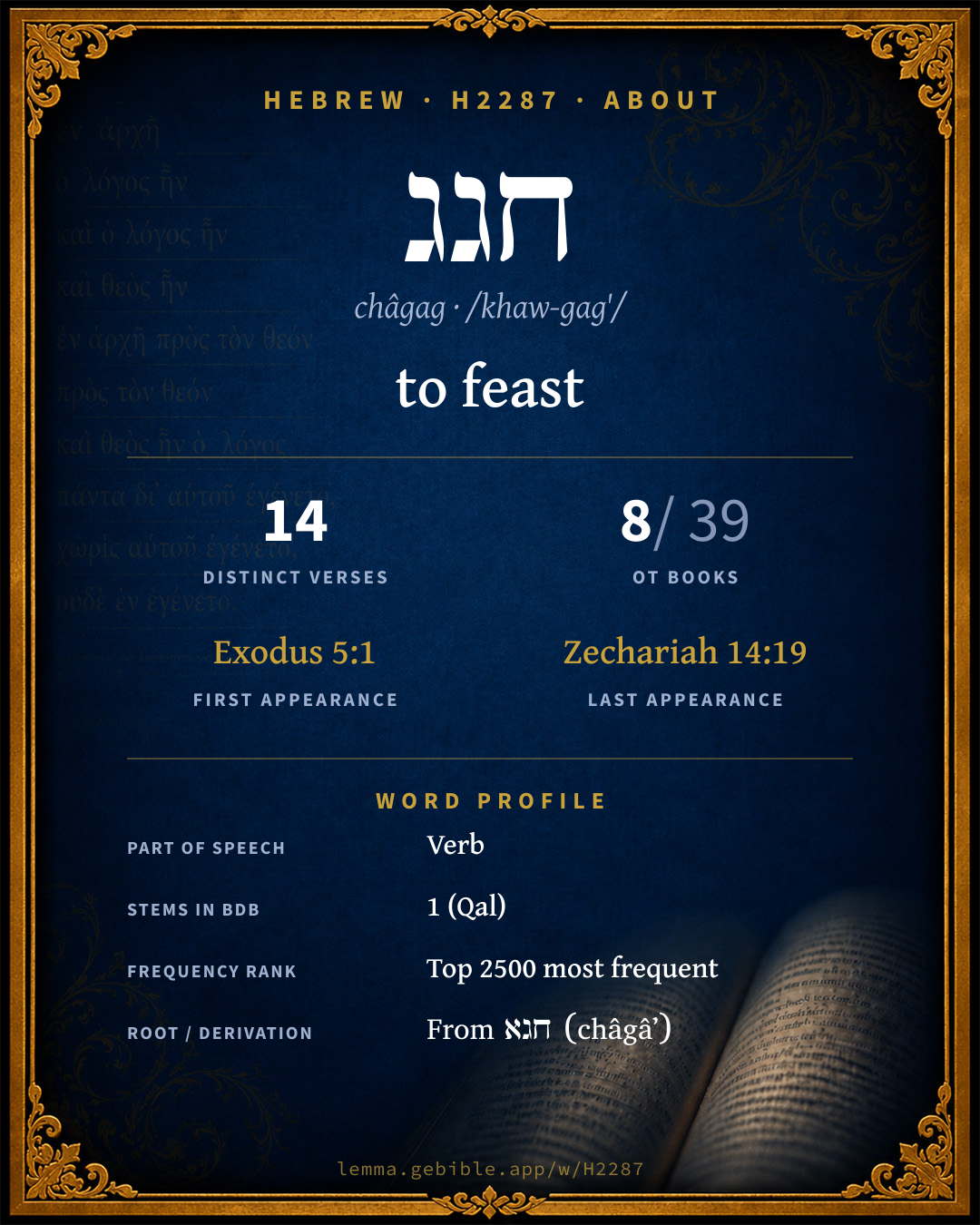
חָגַג
to feast
‘to feast’ is one of 3 main senses fuller range ↓
Full lexicon entry — Brown-Driver-Briggs (BDB)
From Brown-Driver-Briggs (BDB)
Where this word appears
Grammar key — what these labels mean
Part of speech
- Verb
- An action or state-of-being word.
Stem
- Qal
- The basic, simple active stem — the plain form of the verb (“he wrote”). Here: ‘keep a pilgrim-feast’
Form
- Sequential Perfect
- A perfect with prefixed waw continuing a preceding imperfect or command (waw-consecutive perfect).
- Infinitive Construct
- A bound verbal noun, frequently with prepositions (“to write / in writing”).
- Imperfect
- An incomplete, ongoing, or future action (“he will / would write”).
- Participle Active
- A verbal adjective expressing ongoing or characteristic action (“writing / one who writes”).
- Imperative
- A direct command (“write!”).
State
- Absolute
- The independent form of a noun, not bound to a following word.
Person
- 2nd Person
- The one addressed (“you”).
- 3rd Person
- The one spoken about (“he / she / it / they”).
Gender
- Masculine
- Grammatically masculine.
- Feminine
- Grammatically feminine.
Number
- Plural
- More than one (in Hebrew, generally three or more).
- Singular
- One.
Grammatical forms
- Verb, Qal, Sequential Perfect, 2nd Person, Masculine, Plural 3 times (19%)
- Verb, Qal, Infinitive Construct 3 times (19%)
- Verb, Qal, Imperfect, 2nd Person, Masculine, Plural 3 times (19%)
- Verb, Qal, Imperfect, 2nd Person, Masculine, Singular 2 times (13%)
- Verb, Qal, Imperfect, 3rd Person, Masculine, Plural 2 times (13%)
- Verb, Qal, Participle Active, Masculine, Plural, Absolute 1 time (6%)
- Verb, Qal, Participle Active, Masculine, Singular, Absolute 1 time (6%)
- Verb, Qal, Imperative, 2nd Person, Feminine, Singular 1 time (6%)
Parsed forms decoded from the imported morphology (morphhb / Westminster Leningrad Codex — WLC text public domain, morphhb tagging CC BY 4.0), counted across 16 parsed occurrences — not distinct verses.
Every verse where H2287 appears — 14 distinct verses across 8 books. Click any verse to open its interlinear word-by-word view. Verse text shown in the World English Bible for context — . Each verse’s Hebrew form is shown with its reference; the English is not keyword-highlighted, since the data carries no word-level English alignment. Use “Compare translations” on any verse to read it across multiple English versions. This concordance covers the Hebrew Bible; Septuagint (Greek Old Testament) occurrences are not indexed here.
Exodus 3 verses
- Exodus 5:1 וְ/יָחֹ֥גּוּ conj + Qal impf 3mp Afterward Moses and Aaron came, and said to Pharaoh, "This is what Yahweh, the God of Israel, says, 'Let my people go, that they may hold a feast to me in the wilderness.'"
- Exodus 12:14 וְ/חַגֹּתֶ֥ם תְּחָגֻּֽ/הוּ conj + Qal wpf 2mp Qal impf 2mp + sfx pers 3ms This day shall be to you for a memorial, and you shall keep it a feast to Yahweh: throughout your generations you shall keep it a feast by an ordinance forever.
- Exodus 23:14 תָּחֹ֥ג Qal impf 2ms "You shall observe a feast to me three times a year.
Leviticus 2 verses
- Leviticus 23:39 תָּחֹ֥גּוּ Qal impf 2mp "'So on the fifteenth day of the seventh month, when you have gathered in the fruits of the land, you shall keep the feast of Yahweh seven days: on the first day shall be a solemn rest, and on the eighth day shall be a solemn rest.
- Leviticus 23:41 וְ/חַגֹּתֶ֤ם תָּחֹ֥גּוּ conj + Qal wpf 2mp Qal impf 2mp You shall keep it a feast to Yahweh seven days in the year: it is a statute forever throughout your generations; you shall keep it in the seventh month.
Numbers 1 verse
Deuteronomy 1 verse
1 Samuel 1 verse
Psalms 2 verses
- Psalms 42:4 חוֹגֵֽג Qal ptcp.act ms These things I remember, and pour out my soul within me, How I used to go with the crowd, and led them to the house of God, With the voice of joy and praise, a multitude keeping a holy day.
- Psalms 107:27 יָח֣וֹגּוּ Qal impf 3mp They reel back and forth, and stagger like a drunken man, And are at their wits' end.
Nahum 1 verse
Zechariah 3 verses
- Zechariah 14:16 וְ/לָ/חֹ֖ג conj + prep + Qal inf.cs It will happen that everyone who is left of all the nations that came against Jerusalem will go up from year to year to worship the King, Yahweh of Hosts, and to keep the feast of tents.
- Zechariah 14:18 לָ/חֹ֖ג prep + Qal inf.cs If the family of Egypt doesn't go up, and doesn't come, neither will it rain on them. This will be the plague with which Yahweh will strike the nations that don't go up to keep the feast of tents.
- Zechariah 14:19 לָ/חֹ֖ג prep + Qal inf.cs This will be the punishment of Egypt, and the punishment of all the nations that don't go up to keep the feast of tents.
About this entry
At a glance — auto-summarized from this page’s data, not written by a person. Every figure links to its source below. This summary describes the numbers; it doesn’t interpret them.
חגג (châgag) is a Hebrew verb most often rendered “to feast.” It first appears in Exodus 5:1. Spanning 14 verses in 8 books, it ranks among the uncommon words of the Hebrew Bible. It is not a single-sense word — see its full sense range. Related forms include חגא, חג and חוג. For the data behind this summary, explore the sense tree and the renderings breakdown below.
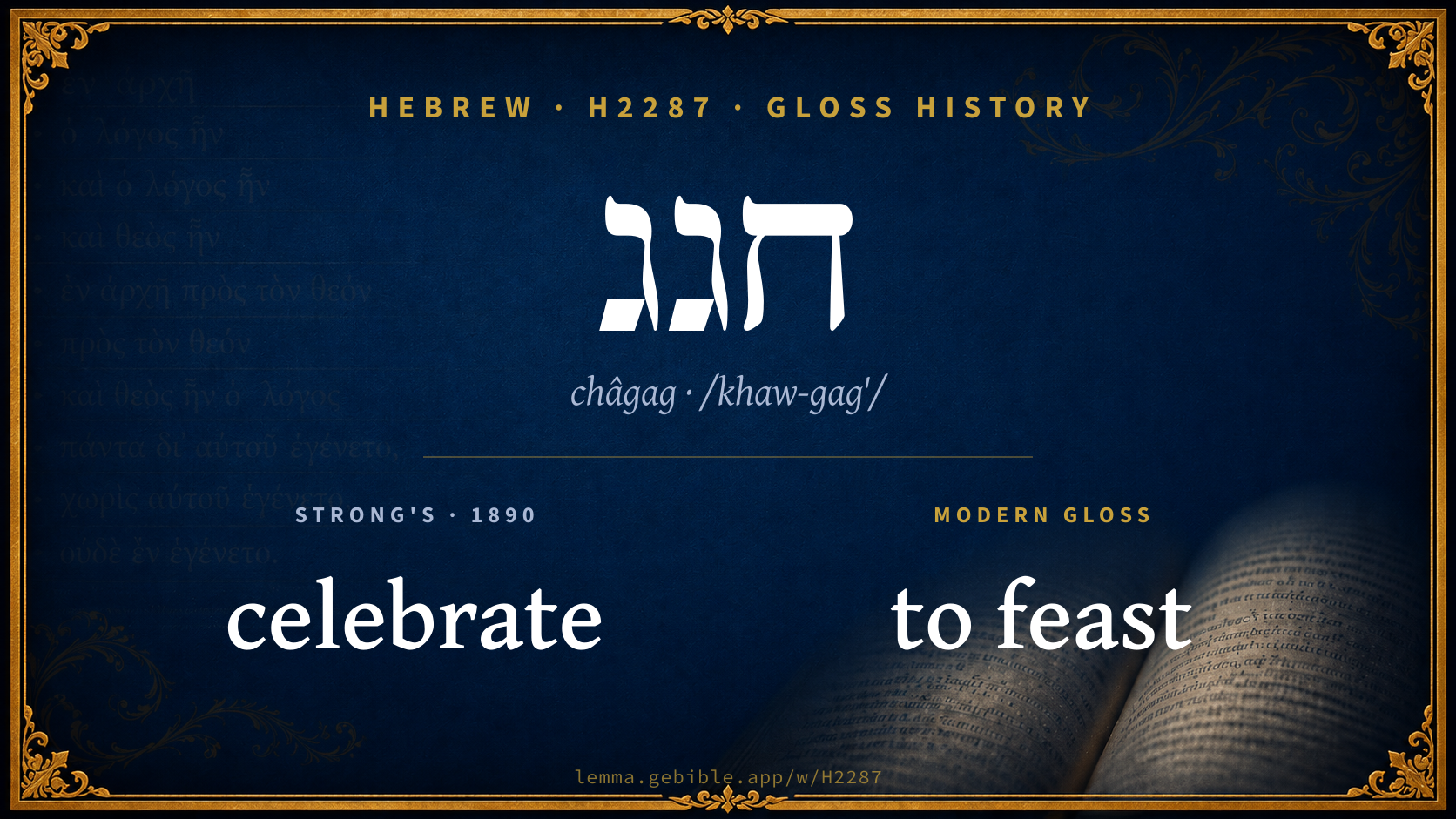
Gloss history
Strong's 1890 vs modern scholarship
About this word
Strong's H2287 catalogs a Hebrew word from the Hebrew Old Testament.
These counts are not copied from any lexicon or concordance. They are computed here, from the morphology-tagged Hebrew Old Testament. What Lemma adds →
- 14
- distinct verses
- The word appears in 14 distinct verses.
- 8 / 39
- OT books
- The word appears in 8 of 39 Old Testament books.
- #1,752
- by frequency
- Top 2500 most frequent Hebrew words (rank 1,752 of 8,640 Hebrew words by occurrence).
View all 14 occurrences in the concordance →
By section of the Old Testament
By traditional corpus
Conventional, traditional groupings — biblical authorship is debated, so this is a traditional corpus grouping, not an authorship claim. Each share is this word’s portion of its verses in that division of the Hebrew canon. Each figure is a share of the word’s 14 distinct verses.
- Torah (Pentateuch) 7 verses · 50%
- Prophets (Nevi'im) 5 verses · 36%
- Writings (Ketuvim) 2 verses · 14%
How translations render this word
Counts come from each version’s own published word-to-Strong’s tagging or interlinear alignment — an approximate guide to how each version renders this word, not a word-level alignment the data otherwise carries. Because each total is that version’s own tagged count, the per-version totals vary from one another and need not match the appearance or distinct-verse counts above. These counts may also differ from a printed concordance because Lemma counts each distinctly tagged rendering and does not collapse phrase taggings into a single head-word total. This is a fixed set of word-tagged versions (KJV, ASV, BSB, ULT) and does not change with the reading translation you choose elsewhere. Each version’s license is shown beside its name below (and on Sources).
- King James Version: Keep 4×, Ye shall keep 4×
- American Standard Version: Ye shall keep 5×, Keep 4×
- Berean Standard Bible: Celebrate 4×, You are to celebrate 4×
- unfoldingWord Literal Text: You shall celebrate 7×, Keep the 3×
King James Version Public Domain
Renders H2287 across 16 tagged occurrences — most commonly:
Plus 8 renderings that appear only once — usually multi-word phrases or single function words the recovered tagging swept in, not distinct renderings.
American Standard Version Public Domain
Renders H2287 across 16 tagged occurrences — most commonly:
Plus 7 renderings that appear only once — usually multi-word phrases or single function words the recovered tagging swept in, not distinct renderings.
Berean Standard Bible Public Domain
Renders H2287 across 15 tagged occurrences — most commonly:
Plus 7 renderings that appear only once — usually multi-word phrases or single function words the recovered tagging swept in, not distinct renderings. Not rendered by a distinct English word in 1 further occurrence.
unfoldingWord Literal Text CC BY-SA 4.0
Renders H2287 across 16 tagged occurrences — most commonly:
Plus 6 renderings that appear only once — usually multi-word phrases or single function words the recovered tagging swept in, not distinct renderings.
Senses in the full BDB
What do BDB’s symbols mean?
BDB uses these scholarly abbreviations:
| Symbol | Meaning |
|---|---|
| 𝔊 | the Septuagint (the ancient Greek translation, LXX) |
| 𝔙 | the Vulgate (the Latin translation) |
| 𝔖 | the Syriac version (the Peshitta) |
| 𝔗 | the Targum (the Aramaic translation) |
| ψ | the Psalms |
| √ | root (the underlying root or stem) |
| ‖ | parallel passage (a synonymous or contrasted parallel) |
| † | the dagger: every passage where the word occurs is cited |
The 4 senses and sub-senses the full Brown-Driver-Briggs lexicon distinguishes for this word, in lexicon order (not ranked by frequency), with BDB’s own verbatim wording and sub-sense lettering. Shown in Hebrew script with BDB’s own scholarly abbreviations. The condensed entry is in the Lexicon Entry tab. See also the Forms in the corpus table below.
Qal
- Pf. 2 mpl. חַגֹּתֶם Ex 12:14 + 2 times; Impf. 2 ms. תָּחֹג Ex 23:14 Dt 16:15; 3 mpl. יָח֫וֹגּוּ ψ 107:27 (Bö§ 1118 (2)); וְיָחֹ֫גּוּ Ex 5:1; 2 mpl. תָּחֹ֫גּוּ Lv 23:39, 41; sf. תְּהָגֻּ֫הוּ Ex 12:14; Imv. f. חָגִּי Na 2:1; Inf. cstr. חֹג Zc 14:18 + 2 times; Pt. חוֹגֵג ψ 42:5; pl. חֹגֲגִים 1 S 30:16;— e.g. Exodus 12:14
- 1. keep a pilgrim-feast, abs. Ex 5:1 (JE) of one proposed by Moses; שׁלשׁ רגלים תחג לי three times shalt thou make pilgrimage unto me (in the year) Ex 23:14 (covt. code); of pilgrim-feasts in general Na 2:1, the Passover Ex 12:14 (P); elsewhere feast of Booths; all celebrated in part by sacred processions and dances; המון חוגג ψ 42:5 multitude keeping festival (led by the Psalmist in procession); חגג חג Lv 23:39 (H), Nu 29:12 (P), Na 2:1 Zc 14:16, 18, 19; חגג אתו חג Ex 12:14 (P), Lv 23:41 (H); אתוֹ Lv 23:41 (H); sf. Ex 12:14 (P). e.g. Exodus 5:1
- 2. behave as at a חָג 1 S 30:16 (of the Amalekites when surprised by David i.e. enjoying themselves merrily, Dr; others, circling in the sacred dance). e.g. 1 Samuel 30:16
- 3. reel, in giddiness on the sea ψ 107:27 (cf. חָגָּא Is 19:17); this either points to an earlier meaning of √; or better, the ψ being late, means reel as from festival excesses (‖ וְיָנוּעוּ כַשִּׁכּוֹר). e.g. Psalms 107:27
Senses from the full Brown-Driver-Briggs lexicon (Brown, Driver, Briggs; Oxford 1906 — public domain), digitized via Sefaria, supplemented by the OpenScriptures HebrewLexicon (CC BY 4.0). Full attribution on Sources.
Word origin
vb. make pilgrimage, keep a pilgrim-feast (Arabic حَجَّ betake oneself to or towards an object of reverence; make a pilgrimage to Mecca; Sab. חגג make pilgrimage Sab. Denkm86, cf. 85; Syriac ܚܰܓܺܝ celebrate a feast. In Palm. חגגו is n.pr. VogNo. 61; cf. also Ph. n.pr. חגי, חגת);—
— Brown-Driver-Briggs (Oxford 1906, public domain), digitized via Sefaria, supplemented by the OpenScriptures HebrewLexicon (CC BY 4.0). See Sources.
Derived from חגא (châgâʼ) (H2283) — terror.
Jastrow Dictionary
A second Hebrew/Aramaic lexicon for comparison, covering Aramaic and post-biblical (Talmudic, Targumic, Midrashic) usage that the biblical-Hebrew BDB does not. Matched by lemma rather than by Strong’s number, so a lemma may carry more than one Jastrow headword (shown separately below), and the entries cover usage well beyond the Bible.
חָגַג
- [to turn,] (denom. of חַג) to celebrate an anniversary, to observe a festival, to make a periodical pilgrimage. Num. R. s. 20 אומה החוֹגֶגֶת וכ׳ a nation that celebrates three pilgrims’ festivals.—Esp. to offer the pilgrim’s festive sacrifice (חֲגִיגָה). Ḥag. I, 6 מי שלא חַג … חוֹגֵג וכ׳ he who failed to offer on the first day …, may do so during the entire festive season. Pes. 70ᵇ חֲגַגְתֶּם חגיגה you have offered &c.; a. fr.
חֲגַג
- 1. to turn, draw a circle. Targ. Prov. VIII, 27 (Ms. חֲגַל).
- 2. to celebrate a festival; to feast. Targ. O. Deut. XVI, 15 תֵּיחוֹג (Y. תְּחַגּוּן). Targ. I Sam. XXX, 16.—Ḥag. 10ᵇ חוֹגוּ חגא, v. חַגָּא I.
A Dictionary of the Targumim, the Talmud Babli and Yerushalmi, and the Midrashic Literature (Marcus Jastrow; London, Luzac, 1903) — Public Domain. Digitized via Sefaria. Digitized via Sefaria. Full attribution on Sources.
Forms in the corpus
The 13 distinct written forms H2287 takes in the Hebrew Bible, most frequent first — each parse links to that stem’s occurrences in the concordance. Hebrew forms include their vowel points and cantillation, so a single lemma takes many written forms.
| Form | Parsing | Example | Uses |
|---|---|---|---|
| וְ/חַגֹּתֶ֥ם | Verb, Qal, Sequential Perfect, 2nd Person, Masculine, Plural | Exodus 12:14 | 2 |
| לָ/חֹ֖ג | Verb, Qal, Infinitive Construct | Zechariah 14:18 | 2 |
| תָּחֹ֥גּוּ | Verb, Qal, Imperfect, 2nd Person, Masculine, Plural | Leviticus 23:39 | 2 |
| וְ/חַגֹּתֶ֤ם | Verb, Qal, Sequential Perfect, 2nd Person, Masculine, Plural | Leviticus 23:41 | 1 |
| וְ/חֹ֣גְגִ֔ים | Verb, Qal, Participle Active, Masculine, Plural, Absolute | 1 Samuel 30:16 | 1 |
| וְ/יָחֹ֥גּוּ | Verb, Qal, Imperfect, 3rd Person, Masculine, Plural | Exodus 5:1 | 1 |
| וְ/לָ/חֹ֖ג | Verb, Qal, Infinitive Construct | Zechariah 14:16 | 1 |
| חָגִּ֧י | Verb, Qal, Imperative, 2nd Person, Feminine, Singular | Nahum 1:15 | 1 |
| חוֹגֵֽג | Verb, Qal, Participle Active, Masculine, Singular, Absolute | Psalms 42:4 | 1 |
| יָח֣וֹגּוּ | Verb, Qal, Imperfect, 3rd Person, Masculine, Plural | Psalms 107:27 | 1 |
| תְּחָגֻּֽ/הוּ | Verb, Qal, Imperfect, 2nd Person, Masculine, Plural | Exodus 12:14 | 1 |
| תָּחֹ֥ג | Verb, Qal, Imperfect, 2nd Person, Masculine, Singular | Exodus 23:14 | 1 |
| תָּחֹג֙ | Verb, Qal, Imperfect, 2nd Person, Masculine, Singular | Deuteronomy 16:15 | 1 |
Same root — word family
Other BDB entries built from the same root as H2287, grouped by Strong’s listed origin. These share a root / origin per the lexicon — not necessarily a shared meaning. Each links to that word’s own entry.
Derives from
Derived from this word
Proper names from this root
People and places named from this root — a name, not an additional meaning of the word.
Compare all same-root words → Showing 4 of 5 — not the complete family. 1 of the same-root words is a proper name (a person or place). They share a root, not necessarily a meaning.
Septuagint verse parallels
This word appears in 12 verses that also exist in the Greek Old Testament (Septuagint), out of the 14 Hebrew verses it occurs in. You can read those verses in Greek by switching the Old Testament edition to the Septuagint.
Read these verses in the Septuagint
- Exodus 5:1
- Leviticus 23:39
- Numbers 29:12
- Deuteronomy 16:15
- 1 Samuel 30:16
- Psalms 42:4
- Zechariah 14:16
This is a verse-level parallel only — the same verses exist in both the Hebrew and Greek Old Testaments. No word-level Hebrew↔Greek correspondence is claimed: the data carries no such alignment, so no Greek word is shown as this Hebrew word’s translation. Coverage is not total — the Septuagint omits the deuterocanon and renumbers the Psalms, so some Hebrew verses have no direct Greek parallel.