
Amos 8:10

Hebrew (Westminster Leningrad Codex) Amos 8:10 appears in the Hebrew Old Testament. The text above is from the Westminster Leningrad Codex. Each word links to its Strong’s number, a concise gloss, and parsing drawn from the Open Scriptures Hebrew Bible morphology. Click any word for its full Brown-Driver-Briggs (BDB) entry.
Download image
Cite this verse

Amos 8:10 (World English Bible). Public Domain. Lemma interlinear Bible study tool, https://lemma.gebible.app/v/amos/8/10.

Show BibTeX & RIS
BibTeX
RIS
English Translation
I will turn your feasts into mourning, And all your songs into lamentation; And I will make you wear sackcloth on all your bodies, And baldness on every head. I will make it like the mourning for an only son, And the end of it like a bitter day.
World English Bible · Public Domain
Download a study sheet

One document with this verse’s original text, its word-by-word gloss line, the meaning frame, cross-references with their text, attributed commentary, and full source and license credits — printable, and it pastes into notes with its structure intact.

This verse Autodidact and up

Study sheet (.html) Plain text (.txt)

A passage Seminary Student

Up to 50 verses in one chapter. A passage sheet keeps up to 6 commentary sources and 12 cross-references per verse, in the order this page ranks them, and says so on the sheet whenever that leaves anything out. Ask for a single verse and you get the Autodidact verse sheet above.

Everything on this page stays free to read, with no account — the sheet is a download of what is already on screen, not access to it.

Want to remove ads? Support Godless Engineer
Compare translations 3

The same verse in 3 English versions, stacked beneath the original-language interlinear above. Click any original word for its lexicon entry.

Each is an independent rendering of the whole verse — the interlinear is not word-aligned to these translations.

Highlighted words mark where these versions differ — a whole-verse word diff, not a word-by-word alignment.

  • World English Bible Public Domain
    I will turn your feasts into mourning, And all your songs into lamentation; And I will make you wear sackcloth on all your bodies, And baldness on every head. I will make it like the mourning for an only son, And the end of it like a bitter day.
  • King James Version Public Domain
    And I will turn your feasts into mourning, and all your songs into lamentation; and I will bring up sackcloth upon all loins, and baldness upon every head; and I will make it as the mourning of an only son, and the end thereof as a bitter day.
  • unfoldingWord Literal Text CC BY-SA 4.0
    I will turn your festivals into mourning and all your songs into lamentation. I will make all of you wear sackcloth and have baldness on every head. I will make it like mourning for an only son, and a bitter day to its end.

unfoldingWord Literal Text — © unfoldingWord, licensed CC BY-SA 4.0. Word-aligned USFM3 via Door43 (git.door43.org/unfoldingWord/en_ult).

Versions to compare (up to 4)

3 of 4 selected

Show all 18 translations

Every available English version of this verse, each an independent rendering of the whole verse.

  • World English Bible Public Domain
    I will turn your feasts into mourning, And all your songs into lamentation; And I will make you wear sackcloth on all your bodies, And baldness on every head. I will make it like the mourning for an only son, And the end of it like a bitter day.
  • Berean Standard Bible Public Domain
    I will turn your feasts into mourning and all your songs into lamentation. I will cause everyone to wear sackcloth and every head to be shaved. I will make it like a time of mourning for an only son, and its outcome like a bitter day.
  • Majority Standard Bible Public Domain
    I will turn your feasts into mourning and all your songs into lamentation. I will cause everyone to wear sackcloth and every head to be shaved. I will make it like a time of mourning for an only son, and its outcome like a bitter day.
  • King James Version Public Domain
    And I will turn your feasts into mourning, and all your songs into lamentation; and I will bring up sackcloth upon all loins, and baldness upon every head; and I will make it as the mourning of an only son, and the end thereof as a bitter day.
  • American Standard Version (1901) Public Domain
    And I will turn your feasts into mourning, and all your songs into lamentation; and I will bring sackcloth upon all loins, and baldness upon every head; and I will make it as the mourning for an only son, and the end thereof as a bitter day.
  • Revised Version (1885) Public Domain
    And I will turn your feasts into mourning, and all your songs into lamentation; and I will bring up sackcloth upon all loins, and baldness upon every head; and I will make it as the mourning for an only son, and the end thereof as a bitter day.
  • Geneva Bible (1599) Public Domain
    And I will turne your feastes into mourning, and all your songs into lamentation: and I will bring sackcloth vpon all loynes, and baldnes vpon euery head: and I will make it as the mourning of an onely sonne, and the ende thereof as a bitter day.
  • Douay-Rheims (1899) Public Domain
    And I will turn your feasts into mourning, and all your songs into lamentation: and I will bring up sackcloth upon every back of yours, and baldness upon every head: and I will make it as the mourning of an only son, and the latter end thereof as a bitter day.
  • Young's Literal Translation Public Domain
    And have turned your festivals to mourning, And all your songs to lamentation, And caused sackcloth to come up on all loins, And on every head -- baldness, And made it as a mourning `of' an only one, And its latter end as a day of bitterness.
  • Literal Standard Version CC BY-SA 4.0
    And have turned your festivals to mourning, || And all your songs to lamentation, || And caused sackcloth to come up on all loins, || And on every head—baldness, || And made it as a mourning of an only one, || And its latter end as a day of bitterness.
  • Unlocked Literal Bible CC BY-SA 4.0
    I will turn your festivals into mourning and all your songs into lamentation. I will make all of you wear sackcloth and have baldness on every head. I will make it like mourning for an only son, and a bitter day to its end.
  • unfoldingWord Literal Text CC BY-SA 4.0
    I will turn your festivals into mourning and all your songs into lamentation. I will make all of you wear sackcloth and have baldness on every head. I will make it like mourning for an only son, and a bitter day to its end.
  • Darby Bible Public Domain
    And I will turn your feasts into mourning, and all your songs into lamentation; and I will bring up sackcloth upon all loins, and baldness upon every head; and I will make it as the mourning for an only [son], and the end thereof as a bitter day.
  • World Messianic Bible Public Domain
    I will turn your feasts into mourning, and all your songs into lamentation; and I will make you wear sackcloth on all your bodies, and baldness on every head. I will make it like the mourning for an only son, and its end like a bitter day.
  • Webster's Bible Public Domain
    And I will turn your feasts into mourning, and all your songs into lamentation; and I will bring up sackcloth upon all loins, and baldness upon every head; and I will make it as the mourning of an only son, and the end of it as a bitter day.
  • Free Bible Version CC BY-SA 4.0
    I will turn your festivals into times of mourning, your happy songs into laments. I will make you wear sackcloth and shave your heads. I will make your mourning like that for an only son. At the end of it all it will be a bitter day.
  • Bible in Basic English Public Domain
    Your feasts will be turned into sorrow and all your melody into songs of grief; everyone will be clothed with haircloth, and the hair of every head will be cut; I will make the weeping like that for an only son, and the end of it like a bitter day.
  • JPS Tanakh (1917) Public Domain
    And I will turn your feasts into mourning, and all your songs into lamentation; and I will bring up sackcloth upon all loins, and baldness upon every head; and I will make it as the mourning for an only son, and the end thereof as a bitter day.

Literal Standard Version (2020), Covenant Press — licensed CC BY-SA 4.0. Text via the HelloAO Bible API (eBible.org). Unlocked Literal Bible (unfoldingWord) — licensed CC BY-SA 4.0. Text via the HelloAO Bible API (eBible.org). unfoldingWord Literal Text — © unfoldingWord, licensed CC BY-SA 4.0. Word-aligned USFM3 via Door43 (git.door43.org/unfoldingWord/en_ult). Free Bible Version, Dr. Jonathan Gallagher — licensed CC BY-SA 4.0. Text via the HelloAO Bible API (eBible.org).

Word by word

More ways to search: Search by grammar → Find every occurrence → Compare this word →

Practice this passage: Drill this verse → Learn its vocabulary →

קָרְחָ֑ה
qorchâh
H7144
“baldness”
Noun, Common, Feminine, Singular, Absolute
Part of Speech
Noun
Type
Common
Gender
Feminine
Number
Singular
State
Absolute
Full BDB Definition

Origin: from H7139

TWOT: 2069b

baldness, bald
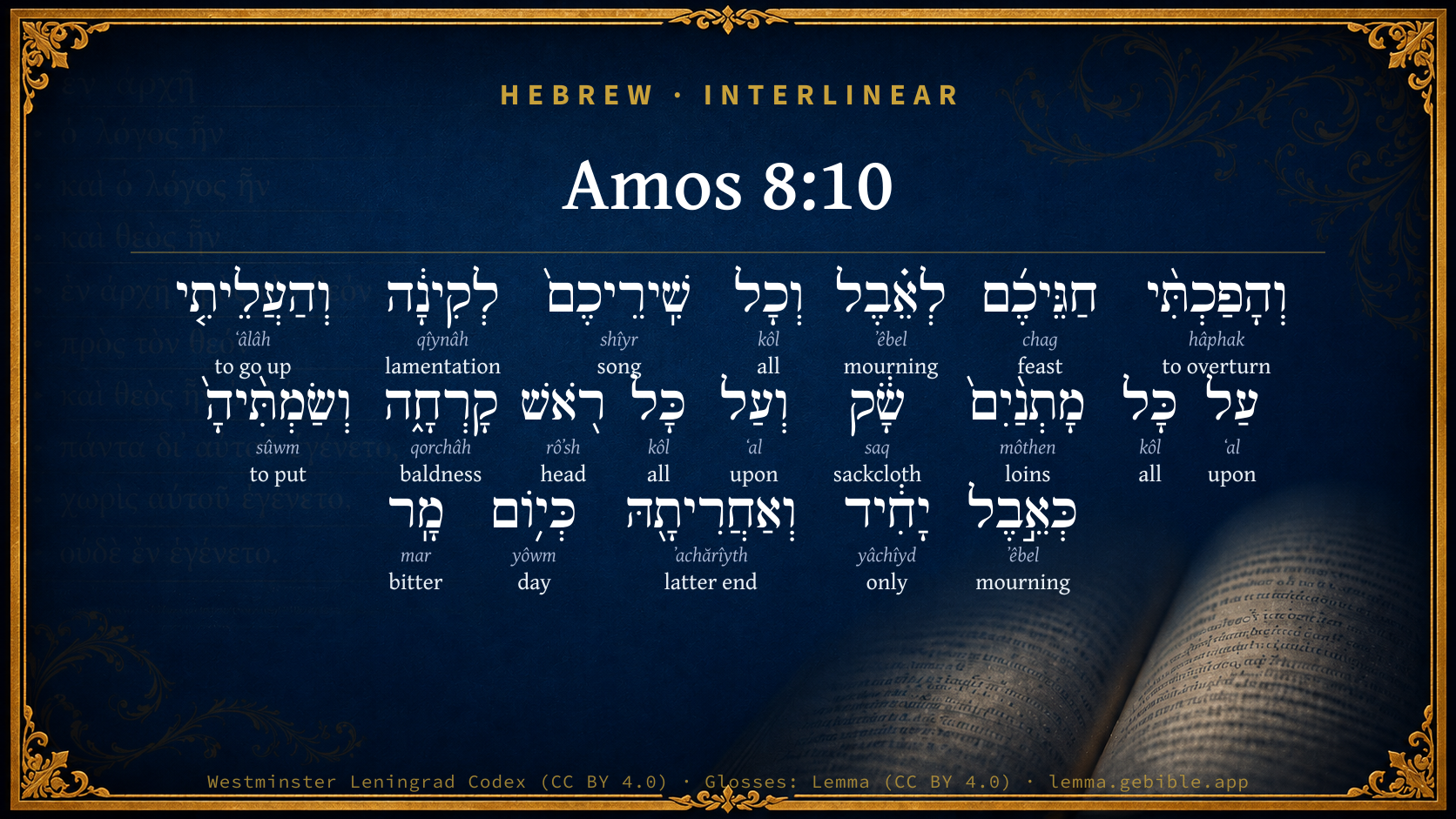
  1. וְהָפַכְתִּ֨י hâphak H2015 “and · to overturn” Conjunction + Verb, Qal, Sequential Perfect, 1st Person, Common, Singular
  2. חַגֵּיכֶ֜ם chag H2282 “feasts · your” Noun, Common, Masculine, Plural, Construct + Suffix, Personal, 2nd Person, Masculine, Plural
  3. לְאֵ֗בֶל ʼêbel H60 “to/for · mourning” Preposition + Noun, Common, Masculine, Singular, Absolute
  4. וְכָל kôl H3605 “and · all of” Conjunction + Noun, Common, Masculine, Singular, Construct
  5. שִֽׁירֵיכֶם֙ shîyr H7892 “songs · your” Noun, Common, Both, Plural, Construct + Suffix, Personal, 2nd Person, Masculine, Plural
  6. לְקִינָ֔ה qîynâh H7015 “to/for · lamentation” Preposition + Noun, Common, Feminine, Singular, Absolute
  7. וְהַעֲלֵיתִ֤י ʻâlâh H5927 “and · to go up” Conjunction + Verb, Hiphil, Sequential Perfect, 1st Person, Common, Singular
  8. עַל ʻal H5921 “upon” Preposition
  9. כָּל kôl H3605 “all of” Noun, Common, Masculine, Singular, Construct
  10. מָתְנַ֨יִם֙ môthen H4975 “loins” Noun, Common, Masculine, Dual, Absolute
  11. שָׂ֔ק saq H8242 “sackcloth” Noun, Common, Masculine, Singular, Absolute
  12. וְעַל ʻal H5921 “and · upon” Conjunction + Preposition
  13. כָּל kôl H3605 “all of” Noun, Common, Masculine, Singular, Construct
  14. רֹ֖אשׁ rôʼsh H7218 “head” Noun, Common, Masculine, Singular, Absolute
  15. וְשַׂמְתִּ֨יהָ֙ sûwm H7760 “and · to put · her” Conjunction + Verb, Qal, Sequential Perfect, 1st Person, Common, Singular + Suffix, Personal, 3rd Person, Feminine, Singular
  16. כְּאֵ֣בֶל ʼêbel H60 “like/as · mourning” Preposition + Noun, Common, Masculine, Singular, Absolute
  17. יָחִ֔יד yâchîyd H3173 “only” Adjective, Adjective, Masculine, Singular, Absolute
  18. וְאַחֲרִיתָ֖הּ ʼachărîyth H319 “and · latter end · her” Conjunction + Noun, Common, Feminine, Singular, Construct + Suffix, Personal, 3rd Person, Feminine, Singular
  19. כְּי֥וֹם yôwm H3117 “like/as · day” Preposition + Noun, Common, Masculine, Singular, Absolute
  20. מָֽר mar H4751 “bitter” Adjective, Adjective, Masculine, Singular, Absolute

About this verse

These counts appear in no published source. They are computed here, from the morphology-tagged text and Lemma’s own curated glosses. What Lemma adds →

21
words
17
distinct lemmas
Prophets
section

Notable vocabulary

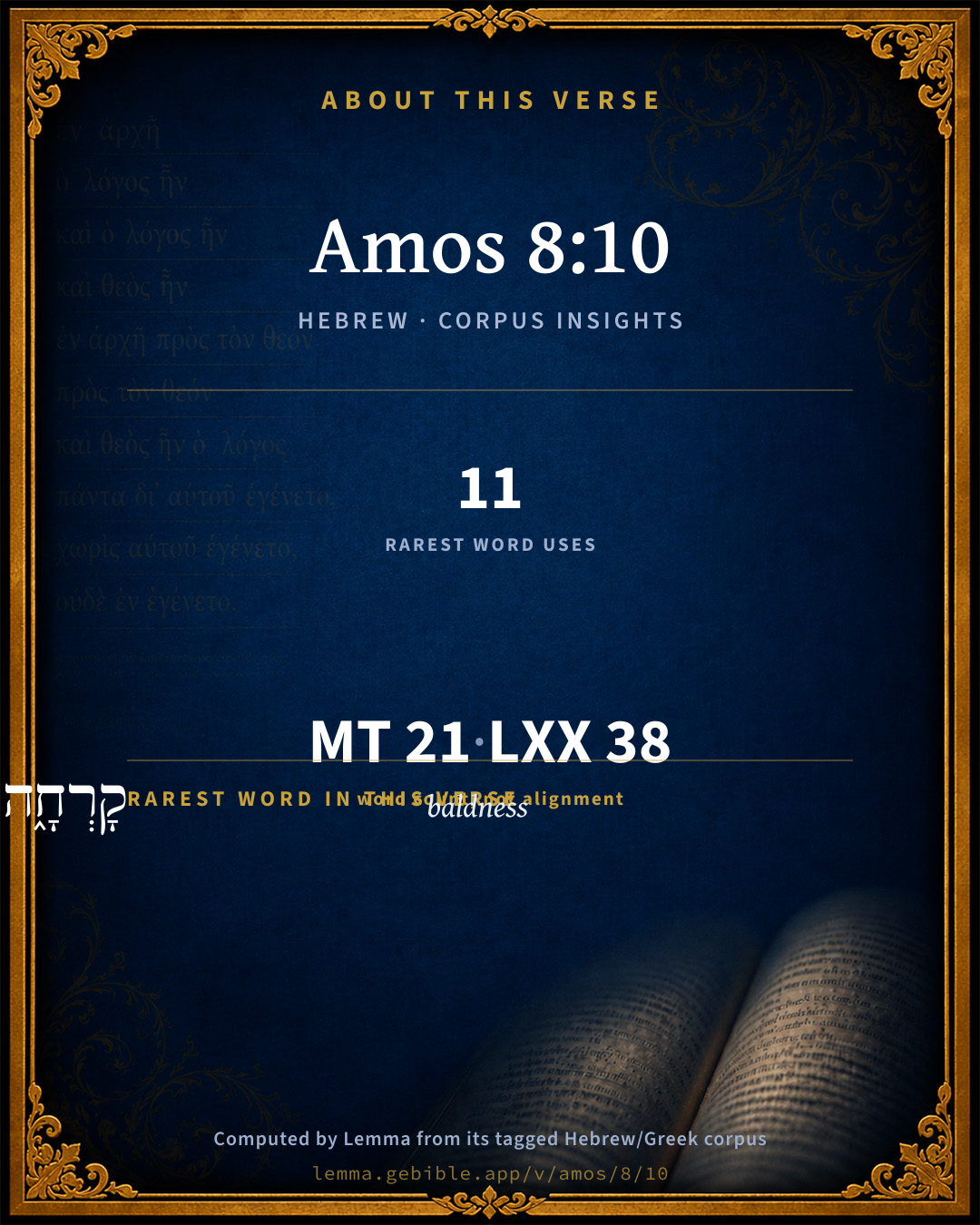
The rarest word here is קָרְחָ֑ה baldness H7144 — appearing just 11 times in the whole Hebrew Bible.

Shared distinctive vocabulary

קָרְחָ֑ה baldness H7144 occurs in 11 verses of the Hebrew Bible. Also found in:

Grammatical profile

  • 3 verbs
  • 14 nouns
  • 2 adjectives
  • 2 prepositions

Verb forms

  • וְהָפַכְתִּ֨י Qal · Sequential Perfect
  • וְהַעֲלֵיתִ֤י Hiphil · Sequential Perfect
  • וְשַׂמְתִּ֨יהָ֙ Qal · Sequential Perfect

Repetition

Words recur within this verse — often emphatic in Hebrew:

  • וְכָל all H3605 ×3
  • לְאֵ֗בֶל mourning H60 ×2
  • עַל upon H5921 ×2

Hebrew & Septuagint length

In English translation the verse runs 49 words from the Hebrew and 49 from the Septuagint (LXX English) — the same length.

A rough comparison of the two English renderings, which tokenize alike — not a word-level alignment.

Word counts can differ between the Hebrew and the Greek without any difference in meaning — e.g. the Hebrew direct-object marker אֵת has no separate Greek word, and Greek often adds the article ὁ.

In the original languages it is 21 Hebrew tokens and 38 Greek tokens — but the two are counted differently (Hebrew bundles its prefixes and suffixes into one token; the Greek is in lemma form), so that isn’t a like-for-like length.

Cross-references

20

Topical passages linked to Amos 8:10 in the Treasury of Scripture Knowledge — connected by theme and wording, ordered by reader-vote popularity; previews shown in the World English Bible.

  • Jeremiah 6:26 Daughter of my people, gird you with sackcloth, and wallow yourself in ashes: make you mourning, as for an only son, most bitter lamentation; for the destroyer shall suddenly come on us.
  • Zechariah 12:10 I will pour on the house of David, and on the inhabitants of Jerusalem, the spirit of grace and of supplication; and they will look to me whom they have pierced; and they shall mourn for him, as one mourns for his only son, and will grieve bitterly for him, as one grieves for his firstborn.
  • Job 20:23 When he is about to fill his belly, God will cast the fierceness of his wrath on him. It will rain on him while he is eating.
  • Jeremiah 48:37 For every head is bald, and every beard clipped: on all the hands are cuttings, and on the loins sackcloth.
  • Ezekiel 7:18 They shall also gird themselves with sackcloth, and horror shall cover them; and shame shall be on all faces, and baldness on all their heads.
  • Isaiah 15:2–3 They are gone up to Bayith, and to Dibon, to the high places, to weep: Moab wails over Nebo, and over Medeba; on all their heads is baldness, every beard is cut off.
  • Hosea 2:11 I will also cause all her celebrations to cease: Her feasts, her new moons, her Sabbaths, and all her solemn assemblies.
  • Luke 7:12–13 Now when he drew near to the gate of the city, behold, one who was dead was carried out, the only son of his mother, and she was a widow. Many people of the city were with her.
  • Deuteronomy 16:14 and you shall rejoice in your feast, you, and your son, and your daughter, and your man-servant, and your maid-servant, and the Levite, and the foreigner, and the fatherless, and the widow, who are within your gates.
  • 1 Samuel 25:36–38 Abigail came to Nabal; and, behold, he held a feast in his house, like the feast of a king; and Nabal's heart was merry within him, for he was very drunken: therefore she told him nothing, less or more, until the morning light.
  • 2 Samuel 13:28–31 Absalom commanded his servants, saying, Mark you now, when Amnon's heart is merry with wine; and when I tell you, Smite Amnon, then kill him; don't be afraid; haven't I commanded you? be courageous, and be valiant.
  • Job 3:5 Let darkness and the shadow of death claim it for their own. Let a cloud dwell on it. Let all that makes black the day terrify it.
  • Isaiah 21:3–4 Therefore are my loins filled with anguish; pangs have taken hold on me, as the pangs of a woman in travail: I am pained so that I can't hear; I am dismayed so that I can't see.
  • Isaiah 22:12–14 In that day did the Lord, Yahweh of Hosts, call to weeping, and to mourning, and to baldness, and to girding with sackcloth:
  • Ezekiel 27:30–31 and shall cause their voice to be heard over you, and shall cry bitterly, and shall cast up dust on their heads, they shall wallow themselves in the ashes:
  • Daniel 5:4–6 They drank wine, and praised the gods of gold, and of silver, of brass, of iron, of wood, and of stone.
  • Amos 5:23 Take away from me the noise of your songs! I will not listen to the music of your harps.
  • Amos 6:4–7 Who lie on beds of ivory, And stretch themselves on their couches, And eat the lambs out of the flock, And the calves out of the midst of the stall;
  • Amos 8:3 The songs of the temple will be wailings in that day," says the Lord Yahweh. "The dead bodies will be many. In every place they will throw them out with silence.
  • Nahum 1:10 For entangled like thorns, and drunken as with their drink, they are consumed utterly like dry stubble.

Cross-references courtesy of OpenBible.info (CC BY 4.0).

Hebrew and Greek witnesses Masoretic Hebrew ↔ Greek Septuagint

The same verse in the two great witnesses to the Old Testament, shown verse-for-verse.

These are two independent witnesses, not word-aligned to each other, and the Septuagint is shown in lemma (dictionary) form.

Hebrew Amos 8:10 Masoretic · Westminster Leningrad Codex

וְהָפַכְתִּ֨י חַגֵּיכֶ֜ם לְאֵ֗בֶל וְכָל שִֽׁירֵיכֶם֙ לְקִינָ֔ה וְהַעֲלֵיתִ֤י עַל כָּל מָתְנַ֨יִם֙ שָׂ֔ק וְעַל כָּל רֹ֖אשׁ קָרְחָ֑ה וְשַׂמְתִּ֨יהָ֙ כְּאֵ֣בֶל יָחִ֔יד וְאַחֲרִיתָ֖הּ כְּי֥וֹם מָֽר

I will turn your feasts into mourning, And all your songs into lamentation; And I will make you wear sackcloth on all your bodies, And baldness on every head. I will make it like the mourning for an only son, And the end of it like a bitter day.

World English Bible · Public Domain

Greek LXX Amos 8:10 Septuagint · lemma form

καί μεταστρέφω ὁ ἑορτή σύ εἰς πένθος καί πᾶς ὁ ᾠδή σύ εἰς θρῆνος καί ἀναβιβάζω ἐπί πᾶς ὀσφύς σάκκος καί ἐπί πᾶς κεφαλή φαλάκρωμα καί τίθημι αὐτός ὡς πένθος ἀγαπητός καί ὁ μετά αὐτός ὡς ἡμέρα ὀδύνη

and I will turn your feasts into mourning, and all your songs into lamentation; and I will bring up sackcloth on all loins, and baldness on every head; and I will make them as the mourning of a beloved friend, and those with them as a day of grief.

LXX2012 (modern English Septuagint) · Public Domain

On this verse, The Pulpit Commentary discusses the Septuagint’s reading. Read the note in Commentary ↓

Hebrew: Westminster Leningrad Codex (CC BY 4.0). Greek: Septuagint (public domain); English from LXX2012 (modern English Septuagint) (Public Domain). How the Septuagint differs from the Hebrew →

Targum (Aramaic paraphrase)

1

The Targum is the ancient Jewish Aramaic paraphrase of the Hebrew Scriptures — an interpretive translation, not the Hebrew text itself. Onkelos (literal) and Pseudo-Jonathan (expansive) render the Torah, and Jonathan the Prophets. Coverage is partial: where no permissively-licensed English translation exists for a verse, only the Aramaic is shown. This is verse-level text, not a word-by-word alignment to the Hebrew.

  1. Targum Jonathan Prophets (Joshua–Malachi)
    וְאַהֲפֵיךְ חֲגֵיכוֹן לְאָבְלָא וְכָל תֻּשְׁבַּחְתְּכוֹן לְאִלְיָא וְאֶסַק עַל כָּל חַרְצִין סַק וְעַל כָּל רֵישׁ מְרַט וְאַשְׁוִינָהּ כְּאֵבֶל יָחִיד וְסוֹפָהּ כְּיוֹם מְרִיר:

    (no public-domain English translation for this verse)

    Targum Jonathan — Aramaic: “Mikraot Gedolot” (public domain). English: “Sefaria Community Translation” (CC0 1.0 (public-domain dedication)); “London "Chaldee Paraphrase," 1871” (public domain). Text via Sefaria.

Commentary

Notes on Amos 8:10 from classic Christian and Jewish commentators (each source and its license shown beneath its notes). The classic Christian expositions comment on the surrounding passage and are grouped to its opening verse, so a note may address several verses; the Jewish commentaries on the Tanakh (Rashi and others) are per-verse, so they appear only where the commentator wrote on this verse.

Lemma curates 59 commentaries, every one of them public domain or Creative Commons licensed, each selected and text-cleaned for this edition rather than reprinted as found. About our sources →

Trapp's Complete Commentary

John Trapp

Amo 8:10 And I will turn your feasts into mourning, and all your songs into lamentation; and I will bring up sackcloth upon all loins, and baldness upon every head; and I will make it as the mourning of an only [son], and the end thereof as a bitter day.

Ver. 10. And I will turn your feasts into mourning] Whether your idolatrous feasts and templemusic, whereby you vainly conceit to be secured from danger, saying, "Is not the Lord among us? what evil can come unto us?" or your common feasts, whereat you have songs to cheer you up, and so to put sorrow from your hearts and evil from your flesh, nourishing yourselves as in a day of slaughter or good cheer, Jas 5:5; all shall be turned into mourning, funeral mourning, see Amo 8:3.

And I will bring up sackcloth upon all loins] For a token of your great grief, as the custom then was, and is still for mourning weeds. The Hebrew word sack is the same in almost all languages; which showeth that the Hebrew is the mother of all the rest, saith Mercer.

And baldness upon every head] You shall pull off your hair for grief; or, because they had learned of the heathens, their neighbours, in token of lamentation, to shave their heads, Eze 7:18 Jer 48:37, and beards too, Isa 15:2, which yet was forbidden them to do, Lev 19:27; Lev 21:9, unless it were to show their sorrow for sin, Isa 22:12.

And I will make it as the mourning of an only son] Which was very bitter, Jer 6:26 Zec 12:10. The loss of a loving yoke fellow is more grievous than that of a son; but to father and mother together nothing more bitter than luctuosa faecunditas (Laeta’s case in Jerome), to bury many children, and especially to bury all in one.

And the end thereof as a bitter day] Thereof, that is, either of that land or of that lamentation there shall be bitterness in the end. So the poet (Tibul. lib. 2),

“ Nunc et amara dies, et noctis amarior umbra est;

Omnia iam tristi tempera felle madent. ”

How could it be otherwise than extreme bitter with this people, when heaven and earth conspired to punish them? neither had they the good word of God (called the word of his patience, Rev 3:10, written on purpose that we through patience and comfort of the Scriptures might have hope, Rom 15:4, that out of those breasts of consolation we might suck and be satisfied, Isa 66:11), to help them and keep from swooning, Psa 119:92. And this was the greatest plague of all the rest; and is therefore reserved to the last place, deterrima tanquam colophon, as a most sad catastrophe.

John Trapp, A Commentary or Exposition upon All the Books of the Old and New Testament (1647–1656) — public domain. Text from a community e-Sword module.

Joseph Benson's Commentary

Amo 8:10. I will turn your feasts into mourning — God commanded the Jews to celebrate their festivals with joy and gladness; but this it would be impossible for them to do under such melancholy circumstances and manifestations of the divine displeasure. And all your songs into lamentation — The particular psalms and hymns which used to be sung at the great festivals are here alluded to. And I will bring up sackcloth upon all loins — All sorts of persons shall put on mourning. And baldness upon every head — Shaving the head and beard was a sign of the greatest sadness. I will make it as the mourning, rather, as in the mourning of [or for] an only son — That is, a most heavy mourning; for the death of an only son generally occasions the severest grief; and the end thereof as a bitter day — A sorrowful day, which you shall wish you had never seen, shall succeed your dark night. In other words, the calamities shall increase more and more; so that the last part of these grievous times shall be far more distressing than any that had preceded. This undoubtedly was the case, as the carrying them into captivity would occasion a separation of friends from friends, children from parents, wives from husbands, than which it is not easy to conceive any thing more deplorable.

Joseph Benson's Commentary on the Old and New Testaments (1811–1818) — public domain. Text from a community e-Sword module.

Jamieson, Fausset & Brown

Robert Jamieson, A. R. Fausset & David Brown

baldness--a sign of mourning (Isa 15:2; Jer 48:37; Eze 7:18).

I will make it as . . . mourning of an only son--"it," that is, "the earth" (Amo 8:9). I will reduce the land to such a state that there shall be the same occasion for mourning as when parents mourn for an only son (Jer 6:26; Zac 12:10).

Jamieson, Fausset & Brown — Commentary Critical and Explanatory on the Whole Bible (1871) — public domain (CC PDM 1.0). Text via the HelloAO Bible API.

Adam Clarke's Commentary

Verse 10. I will turn your feasts into mourning] See on Am 8:3.

A bitter day.] A time of grievous calamity.

Adam Clarke's Commentary on the Bible (1810–1826) — public domain. Text from a community e-Sword/MySword module.

John Calvin's Commentaries

The Prophet pursues the same subject; but he omits the figurative mode which he had before adopted. He therefore denounces vengeance more openly, — that God would turn their festal-days into mourning, and their songs into lamentation. This was designedly mentioned; for the Israelites, we know, flattered themselves on account of their ceremonies by which at the same time they more and more provoked God’s displeasure: for the worship of God, which they pretended to perform, was mere superstition, and was therefore a profanation of true religion. Though then they thus brought on themselves God’s judgment by their wicked ceremonies, they yet thought that they were sufficiently disguised; for as Jeremiah says, ceremonies are to hypocrites the dens of robbers, (Jeremiah 7:10,11.) So here the Prophet speaks expressly of festal-days and of songs, — “Think ye that I am pacified on your feast-days, when ye offer sacrifices to me, or rather to idols under my name; and think ye that I am delighted with your songs? these things are so regarded by me, that they the more excite my wrath. Your festal-days then will I turn to mourning, and your songs to lamentation. At the same time, the Prophet threatens generally what we have before noticed, — that there would be mourning among the whole people for having too long abused the forbearance of God; I will then turn your joy into mourning. This is the sum of the whole. We have already shown why he names feast-days and songs, and that is, because they thought them to be expiations to turn aside God’s vengeance, when yet they were fans by which they kindled more and more the fire of his displeasure.

He afterwards adds, I will make to come up on all backs the sackcloth, and on every head baldness. These are various modes of speaking, which refer to the same thing: for they were wont to put on sackcloth and they were wont to shave their heads when in grief and mourning. The Prophet then means, that there would be extreme sorrow among the people, that having cast away all delights, they would be constrained to give up themselves entirely to weeping, lamentation, and grief. I will then make to come up on all loins the sackcloth, that is, I will make each one to put off all valuable and soft clothing and to put on sackcloth; and also to shave their heads, and even to tear off their hair, as they were wont to do. We indeed know that the orientals were more disposed to adopt external tokens of sorrow than we are. It was in truth the levity of that country that accounts for their playing the part of actors in mourning; and from this practice of mourning our Prophet borrowed his mode of speaking.

He afterwards subjoins, I will set her (he speaks of the Israelites under the name of land) in mourning as for an only begotten This similitude occurs also in another place, ‘They shall mourn as for an only-begotten,’ says Zechariah 12; so also in other places; so that there is no need of a long explanation. For when one has many children and one dies, he patiently bears his death; but when any one is bereaved of an only-begotten, there is no end nor moderation to his grief; for there is no comfort remaining. This is the reason why the Prophet says, that there would be grief, such as that which is felt for an only-begotten.

And he shows that these calamities would not be for a short time only, Her posterity, he says, shall be as in the day of bitterness For hypocrites drive away, or at least moderate, their fear of punishment by imagining that God will not be so severe and rigid but for a short time, — “O! it cannot be God will for long punish our sins; but it will be like mist which soon passes away.” Thus hypocrites felicitate themselves. Then the Prophet does not without reason subjoin this second clause, that their posterity shall be as in the day of bitterness. Hence when they shall think themselves freed from all evils, then new ones shall succeed, so that their posterity shall even doubly grieve; for they shall feel more bitterness than their fathers. It now follows —

John Calvin's Commentaries (1540-1563) — public domain. Text from the Calvin Translation Society English edition (1840s-50s) via the Christian Classics Ethereal Library (ccel.org). Calvin's coverage is partial (roughly two-thirds of the Bible); uncommented books and verses are honest gaps, never fabricated. The 19th-century editor's footnotes and remarks are omitted so the notes are faithfully Calvin's own voice.

Ellicott's Commentary for English Readers

(10, 11) The imagery is very vivid. The prophet threatens a famine of the word of Jehovah, and a parching thirst for the Water of Life, now no longer attainable. Such terrible destitution often supervenes on the neglect of the Word of God, the power to discern the ever-present Word being exhausted. Then comes the withdrawal of revelation, the silence of seers. One of the awful dooms of unbelief in the next world will be this famine, this hopeless thirst and fathomless suspense.

A Bible Commentary for English Readers, edited by Charles John Ellicott (1878–1897) — public domain. Text from a community e-Sword module.

The Cambridge Bible for Schools and Colleges

gen. ed. J. J. S. Perowne

10. The lamentation to be produced by such an alarming spectacle.

And I will turn your pilgrimages into mourning] The sacred pilgrimages (Amo_5:21) were occasions of rejoicing: cf. Isa_30:29; Hos_2:11 “And I will cause all her mirth to cease, her pilgrimages, her new moons, her sabbaths, and all her sacred seasons.” Comp. also Lam_5:15 “our dance is turned into mourning.”

into lamentation] into a dirge (Amo_5:1). Not unrestrained wailings, but a regularly constructed dirge (see on Amo_5:1), is what Amos pictures as taking the place of joyous songs.

bring up upon] Heb. cause to come up upon, the correlative of come up upon, said idiomatically of a garment (Lev_19:19; Eze_44:17).

sackcloth] i.e. rough, coarse hair-cloth, which was bound about the loins in times of mourning (2Sa_3:31; Jer_4:8; Jer_48:37 &c.).

baldness] Artificial baldness, produced by shaving off the hair on the forehead (Deu_14:1), was another sign of mourning, often alluded to by the prophets, as resorted to, both by the Israelites, and among other nations: see Isa_3:24; Isa_15:2 (in Moab), Isa_22:12 (where Jehovah “calls” to it in Jerusalem); Mic_1:16; Jer_47:5; Jer_48:37 (also in Moab); Eze_7:18 (“and on all your heads baldness”), Eze_27:31 (of Tyrian mariners). It is prohibited in Deu_14:1, on account (as it seems) of its heathen associations.

and I will make it] viz. the lamentation of Israel in that day.

of an only son] Cf. Jer_6:26; Zec_12:10 end.

and the end thereof as a bitter day] Most griefs at length wear themselves out: the end of this grief should be not an alleviation, but an aggravation of the distress; it should introduce, viz., a further stage in the threatened doom.

The Cambridge Bible for Schools and Colleges (gen. ed. J. J. S. Perowne; Cambridge University Press, 1878–1918) — public domain. Text from a community e-Sword module.

John Gill's Exposition

And I will turn your feasts into mourning, and all your songs into lamentation,.... Either their religious feasts, the feasts of pentecost, tabernacles, and passover; at which three feasts there were eclipses of the sun, a few years after this prophecy of Amos, as Bishop Usher (q) observes: the first was an eclipse of the sun about ten digits, in the year 3213 A.M. or 791 B.C., June twenty fourth, at the feast of pentecost; the next was almost twelve digits, about eleven years after, on November eighth, 780 B.C., at the feast of the tabernacles; and the third was more than eleven digits in the following year, 779 B.C., on May fifth, at the feast of the passover; which the prophecy may literally refer to, and which might occasion great sorrow and concern, and especially at what they might be thought to forebode: but particularly this was fulfilled when these feasts could not be observed any longer, nor the songs used at them sung any more; or else their feasts, and songs at them, in their own houses, in which they indulged themselves in mirth and jollity; but now, instead thereof, there would be mourning and lamentation the loss of their friends, and being carried captive into a strange land;

and I will bring up sackcloth upon all loins; of high and low, rich and poor; even those that used to be covered with silk and rich embroideries: sackcloth was a coarse cloth put on in times of mourning for the dead, or on account of public calamities:

and baldness upon every head: the hair being either shaved off or pulled off; both which were sometimes done, as a token of mourning:

and I will make it as the mourning of an only son; as when parents mourn for an only son, which is generally carried to the greatest height, and continued longest, as well as is most sincere and passionate; the case being exceeding cutting and afflictive, as this is hereby represented to be:

and the end thereof as a bitter day; a day of bitter calamity, and of bitter wailing and mourning, in the bitterness of their spirits; though the beginning of the day was bright and clear, a fine sunshine, yet the end of it dark and bitter, distressing and sorrowful, it being the end of the people of Israel, as in Amo 8:2.

(q) Annales Vet. Test. ad A. M. 3213.

John Gill's Exposition of the Whole Bible (1746–1763) — public domain (CC PDM 1.0). Text via the HelloAO Bible API.

Albert Barnes' Notes on the Bible

I will turn your feasts into mourning - He recurs to the sentence which he had pronounced Amo 8:3, before he described the avarice and oppression which brought it down. Hosea too had foretold, “I will cause all her mirth to cease, her feast-days, etc” Hos 2:11. So Jeremiah describes, “the joy of our heart is ceased; our dance is turned into mourning” Lam 5:15. The Book of Tobit bears witness how these sayings of Amos lived in the hearts of the captive Israelites. The word of God seems oftentimes to fail, yet it finds those who are His. “I remembered,” he said, “that prophecy of Amos, your feasts shall be turned into mourning” (Tobit 2:6).

The correspondence of these words with the miracle at our Blessed Lord’s Passion, in that “the earth was darkened in the clear day, at noon-day,” was noticed by the earliest fathers , and that the more, since it took place at the Feast of the Passover, and, in punishment for that sin, their “feasts were turned into mourning,” in the desolation of their country and the cessation of their worship.

I will bring up sackcloth - (that is, the rough coarse haircloth, which, being fastened with the girdle tight over the loins (see above Joe 1:8, Joe 1:13, pp. 107, 109), was wearing to the frame) “and baldness upon every head.” The mourning of the Jews was no half-mourning, no painless change of one color of becoming dress for another. For the time, they were dead to the world or to enjoyment. As the clothing was coarse, uncomely, distressing, so they laid aside every ornament, the ornament of their hair also (as English widows used, on the same principle, to cover it). They shore it off; each sex, what was the pride of their sex; the men, their beards; the women, their long hair. The strong words, “baldness, is balded Jer 16:6, shear Mic 1:16; Jer 7:29, hew off, enlarge thy baldness” , are used to show the completeness of this expression of sorrow. None exempted themselves in the universal sorrow; “on every head” came up “baldness.”

And I will make it - (probably, the whole state and condition of things, everything, as we use our “it”) as the mourning of an only son As, when God delivered Israel from Egypt, “there was not,” among the Egyptians: “a house where there was not one dead Exo 12:30, and one universal cry arose from end to end of the land, so now too in apostate Israel. The whole mourning should be the one most grievous mourning of parents, over the one child in whom they themselves seemed anew to live.

And the end thereof as a bitter day - Most griefs have a rest or pause, or wear themselves out. “The end” of this should be like the beginning, nay, one concentrated grief, a whole day of bitter grief summed up in its close. It was to be no passing trouble, but one which should end in bitterness, an unending sorrow and destruction; image of the undying death in hell.

Albert Barnes' Notes on the Bible (1834–1885) — public domain. Text from a community e-Sword/MySword module.

Haydock's Catholic Bible Commentary

Baldness, the hair being cut in mourning, Job i. 20. --- Son, most afflicted, Zacharias xii. 10., and Jeremias vi. 26. (Calmet)

George Leo Haydock (1774–1849), Haydock's Catholic Family Bible and Commentary, 1859 edition — public domain. Excludes Psalms (Douay-Rheims chapter numbering differs from Protestant) and Deuterocanonical books (Catholic canon only).

Matthew Poole's English Annotations

I will turn your feasts, religious, though idolatrous in your temples, see Amo 8:3, and your ordinary civil feasts in your palaces, into mourning: see Amo 8:3.

And all your songs into lamentation: this ingemination doth assure the thing, and forebode the sadness of their state.

I will bring up sackcloth; as all inwardly shall be sadness, so all that appears outwardly shall speak their sorrow and sadness.

Upon all loins; all sorts of persons should put on this mourning, and gird it close to their loins that it might afflict them the more, a custom very general in those times and places.

Baldness upon every head; partly pulling off the hair of the head through anguish, or shaving the head and beard in sign of greatest sadness, as the Eastern people did: see Mic 1:16.

As the mourning of an only son: this is accounted the greatest mourning, and seems proverbially to express such mourning, Jer 6:26; Zec 12:10, which see; so God will afflict this people with greatest sorrows, and fill them with greatest mourning.

The end; you may hope these troubles will be over, and come to an end, but that will be little to your comfort; a bitter day, which you shall wish you had never seen, shall succeed your dark night, as indeed it doth to this day.

Matthew Poole's English Annotations on the Holy Bible (1683–1685) — public domain. Text from a community e-Sword/MySword module.

Whedon's Commentary on the Bible

Daniel D. Whedon

10. Whether interpreted literally or figuratively Amo_8:8-9 speak of a terrible visitation of Jehovah, the result of which will be universal wailing and lamentation.

Feasts — See on Hos_2:11. Under normal conditions these were occasions of rejoicing (Amo_5:21-23; Isa_30:29); in that day they will be seasons of mourning (Amo_5:16-17; Amo_8:3).

Songs — Joyful songs (see on Amo_8:3).

Lamentation — For the dead. The same word as in Amo_5:1 (see there).

Sackcloth — A symbol of mourning (see on Joe_1:8).

Baldness — Artificial baldness was another sign of mourning (see on Mic_1:16).

Of an only son — The bitterest grief imaginable (Zec_12:10; Jer_6:26).

The end — Of the mourning.

As a bitter day — Time heals most wounds and makes most sorrows less intense; not so in this case — the end will be as bitter as the beginning or even worse.

Daniel D. Whedon (gen. ed.), Commentary on the Old and New Testaments (1874–1909) — public domain. Text from a community e-Sword module.

The Pulpit Commentary

I will turn your feasts into mourning, etc. (comp. ver. 3: Amo_5:16, Amo_5:17; Lam_5:15; Hos_2:11 RAPC Tob 2:6) Sackcloth. A token of mourning (1Ki_20:31; Isa_15:3; Joe_1:8, Joe_1:13) Baldness. On shaving the head as a sign of mourning, see note on (Mic_1:16; and comp. Job_1:20; Isa_3:24; Jer_16:6 Jer_47:5; Eze_7:18) I will make it; Ponam eam (Vulgate); sc. terram . But it is better to take it to refer to the whole state of things mentioned before. The mourning for an only son was proverbially severe, like that of the widow of Nain. (Luk_7:12, etc.; comp. Jer_6:26; Zec_12:10) And the end thereof as a bitter day. The calamity should not wear itself out; it should be bitter unto the end. Septuagint, Qhsomai tout aujtou wJv hJmeran ojdunhv, "I will make those with him as a day of anguish.

A bitter day.

There is something incongruous in this language. Day is the bright and beauteous gift of God, and its sunlight and all the glory it reveals may justly be taken as the emblem of happiness and prosperity. The light is sweet; the day is joyous. Yet here there is depicted a bitter day! The context makes it evident that this is attributable to sin, which makes all sweet things bitter, and all bright things dim.

I THE BITTER DAY OF ISRAEL CONTRASTS WITH BYGONE DAYS OF SWEETNESS. Festivals and songs are mentioned in the context as distinctive of the religious life of the chosen people. And in times of national plenty and prosperity there had never been wanting abundance and even luxury, mirth and music, festivity and joy. These things have vanished into the past now that the "bitter day" has dawned.

II THE BITTER DAY OF ISRAEL IS MARKED BY CIRCUMSTANCES OF TERRIBLE DISTRESS. The sun goes down, the land is darkened, mourning and lamentation are heard, sackcloth is worn, the hair is shaved off the heads lately anointed for the banquet and wreathed with flowers; the signs are those of "mourning for an only son." The fallen and wretched condition of the nation could not be depicted more graphically. The prophet artist is skilful to heighten the dark colours which are expressive of Israel"s woe.

III THE BITTER DAY OF ISRAEL IS THE RESULT OF ISRAEL"S SINS. What is called misfortune and calamity is often really punishment. There was nothing accidental in what befell this nation. On the contrary, Israel brought disaster upon itself by unfaithfulness, disobedience, rebellion. As the people had sown, so they were to reap. Under the government of a just God it cannot be otherwise. The fruit of sin cannot be otherwise than bitter.

IV THE BITTER DAY OF ISRAEL IS SUGGESTIVE OF LESSONS OF WISDOM TO EVERY NATION. The rule of a righteous God is a fact not to be disputed. The retributive consequences of that rule are not to be evaded. Let not the people imagine a vain thing, or the rulers take counsel together against the Lord. T.

The Pulpit Commentary (1880–1919), ed. H.D.M. Spence-Jones & Joseph S. Exell — public domain. Text from a community e-Sword module.

John Wesley's Explanatory Notes

Upon all loins - All sorts of persons shall put on mourning. Baldness - Shaving the head and beard was a sign of the greatest sadness. A bitter day - A bitter day, which you shall wish you had never seen, shall succeed your dark night.

John Wesley, Explanatory Notes Upon the Whole Bible (1754–1765) — public domain. Text via the GEBible commentary corpus.

Rashi

Rabbi Shlomo Yitzchaki (Rashi)

And I will turn your festivals into mourning—as the matter is stated: (II Chron 35:24) “And all Judah and Jerusalem mourned for Josiah.”

and all your songs into lamentation—as the matter is stated: (ibid. verse 25) “And all the singing men and singing women spoke in their lamentations.”

like the mourning for an only son—Like a father who mourns over an only son.

Rashi on the Tanakh — English translations: “The Judaica Press complete Tanach with Rashi, translated by A. J. Rosenberg” (CC BY 4.0); “Pentateuch with Rashi's commentary by M. Rosenbaum and A.M. Silbermann, 1929-1934” (public domain); “The Metsudah Tanach series, Lakewood, N.J” (CC BY 4.0); and “The Book of Joshua, Metsudah Publications, 1997” (CC BY 4.0). Text via Sefaria.

Lesson kit

Teaching starters — assembled from the data on this page, not authored interpretation. Every prompt links to the verse data it draws on. Edit before teaching.

Amos, in the Prophets, opens this verse with 21 words (17 distinct Hebrew lemmas). Its most distinctive word is qorchâh (“baldness”). A historical commentator’s framing appears above. Read the whole chapter for the surrounding context.

Discussion questions

  1. How does “baldness” (qorchâh) shape what this verse is saying?
  2. How does Leviticus 21:5, which shares the word «baldness», read alongside this verse?
  3. What does the repetition of “all” (3× in this one verse) do in this verse?
  4. These translations render this verse differently. What is at stake in choosing one wording over another?
  5. «וְהָפַכְתִּ֨י» is a Qal Sequential Perfect verb. How does that grammatical form shape the action described?
  6. Compare how Trapp's Complete Commentary and Joseph Benson's Commentary read this verse. Where do they agree or differ?

Things to notice

Reading settings

Reading text

Shown beneath each verse's original-language words.

Old Testament
Old Testament edition

Read the OT as the Masoretic Hebrew (MT) or the Greek Septuagint (LXX).

English shown for the Greek Septuagint (in the Hebrew ↔ Greek comparison).

Comparing translations? Open the Compare panel on any verse page to stack up to four side by side.