
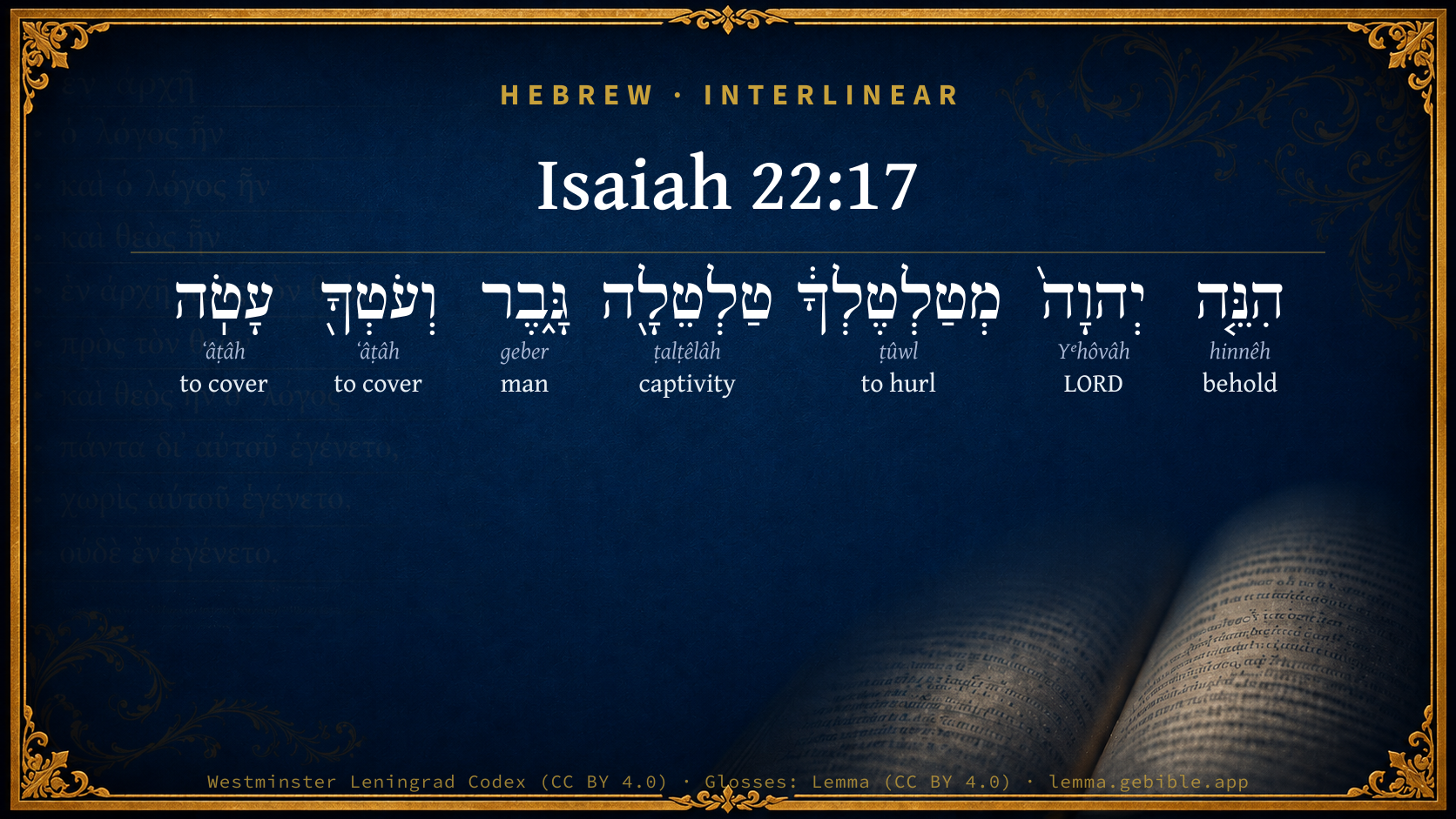
Isaiah 22:17

Hebrew (Westminster Leningrad Codex) Isaiah 22:17 appears in the Hebrew Old Testament. The text above is from the Westminster Leningrad Codex. Each word links to its Strong’s number, a concise gloss, and parsing drawn from the Open Scriptures Hebrew Bible morphology. Click any word for its full Brown-Driver-Briggs (BDB) entry.
Download image
Cite this verse

Isaiah 22:17 (World English Bible). Public Domain. Lemma interlinear Bible study tool, https://lemma.gebible.app/v/isaiah/22/17.

Show BibTeX & RIS
BibTeX
RIS
English Translation
Behold, Yahweh, like a [strong] man, will hurl you away violently; yes, he will wrap you up closely.
World English Bible · Public Domain
Highlights
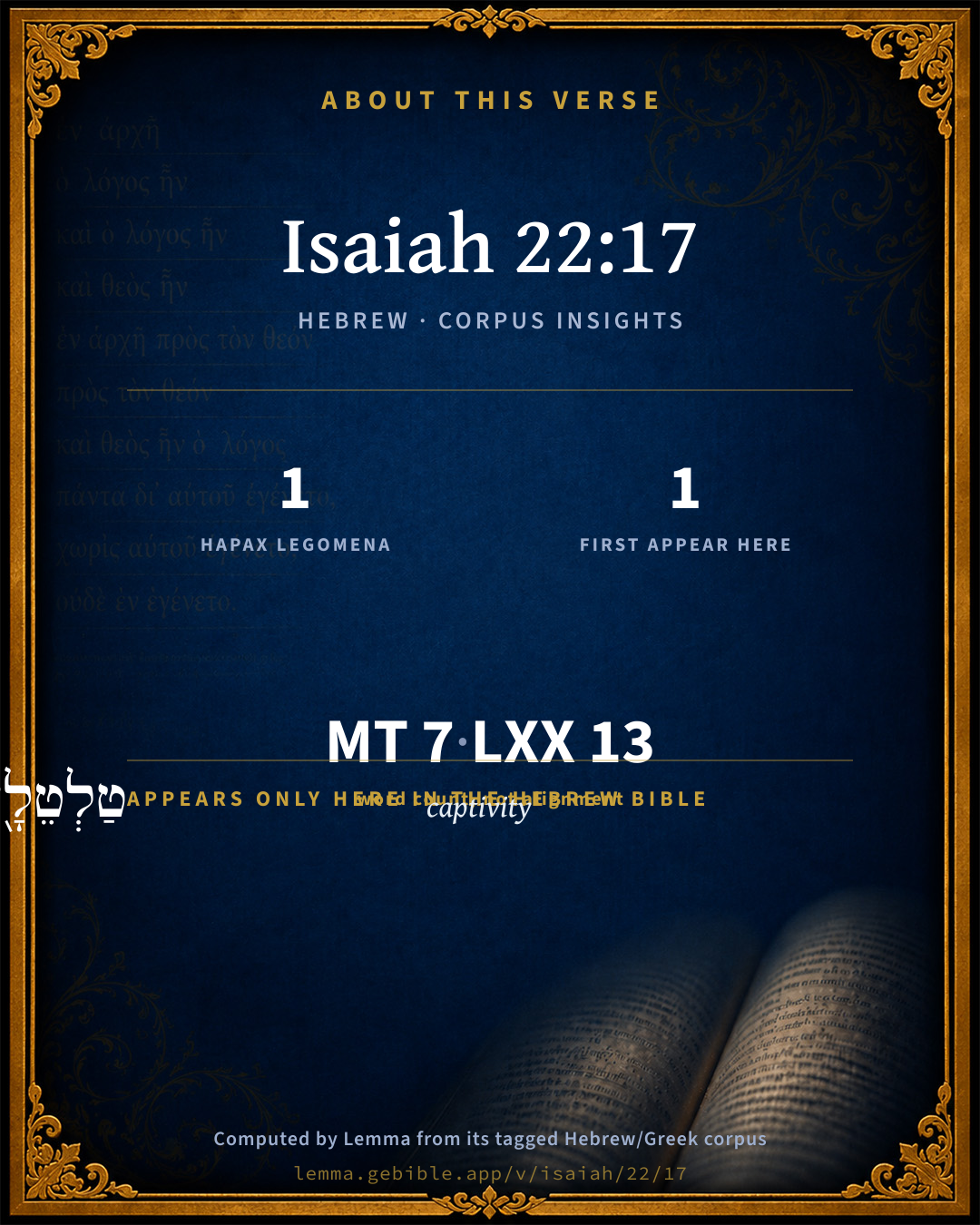
  • 1 hapax legomenon — only here in the Hebrew Bible
  • 1 first appearance in the Hebrew Bible
Full analysis ↓
Download a study sheet

One document with this verse’s original text, its word-by-word gloss line, the meaning frame, cross-references with their text, attributed commentary, and full source and license credits — printable, and it pastes into notes with its structure intact.

This verse Autodidact and up

Study sheet (.html) Plain text (.txt)

A passage Seminary Student

Up to 50 verses in one chapter. A passage sheet keeps up to 6 commentary sources and 12 cross-references per verse, in the order this page ranks them, and says so on the sheet whenever that leaves anything out. Ask for a single verse and you get the Autodidact verse sheet above.

Everything on this page stays free to read, with no account — the sheet is a download of what is already on screen, not access to it.

Want to remove ads? Support Godless Engineer
Compare translations 3

The same verse in 3 English versions, stacked beneath the original-language interlinear above. Click any original word for its lexicon entry.

Each is an independent rendering of the whole verse — the interlinear is not word-aligned to these translations.

Highlighted words mark where these versions differ — a whole-verse word diff, not a word-by-word alignment.

  • World English Bible Public Domain
    Behold, Yahweh, like a [strong] man, will hurl you away violently; yes, he will wrap you up closely.
  • King James Version Public Domain
    Behold, the LORD will carry thee away with a mighty captivity, and will surely cover thee.
  • unfoldingWord Literal Text CC BY-SA 4.0
    Behold Yahweh, hurling you a hurling, man, and wrapping, he will wrap you.

unfoldingWord Literal Text — © unfoldingWord, licensed CC BY-SA 4.0. Word-aligned USFM3 via Door43 (git.door43.org/unfoldingWord/en_ult).

Versions to compare (up to 4)

3 of 4 selected

Show all 18 translations

Every available English version of this verse, each an independent rendering of the whole verse.

  • World English Bible Public Domain
    Behold, Yahweh, like a [strong] man, will hurl you away violently; yes, he will wrap you up closely.
  • Berean Standard Bible Public Domain
    Look, O mighty man! The LORD is about to shake you violently. He will take hold of you,
  • Majority Standard Bible Public Domain
    Look, O mighty man! The LORD is about to shake you violently. He will take hold of you,
  • King James Version Public Domain
    Behold, the LORD will carry thee away with a mighty captivity, and will surely cover thee.
  • American Standard Version (1901) Public Domain
    Behold, Jehovah, like a `strong' man, will hurl thee away violently; yea, he will wrap thee up closely.
  • Revised Version (1885) Public Domain
    Behold, the LORD will hurl thee away violently as a strong man; yea, he will wrap thee up closely.
  • Geneva Bible (1599) Public Domain
    Beholde, the Lord wil carie thee away with a great captiuitie, and will surely couer thee.
  • Douay-Rheims (1899) Public Domain
    Behold the Lord will cause thee to be carried away, as a cock is carried away, and he will lift thee up as a garment.
  • Young's Literal Translation Public Domain
    Lo, Jehovah is casting thee up and down, A casting up and down, O mighty one,
  • Literal Standard Version CC BY-SA 4.0
    Behold, YHWH is casting you up and down, || A casting up and down, O mighty one,
  • Unlocked Literal Bible CC BY-SA 4.0
    See, Yahweh is about to throw you, a mighty man, about to throw you down; he will grasp you tightly.
  • unfoldingWord Literal Text CC BY-SA 4.0
    Behold Yahweh, hurling you a hurling, man, and wrapping, he will wrap you.
  • Darby Bible Public Domain
    Behold, Jehovah will hurl thee with the force of a mighty man, and will cover thee entirely.
  • World Messianic Bible Public Domain
    Behold, the LORD will overcome you and hurl you away violently. Yes, he will grasp you firmly.
  • Webster's Bible Public Domain
    Behold, the LORD will carry thee away with a mighty captivity, and will surely cover thee.
  • Free Bible Version CC BY-SA 4.0
    Watch out, you great man! The Lord is about to grab you and violently toss you aside.
  • Bible in Basic English Public Domain
    See, O strong man, the Lord will send you violently away, gripping you with force,
  • JPS Tanakh (1917) Public Domain
    Behold, the LORD will hurl thee up and down with a man's throw; yea, He will wind thee round and round;

Literal Standard Version (2020), Covenant Press — licensed CC BY-SA 4.0. Text via the HelloAO Bible API (eBible.org). Unlocked Literal Bible (unfoldingWord) — licensed CC BY-SA 4.0. Text via the HelloAO Bible API (eBible.org). unfoldingWord Literal Text — © unfoldingWord, licensed CC BY-SA 4.0. Word-aligned USFM3 via Door43 (git.door43.org/unfoldingWord/en_ult). Free Bible Version, Dr. Jonathan Gallagher — licensed CC BY-SA 4.0. Text via the HelloAO Bible API (eBible.org).

Word by word

More ways to search: Search by grammar → Find every occurrence → Compare this word →

Practice this passage: Drill this verse → Learn its vocabulary →

About this verse

These counts appear in no published source. They are computed here, from the morphology-tagged text and Lemma’s own curated glosses. What Lemma adds →

7
words
6
distinct lemmas
Prophets
section

Notable vocabulary

1 hapax legomenon — a word that appears only here in the entire Hebrew Bible:

  • טַלְטֵלָ֖ה captivity H2925

First appearance in Scripture

This word makes its first canonical appearance in the Hebrew Bible here:

  • טַלְטֵלָ֖ה captivity H2925

Shared distinctive vocabulary

מְטַלְטֶלְךָ֔ to hurl H2904 occurs in 14 verses of the Hebrew Bible. Also found in:

Grammatical profile

  • 3 verbs
  • 3 nouns
  • 1 particle

Verb forms

  • מְטַלְטֶלְךָ֔ Pilpel · Participle Active
  • וְעֹטְךָ֖ Qal · Participle Active
  • עָטֹֽה Qal · Infinitive Absolute

Repetition

A word recurs within this verse — often emphatic in Hebrew:

  • וְעֹטְךָ֖ to cover H5844 ×2

Hebrew & Septuagint length

In English translation the verse runs 18 words from the Hebrew and 25 from the Septuagint (LXX English) — closely comparable.

A rough comparison of the two English renderings, which tokenize alike — not a word-level alignment.

Word counts can differ between the Hebrew and the Greek without any difference in meaning — e.g. the Hebrew direct-object marker אֵת has no separate Greek word, and Greek often adds the article ὁ.

In the original languages it is 7 Hebrew tokens and 13 Greek tokens — but the two are counted differently (Hebrew bundles its prefixes and suffixes into one token; the Greek is in lemma form), so that isn’t a like-for-like length.

Cross-references

3

Topical passages linked to Isaiah 22:17 in the Treasury of Scripture Knowledge — connected by theme and wording, ordered by reader-vote popularity; previews shown in the World English Bible.

  • Jeremiah 14:3 Their nobles send their little ones to the waters: they come to the cisterns, and find no water; they return with their vessels empty; they are disappointed and confounded, and cover their heads.
  • Esther 7:8 Then the king returned out of the palace garden into the place of the banquet of wine; and Haman was fallen on the couch whereon Esther was. Then said the king, Will he even force the queen before me in the house? As the word went out of the king's mouth, they covered Haman's face.
  • Job 9:24 The earth is given into the hand of the wicked. He covers the faces of the judges of it. If not he, then who is it?

Cross-references courtesy of OpenBible.info (CC BY 4.0).

Hebrew and Greek witnesses Masoretic Hebrew ↔ Greek Septuagint

The same verse in the two great witnesses to the Old Testament, shown verse-for-verse.

These are two independent witnesses, not word-aligned to each other, and the Septuagint is shown in lemma (dictionary) form.

Hebrew Isaiah 22:17 Masoretic · Westminster Leningrad Codex

הִנֵּ֤ה יְהוָה֙ מְטַלְטֶלְךָ֔ טַלְטֵלָ֖ה גָּ֑בֶר וְעֹטְךָ֖ עָטֹֽה

Behold, Yahweh, like a [strong] man, will hurl you away violently; yes, he will wrap you up closely.

World English Bible · Public Domain

Greek LXX Isaiah 22:17 Septuagint · lemma form

ἰδού δή κύριος σαβαωθ ἐκβάλλω καί ἐκτρίβω ἀνήρ καί ἀποαἱρέω ὁ στολή σύ

Behold now, the Lord of hosts casts forth and will utterly destroy such a man, and will take away your robe and your glorious crown,

LXX2012 (modern English Septuagint) · Public Domain

On this verse, Haydock's Catholic Bible Commentary discusses the Septuagint’s reading. Read the note in Commentary ↓

Hebrew: Westminster Leningrad Codex (CC BY 4.0). Greek: Septuagint (public domain); English from LXX2012 (modern English Septuagint) (Public Domain). How the Septuagint differs from the Hebrew →

Targum (Aramaic paraphrase)

1

The Targum is the ancient Jewish Aramaic paraphrase of the Hebrew Scriptures — an interpretive translation, not the Hebrew text itself. Onkelos (literal) and Pseudo-Jonathan (expansive) render the Torah, and Jonathan the Prophets. Coverage is partial: where no permissively-licensed English translation exists for a verse, only the Aramaic is shown. This is verse-level text, not a word-by-word alignment to the Hebrew.

  1. Targum Jonathan Prophets (Joshua–Malachi)
    הָא יְיָ מְטַלְטְלָךְ טִלְטוּל דְגַבְרָא וְתַחֲפִינָךְ בַּהֲתָא:

    Behold, the Lord will cast thee out with a mighty casting out, and confusion shall cover thee.

    Targum Jonathan — Aramaic: “Mikraot Gedolot” (public domain). English: “Sefaria Community Translation” (CC0 1.0 (public-domain dedication)); “London "Chaldee Paraphrase," 1871” (public domain). Text via Sefaria.

Commentary

Notes on Isaiah 22:17 from classic Christian and Jewish commentators (each source and its license shown beneath its notes). The classic Christian expositions comment on the surrounding passage and are grouped to its opening verse, so a note may address several verses; the Jewish commentaries on the Tanakh (Rashi and others) are per-verse, so they appear only where the commentator wrote on this verse.

Lemma curates 59 commentaries, every one of them public domain or Creative Commons licensed, each selected and text-cleaned for this edition rather than reprinted as found. About our sources →

Trapp's Complete Commentary

John Trapp

Isa 22:17 Behold, the LORD will carry thee away with a mighty captivity, and will surely cover thee.

Ver. 17. Behold, the Lord will carry thee away, &c.] Or, Is casting thee out with casting, O thou mighty man. Not, God will carry thee away as a cock is carried, so the Vulgate translator hath it; which caused a learned interpreter to say he wondered whence this cock flew into the text.

And will surely cover thee.] As they used to do to condemned persons unworthy any longer to see the light, they covered their faces, {as Job 9:24 Est 7:8} {See Trapp on "Job 9:24"} {See Trapp on "Est 7:8"}

John Trapp, A Commentary or Exposition upon All the Books of the Old and New Testament (1647–1656) — public domain. Text from a community e-Sword module.

Jamieson, Fausset & Brown

Robert Jamieson, A. R. Fausset & David Brown

carry . . . away with . . . captivity--rather, "will cast thee away with a mighty throw" [MAURER]. "Mighty," literally, "of a man" (so Job 38:3).

surely cover--namely, with shame, where thou art rearing a monument to perpetuate thy fame [VITRINGA]. "Rolling will roll thee," that is, will continually roll thee on, as a ball to be tossed away [MAURER]. Compare Isa 22:18.

Jamieson, Fausset & Brown — Commentary Critical and Explanatory on the Whole Bible (1871) — public domain (CC PDM 1.0). Text via the HelloAO Bible API.

Adam Clarke's Commentary

Verse 17. Cover thee] That is, thy face. This was the condition of mourners in general, and particularly of condemned persons. See Est 6:12; Est 7:8.

Adam Clarke's Commentary on the Bible (1810–1826) — public domain. Text from a community e-Sword/MySword module.

Ellicott's Commentary for English Readers

(17) The Lord will carry thee away with a mighty captivity.—Better, will hurl thee with the hurling of a mighty man—i.e., strongly and effectually. The words have, however, been rendered (Cheyne), “will hurl, will hurl thee, O mighty man.” The marginal rendering rests on no sufficient grounds.

Will surely cover thee.—Better, Will surely grasp thee, so that thou shalt not escape.

A Bible Commentary for English Readers, edited by Charles John Ellicott (1878–1897) — public domain. Text from a community e-Sword module.

The Cambridge Bible for Schools and Colleges

gen. ed. J. J. S. Perowne

17. will carry thee away … captivity] Translate: will fling thee forth violently, O thou man. The A.V. preserves the sense but entirely misses the bold metaphor, which is carried on to the middle of Isa_22:18. The next words and will surely cover thee, when so rendered, hardly suit the context. The verb may be the equivalent of an Arabic verb, meaning “seize,” which gives an appropriate idea, although it is the solitary instance in the O.T. Render accordingly: and will seize thee firmly (lit. “with a seizing”).

17, 18. The doom of Shebna is set forth in language of extraordinary force and passion.

The Cambridge Bible for Schools and Colleges (gen. ed. J. J. S. Perowne; Cambridge University Press, 1878–1918) — public domain. Text from a community e-Sword module.

John Gill's Exposition

Behold, the Lord will carry thee away with a mighty captivity,.... Or with the captivity of a man; so the Targum, of a mighty man, Sennacherib king of Assyria; who, as the Jews say (z), when he went from Jerusalem, upon the rumour of Tirhakah king of Ethiopia coming against him, carried away Shebna and his company, as with an inundation: or as a man is carried captive, whose captivity is harder, and more severe and cruel, than a woman's, as the Rabbins (a) observe; a woman finding more mercy in captivity usually than a man does. Some of the Jewish writers render the word "geber" a cock, as they do elsewhere; and gloss it, as a cock is carried away, and goes from place to place (b); and so the Vulgate Latin version,

"behold, the Lord shall cause thee to be carried away, as a cock is carried away;''

but it seems best, with Aben Ezra and Kimchi, to read the word "man" in the vocative case; the Lord will carry thee away, "O man", O mighty man (c); as mighty a man as thou art in office, in power, in riches, God shall carry thee away with the greatest ease imaginable:

and will surely cover thee: or, "in covering cover thee"; with confusion, as the Targum. Jarchi says the word has the signification of flying; and so interprets it, he shall cause thee to fly like a bird into captivity; that is, very speedily and swiftly. The Rabbins gather from hence that Shebna was struck with leprosy, because the leper was obliged to put a covering upon his upper lip; and this sense is embraced by Grotius; but the allusion seems to be to persons in disgrace, or condemned to die, whose faces used to be covered, Est 7:8.

(z) Seder Olam Rabba, c. 23. p. 64. (a) T. Bab. Sanhedrin, fol. 26. 2. (b) Jarchi in loc. Vajikra Rabba, sect. 5. fol. 150. 2. (c) "O vir poteus", Grotius; "O tu heros", Tigurine version.

John Gill's Exposition of the Whole Bible (1746–1763) — public domain (CC PDM 1.0). Text via the HelloAO Bible API.

Albert Barnes' Notes on the Bible

Behold, the Lord will carry thee away - Of the historical fact here referred to we have no other information. To what place he was to be carried, we know not. It is probable, however, that it was to Assyria.

With a mighty captivity - Hebrew, גבר geber - ‘Of a man,’ or perhaps, ‘O man.’ If it means ‘the captivity of a man,’ the sense is, a strong, irresistible, mighty captivity where the word “man” is emphatic, and means such as a mighty man would make. Compare Job 38:3 : ‘Gird up now thy loins like a man.’ The margin reads this, he ‘who covered thee with an excellent covering, and clothed thee gorgeously, shall surely turn and toss thee.’ But the text conveys more nearly the idea of the Hebrew word, which denotes the action of “casting away, or throwing” from one as a man throws a stone. See the same use of the word טול ṭûl in 1Sa 18:2; 1Sa 20:33; Jer 17:13; Jer 22:26, Jer 22:28; Jon 1:5, Jon 1:12, Jon 1:16. “And will surely cover thee.” ‘Thy face,’ says Lowth, for this was the condition of mourners. The Chaldee is, ‘Shall cover thee with confusion.’ So Vitringa, who supposes that it means that although Shebna was endeavoring to rear a monument that should perpetuate his name and that of his family, God would cover them with ignominy, and reduce them to their primitive, obscure, and humble condition.

Albert Barnes' Notes on the Bible (1834–1885) — public domain. Text from a community e-Sword/MySword module.

Haydock's Catholic Bible Commentary

Cock. St. Jerome’s master assured him that the word which is usually rendered a warrior, has this meaning. (Haydock) --- The comparison agrees well with a proud man reduced to misery. (Calmet) --- Hebrew, "With the captivity of a man, and he will cover thee." Septuagint, "he will cast out and bruise the man, and will take away thy comely robe, and throw thee into," &c. (Haydock)

George Leo Haydock (1774–1849), Haydock's Catholic Family Bible and Commentary, 1859 edition — public domain. Excludes Psalms (Douay-Rheims chapter numbering differs from Protestant) and Deuterocanonical books (Catholic canon only).

Matthew Poole's English Annotations

I will carry thee away with a mighty captivity; will cause thee to be carried into captivity by a strong hand, or by the hand of a mighty man, from which therefore thou shalt not be able to escape. Or, will cast thee away with the casting of a mighty man, i.e. with great force; or, in casting will cast thee away, O thou mighty man. Will surely cover thee, to wit, with confusion, as is here implied, and as this phrase is more fully expressed, Psa 89:40; 109:29. Or

covering may be put for obscuring his glory, which he designed to publish, and to that end erected stately monuments, &c. Or this may be an allusion to the ancient custom of covering the faces of condemned persons; of which see Est 7:8. Compare Job 9:24; Eze 12:6,12.

Matthew Poole's English Annotations on the Holy Bible (1683–1685) — public domain. Text from a community e-Sword/MySword module.

Whedon's Commentary on the Bible

Daniel D. Whedon

17-19. Behold — The doom of this faithless heathen officer, also a leader away of the people, now follows.

Carry thee… mighty captivity — The words of these verses are violent words, and indicate sharp, indignant, violent feeling and action in executing punishment upon this man. There is scarce power in any language to translate them.

Cover thee — Wrap thee up, (as by straps and thongs.)

Violently turn and toss thee — Some translate: “Bind thee with head band into a ball, then whirl thee round and round and cast thee away.”

Into a large country — Perhaps Assyria; there is nothing certain as to what country is meant. The Jewish comment is, that Shebna was tied, as a traitor, to horses’ tails in Assyria, and so died.

Daniel D. Whedon (gen. ed.), Commentary on the Old and New Testaments (1874–1909) — public domain. Text from a community e-Sword module.

The Pulpit Commentary

The Lord win carry thee away with a mighty captivity; rather, the Lord will hurl thee away, O man, with a hurling; i.e. "will hurl thee away to a distance." It is not said that Shebna would be a captive. Will surely cover thee; literally, will cover thee with a covering; i.e. will make thee obscure" (Rosenm a fitting punishment for one who aimed at attracting attention and making himself famous (ver. 16).

HOMILIES BY W.M. STATHAM Ver. 17. Captivity, and yet safety.

"Behold, the Lord will carry thee away with a mighty captivity, and will surely cover thee." These threatenings of the Almighty had mercy at the heart of them. Captivity was a drastic remedy, but it once and again saved the health of Israel It was a time of home-longing and sickness of heart. It was a time when the old religious memories flooded the heart till they filled it with an aching sense of shame for sin, and supplication for mercy.

I GOD CARRIED THEM AWAY. The enemies of Israel were but instruments in the hands of Jehovah. He reigned over their interests as truly then as in their more prosperous day. "The day is thine, the night also is thine." And in the Captivity, God was disciplining the people as no other dispensation could. Their lofty looks were changed for penitential tears, and their proud hearts were brought low. God would, in due time "turn again the captivity of Israel;" and the Law would be read again, and not only be read, but be "lived.

II THE CAPTIVITY WAS A MIGHTY ONE. It occurred to a mighty multitude; it affected mighty interests; and it produced, mighty results. For this people God had formed for himself, to show forth his praise. We have to learn the lesson too. How tremendous are the powers of grief and loss, change and sickness, under which God often brings his children captive now! We are "prisoned" by pain and circumstance. In our hours of solitude and sorrow, God renews our will, separates the chaff from the wheat in our character, and meetens us for service here and for the inheritance of the saints in light hereafter.

III THE COVERING WAS SURE. They were not cast away; they were only cast down. The almighty wings were still over them. In strange lands, amid strange faces, and listening to strange voices, they could not sing the Lord"s song in a strange land. But the time of joy was to return. God was very near them still, and none could really harm them. What a covering!

Not the mere roof of the home; not the mere outward raiment; but the Lord himself" was there, spreading his shield over them, when they were away from the munitions of rocks and from the defenses of dear Jerusalem. Sure! That is what we want. He also is our Dwelling-place in all generations and under all skies. W.M.S.

The Pulpit Commentary (1880–1919), ed. H.D.M. Spence-Jones & Joseph S. Exell — public domain. Text from a community e-Sword module.

John Wesley's Explanatory Notes

Will carry - Will cause thee to be carried into captivity by a strong hand. Cover - This may be an allusion to the ancient custom of covering the faces of condemned persons.

John Wesley, Explanatory Notes Upon the Whole Bible (1754–1765) — public domain. Text via the GEBible commentary corpus.

J. A. Alexander on Isaiah

Joseph Addison Alexander

“Behold, Jehovah is casting thee a cast, oh man! and covering thee a covering.” The idea is that He is certainly about to cast and cover thee, or to do it completely and with violence.

Joseph Addison Alexander, The Prophecies of Isaiah (1846–1847; New York: Scribner, 1870–1878) — public domain. Text from a community e-Sword module.

unfoldingWord translationNotes

Door43 World Missions Community

General Information:

Isaiah continues to speak God's message to Shebna.

He will surely wind you round and round, and toss you like a ball into a vast country

The enemy soldiers coming and taking Shebna as a captive to a foreign land is spoken of as if Yahweh were throwing him like a ball into another land. (See: Metaphor)

you will be the shame of your master's house

Here "house" represents the people who work in the king's palace. AT: "you will cause shame for all those in your master's palace" (See: Metonymy)

I will thrust you from your office and from your station. You will be pulled down

Yahweh causing Shebna to no longer work in the king's palace is spoken of as if Yahweh will throw him to the ground. (See: Metaphor)

You will be pulled down

This can be stated in active form. AT: "I will bring you down from your honored position" (See: Active or Passive)

translationWords

Yahweh

might

die

glory

chariot

shame

lord

house

unfoldingWord translationNotes — © Distant Shores Media and the Door43 World Missions Community, licensed CC BY-SA 4.0. Source: git.door43.org/Door43/en_tn.

Rashi

Rabbi Shlomo Yitzchaki (Rashi)

Shall cast you about with a mighty toss (גָבֶר) like a rooster that wanders from place to place (Lev. Rabbah ibid.) The Midrash explains גֶבֶר as a rooster. Our Rabbis, however, stated that the wandering of a man is more trying than that of a woman (San. 26a).

and cause you to fly. Heb. (וְעֹטְךָ עָטֹה). Comp. (I Sam. 25:14) “And he drove them away (וַיָּעַט),” an expression of עַיִּט, a bird. He will make you fly away like a bird, in exile. Our Rabbis, however, stated that ‘zaraath’ broke out upon him, as is stated: (Leviticus 13:45) “And on his upper lip he shall enwrap himself (יַעְטֶה).”

Rashi on the Tanakh — English translations: “The Judaica Press complete Tanach with Rashi, translated by A. J. Rosenberg” (CC BY 4.0); “Pentateuch with Rashi's commentary by M. Rosenbaum and A.M. Silbermann, 1929-1934” (public domain); “The Metsudah Tanach series, Lakewood, N.J” (CC BY 4.0); and “The Book of Joshua, Metsudah Publications, 1997” (CC BY 4.0). Text via Sefaria.

Ibn Ezra

Rabbi Abraham ibn Ezra

מטלטלך Will carry thee away. Reduplication of טול to carry. Comp. ויטילו And they cast (Jon. 1:5).

גבר O man. Thou, who thinkest that thou art mighty. Comp. והיית לאיש and show thyself a man (1 Kgs. 2:2). גבר is here the vocative case. It can also mean as the carrying away of a man. I prefer the first explanation.

Ibn Ezra on the Tanakh — English translations: “Sefaria Community Translation” (CC0 1.0 (public-domain dedication)); “Yalkut, Sifsei Chachomim Chumash, Metsudah Publications, 2009” (CC BY 4.0); and “Commentary of Ibn Ezra on Isaiah - trans. by M. Friedlander, 1873” (public domain). Text via Sefaria.

Lesson kit

Teaching starters — assembled from the data on this page, not authored interpretation. Every prompt links to the verse data it draws on. Edit before teaching.

Isaiah, in the Prophets, opens this verse with 7 words (6 distinct Hebrew lemmas). Its most distinctive word is ṭalṭêlâh (“captivity”). A historical commentator’s framing appears above. Read the whole chapter for the surrounding context.

Discussion questions

  1. How does “captivity” (ṭalṭêlâh) shape what this verse is saying?
  2. 1 word here appears nowhere else in the Hebrew Bible. Why might the author reach for such rare wording?
  3. This is the first place “captivity” appears in Scripture (first appears here). What does its debut here establish?
  4. How does 1 Samuel 18:11, which shares the word «to hurl», read alongside this verse?
  5. What does the repetition of “to cover” (2× in this one verse) do in this verse?
  6. These translations render this verse differently. What is at stake in choosing one wording over another?
  7. «מְטַלְטֶלְךָ֔» is a Pilpel Participle Active verb. How does that grammatical form shape the action described?
  8. Compare how Trapp's Complete Commentary and Jamieson, Fausset & Brown read this verse. Where do they agree or differ?

Things to notice

  • 1 word in this verse appears nowhere else in the Hebrew Bible.
  • 1 word makes its first canonical appearance in Scripture here.
  • This verse counts 7 Hebrew ↔ 13 Greek words.
  • These translations choose different wording for 20 words in this verse.
  • “to cover” occurs 2× in this single verse.

Reading settings

Reading text

Shown beneath each verse's original-language words.

Old Testament
Old Testament edition

Read the OT as the Masoretic Hebrew (MT) or the Greek Septuagint (LXX).

English shown for the Greek Septuagint (in the Hebrew ↔ Greek comparison).

Comparing translations? Open the Compare panel on any verse page to stack up to four side by side.