
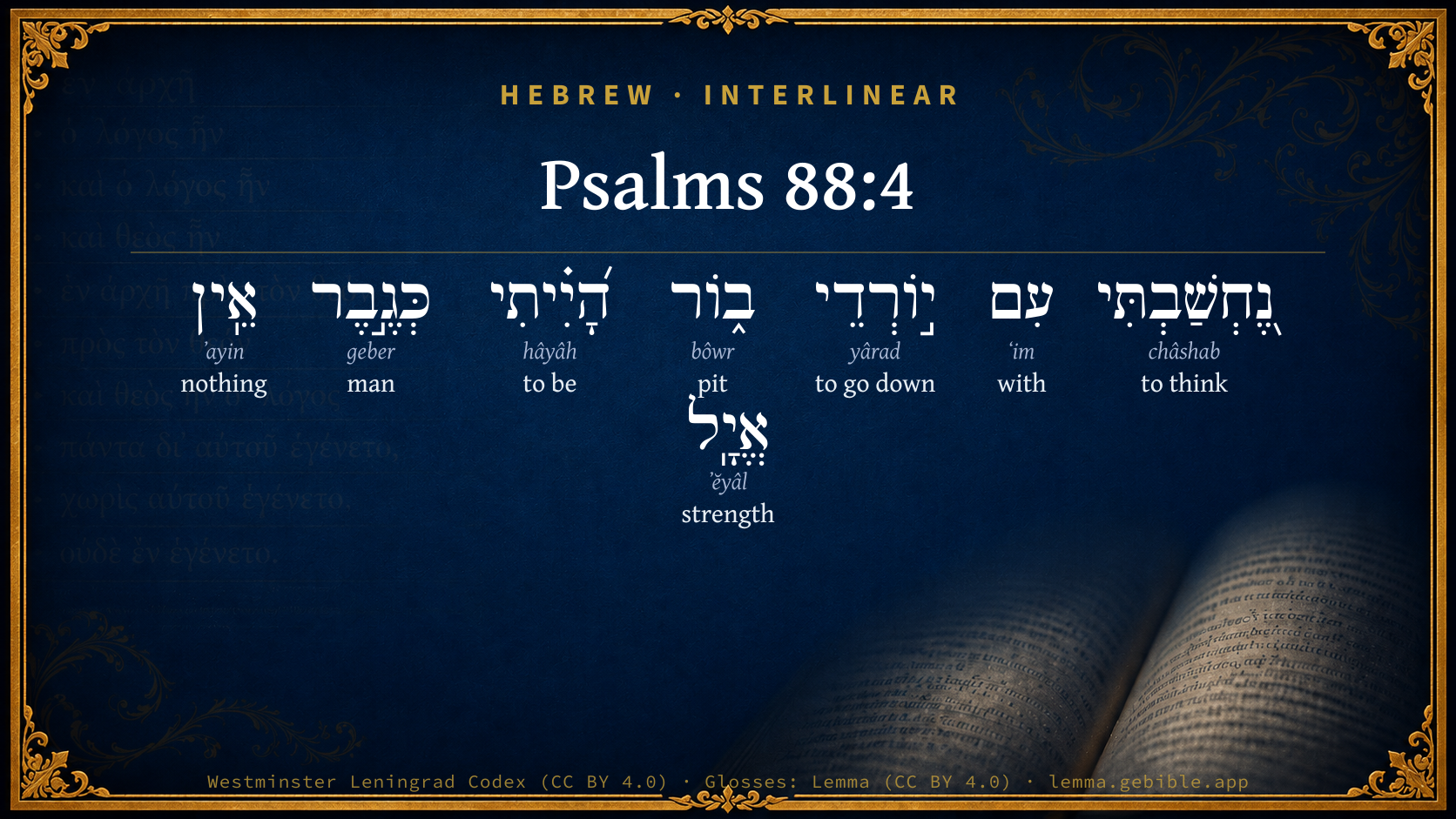
Psalms 88:4

Hebrew (Westminster Leningrad Codex) Psalms 88:4 appears in the Hebrew Old Testament. The text above is from the Westminster Leningrad Codex. Each word links to its Strong’s number, a concise gloss, and parsing drawn from the Open Scriptures Hebrew Bible morphology. Click any word for its full Brown-Driver-Briggs (BDB) entry.
Download image
Cite this verse

Psalms 88:4 (World English Bible). Public Domain. Lemma interlinear Bible study tool, https://lemma.gebible.app/v/psalms/88/4.

Show BibTeX & RIS
BibTeX
RIS
English Translation
I am counted among those who go down into the pit. I am like a man who has no help,
World English Bible · Public Domain
Highlights
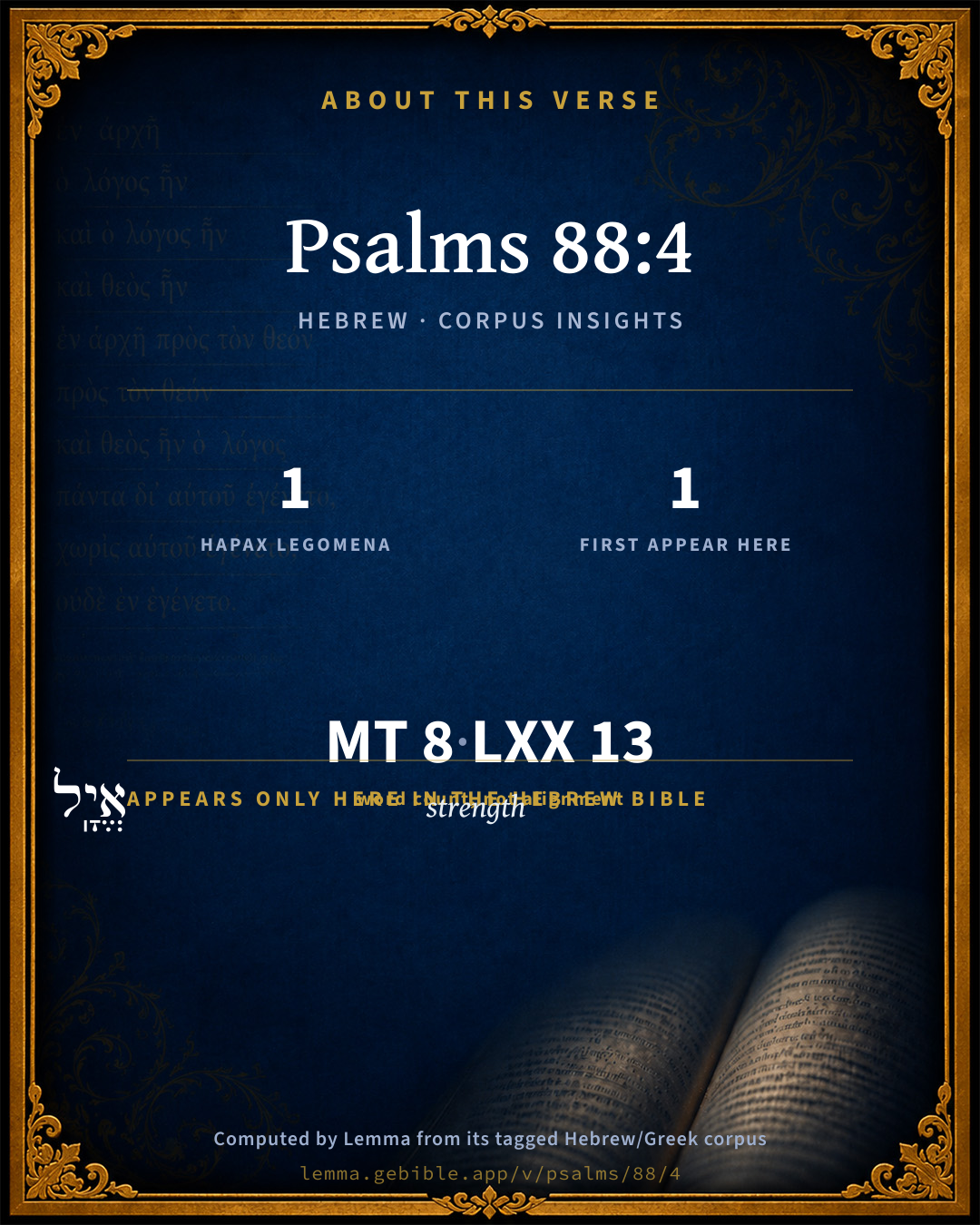
  • 1 hapax legomenon — only here in the Hebrew Bible
  • 1 first appearance in the Hebrew Bible
Full analysis ↓
Download a study sheet

One document with this verse’s original text, its word-by-word gloss line, the meaning frame, cross-references with their text, attributed commentary, and full source and license credits — printable, and it pastes into notes with its structure intact.

This verse Autodidact and up

Study sheet (.html) Plain text (.txt)

A passage Seminary Student

Up to 50 verses in one chapter. A passage sheet keeps up to 6 commentary sources and 12 cross-references per verse, in the order this page ranks them, and says so on the sheet whenever that leaves anything out. Ask for a single verse and you get the Autodidact verse sheet above.

Everything on this page stays free to read, with no account — the sheet is a download of what is already on screen, not access to it.

Want to remove ads? Support Godless Engineer
Compare translations 3

The same verse in 3 English versions, stacked beneath the original-language interlinear above. Click any original word for its lexicon entry.

Each is an independent rendering of the whole verse — the interlinear is not word-aligned to these translations.

Highlighted words mark where these versions differ — a whole-verse word diff, not a word-by-word alignment.

  • World English Bible Public Domain
    I am counted among those who go down into the pit. I am like a man who has no help,
  • King James Version Public Domain
    I am counted with them that go down into the pit: I am as a man that hath no strength:
  • unfoldingWord Literal Text CC BY-SA 4.0
    I am reckoned with the ones going down the pit; I have become like a man without strength,

unfoldingWord Literal Text — © unfoldingWord, licensed CC BY-SA 4.0. Word-aligned USFM3 via Door43 (git.door43.org/unfoldingWord/en_ult).

Versions to compare (up to 4)

3 of 4 selected

Show all 18 translations

Every available English version of this verse, each an independent rendering of the whole verse.

  • World English Bible Public Domain
    I am counted among those who go down into the pit. I am like a man who has no help,
  • Berean Standard Bible Public Domain
    I am counted among those descending to the Pit. I am like a man without strength.
  • Majority Standard Bible Public Domain
    I am counted among those descending to the Pit. I am like a man without strength.
  • King James Version Public Domain
    I am counted with them that go down into the pit: I am as a man that hath no strength:
  • American Standard Version (1901) Public Domain
    I am reckoned with them that go down into the pit; I am as a man that hath no help,
  • Revised Version (1885) Public Domain
    I am counted with them that go down into the pit; I am as a man that hath no help:
  • Geneva Bible (1599) Public Domain
    I am counted among them that go downe vnto the pit, and am as a man without strength:
  • Douay-Rheims (1899) Public Domain
    For my soul is filled with evils: and my life hath drawn nigh to hell.
  • Young's Literal Translation Public Domain
    I have been reckoned with those going down `to' the pit, I have been as a man without strength.
  • Literal Standard Version CC BY-SA 4.0
    I have been reckoned with those going down [to] the pit, || I have been as a man without strength.
  • Unlocked Literal Bible CC BY-SA 4.0
    People treat me like those who go down into the pit; I am a man with no strength.
  • unfoldingWord Literal Text CC BY-SA 4.0
    I am reckoned with the ones going down the pit; I have become like a man without strength,
  • Darby Bible Public Domain
    I am reckoned with them that go down into the pit; I am as a man that hath no strength:
  • World Messianic Bible Public Domain
    I am counted among those who go down into the pit. I am like a man who has no help,
  • Webster's Bible Public Domain
    \\88:3\\For my soul is full of troubles: and my life draweth nigh to the grave.
  • Free Bible Version CC BY-SA 4.0
    I'm counted among the dying; a man with no strength.
  • Bible in Basic English Public Domain
    I am numbered among those who go down into the earth; I have become like a man for whom there is no help:
  • JPS Tanakh (1917) Public Domain
    (88-5) I am counted with them that go down into the pit; I am become as a man that hath no help;

Literal Standard Version (2020), Covenant Press — licensed CC BY-SA 4.0. Text via the HelloAO Bible API (eBible.org). Unlocked Literal Bible (unfoldingWord) — licensed CC BY-SA 4.0. Text via the HelloAO Bible API (eBible.org). unfoldingWord Literal Text — © unfoldingWord, licensed CC BY-SA 4.0. Word-aligned USFM3 via Door43 (git.door43.org/unfoldingWord/en_ult). Free Bible Version, Dr. Jonathan Gallagher — licensed CC BY-SA 4.0. Text via the HelloAO Bible API (eBible.org).

Word by word

More ways to search: Search by grammar → Find every occurrence → Compare this word →

Practice this passage: Drill this verse → Learn its vocabulary →

About this verse

These counts appear in no published source. They are computed here, from the morphology-tagged text and Lemma’s own curated glosses. What Lemma adds →

8
words
8
distinct lemmas
Wisdom
section

Notable vocabulary

1 hapax legomenon — a word that appears only here in the entire Hebrew Bible:

  • אֱיָֽל strength H353

First appearance in Scripture

This word makes its first canonical appearance in the Hebrew Bible here:

  • אֱיָֽל strength H353

Grammatical profile

  • 3 verbs
  • 3 nouns
  • 1 preposition
  • 1 particle

Verb forms

  • נֶ֭חְשַׁבְתִּי Niphal · Perfect
  • י֣וֹרְדֵי Qal · Participle Active
  • הָ֝יִ֗יתִי Qal · Perfect

Hebrew & Septuagint length

In English translation the verse runs 20 words from the Hebrew and 19 from the Septuagint (LXX English) — closely comparable.

A rough comparison of the two English renderings, which tokenize alike — not a word-level alignment.

Word counts can differ between the Hebrew and the Greek without any difference in meaning — e.g. the Hebrew direct-object marker אֵת has no separate Greek word, and Greek often adds the article ὁ.

In the original languages it is 8 Hebrew tokens and 13 Greek tokens — but the two are counted differently (Hebrew bundles its prefixes and suffixes into one token; the Greek is in lemma form), so that isn’t a like-for-like length.

Cross-references

12

Topical passages linked to Psalms 88:4 in the Treasury of Scripture Knowledge — connected by theme and wording, ordered by reader-vote popularity; previews shown in the World English Bible.

  • Psalms 28:1 To you, Yahweh, I call. My rock, don't be deaf to me; Lest, if you are silent to me, I would become like those who go down into the pit.
  • 2 Corinthians 1:9 Yes, we ourselves have had the sentence of death within ourselves, that we should not trust in ourselves, but in God who raises the dead,
  • Psalms 31:12 I am forgotten from their hearts like a dead man. I am like broken pottery.
  • Psalms 143:7 Hurry to answer me, Yahweh. My spirit fails. Don't hide your face from me, So that I don't become like those who go down into the pit.
  • Job 17:1 "My spirit is consumed, my days are extinct, And the grave is ready for me.
  • Psalms 30:9 "What profit is there in my destruction, if I go down to the pit? Shall the dust praise you? Shall it declare your truth?
  • Isaiah 38:17–18 Behold, [it was] for [my] peace [that] I had great bitterness: But you have in love to my soul delivered it from the pit of corruption; For you have cast all my sins behind your back.
  • Psalms 109:22–24 For I am poor and needy. My heart is wounded within me.
  • Ezekiel 26:20 then will I bring you down with those who descend into the pit, to the people of old time, and will make you to dwell in the lower parts of the earth, in the places that are desolate of old, with those who go down to the pit, that you be not inhabited; and I will set glory in the land of the living:
  • Jonah 2:6 I went down to the bottoms of the mountains. The earth barred me in forever: Yet have you brought up my life from the pit, Yahweh my God.
  • Romans 5:6 For while we were yet weak, at the right time Christ died for the ungodly.
  • 2 Corinthians 13:4 For he was crucified through weakness, yet he lives through the power of God. For we also are weak in him, but we will live with him through the power of God toward you.

Cross-references courtesy of OpenBible.info (CC BY 4.0).

Hebrew and Greek witnesses Masoretic Hebrew ↔ Greek Septuagint

The same verse in the two great witnesses to the Old Testament, shown verse-for-verse.

You’re reading Greek Psalm 87 (Hebrew Psalm 88). The Septuagint counts the superscription, so verse numbers can differ from the Hebrew — chapter-level alignment, not verse-by-verse. Numbering follows Rahlfs.

These are two independent witnesses, not word-aligned to each other, and the Septuagint is shown in lemma (dictionary) form.

Hebrew Psalms 88:4 Masoretic · Westminster Leningrad Codex

נֶ֭חְשַׁבְתִּי עִם י֣וֹרְדֵי ב֑וֹר הָ֝יִ֗יתִי כְּגֶ֣בֶר אֵֽין אֱיָֽל

I am counted among those who go down into the pit. I am like a man who has no help,

World English Bible · Public Domain

Greek LXX Greek Psalm 87:4 Septuagint · lemma form

ὅτι πίμπλημι κακός ὁ ψυχή ἐγώ καί ὁ ζωή ἐγώ ὁ ᾅδης ἐγγίζω

I have been reckoned with them that go down to the pit; I became as a man without help;

LXX2012 (modern English Septuagint) · Public Domain

Hebrew: Westminster Leningrad Codex (CC BY 4.0). Greek: Septuagint (public domain); English from LXX2012 (modern English Septuagint) (Public Domain). How the Septuagint differs from the Hebrew →

Commentary

Notes on Psalms 88:4 from classic Christian and Jewish commentators (each source and its license shown beneath its notes). The classic Christian expositions comment on the surrounding passage and are grouped to its opening verse, so a note may address several verses; the Jewish commentaries on the Tanakh (Rashi and others) are per-verse, so they appear only where the commentator wrote on this verse.

Lemma curates 59 commentaries, every one of them public domain or Creative Commons licensed, each selected and text-cleaned for this edition rather than reprinted as found. About our sources →

Trapp's Complete Commentary

John Trapp

Psa 88:4 I am counted with them that go down into the pit: I am as a man [that hath] no strength:

Ver. 4. I am counted with them, &c.] I am looked upon as irrecoverable, given up for desperate. Conclamatum est.

I am as a man that hath no strength] A man no man; weak as water, ακιας αναρ ανθρωπος.

John Trapp, A Commentary or Exposition upon All the Books of the Old and New Testament (1647–1656) — public domain. Text from a community e-Sword module.

J. A. Alexander on Psalms

Joseph Addison Alexander

5. (Psa 88:4) I am reckoned with those going down to the pit; I am (or am become) as a man with no strength. With the first clause compare Psa 28:1; Psa 143:7. With no strength, literally (to whom) there is no strength. The last word in Hebrew occurs only here, but a cognate form in Psa 22:19). There is in the original an antithesis, which cannot be conveyed by mere translation, arising from the fact that the first word for man is one implying strength.

Joseph Addison Alexander, The Psalms Translated and Explained (1850) — public domain. Text from a community e-Sword module.

Adam Clarke's Commentary

Verse 4. I am counted with them, c.] I am as good as dead nearly destitute of life and hope.

Adam Clarke's Commentary on the Bible (1810–1826) — public domain. Text from a community e-Sword/MySword module.

Ellicott's Commentary for English Readers

(4) As a man . . .—Rather, like a hero whose strength is gone.

A Bible Commentary for English Readers, edited by Charles John Ellicott (1878–1897) — public domain. Text from a community e-Sword module.

The Cambridge Bible for Schools and Colleges

gen. ed. J. J. S. Perowne

4. He is regarded as a dying man. The pit is the grave or Sheol. Cp. Psa_28:1; Psa_143:7; Psa_22:29; Pro_1:12.

that hath no strength] Like the feeble shadows of the dead. Or as R.V., that hath no help: cp. the cognate word in Psa_22:19, rendered in R.V., O thou my succour.

The Cambridge Bible for Schools and Colleges (gen. ed. J. J. S. Perowne; Cambridge University Press, 1878–1918) — public domain. Text from a community e-Sword module.

John Gill's Exposition

I am counted with them that go down into the pit,.... With the dead, with them that are worthy of death, with malefactors that are judicially put to death, and are not laid in a common grave, but put into a pit together: thus Christ was reckoned and accounted of by the Jews; the sanhedrim counted him worthy of death; and the common people cried out Crucify him; and they did crucify him between two malefactors; and so he was numbered or counted with transgressors, and as one of them, Isa 53:3.

I am as a man that hath no strength; for his "strength" was "dried up like a potsherd", Psa 22:15, though he was the mighty God, and, as man, was made strong by the Lord for himself.

John Gill's Exposition of the Whole Bible (1746–1763) — public domain (CC PDM 1.0). Text via the HelloAO Bible API.

Albert Barnes' Notes on the Bible

I am counted with them that go down into the pit - I am so near to death that I may be reckoned already as among the dead. It is so manifest to others that I must die - that my disease is mortal - that they already speak of me as dead. The word “pit” here means the grave - the same as Sheol in the previous verse. It means properly

(1) a pit,

(2) a cistern, Gen 37:20,

(3) a prison or dungeon, Isa 24:22,

(4) the grave, Psa 28:1; Psa 30:4; Isa 38:18.

I am as a man that hath no strength - Who has no power to resist disease, no vigor of constitution remaining; who must die.

Albert Barnes' Notes on the Bible (1834–1885) — public domain. Text from a community e-Sword/MySword module.

Matthew Poole's English Annotations

I am given up by my friends and acquaintance for a lost man.

Matthew Poole's English Annotations on the Holy Bible (1683–1685) — public domain. Text from a community e-Sword/MySword module.

The Treasury of David

Charles H. Spurgeon

Ver. 4. I am counted with them that go down into the pit. My weakness is so great that both by myself and others I am considered as good as dead. If those about me have not ordered my coffin they have at least conversed about my sepulchre, discussed my estate, and reckoned their share of it. Many a man has been buried before he was dead, and the only mourning over him has been because he refused to fulfil the greedy expectations of his hypocritical relatives by going down to the pit at once. It has come to this with some afflicted believers, that their hungry heirs think they have lived too long.

I am as a mat, that hath no strength. I have but the name to live; my constitution is broken up; I can scarce crawl about my sick room, my mind is even weaker than my body, and my faith weakest of all. The sons and daughters of sorrow will need but little explanation of these sentences, they are to such tried ones as household words.

Ver. 4. I am counted with them that go down into the pit. Not only myself, says he, but others also now despair of my life, and number me with those whose corpses are borne forth to burial. For now all my powers have failed and my vital spirits become quenched. He uses the word rbg which indicates fortitude rather than Mda or wya in order to show how great the severity of these evils was, and the vehemence of his griefs, which had broken even a most robust man. Mollerus.

Ver. 4. I am counted with them that go down into the pit. Next to the troubles of Christ's soul, are mentioned the disgrace and ignominy to which he submitted: He who was the fountain of immortality, from whom no one could take his life, who could in a moment have commanded twelve legions of angels to his aid, or have caused heaven and earth, at a word speaking, to fly away before him, he was counted among them that go down into the pit; he died, to all appearance, like the rest of mankind, nay, he was forcibly put to death, as a malefactor; and seemed, in the hands of his executioners, as a man that had no strength, no power, or might, to help and save himself. His strength went from him; he became weak, and like another man. The people shook their heads at him, saying, "He saved others, himself he cannot save." Samuel Burder.

Ver. 4. There is in the original an antithesis, which cannot be conveyed by mere translation, arising from the fact that the first word for man is one implying strength. J.A. Alexander.

Ver. 4. (last clause). Conscious weakness, painfully felt, at certain times, in various duties. Intended to keep us humble, to drive us to our knees, and to bring greater glory to God.

Ver. 4-5.

1. The resemblance of the righteous man to the wicked.

(a) In natural death.

(b) In bodily infirmities.

2. His difference from them. He is "counted with them" but is not of them.

(a) He experiences natural death only.

(b) His strength is perfected in weakness.

(c) For him to die is gain. G.R.

Psalms 88:5*

Charles H. Spurgeon's The Treasury of David (1869–1885) — public domain. Psalms only. Text from a community e-Sword/MySword module.

Whedon's Commentary on the Bible

Daniel D. Whedon

4. I am counted—I am already reckoned among the dead. The pit— Another word for grave, and equal to sheol, Psa_88:3. See Psa_88:6.

As a man that hath no strength—Literally, As a strong man, or warrior, without strength.

Daniel D. Whedon (gen. ed.), Commentary on the Old and New Testaments (1874–1909) — public domain. Text from a community e-Sword module.

The Pulpit Commentary

I am counted with them that go down into the pit; i.e. "to the grave." I am reckoned as one just about to die. I am as a man that hath no strength. All my strength is departed from me; I am utterly feeble and weak a mere shadow of my former self. Physical weakness, something like paralysis, seems to be meant.

The Pulpit Commentary (1880–1919), ed. H.D.M. Spence-Jones & Joseph S. Exell — public domain. Text from a community e-Sword module.

John Wesley's Explanatory Notes

Counted - l am given up by my friends for a lost man.

John Wesley, Explanatory Notes Upon the Whole Bible (1754–1765) — public domain. Text via the GEBible commentary corpus.

Rashi

Rabbi Shlomo Yitzchaki (Rashi)

For my soul is sated with troubles He says this concerning the people of Israel.

Rashi on the Tanakh — English translations: “The Judaica Press complete Tanach with Rashi, translated by A. J. Rosenberg” (CC BY 4.0); “Pentateuch with Rashi's commentary by M. Rosenbaum and A.M. Silbermann, 1929-1934” (public domain); “The Metsudah Tanach series, Lakewood, N.J” (CC BY 4.0); and “The Book of Joshua, Metsudah Publications, 1997” (CC BY 4.0). Text via Sefaria.

Lesson kit

Teaching starters — assembled from the data on this page, not authored interpretation. Every prompt links to the verse data it draws on. Edit before teaching.

Psalms, in the Wisdom, opens this verse with 8 words (8 distinct Hebrew lemmas). Its most distinctive word is ʼĕyâl (“strength”). A historical commentator’s framing appears above. Read the whole chapter for the surrounding context.

Discussion questions

  1. What does “strength” (ʼĕyâl) contribute to the verse as a whole?
  2. This verse holds 1 word here found nowhere else in the Hebrew Bible. What might the rare word draw attention to?
  3. The word “strength” first appears here in Scripture. What is being introduced at this debut?
  4. Psalms 28:1 shares this passage’s theme. How do the two illuminate each other?
  5. These translations render this verse differently. What is at stake in choosing one wording over another?
  6. The verb «נֶ֭חְשַׁבְתִּי» is Niphal Perfect. How does its form color the action?
  7. Reading how Trapp's Complete Commentary and J. A. Alexander on Psalms read this verse, where do the two commentators agree and where do they part?

Things to notice

Reading settings

Reading text

Shown beneath each verse's original-language words.

Old Testament
Old Testament edition

Read the OT as the Masoretic Hebrew (MT) or the Greek Septuagint (LXX).

English shown for the Greek Septuagint (in the Hebrew ↔ Greek comparison).

Comparing translations? Open the Compare panel on any verse page to stack up to four side by side.