
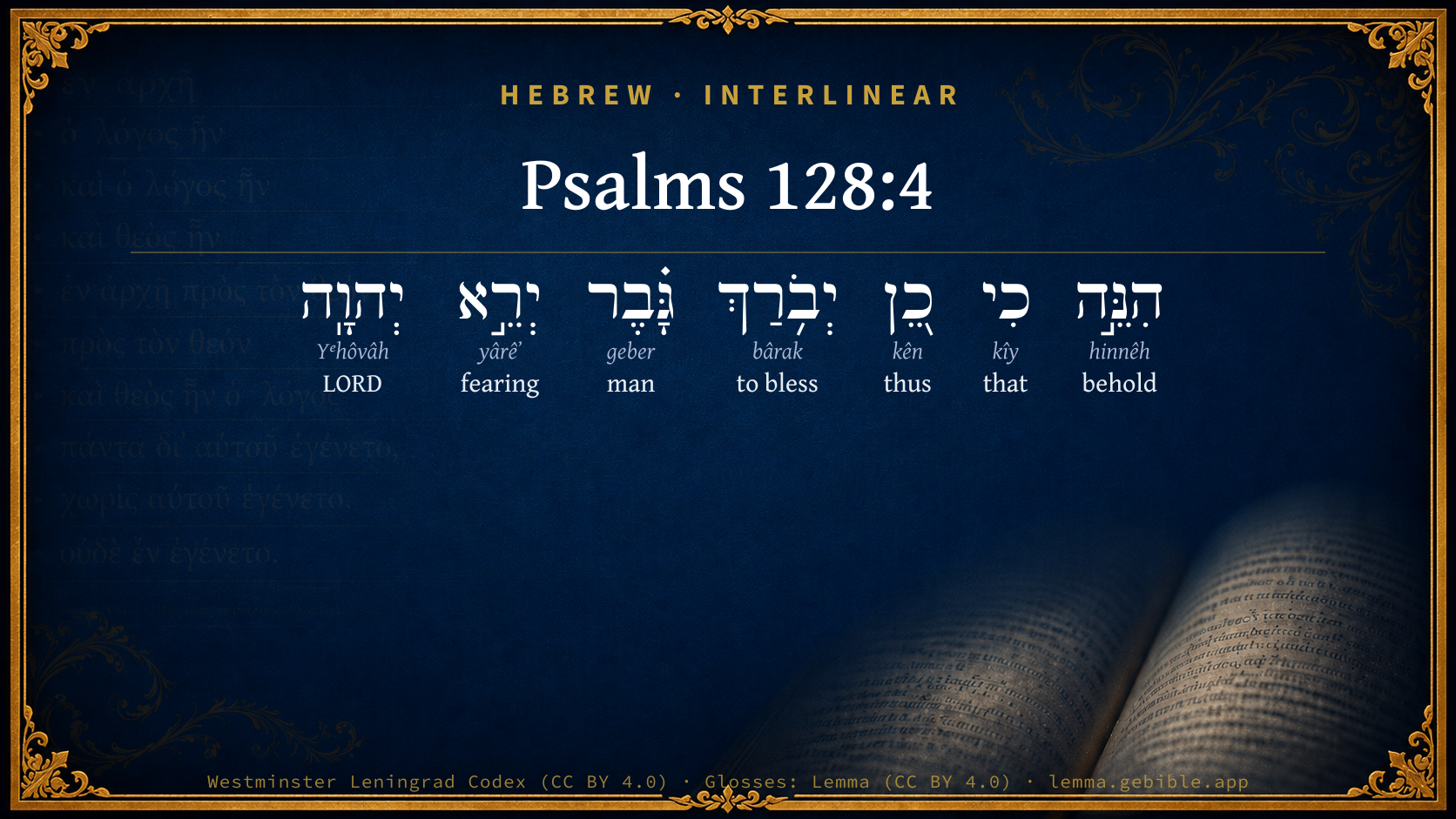
Psalms 128:4

Hebrew (Westminster Leningrad Codex) Psalms 128:4 appears in the Hebrew Old Testament. The text above is from the Westminster Leningrad Codex. Each word links to its Strong’s number, a concise gloss, and parsing drawn from the Open Scriptures Hebrew Bible morphology. Click any word for its full Brown-Driver-Briggs (BDB) entry.
Download image
Cite this verse

Psalms 128:4 (World English Bible). Public Domain. Lemma interlinear Bible study tool, https://lemma.gebible.app/v/psalms/128/4.

Show BibTeX & RIS
BibTeX
RIS
English Translation
Behold, thus is the man blessed who fears Yahweh.
World English Bible · Public Domain
Download a study sheet

One document with this verse’s original text, its word-by-word gloss line, the meaning frame, cross-references with their text, attributed commentary, and full source and license credits — printable, and it pastes into notes with its structure intact.

This verse Autodidact and up

Study sheet (.html) Plain text (.txt)

A passage Seminary Student

Up to 50 verses in one chapter. A passage sheet keeps up to 6 commentary sources and 12 cross-references per verse, in the order this page ranks them, and says so on the sheet whenever that leaves anything out. Ask for a single verse and you get the Autodidact verse sheet above.

Everything on this page stays free to read, with no account — the sheet is a download of what is already on screen, not access to it.

Want to remove ads? Support Godless Engineer
Compare translations 3

The same verse in 3 English versions, stacked beneath the original-language interlinear above. Click any original word for its lexicon entry.

Each is an independent rendering of the whole verse — the interlinear is not word-aligned to these translations.

Highlighted words mark where these versions differ — a whole-verse word diff, not a word-by-word alignment.

  • World English Bible Public Domain
    Behold, thus is the man blessed who fears Yahweh.
  • King James Version Public Domain
    Behold, that thus shall the man be blessed that feareth the LORD.
  • unfoldingWord Literal Text CC BY-SA 4.0
    Behold, for thus the man fearing Yahweh will be blessed.

unfoldingWord Literal Text — © unfoldingWord, licensed CC BY-SA 4.0. Word-aligned USFM3 via Door43 (git.door43.org/unfoldingWord/en_ult).

Versions to compare (up to 4)

3 of 4 selected

Show all 18 translations

Every available English version of this verse, each an independent rendering of the whole verse.

  • World English Bible Public Domain
    Behold, thus is the man blessed who fears Yahweh.
  • Berean Standard Bible Public Domain
    In this way indeed shall blessing come to the man who fears the LORD.
  • Majority Standard Bible Public Domain
    In this way indeed shall blessing come to the man who fears the LORD.
  • King James Version Public Domain
    Behold, that thus shall the man be blessed that feareth the LORD.
  • American Standard Version (1901) Public Domain
    Behold, thus shall the man be blessed That feareth Jehovah.
  • Revised Version (1885) Public Domain
    Behold, that thus shall the man be blessed that feareth the LORD.
  • Geneva Bible (1599) Public Domain
    Lo, surely thus shall the man be blessed, that feareth the Lord.
  • Douay-Rheims (1899) Public Domain
    As arrows in the hand of the mighty, so the children of them that have been shaken.
  • Young's Literal Translation Public Domain
    Lo, surely thus is the man blessed who is fearing Jehovah.
  • Literal Standard Version CC BY-SA 4.0
    Behold, surely thus is the man blessed who is fearing YHWH.
  • Unlocked Literal Bible CC BY-SA 4.0
    Yes, indeed, the man will be blessed who honors Yahweh.
  • unfoldingWord Literal Text CC BY-SA 4.0
    Behold, for thus the man fearing Yahweh will be blessed.
  • Darby Bible Public Domain
    Behold, thus shall the man be blessed that feareth Jehovah.
  • World Messianic Bible Public Domain
    Behold, this is how the man who fears the LORD is blessed.
  • Webster's Bible Public Domain
    Behold, that thus shall the man be blessed that feareth the LORD.
  • Free Bible Version CC BY-SA 4.0
    This will certainly be the Lord's blessing on those who worship him.
  • Bible in Basic English Public Domain
    See! this is the blessing of the worshipper of the Lord.
  • JPS Tanakh (1917) Public Domain
    Behold, surely thus shall the man be blessed that feareth the LORD.

Literal Standard Version (2020), Covenant Press — licensed CC BY-SA 4.0. Text via the HelloAO Bible API (eBible.org). Unlocked Literal Bible (unfoldingWord) — licensed CC BY-SA 4.0. Text via the HelloAO Bible API (eBible.org). unfoldingWord Literal Text — © unfoldingWord, licensed CC BY-SA 4.0. Word-aligned USFM3 via Door43 (git.door43.org/unfoldingWord/en_ult). Free Bible Version, Dr. Jonathan Gallagher — licensed CC BY-SA 4.0. Text via the HelloAO Bible API (eBible.org).

Word by word

More ways to search: Search by grammar → Find every occurrence → Compare this word →

Practice this passage: Drill this verse → Learn its vocabulary →

About this verse

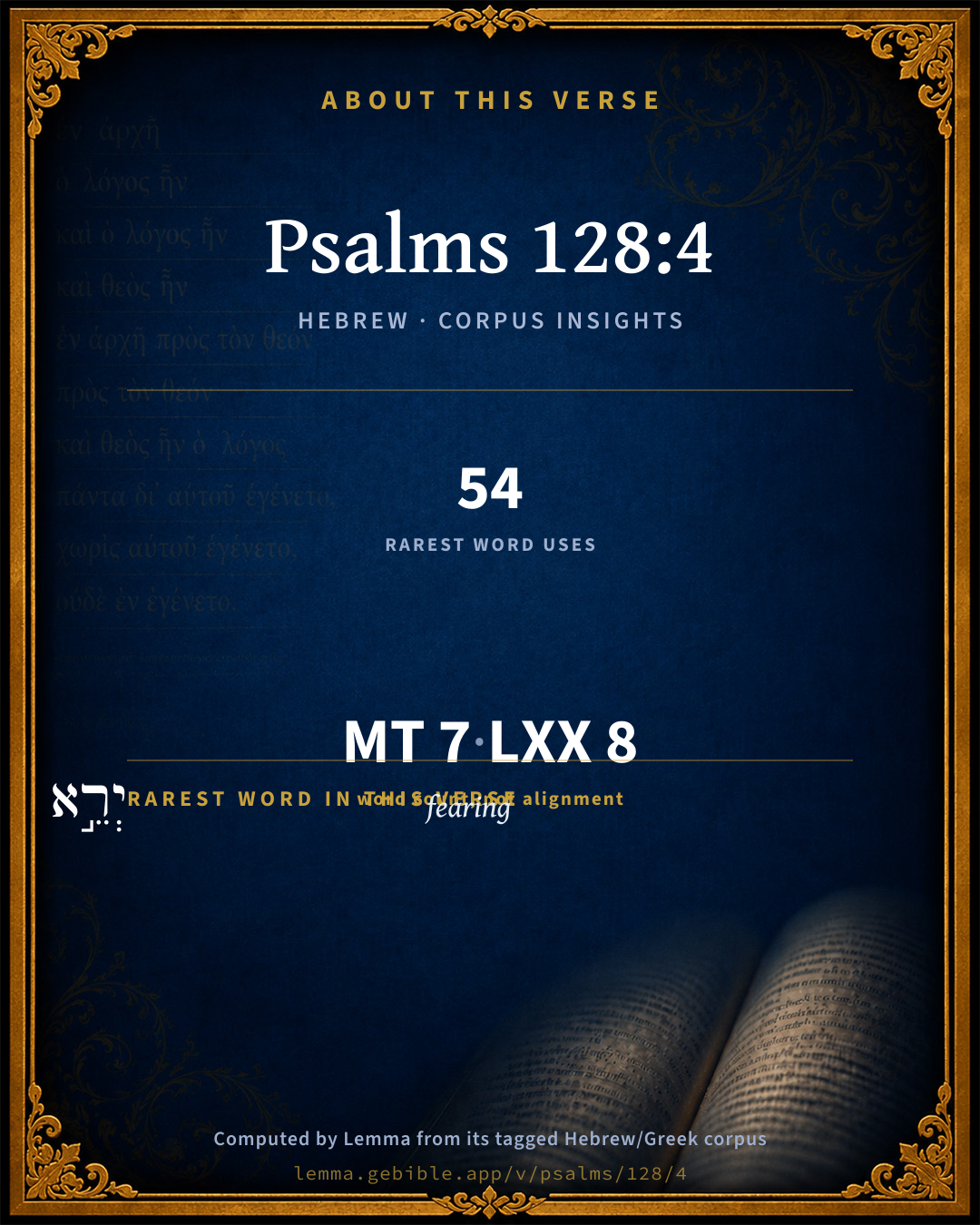
These counts appear in no published source. They are computed here, from the morphology-tagged text and Lemma’s own curated glosses. What Lemma adds →

7
words
7
distinct lemmas
Wisdom
section

Shared distinctive vocabulary

יְרֵ֣א fearing H3373 occurs in 54 verses of the Hebrew Bible. Also found in:

Grammatical profile

  • 1 verb
  • 2 nouns
  • 1 adjective
  • 1 conjunction
  • 1 adverb
  • 1 particle

Verb forms

  • יְבֹ֥רַךְ Pual · Imperfect

Hebrew & Septuagint length

In English translation the verse runs 9 words from the Hebrew and 11 from the Septuagint (LXX English) — closely comparable.

A rough comparison of the two English renderings, which tokenize alike — not a word-level alignment.

Word counts can differ between the Hebrew and the Greek without any difference in meaning — e.g. the Hebrew direct-object marker אֵת has no separate Greek word, and Greek often adds the article ὁ.

In the original languages it is 7 Hebrew tokens and 8 Greek tokens — but the two are counted differently (Hebrew bundles its prefixes and suffixes into one token; the Greek is in lemma form), so that isn’t a like-for-like length.

Hebrew and Greek witnesses Masoretic Hebrew ↔ Greek Septuagint

The same verse in the two great witnesses to the Old Testament, shown verse-for-verse.

You’re reading Greek Psalm 127 (Hebrew Psalm 128). The Septuagint counts the superscription, so verse numbers can differ from the Hebrew — chapter-level alignment, not verse-by-verse. Numbering follows Rahlfs.

These are two independent witnesses, not word-aligned to each other, and the Septuagint is shown in lemma (dictionary) form.

Hebrew Psalms 128:4 Masoretic · Westminster Leningrad Codex

הִנֵּ֣ה כִי כֵ֭ן יְבֹ֥רַךְ גָּ֗בֶר יְרֵ֣א יְהוָֽה

Behold, thus is the man blessed who fears Yahweh.

World English Bible · Public Domain

Greek LXX Greek Psalm 127:4 Septuagint · lemma form

ἰδού οὕτως εὐλογέω ἄνθρωπος ὁ φοβέω ὁ κύριος

Behold, thus shall the man be blessed that fears the Lord.

LXX2012 (modern English Septuagint) · Public Domain

Hebrew: Westminster Leningrad Codex (CC BY 4.0). Greek: Septuagint (public domain); English from LXX2012 (modern English Septuagint) (Public Domain). How the Septuagint differs from the Hebrew →

Commentary

Notes on Psalms 128:4 from classic Christian and Jewish commentators (each source and its license shown beneath its notes). The classic Christian expositions comment on the surrounding passage and are grouped to its opening verse, so a note may address several verses; the Jewish commentaries on the Tanakh (Rashi and others) are per-verse, so they appear only where the commentator wrote on this verse.

Lemma curates 59 commentaries, every one of them public domain or Creative Commons licensed, each selected and text-cleaned for this edition rather than reprinted as found. About our sources →

Trapp's Complete Commentary

John Trapp

Psa 128:4 Behold, that thus shall the man be blessed that feareth the LORD.

Ver. 4. Behold, that thus shall the man be blessed, &c.] "Behold," and "that thus"; q.d. Know it for a truth, and rest assured of the blessedness of married couples, whatsoever the devil and his agents (speaking basely of marriage) suggest to the contrary, so be it they fear the Lord, for that is it that sweeteneth and sanctifieth all estates of life whatsoever.

John Trapp, A Commentary or Exposition upon All the Books of the Old and New Testament (1647–1656) — public domain. Text from a community e-Sword module.

J. A. Alexander on Psalms

Joseph Addison Alexander

4. (Psa 128:4) See--for so shall be blessed the man fearing Jehovah. The lo or behold at the beginning is equivalent to saying, Look upon this picture, for it represents the state of one who truly fears the Lord. Although such a connection between goodness and prosperity was far from uniform and constant under the Old Testament than now, it is not to be supposed that these promises were actually verified in the experience of every godly Israelite. This has led some of the most eminent interpreters to the conclusion, that the promises of this psalm are not personal at all, but addressed to an ideal person representing the whole class of true believers, the true Israel.

Joseph Addison Alexander, The Psalms Translated and Explained (1850) — public domain. Text from a community e-Sword module.

Tyndale Open Study Notes

Tyndale Open Resources

128:4-6 God will continually bless all who fear him (133:3) from his dwelling in Zion (20:2; 50:2; 110:2), no matter where they live. • grandchildren: God’s blessings extend from generation to generation for the faithful (79:12-13; 89:1; 100:4-5; 103:17-19).

Tyndale Open Study Notes — © Tyndale Open Resources, licensed CC BY-SA 4.0. Text via the HelloAO Bible API.

Adam Clarke's Commentary

Verse 4. Thus shall the man be blessed that feareth the Lord.] A great price for a small consideration. Fear God, and thou shalt have as much domestic good as may be useful to thee.

Adam Clarke's Commentary on the Bible (1810–1826) — public domain. Text from a community e-Sword/MySword module.

John Calvin's Commentaries

4. Lo! surely, thus blessed shall be the man who feareth Jehovah. The preceding doctrine, that even in the outward condition of God’s servants while in this transitory state there is afforded such evidence of the divine favor and goodness as demonstrates that we do not lose our labor in serving him, is here confirmed by the Prophet. Yet as the reward of godliness does not appear eminently conspicuous, he, in the first place, uses the demonstrative particle, Lo! Il use en premier lieu d’un mot qui est commoe pour demonstrer la chose au doigt ou a l’oeil, voyla — Fr. “He, in the first place, uses a word, which is, as it were, to point to the thing with the finger, or show it to the eye, Lo!”

John Calvin's Commentaries (1540-1563) — public domain. Text from the Calvin Translation Society English edition (1840s-50s) via the Christian Classics Ethereal Library (ccel.org). Calvin's coverage is partial (roughly two-thirds of the Bible); uncommented books and verses are honest gaps, never fabricated. The 19th-century editor's footnotes and remarks are omitted so the notes are faithfully Calvin's own voice.

Ellicott's Commentary for English Readers

(4) Behold, that.—Better, Look! for thus, &c. The poet calls attention to the charming picture he has drawn of domestic bliss and then points his moral.

A Bible Commentary for English Readers, edited by Charles John Ellicott (1878–1897) — public domain. Text from a community e-Sword module.

The Cambridge Bible for Schools and Colleges

gen. ed. J. J. S. Perowne

4. Behold, that thus &c.] Lo, surely thus &c. Cp. Psa_127:3.

4–6. Prayers and hopes for the welfare of the community.

The Cambridge Bible for Schools and Colleges (gen. ed. J. J. S. Perowne; Cambridge University Press, 1878–1918) — public domain. Text from a community e-Sword module.

John Gill's Exposition

Behold, that thus shall the man be blessed that feareth the Lord. In the manner before described, and in the instances already given, as well as in the following; this is said to raise attention, and fix a sense of the blessedness of such persons; and who are further addressed, and pronounced happy, in the next verses.

Behold, that thus shall the man be blessed that feareth the Lord. In the manner before described, and in the instances already given, as well as in the following; this is said to raise attention, and fix a sense of the blessedness of such persons; and who are further addressed, and pronounced happy, in the next verses.

Psalms 128:5

psa 128:5

psa 128:5

psa 128:5The Lord shall bless thee out of Zion,.... The church of God, where he dwells, out of which he shines, even the Word of the Lord, as the Targum in the king's Bible; and where he commands his blessings of grace to descend on his people, even life for evermore, Psa 133:3. Here he blesses them with his word and ordinances, which are the goodness and fatness of his house, and with his presence in them; so that the man that fears God is blessed, not only in his person, and in his family, but in the house of God; see Psa 118:26;

and thou shall see the good of Jerusalem all the days of thy life; the goodness of God in Jerusalem, which is another name for the church of God; the beauty of the Lord in his house and ordinances; his power and his glory in the sanctuary: or should see the church of God in prosperous circumstances all his days; true religion flourish, the power of godliness in the professors of it; the word and ordinances blessed to the edification of saints, and many sinners converted and gathered in. This may be applied to Christ, Isa 53:11.

John Gill's Exposition of the Whole Bible (1746–1763) — public domain (CC PDM 1.0). Text via the HelloAO Bible API.

Albert Barnes' Notes on the Bible

Behold, that thus shall the man be blessed ... - As if he had said, “Look upon this picture. See the farmer cultivating his fields; see him gathering in the grain; see him at his own table calmly, quietly, and gratefully enjoying the fruit of his toil. Look upon that picture of a happy family - numerous, cheerful, beloved - giving promise of upholding the name of the family in future years - and see all this as coming from the Lord - and you have an illustration of the blessedness which follows a religious life.”

Albert Barnes' Notes on the Bible (1834–1885) — public domain. Text from a community e-Sword/MySword module.

The Treasury of David

Charles H. Spurgeon

Ver. 4. Behold, that thus shall the man be blessed that feareth the LORD. Mark this. Put a Nota Bene against it, for it is worthy of observation. It is not to be inferred that all blessed men are married, and are fathers; but that this is the way in which the Lord favours godly people who are placed in domestic life. He makes their relationships happy and profitable. In this fashion does Jehovah bless God fearing households, for he is the God of all the families of Israel. We have seen this blessing scores of times, and we have never ceased to admire in domestic peace the sweetest of human felicity. Family blessedness comes from the Lord, and is a part of his plan for the preservation of a godly race, and for the maintenance of his worship in the land. To the Lord alone we must look for it. The possession of riches will not ensure it; the choice of a healthy and beautiful bride will not ensure it; the birth of numerous comely children will not ensure it: there must be the blessing of God, the influence of piety, the result of holy living.

Ver. 4. As Haman caused it to be proclaimed (Es 6:9), "Thus shall it be done to the man whom the king delighteth to honour"; so here, Behold, that thus shall the man be blessed that feareth the Lord. He shall be blessed in his wife, and blessed in his children; so blessed in both that the Psalmist calls all to behold it, as a rare, beautiful, yea, wonderful sight: "Behold, thus shall the man be blessed." And yet the man fearing God shall be blessed more than thus: his blessing shall come in the best way (Ps 128:5): "The Lord shall bless thee out of Zion"; his temporal mercies shall come in a spiritual way, yea, he shall have spiritual blessings: "He shall bless thee out of Zion"; and he shall have blessings beyond his own walls: "Thou shalt see the good of Jerusalem all the days of thy life. Yea, thou shalt see thy children's children, and peace upon Israel." Sometimes a good man can take no content in his family mercies because of the church's afflictions; he "prefers Jerusalem above his chief joy" (Ps 137:6), and while that is mourning he cannot but be sorrowing, though his own house be full of joy. Sometimes a man's own family is so afflicted, and his house so full of sorrow, that he cannot but mourn, even when Jerusalem rejoiceth and Zion is glad. But when a good man looks home to his own house and sees good there; when also he looks abroad to Jerusalem and sees good there too, how full is his joy! how complete is his blessedness! and, "Behold, thus the man is blessed that feareth the Lord." Joseph Caryl.

Ver. 4. Behold, that thus shall the man be blessed, etc. It is asserted with a note commanding attention: behold it by faith in the promise; behold it by observation in the performance of the promise; behold it with assurance that it shall be so, for God is faithful; and with admiration that it should be so; for we merit no favour, no blessing from him. Matthew Henry.

Ver. 4. Domestic happiness the peculiar blessing of piety. Show how it produces and maintains it.

Psalms 128:5*

Charles H. Spurgeon's The Treasury of David (1869–1885) — public domain. Psalms only. Text from a community e-Sword/MySword module.

Whedon's Commentary on the Bible

Daniel D. Whedon

4. Behold, that thus—The asseverating particle is again employed, as in Psa_128:2, to confirm the happiness of the God-fearing man. “Behold,” surely “thus,” etc., a beautiful setting in the picture of a happy, pious nation.

Daniel D. Whedon (gen. ed.), Commentary on the Old and New Testaments (1874–1909) — public domain. Text from a community e-Sword module.

The Pulpit Commentary

Behold, that thus shall the man be blessed that feareth the Lord. The promise must not be regarded as universal and absolute, but as general and admitting exceptions. Still, even under the new covenant, "Godliness has the promise of the life that now is, and of that which is to come". (1Ti_4:8)

The present blessings of the pious.

Dr. Binney, in his day, made some commotion by his book on "Making the Best of Both Worlds." And yet he did but write in the line of all Old Testament teaching; in accordance with the teaching of our Divine Lord, "Seek ye first the kingdom of God and his righteousness, and all these things shall be added unto you;" and after the firm declaration of St. Paul, "Godliness is profitable unto all things, having the promise of the life that now is, and of that which is to come." We ought to have outlived all possibility of misapprehending such teaching; and yet there are still among us those who see in religion only a safety for the world to come, which permits indifference to the interests of the present. "Living on high" is too often confused with "living on yonder." And it is too readily forgotten that this world is just as truly, and just as much, God"s world as any other world can be. The devil talked about giving the world to Jesus; but a good many people besides the devil have offered to give what never was and never will be theirs. "The earth is the Lord"s, and the fullness thereof; the round world, and they that dwell therein.

I THE MORAL INFLUENCE OF DEFERRED BLESSING. It must be distinctly recognized that the immediate connection between happiness and piety is never guaranteed. The connection is, but the immediacy is not. If man was beyond the need of moral training, happiness and piety might have no break between them. But man has to learn to trust. It is a lesson that is only learned in the school of deferred hope.

II THE MORAL INFLUENCE OF BESTOWED BLESSINGS. For, as a rule, the good man is happy in his goodness, and happy through his goodness. And that sign of Divine favor tends to nourish and culture humility and thankfulness. In true-minded persons to win may be a peril by nourishing pride; but to receive never is a peril, for it nourishes humility. The wonder of the grateful man is the blessing of which he is the recipient. So God works his work of grace by his benedictions.

III THE MORAL INFLUENCE OF PROMISED BLESSINGS. If the present is bright, we look up rather than on. If the present is dark, we look on rather than up. We do not always want the future; it is sufficiently guaranteed by God"s grace in the present. But there are times of bodily frailty and trying circumstance, when hope dies down in the soul. Then it is we need the cheer of visions of the city of everlasting good, and love, and life. R.T.

The Pulpit Commentary (1880–1919), ed. H.D.M. Spence-Jones & Joseph S. Exell — public domain. Text from a community e-Sword module.

Keil & Delitzsch

C. F. Keil & F. Delitzsch

Pointing back to this charming picture of family life, the poet goes on to say: behold, for thus = behold, thus is the man actually blessed who fears Jahve. כּי confirms the reality of the matter of fact to which the הנּה points. The promissory future in Psa 128:5 is followed by imperatives which call upon the God-fearing man at once to do that which, in accordance with the promises, stands before him as certain. מציּון as in Psa 134:3; Psa 20:3. בּנים לבניך instead of בּני בניך gives a designed indefiniteness to the first member of the combination. Every blessing the individual enjoys comes from the God of salvation, who has taken up His abode in Zion, and is perfected in participation in the prosperity of the holy city and of the whole church, of which it is the centre. A New Testament song would here open up the prospect of the heavenly Jerusalem. But the character of limitation to this present world that is stamped upon the Old Testament does not admit of this. The promise refers only to a present participation in the well-being of Jerusalem (Zac 8:15) and to long life prolonged in one's children's children; and in this sense calls down intercessorily peace upon Israel in all its members, and in all places and all ages.

Keil & Delitzsch — Biblical Commentary on the Old Testament (1861–1891) — public domain (CC PDM 1.0). Text via the HelloAO Bible API. (Old Testament only.)

Lesson kit

Teaching starters — assembled from the data on this page, not authored interpretation. Every prompt links to the verse data it draws on. Edit before teaching.

Psalms, in the Wisdom, opens this verse with 7 words (7 distinct Hebrew lemmas). Its most distinctive word is yârêʼ (“fearing”). A historical commentator’s framing appears above. Read the whole chapter for the surrounding context.

Discussion questions

  1. What does “fearing” (yârêʼ) contribute to the verse as a whole?
  2. How does Genesis 22:12, which shares the word «fearing», read alongside this verse?
  3. The translations on this page render this verse differently — a whole-verse word diff, not a word-by-word alignment. What might account for the different wordings?
  4. «יְבֹ֥רַךְ» is a Pual Imperfect verb. How does that grammatical form shape the action described?
  5. Compare how Trapp's Complete Commentary and J. A. Alexander on Psalms read this verse. Where do they agree or differ?

Things to notice

Reading settings

Reading text

Shown beneath each verse's original-language words.

Old Testament
Old Testament edition

Read the OT as the Masoretic Hebrew (MT) or the Greek Septuagint (LXX).

English shown for the Greek Septuagint (in the Hebrew ↔ Greek comparison).

Comparing translations? Open the Compare panel on any verse page to stack up to four side by side.