Joel 2:8

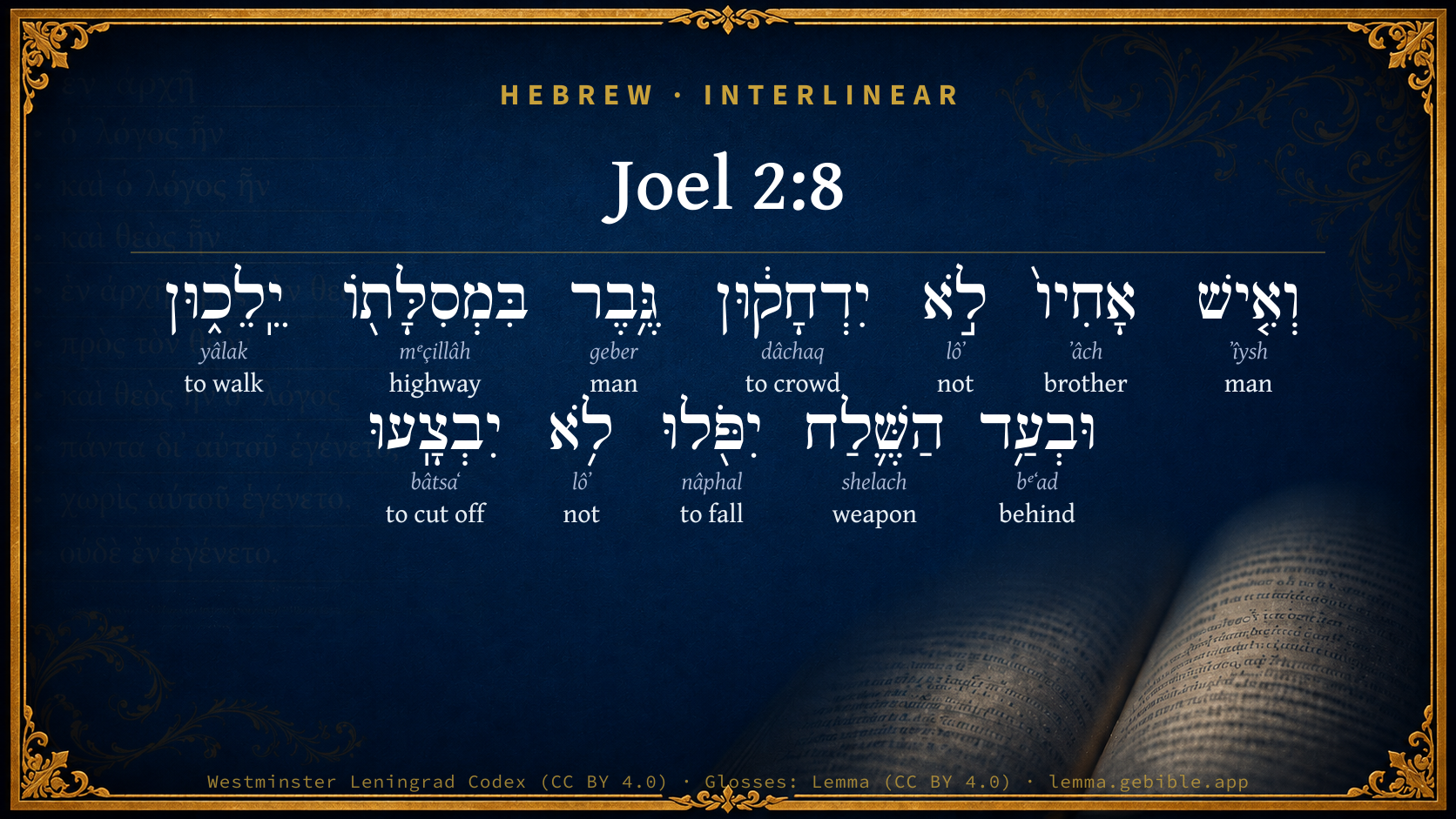
Hebrew (Westminster Leningrad Codex) Joel 2:8 appears in the Hebrew Old Testament. The text above is from the Westminster Leningrad Codex. Each word links to its Strong’s number, a concise gloss, and parsing drawn from the Open Scriptures Hebrew Bible morphology. Click any word for its full Brown-Driver-Briggs (BDB) entry.
Download image
Cite this verse

Joel 2:8 (World English Bible). Public Domain. Lemma interlinear Bible study tool, https://lemma.gebible.app/v/joel/2/8.

Show BibTeX & RIS
BibTeX
RIS
English Translation
Neither does one jostle another; They march everyone in his path, And they burst through the defenses, And don't break ranks.
World English Bible · Public Domain
Download a study sheet

One document with this verse’s original text, its word-by-word gloss line, the meaning frame, cross-references with their text, attributed commentary, and full source and license credits — printable, and it pastes into notes with its structure intact.

This verse Autodidact and up

Study sheet (.html) Plain text (.txt)

A passage Seminary Student

Up to 50 verses in one chapter. A passage sheet keeps up to 6 commentary sources and 12 cross-references per verse, in the order this page ranks them, and says so on the sheet whenever that leaves anything out. Ask for a single verse and you get the Autodidact verse sheet above.

Everything on this page stays free to read, with no account — the sheet is a download of what is already on screen, not access to it.

Want to remove ads? Support Godless Engineer
Compare translations 3

The same verse in 3 English versions, stacked beneath the original-language interlinear above. Click any original word for its lexicon entry.

Each is an independent rendering of the whole verse — the interlinear is not word-aligned to these translations.

Highlighted words mark where these versions differ — a whole-verse word diff, not a word-by-word alignment.

  • World English Bible Public Domain
    Neither does one jostle another; They march everyone in his path, And they burst through the defenses, And don't break ranks.
  • King James Version Public Domain
    Neither shall one thrust another; they shall walk every one in his path: and when they fall upon the sword, they shall not be wounded.
  • unfoldingWord Literal Text CC BY-SA 4.0
    And a man does not crowd his brother; they walk, a man in his road. Among the weapons they fall, and they do not break off.

unfoldingWord Literal Text — © unfoldingWord, licensed CC BY-SA 4.0. Word-aligned USFM3 via Door43 (git.door43.org/unfoldingWord/en_ult).

Versions to compare (up to 4)

3 of 4 selected

Show all 18 translations

Every available English version of this verse, each an independent rendering of the whole verse.

  • World English Bible Public Domain
    Neither does one jostle another; They march everyone in his path, And they burst through the defenses, And don't break ranks.
  • Berean Standard Bible Public Domain
    They do not jostle one another; each proceeds in his path. They burst through the defenses, never breaking ranks.
  • Majority Standard Bible Public Domain
    They do not jostle one another; each proceeds in his path. They burst through the defenses, never breaking ranks.
  • King James Version Public Domain
    Neither shall one thrust another; they shall walk every one in his path: and when they fall upon the sword, they shall not be wounded.
  • American Standard Version (1901) Public Domain
    Neither doth one thrust another; they march every one in his path; and they burst through the weapons, and break not off `their course'.
  • Revised Version (1885) Public Domain
    Neither doth one thrust another; they march every one in his path: and they burst through the weapons, and break not off their course.
  • Geneva Bible (1599) Public Domain
    Neither shall one thrust another, but euery one shall walke in his path: and when they fall vpon the sword, they shall not be wounded.
  • Douay-Rheims (1899) Public Domain
    No one shall press upon his brother: they shall walk every one in his path: yea, and they shall fall through the windows, and shall take no harm.
  • Young's Literal Translation Public Domain
    And each his brother they press not, Each in his way they go on, If by the missile they fall, they are not cut off.
  • Literal Standard Version CC BY-SA 4.0
    And each does not press his brother, || They each go on in his way, || If they fall by the missile, they are not cut off.
  • Unlocked Literal Bible CC BY-SA 4.0
    Neither does one thrust another aside; they march, each in his path; they break through the defenses and do not fall out of line.
  • unfoldingWord Literal Text CC BY-SA 4.0
    And a man does not crowd his brother; they walk, a man in his road. Among the weapons they fall, and they do not break off.
  • Darby Bible Public Domain
    Neither doth one press upon another; they march every one in his path; and fall amid weapons, but are not wounded.
  • World Messianic Bible Public Domain
    One doesn’t jostle another. They each march in their own path. They burst through the defenses and don’t break ranks.
  • Webster's Bible Public Domain
    Neither shall one thrust another; they shall walk every one in his path: and when they fall upon the sword, they shall not be wounded.
  • Free Bible Version CC BY-SA 4.0
    They do not jostle one another, they stay on track; and even if some are cut down, they are not stopped.
  • Bible in Basic English Public Domain
    No one is pushing against another; everyone goes straight on his way: bursting through the sword points, their order is not broken.
  • JPS Tanakh (1917) Public Domain
    Neither doth one thrust another, they march every one in his highway; and they break through the weapons, and suffer no harm.

Literal Standard Version (2020), Covenant Press — licensed CC BY-SA 4.0. Text via the HelloAO Bible API (eBible.org). Unlocked Literal Bible (unfoldingWord) — licensed CC BY-SA 4.0. Text via the HelloAO Bible API (eBible.org). unfoldingWord Literal Text — © unfoldingWord, licensed CC BY-SA 4.0. Word-aligned USFM3 via Door43 (git.door43.org/unfoldingWord/en_ult). Free Bible Version, Dr. Jonathan Gallagher — licensed CC BY-SA 4.0. Text via the HelloAO Bible API (eBible.org).

Word by word

More ways to search: Search by grammar → Find every occurrence → Compare this word →

Practice this passage: Drill this verse → Learn its vocabulary →

יִדְחָק֔וּן
dâchaq
H1766
“to crowd”
Verb, Qal, Imperfect, 3rd Person, Masculine, Plural + Suffix, n
Part of Speech
Verb
Stem
Qal
Form
Imperfect
Person
3rd Person
Gender
Masculine
Number
Plural
Full BDB Definition

Origin: a primitive root

TWOT: 424

to thrust, oppress, crowd - (Qal) to thrust, crowd
  1. וְאִ֤ישׁ ʼîysh H376 “and · man” Conjunction + Noun, Common, Masculine, Singular, Absolute
  2. אָחִיו֙ ʼâch H251 “brother · his” Noun, Common, Masculine, Singular, Construct + Suffix, Personal, 3rd Person, Masculine, Singular
  3. לֹ֣א lôʼ H3808 “not” Particle, Negative
  4. גֶּ֥בֶר geber H1397 “man” Noun, Common, Masculine, Singular, Absolute
  5. בִּמְסִלָּת֖וֹ mᵉçillâh H4546 “in/at · highway · his” Preposition + Noun, Common, Feminine, Singular, Construct + Suffix, Personal, 3rd Person, Masculine, Singular
  6. יֵֽלֵכ֑וּן yâlak H3212 “to walk” Verb, Qal, Imperfect, 3rd Person, Masculine, Plural + Suffix, n
  7. וּבְעַ֥ד bᵉʻad H1157 “and · behind” Conjunction + Preposition
  8. הַשֶּׁ֛לַח shelach H7973 “the · weapon” Particle, Definite Article + Noun, Common, Masculine, Singular, Absolute
  9. יִפֹּ֖לוּ nâphal H5307 “to fall” Verb, Qal, Imperfect, 3rd Person, Masculine, Plural
  10. לֹ֥א lôʼ H3808 “not” Particle, Negative
  11. יִבְצָֽעוּ bâtsaʻ H1214 “to cut off” Verb, Qal, Imperfect, 3rd Person, Masculine, Plural

About this verse

These counts appear in no published source. They are computed here, from the morphology-tagged text and Lemma’s own curated glosses. What Lemma adds →

12
words
11
distinct lemmas
Prophets
section

Notable vocabulary

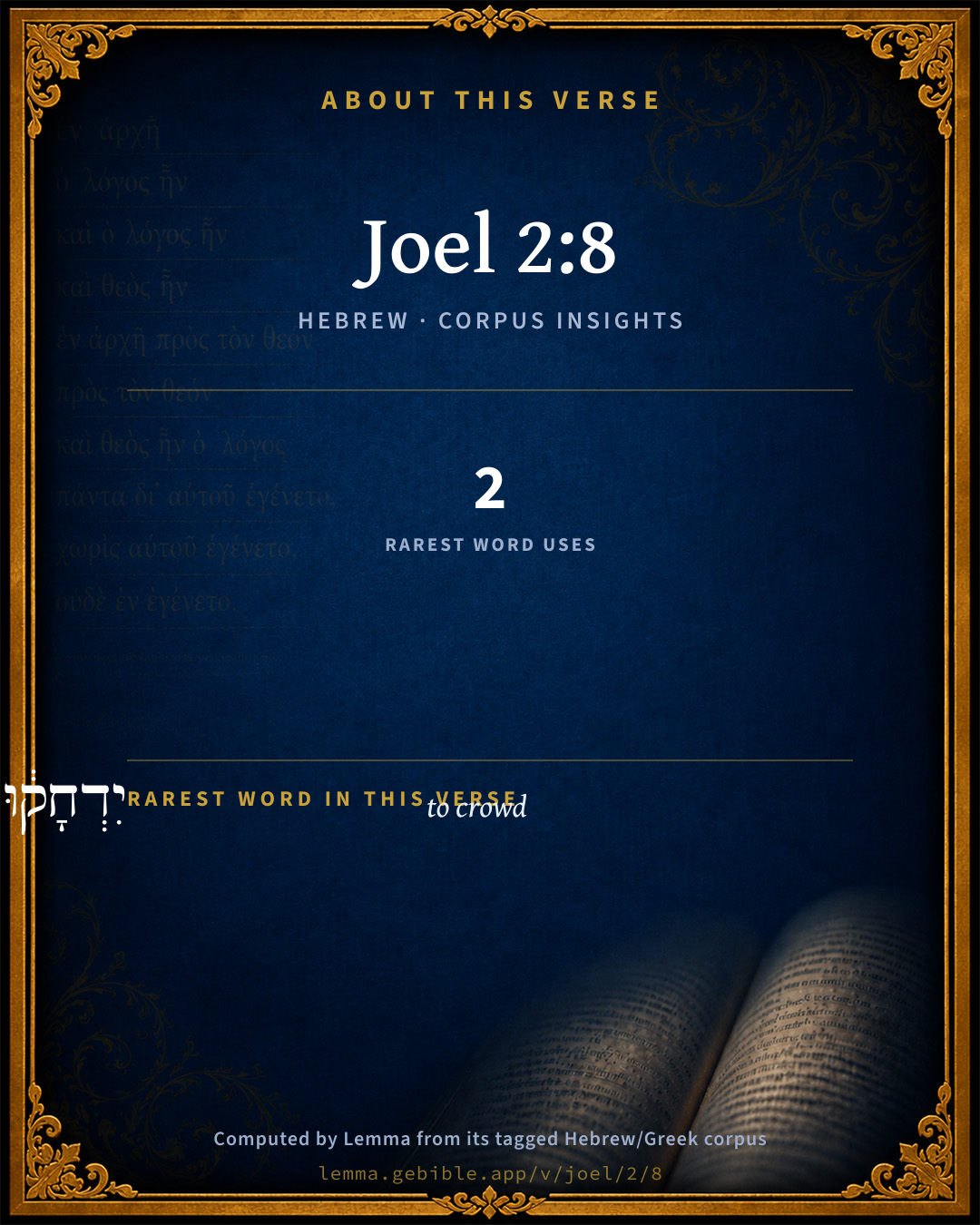
The rarest word here is יִדְחָק֔וּן to crowd H1766 — appearing just 2 times in the whole Hebrew Bible.

Shared distinctive vocabulary

יִדְחָק֔וּן to crowd H1766 occurs in 2 verses of the Hebrew Bible. Also found in:

Grammatical profile

  • 4 verbs
  • 5 nouns
  • 1 preposition
  • 2 particles

Verb forms

  • יִדְחָק֔וּן Qal · Imperfect
  • יֵֽלֵכ֑וּן Qal · Imperfect
  • יִפֹּ֖לוּ Qal · Imperfect
  • יִבְצָֽעוּ Qal · Imperfect

Repetition

A word recurs within this verse — often emphatic in Hebrew:

Hebrew & Septuagint length

In English translation the verse runs 21 words from the Hebrew and 32 from the Septuagint (LXX English) — the Septuagint runs noticeably longer here. See the side-by-side →

A rough comparison of the two English renderings, which tokenize alike — not a word-level alignment.

Word counts can differ between the Hebrew and the Greek without any difference in meaning — e.g. the Hebrew direct-object marker אֵת has no separate Greek word, and Greek often adds the article ὁ.

Cross-references

7

Topical passages linked to Joel 2:8 in the Treasury of Scripture Knowledge — connected by theme and wording, ordered by reader-vote popularity; previews shown in the World English Bible.

  • 2 Chronicles 23:10 He set all the people, every man with his weapon in his hand, from the right side of the house to the left side of the house, along by the altar and the house, by the king round about.
  • 2 Chronicles 32:5 He took courage, and built up all the wall that was broken down, and raised [it] up to the towers, and the other wall outside, and strengthened Millo [in] the city of David, and made weapons and shields in abundance.
  • Nehemiah 4:23 So neither I, nor my brothers, nor my servants, nor the men of the guard who followed me, none of us put off our clothes, everyone [went with] his weapon [to] the water.
  • Job 33:18 He keeps back his soul from the pit, And his life from perishing by the sword.
  • Nehemiah 4:17 They all built the wall and those who bore burdens loaded themselves; everyone with one of his hands worked in the work, and with the other held his weapon;
  • Job 36:12 But if they don't listen, they shall perish by the sword; They shall die without knowledge.
  • Song of Solomon 4:13 Your shoots are an orchard of pomegranates, with precious fruits: Henna with spikenard plants,

Cross-references courtesy of OpenBible.info (CC BY 4.0).

Hebrew and Greek witnesses Masoretic Hebrew ↔ Greek Septuagint

The same verse in the two great witnesses to the Old Testament, shown verse-for-verse.

Here the Septuagint runs noticeably longer than the Hebrew — LXX2012 (modern English Septuagint) 32 words vs World English Bible 21. A rough length comparison of the two English translations, not a word-level alignment — read both below.

These are two independent witnesses, not word-aligned to each other, and the Septuagint is shown in lemma (dictionary) form.

Hebrew Joel 2:8 Masoretic · Westminster Leningrad Codex

וְאִ֤ישׁ אָחִיו֙ לֹ֣א יִדְחָק֔וּן גֶּ֥בֶר בִּמְסִלָּת֖וֹ יֵֽלֵכ֑וּן וּבְעַ֥ד הַשֶּׁ֛לַח יִפֹּ֖לוּ לֹ֥א יִבְצָֽעוּ

Neither does one jostle another; They march everyone in his path, And they burst through the defenses, And don't break ranks.

World English Bible · Public Domain

Greek LXX Joel 2:8 Septuagint · lemma form

καί ἕκαστος ἀπό ὁ ἀδελφός αὐτός οὐ ἀποἔχω καταβαρύνω ἐν ὁ ὅπλον αὐτός πορεύομαι καί ἐν ὁ βέλος αὐτός πίπτω καί οὐ μή συντελέω

and not one shall stand aloof from his brother: they shall go on weighed down with their arms, and they fall upon their weapons, yet shall they in no wise be destroyed.

LXX2012 (modern English Septuagint) · Public Domain

On this verse, Haydock's Catholic Bible Commentary discusses the Septuagint’s reading. Read the note in Commentary ↓

Hebrew: Westminster Leningrad Codex (CC BY 4.0). Greek: Septuagint (public domain); English from LXX2012 (modern English Septuagint) (Public Domain). How the Septuagint differs from the Hebrew →

Targum (Aramaic paraphrase)

1

The Targum is the ancient Jewish Aramaic paraphrase of the Hebrew Scriptures — an interpretive translation, not the Hebrew text itself. Onkelos (literal) and Pseudo-Jonathan (expansive) render the Torah, and Jonathan the Prophets. Coverage is partial: where no permissively-licensed English translation exists for a verse, only the Aramaic is shown. This is verse-level text, not a word-by-word alignment to the Hebrew.

  1. Targum Jonathan Prophets (Joshua–Malachi)
    וּגְבַר אֲחוֹהִי לָא דָחֲקִין גְבַר בִּכְבִישֵׁיה אָזְלִין לַאֲתַר דְאִינּוּן שְׁלִיחִין קַטְלִין וְלָא מְקַבְּלִין מָמוֹן:

    (no public-domain English translation for this verse)

    Targum Jonathan — Aramaic: “Mikraot Gedolot” (public domain). English: “Sefaria Community Translation” (CC0 1.0 (public-domain dedication)); “London "Chaldee Paraphrase," 1871” (public domain). Text via Sefaria.

Commentary

Notes on Joel 2:8 from classic Christian and Jewish commentators (each source and its license shown beneath its notes). The classic Christian expositions comment on the surrounding passage and are grouped to its opening verse, so a note may address several verses; the Jewish commentaries on the Tanakh (Rashi and others) are per-verse, so they appear only where the commentator wrote on this verse.

Lemma curates 59 commentaries, every one of them public domain or Creative Commons licensed, each selected and text-cleaned for this edition rather than reprinted as found. About our sources →

Trapp's Complete Commentary

John Trapp

Joe 2:8 Neither shall one thrust another; they shall walk every one in his path: and [when] they fall upon the sword, they shall not be wounded.

Ver. 8. Neither shall one thrust another] Or straiten another. The Greek word διωκω, to press and persecute, seems to come from this Hebrew word Dakag. The prophet still alludeth to the matter of marshalling armies in such sort, as that neither may the soldiers hinder one another, nor the enemy have any advantage to break in upon them. Exercitus pulchre dispositus, et amicis pulcherrimus videtur, et hostibus inexpugnabilis, saith Xenophon (In Oeconom.); that is, a well ordered army seemeth both beautiful to their friends and invincible to their enemies.

They shall walk every one] Heb. גבר Man, mighty man, q.d. each locust shall walk and stalk, as a strong lusty man in his trodden track, in the path that God hath put him into, and shall hold to it. ( Vir validus, Mesillah, Via trita.)

And when they fall upon the sword] Heb. the long sword, or javelin, they shall not be wounded; as if they were unwoundable, or shot free, as the poet fabled of Achilles, and as the Persians, vanquished by the Athenians at the field of Marathon, cried out

Bαλλομεν, ου πιπτουσι τιτρωσκομεν, ου φοβεονται.

“We fell them, yet they fall not;

we them wound,

And think them dead, but they are

safe and sound” (Stobaeus).

John Trapp, A Commentary or Exposition upon All the Books of the Old and New Testament (1647–1656) — public domain. Text from a community e-Sword module.

The Biblical Illustrator

Joseph S. Exell

Joe_2:8

Neither shall one thrust another; they shall walk every one in his path.

Order is heavens first law

Reference is to the orderly march of locusts. Note the order which reigns throughout the whole of Gods world. After this fashion there should be order and arrangement in the Christian Church. Note the order of the movements of the heavenly bodies. The same law holds good with the whole animal creation. There is also order in the providence of God. An the events in our own little lives are marching straight on to a gracious consummation. We may rise higher; we may think of God Himself. We may say of all His attributes, neither doth one thrust another, but each one walketh in his path. The same order is perceptible in the doctrines of the Word. Doctrines which look as if they contradicted each other, are nevertheless fully agreed. Apply the lesson to the Christian life. We should remember that our thoughts, graces, and actions, ought all to keep their proper position. We ought to endeavour, as God shall teach us by His Spirit, to keep our thoughts of Gods Word in their due harmony. Doctrine is not all that is taught in the Word, there are duties and promises also. The same should hold good in the graces which we cultivate. The same proportions and balancings should be found in our Christian duties. God would have us attend to all duties. The difficulty is often felt as to how much is due to diligence in business, and how much to fervency in spirit. Each one must decide and draw the line for himself. There is a greater difficulty with regard to the arrangement of distinct duties, when they are likely to run counter to one another. What is true in the little commonwealth of the heart and home, ought also to be true of the Church at large. There are different orders of workers, and these must co-operate. (C. H. Spurgeon.)

The army of the locusts

I. They are very bold and daring. Some of the ancients have observed that the head of a locust is very like in shape to the head of a horse.

2. Very loud and noisy. Like the noise of chariots, of many chariots, when driven furiously over rough ground. Historians tell us that the noise made by swarms of locusts in those countries that are infested with them has sometimes been heard six miles off. The noise is compared to that of a roaring fire.

3. They are very regular, and keep ranks in their march. They shall march every one on his ways, straight forward, as if they had been trained up by the discipline of war to keep their post and observe their right-hand man. Their number and swiftness shall breed no confusion. See how God can make creatures to act by rule that have no reason to act by, when He designs to serve His own purposes by them. And see how necessary it is that those who are employed in any service for God should observe order and keep rank, should diligently go on in their own work, and not stand in one anothers way. (Matthew Henry.)

The Biblical Illustrator, edited by Joseph S. Exell (c. 1880s–1900s) — public domain. Text from a community e-Sword module.

Geneva Bible (1599)

Geneva Bible translators

For none shall be able to resist them.

Geneva Bible (1599) marginal notes — public domain. Text via Bolls.life.

Jamieson, Fausset & Brown

Robert Jamieson, A. R. Fausset & David Brown

Neither shall one thrust another--that is, press upon so as to thrust his next neighbor out of his place, as usually occurs in a large multitude.

when they fall upon the sword--that is, among missiles.

not be wounded--because they are protected by defensive armor [GROTIUS]. MAURER translates, "Their (the locusts') ranks are not broken when they rush among missiles" (compare Dan 11:22).

Jamieson, Fausset & Brown — Commentary Critical and Explanatory on the Whole Bible (1871) — public domain (CC PDM 1.0). Text via the HelloAO Bible API.

Adam Clarke's Commentary

Verse 8. They shall not be wounded.] They have hard scales like a coat of mail; but the expression refers to the utter uselessness of all means to prevent their depredations. See Shaw's account above.

Adam Clarke's Commentary on the Bible (1810–1826) — public domain. Text from a community e-Sword/MySword module.

John Calvin's Commentaries

He then adds, A man shall not push his brother. By this mode of speaking the Prophet means that they would come in perfect order, so that the multitude would create no confusion, as it is mostly the case: for it is very difficult for an army to march in regular order without tumult, like two or three men walking together. For when a hundred horsemen march together some commonly hinder others. When therefore so large a number assemble together, it can hardly be possible for them not to retard and impede one another. But the Prophet declares that this would not be the case with the Assyrians, for the Lord would direct their goings. Though then the Lord would bring so large a multitude, it would yet be so well arranged and in such order, that no one would push his companion, or be any hindrance to him. A man, he says, shall in his way proceed, even without any impediment.

And on swords they shall fall, and shall not be wounded: that is, they shall not only be strong men of war, so that they shall intrepidly face every kind of danger; but they shall also escape unhurt from all weapons; though they may rush on swords like madmen and show no care for themselves, they shall not yet be wounded. But this may be taken in a still simpler way, “They shall not be wounded” that is, as if they could not be wounded. And it seems to me to be the genuine sense of the Prophet, that they would not entertain any fear of death, so as cautiously to attack their enemies, but would with impunity provoke death itself by casting themselves on the very swords: they would not then fear any wound, but dare to face swords as if they were wholly harmless to them. Some render the word, “they shall not covet;” and then the word means as if the Prophet had said, that they would not be covetous of money. But this meaning can hardly suit this place; and we see that the best sense seems to be, that they would heedlessly rush on swords, as though they could not be wounded.

John Calvin's Commentaries (1540-1563) — public domain. Text from the Calvin Translation Society English edition (1840s-50s) via the Christian Classics Ethereal Library (ccel.org). Calvin's coverage is partial (roughly two-thirds of the Bible); uncommented books and verses are honest gaps, never fabricated. The 19th-century editor's footnotes and remarks are omitted so the notes are faithfully Calvin's own voice.

The Cambridge Bible for Schools and Colleges

gen. ed. J. J. S. Perowne

8. they move along every one in his highway] or raised way, specially prepared by throwing up earth, stones, &c., and then levelling the surface (Isa_40:3; Isa_57:14; Isa_62:10). Here figuratively for a definitely marked path.

and they fall about the weapons without breaking (their course)] i.e. weapons are powerless to arrest their progress: a few may fall wounded, when the sword is directed against them, but the mass moves on, with its ranks still unbroken. Similarly R.V. marg. The words are however difficult; and this explanation cannot be said to be certain. R.V. renders the first clause (with Hitzig, Keil, and Wellhausen) “and they burst through (i.e. in between) the weapons,” viz. without injuring themselves, or having their progress impeded; but this implies a rather doubtful paraphrase of fall. The rendering of A.V. is not tenable.

weapons] not the usual word, but one (שׁלח) which otherwise occurs only in late writings, viz. 2Ch_23:10 (where the parallel passage 2Ki_11:11 has the ordinary word כלים), 2Ch_32:5 (no parallel in Kings); Neh_4:11; Neh_4:17 [A.V. 17, 23]; Job_33:18; Job_36:12. Silâḥ in Arabic has the same sense.

It is practically impossible[38] to arrest or divert the advance of a body of locusts. “The guard of the Red Tower attempted to stop their irruption into Pennsylvania by firing at them; and indeed when the balls and shot swept through the swarm, they gave way and divided; but having filled up their ranks in a moment, they proceeded on their journey.” When locusts on the march approach a village, the inhabitants endeavour often to stop their advance by kindling fires, or digging trenches and filling them with water, but to little effect (see pp. 88 ff.): a flight of locusts is however sometimes deterred from alighting by the noise of pots and pans, kettles, drums, &c.

[38] Except indeed by elaborate contrivances such as are in use now in Cyprus.

The Cambridge Bible for Schools and Colleges (gen. ed. J. J. S. Perowne; Cambridge University Press, 1878–1918) — public domain. Text from a community e-Sword module.

John Gill's Exposition

Neither shall one thrust another,.... Press upon another, thrust him out of his place, or push him forward, or any ways straiten and distress him, or in the least hinder him in his progress:

they shall walk everyone in his path; or "highway" (o); everyone should have his path, and keep in it, and it should be as roomy to him as if he had a highway to walk in by himself, and in which he could not err:

and when they shall fall upon the sword; on which they would pitch without any fear or dread of it:

they shall not be wounded: or "cut to pieces" (p) by it; it not being easy for the sword to pierce and cut them, through the smoothness and smallness of their bodies; see Rev 9:9; and besides, their numbers being so great, the loss of a few by the use of a sword, or a dart, or any such flying projectile, as the word (q) signifies, would be of little consequence, and avail very little to the utter rout, or cutting of them in pieces. Kimchi observes that the word signifies haters of gain; and to this sense Jarchi explains it; and so the Targum,

"they go to the place whither they are sent, they slay, and receive not mammon;''

they are not, as other enemies, to be appeased by money, as Kimchi interprets it. The Targum is, they are not to be bribed, as soldiers sometimes may be, and so depart; see Isa 13:17; and to this sense are other versions (r).

(o) "per aggerem suum", Junius & Tremellius, Piscator; "via elevata", Drusius; "via strata sua", Cocceius. (p) "verbum significat discidit", Amos ix. 1. Tarnovius, so Ben Melech. (q) "per missile", Cocceius; so Bochartus, Castalio, Drusius, Burkius; "super missile", Montanus. (r) "Non avari erunt", Montanus; "nec lucro inhiant", Tigurine version; "non studebunt avaritiae", so some in Vatablus.

John Gill's Exposition of the Whole Bible (1746–1763) — public domain (CC PDM 1.0). Text via the HelloAO Bible API.

Albert Barnes' Notes on the Bible

When they fall upon the sword - (literally, “among the darts”) they shall not be wounded It may be that the prophet would describe how the locust seems armed as in a suit of armor. As one says , “Their form was wondrous; they had a sort of gorget round their neck like a lancer, and a helm on their head, such as soldiers wear.” But, more, he exhibits their indomitableness and impenetrableness, how nothing checks, nothing retards, nothing makes any impression upon them. : “They do not suffer themselves to be impeded by any obstacles, but fly boldly on, and are drowned in the sea when they come to it.” : “When on a march during the day, it is utterly impossible to turn the direction of a troop, which is generally with the wind.” : “The guard of the Red Town attempted to stop their irruption into Transylvania by firing at them; and indeed when the balls and shot swept through the swarm, they gave way and divided; but having filled up their ranks in a moment, they proceeded on their journey.”

And in like way of the young swarms ; “The inhabitants, to stop their progress, made trenches all over their fields and gardens and filled them with water; or else, placing in a row great quantities of heath, stubble, and such like combustible matter, they set them on fire on the approach of the locusts. But all this was to no purpose, for the trenches were quickly filled up, and the fires put out by infinite swarms, succeeding one another; while the front seemed regardless of danger, and the van pressed on so close, that a retreat was impossible.” : “Like waves, they roll over one another on and on, and let themselves be stopped by nothing. Russians and Germans try many means with more or less success against them, when they come from the waste against the grainlands. Bundles of straw are laid in rows and set on fire before them; they march in thick heaps into the fire, but this is often put out thro’ the great mass of the animals and those advancing from behind march away over the corpses of their companions, and continue the march.” : “Their number was astounding; the whole face of the mountain was black with them. On they came like a living deluge. We dug trenches, and kindled fires, and beat and burned to death heaps upon heaps, but the effort was utterly useless. wave after wave rolled up the mountain side, and poured over rocks, walls, ditches and hedges, those behind covering up and bridging over the masses already killed. After a long and fatiguing contest, I descended the mountain to examine the depth of the column, but I could not see to the end of it.” “It was perfectly appalling to watch this animated river, as it flowed up the road and ascended the hill.”

Both in ancient and modern times, armies have been marched against them ; but in vain, unless they destroyed them, before they were full-grown.

Since the very smallest of God’s judgments are thus irreversible, since creatures so small cannot be turned aside, since we cannot turn away the time of one of the least of our Master’s servants, since they are each as a “man of might”, (so he calls them, it is the force of the word rendered “each”) what of the greater? what of the whole?

Albert Barnes' Notes on the Bible (1834–1885) — public domain. Text from a community e-Sword/MySword module.

Haydock's Catholic Bible Commentary

Brother. St. Jerome saw a cloud of them in Judea. They were not "a finger-nail’s breadth from each other." (Calmet) --- The Arabs discover the military art in them. (Bochart) --- They invested France (the year of the Lord 874) with all the skill of an army, the chiefs marking out the place for the camp the night before. (Sigebert.) --- Windows. They eat the wood, (Haydock) and the windows were simple lattices or curtains. (Calmet) --- Hebrew, "they fall upon the sword, and shall not be hurt." Septuagint, "consumed or filled." (Haydock) --- They are never satisfied. (Theodoret)

George Leo Haydock (1774–1849), Haydock's Catholic Family Bible and Commentary, 1859 edition — public domain. Excludes Psalms (Douay-Rheims chapter numbering differs from Protestant) and Deuterocanonical books (Catholic canon only).

Matthew Poole's English Annotations

Neither shall one thrust another: the prophet, in pursuance of the allegory, tells us how this army of locusts do move without disorder; so shall they who are hereby typified; it is much the same with the last clause of the former verse.

They shall walk; before it was run, i.e. for speed, now it is walk, for stedfast and even motion.

Every one in his path; the track he first takes to, follow his leader exactly, and observe rank and file.

When they fall upon the sword, they shall not be wounded; the sword shall not be a weapon to destroy them, they shall run among swords, yet not be wounded; literally verified in the locusts, and verified in the strange preservations and escapes from dangers in midst of the most desperate adventures made by Assyrians or Babylonians.

Matthew Poole's English Annotations on the Holy Bible (1683–1685) — public domain. Text from a community e-Sword/MySword module.

The Pulpit Commentary

Neither shall one thrust another; they shall walk every one in his path. "And not one shall stand aloof from his brother." This is either the sequence of their not breaking rank, or perhaps it is a co-ordinate particular in the detail. They neither straggle away from each other, and so fall out of rank, nor do they crowd and crush and press each other while keeping rank. The order of their march is perfect, every one keeping his proper place and in the proper path. And when they fall upon the sword (margin, dart), they shall not be wounded. The meaning is either

(1) that the weapons shall not wound them, or intransitively, as in the text, they shall not be wounded, xK, to cut, or break in pieces, being here synonymous with xp, to wound; or

(2) that they do not cut off, break off, or interrupt their course. No force of arms can stay their progress or step their advance. On this clause Kimchi remarks, "This army is not like other enemies, which you may hinder by the sword from coming upon you; but these light upon the swords, and are not wounded by reason of their lightness? He also remarks on rbG, "Because he compares them with men and heroes, he uses rbG, although this word does not apply except to the sons of men."

The Pulpit Commentary (1880–1919), ed. H.D.M. Spence-Jones & Joseph S. Exell — public domain. Text from a community e-Sword module.

John Wesley's Explanatory Notes

The sword - The sword shall not be a weapon to destroy them; literally verified in the locusts, and verified in the strange preservations in the most desperate adventures made by the Assyrians or Babylonians.

John Wesley, Explanatory Notes Upon the Whole Bible (1754–1765) — public domain. Text via the GEBible commentary corpus.

unfoldingWord translationNotes

Door43 World Missions Community

General Information:

The description of the locust army of Yahweh continues.

they break through the defenses

they overcome the soldiers defending the city.

unfoldingWord translationNotes — © Distant Shores Media and the Door43 World Missions Community, licensed CC BY-SA 4.0. Source: git.door43.org/Door43/en_tn.

Rashi

Rabbi Shlomo Yitzchaki (Rashi)

and upon the swords Heb. וּבְעַד הַשֶּׁלַח, (verse 9) “through the windows (בְּעַד הַחַלוֹנִים).” Upon the weapons they fall and camp.

they do not receive monetary gain Heb. לֹא יִבְצָעוּ. They do not receive monetary gain. And Jonathan interpreted it (הַשֶּׁלַח) as an expression of an errand. Because of the errand of the Holy One, blessed be He, they cast themselves down, and they do not receive monetary gain.

Rashi on the Tanakh — English translations: “The Judaica Press complete Tanach with Rashi, translated by A. J. Rosenberg” (CC BY 4.0); “Pentateuch with Rashi's commentary by M. Rosenbaum and A.M. Silbermann, 1929-1934” (public domain); “The Metsudah Tanach series, Lakewood, N.J” (CC BY 4.0); and “The Book of Joshua, Metsudah Publications, 1997” (CC BY 4.0). Text via Sefaria.

Lesson kit

Teaching starters — assembled from the data on this page, not authored interpretation. Every prompt links to the verse data it draws on. Edit before teaching.

Joel, in the Prophets, opens this verse with 12 words (11 distinct Hebrew lemmas). Its most distinctive word is dâchaq (“to crowd”). The Greek Septuagint runs longer here. A historical commentator’s framing appears above. Read the whole chapter for the surrounding context.

Discussion questions

  1. What does “to crowd” (dâchaq) contribute to the verse as a whole?
  2. Judges 2:18 shares the word «to crowd» with this verse. How do the two illuminate each other?
  3. “not” occurs 2× in this one verse. What is the effect of the repetition?
  4. Compared with the Hebrew, the Septuagint runs longer here. What questions does that raise?
  5. These translations render this verse differently. What is at stake in choosing one wording over another?
  6. The verb «יִדְחָק֔וּן» is Qal Imperfect. How does its form color the action?
  7. Reading how Trapp's Complete Commentary and The Biblical Illustrator read this verse, where do the two commentators agree and where do they part?

Things to notice

Reading settings

Reading text

Shown beneath each verse's original-language words.

Old Testament
Old Testament edition

Read the OT as the Masoretic Hebrew (MT) or the Greek Septuagint (LXX).

English shown for the Greek Septuagint (in the Hebrew ↔ Greek comparison).

Comparing translations? Open the Compare panel on any verse page to stack up to four side by side.