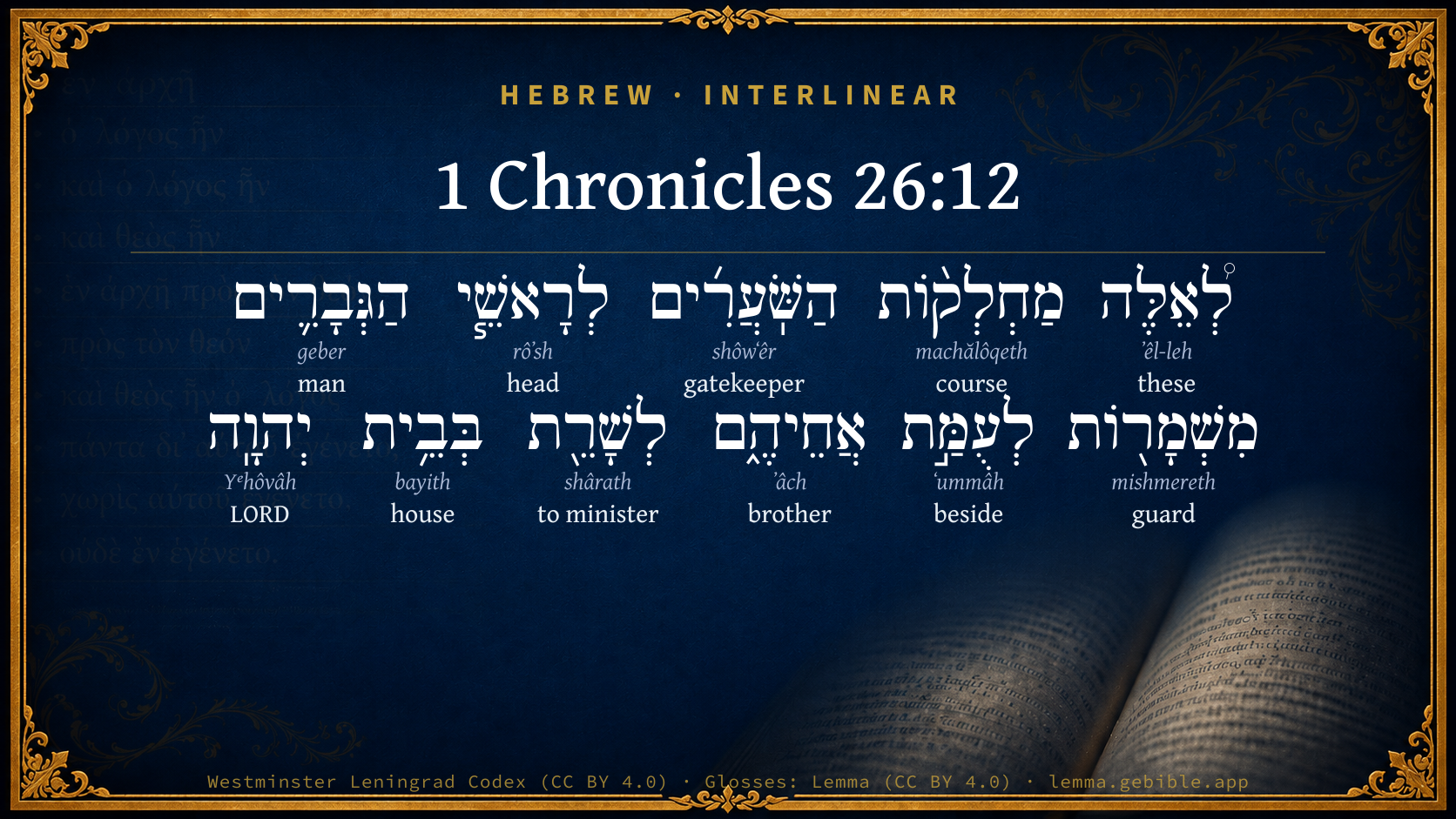
1 Chronicles 26:12

Hebrew (Westminster Leningrad Codex) 1 Chronicles 26:12 appears in the Hebrew Old Testament. The text above is from the Westminster Leningrad Codex. Each word links to its Strong’s number, a concise gloss, and parsing drawn from the Open Scriptures Hebrew Bible morphology. Click any word for its full Brown-Driver-Briggs (BDB) entry.
Download image
Cite this verse

1 Chronicles 26:12 (World English Bible). Public Domain. Lemma interlinear Bible study tool, https://lemma.gebible.app/v/1-chronicles/26/12.

Show BibTeX & RIS
BibTeX
RIS
English Translation
Of these were the divisions of the doorkeepers, even of the chief men, having offices like their brothers, to minister in the house of Yahweh.
World English Bible · Public Domain
Download a study sheet

One document with this verse’s original text, its word-by-word gloss line, the meaning frame, cross-references with their text, attributed commentary, and full source and license credits — printable, and it pastes into notes with its structure intact.

This verse Autodidact and up

Study sheet (.html) Plain text (.txt)

A passage Seminary Student

Up to 50 verses in one chapter. A passage sheet keeps up to 6 commentary sources and 12 cross-references per verse, in the order this page ranks them, and says so on the sheet whenever that leaves anything out. Ask for a single verse and you get the Autodidact verse sheet above.

Everything on this page stays free to read, with no account — the sheet is a download of what is already on screen, not access to it.

Want to remove ads? Support Godless Engineer
Compare translations 3

The same verse in 3 English versions, stacked beneath the original-language interlinear above. Click any original word for its lexicon entry.

Each is an independent rendering of the whole verse — the interlinear is not word-aligned to these translations.

Highlighted words mark where these versions differ — a whole-verse word diff, not a word-by-word alignment.

  • World English Bible Public Domain
    Of these were the divisions of the doorkeepers, even of the chief men, having offices like their brothers, to minister in the house of Yahweh.
  • King James Version Public Domain
    Among these were the divisions of the porters, even among the chief men, having wards one against another, to minister in the house of the LORD.
  • unfoldingWord Literal Text CC BY-SA 4.0
    To these divisions of the gatekeepers, to the heads of the men, a duty like their brothers to minister in the house of Yahweh.

unfoldingWord Literal Text — © unfoldingWord, licensed CC BY-SA 4.0. Word-aligned USFM3 via Door43 (git.door43.org/unfoldingWord/en_ult).

Versions to compare (up to 4)

3 of 4 selected

Show all 18 translations

Every available English version of this verse, each an independent rendering of the whole verse.

  • World English Bible Public Domain
    Of these were the divisions of the doorkeepers, even of the chief men, having offices like their brothers, to minister in the house of Yahweh.
  • Berean Standard Bible Public Domain
    These divisions of the gatekeepers, through their chief men, had duties for ministering in the house of the LORD, just as their brothers did.
  • Majority Standard Bible Public Domain
    These divisions of the gatekeepers, through their chief men, had duties for ministering in the house of the LORD, just as their relatives did.
  • King James Version Public Domain
    Among these were the divisions of the porters, even among the chief men, having wards one against another, to minister in the house of the LORD.
  • American Standard Version (1901) Public Domain
    Of these were the courses of the doorkeepers, even of the chief men, having offices like their brethren, to minister in the house of Jehovah.
  • Revised Version (1885) Public Domain
    Of these were the courses of the doorkeepers, even of the chief men, having charges like as their brethren, to minister in the house of the LORD.
  • Geneva Bible (1599) Public Domain
    Of these were the diuisions of the porters of the chiefe men, hauing the charge against their brethren, to serue in the house of the Lord.
  • Douay-Rheims (1899) Public Domain
    Among these were the divisions of the porters, so that the chiefs of the wards, as well as their brethren, always ministered in the house of the Lord.
  • Young's Literal Translation Public Domain
    According to these `are' the courses of the gatekeepers; to the heads of the mighty ones `are' charges over-against their brethren, to minister in the house of Jehovah,
  • Literal Standard Version CC BY-SA 4.0
    For these [are] the divisions of the gatekeepers, of the heads of the mighty ones, [with] charges just as their brothers, to minister in the house of YHWH,
  • Unlocked Literal Bible CC BY-SA 4.0
    These divisions of the gatekeepers, corresponding to their leaders, had responsibilities, like their relatives, to serve in Yahweh's house.
  • unfoldingWord Literal Text CC BY-SA 4.0
    To these divisions of the gatekeepers, to the heads of the men, a duty like their brothers to minister in the house of Yahweh.
  • Darby Bible Public Domain
    Among these were the divisions of the doorkeepers, among the head-men, as to the charges together with their brethren, for performing the service in the house of Jehovah.
  • World Messianic Bible Public Domain
    Of these were the divisions of the doorkeepers, even of the chief men, having offices like their brothers, to minister in the LORD’s house.
  • Webster's Bible Public Domain
    Among these were the divisions of the porters, even among the chief men, having wards one against another, to minister in the house of the LORD.
  • Free Bible Version CC BY-SA 4.0
    These divisions of the gatekeepers, through their family leaders, served in the house of the Lord, just like their brothers.
  • Bible in Basic English Public Domain
    Of these were the divisions of the door-keepers, men of authority, having responsible positions like their brothers to be servants in the house of the Lord.
  • JPS Tanakh (1917) Public Domain
    These courses of the doorkeepers, even the chief men, had wards over against their brethren, to minister in the house of the LORD.

Literal Standard Version (2020), Covenant Press — licensed CC BY-SA 4.0. Text via the HelloAO Bible API (eBible.org). Unlocked Literal Bible (unfoldingWord) — licensed CC BY-SA 4.0. Text via the HelloAO Bible API (eBible.org). unfoldingWord Literal Text — © unfoldingWord, licensed CC BY-SA 4.0. Word-aligned USFM3 via Door43 (git.door43.org/unfoldingWord/en_ult). Free Bible Version, Dr. Jonathan Gallagher — licensed CC BY-SA 4.0. Text via the HelloAO Bible API (eBible.org).

Word by word

More ways to search: Search by grammar → Find every occurrence → Compare this word →

Practice this passage: Drill this verse → Learn its vocabulary →

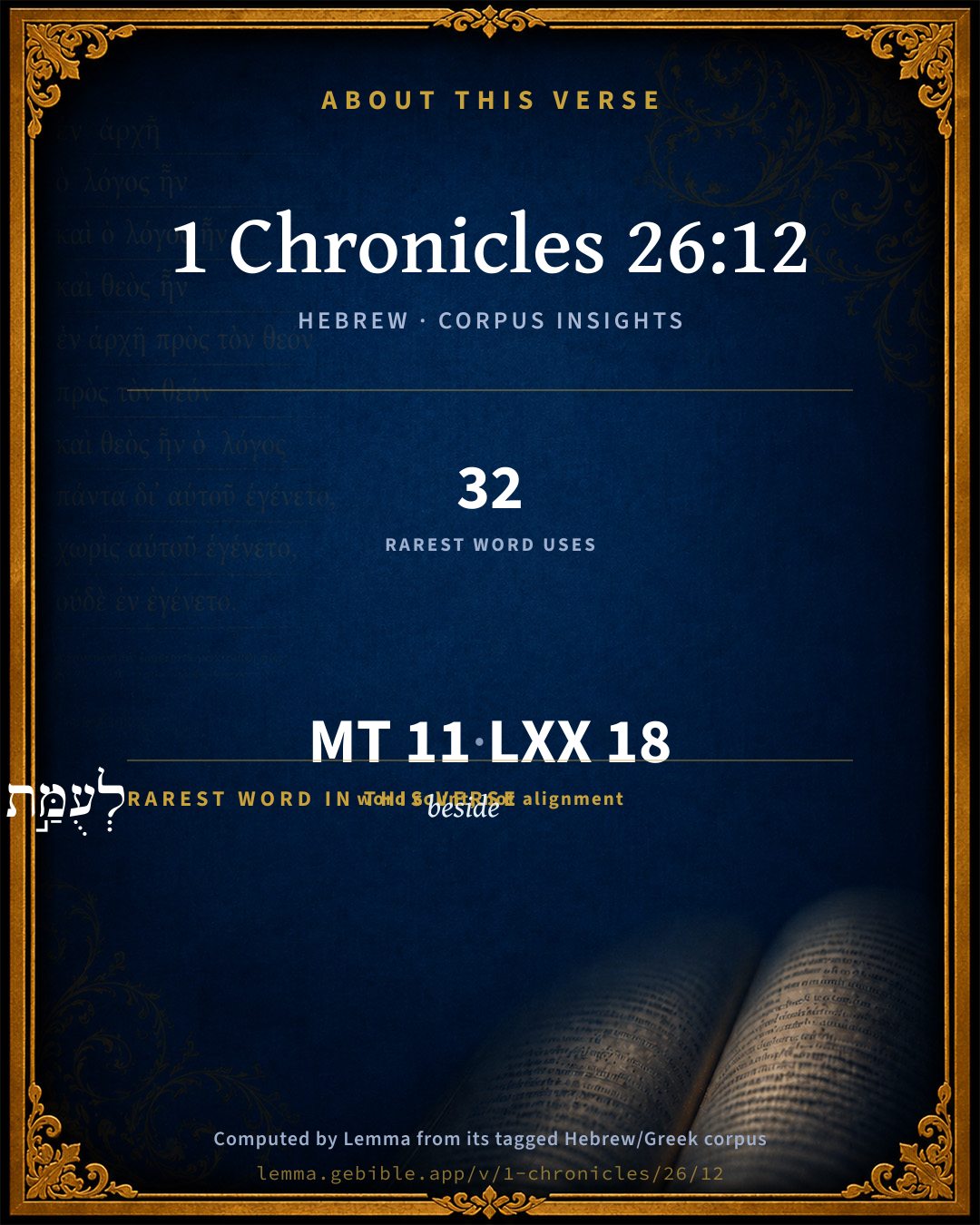
לְעֻמַּ֣ת
ʻummâh
H5980
“to/for · beside of”
Preposition + Noun, Common, Feminine, Singular, Construct
Part of Speech
Preposition + Noun
Type
Common
Gender
Feminine
Number
Singular
State
Construct
Full BDB Definition

Origin: from H6004

TWOT: 1640f

juxtaposition - used only as a preposition - close by, side by side with, alongside of, parallel with - agreeing with, corresponding to, exactly as, close beside - correspondingly to
  1. לְ֠אֵלֶּה ʼêl-leh H428 “to/for · these” Preposition + Pronoun, Demonstrative, Common, Plural
  2. מַחְלְק֨וֹת machălôqeth H4256 “courses of” Noun, Common, Feminine, Plural, Construct
  3. הַשֹּֽׁעֲרִ֜ים shôwʻêr H7778 “the · gatekeepers” Particle, Definite Article + Noun, Common, Masculine, Plural, Absolute
  4. לְרָאשֵׁ֧י rôʼsh H7218 “to/for · heads of” Preposition + Noun, Common, Masculine, Plural, Construct
  5. הַגְּבָרִ֛ים geber H1397 “the · men” Particle, Definite Article + Noun, Common, Masculine, Plural, Absolute
  6. מִשְׁמָר֖וֹת mishmereth H4931 “guards” Noun, Common, Feminine, Plural, Absolute
  7. אֲחֵיהֶ֑ם ʼâch H251 “brothers · their” Noun, Common, Masculine, Plural, Construct + Suffix, Personal, 3rd Person, Masculine, Plural
  8. לְשָׁרֵ֖ת shârath H8334 “to minister” Preposition + Verb, Piel, Infinitive Construct
  9. בְּבֵ֥ית bayith H1004 “in/at · house of” Preposition + Noun, Common, Masculine, Singular, Construct
  10. יְהוָֽה Yᵉhôvâh H3068 “LORD” Noun, Proper

About this verse

These counts appear in no published source. They are computed here, from the morphology-tagged text and Lemma’s own curated glosses. What Lemma adds →

11
words
11
distinct lemmas
Historical
section

Shared distinctive vocabulary

לְעֻמַּ֣ת beside H5980 occurs in 28 verses of the Hebrew Bible. Also found in:

Grammatical profile

  • 1 verb
  • 9 nouns
  • 1 pronoun

Verb forms

  • לְשָׁרֵ֖ת Piel · Infinitive Construct

Hebrew & Septuagint length

In English translation the verse runs 25 words from the Hebrew and 30 from the Septuagint (LXX English) — closely comparable.

A rough comparison of the two English renderings, which tokenize alike — not a word-level alignment.

Word counts can differ between the Hebrew and the Greek without any difference in meaning — e.g. the Hebrew direct-object marker אֵת has no separate Greek word, and Greek often adds the article ὁ.

In the original languages it is 11 Hebrew tokens and 18 Greek tokens — but the two are counted differently (Hebrew bundles its prefixes and suffixes into one token; the Greek is in lemma form), so that isn’t a like-for-like length.

Cross-references

1

Topical passages linked to 1 Chronicles 26:12 in the Treasury of Scripture Knowledge — connected by theme and wording, ordered by reader-vote popularity; previews shown in the World English Bible.

  • 1 Chronicles 25:8 They cast lots for their offices, all alike, as well the small as the great, the teacher as the scholar.

Cross-references courtesy of OpenBible.info (CC BY 4.0).

Hebrew and Greek witnesses Masoretic Hebrew ↔ Greek Septuagint

The same verse in the two great witnesses to the Old Testament, shown verse-for-verse.

These are two independent witnesses, not word-aligned to each other, and the Septuagint is shown in lemma (dictionary) form.

Hebrew 1 Chronicles 26:12 Masoretic · Westminster Leningrad Codex

לְ֠אֵלֶּה מַחְלְק֨וֹת הַשֹּֽׁעֲרִ֜ים לְרָאשֵׁ֧י הַגְּבָרִ֛ים מִשְׁמָר֖וֹת לְעֻמַּ֣ת אֲחֵיהֶ֑ם לְשָׁרֵ֖ת בְּבֵ֥ית יְהוָֽה

Of these were the divisions of the doorkeepers, even of the chief men, having offices like their brothers, to minister in the house of Yahweh.

World English Bible · Public Domain

Greek LXX 1 Chronicles 26:12 Septuagint · lemma form

οὗτος ὁ διαίρεσις ὁ πύλη ὁ ἄρχων ὁ δυνατός ἐφημερία καθώς ὁ ἀδελφός αὐτός λειτουργέω ἐν οἶκος κύριος

To these were assigned the divisions of the gates, to the chiefs of the mighty men the daily courses, even their brethren, to minister in the house of the Lord.

LXX2012 (modern English Septuagint) · Public Domain

Hebrew: Westminster Leningrad Codex (CC BY 4.0). Greek: Septuagint (public domain); English from LXX2012 (modern English Septuagint) (Public Domain). How the Septuagint differs from the Hebrew →

Commentary

Notes on 1 Chronicles 26:12 from classic Christian and Jewish commentators (each source and its license shown beneath its notes). The classic Christian expositions comment on the surrounding passage and are grouped to its opening verse, so a note may address several verses; the Jewish commentaries on the Tanakh (Rashi and others) are per-verse, so they appear only where the commentator wrote on this verse.

Lemma curates 59 commentaries, every one of them public domain or Creative Commons licensed, each selected and text-cleaned for this edition rather than reprinted as found. About our sources →

Joseph Benson's Commentary

1Ch 26:12. Wards — Hebrew, having wards answerably to their brethren the other Levites, who were divided into twenty-four courses, as the priests also, and the porters were.

Joseph Benson's Commentary on the Old and New Testaments (1811–1818) — public domain. Text from a community e-Sword module.

Geneva Bible (1599)

Geneva Bible translators

According to their turns as well the one as the other.

Or, courses.

Geneva Bible (1599) marginal notes — public domain. Text via Bolls.life.

Jamieson, Fausset & Brown

Robert Jamieson, A. R. Fausset & David Brown

Among these were the divisions of the porters, even among the chief men--These were charged with the duty of superintending the watches, being heads of the twenty-four courses of porters.

Jamieson, Fausset & Brown — Commentary Critical and Explanatory on the Whole Bible (1871) — public domain (CC PDM 1.0). Text via the HelloAO Bible API.

Adam Clarke's Commentary

Verse 12. The rest of this chapter, with the whole of the xxviiith, is wanting both in the Syriac and Arabic.

Adam Clarke's Commentary on the Bible (1810–1826) — public domain. Text from a community e-Sword/MySword module.

Ellicott's Commentary for English Readers

(12) Among these were the divisions of the porters.—Rather, To these, the courses (1Ch_23:6) of porters, that is, to the heads of the men (1Ch_24:4), were watches or charges (1Ch_25:8) in common with their brethren (1Ch_24:31), to minister in the house of Jehovah (1Ch_16:37). The statement of this verse makes it evident that the names in 1Ch_26:2-11 represent the courses of the porters or warders. As the twenty-four sons of Asaph, Heman, and Jeduthun represented the twenty-four courses of musicians in 1 Chronicles 25, a similar classification might naturally be expected here. Accordingly, we actually find seven sons of Meshelemiah (1Ch_26:2-3), eight sons of Obed-edom (1Ch_26:4-5), and four sons of Hosah (1Ch_26:10-11), which together make nineteen heads and classes. It remains to add the “sons” of Shemaiah son of Obed-edom. As the text stands, these appear to be six in number, which would give a total of twenty-five (7 + 8 + 4 + 6). But the connection of the Hebrew in 1Ch_26:7 is so unusual as to suggest at once that something is wrong: and if we assume Obed-Elzabad to represent one original composite name, like Obed-edom, we get five “sons of Shemaiah,” and so a total of twenty-four classes or courses of warders. (From this verse to the end of chapter 27 the Syriac and Arabic versions fail us.)

A Bible Commentary for English Readers, edited by Charles John Ellicott (1878–1897) — public domain. Text from a community e-Sword module.

The Cambridge Bible for Schools and Colleges

gen. ed. J. J. S. Perowne

12. Among these … another] R.V. Of these were the courses of the doorkeepers, even of the chief man, having charges like as their brethren. In 1Ch_26:8-9; 1Ch_26:11 taken together ninety-three doorkeepers are enumerated, who are presumably the heads of the four thousand mentioned in 1Ch_23:5. In 1Ch_9:22 again the total number (as it seems) of doorkeepers is given as two hundred and twelve. The discrepancy is probably due to the use of different documents belonging to different dates by the Chronicler.

The Cambridge Bible for Schools and Colleges (gen. ed. J. J. S. Perowne; Cambridge University Press, 1878–1918) — public domain. Text from a community e-Sword module.

John Gill's Exposition

And the lot eastward fell to Shelemiah,.... The same with Meshelemiah, Ch1 26:1 he by lot was placed at the eastern gate, called afterwards the gate Shushan, the city Shushan being portrayed upon it (u):

then for Zechariah his son (a wise counsellor); and who was his firstborn, Ch1 26:2 a man of great parts and learning: for they were not mean persons that were employed in this office, nor was the office a mean one, like that of our porters; but men of considerable rank and figure, and of knowledge and learning, were in it; some of them were judges, Ch1 26:29 and their places were places of great trust, they had much treasure committed to them, as appears by Ch1 26:20,

they cast lots, and his lot came out northward; where was a gate in later times, called Teri or Tedi, which differed from other gates in this, that it had no threshold, only one stone was laid upon another, and was not commonly used (w).

(u) Ib. (Misn. Middot, c. 1.), sect. 3. (w) Misn. Middot, ib. (c. 1. sect. 3.) & c. 2. sect. 3.

John Gill's Exposition of the Whole Bible (1746–1763) — public domain (CC PDM 1.0). Text via the HelloAO Bible API.

Albert Barnes' Notes on the Bible

This verse is obscure, but its probable meaning is the following: “To these divisions of the porters, principal men, (were assigned) the watches, together with their brethren, for service in the house of the Lord;” i. e., the “chief men” 1Ch 26:1-11, amounting to no more than 93, kept the watch and ward of the house, together with a further number of their brethren (4,000, 1Ch 23:5), who assisted them from time to time.

Albert Barnes' Notes on the Bible (1834–1885) — public domain. Text from a community e-Sword/MySword module.

Haydock's Catholic Bible Commentary

Lord. The companies succeeded each other every sabbath, but the chiefs were not changed. (Calmet) --- The office of these men was most noble. From them were selected treasurers, overseers, prefects, &c., ver. 16-32. (Tirinus) --- The lot decided only between the heads of families. (Du Hamel)

George Leo Haydock (1774–1849), Haydock's Catholic Family Bible and Commentary, 1859 edition — public domain. Excludes Psalms (Douay-Rheims chapter numbering differs from Protestant) and Deuterocanonical books (Catholic canon only).

Matthew Poole's English Annotations

Having wards one against another; Heb. having wards against or answerably to their brethren, to wit, the other Levites, who were divided into twenty-four courses, as the priests also were, and so it seems were the porters.

Matthew Poole's English Annotations on the Holy Bible (1683–1685) — public domain. Text from a community e-Sword/MySword module.

The Pulpit Commentary

Translate, To these divisions of the porters, as regards the chief men, belonged the charge together with their brethren to officiate in the house of the Lord. According to the present chapter, then, the divisions add up to ninety-three. And if at any time of the history it were the case that these ninety-three were the leaders of groups among the total of "four thousand porters," it would put exactly forty-two under each of these ninety-three, leaving but one over. This number ninety-three, meantime, does not agree with the two hundred and twelve of 1Ch_9:22. And the three score and two of Obed-edom in ver. 8 of the present chapter does not agree with the three score and eight of Obededom in 1Ch_16:38. At the same time, no little light may be thrown on this subject by noticing that the porters numbered in Zerubbabel"s time one hundred and thirty-nine; (Ezr_2:42) and that the number one hundred and seventy-two is given for them by Nehemiah. (Neh_11:19) The conclusion may well be that the numbers varied in David"s time and the other times severally; and that the date in question (1Ch_9:22) was not the same with the date of David in our present chapter, but was a subsequent date nearer the time of the Captivity. There is, therefore, no special ground for doubting the accuracy of the numbers given in this chapter.

The acceptableness of lowly services.

porters." This subject has been previously treated (see homily on, 1Ch_9:19) but another outline may be suggested.

I MAN"S ESTIMATE OF THE LOFTY AND THE LOWLY IN SERVICE. On what considerations does it rest? And what decisions does it involve? Indicate some of the mistakes men make, especially in undervaluing kinds of service that do not gain prominence.

II THE SUPERIOR PRACTICAL NECESSITY OF LOWLY SERVICES IN ACTUAL LIFE. Illustrate that for our physical and moral good we could much better dispense with the few great services than with the thousandfold lowly ones. On these the real sum of human happiness depends. And it may some day come to light that our Lord"s blessed kingdom was more prospered and advanced by Christian faithfulness in little things, than by the great doings which won men"s attention and praise.

III THE POSSIBILITY OF FINDING EXPRESSION FOR HIGH CHRISTIAN CHARACTER IN ALL KINDS OF SERVICE BOTH IN THE LOFTY AND IN THE LOWLY, Porter and priest may both show themselves, and utter their sanctified characters, in their several work.

IV THE SUPERIOR OPPORTUNITIES FOE EXPRESSING CHARACTER WHICH ARE FOUND IN THE LOWLY PLACES. Because a certain self-consciousness tends to spoil all public work. In the lowly spheres no "eye of man" attracts our attention. We work altogether "in the great Taskmaster"s eye;" and so we can be altogether more simple and genuine. There is too much of self always tempting men who toil in what are called the higher kinds of service.

In conclusion, show the Divine estimate of place and work, and how it stands in the second place, subordinate always to the Divine estimate of character. God, we may surely say, is chiefly concerned, not with what we did, but with how we did it. The welcome is given at last to character. To priest and porter God will only say at last, "Well done, good and faithful.

R.T.

The Pulpit Commentary (1880–1919), ed. H.D.M. Spence-Jones & Joseph S. Exell — public domain. Text from a community e-Sword module.

John Wesley's Explanatory Notes

Wards - Hebrew. having wards answerably to their brethren the other Levites, who were divided into twenty-four courses, as the priests also and the porters were.

John Wesley, Explanatory Notes Upon the Whole Bible (1754–1765) — public domain. Text via the GEBible commentary corpus.

Keil & Delitzsch

C. F. Keil & F. Delitzsch

And the lot eastward fell to Shelemiah,.... The same with Meshelemiah, Ch1 26:1 he by lot was placed at the eastern gate, called afterwards the gate Shushan, the city Shushan being portrayed upon it (u):

then for Zechariah his son (a wise counsellor); and who was his firstborn, Ch1 26:2 a man of great parts and learning: for they were not mean persons that were employed in this office, nor was the office a mean one, like that of our porters; but men of considerable rank and figure, and of knowledge and learning, were in it; some of them were judges, Ch1 26:29 and their places were places of great trust, they had much treasure committed to them, as appears by Ch1 26:20,

they cast lots, and his lot came out northward; where was a gate in later times, called Teri or Tedi, which differed from other gates in this, that it had no threshold, only one stone was laid upon another, and was not commonly used (w).

(u) Ib. (Misn. Middot, c. 1.), sect. 3. (w) Misn. Middot, ib. (c. 1. sect. 3.) & c. 2. sect. 3.

Keil & Delitzsch — Biblical Commentary on the Old Testament (1861–1891) — public domain (CC PDM 1.0). Text via the HelloAO Bible API. (Old Testament only.)

unfoldingWord translationNotes

Door43 World Missions Community

divisions

groups

threw lots

"cast lots"

both young and old

This refers to all of the men by describing the extremes. See how you translated a similar phrase in 1 Chronicles 25:8. AT: "all of them, including the young men and the old men" or "men of all ages" (See: Merism)

When the lot was cast

This can be stated in active form. AT: "When they cast the lot" (See: Active or Passive)

Zechariah

See how you translated this man's name in 1 Chronicles 26:2. (See: How to Translate Names)

a prudent advisor

This is a person who shows good judgment in making decisions.

translationWords

house of God

lots

gate

unfoldingWord translationNotes — © Distant Shores Media and the Door43 World Missions Community, licensed CC BY-SA 4.0. Source: git.door43.org/Door43/en_tn.

Rashi

Rabbi Shlomo Yitzchaki (Rashi)

watches corresponding to their brethren the chiefs of twenty-four watches.

Rashi on the Tanakh — English translations: “The Judaica Press complete Tanach with Rashi, translated by A. J. Rosenberg” (CC BY 4.0); “Pentateuch with Rashi's commentary by M. Rosenbaum and A.M. Silbermann, 1929-1934” (public domain); “The Metsudah Tanach series, Lakewood, N.J” (CC BY 4.0); and “The Book of Joshua, Metsudah Publications, 1997” (CC BY 4.0). Text via Sefaria.

Lesson kit

Teaching starters — assembled from the data on this page, not authored interpretation. Every prompt links to the verse data it draws on. Edit before teaching.

1 Chronicles, in the Historical, opens this verse with 11 words (11 distinct Hebrew lemmas). Its most distinctive word is ʻummâh (“beside”). A historical commentator’s framing appears above. Read the whole chapter for the surrounding context.

Discussion questions

  1. What does “beside” (ʻummâh) contribute to the verse as a whole?
  2. Exodus 25:27 shares the word «beside» with this verse. How do the two illuminate each other?
  3. These translations render this verse differently. What is at stake in choosing one wording over another?
  4. The verb «לְשָׁרֵ֖ת» is Piel Infinitive Construct. How does its form color the action?
  5. Reading how Joseph Benson's Commentary and Geneva Bible (1599) read this verse, where do the two commentators agree and where do they part?

Things to notice

Reading settings

Reading text

Shown beneath each verse's original-language words.

Old Testament
Old Testament edition

Read the OT as the Masoretic Hebrew (MT) or the Greek Septuagint (LXX).

English shown for the Greek Septuagint (in the Hebrew ↔ Greek comparison).

Comparing translations? Open the Compare panel on any verse page to stack up to four side by side.