
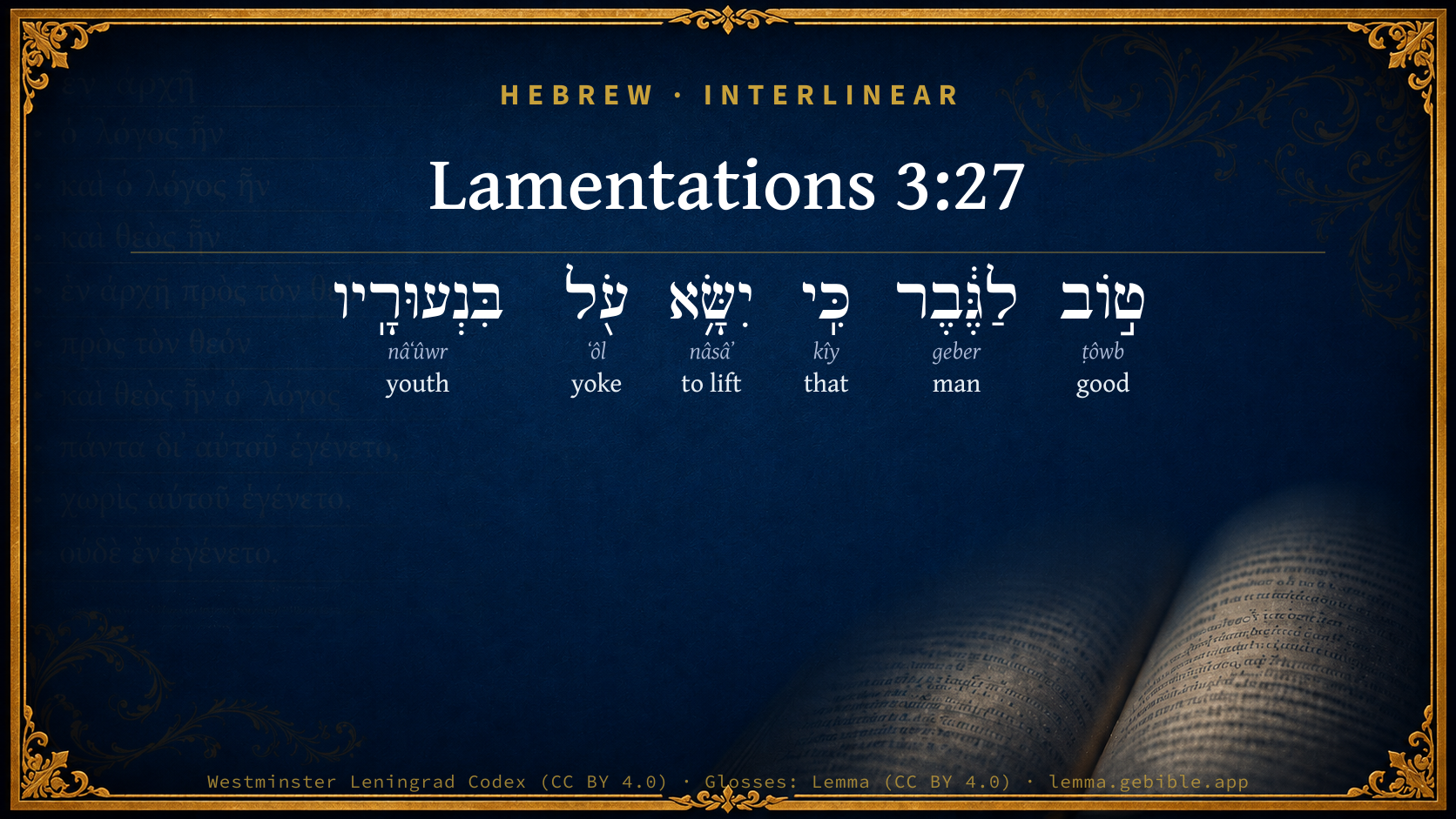
Lamentations 3:27

Hebrew (Westminster Leningrad Codex) Lamentations 3:27 appears in the Hebrew Old Testament. The text above is from the Westminster Leningrad Codex. Each word links to its Strong’s number, a concise gloss, and parsing drawn from the Open Scriptures Hebrew Bible morphology. Click any word for its full Brown-Driver-Briggs (BDB) entry.
Download image
Cite this verse

Lamentations 3:27 (World English Bible). Public Domain. Lemma interlinear Bible study tool, https://lemma.gebible.app/v/lamentations/3/27.

Show BibTeX & RIS
BibTeX
RIS
English Translation
It is good for a man that he bear the yoke in his youth.
World English Bible · Public Domain
Download a study sheet

One document with this verse’s original text, its word-by-word gloss line, the meaning frame, cross-references with their text, attributed commentary, and full source and license credits — printable, and it pastes into notes with its structure intact.

This verse Autodidact and up

Study sheet (.html) Plain text (.txt)

A passage Seminary Student

Up to 50 verses in one chapter. A passage sheet keeps up to 6 commentary sources and 12 cross-references per verse, in the order this page ranks them, and says so on the sheet whenever that leaves anything out. Ask for a single verse and you get the Autodidact verse sheet above.

Everything on this page stays free to read, with no account — the sheet is a download of what is already on screen, not access to it.

Want to remove ads? Support Godless Engineer
Compare translations 3

The same verse in 3 English versions, stacked beneath the original-language interlinear above. Click any original word for its lexicon entry.

Each is an independent rendering of the whole verse — the interlinear is not word-aligned to these translations.

Highlighted words mark where these versions differ — a whole-verse word diff, not a word-by-word alignment.

  • World English Bible Public Domain
    It is good for a man that he bear the yoke in his youth.
  • King James Version Public Domain
    It is good for a man that he bear the yoke of his youth.
  • unfoldingWord Literal Text CC BY-SA 4.0
    is good for a man that he bears a yoke in his youth. YODH

unfoldingWord Literal Text — © unfoldingWord, licensed CC BY-SA 4.0. Word-aligned USFM3 via Door43 (git.door43.org/unfoldingWord/en_ult).

Versions to compare (up to 4)

3 of 4 selected

Show all 18 translations

Every available English version of this verse, each an independent rendering of the whole verse.

  • World English Bible Public Domain
    It is good for a man that he bear the yoke in his youth.
  • Berean Standard Bible Public Domain
    It is good for a man to bear the yoke while he is still young.
  • Majority Standard Bible Public Domain
    It is good for a man to bear the yoke while he is still young.
  • King James Version Public Domain
    It is good for a man that he bear the yoke of his youth.
  • American Standard Version (1901) Public Domain
    It is good for a man that he bear the yoke in his youth.
  • Revised Version (1885) Public Domain
    It is good for a man that he bear the yoke in his youth.
  • Geneva Bible (1599) Public Domain
    It is good for a man that he beare the yoke in his youth.
  • Douay-Rheims (1899) Public Domain
    Teth. It is good for a man, when he hath borne the yoke from his youth.
  • Young's Literal Translation Public Domain
    Good for a man that he beareth a yoke in his youth.
  • Literal Standard Version CC BY-SA 4.0
    [It is] good for a man that he bears a yoke in his youth.
  • Unlocked Literal Bible CC BY-SA 4.0
    It is good for a man that he bear the yoke in his youth.
  • unfoldingWord Literal Text CC BY-SA 4.0
    is good for a man that he bears a yoke in his youth. YODH
  • Darby Bible Public Domain
    It is good for a man that he bear the yoke in his youth:
  • World Messianic Bible Public Domain
    It is good for a man that he bear the yoke in his youth.
  • Webster's Bible Public Domain
    It is good for a man that he should bear the yoke in his youth.
  • Free Bible Version CC BY-SA 4.0
    It is good for people to learn to patiently bear discipline while they're still young.
  • Bible in Basic English Public Domain
    It is good for a man to undergo the yoke when he is young.
  • JPS Tanakh (1917) Public Domain
    It is good for a man that he bear the yoke in his youth.

Literal Standard Version (2020), Covenant Press — licensed CC BY-SA 4.0. Text via the HelloAO Bible API (eBible.org). Unlocked Literal Bible (unfoldingWord) — licensed CC BY-SA 4.0. Text via the HelloAO Bible API (eBible.org). unfoldingWord Literal Text — © unfoldingWord, licensed CC BY-SA 4.0. Word-aligned USFM3 via Door43 (git.door43.org/unfoldingWord/en_ult). Free Bible Version, Dr. Jonathan Gallagher — licensed CC BY-SA 4.0. Text via the HelloAO Bible API (eBible.org).

Word by word

More ways to search: Search by grammar → Find every occurrence → Compare this word →

Practice this passage: Drill this verse → Learn its vocabulary →

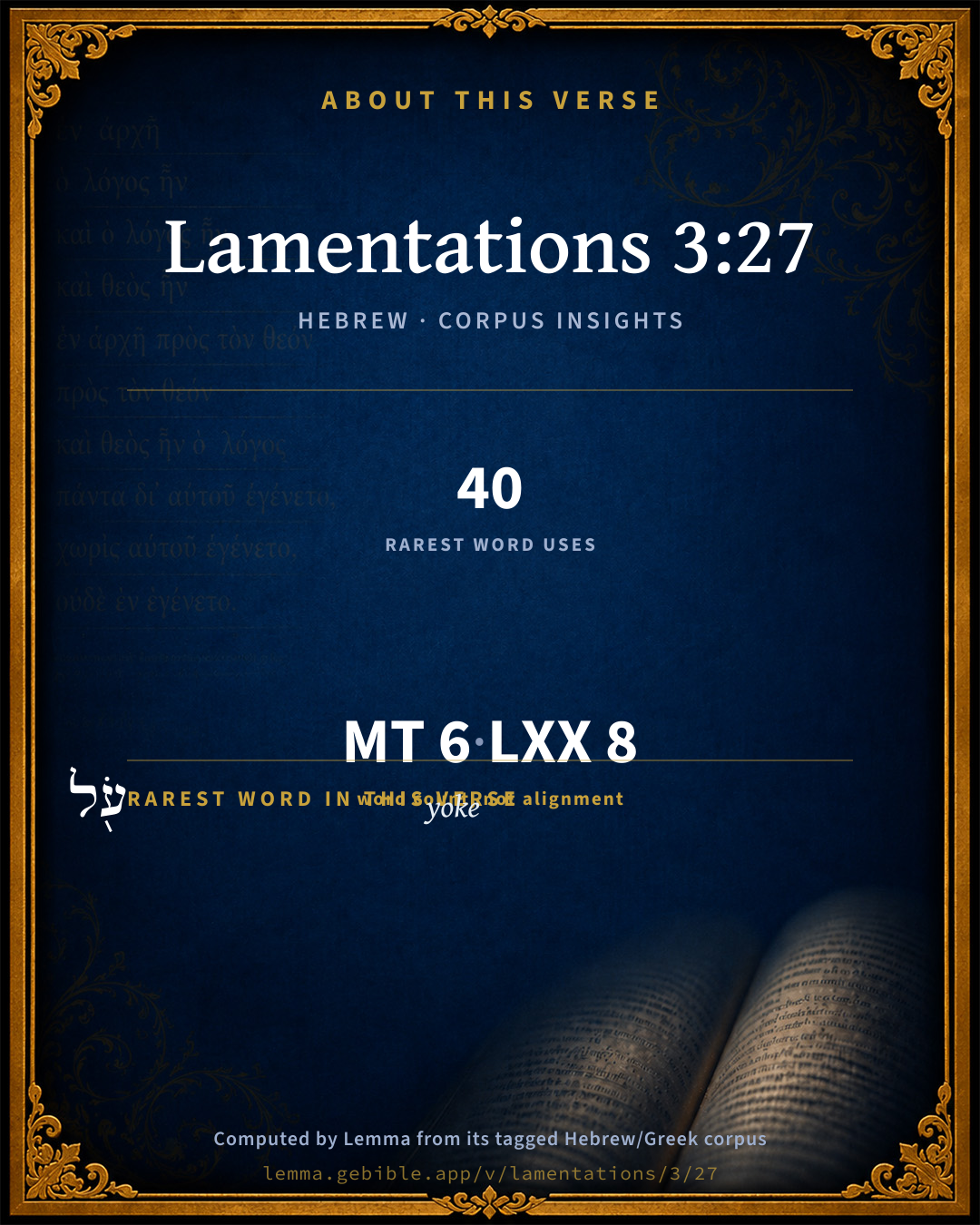
About this verse

These counts appear in no published source. They are computed here, from the morphology-tagged text and Lemma’s own curated glosses. What Lemma adds →

6
words
6
distinct lemmas
Prophets
section

Shared distinctive vocabulary

עֹ֖ל yoke H5923 occurs in 34 verses of the Hebrew Bible. Also found in:

Grammatical profile

  • 1 verb
  • 3 nouns
  • 1 adjective
  • 1 conjunction

Verb forms

  • יִשָּׂ֥א Qal · Imperfect

Hebrew & Septuagint length

In English translation the verse runs 14 words from the Hebrew and 15 from the Septuagint (LXX English) — closely comparable.

A rough comparison of the two English renderings, which tokenize alike — not a word-level alignment.

Word counts can differ between the Hebrew and the Greek without any difference in meaning — e.g. the Hebrew direct-object marker אֵת has no separate Greek word, and Greek often adds the article ὁ.

In the original languages it is 6 Hebrew tokens and 8 Greek tokens — but the two are counted differently (Hebrew bundles its prefixes and suffixes into one token; the Greek is in lemma form), so that isn’t a like-for-like length.

Cross-references

6

Topical passages linked to Lamentations 3:27 in the Treasury of Scripture Knowledge — connected by theme and wording, ordered by reader-vote popularity; previews shown in the World English Bible.

  • Ecclesiastes 12:1 Remember also your Creator in the days of your youth, Before the evil days come, and the years draw near, When you will say, "I have no pleasure in them;"
  • Matthew 11:29–30 Take my yoke upon you, and learn from me, for I am gentle and lowly in heart; and you will find rest for your souls.
  • Psalms 119:71 It is good for me that I have been afflicted, That I may learn your statutes.
  • Psalms 94:12 Blessed is the man whom you discipline, Yah, And teach out of your law;
  • Psalms 90:12 So teach us to number our days, That we may gain a heart of wisdom.
  • Hebrews 12:5–12 and you have forgotten the exhortation which reasons with you as with children, "My son, don't take lightly the chastening of the Lord, Nor faint when you are reproved by him;

Cross-references courtesy of OpenBible.info (CC BY 4.0).

Hebrew and Greek witnesses Masoretic Hebrew ↔ Greek Septuagint

The same verse in the two great witnesses to the Old Testament, shown verse-for-verse.

These are two independent witnesses, not word-aligned to each other, and the Septuagint is shown in lemma (dictionary) form.

Hebrew Lamentations 3:27 Masoretic · Westminster Leningrad Codex

ט֣וֹב לַגֶּ֔בֶר כִּֽי יִשָּׂ֥א עֹ֖ל בִּנְעוּרָֽיו

It is good for a man that he bear the yoke in his youth.

World English Bible · Public Domain

Greek LXX Lamentations 3:27 Septuagint · lemma form

ἀγαθός ἀνήρ ὅταν αἴρω ζυγός ἐν νεότης αὐτός

TETH. It is good for a man when he bears a yoke in his youth.

LXX2012 (modern English Septuagint) · Public Domain

On this verse, The Pulpit Commentary discusses the Septuagint’s reading. Read the note in Commentary ↓

Hebrew: Westminster Leningrad Codex (CC BY 4.0). Greek: Septuagint (public domain); English from LXX2012 (modern English Septuagint) (Public Domain). How the Septuagint differs from the Hebrew →

Commentary

Notes on Lamentations 3:27 from classic Christian and Jewish commentators (each source and its license shown beneath its notes). The classic Christian expositions comment on the surrounding passage and are grouped to its opening verse, so a note may address several verses; the Jewish commentaries on the Tanakh (Rashi and others) are per-verse, so they appear only where the commentator wrote on this verse.

Lemma curates 59 commentaries, every one of them public domain or Creative Commons licensed, each selected and text-cleaned for this edition rather than reprinted as found. About our sources →

Trapp's Complete Commentary

John Trapp

Lam 3:27 [It is] good for a man that he bear the yoke in his youth.

Ver. 27. It is good for a man that he bear the yoke from his youth.] The yoke of God’s law, and the discipline of afflictions: it is good to be betime in God’s nurturing house, and remain a good while there, that he be trained up in the school of afflictions, that he be a well-beaten soldier to the cross. {a} The description of such a one followeth.

{a} Quo semel iste imbuta reccus servabit odorem Testa diu. - Hor.

John Trapp, A Commentary or Exposition upon All the Books of the Old and New Testament (1647–1656) — public domain. Text from a community e-Sword module.

Joseph Benson's Commentary

Lam 3:27-30. It is good for a man that he bear the yoke in his youth — That he be inured betimes to bear those useful restraints which may give him a right sense of the duty which he owes to God, and the obedience he ought to pay to his laws. For the prophet’s expression is very applicable to the yoke of God’s commands; it is good for us to take that yoke upon us in our youth; we cannot begin too soon to be religious; it will make our duty the more acceptable to God, and easy to ourselves, if we engage in it when we are young. Here, however, the prophet seems to speak chiefly of the yoke of affliction; many have found it good to bear this yoke in their youth; it has made those humble, and serious, and spiritually minded, who otherwise would have been proud, unruly, and as a bullock unaccustomed to the yoke. If it be asked, when we bear this yoke so that it is really good for us to bear it? we have the answer in the following verses: 1st, When we are sedate and quiet under our afflictions; when we sit alone and keep silence; retire into privacy that we may converse with God, and commune with our own hearts, silencing all discontented, distrustful thoughts, and laying our hand upon our mouth, as Aaron, who, under a severe trial, held his peace. When those that are afflicted in their youth accommodate themselves to their afflictions, and study to answer God’s end in afflicting them, then they will find it good for them to bear it; for it yields the peaceable fruit of righteousness to them that are exercised thereby. 2d, When we are humble and patient under affliction; he gets good by the yoke, that not only lays his hand upon his mouth in token of submission to the will of God in the affliction, but puts his mouth in the dust in token of sorrow, shame, and self-loathing at the remembrance of sin, and as one perfectly reduced and reclaimed, and brought, as it were, to lick the dust, Psa 72:9. And we must thus humble ourselves, if so be there may be hope. If there be any way to acquire and secure a good hope under our afflictions, as, blessed be God, there is, it is this way, and while we look for it we must own ourselves utterly unworthy of Lam 2:3 d, When we are meek and gentle toward those that are the instruments of our trouble, and manifest a forgiving spirit. He gets good by the yoke that gives his cheek to him that smiteth him, and rather turns the other cheek, than returns the second blow. He that can bear contempt and reproach, and not render railing for railing, and bitterness for bitterness; that when he is filled with reproach, keeps it to himself, and does not retort it upon them that filled him with it, but pours it out before the Lord, Psa 123:4; he shall find it good to bear the yoke, and it shall turn to his spiritual advantage. The sum is, if tribulation work patience, that patience will work experience, and that experience a hope that maketh not ashamed.

Joseph Benson's Commentary on the Old and New Testaments (1811–1818) — public domain. Text from a community e-Sword module.

Geneva Bible (1599)

Geneva Bible translators

He showeth that we can never begin too timely to be exercised under the cross, that when the afflictions grow greater, our patience also by experience may be stronger.

Geneva Bible (1599) marginal notes — public domain. Text via Bolls.life.

Jamieson, Fausset & Brown

Robert Jamieson, A. R. Fausset & David Brown

yoke--of the Lord's disciplinary teaching (Psa 90:12; Psa 119:71). CALVIN interprets it, The Lord's doctrine (Mat 11:29-30), which is to be received in a docile spirit. The earlier the better; for the old are full of prejudices (Pro 8:17; Ecc 12:1). Jeremiah himself received the yoke, both of doctrine and chastisement in his youth (Jer 1:6-7).

Jamieson, Fausset & Brown — Commentary Critical and Explanatory on the Whole Bible (1871) — public domain (CC PDM 1.0). Text via the HelloAO Bible API.

Adam Clarke's Commentary

Verse 27. That he bear the yoke in his youth.] Early habits, when good, are invaluable. Early discipline is equally so. He who has not got under wholesome restraint in youth will never make a useful man, a good man, nor a happy man.

Adam Clarke's Commentary on the Bible (1810–1826) — public domain. Text from a community e-Sword/MySword module.

John Calvin's Commentaries

This verse admits of two meanings; for the word yoke may be explained as signifying teaching, or the scourges of God. We, indeed, undertake or bear in two ways the yoke of God, even when we are taught to receive his doctrine, or when we are resigned when he chastises us, when we are not obstreperous, but willingly submit to his corrections. As then some take the word עול, for the yoke of instruction, and others for the yoke of chastisement, two explanations, as I have said, are given; and both are admissible. It is indeed truly said, that it is good for man to be accustomed from his youth to God’s corrections; but Jeremiah seems rather to speak of that obedience generally, which the faithful render to God when they submit to his will. It is then our true happiness when we acknowledge that we are not our own, and allow God, by his sovereign power, to rule us as he pleases. But we ought to begin with the law of God. Hence, then, it is, that we are said to bear the yoke of God, when we relinquish our own judgment, and become wise through God’s word, when, with our affections surrendered and subdued, we hear what God commands us, and receive what he commands. This, then, is what Jeremiah means by bearing the yoke.

And he says, in youth. For they who have lived unrestrained throughout their life, can hardly bear to be brought into any order. We indeed know, that, the aged are less tractable than the young; nay, whether we refer to the arts or to the liberal sciences, the youthful age is the most flexible. The aged are also much slower; and added to this is another evil, they are very obstinate, and will hardly bear to be taught the first rudiments, being imbued with a false notion, as though they must have lived long in vain. As, then, the disposition in the old is not easily changed, the Prophet says that it is good for us to be formed from childhood to bear the yoke. And this is also seen in brute animals; when a horse is allowed full liberty in the fields, and not in due time tamed, he will hardly ever bear the curb, he will be always refractory. The oxen, also, will never be brought to bear the yoke, if they be put under it in the sixth or eighth year. The same is found to be the case with men. Jeremiah, then, does not say, without reason, that it is good for every one to be trained from his youth in the service of God; and thus he exhorts children and youth not to wait for old age, as it is usually the case. For it has been a common evil, in all ages, for children and youth to leave the study of wisdom to the old. “Oh! it will be time enough for me to be wise, when I arrive at a middle age; but some liberty must be given to childhood and youthful days.” And for this reason, Solomon exhorts all not to wait for old age, but duly to learn to fear God in childhood. So also our Prophet declares that it is good for one to bear the yoke in his childhood. It then follows. —

John Calvin's Commentaries (1540-1563) — public domain. Text from the Calvin Translation Society English edition (1840s-50s) via the Christian Classics Ethereal Library (ccel.org). Calvin's coverage is partial (roughly two-thirds of the Bible); uncommented books and verses are honest gaps, never fabricated. The 19th-century editor's footnotes and remarks are omitted so the notes are faithfully Calvin's own voice.

Ellicott's Commentary for English Readers

(27) Bear the yoke in his youth.—The words have been pressed “with a strange literalism” in favour of the view that the Lamentations were written in the youth of Jeremiah and on the death of Josiah. It may fairly be contended, on the other hand, that the tone of the maxim is that of one who looks back from the experience of age on the passionate complaints of his earlier years (Jer_15:10; Jer_20:7-18).

A Bible Commentary for English Readers, edited by Charles John Ellicott (1878–1897) — public domain. Text from a community e-Sword module.

The Cambridge Bible for Schools and Colleges

gen. ed. J. J. S. Perowne

27. in his youth] in the time when his passions are strongest and therefore most need the discipline, which, if established in its seat then, will hold sway throughout his life. The words by no means imply that the writer was young at the time he used them. Rather he is looking back through a long life of trouble and the experience which he has gained in the course of it. Cp. Heb_12:7-11.

The Cambridge Bible for Schools and Colleges (gen. ed. J. J. S. Perowne; Cambridge University Press, 1878–1918) — public domain. Text from a community e-Sword module.

John Gill's Exposition

It is good for a man that he bear the yoke in his youth. Either the yoke of the commandments, as the Targum; or of correction, as Aben Ezra; of afflictions, as fatherly chastisements; both senses may be retained. It is good to bear the yoke of the moral law, or the commandments of God, as they are in the hands of Christ, a rule of walk and conversation; a yoke obliging all mankind, and especially saints; it is the duty of all to submit their necks to this yoke; it is but their reasonable service to love the Lord their God, and their neighbour as themselves; as must be judged by all but sons of Belial, who are without this yoke, having cast it off; and especially it is "good" to bear the yoke of Christ, to embrace his doctrines, and profess them, and submit to his ordinances, since his yoke is easy, and leads to true rest, Mat 11:29; it is commendable so to do; since it is a following Christ, and those who through faith and patience have inherited the promises; and, besides, is both pleasant and profitable, being the means of increasing spiritual strength, light, and joy: and it is right to do this "in youth"; which is the choices, time of life, and most acceptable to Christ, and when a man is capable of doing him most service; and especially, if men do not take upon them this yoke in the day of their espousals, and while their first love lasts, it is much if they ever do it after, and therefore should not neglect it: and so it is good to bear the yoke of afflictions, though disagreeable to flesh and blood, to take up the cross, and bear it after Christ, willingly, and cheerfully, and patiently; this is "good", for hereby souls are brought to a sense of sin, to be humbled for it, and confess it; it is a means of purging from it, and preventing it; hereby the graces of the Spirit are tried, exercised, and become brighter; saints are instructed in many useful lessons in the word of God, in humility faith, and fear; herein they enjoy much of the presence of God, and all work for their good, spiritual and eternal. And as there is a close connection between a profession of faith in Christ, and submission to his ordinances, and suffering reproach and persecution for the same; it is good for a than to bear the one, as well as the other, "in his youth"; this will serve to keep him humble, and hide pride from him, which youth are addicted to; to wean him from the world, the lusts and pleasures of it, which are ensnaring to that age; to prevent many sins and evils such might be tempted to go into; and to inure them to hardships, and make them good soldiers of Christ.

; it is commendable so to do; since it is a following Christ, and those who through faith and patience have inherited the promises; and, besides, is both pleasant and profitable, being the means of increasing spiritual strength, light, and joy: and it is right to do this "in youth"; which is the choices, time of life, and most acceptable to Christ, and when a man is capable of doing him most service; and especially, if men do not take upon them this yoke in the day of their espousals, and while their first love lasts, it is much if they ever do it after, and therefore should not neglect it: and so it is good to bear the yoke of afflictions, though disagreeable to flesh and blood, to take up the cross, and bear it after Christ, willingly, and cheerfully, and patiently; this is "good", for hereby souls are brought to a sense of sin, to be humbled for it, and confess it; it is a means of purging from it, and preventing it; hereby the graces of the Spirit are tried, exercised, and become brighter; saints are instructed in many useful lessons in the word of God, in humility faith, and fear; herein they enjoy much of the presence of God, and all work for their good, spiritual and eternal. And as there is a close connection between a profession of faith in Christ, and submission to his ordinances, and suffering reproach and persecution for the same; it is good for a than to bear the one, as well as the other, "in his youth"; this will serve to keep him humble, and hide pride from him, which youth are addicted to; to wean him from the world, the lusts and pleasures of it, which are ensnaring to that age; to prevent many sins and evils such might be tempted to go into; and to inure them to hardships, and make them good soldiers of Christ.

Lamentations 3:28

lam 3:28

lam 3:28

lam 3:28He sitteth alone,.... Retires from the world, and the men of it, who takes upon him the yoke of Christ; though he is not alone, but God, Father, Son, and Spirit, are with him; and he is with the saints, the excellent of the earth, and has communion with them; and so he is that under the afflicting hand of God bears it patiently, and does not run from place to place complaining of it, but sits still, and considers the cause, end, and use of it. Some render the words in connection with the preceding, it is good "that he sit alone" (b); it is good for a man to be alone; in his closet, praying to God; in his house or chamber, reading the word of God; in the field, or elsewhere, meditating upon it, and upon the works of God, of nature, providence, and grace:

and keepeth silence, because he hath borne it on him: or, "took it on him"; either because he took it upon him willingly, and therefore should bear it patiently; or because he (God) hath put it upon him (c), and therefore should be silent, and not murmur and repine, since he hath done it, Psa 39:9.

(b) "ut sedeat solus", Gataker. (c) "projecit super ipsum", Tigurine version; "sub. Dominus", Vatablus; "quod imposuerit ipsi Deus", Junius & Tremellius, Michaelis.

John Gill's Exposition of the Whole Bible (1746–1763) — public domain (CC PDM 1.0). Text via the HelloAO Bible API.

Haydock's Catholic Bible Commentary

Yoke. Afflictions endured for justice sake ensure a blessing. (Haydock) --- All may derive great benefit from suffering.

George Leo Haydock (1774–1849), Haydock's Catholic Family Bible and Commentary, 1859 edition — public domain. Excludes Psalms (Douay-Rheims chapter numbering differs from Protestant) and Deuterocanonical books (Catholic canon only).

Matthew Poole's English Annotations

Good here must be expounded in the same sense as in the foregoing verse. It is not pleasant, but it is profitable, it is honourable, what becomes us, and is our duty, quietly and patiently to bear what afflictions God will please to lay upon us, to restrain our wild and wanton spirits when they are most prone to be too brisk and lascivious. Some by yoke understand the law of God, called a

yoke, ( because indeed it is so to flesh and blood,) Mat 11:29. It is not so easy to bend a neck stiffened with age, or change a heart made hard by custom. Solomon bids us to train up one in their youth in the way we would have them to walk; and whether God will tame us when young by his word or by his rod, it is of advantage to a man. It is also laudable, and what becomes a man, early to bear the yoke of God’s law, or to bear afflictive providences, to have his heart betimes humbled to the will and feet of God.

Matthew Poole's English Annotations on the Holy Bible (1683–1685) — public domain. Text from a community e-Sword/MySword module.

The Pulpit Commentary

In his youth. The thought of this verse reminds us of Psa_119:71. Youth is mentioned as the time when it is easier to adapt one"s self to circumstances, and when discipline is most readily accepted. The words do not prove that the writer is young, any more than vers. 9 and Psa_119:100 prove that the psalmist was an aged man (against this view, see vers. 84-87). There is no occasion, therefore, for the textual alteration (for as such I cannot help regarding it), "from his youth," found in some Hebrew manuscripts in Theodotion, in the Aldine edition of the Septuagint, and in the Vulgate. The reading was probably dictated by the unconscious endeavour to prop up the theory of Jeremiah"s authorship. The scribes and translators remembered, inopportunely, that the trials of Jeremiah began in early manhood.

Youth.

I THE YOKE BELONGS TO YOUTH. It is common to hear youth spoken of as a time of pleasure. Older people do their best to damp the joyousness of the young by telling them that these are their happy days, soon will come the dark days of trouble, let them enjoy the bright time while it lasts. Even if such a view of life were correct, the wisdom of thrusting it forward is not easy to discover. Why spoil the feast by pointing to the sword of Damocles? Why direct the walk on a fair spring day to the graveyard? Surely it were wiser to say, "Sufficient unto the day is the evil thereof." But this view is false. It arises from the disturbed imagination of later years. Grown morose with care, men look back on the earlier days of their life and imagine them to have been far brighter than those they now enjoy; but. they only do so by that common trick of memory that selects the pleasant pictures and drops the unpleasant ones.

1. Youth is a time of restraint. With all their lightness of heart, children feel the bonds of authority and long for the time when they shall be their own masters. It is difficult for grown men who have the free command of their own actions to understand the irksomeness of the necessary bonds of childhood. Restrained in the nursery and in the schoolroom under law and supervision, liable to ignominious rebuke, many children feel themselves in slavery. Wiser treatment gives more liberty; but still it necessarily continues many restraints. And in full grown life, when the bondage is more galling, young men commonly have to obey and submit to direction more than older men.

2. Youth is a time of toil. Men generally have to work hard in their younger years. The hours of labour are longest; the tasks imposed are the most disagreeable; the wages paid are the lowest. Most men as they advance in years work for shorter hours at more agreeable tasks and for greater rewards.

II THE YOKE IS GOOD FOR YOUTH. We have seen that it is incorrect to regard youth as a time of exceptional pleasantness. For a normal life the day brightens as it lengthens, at least till the meridian is attained, and even later the soft light of evening is to many a source of deep, calm joy unknown in the feverish excitement of youth (see Wordsworth"s poem on the superiority of the quiet September songs of the birds to their wild, restless spring songs). Nevertheless, the very yoke of youth is good.

1. If it must be borne at all, the yoke can be best borne in youth. The mind is then most supple to shape itself to the unwonted burden and pressure of it, Then a man can yield to authority with most pliancy and face hard labour most confidently.

2. The yoke is necessary for youth. It is a good thing to bear it in youth.

(1) Restraint is then necessary. Liberty would be abused. Until an independent conscience has been developed, instructed, and strengthened, the external conscience of authority is needed.

(2) Work is also good for youth. Even the discipline of unpleasant tasks is wholesome. It conquers self-will and the idle love of pleasure, and trains in self-denial.

3. Later years are benefited by the yoke of youth. Even if the years during which it is borne are not so happy as they might be, the man himself is better in the whole of his life. He profits by the discipline. He learns habits of self-restraint and industry. He is able better to appreciate the privileges of advancing stages of life.

The yoke in youth.

This is not a welcome lesson. It is natural to all, and especially the young, to resist authority, to defy restraint, to resent punishment. As the young ox has to be brought under the yoke, as the young horse has to be accustomed to the bit and the bridle, the harness and the saddle, so the young must learn the practical and valuable lesson of endurance and submission.

I IN HUMAN LIFE A YOKE IS IMPOSED UPON ALL. In some cases it is easier and in others more galling; but there is no escape, no exception. Labour must be undergone, the daily burden must be borne, restraints must be endured for the sake of the general good, sacrifices must be made, patience must be called forth and cultivated.

II WHEN FIRST FELT IN LATER LIFE, THE YOKE IS ESPECIALLY HARD TO BEAR. It sometimes happens that youth is sheltered from the storm of adversity, which beats fiercely upon the inexperienced and the undisciplined only in later years. It is well known how severely trouble is felt in such cases; for the back is not fitted to the burden, the neck is not bent to the yoke.

III THE DISCIPLINE EXPERIENCED IN YOUTH FITS FOR THE TOIL AND SUFFERING OF AFTER LIFE. This is why it is "good" then to endure it. Many of the noblest characters have known trouble in early life, and have thus learned the wholesome lessons of adversity which have stood them in good stead in after years. They who are afflicted in their youth learn the limitation of their own powers, learn the inexorable necessities of human life, and become apt scholars in the great school of Divine providence.

IV RESISTANCE TO THE YOKE IS WRONG AND FOOLISH, SUBMISSION IS RIGHT AND WISE. It is hard to kick against the goads; it is useless to resent the appointments of Divine wisdom. There are cases in which a rebellious spirit lasts all through life, and it is unquestionable that misery accompanies it. On the other hand, if the yoke be borne early and borne patiently, it becomes easier with custom. And those who are strong to suffer are also strong to serve. T.

The discipline of youth.

Remember how early Jeremiah was called to prophesy. He says at the beginning, "Ah, Lord God! behold, I cannot speak: for I am a child". (Jer_1:6) He had to bear the yoke in his youth, and doubtless this did much to fit him for a useful and well controlled life afterwards. The comparison, of course, is plain. An ox might be put under the yoke when quite young, and then, though the restraint would be irksome for a while, at last the sense of restraint would pass away, and the yoke become second nature; whereas if an ox had never been tried with the yoke until full grown, the chances were it would not accept it in a docile and serviceable way. There is this difference between the youthful ox and the youthful human being, that the youthful ox is entirely in the hands of his master, while the youthful human being has his own choice. For we do not take the yoke here to mean chiefly the external circumstances of life. The yoke is that which we take upon ourselves, seeing that it is the right and manly thing to do. Self-denial is a yoke. The effort needful in forming right habits is a yoke. The subordination of the present to the future, the lower to the higher, the human to the Divine, is a yoke. Not that we are to leave external circumstances altogether out of the question. Men who had hard times when young have come to be thankful, in after years, for those very hard limes. It is better to be an orphan than to be the child of parents who have both the means and the disposition which make them lavishly indulgent. Only bear in mind that external circumstances have not in themselves any disciplining power. The materials of a yoke might be used to make something else, The decision rests with us. One may make a yoke out of prosperity and favourable circumstances, while another so chafes and sulks under adversity as to become worse every day. Y.

The Pulpit Commentary (1880–1919), ed. H.D.M. Spence-Jones & Joseph S. Exell — public domain. Text from a community e-Sword module.

John Wesley's Explanatory Notes

Bear - Quietly and patiently to bear what afflictions God will please to lay upon us. And if God tame us when young, by his word or by his rod, it is an unspeakable advantage.

John Wesley, Explanatory Notes Upon the Whole Bible (1754–1765) — public domain. Text via the GEBible commentary corpus.

Lesson kit

Teaching starters — assembled from the data on this page, not authored interpretation. Every prompt links to the verse data it draws on. Edit before teaching.

Lamentations, in the Prophets, opens this verse with 6 words (6 distinct Hebrew lemmas). Its most distinctive word is ʻôl (“yoke”). A historical commentator’s framing appears above. Read the whole chapter for the surrounding context.

Discussion questions

  1. The word ʻôl carries the sense “yoke.” How does it shape the verse?
  2. How does Genesis 27:40, which shares the word «yoke», read alongside this verse?
  3. The translations on this page render this verse differently — a whole-verse word diff, not a word-by-word alignment. What might account for the different wordings?
  4. «יִשָּׂ֥א» is a Qal Imperfect verb. How does that grammatical form shape the action described?
  5. Compare how Trapp's Complete Commentary and Joseph Benson's Commentary read this verse. Where do they agree or differ?

Things to notice

Reading settings

Reading text

Shown beneath each verse's original-language words.

Old Testament
Old Testament edition

Read the OT as the Masoretic Hebrew (MT) or the Greek Septuagint (LXX).

English shown for the Greek Septuagint (in the Hebrew ↔ Greek comparison).

Comparing translations? Open the Compare panel on any verse page to stack up to four side by side.