
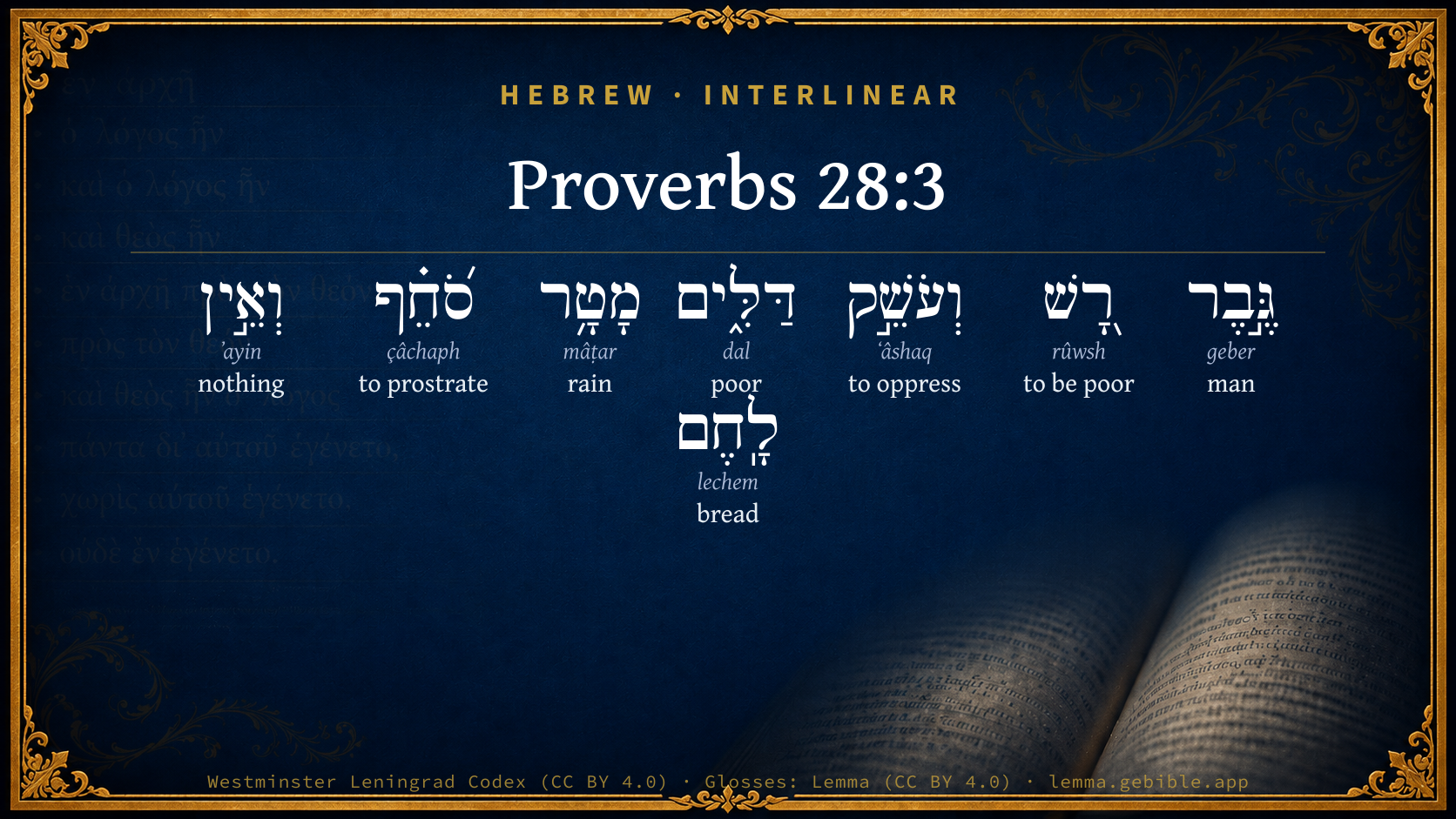
Proverbs 28:3

Hebrew (Westminster Leningrad Codex) Proverbs 28:3 appears in the Hebrew Old Testament. The text above is from the Westminster Leningrad Codex. Each word links to its Strong’s number, a concise gloss, and parsing drawn from the Open Scriptures Hebrew Bible morphology. Click any word for its full Brown-Driver-Briggs (BDB) entry.
Download image
Cite this verse

Proverbs 28:3 (World English Bible). Public Domain. Lemma interlinear Bible study tool, https://lemma.gebible.app/v/proverbs/28/3.

Show BibTeX & RIS
BibTeX
RIS
English Translation
A needy man who oppresses the poor Is like a driving rain which leaves no crops.
World English Bible · Public Domain
Highlights
  • 1 first appearance in the Hebrew Bible
Full analysis ↓
Download a study sheet

One document with this verse’s original text, its word-by-word gloss line, the meaning frame, cross-references with their text, attributed commentary, and full source and license credits — printable, and it pastes into notes with its structure intact.

This verse Autodidact and up

Study sheet (.html) Plain text (.txt)

A passage Seminary Student

Up to 50 verses in one chapter. A passage sheet keeps up to 6 commentary sources and 12 cross-references per verse, in the order this page ranks them, and says so on the sheet whenever that leaves anything out. Ask for a single verse and you get the Autodidact verse sheet above.

Everything on this page stays free to read, with no account — the sheet is a download of what is already on screen, not access to it.

Want to remove ads? Support Godless Engineer
Compare translations 3

The same verse in 3 English versions, stacked beneath the original-language interlinear above. Click any original word for its lexicon entry.

Each is an independent rendering of the whole verse — the interlinear is not word-aligned to these translations.

Highlighted words mark where these versions differ — a whole-verse word diff, not a word-by-word alignment.

  • World English Bible Public Domain
    A needy man who oppresses the poor Is like a driving rain which leaves no crops.
  • King James Version Public Domain
    A poor man that oppresseth the poor is like a sweeping rain which leaveth no food.
  • unfoldingWord Literal Text CC BY-SA 4.0
    A man who is poor and who oppresses the lowly a rain washes away, and there is no bread.

unfoldingWord Literal Text — © unfoldingWord, licensed CC BY-SA 4.0. Word-aligned USFM3 via Door43 (git.door43.org/unfoldingWord/en_ult).

Versions to compare (up to 4)

3 of 4 selected

Show all 18 translations

Every available English version of this verse, each an independent rendering of the whole verse.

  • World English Bible Public Domain
    A needy man who oppresses the poor Is like a driving rain which leaves no crops.
  • Berean Standard Bible Public Domain
    A destitute leader who oppresses the poor is like a driving rain that leaves no food.
  • Majority Standard Bible Public Domain
    A destitute leader who oppresses the poor is like a driving rain that leaves no food.
  • King James Version Public Domain
    A poor man that oppresseth the poor is like a sweeping rain which leaveth no food.
  • American Standard Version (1901) Public Domain
    A needy man that oppresseth the poor Is `like' a sweeping rain which leaveth no food.
  • Revised Version (1885) Public Domain
    A needy man that oppresseth the poor is like a sweeping rain which leaveth no food.
  • Geneva Bible (1599) Public Domain
    A poore man, if he oppresse the poore, is like a raging raine, that leaueth no foode.
  • Douay-Rheims (1899) Public Domain
    A poor man that oppresseth the poor, is like a violent shower, which bringeth a famine.
  • Young's Literal Translation Public Domain
    A man -- poor and oppressing the weak, `Is' a sweeping rain, and there is no bread.
  • Literal Standard Version CC BY-SA 4.0
    A man—poor and oppressing the weak, || [Is] a sweeping rain, and there is no bread.
  • Unlocked Literal Bible CC BY-SA 4.0
    A poor person who oppresses other poor people is like a beating rain that leaves no food.
  • unfoldingWord Literal Text CC BY-SA 4.0
    A man who is poor and who oppresses the lowly a rain washes away, and there is no bread.
  • Darby Bible Public Domain
    A poor man who oppresseth the helpless is a sweeping rain which leaveth no food.
  • World Messianic Bible Public Domain
    A needy man who oppresses the poor is like a driving rain which leaves no crops.
  • Webster's Bible Public Domain
    A poor man that oppresseth the poor is like a sweeping rain which leaveth no food.
  • Free Bible Version CC BY-SA 4.0
    When someone poor oppresses the poor, it's like heavy rain that beats down the crops.
  • Bible in Basic English Public Domain
    A man of wealth who is cruel to the poor is like a violent rain causing destruction of food.
  • JPS Tanakh (1917) Public Domain
    A poor man that oppresseth the weak is like a sweeping rain which leaveth no food.

Literal Standard Version (2020), Covenant Press — licensed CC BY-SA 4.0. Text via the HelloAO Bible API (eBible.org). Unlocked Literal Bible (unfoldingWord) — licensed CC BY-SA 4.0. Text via the HelloAO Bible API (eBible.org). unfoldingWord Literal Text — © unfoldingWord, licensed CC BY-SA 4.0. Word-aligned USFM3 via Door43 (git.door43.org/unfoldingWord/en_ult). Free Bible Version, Dr. Jonathan Gallagher — licensed CC BY-SA 4.0. Text via the HelloAO Bible API (eBible.org).

Word by word

More ways to search: Search by grammar → Find every occurrence → Compare this word →

Practice this passage: Drill this verse → Learn its vocabulary →

About this verse

These counts appear in no published source. They are computed here, from the morphology-tagged text and Lemma’s own curated glosses. What Lemma adds →

8
words
8
distinct lemmas
Wisdom
section

Notable vocabulary

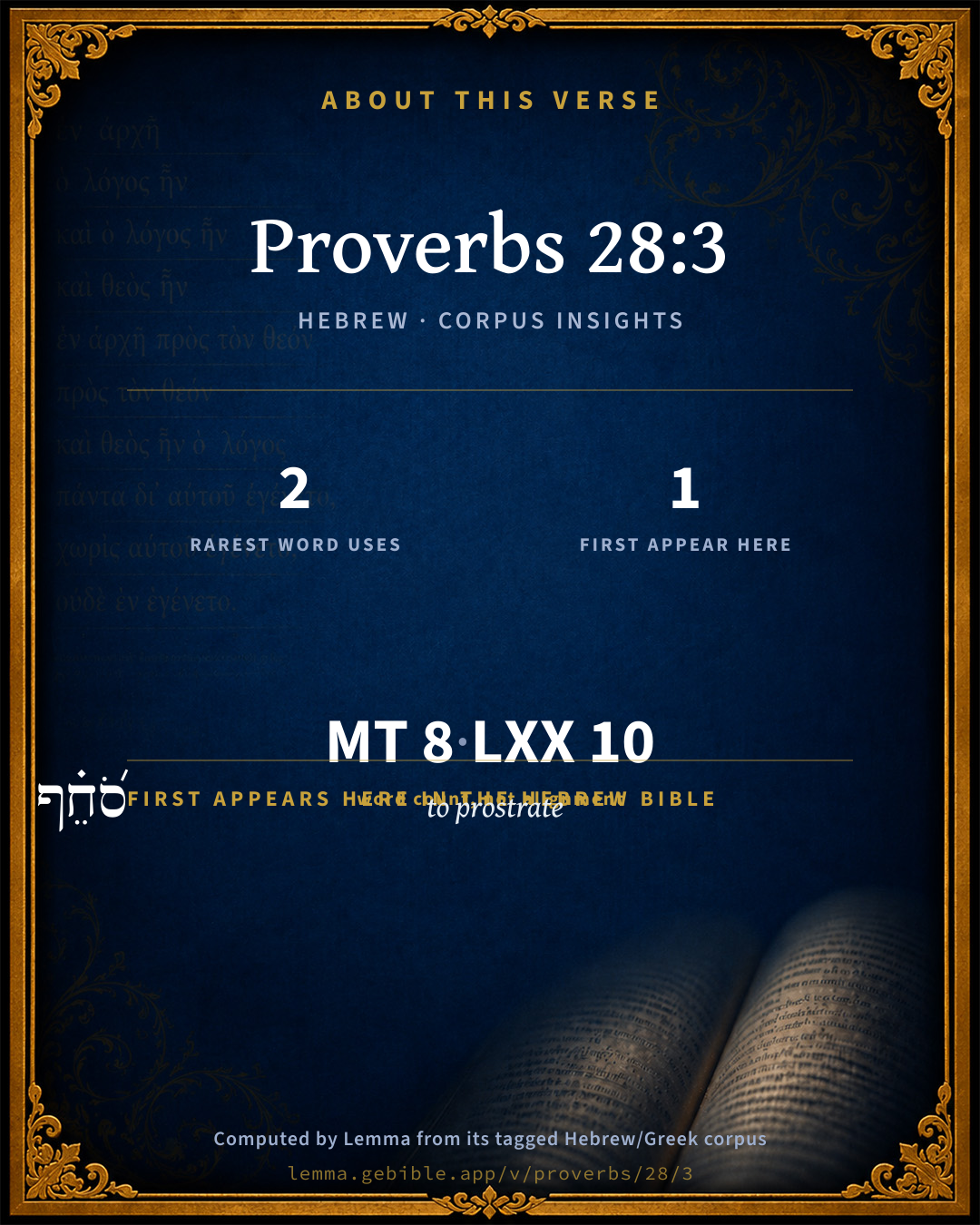
The rarest word here is סֹ֝חֵ֗ף to prostrate H5502 — appearing just 2 times in the whole Hebrew Bible.

First appearance in Scripture

This word makes its first canonical appearance in the Hebrew Bible here:

  • סֹ֝חֵ֗ף to prostrate H5502

Shared distinctive vocabulary

סֹ֝חֵ֗ף to prostrate H5502 occurs in 2 verses of the Hebrew Bible. Also found in:

Grammatical profile

  • 3 verbs
  • 3 nouns
  • 1 adjective
  • 1 particle

Verb forms

  • רָ֭שׁ Qal · Participle Active
  • וְעֹשֵׁ֣ק Qal · Participle Active
  • סֹ֝חֵ֗ף Qal · Participle Active

Hebrew & Septuagint length

In English translation the verse runs 16 words from the Hebrew and 15 from the Septuagint (LXX English) — closely comparable.

A rough comparison of the two English renderings, which tokenize alike — not a word-level alignment.

Word counts can differ between the Hebrew and the Greek without any difference in meaning — e.g. the Hebrew direct-object marker אֵת has no separate Greek word, and Greek often adds the article ὁ.

In the original languages it is 8 Hebrew tokens and 10 Greek tokens — but the two are counted differently (Hebrew bundles its prefixes and suffixes into one token; the Greek is in lemma form), so that isn’t a like-for-like length.

Cross-references

1

Topical passages linked to Proverbs 28:3 in the Treasury of Scripture Knowledge — connected by theme and wording, ordered by reader-vote popularity; previews shown in the World English Bible.

  • Matthew 18:28–30 "But that servant went out, and found one of his fellow servants, who owed him one hundred denarii, and he grabbed him, and took him by the throat, saying, 'Pay me what you owe!'

Cross-references courtesy of OpenBible.info (CC BY 4.0).

Hebrew and Greek witnesses Masoretic Hebrew ↔ Greek Septuagint

The same verse in the two great witnesses to the Old Testament, shown verse-for-verse.

These are two independent witnesses, not word-aligned to each other, and the Septuagint is shown in lemma (dictionary) form.

Hebrew Proverbs 28:3 Masoretic · Westminster Leningrad Codex

גֶּ֣בֶר רָ֭שׁ וְעֹשֵׁ֣ק דַּלִּ֑ים מָטָ֥ר סֹ֝חֵ֗ף וְאֵ֣ין לָֽחֶם

A needy man who oppresses the poor Is like a driving rain which leaves no crops.

World English Bible · Public Domain

Greek LXX Proverbs 28:3 Septuagint · lemma form

ἀνδρεῖος ἐν ἀσέβεια συκοφαντέω πτωχός ὥσπερ ὑετός λάβρος καί ἀνωφελής

A bold man oppresses the poor by ungodly deeds. As an impetuous and profitable rain,

LXX2012 (modern English Septuagint) · Public Domain

On this verse, The Pulpit Commentary discusses the Septuagint’s reading. Read the note in Commentary ↓

Hebrew: Westminster Leningrad Codex (CC BY 4.0). Greek: Septuagint (public domain); English from LXX2012 (modern English Septuagint) (Public Domain). How the Septuagint differs from the Hebrew →

Commentary

Notes on Proverbs 28:3 from classic Christian and Jewish commentators (each source and its license shown beneath its notes). The classic Christian expositions comment on the surrounding passage and are grouped to its opening verse, so a note may address several verses; the Jewish commentaries on the Tanakh (Rashi and others) are per-verse, so they appear only where the commentator wrote on this verse.

Lemma curates 59 commentaries, every one of them public domain or Creative Commons licensed, each selected and text-cleaned for this edition rather than reprinted as found. About our sources →

Trapp's Complete Commentary

John Trapp

Pro 28:3 A poor man that oppresseth the poor [is like] a sweeping rain which leaveth no food.

Ver. 3. A poor man that oppresseth the poor, &c.] Such an oppressor bites hard (as a lean louse doth), makes clean work, plunders to the life, as they say, Omnia corradit et converret. Poor men should pity poor men, as knowing the misery of poverty; but to oppress or defraud their comrades is greatest inhumanity, as that merciless fellow servant did. {Mat 18:28, &c.} A weasel is a ravenous beast, as well as a lion; a sparrow hawk as greedy as an eagle; and more mercy is to be expected from those more noble creatures than from the base and abject.

John Trapp, A Commentary or Exposition upon All the Books of the Old and New Testament (1647–1656) — public domain. Text from a community e-Sword module.

Joseph Benson's Commentary

Pro 28:3. A poor man that oppresseth the poor — Who, being advanced into a place of authority, abuses it, to oppress those that are poor, and unable to resist him; is like a sweeping rain, or flood, which leaveth no food — Which washeth away the very seeds that are in the earth, and spoils the corn and fruit which are upon it. He is the worst of all oppressors, because his low and base mind is made worse by his sudden elevation into a high condition, and his own necessities inflame his desires, and make him greedy to take all, yea, even the smallest advantages for enriching himself. This the ancients expressed by the similitudes of an empty horseleech, which sticks much more strongly than that which is already filled; and of a dry sponge, which licks up far more water than one which is wet before. See Lord Bacon’s Adv. of Learning, lib. 8. cap. 2.

Joseph Benson's Commentary on the Old and New Testaments (1811–1818) — public domain. Text from a community e-Sword module.

The Preacher's Complete Homiletical Commentary

Joseph S. Exell (gen. ed.)

MAIN HOMILETICS OF Pro_28:3

THE MOST INEXCUSABLE OPPRESSION

I. Oppression from an unexpected quarter. Although poverty sometimes has a very hardening influence upon men, we do not often find it takes the form of oppression of their fellow-sufferers in poverty. On the contrary, the sympathy of one poor man for another is often the brightest spot in his character. But the ability to oppress implies some elevation of the oppressor over the oppressed, and therefore leads us rather to look for the heartless tyrant among those who have known poverty, but who are now in some degree raised above it. And even here we should hardly expect to find an oppressor of the poor. Such a man cannot plead ignorance of the miseries of poverty. We might expect that he would be full of sympathy for those into whose trials his own experience has so fitted him to enter. If we wanted a tender nurse for a wounded man we should expect to find one in him who has himself been wounded, and who knows what bodily pain is, and in a man who has himself been poor we ought to find the most patient and generous ruler and judge of the poor. Oppression from such a quarter is a painful surprise.

II. Oppression to an extreme degree. The oppressor of the proverb is one who has sinned against the knowledge furnished by his own experience, and is therefore a greater transgressor than one who sins without such experimental knowledge. If this barrier is not strong enough to restrain him, he is not likely to be hindered by any less powerful ones, and will therefore allow his cruel and unnatural passions to have full dominion over his conduct. And so it will come to pass that a man, who has been poor if he become an oppressor, will be a more terrible one than he who has been always rich and powerful. It may be regarded as a rule with few exceptions, that he who breaks through the most restraints in order to sin will go to the greatest lengths in it.

ILLUSTRATION

This illustrative comparison is here most impressive. It is founded upon a phenomenon which I have frequently seen, and sometimes felt. A small black cloud traverses [the sky in the latter part of summer or beginning of autumn and pours down a flood of rain that sweeps all before it. The Arabs call it sale; we, a water-spout, or the bursting of a cloud. In the neighbourhood of Hermon I have witnessed it repeatedly, and was caught in one last year, which in five minutes flooded the whole mountain side, washed away the fallen olives—the food of the poor—overthrew stone walls, etc. Every summer threshing-floor along the line of its march was swept bare of all precious food … And such is the oppression of a poor man that oppresseth the poor. These landlords, and sheiks, and emirs are generally poor, hungry, greedy, remorseless, and they come in successive swarms, each more ravenous than his predecessor. On a gigantic scale, every hungry pasha from the capital is such a sale, sweeping over the distant provinces of the empire. Vast regions, formerly covered with golden harvests in their season, and swarming with people full of food and gladness, are now reduced to frightful deserts by their rapacity.—Thomson’s “The Land and the Book.”

OUTLINES AND SUGGESTIVE COMMENTS

Woeful is the condition when necessity and imbecility meet together and encounter. For necessity hath no mercy, imbecility hath no help. When poverty oppresseth anyone, there is no measure in his oppressing another that is poor. He spares not to strip him naked who hath already no clothes on. He fears not to be a spoiler whom spoiling hath left nothing. For there is nothing that doth so harden the heart of man as his own need; and he hath little or no feeling of another’s misery, who feels the biting of his own. As the rain falls, so the earth bears it; and as oppression dealeth, so must the poor suffer it; for as the earth lieth under all, so doth he. The rich man is a dashing rain upon him, and when he pleaseth, washeth away his means and succour from him … but there is no such sweeping rain unto him as when the oppressor is oppressed by poverty.… For he having nothing, takes all that he can get, and the hunger of his own distress so devoureth all, as that he Jeaveth no food.—Jermin.

The Preacher's Complete Homiletical Commentary (gen. ed. Joseph S. Exell; Funk & Wagnalls, c. 1892) — public domain (pre-1929). A full-Bible homiletical/sermon-outline anthology covering 65 of 66 books (2 John is absent from the source module). Text from a community e-Sword module.

Matthew Henry's Commentary

See here, 1. How hard-hearted poor people frequently are to one another, not only not doing such good offices as they might do one to another, but imposing upon and over-reaching one another. Those who know by experience the miseries of poverty should be compassionate to those who suffer the like, but they are inexcusably barbarous if they be injurious to them. 2. How imperious and griping those commonly are who, being indigent and necessitous, get into power. If a prince prefer a poor man, he forgets that ever he was poor, and none shall be so oppressive to the poor as he, nor squeeze them so cruelly. The hungry leech and the dry sponge suck most. Set a beggar on horseback, and he will ride without mercy. He is like a sweeping rain, which washes away the corn in the ground, and lays and beats out that which has grown, so that it leaves no food. Princes therefore ought not to put those into places of trust who are poor, and in debt, and behind-hand in the world, nor any who make it their main business to enrich themselves.

Matthew Henry's Commentary on the Whole Bible (1708–1710) — public domain (CC PDM 1.0). Text via the HelloAO Bible API.

Jamieson, Fausset & Brown

Robert Jamieson, A. R. Fausset & David Brown

A poor man, &c.--Such, in power, exact more severely, and so leave subjects bare.

Jamieson, Fausset & Brown — Commentary Critical and Explanatory on the Whole Bible (1871) — public domain (CC PDM 1.0). Text via the HelloAO Bible API.

Adam Clarke's Commentary

Verse 3. A poor man that oppresseth the poor] Our Lord illustrates this proverb most beautifully, by the parable of the two debtors, Mt 18:23, c. One owed ten thousand talents, was insolvent, begged for time, was forgiven. A fellow servant owed this one a hundred pence: he was insolvent but prayed his fellow servant to give him a little time, and he would pay it all. He would not, took him by the throat, and cast him into prison till he should pay that debt. Here the poor oppressed the poor; and what was the consequence? The oppressing poor was delivered to the tormentors; and the forgiven debt charged to his amount, because he showed no mercy. The comparatively poor are often shockingly uncharitable and unfeeling towards the real poor.

Like a sweeping rain] These are frequent in the East; and sometimes carry flocks, crops, and houses, away with them.

Adam Clarke's Commentary on the Bible (1810–1826) — public domain. Text from a community e-Sword/MySword module.

Ellicott's Commentary for English Readers

(3) A poor man that oppresseth the poor.—If the recollection of his own former troubles has not softened his heart towards his poor neighbours, he will be rendered more callous to their sufferings.

Is like a sweeping rain which leaveth no food.—That sweeps away grain and soil, instead of bringing plenty with it.

A Bible Commentary for English Readers, edited by Charles John Ellicott (1878–1897) — public domain. Text from a community e-Sword module.

The Cambridge Bible for Schools and Colleges

gen. ed. J. J. S. Perowne

3. a poor man] Better, with R.V., a needy man, the Hebrew word being different from that rendered poor immediately after.

The proverb has commonly been held to refer to official oppression. “A man in authority is implied. In many Eastern countries the offices of government are frequently sold to needy men, who use their power to reimburse themselves by oppressing others,” Rel. Tr. Soc. Comm. But the scope of the proverb must not be restricted to this. It is quite general, and is verified in the exactions of the needy employer, or owner, or creditor among ourselves, as well as in the oppression of Oriental misrule.

“The hungry contractor undertakes the job at the lowest possible price, and secures his profit by getting hungrier and weaker creatures than himself to do the work at a price lower than possible, literally at starvation wages.” Horton.

leaveth no food] Heb. without food; Vulg. in quo paratur fames; which, instead of bringing fruitful seasons (Act_14:17; Isa_30:23), takes away man’s food by uprooting the herbs of the field and washing the seed corn out of the earth.

The Cambridge Bible for Schools and Colleges (gen. ed. J. J. S. Perowne; Cambridge University Press, 1878–1918) — public domain. Text from a community e-Sword module.

John Gill's Exposition

A poor man that oppresseth the poor,.... Either one that is poor at the time he oppresses another like himself, either by secret fraud or open injury; from whom the oppressed can get no redress, as sometimes he may and does from a rich man: or rather one that has been poor, but now become rich, and got into some place of authority and profit, who should remember what he had been; and it might be expected that such an one would put on bowels of compassion towards the poor, as knowing what it was to be in indigent circumstances; but if, instead of this, he exercises his authority over the poor in a severe and rigid manner, and oppresses them, and squeezes that little out of them they have: he

is like a sweeping rain which leaveth no food: like a violent hasty shower of rain; which, instead of watering the seed, herbs, and plants, and causing them to grow, as moderate rain does, it washes away the very seed sown in the earth, or beats out the ripe corn from the ears, or beats it down, so that it riseth not up again; the effect of which is, there is no bread to the eater, nor seed to the sower, and consequently a famine. The design of the proverb is, to show how unnatural as well as intolerable is the oppression of the poor, by one that has been poor himself; even as it is contrary to the nature and use of rain, which is to fructify, and not to sweep away and destroy; and which when it does, there is no standing against it or diverting it.

John Gill's Exposition of the Whole Bible (1746–1763) — public domain (CC PDM 1.0). Text via the HelloAO Bible API.

Albert Barnes' Notes on the Bible

People raise a man of the people, poor like themselves, to power. They find him the worst oppressor of all, plundering them to their last morsels, like the storm-rain which sweeps off the seed-corn instead of bringing fertility.

Albert Barnes' Notes on the Bible (1834–1885) — public domain. Text from a community e-Sword/MySword module.

Matthew Poole's English Annotations

When a poor man being advanced into a place of authority, abuseth it to oppress those that are poor and unable to resist him, he is like a violent rain or flood, which washeth away the very seeds which are in the earth, and spoileth the corn and fruits which are upon it. He is the worst of all oppressors, because as he is of a base mind, which also is made much worse by a sudden change and elevation into a high condition; so his own necessities inflame his desires, and make him greedy to take all, yea, even the small, advantages of enriching himself; which the ancients expressed by the similitude of an empty horseleech, which sucketh much more strongly than that which is already filled; and of a dry sponge, which licks up far more water than that which was wet before.

Matthew Poole's English Annotations on the Holy Bible (1683–1685) — public domain. Text from a community e-Sword/MySword module.

Whedon's Commentary on the Bible

Daniel D. Whedon

3. A poor man — גבר רשׁ, (gebher rash,) literally, a strong one poor, possibly a man naturally strong, but poor.

The poor — דלים, (dallim,) the weak, feeble.

Sweeping rain — A flood, sweeping off and carrying every thing before it.

Which leaveth no food — Literally, no bread; this is the final result. A man of ability, but a needy wretch, promoted to some station of honour, is often a great scourge. It would be natural to suppose that a poor man would sympathize with the indigent; but observation, as a general thing, proves the contrary. Hence such an overbearing, insolent, and tyrannical officer is compared not to a rain producing its natural beneficent effects, fertilizing the ground, and augmenting the crops; but to a “sweeping rain,” which destroys and carries them away. “The comparatively poor are often shockingly uncharitable and unfeeling to the real poor.” — A. Clarke. Comp. Mat_18:23-35.

Daniel D. Whedon (gen. ed.), Commentary on the Old and New Testaments (1874–1909) — public domain. Text from a community e-Sword module.

The Pulpit Commentary

A poor man that oppresseth the poor. The words rendered "poor" are different. The former is rash, "needy," the latter dal, "feeble". (see on Pro_10:15) Delitzsch notes that, in accordance with the accents in the Masoretic text, we should translate, "A poor man and an oppressor of the lowly a sweeping rain without bringing bread," which would mean that a tyrant who oppresses the lowly bears the same relation to the poor that a devastating rain does to those whom it deprives of their food. But it is pretty certain that "the poor" and "the oppressor" designate the same person (though the vocalization is against it); hence the gnome refers to a usurper who, rising to power from poor estate, makes the very worst and most tyrannical ruler. Such a one has learned nothing from his former condition but callous indifference, and now seeks to exercise on others that power which once galled him. Thus among schoolboys it is found that the greatest bully is one who has himself been bullied; and needy revolutionists make the most rapacious and iniquitous demagogues. Of such tyrants the prophets complain. (see Isa_5:8, etc.; Mic_2:2) Wordsworth refers, as an illustration, to Catiline and his fellow conspirators, who were moved by selfish interests to overthrow the commonwealth. Many modern commentators (e.g. Hitzig, Delitzsch, Nowack), in view of the present text, regarding the combination vr rbn, and noting that elsewhere the oppressor and the poor are always introduced in opposition, (comp. Pro_29:13) read vaOr, or consider vr as equivalent to itrosh, "the head," in the signification of "master," "ruler." The gnome thus becomes concinnous, the ruler who ought to benefit his dependents, but injures them, corresponding to the rain which, instead of fertilizing, devastates the crops. The LXX had a different reading, as it readers, "A bold man in his impieties (andreiov en asebeiaiv ) calumniates the poor." Is like a sweeping rain which leaveth no food; literally, and not bread. A violent storm coming at seed time and washing away soil and seed, or happening at harvest time and destroying the ripe corn. Vulgate, Similis est imbri vehementi, in quo paratur fames. Ewald supposes that such proverbs as these and the following belong to the time of Jeroboam II, when the prosperity of the people induced luxury and arrogance, and was accompanied with much moral evil, oppression, and perversion of justice ("Hist. of Israel," 3:126, Eng. transl.). The Bengalee compares the relation of the rich oppressor to the poor, not with the rainstorm, but with that of the carving knife to the pumpkin.

The Pulpit Commentary (1880–1919), ed. H.D.M. Spence-Jones & Joseph S. Exell — public domain. Text from a community e-Sword module.

John Wesley's Explanatory Notes

It like - Is like a violent rain or flood, which washes away the very seeds in the earth. He is the worst of all oppressors.

John Wesley, Explanatory Notes Upon the Whole Bible (1754–1765) — public domain. Text via the GEBible commentary corpus.

Keil & Delitzsch

C. F. Keil & F. Delitzsch

A proverb of a tyrant here connects itself with that of usurpers:

A poor man and an oppressor of the lowly -

A sweeping rain without bringing bread.

Thus it is to be translated according to the accents. Fleischer otherwise, but also in conformity with the accents: Quales sunt vir pauper et oppressor miserorum, tales sunt pluvia omnia secum abripiens et qui panem non habent, i.e., the relation between a poor man and an oppressor of the needy is the same as that between a rain carrying all away with it and a people robbed thereby of their sustenance; in other words: a prince or potentate who robs the poor of their possessions is like a pouring rain which floods the fruitful fields - the separate members of the sentence would then correspond with each other after the scheme of the chiasmus. But the comparison would be faulty, for גּבר רשׁ and אין לחם fall together, and then the explanation would be idem per idem. A "sweeping rain" is one which has only that which is bad, and not that which is good in rain, for it only destroys instead of promoting the growth of the corn; and as the Arab, according to a proverb compared by Hitzig, says of an unjust sultan, that he is a stream without water, so an oppressor of the helpless is appropriately compared to a rain which floods the land and brings no bread. But then the words, "a poor man and an oppressor of the lowly," must designate one person, and in that case the Heb. words must be accentuated, גבר רשׁ ועשׁק דלים (cf. Pro 29:4). For, that the oppressor of the helpless deports himself toward the poor man like a sweeping rain which brings no bread, is a saying not intended to be here used, since this is altogether too obvious, that the poor man has nothing to hope for from such an extortioner. But the comparison would be appropriate if 3a referred to an oppressive master; for one who belongs to a master, or who is in any way subordinated to him, has before all to expect from him that which is good, as a requital for his services, and as a proof of his master's condescending sympathy. It is thus asked whether "a poor man and an oppressor of the lowly" may be two properties united in the person of one master. This is certainly possible, for he may be primarily a poor official or an upstart (Zckler), such as were the Roman proconsuls and procurators, who enriched themselves by impoverishing their provinces (cf. lxx Pro 28:15); or a hereditary proprietor, who seeks to regain what he has lost by extorting it from his relatives and workmen. But רשׁ (poor) is not sufficient to give this definite feature to the figure of the master; and what does this feature in the figure of the master at all mean? What the comparison 3b says is appropriate to any oppressive ruler, and one does not think of an oppressor of the poor as himself poor; he may find himself in the midst of shattered possessions, but he is not poor; much rather the oppressor and the poor are, as e.g., at Pro 29:13, contrasted with each other. Therefore we hold, with Hitzig, that רשׁ of the text is to be read rosh, whether we have to change it into ראשׁ, or to suppose that the Jewish transcriber has here for once slipped into the Phoenician writing of the word;

(Note: The Phoen. writes רש (i.e., רשׁ, rus); vid., Schrder's Phnizische Gram. p. 133; cf. Gesen. Thes. under ראשׁ.)

we do not interpret, with Hitzig, גּבר ראשׁ in the sense of ἄνθρωπος δυνάστης, Sir. 8:1, but explain: a man (or master = גּביר) is the head (cf. e.g., Jdg 11:8), and oppresses the helpless. This rendering is probable, because גּבר רשׁ, a poor man, is a combination of words without a parallel; the Book of Proverbs does not once use the expression אישׁ רשׁ, but always simply רשׁ (e.g., Pro 28:6; Pro 29:13); and גּבר is compatible with חכם and the like, but not with רשׁ. If we stumble at the isolated position of ראשׁ, we should consider that it is in a certain measure covered by דלים; for one has to think of the גבר, who is the ראשׁ, also as the ראשׁ of these דלים, as one placed in a high station who numbers poor people among his subordinates. The lxx translates ἀνδρεῖος ἐν ἀσεβείαις as if the words of the text were גּבּור רשׁע (cf. the interchange of גּבר and גּבּור in both texts of Psa 18:26), but what the lxx read must have been גּבּור להרשׁיע (Isa 5:22); and what can גּבּור here mean? The statement here made refers to the ruinous conduct of a גּבר, a man of standing, or גּביר, a high lord, a "wicked ruler," Pro 28:15. On the contrary, what kind of rain the rule of an ideal governor is compared to, Psa 72:1-8 tells.

Keil & Delitzsch — Biblical Commentary on the Old Testament (1861–1891) — public domain (CC PDM 1.0). Text via the HelloAO Bible API. (Old Testament only.)

Bridges on Proverbs

Charles Bridges

Unrestrained power is often an engine of oppression;†1 never more so, than when in the grasp of the poor. Place an unprincipled spendthrift in power, and he is a destructive flood in his sphere: greedily serving every advantage by oppression to redeem his substance. A poor man suddenly raised to power, instead of sympathizing with grievances familiar to his former recollection,†2 is usually pre-eminently distinguished by selfishness. Only a fool will admire the splendor of his power, reckless of the mischief, that it is spreading all round. Esther, when raised to a throne from an obscure station, was well reminded to use her power for God; for that some great work was surely intended by the remarkable Providence. (Est 4:14 .) But a base mind becomes more corrupt from a hasty elevation. The man’s necessities inflame his desires; and being without a spark of generous humanity, he is only bent upon improving his uncertain opportunities for selfish aggrandizement.†3 Some of the rulers in the French Revolution were raised from the lowest ranks. And their oppression was indeed a sweeping rain, leaving no food in fertile districts.

Cheering is the contrast of Him, once poor himself by his voluntary abasement, now raised to honor and glory; yet pitying, not ashamed of, his "poor brethren."†4 Truly his administration is not the sweeping rain of desolation, but "the rain upon the mown grass," rich in mercy. "He shall deliver the needy when he crieth; the poor also, and him that hath no helper. He shall redeem their soul from deceit and violence; and precious shall their blood be in his sight." (Psa 72:12-14 .)

Footnotes:

†1 Gen 31:29. Ecc 4:1 .

†2 Mat 18:28-30.

†3 ’It is in matter of power’ — as Bp. Sanderson admirably observes — ’as it is in matter of learning. They that have but a smattering of scholarship you shall ever observe to be the forwardest to make ostentation of those few ends they have; because they fear there would be little notice taken of their learning, if they should not now show it when they can. It is even so in this case. Men of base spirit and condition, when they have gotten the advantage of a little power, conceive, that the world would not know what goodly men they are, if they should not do some act or other, to shew forth their power to the world. And then, their minds being too narrow to comprehend any generous way whereby to do it, they cannot frame to do it any other way, than by trampling upon those that are below them; and that they do beyond all reason, and without all mercy.’ — Sermon on Pro 24:11-12 . Compare also on 1Sa 12:3 .

†4 2Co 8:9 . Php 2:7-11, with Heb 2:11-12 .

Charles Bridges, An Exposition of the Book of Proverbs (1846) — public domain. Text from a community e-Sword module.

unfoldingWord translationNotes

Door43 World Missions Community

who oppresses

"who severely mistreats"

like a beating rain that leaves no food

The poor man who oppresses other poor people is compared to a rain that falls so hard that it leaves no crop to harvest. (See: Simile)

beating rain

This is a metaphor for a rain coming down hard enough to cause crops to be driven down. AT: "damaging rain" (See: Metaphor)

forsake the law

"forsake God's law"

those who keep the law

To "keep the law" means to do what God's law requires. AT: "those who obey God's law" (See: Metaphor)

fight against them

"struggle against them." This means to strongly oppose or resist them. (See: Metaphor)

translationWords

oppress

forsake

law, laws

praise

evil

unfoldingWord translationNotes — © Distant Shores Media and the Door43 World Missions Community, licensed CC BY-SA 4.0. Source: git.door43.org/Door43/en_tn.

Rashi

Rabbi Shlomo Yitzchaki (Rashi)

A poor man An ignorant judge.

who oppresses the poor in judgment because he does not take his time in arriving at a verdict. He is like rain that floods a field, and it does not produce fruit.

flooding Heb. סחף and the language of the Mishnah (Keth. 1:6): “his field was ruined (נסתחפה)” and similarly (Jer. 46: 15): “Have your mighty men been swept away (נחסף)?” They were flooded, they slipped and stumbled.

Rashi on the Tanakh — English translations: “The Judaica Press complete Tanach with Rashi, translated by A. J. Rosenberg” (CC BY 4.0); “Pentateuch with Rashi's commentary by M. Rosenbaum and A.M. Silbermann, 1929-1934” (public domain); “The Metsudah Tanach series, Lakewood, N.J” (CC BY 4.0); and “The Book of Joshua, Metsudah Publications, 1997” (CC BY 4.0). Text via Sefaria.

Lesson kit

Teaching starters — assembled from the data on this page, not authored interpretation. Every prompt links to the verse data it draws on. Edit before teaching.

Proverbs, in the Wisdom, opens this verse with 8 words (8 distinct Hebrew lemmas). Its most distinctive word is çâchaph (“to prostrate”). A historical commentator’s framing appears above. Read the whole chapter for the surrounding context.

Discussion questions

  1. The word çâchaph carries the sense “to prostrate.” How does it shape the verse?
  2. The word “to prostrate” first appears here in Scripture. What is being introduced at this debut?
  3. Jeremiah 46:15 shares the word «to prostrate» with this verse. How do the two illuminate each other?
  4. These translations render this verse differently. What is at stake in choosing one wording over another?
  5. The verb «רָ֭שׁ» is Qal Participle Active. How does its form color the action?
  6. Reading how Trapp's Complete Commentary and Joseph Benson's Commentary read this verse, where do the two commentators agree and where do they part?

Things to notice

Reading settings

Reading text

Shown beneath each verse's original-language words.

Old Testament
Old Testament edition

Read the OT as the Masoretic Hebrew (MT) or the Greek Septuagint (LXX).

English shown for the Greek Septuagint (in the Hebrew ↔ Greek comparison).

Comparing translations? Open the Compare panel on any verse page to stack up to four side by side.