
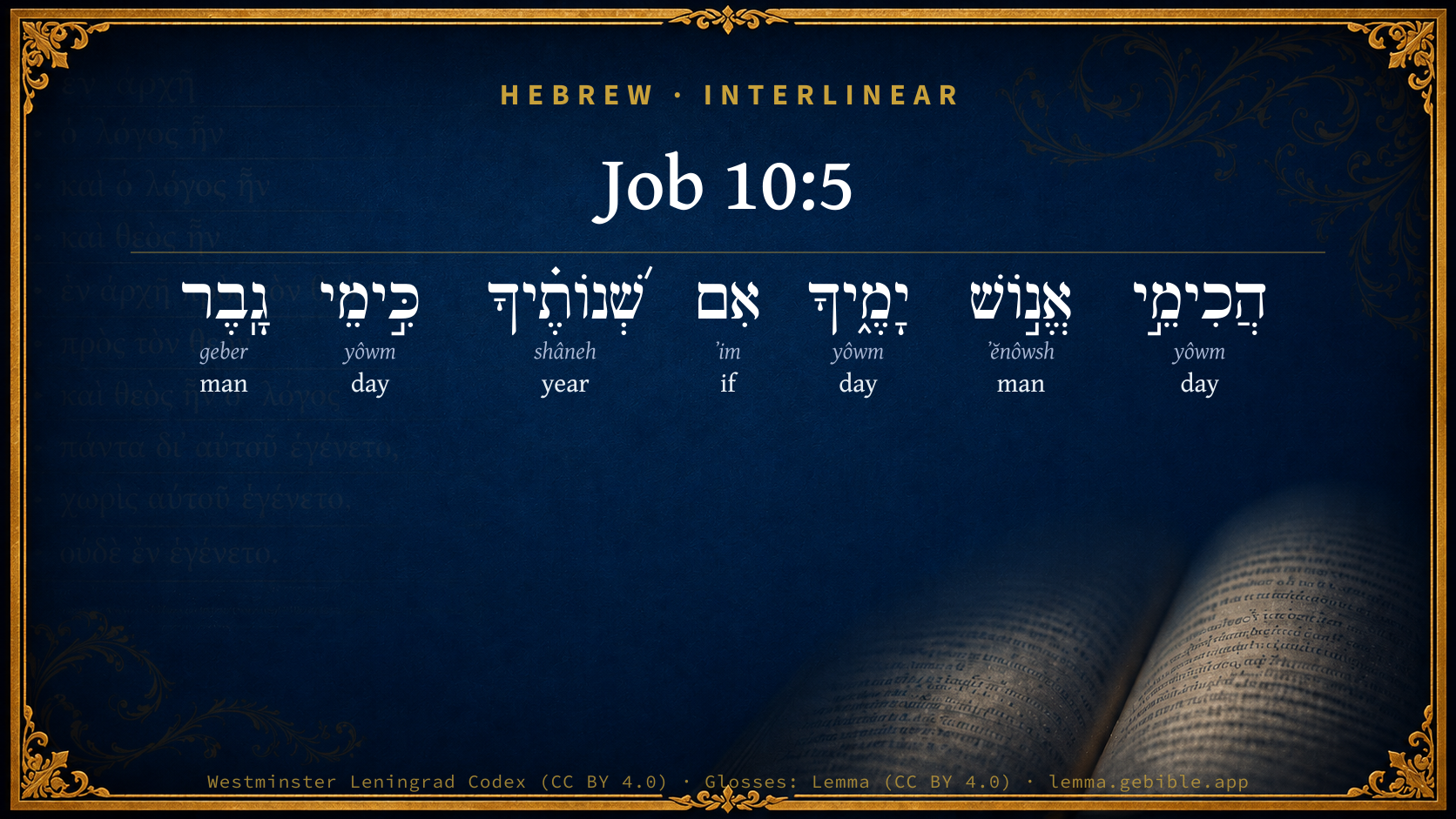
Job 10:5

Hebrew (Westminster Leningrad Codex) Job 10:5 appears in the Hebrew Old Testament. The text above is from the Westminster Leningrad Codex. Each word links to its Strong’s number, a concise gloss, and parsing drawn from the Open Scriptures Hebrew Bible morphology. Click any word for its full Brown-Driver-Briggs (BDB) entry.
Download image
Cite this verse

Job 10:5 (World English Bible). Public Domain. Lemma interlinear Bible study tool, https://lemma.gebible.app/v/job/10/5.

Show BibTeX & RIS
BibTeX
RIS
English Translation
Are your days as the days of mortals, Or your years as man's years,
World English Bible · Public Domain
Download a study sheet

One document with this verse’s original text, its word-by-word gloss line, the meaning frame, cross-references with their text, attributed commentary, and full source and license credits — printable, and it pastes into notes with its structure intact.

This verse Autodidact and up

Study sheet (.html) Plain text (.txt)

A passage Seminary Student

Up to 50 verses in one chapter. A passage sheet keeps up to 6 commentary sources and 12 cross-references per verse, in the order this page ranks them, and says so on the sheet whenever that leaves anything out. Ask for a single verse and you get the Autodidact verse sheet above.

Everything on this page stays free to read, with no account — the sheet is a download of what is already on screen, not access to it.

Want to remove ads? Support Godless Engineer
Compare translations 3

The same verse in 3 English versions, stacked beneath the original-language interlinear above. Click any original word for its lexicon entry.

Each is an independent rendering of the whole verse — the interlinear is not word-aligned to these translations.

Highlighted words mark where these versions differ — a whole-verse word diff, not a word-by-word alignment.

  • World English Bible Public Domain
    Are your days as the days of mortals, Or your years as man's years,
  • King James Version Public Domain
    Are thy days as the days of man? are thy years as man's days,
  • unfoldingWord Literal Text CC BY-SA 4.0
    your days like the days of a man? If your years like the days of a man,

unfoldingWord Literal Text — © unfoldingWord, licensed CC BY-SA 4.0. Word-aligned USFM3 via Door43 (git.door43.org/unfoldingWord/en_ult).

Versions to compare (up to 4)

3 of 4 selected

Show all 18 translations

Every available English version of this verse, each an independent rendering of the whole verse.

  • World English Bible Public Domain
    Are your days as the days of mortals, Or your years as man's years,
  • Berean Standard Bible Public Domain
    Are Your days like those of a mortal, or Your years like those of a man,
  • Majority Standard Bible Public Domain
    Are Your days like those of a mortal, or Your years like those of a man,
  • King James Version Public Domain
    Are thy days as the days of man? are thy years as man's days,
  • American Standard Version (1901) Public Domain
    Are thy days as the days of man, Or thy years as man's days,
  • Revised Version (1885) Public Domain
    Are thy days as the days of man, or thy years as man’s days,
  • Geneva Bible (1599) Public Domain
    Are thy dayes as mans dayes? or thy yeres, as the time of man,
  • Douay-Rheims (1899) Public Domain
    Are thy days as the days of man, and are thy years as the times of men:
  • Young's Literal Translation Public Domain
    As the days of man `are' Thy days? Thy years as the days of a man?
  • Literal Standard Version CC BY-SA 4.0
    [Are] Your days as the days of man? Your years as the days of a man?
  • Unlocked Literal Bible CC BY-SA 4.0
    Are your days like the days of mankind or your years like the years of people,
  • unfoldingWord Literal Text CC BY-SA 4.0
    your days like the days of a man? If your years like the days of a man,
  • Darby Bible Public Domain
    Are thy days as the days of a mortal? are thy years as a man's days,
  • World Messianic Bible Public Domain
    Are your days as the days of mortals, or your years as man’s years,
  • Webster's Bible Public Domain
    Are thy days as the days of man? are thy years as man's days,
  • Free Bible Version CC BY-SA 4.0
    Is your life as short as mortal beings? Are your years as brief as those of humanity,
  • Bible in Basic English Public Domain
    Are your days as the days of man, or your years like his,
  • JPS Tanakh (1917) Public Domain
    Are Thy days as the days of man, or Thy years as a man's days,

Literal Standard Version (2020), Covenant Press — licensed CC BY-SA 4.0. Text via the HelloAO Bible API (eBible.org). Unlocked Literal Bible (unfoldingWord) — licensed CC BY-SA 4.0. Text via the HelloAO Bible API (eBible.org). unfoldingWord Literal Text — © unfoldingWord, licensed CC BY-SA 4.0. Word-aligned USFM3 via Door43 (git.door43.org/unfoldingWord/en_ult). Free Bible Version, Dr. Jonathan Gallagher — licensed CC BY-SA 4.0. Text via the HelloAO Bible API (eBible.org).

Word by word

More ways to search: Search by grammar → Find every occurrence → Compare this word →

Practice this passage: Drill this verse → Learn its vocabulary →

About this verse

These counts appear in no published source. They are computed here, from the morphology-tagged text and Lemma’s own curated glosses. What Lemma adds →

7
words
5
distinct lemmas
Wisdom
section

Shared distinctive vocabulary

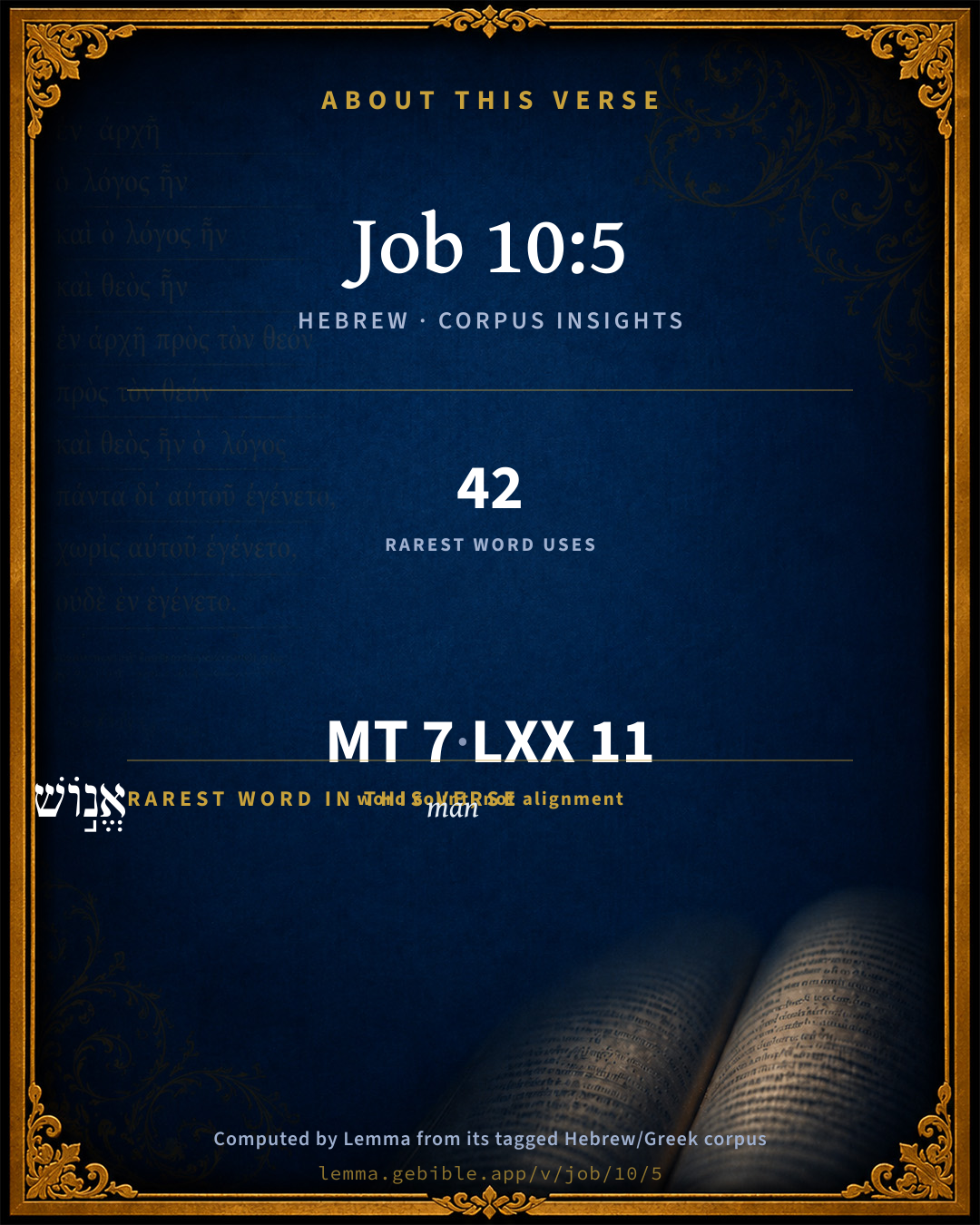
אֱנ֣וֹשׁ man H582 occurs in 41 verses of the Hebrew Bible. Also found in:

Grammatical profile

  • 6 nouns
  • 1 conjunction

Repetition

A word recurs within this verse — often emphatic in Hebrew:

  • הֲכִימֵ֣י day H3117 ×3

Hebrew & Septuagint length

In English translation the verse runs 14 words from the Hebrew and 13 from the Septuagint (LXX English) — closely comparable.

A rough comparison of the two English renderings, which tokenize alike — not a word-level alignment.

Word counts can differ between the Hebrew and the Greek without any difference in meaning — e.g. the Hebrew direct-object marker אֵת has no separate Greek word, and Greek often adds the article ὁ.

In the original languages it is 7 Hebrew tokens and 11 Greek tokens — but the two are counted differently (Hebrew bundles its prefixes and suffixes into one token; the Greek is in lemma form), so that isn’t a like-for-like length.

Cross-references

6

Topical passages linked to Job 10:5 in the Treasury of Scripture Knowledge — connected by theme and wording, ordered by reader-vote popularity; previews shown in the World English Bible.

  • 2 Peter 3:8 But don't forget this one thing, beloved, that one day is with the Lord as a thousand years, and a thousand years as one day.
  • Psalms 90:2–4 Before the mountains were brought forth, Or ever you had formed the earth and the world, Even from everlasting to everlasting, you are God.
  • Psalms 102:24–27 I said, "My God, don't take me away in the midst of my days. Your years are throughout all generations.
  • Hebrews 1:12 As a mantle you will roll them up, And they will be changed; But you are the same. Your years will not fail."
  • Job 36:26 Behold, God is great, and we don't know him. The number of his years is unsearchable.
  • Psalms 102:12 But you, Yahweh, will abide forever; Your renown endures to all generations.

Cross-references courtesy of OpenBible.info (CC BY 4.0).

Hebrew and Greek witnesses Masoretic Hebrew ↔ Greek Septuagint

The same verse in the two great witnesses to the Old Testament, shown verse-for-verse.

These are two independent witnesses, not word-aligned to each other, and the Septuagint is shown in lemma (dictionary) form.

Hebrew Job 10:5 Masoretic · Westminster Leningrad Codex

הֲכִימֵ֣י אֱנ֣וֹשׁ יָמֶ֑יךָ אִם שְׁ֝נוֹתֶ֗יךָ כִּ֣ימֵי גָֽבֶר

Are your days as the days of mortals, Or your years as man's years,

World English Bible · Public Domain

Greek LXX Job 10:5 Septuagint · lemma form

ἦ ὁ βίος σύ ἀνθρώπινος εἰμί ἤ ὁ ἔτος σύ ἀνήρ

Or is your life human, or your years the years of a man,

LXX2012 (modern English Septuagint) · Public Domain

Hebrew: Westminster Leningrad Codex (CC BY 4.0). Greek: Septuagint (public domain); English from LXX2012 (modern English Septuagint) (Public Domain). How the Septuagint differs from the Hebrew →

Commentary

Notes on Job 10:5 from classic Christian and Jewish commentators (each source and its license shown beneath its notes). The classic Christian expositions comment on the surrounding passage and are grouped to its opening verse, so a note may address several verses; the Jewish commentaries on the Tanakh (Rashi and others) are per-verse, so they appear only where the commentator wrote on this verse.

Lemma curates 59 commentaries, every one of them public domain or Creative Commons licensed, each selected and text-cleaned for this edition rather than reprinted as found. About our sources →

Trapp's Complete Commentary

John Trapp

Job 10:5 [Are] thy days as the days of man? [are] thy years as man’s days,

Ver. 5. Are thy days as the days of man?] Art thou mortal and short lived, as sorry man is, that thou proceedest in this sudden and severe manner, as if thou shouldest not have time enough to try me, and to take an order with me? Art not thou eternal, and dost thou not know in the indivisible moment of thine eternity, all what hath been, is, and shall be? "Known unto God are all his works from the beginning of the world," Act 15:18; yea, long before. The truth is, neither foreknowledge nor remembrance are properly in God, since all things, both past and future, are present with him, Rom 4:17 2Pe 3:8 Jer 1:5-7 Psa 139:2; and all things without him are but as a point or ball, which with as much ease he discerneth as we turn our eyes.

Are thy years as man’s days] It is well observed that God’s time is set out by years, man’s by days; his time is so short, that it is reckoned by the shortest complete time, a day. The days of our years are threescore and ten, Psa 90:10. As for God, he is not only the Ancient of days, Dan 7:9, but the day’s Ancient, for he made the day.

John Trapp, A Commentary or Exposition upon All the Books of the Old and New Testament (1647–1656) — public domain. Text from a community e-Sword module.

Joseph Benson's Commentary

Job 10:5. Are thy days as the days of man? — Man’s time is short and uncertain, and therefore he must improve it, and diligently search out the crimes of malefactors, lest by death he lose the opportunity of doing justice: but thou art eternal, and seest at one view all men’s hearts, and all their actions, present and to come; and therefore thou dost not need to proceed with me in this manner, by making so long a scrutiny into my heart and life.

Joseph Benson's Commentary on the Old and New Testaments (1811–1818) — public domain. Text from a community e-Sword module.

Geneva Bible (1599)

Geneva Bible translators

Art thou inconstant and changeable, as the times, today a friend, tomorrow an enemy?

Geneva Bible (1599) marginal notes — public domain. Text via Bolls.life.

Adam Clarke's Commentary

Verse 5. Are thy days as the days of man] אנוש enosh, wretched, miserable man. Thy years as man's days; גבר gaber, the strong man. Thou art not short-lived, like man in his present imperfect state; nor can the years of the long-lived patriarchs be compared with thine. The difference of the phraseology in the original justifies this view of the subject. Man in his low estate cannot be likened unto thee; nor can he in his greatest excellence, though made in thy own image and likeness, be compared to thee.

Adam Clarke's Commentary on the Bible (1810–1826) — public domain. Text from a community e-Sword/MySword module.

The Cambridge Bible for Schools and Colleges

gen. ed. J. J. S. Perowne

5–7. Then he asks if God’s life be brief like human life, that by the inquisition of chastisements He seeks to bring Job’s sin to light, lest His victim should outlive Him, and hurries on his punishment lest some one should rescue His captive from His hand.

The Cambridge Bible for Schools and Colleges (gen. ed. J. J. S. Perowne; Cambridge University Press, 1878–1918) — public domain. Text from a community e-Sword module.

John Gill's Exposition

Are thy days as the days of man?.... No, they are not: not so few; the days of the years of man's life in common are threescore years and ten, Psa 90:10; but a thousand years with the Lord are but as one day, Pe2 3:8; his days are days not of time, but of eternity: nor so mutable, or he so mutable in them; man is of one mind today, and of another tomorrow; but the Lord is in one mind one day as another; he is the Lord that changes not, Mal 3:6; immutable in his nature, purposes, promises, and affections: but Job suggests as if his dispensations towards him showed the contrary; one day smiling upon him, and heaping his favours on him, and the next frowning on him, and stripping him of all: but this was a wrong way of judging; for, though God may change the dispensations of his providence towards men, and particularly his own people, his nature changes not, nor does he change his will, his purposes, and designs, nor his love and affection:

are thy years as man's days? as few as they, or fail like them? no, he is the same, and his years fail not, and has the same good will to his people in adverse as well as in prosperous dispensations of his providence. Some understand all this in such sense, in connection with what follows, as if Job had observed, that since God was omniscient, and knew and saw all persons and things, his eyes not being like men's eyes, eyes of flesh; and since he was eternal, and wanted not for time, there was no need for him to take such methods as he did with him, through afflictive providences, to find out his sin; since, if he was guilty, it was at once known to him; nor need he be in such haste to do it, since his time was not short, as it is with an envious and ill natured man, who is for losing no time to find out and take an advantage of him he bears an ill will unto.

John Gill's Exposition of the Whole Bible (1746–1763) — public domain (CC PDM 1.0). Text via the HelloAO Bible API.

Albert Barnes' Notes on the Bible

Are thy days as the days of man - Does thy life pass on like that of man? Dost thou expect soon to die, that thou dost pursue me in this manner, searching out my sins, and afflicting me as if there were no time to lose? The idea is, that God seemed to press this matter as if he were soon to cease to exist, and as if there were no time to spare in accomplishing it. His strokes were unintermitted, as if it were necessary that the work should be done soon, and as if no respite could be given for a full and fair development of the real character of the sufferer. The whole passage Job 10:4-7 expresses the settled conviction of Job that God could not resemble man; Man was short lived, fickle, blind; he was incapable, from the brevity of his existence, and from his imperfections, of judging correctly of the character of others. But it could not be so with God. He was eternal. He knew the heart. He saw everything as it was. Why, then, Job asks with deep feeling, did he deal with him as if he were influenced by the methods of judgment which were inseparable from the condition of imperfect and dying man?

Albert Barnes' Notes on the Bible (1834–1885) — public domain. Text from a community e-Sword/MySword module.

Haydock's Catholic Bible Commentary

Days, sometimes denote judgments, 1 Corinthians iv. 3. Is God liable to change, like men, or does he stand in need of time to examine them, or fear lest they should escape? (Calmet) --- Is it necessary for him to prove his friends, to know their real dispositions? (Sanctius)

George Leo Haydock (1774–1849), Haydock's Catholic Family Bible and Commentary, 1859 edition — public domain. Excludes Psalms (Douay-Rheims chapter numbering differs from Protestant) and Deuterocanonical books (Catholic canon only).

Matthew Poole's English Annotations

Man’s time is short and uncertain, and therefore he must improve his time whilst he hath it, and diligently search out the crimes of malefactors, and punish them whilst he may, lest by death he lose the opportunity of doing justice, and the criminal get out of his power. But it is not so with thee, thou art eternal and unchangeable, and seest at one view all men’s hearts, and all their actions present and to come; and therefore thou dost not need to proceed with me in this manner, by making so long and so severe a scrutiny into my heart and life.

Matthew Poole's English Annotations on the Holy Bible (1683–1685) — public domain. Text from a community e-Sword/MySword module.

Whedon's Commentary on the Bible

Daniel D. Whedon

5. As man’s days — The third reason Job gives is, that God’s years are not limited like the days of men. There is, therefore, no danger that man should outlive Deity, and thus escape his just deserts. Consequently hurried judgment is unworthy an eternal God.

Daniel D. Whedon (gen. ed.), Commentary on the Old and New Testaments (1874–1909) — public domain. Text from a community e-Sword module.

The Pulpit Commentary

Are thy days as man"s days? In short-lived man, shortsightedness and prejudice are excusable, but not in one whose days are unlike man"s days whose "years endure throughout all generations". (Psa_102:24) Such a one ought to be above all human infirmity. Or thy years as man"s days? We should have expected "as man"s years. " But it marks the disparity more strongly to say, "Are thy years not greater in number even than man"s literally, "a strong man"s days?"

The Pulpit Commentary (1880–1919), ed. H.D.M. Spence-Jones & Joseph S. Exell — public domain. Text from a community e-Sword module.

John Wesley's Explanatory Notes

Man's - Man's time is short and uncertain, and therefore he must improve it, and diligently search out the crimes of malefactors, lest by death he lose the opportunity of doing justice: but thou art eternal, and seest at one view all mens hearts, and all their actions present and to come; and therefore thou dost not need to proceed with me in this manner, by making so long a scrutiny into my heart and life.

John Wesley, Explanatory Notes Upon the Whole Bible (1754–1765) — public domain. Text via the GEBible commentary corpus.

Rashi

Rabbi Shlomo Yitzchaki (Rashi)

Are Your days like the days of a mortal to provoke him and pursue [him]?

Rashi on the Tanakh — English translations: “The Judaica Press complete Tanach with Rashi, translated by A. J. Rosenberg” (CC BY 4.0); “Pentateuch with Rashi's commentary by M. Rosenbaum and A.M. Silbermann, 1929-1934” (public domain); “The Metsudah Tanach series, Lakewood, N.J” (CC BY 4.0); and “The Book of Joshua, Metsudah Publications, 1997” (CC BY 4.0). Text via Sefaria.

Lesson kit

Teaching starters — assembled from the data on this page, not authored interpretation. Every prompt links to the verse data it draws on. Edit before teaching.

Job, in the Wisdom, opens this verse with 7 words (5 distinct Hebrew lemmas). Its most distinctive word is ʼĕnôwsh (“man”). A historical commentator’s framing appears above. Read the whole chapter for the surrounding context.

Discussion questions

  1. How does “man” (ʼĕnôwsh) shape what this verse is saying?
  2. How does Deuteronomy 32:26, which shares the word «man», read alongside this verse?
  3. What does the repetition of “day” (3× in this one verse) do in this verse?
  4. These translations render this verse differently; the difference is in the English rendering, not the original. What questions does that raise?
  5. Compare how Trapp's Complete Commentary and Joseph Benson's Commentary read this verse. Where do they agree or differ?

Things to notice

Reading settings

Reading text

Shown beneath each verse's original-language words.

Old Testament
Old Testament edition

Read the OT as the Masoretic Hebrew (MT) or the Greek Septuagint (LXX).

English shown for the Greek Septuagint (in the Hebrew ↔ Greek comparison).

Comparing translations? Open the Compare panel on any verse page to stack up to four side by side.