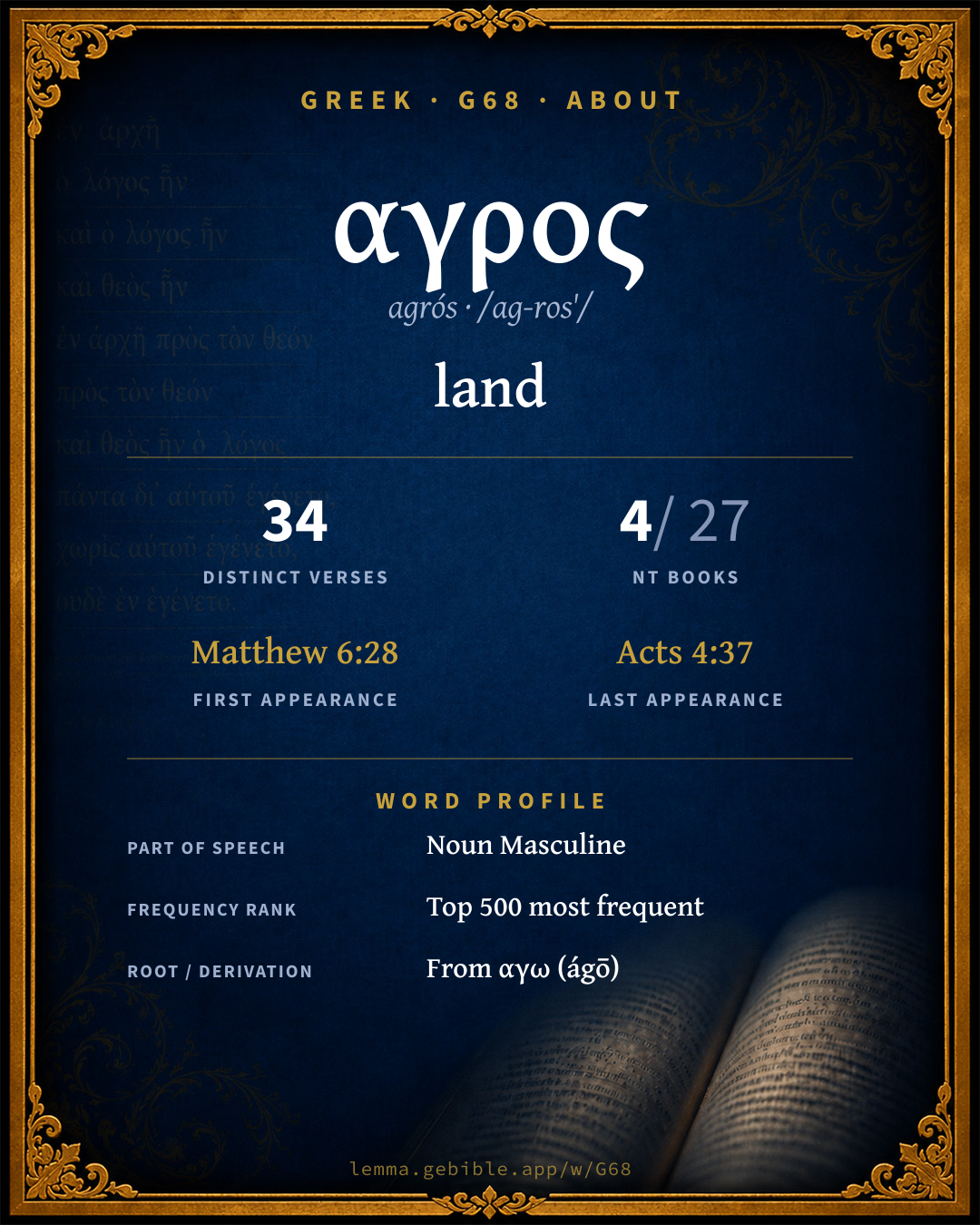
ἀγρός
land
Full lexicon entry — Thayer's Greek Lexicon
From Thayer's Greek Lexicon
Where this word appears
See every Dative-case word in the Greek New Testament →
Grammar key — what these labels mean
Part of speech
- Noun
- A naming word — a person, place, thing, or idea.
Case
- Accusative
- The case of the direct object and of extent.
- Dative
- The case of the indirect object, means, or location — “to / for / with / in.”
- Genitive
- The case of source, possession, or “of” — answers “whose / from what.”
- Nominative
- The case of the subject (and the predicate nominative).
Gender
- Masculine
- Grammatically masculine.
Number
- Plural
- More than one.
- Singular
- One.
2 verses where G68 appears in the Nominative case in the Book of Matthew. Filtered view — show all forms. Click any verse to open its interlinear word-by-word view. Verse text shown in the World English Bible for context — . Each verse’s Greek form is shown with its reference; the English is not keyword-highlighted, since the data carries no word-level English alignment. Use “Compare translations” on any verse to read it across multiple English versions. This concordance covers the Greek New Testament; Septuagint (Greek Old Testament) occurrences of this word are not indexed here.
Matthew
About this entry
At a glance — auto-summarized from this page’s data, not written by a person. Every figure links to its source below. This summary describes the numbers; it doesn’t interpret them.
At its core, αγρος (agrós) means “land.” Scripture first uses it in Matthew 6:28. It appears 34 verses across 4 books of the Greek New Testament, among its moderately common vocabulary. The word gravitates to Matthew (44%), then Mark and Luke. It clusters with αγω, αγγελος and αγε under a shared root. Dig into 34-verse concordance and the renderings breakdown below.
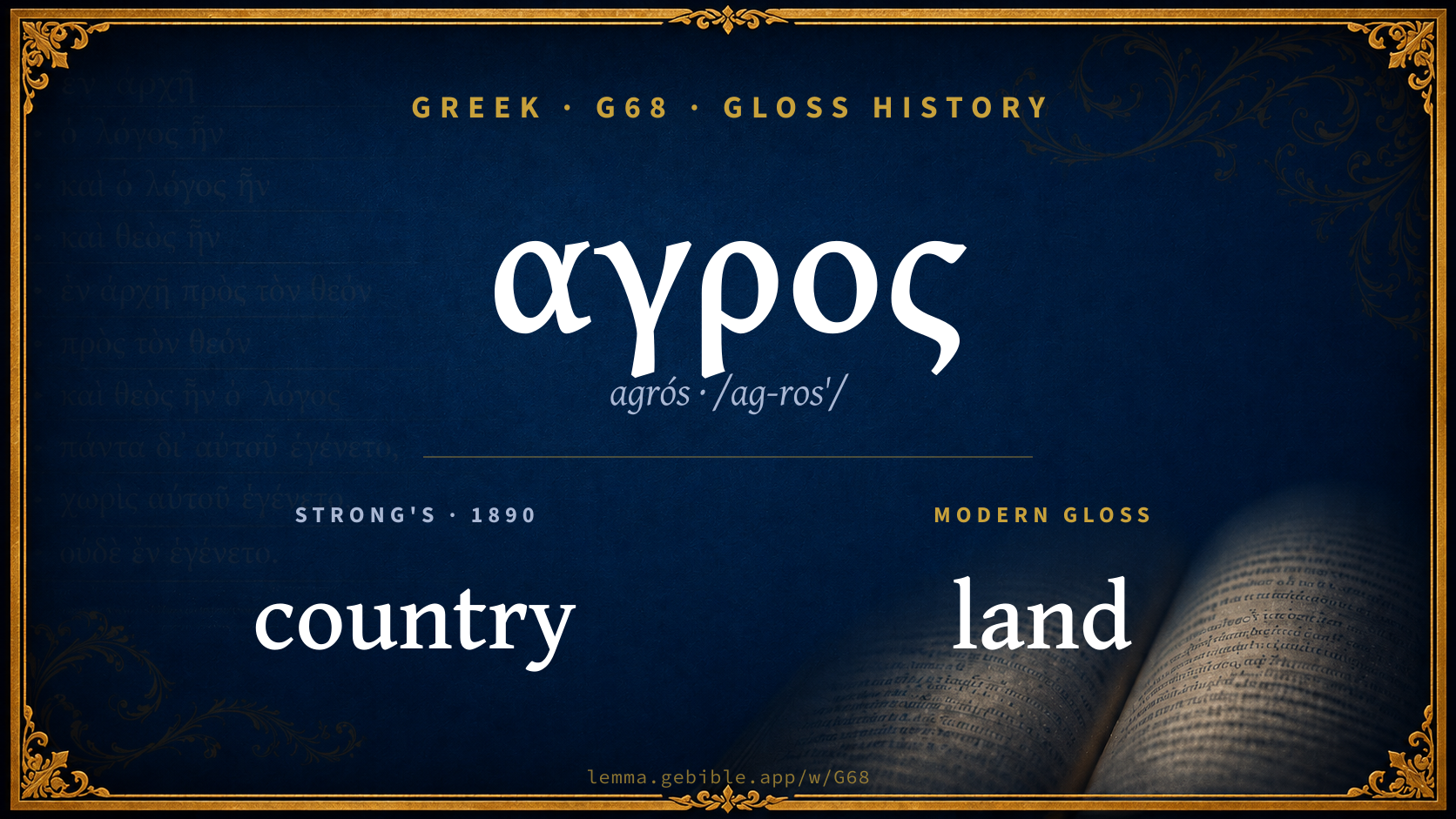
Gloss history
Strong's 1890 vs modern scholarship
About this word
Strong's G68 catalogs a Greek word from the Greek New Testament.
These counts are not copied from any lexicon or concordance. They are computed here, from the morphology-tagged Greek New Testament. What Lemma adds →
- 34
- distinct verses
- The word appears in 34 distinct verses.
- 4 / 27
- NT books
- The word appears in 4 of 27 New Testament books.
- #406
- by frequency
- Top 500 most frequent Greek words (rank 406 of 5,347 Greek words by occurrence).
View all 34 occurrences in the concordance →
By section of the New Testament
By traditional corpus
Conventional, traditional groupings — biblical authorship is debated, so this is a traditional corpus grouping, not an authorship claim. Some books belong to more than one corpus (Luke is in both the Gospels and the Lukan corpus, and so on), so these shares overlap and need not total 100%. Each figure is a share of the word’s 34 distinct verses.
- Gospels 33 verses · 97%
- Lukan (Luke–Acts) 10 verses · 29%
How translations render this word
Counts come from each version’s own published word-to-Strong’s tagging or interlinear alignment — an approximate guide to how each version renders this word, not a word-level alignment the data otherwise carries. Because each total is that version’s own tagged count, the per-version totals vary from one another and need not match the appearance or distinct-verse counts above. These counts may also differ from a printed concordance because Lemma counts each distinctly tagged rendering and does not collapse phrase taggings into a single head-word total. This is a fixed set of word-tagged versions (KJV, ASV, BSB, ULT) and does not change with the reading translation you choose elsewhere. Each version’s license is shown beside its name below (and on Sources).
- King James Version: Field 21×, Country 8×, Lands 3×
- American Standard Version: Field 19×, Country 8×, Lands 3×
- Berean Standard Bible: Field 22×, Fields 5×, Countryside 4×
- unfoldingWord Literal Text: Field 24×, Countryside 4×, Country 3×
King James Version Public Domain
Renders G68 across 36 tagged occurrences — most commonly:
Plus 4 renderings that appear only once — usually multi-word phrases or single function words the recovered tagging swept in, not distinct renderings.
American Standard Version Public Domain
Renders G68 across 35 tagged occurrences — most commonly:
Plus 3 renderings that appear only once — usually multi-word phrases or single function words the recovered tagging swept in, not distinct renderings.
Berean Standard Bible Public Domain
Renders G68 across 35 tagged occurrences — most commonly:
Plus 1 rendering that appears only once — usually multi-word phrases or single function words the recovered tagging swept in, not distinct renderings. Not rendered by a distinct English word in 1 further occurrence.
unfoldingWord Literal Text CC BY-SA 4.0
Renders G68 across 37 tagged occurrences — most commonly:
Senses in Thayer's
The 1 sense Thayer's distinguishes for this word, in lexicon order (not ranked by frequency or importance). The full entry — with sub-senses — is in the Lexicon Entry tab.
- land
Word origin
Derived from αγω (ágō) (G71) — to lead.
From G71 ; a field (as a drive for cattle); generally the country ; specifically a farm that is hamlet : - country farm piece of ground land.
— Strong’s Exhaustive Concordance (1890), public domain.
Forms in the corpus
The 9 distinct written forms G68 takes in the Greek New Testament, most frequent first — each parse links to that case’s occurrences in the concordance.
| Form | Parsing | Example | Uses |
|---|---|---|---|
| ἀγρῷ agrō̂ | Noun, Dative, Singular, Masculine | Matthew 13:24 | 9 |
| ἀγροὺς agroùs | Noun, Accusative, Plural, Masculine | Matthew 19:29 | 7 |
| ἀγροῦ agroû | Noun, Genitive, Singular, Masculine | Matthew 6:28 | 7 |
| ἀγρὸν agròn | Noun, Accusative, Singular, Masculine | Matthew 13:44 | 5 |
| ἀγρούς agroús | Noun, Accusative, Plural, Masculine | Mark 5:14 | 2 |
| ἀγρόν agrón | Noun, Accusative, Singular, Masculine | Matthew 22:5 | 2 |
| ἀγρὸς agròs | Noun, Nominative, Singular, Masculine | Matthew 27:8 | 2 |
| ἀγρός agrós | Noun, Nominative, Singular, Masculine | Matthew 13:38 | 1 |
| ἀγρῶν agrō̂n | Noun, Genitive, Plural, Masculine | Mark 11:8 | 1 |
Same root — word family
Other Thayer's entries built from the same root as G68, grouped by Strong’s listed origin. These share a root / origin per the lexicon — not necessarily a shared meaning. Each links to that word’s own entry.
Derives from
Shares the same root
- αγγελος ángelos G32 angel
- αγε áge G33 come
- αγελη agélē G34 herd
- αγρα ágra G61 prey
- αγωγη agōgḗ G72 conduct
- αγων agṓn G73 assembly
- αξιος áxios G514 worthy
- ηγεομαι hēgéomai G2233 to govern
Derived from this word
Compare all same-root words → Showing 4 of 12 — not the complete family. They share a root, not necessarily a meaning.
Septuagint usage
The same Greek word αγρος appears 226 times in the Greek Old Testament (Septuagint), across 208 verses in 29 books.
- 226
- LXX occurrences
- Tagged occurrences of this Greek word in the Septuagint.
- 208
- verses
- Distinct Septuagint verses containing this word.
- 29 / 39
- OT books
- The word appears in 29 of the 39 Old Testament books.
Sample Septuagint occurrences
- Genesis 2:5 ἀγρός
- Exodus 8:9 ἀγρός
- Leviticus 19:9 ἀγρός
- Numbers 16:14 ἀγρός
- Deuteronomy 5:21 ἀγρός
- Joshua 15:18 ἀγρός
- Judges 1:14 ἀγρός
- Ruth 1:1 ἀγρός
- 1 Samuel 4:2 ἀγρός
- 2 Samuel 1:21 ἀγρός
- 1 Kings 2:26 ἀγρός
- 2 Kings 4:39 ἀγρός
Septuagint occurrences (same lexeme)
Every verse where the same Strong’s number (G68) appears in the Greek Septuagint — showing the first 50 of 208. Verse text shown in the World English Bible for context; the Greek form is the matched word — the English is not keyword-highlighted.
- Genesis 2:5 ἀγρός No plant of the field was yet in the earth, and no herb of the field had yet sprung up; for Yahweh God had not caused it to rain on the earth. There was not a man to till the ground,
- Genesis 2:19 ἀγρός Out of the ground Yahweh God formed every animal of the field, and every bird of the sky, and brought them to the man to see what he would call them. Whatever the man called every living creature, that was its name.
- Genesis 2:20 ἀγρός The man gave names to all cattle, and to the birds of the sky, and to every animal of the field; but for man there was not found a helper suitable for him.
- Genesis 3:18 ἀγρός Thorns also and thistles will it bring forth to you; and you will eat the herb of the field.
- Genesis 23:9 ἀγρός that he may give me the cave of Machpelah, which he has, which is in the end of his field. For the full price let him give it to me in the midst of you for a possession of a burying-place."
- Genesis 23:11 ἀγρός "No, my lord, hear me. I give you the field, and I give you the cave that is in it. In the presence of the children of my people I give it to you. Bury your dead."
- Genesis 23:13 ἀγρός He spoke to Ephron in the audience of the people of the land, saying, "But if you will, please hear me. I will give the price of the field. Take it from me, and I will bury my dead there."
- Genesis 23:17 ἀγρός So the field of Ephron, which was in Machpelah, which was before Mamre, the field, the cave which was therein, and all the trees that were in the field, that were in all the border of it round about, were made sure
- Genesis 23:19 ἀγρός After this, Abraham buried Sarah his wife in the cave of the field of Machpelah before Mamre (the same is Hebron), in the land of Canaan.
- Genesis 23:20 ἀγρός The field, and the cave that is therein, were made sure to Abraham for a possession of a burying place by the children of Heth.
- Genesis 25:9 ἀγρός Isaac and Ishmael, his sons, buried him in the cave of Machpelah, in the field of Ephron, the son of Zohar the Hittite, which is before Mamre,
- Genesis 25:10 ἀγρός the field which Abraham purchased of the children of Heth. There was Abraham buried, with Sarah his wife.
- Genesis 27:27 ἀγρός He came near, and kissed him. He smelled the smell of his clothing, and blessed him, and said, "Behold, the smell of my son Is as the smell of a field which Yahweh has blessed.
- Genesis 30:14 ἀγρός Reuben went in the days of wheat harvest, and found mandrakes in the field, and brought them to his mother, Leah. Then Rachel said to Leah, "Please give me some of your son's mandrakes."
- Genesis 30:16 ἀγρός Jacob came from the field in the evening, and Leah went out to meet him, and said, "You must come in to me; for I have surely hired you with my son's mandrakes." He lay with her that night.
- Genesis 33:19 ἀγρός He bought the parcel of ground, where he had spread his tent, at the hand of the children of Hamor, Shechem's father, for one hundred pieces of money.
- Genesis 39:5 ἀγρός It happened from the time that he made him overseer in his house, and over all that he had, that Yahweh blessed the Egyptian's house for Joseph's sake; and the blessing of Yahweh was on all that he had, in the house and in the field.
- Genesis 49:29 ἀγρός He charged them, and said to them, "I am to be gathered to my people. Bury me with my fathers in the cave that is in the field of Ephron the Hittite,
- Genesis 49:32 ἀγρός the field and the cave that is therein, which was purchased from the children of Heth."
- Exodus 8:9 ἀγρός Moses said to Pharaoh, "I give you the honor of setting the time that I should pray for you, and for your servants, and for your people, that the frogs be destroyed from you and your houses, and remain in the river only."
- Exodus 20:17 ἀγρός "You shall not covet your neighbor's house. You shall not covet your neighbor's wife, nor his man-servant, nor his maid-servant, nor his ox, nor his donkey, nor anything that is your neighbor's."
- Exodus 22:4 ἀγρός If the stolen property is found in his hand alive, whether it is ox, donkey, or sheep, he shall pay double.
- Exodus 23:16 ἀγρός And the feast of harvest, the first fruits of your labors, which you sow in the field: and the feast of harvest, at the end of the year, when you gather in your labors out of the field.
- Leviticus 19:9 ἀγρός "'When you reap the harvest of your land, you shall not wholly reap the corners of your field, neither shall you gather the gleanings of your harvest.
- Leviticus 23:22 ἀγρός "'When you reap the harvest of your land, you shall not wholly reap into the corners of your field, neither shall you gather the gleanings of your harvest: you shall leave them for the poor, and for the foreigner. I am Yahweh your God.'"
- Leviticus 25:3 ἀγρός Six years you shall sow your field, and six years you shall prune your vineyard, and gather in its fruits;
- Leviticus 25:4 ἀγρός but in the seventh year there shall be a Sabbath of solemn rest for the land, a Sabbath to Yahweh. You shall not sow your field or prune your vineyard.
- Leviticus 25:5 ἀγρός What grows of itself in your harvest you shall not reap, and the grapes of your undressed vine you shall not gather. It shall be a year of solemn rest for the land.
- Leviticus 25:31 ἀγρός But the houses of the villages which have no wall round about them shall be reckoned with the fields of the country: they may be redeemed, and they shall be released in the Jubilee.
- Leviticus 25:34 ἀγρός But the field of the suburbs of their cities may not be sold; for it is their perpetual possession.
- Leviticus 26:20 ἀγρός and your strength will be spent in vain; for your land won't yield its increase, neither will the trees of the land yield their fruit.
- Leviticus 27:16 ἀγρός "'If a man dedicates to Yahweh part of the field of his possession, then your valuation shall be according to the seed for it: the sowing of a homer of barley shall be valued at fifty shekels of silver.
- Leviticus 27:17 ἀγρός If he dedicates his field from the Year of Jubilee, according to your valuation it shall stand.
- Leviticus 27:18 ἀγρός But if he dedicates his field after the Jubilee, then the priest shall reckon to him the money according to the years that remain to the Year of Jubilee; and an abatement shall be made from your valuation.
- Leviticus 27:19 ἀγρός If he who dedicated the field will indeed redeem it, then he shall add the fifth part of the money of your valuation to it, and it shall remain his.
- Leviticus 27:20 ἀγρός If he will not redeem the field, or if he has sold the field to another man, it shall not be redeemed any more;
- Leviticus 27:21 ἀγρός but the field, when it goes out in the Jubilee, shall be holy to Yahweh, as a field devoted; it shall be owned by the priests.
- Leviticus 27:22 ἀγρός "'If he dedicates to Yahweh a field which he has bought, which is not of the field of his possession,
- Leviticus 27:24 ἀγρός In the Year of Jubilee the field shall return to him from whom it was bought, even to him to whom the possession of the land belongs.
- Leviticus 27:28 ἀγρός "'Notwithstanding, no devoted thing, that a man shall devote to Yahweh of all that he has, whether of man or animal, or of the field of his possession, shall be sold or redeemed: every devoted thing is most holy to Yahweh.
- Numbers 16:14 ἀγρός Moreover you haven't brought us into a land flowing with milk and honey, nor given us inheritance of fields and vineyards: will you put out the eyes of these men? we won't come up.
- Numbers 20:17 ἀγρός Please let us pass through your land: we will not pass through field or through vineyard, neither will we drink of the water of the wells: we will go along the king's highway; we will not turn aside to the right hand nor to the left, until we have passed your border.
- Numbers 21:22 ἀγρός Let me pass through your land: we will not turn aside into field, or into vineyard; we will not drink of the water of the wells: we will go by the king's highway, until we have passed your border.
- Numbers 23:14 ἀγρός He took him into the field of Zophim, to the top of Pisgah, and built seven altars, and offered up a bull and a ram on every altar.
- Deuteronomy 5:21 ἀγρός "Neither shall you covet your neighbor's wife; neither shall you desire your neighbor's house, his field, or his man-servant, or his maid-servant, his ox, or his donkey, or anything that is your neighbor's."
- Deuteronomy 11:15 ἀγρός I will give grass in your fields for your cattle, and you shall eat and be full.
- Deuteronomy 14:22 ἀγρός You shall surely tithe all the increase of your seed, that which comes forth from the field year by year.
- Deuteronomy 20:19 ἀγρός When you shall besiege a city a long time, in making war against it to take it, you shall not destroy the trees of it by wielding an axe against them; for you may eat of them, and you shall not cut them down; for is the tree of the field man, that it should be besieged of you?
- Deuteronomy 22:27 ἀγρός for he found her in the field, the pledged to be married lady cried, and there was none to save her.
- Deuteronomy 24:19 ἀγρός When you reap your harvest in your field, and have forgot a sheaf in the field, you shall not go again to get it: it shall be for the foreigner, for the fatherless, and for the widow; that Yahweh your God may bless you in all the work of your hands.
These are occurrences of the same Greek lexeme (G68) in the Septuagint — not a translation of any one Hebrew word. The store carries no word-level Hebrew↔Greek alignment, so no Hebrew original is asserted here. Counts come from the recovered LXX Strong's tagging — high-frequency vocabulary is well covered, while rare or late forms may be untagged — so they reflect tagged occurrences and may slightly undercount.