
Job 19:6

Hebrew (Westminster Leningrad Codex) Job 19:6 appears in the Hebrew Old Testament. The text above is from the Westminster Leningrad Codex. Each word links to its Strong’s number, a concise gloss, and parsing drawn from the Open Scriptures Hebrew Bible morphology. Click any word for its full Brown-Driver-Briggs (BDB) entry.
Download image
Cite this verse

Job 19:6 (World English Bible). Public Domain. Lemma interlinear Bible study tool, https://lemma.gebible.app/v/job/19/6.

Show BibTeX & RIS
BibTeX
RIS
English Translation
Know now that God has subverted me, And has surrounded me with his net.
World English Bible · Public Domain
Download a study sheet

One document with this verse’s original text, its word-by-word gloss line, the meaning frame, cross-references with their text, attributed commentary, and full source and license credits — printable, and it pastes into notes with its structure intact.

This verse Autodidact and up

Study sheet (.html) Plain text (.txt)

A passage Seminary Student

Up to 50 verses in one chapter. A passage sheet keeps up to 6 commentary sources and 12 cross-references per verse, in the order this page ranks them, and says so on the sheet whenever that leaves anything out. Ask for a single verse and you get the Autodidact verse sheet above.

Everything on this page stays free to read, with no account — the sheet is a download of what is already on screen, not access to it.

Want to remove ads? Support Godless Engineer
Compare translations 3

The same verse in 3 English versions, stacked beneath the original-language interlinear above. Click any original word for its lexicon entry.

Each is an independent rendering of the whole verse — the interlinear is not word-aligned to these translations.

Highlighted words mark where these versions differ — a whole-verse word diff, not a word-by-word alignment.

  • World English Bible Public Domain
    Know now that God has subverted me, And has surrounded me with his net.
  • King James Version Public Domain
    Know now that God hath overthrown me, and hath compassed me with his net.
  • unfoldingWord Literal Text CC BY-SA 4.0
    then know that God has wronged me, and his net has closed around me.

unfoldingWord Literal Text — © unfoldingWord, licensed CC BY-SA 4.0. Word-aligned USFM3 via Door43 (git.door43.org/unfoldingWord/en_ult).

Versions to compare (up to 4)

3 of 4 selected

Show all 18 translations

Every available English version of this verse, each an independent rendering of the whole verse.

  • World English Bible Public Domain
    Know now that God has subverted me, And has surrounded me with his net.
  • Berean Standard Bible Public Domain
    then understand that it is God who has wronged me and drawn His net around me.
  • Majority Standard Bible Public Domain
    then understand that it is God who has wronged me and drawn His net around me.
  • King James Version Public Domain
    Know now that God hath overthrown me, and hath compassed me with his net.
  • American Standard Version (1901) Public Domain
    Know now that God hath subverted me `in my cause', And hath compassed me with his net.
  • Revised Version (1885) Public Domain
    Know now that God hath subverted me in my cause, and hath compassed me with his net.
  • Geneva Bible (1599) Public Domain
    Know nowe, that God hath ouerthrowen me, and hath compassed me with his net.
  • Douay-Rheims (1899) Public Domain
    At least now understand, that God hath not afflicted me with an equal judgment, and compassed me with his scourges.
  • Young's Literal Translation Public Domain
    Know now, that God turned me upside down, And His net against me hath set round,
  • Literal Standard Version CC BY-SA 4.0
    Know now, that God turned me upside down, || And has set around His net against me,
  • Unlocked Literal Bible CC BY-SA 4.0
    then you should know that God has done wrong to me and has caught me in his net.
  • unfoldingWord Literal Text CC BY-SA 4.0
    then know that God has wronged me, and his net has closed around me.
  • Darby Bible Public Domain
    Know now that +God hath overthrown me, and hath surrounded me with his net.
  • World Messianic Bible Public Domain
    know now that God has subverted me, and has surrounded me with his net.
  • Webster's Bible Public Domain
    Know now that God hath overthrown me, and hath encompassed me with his net.
  • Free Bible Version CC BY-SA 4.0
    But you should realize that it's God who has wronged me, he has trapped me in his net.
  • Bible in Basic English Public Domain
    Be certain that it is God who has done me wrong, and has taken me in his net.
  • JPS Tanakh (1917) Public Domain
    Know now that God hath subverted my cause, and hath compassed me with His net.

Literal Standard Version (2020), Covenant Press — licensed CC BY-SA 4.0. Text via the HelloAO Bible API (eBible.org). Unlocked Literal Bible (unfoldingWord) — licensed CC BY-SA 4.0. Text via the HelloAO Bible API (eBible.org). unfoldingWord Literal Text — © unfoldingWord, licensed CC BY-SA 4.0. Word-aligned USFM3 via Door43 (git.door43.org/unfoldingWord/en_ult). Free Bible Version, Dr. Jonathan Gallagher — licensed CC BY-SA 4.0. Text via the HelloAO Bible API (eBible.org).

Word by word

More ways to search: Search by grammar → Find every occurrence → Compare this word →

Practice this passage: Drill this verse → Learn its vocabulary →

עִוְּתָ֑נִי
ʻâvath
H5791
“to be crooked · me”
Verb, Piel, Perfect, 3rd Person, Masculine, Singular + Suffix, Personal, 1st Person, Common, Singular
Part of Speech
Verb
Stem
Piel
Form
Perfect
Person
3rd Person
Gender
Masculine
Number
Singular
Full BDB Definition

Origin: a primitive root

TWOT: 1591

to be bent, be crooked, bend, make crooked, pervert - (Piel) - to make crooked, falsify, pervert, subvert - to bend, make crooked - (Pual) thing bent (participle) - (Hithpael) to bend oneself
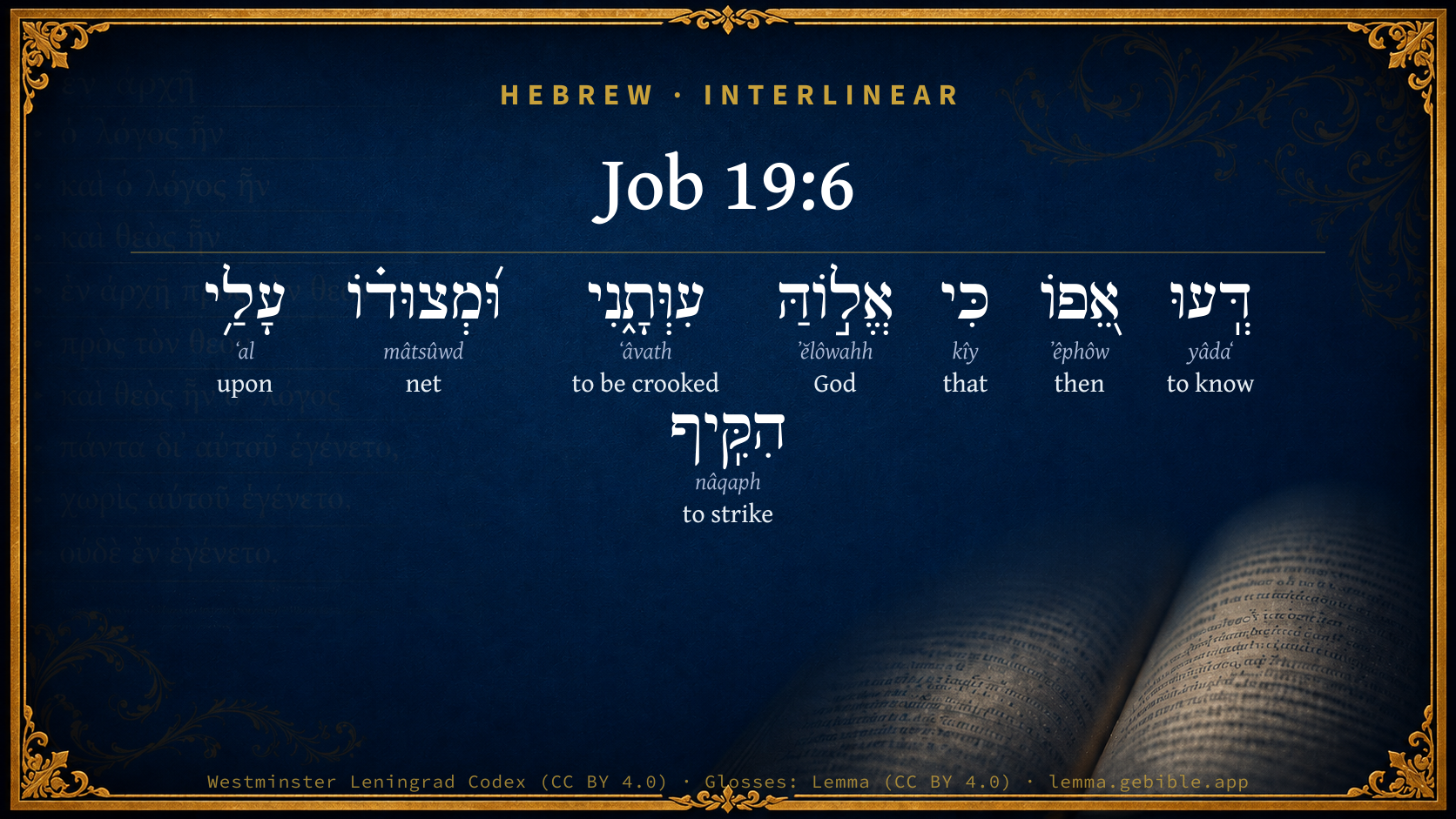
  1. דְּֽעוּ yâdaʻ H3045 “know” Verb, Qal, Imperative, 2nd Person, Masculine, Plural
  2. אֵ֭פוֹ ʼêphôw H645 “then” Adverb
  3. כִּי kîy H3588 “that” Conjunction
  4. אֱל֣וֹהַּ ʼĕlôwahh H433 “God” Noun, Common, Masculine, Singular, Absolute
  5. וּ֝מְצוּד֗וֹ mâtsûwd H4686 “and · net · his” Conjunction + Noun, Common, Both, Singular, Construct + Suffix, Personal, 3rd Person, Masculine, Singular
  6. עָלַ֥י ʻal H5921 “upon · me” Preposition + Suffix, Personal, 1st Person, Common, Singular
  7. הִקִּֽיף nâqaph H5362 “to strike” Verb, Hiphil, Perfect, 3rd Person, Masculine, Singular

About this verse

These counts appear in no published source. They are computed here, from the morphology-tagged text and Lemma’s own curated glosses. What Lemma adds →

8
words
8
distinct lemmas
Wisdom
section

Notable vocabulary

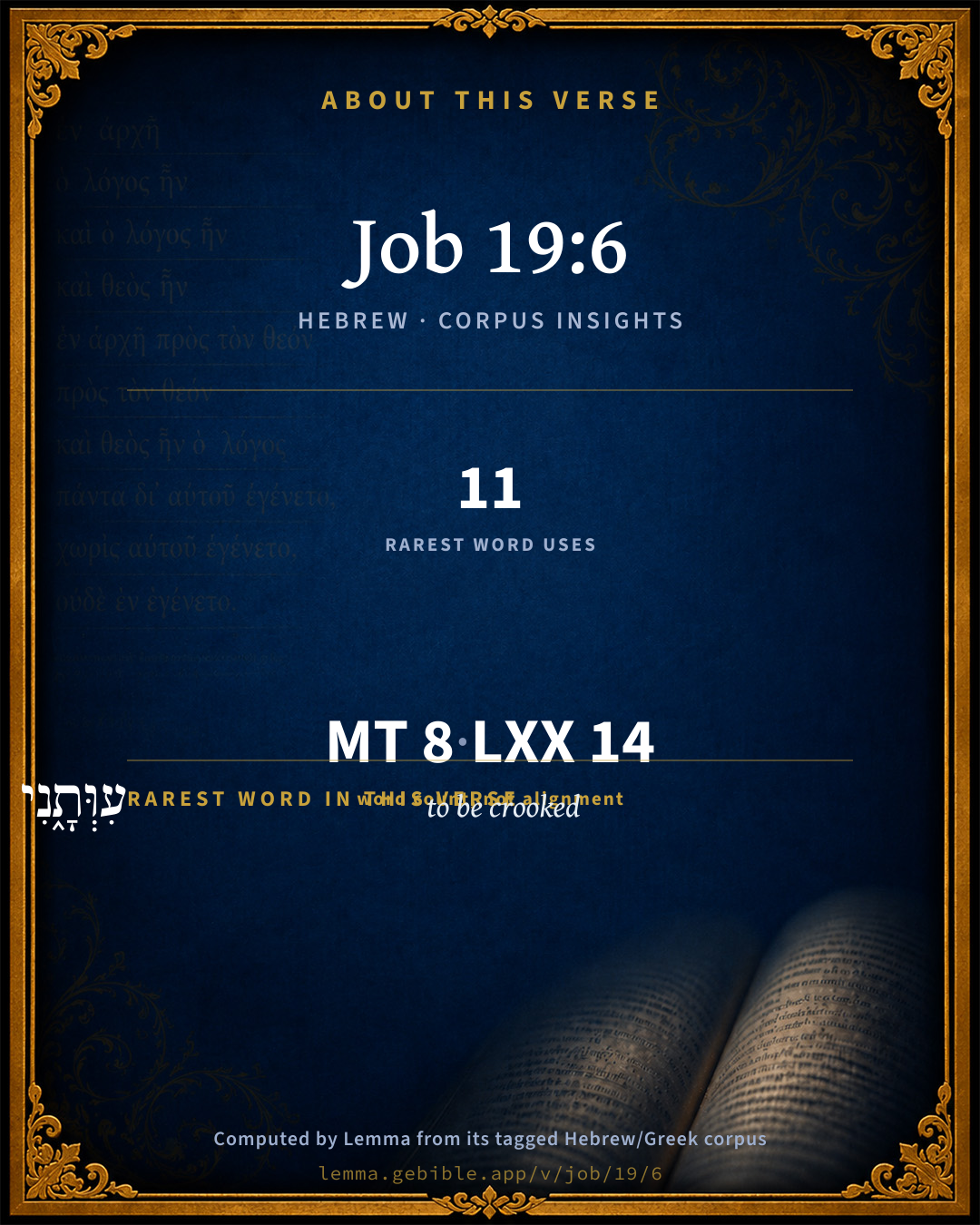
The rarest word here is עִוְּתָ֑נִי to be crooked H5791 — appearing just 11 times in the whole Hebrew Bible.

Shared distinctive vocabulary

עִוְּתָ֑נִי to be crooked H5791 occurs in 10 verses of the Hebrew Bible. Also found in:

Grammatical profile

  • 3 verbs
  • 2 nouns
  • 1 preposition
  • 1 conjunction
  • 1 adverb

Verb forms

  • דְּֽעוּ Qal · Imperative
  • עִוְּתָ֑נִי Piel · Perfect
  • הִקִּֽיף Hiphil · Perfect

Hebrew & Septuagint length

In English translation the verse runs 14 words from the Hebrew and 18 from the Septuagint (LXX English) — closely comparable.

A rough comparison of the two English renderings, which tokenize alike — not a word-level alignment.

Word counts can differ between the Hebrew and the Greek without any difference in meaning — e.g. the Hebrew direct-object marker אֵת has no separate Greek word, and Greek often adds the article ὁ.

In the original languages it is 8 Hebrew tokens and 14 Greek tokens — but the two are counted differently (Hebrew bundles its prefixes and suffixes into one token; the Greek is in lemma form), so that isn’t a like-for-like length.

Cross-references

10

Topical passages linked to Job 19:6 in the Treasury of Scripture Knowledge — connected by theme and wording, ordered by reader-vote popularity; previews shown in the World English Bible.

  • Job 18:8–10 For he is cast into a net by his own feet, And he wanders into its mesh.
  • Job 7:20 If I have sinned, what do I do to you, you watcher of men? Why have you set me as a mark for you, So that I am a burden to myself?
  • Job 16:11–14 God delivers me to the ungodly, And casts me into the hands of the wicked.
  • Job 27:2 "As God lives, who has taken away my right, The Almighty, who has made my soul bitter.
  • Psalms 44:9–14 But now you rejected us, and brought us to dishonor, And don't go out with our armies.
  • Psalms 66:10–12 For you, God, have tested us. You have refined us, as silver is refined.
  • Lamentations 1:12–13 Is it nothing to you, all you who pass by? Look, and see if there be any sorrow like my sorrow, which is brought on me, With which Yahweh has afflicted [me] in the day of his fierce anger.
  • Ezekiel 12:13 My net also will I spread on him, and he shall be taken in my snare; and I will bring him to Babylon to the land of the Chaldeans; yet shall he not see it, though he shall die there.
  • Ezekiel 32:3 Thus says the Lord Yahweh: I will spread out my net on you with a company of many peoples; and they shall bring you up in my net.
  • Hosea 7:12 When they go, I will spread my net on them. I will bring them down like the birds of the sky. I will chastise them, as their congregation has heard.

Cross-references courtesy of OpenBible.info (CC BY 4.0).

Hebrew and Greek witnesses Masoretic Hebrew ↔ Greek Septuagint

The same verse in the two great witnesses to the Old Testament, shown verse-for-verse.

These are two independent witnesses, not word-aligned to each other, and the Septuagint is shown in lemma (dictionary) form.

Hebrew Job 19:6 Masoretic · Westminster Leningrad Codex

דְּֽעוּ אֵ֭פוֹ כִּי אֱל֣וֹהַּ עִוְּתָ֑נִי וּ֝מְצוּד֗וֹ עָלַ֥י הִקִּֽיף

Know now that God has subverted me, And has surrounded me with his net.

World English Bible · Public Domain

Greek LXX Job 19:6 Septuagint · lemma form

γιγνώσκω οὖν ὅτι ὁ κύριος εἰμί ὁ ταράσσω ὀχύρωμα δέ αὐτός ἐπί ἐγώ ὑψόω

Know then that it is the Lord that has troubled me, and has raised his bulwark against me.

LXX2012 (modern English Septuagint) · Public Domain

Hebrew: Westminster Leningrad Codex (CC BY 4.0). Greek: Septuagint (public domain); English from LXX2012 (modern English Septuagint) (Public Domain). How the Septuagint differs from the Hebrew →

Commentary

Notes on Job 19:6 from classic Christian and Jewish commentators (each source and its license shown beneath its notes). The classic Christian expositions comment on the surrounding passage and are grouped to its opening verse, so a note may address several verses; the Jewish commentaries on the Tanakh (Rashi and others) are per-verse, so they appear only where the commentator wrote on this verse.

Lemma curates 59 commentaries, every one of them public domain or Creative Commons licensed, each selected and text-cleaned for this edition rather than reprinted as found. About our sources →

Trapp's Complete Commentary

John Trapp

Job 19:6 Know now that God hath overthrown me, and hath compassed me with his net.

Ver. 6. Know that God hath overthrown me] Do not you therefore add affliction to the afflicted, which is so odious a thing to God, Psa 41:2; Psa 69:26; but regard the greatness of mine evils, which draw these complaints from me that seem so immoderate to you. See Job 6:2 (Diodati).

And hath compassed me with his net] Hath encompassed me round with affliction, that I can get out no way. A hunting term, Job 10:16 Lam 1:13 Eze 12:13 Hos 7:12. Bildad had made much mention of nets and gins, wherein God ensnareth and ensnarleth the wicked, Job 18:8-9. Job granteth that God’s net had encompassed him; but withal denieth himself to be wicked, or that his friends should therefore reproach him, but rather pity him.

John Trapp, A Commentary or Exposition upon All the Books of the Old and New Testament (1647–1656) — public domain. Text from a community e-Sword module.

The Biblical Illustrator

Joseph S. Exell

Job_19:6-7

Know new that God has overthrown me.

The difficulties of unbelief

One thing is to be noticed, with both Job and his friends the existence of God is a part of the problem, not to be discharged from it even hypothetically. The misfortunes of the good, the prosperity of the wicked, the inequalities and the caprices of fate--these are just what have to be reconciled with the existence of a just and all-powerful God. The discussion starts from the supposition of a temporal Providence. All the debate is on what the debaters take to be religious ground. In a certain sense, the idea of God introduces a difficulty into the discussion. If we could look out upon the world as if it had no moral order dependent upon the will of One infinitely good and wise, then the particular difficulty of reconciling things as they are with any worthy conception of Divine power and goodness would suddenly disappear. It is suggested that, when a belief in God is dropped, the difficulty and confusion will disappear. The world, it is true, will be no brighter for the abandonment of faith; but at least no delusive marshfires will lead us astray from the true objects of life. We shall know neither whence we came, nor whither we are going; but we shall live our little day, neither vexed by vain questionings, nor relying upon baseless hopes. No doubt this is true to a certain extent, but only to that limited extent which involves essential and absolute untruth. Theism brings its own difficulties with it into the physical and moral problem of the universe. But what right have we to suppose that any hypothesis, as alone we can conceive it, will explain everything? And have we not the right to turn round upon rival theories, and ask if they can explain more than ours, or whether to them the mystery of the world is not mysterious still? Theism, with all that it is commonly held to involve, is an explanation of the mysteries of nature and of life; but not a complete explanation. Taking its pretensions at the lowest, and the least, it gathers up the facts of life into a unity, and supplies us with a theory in the light of which they may be correlated and understood. More than this, it furnishes a practical rule of living. It is precisely this which the opposite theory cannot do. The very necessity of its nature is to explain nothing. It leaves the obscurities of life just as it finds them. Pain and sin and loss are with it ultimate facts; nor has it the faintest glimmer of light to throw upon their absolute blackness The case might be different had human nature no side of relation to the infinite, or even were that relation apprehended only by one here and there. The mystery of the universe would be nothing to us if we had no faculty of knowing and feeling it. But, with a few and partial exceptions, this attempt to pass beyond the finite into the infinite belongs ineradicably to us all. A shrewd thinker once said, that if there were not a God, it would be necessary to invent one. Men will never permanently consent to the narrowing of power and life. Eternity and infinity may still hold their secrets in inexorable grasp, but we shall never cease to go in search of them, and to hold ourselves higher and better for the quest. Granting for a moment that these aspirations and longings are mistakes, remnants of a lower state, things out of which we shall grow, is the aspect of the case materially altered? I am still face to face with the facts of existence: I have still to meet, and bear, and make the best of my fate. We cannot permanently silence curiosity as to the universe simply by rejecting a single familiar explanation of it. In ceasing to believe in a God, you bare made absolutely no progress in explaining the mystery of the universe. You have only returned to the standpoint of absolute uncertainty and blank perplexity. Take the mystery of pain, and its correlative mystery of wrong--evil, that is, on its physical and on its moral side. Theism will not explain it. It points out palliations of it. It suggests that it is related to the power of choice in man, and so necessary to the moral government of the world. Still, these answers do not cover the whole question. But is Atheism better off or worse? Are pain and wrong any more endurable, any less weight upon the sympathetic conscience, because they are looked upon as bare, blank, absolutely unexplained facts? Atheism escapes from the characteristic difficulties of Theism only at the price of encumbering itself with a difficulty of its own. According to any theory, there is at least a set of humanity in an upward direction. Theism has hard work to account for the evil in the world; Can Atheism explain the good? How should the whole creation move, to one far-off event, and rise upon the circling wheels of time higher and ever higher, unless at the call and under the inspiration of God? One more illustration. We all know too well the meaning of human waste and loss. You tell me this is simply a matter of physical law. But, in so saying, have you explained what needs explanation? I cannot answer those questions, I know; but dream not that they do not weigh upon you too. You have to face them as well as I, and to bear the heartache, and the desolation, and the thought of severance, without the hope of immortality, and the stay of a Divine presence. (C. Beard, B. A.)

The Biblical Illustrator, edited by Joseph S. Exell (c. 1880s–1900s) — public domain. Text from a community e-Sword module.

Joseph Benson's Commentary

Job 19:6-7. Know now — Consider well, that God hath overthrown me — Hath grievously afflicted me in various ways, and therefore it ill becomes you to aggravate my miseries. Hebrew, עותני, gnivetani; hath perverted me; either my state and condition, as has now been said: or my right and cause. He oppresseth me with power, and will not give me a fair hearing, as it follows, Job 19:7. This is a harsh reflection on God: but such thoughts and expressions have sometimes proceeded from good men when they have been under sore afflictions and temptations, which was now Job’s case. And hath compassed me with his net — With afflictions on every side, so that I cannot escape, nor obtain freedom to plead with him as I desire. Behold, I cry out of wrong — Hebrew, אצעק חמס, etsgnack chamas, literally, I cry out injury! violence! namely, from my friends, who show me no pity, but condemn me without cause, and rob me of my good name; or from the Sabeans and Chaldeans, who have plundered me of my substance. Perhaps he also meant to complain that God himself treated him with rigorous justice, and not according to the mercy and benignity which he was wont to show to upright and good men. I cry aloud, but there is no judgment — Neither God nor man relieves or pities me. God, for a time, may seem to turn away his ear from his people, to be angry at their prayers, and overlook their appeals to him, and they must be excused if in that case they complain bitterly. Wo unto us if God be against us.

Joseph Benson's Commentary on the Old and New Testaments (1811–1818) — public domain. Text from a community e-Sword module.

Whedon's Commentary on the Bible

Daniel D. Whedon

First division — NONE OTHER THAN GOD COULD BE THE AUTHOR OF SUCH CALAMITIES AS THOSE THAT HAVE BEFALLEN Job , vv6-20.

First strophe — Job admits that it is impossible that a calamity bearing such marks of design (comp. Job_19:6 with Job_18:8-10) — one, too, so complete and overwhelming — should have proceeded from any other than God, who consistently turns a deaf ear to his solemn appeals, Job_19:6-12.

Satan so contrived the misfortunes, and especially the disease, of Job, as to convince him that they must be the work of God, hoping the more assuredly to wreck his faith. See note on Job_1:15, and Job_19:21.

6. Overthrown me — Others read, perverted, wrested me.

With his net — The net was frequently used in ancient warfare for the purpose of entangling, and thus more easily destroying, an enemy. Kitto (Pict. Bible) cites an instance in history (about 600 years before Christ) of a single combat between the commanders of the Athenian and Mitylenean forces; the latter (Pittacus, one of the famous seven sages) concealed behind his shield a net, in which, throwing it suddenly, he entangled the Athenian general, and easily slew him. “Bildad had said that the wicked would be taken in his own snares. Job says that God has ensnared him.” — Elzas.

Daniel D. Whedon (gen. ed.), Commentary on the Old and New Testaments (1874–1909) — public domain. Text from a community e-Sword module.

Tyndale Open Study Notes

Tyndale Open Resources

19:6 Job was convinced that justice had been delayed (19:7) and that God had wronged him (19:8-12). Later, Elihu (34:12) and God himself (40:2) disagreed. • capturing me in his net: Job might have been responding to Bildad’s accusation (18:8-10).

Tyndale Open Study Notes — © Tyndale Open Resources, licensed CC BY-SA 4.0. Text via the HelloAO Bible API.

Geneva Bible (1599)

Geneva Bible translators

He bursteth out again into his passions, and declareth still that his affliction cometh of God, though he be not able to feel the cause in himself.

Geneva Bible (1599) marginal notes — public domain. Text via Bolls.life.

Jamieson, Fausset & Brown

Robert Jamieson, A. R. Fausset & David Brown

compassed . . . net--alluding to Bildad's words (Job 18:8). Know, that it is not that I as a wicked man have been caught in my "own net"; it is God who has compassed me in His--why, I know not.

Jamieson, Fausset & Brown — Commentary Critical and Explanatory on the Whole Bible (1871) — public domain (CC PDM 1.0). Text via the HelloAO Bible API.

Adam Clarke's Commentary

Verse 6. Know now that God hath overthrown me] The matter is between him and me, and he has not commissioned you to add reproaches to his chastisements.

And hath compassed me with his net.] There may be an allusion here to the different modes of hunting which have been already referred to in the preceding chapter. But if we take the whole verse together, and read the latter clause before the former, thus, "Know, therefore, that God hath encompassed me with his net, and overthrown me;" the allusion may be to an ancient mode of combat practised among the ancient Persians, ancient Goths, and among the Romans. The custom among the Romans was this: "One of the combatants was armed with a sword and shield, the other with a trident and net. The net he endeavoured to cast over the head of his adversary, in which, when he succeeded, the entangled person was soon pulled down by a noose that fastened round the neck, and then despatched. The person who carried the net and trident was called Retiarius, and the other who carried the sword and shield was termed Secutor, or the pursuer, because, when the Retiarius missed his throw, he was obliged to run about the ground till he got his net in order for a second throw, while the Secutor followed hard to prevent and despatch him." The Persians in old times used what was called [Persic] kumund, the noose. It was not a net, but a sort of running loop, which horsemen endeavoured to cast over the heads of their enemies that they might pull them off their horses.

That the Goths used a hoop net fastened to a pole, which they endeavoured to throw over the heads of their foes, is attested by Olaus Magnus, Hist. de Gentibus Septentrionalibus, Rom. 1555, lib. xi., cap. 13, De diversis Modis praeliandi Finnorum. His words are, Quidam restibus instar retium ferinorum ductilibus sublimi jactatione utuntur: ubi enim cum hoste congressi sunt, injiciunt eos restes quasi laqueos in caput resistentis, ut equum aut hominem ad se trahant. "Some use elastic ropes, formed like hunting nets, which they throw aloft; and when they come in contact with the enemy, they throw these ropes over the head of their opponent, and by this means they can then drag either man or horse to themselves." At the head of the page he gives a wood-cut representing the net, and the manner of throwing it over the head of the enemy. To such a device Job might allude, God hath encompassed me with his NET, and overthrown me.

Adam Clarke's Commentary on the Bible (1810–1826) — public domain. Text from a community e-Sword/MySword module.

Ellicott's Commentary for English Readers

(6) Know now that God hath overthrown me.—Bildad had spoken a great deal about the wicked being snared by his own sin, and now Job, without actually quoting his words—for he uses a word for net that Bildad had not used—speaks to their substance. It is God who has taken him in His net and compassed him about therewith. This is the assertion he has made before (Job_16:7; Job_13:27, &c.).

A Bible Commentary for English Readers, edited by Charles John Ellicott (1878–1897) — public domain. Text from a community e-Sword module.

The Cambridge Bible for Schools and Colleges

gen. ed. J. J. S. Perowne

6. Know now] Or, as we say, know then. The word God is emphatic.

overthrown me] More probably, perverted my right (Job_19:7); this, not his guilt, is the explanation of his afflictions. By his reference to the “net” of God Job repudiates the statements of Bildad, ch. Job_18:8 seq.; it was not his own feet that led him into the net, God had thrown it about him.

The Cambridge Bible for Schools and Colleges (gen. ed. J. J. S. Perowne; Cambridge University Press, 1878–1918) — public domain. Text from a community e-Sword module.

John Gill's Exposition

Behold, I cry out of wrong,.... Or of "violence" (m), or injury done him by the Sabeans and Chaldeans upon his substance, and by Satan upon his health; this he cried out and complained of in prayer to God, and of it as it were in open court, as a violation of justice, and as being dealt very unjustly with:

but I am not heard; his prayer was not heard; he could get no relief, nor any redress of his grievances, nor any knowledge of the reasons of his being thus used; see Hab 1:2;

I cry aloud, but there is no judgment; notwithstanding his vehement and importunate requests; and which were repeated time after time, that there might be a hearing of his cause; that it might be searched into and tried, that his innocence might be cleared, and justice done him, and vengeance taken on those that wronged him; but he could not obtain it; there was no time appointed for judgment, no court of judicature set, nor any to judge. Now seeing this was the case, that the hand of God was in all his afflictions; that he had complained to him of the injury done him; and that he had most earnestly desired his cause might be heard, and the reasons given why he was thus used, but could get no answer to all this; therefore it became them to be cautious and careful of what they said concerning the dealings of God with him, and to what account they placed them; of which he gives a particular enumeration in the following verses.

(m) "violentiam", Junius & Tremellius, Piscator, &c. "injuriam", Montanus.

John Gill's Exposition of the Whole Bible (1746–1763) — public domain (CC PDM 1.0). Text via the HelloAO Bible API.

Albert Barnes' Notes on the Bible

Know now that God - Understand the case; and in order that they might, he goes into an extended description of the calamities which God had brought upon him. He wished them to be “fully” apprised of all that he had suffered at the hand of God.

Hath overthrown me - The word used here (עות ‛âvath) means to bend, to make crooked or curved; then to distort, prevert: them to overturn, to destroy; Isa 24:1; Lam 3:9. The meaning here is, that he had been in a state of prosperity, but that God had completely “reversed” everything.

And hath compassed me with his net - Has sprung his net upon me as a hunter does, and I am caught. Perhaps there may be an allusion here to what Bildad said in Job 18:8 ff, that the wicked would be taken in his own snares. Instead of that, Job says that “God” had sprung the snare upon him - for reasons which he could not understand, but in such a manner as should move the compassion of his friends.

Albert Barnes' Notes on the Bible (1834–1885) — public domain. Text from a community e-Sword/MySword module.

Haydock's Catholic Bible Commentary

With an equal judgment. St. Gregory explains these words thus: Job being a just man, and truly considering his own life, thought that his affliction was greater than his sins deserved; and in that respect, that the punishment was not equal, yet it was just, as coming from God, who give a crown of justice to those who suffer for righteousness’ sake, and proves the just with tribulations, as gold is tried by fire. (Challoner) --- He knew that God would surely give a just reward, 2 Timothy iv. (St. Gregory xiv. 16.) (Worthington) --- The friends of Job had too contracted a notion of Providence, supposing that the virtuous could not be afflicted. Job allowed that the ordinary rules were not here observed. Hebrew, "the Lord hath perverted or overthrown me." (Calmet) --- This gave him no small uneasiness. If the thing had been as plain as it appears now to us, he might have refuted all with a bare denial. (Houbigant)

George Leo Haydock (1774–1849), Haydock's Catholic Family Bible and Commentary, 1859 edition — public domain. Excludes Psalms (Douay-Rheims chapter numbering differs from Protestant) and Deuterocanonical books (Catholic canon only).

Matthew Poole's English Annotations

Know now; consider what I am now saying.

Hath overthrown me; hath grievously afflicted me in all kinds; therefore it ill becomes you to aggravate my miseries; and if my passions, hereby raised, have broken forth into some extravagant and unmeet expressions, I might expect your pity and favourable construction, and not such severe censures and reproaches. Heb. God hath perverted me, i.e. either my state or condition, as was now said, or my right and cause. He oppresseth me with power, and will not give me a fair hearing, as it follows, Job 19:7. He giveth me very hard measure, and dealeth worse with me than I might in reason and justice expect from so wise and good a God. This is a harsh reflection upon God; but such passages have sometimes come from good men, when under sore afflictions and temptations, which was Job’s case.

With his net, i.e. with afflictions on every side, so that I cannot escape, nor get any freedom to come to him and plead with him, as I desire.

Matthew Poole's English Annotations on the Holy Bible (1683–1685) — public domain. Text from a community e-Sword/MySword module.

The Pulpit Commentary

Know now that God hath overthrown me; or, perverted me me in my cause". (see Lam_3:6) And hath compassed me with his net. Professor Lee thinks that the net, or rather noose, intended by the rare word dWxm is the lasso"which was certainly employed in war (Herod., 7:85), and probably also in hunting, from ancient times in the East. Bildad had insinuated that Job had fallen into his own; (Job_18:7-9) Job replies that the snare in which he is taken is from God.

The Pulpit Commentary (1880–1919), ed. H.D.M. Spence-Jones & Joseph S. Exell — public domain. Text from a community e-Sword module.

Kretzmann's Popular Commentary

Paul E. Kretzmann

Job Complains of the Neglect he Suffers

v. 6. Know now that God hath overthrown me, wresting him, treating him without proper regard for the justness of tile case, and hath compassed me with His net, like a wild beast which is so wound up in the meshes of the hunter’s net that it cannot move.

v. 7. Behold, I cry out of wrong, crying out in complaint over the violence which he was experiencing, but I am not heard; I cry aloud, but there is no judgment, God will not vindicate his just cause, nor will his friends impartially examine and decide his case.

v. 8. He hath fenced up my way, hedging it up so closely that there is no passage, that I cannot pass, and He hath set darkness in my paths, making it impossible for Job to continue his way.

v. 9. He hath stripped me of my glory, the honor which his righteousness had formerly given him before men, and taken the crown, namely, that of his good name, from my head. Cf Isa 41:10; Isa 42:3.

v. 10. He hath destroyed me on every side, like a building doomed for destruction, which is razed to the ground, and I am gone, both his prosperity and his health having been taken from him; and mine hope hath He removed like a tree, tearing it out, uprooting it entirely.

v. 11. He hath also kindled His wrath against me, like a forest-fire, which devours everything in its path; and He counteth me unto Him as one of His enemies, regarding and treating him as the representative of all His foes and therefore concentrating all His hostility upon him.

v. 12. His troops come together, the armies of God, the calamities and sufferings advance, and raise up their way against me, erecting bulwarks as they proceed to their attack, and encamp round about my tabernacle, besieging him on every side.

v. 13. He hath put my brethren far from me, driving his nearest kinsmen away from him, and mine acquaintance, his very bosom friends, are verily estranged from me.

v. 14. My kinsfolk, his house associates, those who lived with him under the same roof, have failed, remained away from him in his present misery, and my familiar friends have forgotten me, those whose confidence and respect he had formerly enjoyed.

v. 15. They that dwell in mine house, the sojourners who partook of Job’s hospitality, and my maids, all his hired servants, count me for a stranger; I am an alien in their sight, an outsider, a man hailing from a strange country.

v. 16. I called my servant, and he gave me no answer, treating his master with such contempt that he calmly ignored his call; I intreated him with my mouth, where formerly a beckoning nod was sufficient, Job was now obliged to beg for any service which he wished to have performed.

v. 17. My breath is strange to my wife, the evil odor of his festering ulcers had caused his wife to turn from him with loathing, though I intreated for the children’s sake of mine own body, that is, the stench of his wounds had driven away also other relatives, probably grandsons, Job speaking of his great wretchedness in general terms.

v. 18. Yea, young children, wicked youngsters, rude and impudent mockers, despised me, he had become a target of mockery on every side; I arose, and they spake against me, if he did arise to assert his former influence and authority, they made him the butt for their coarse jokes.

v. 19. All my inward friends, his bosom friends, who enjoyed his confidence, abhorred me; and they whom I loved are turned against me. the reference being undoubtedly to the friends who had so openly spurned and attacked him.

v. 20. My bone cleaveth to my skin and to my flesh, he was wasted away to such a degree that his bones showed through his skin and his flesh, and I am escaped with the skin of my teeth, his gums at least not yet having been attacked by the fearful malady, so that he could still speak.

v. 21. Have pity upon me, have pity upon me, O ye my friends; for the hand of God hath touched me, namely, in this terrible plague with which he was afflicted. He begs for a show of pity, since he is already suffering with the fearful disease, apparently the punishment of an angry God.

v. 22. Why do ye persecute me as God, why should they assume divine authority in adding their persecution to that which the Lord had laid upon him, and are not satisfied with my flesh? Though they were gnawing at his very life with the tooth of suspicion and slander and thus devouring his very flesh, they did not yet seem to be satisfied, but were continuing their persecutions and increasing Job’s agony. It is the way of officious meddlers to continue their boring with bland and torturing persistence, thus adding to the misery of the afflicted.

Paul E. Kretzmann, Popular Commentary of the Bible (1921–1924) — public domain. Text from a community e-Sword module.

Lesson kit

Teaching starters — assembled from the data on this page, not authored interpretation. Every prompt links to the verse data it draws on. Edit before teaching.

Job, in the Wisdom, opens this verse with 8 words (8 distinct Hebrew lemmas). Its most distinctive word is ʻâvath (“to be crooked”). A historical commentator’s framing appears above. Read the whole chapter for the surrounding context.

Discussion questions

  1. What does “to be crooked” (ʻâvath) contribute to the verse as a whole?
  2. How does Job 8:3, which shares the word «to be crooked», read alongside this verse?
  3. The translations on this page render this verse differently — a whole-verse word diff, not a word-by-word alignment. What might account for the different wordings?
  4. «דְּֽעוּ» is a Qal Imperative verb. How does that grammatical form shape the action described?
  5. Compare how Trapp's Complete Commentary and The Biblical Illustrator read this verse. Where do they agree or differ?

Things to notice

Reading settings

Reading text

Shown beneath each verse's original-language words.

Old Testament
Old Testament edition

Read the OT as the Masoretic Hebrew (MT) or the Greek Septuagint (LXX).

English shown for the Greek Septuagint (in the Hebrew ↔ Greek comparison).

Comparing translations? Open the Compare panel on any verse page to stack up to four side by side.