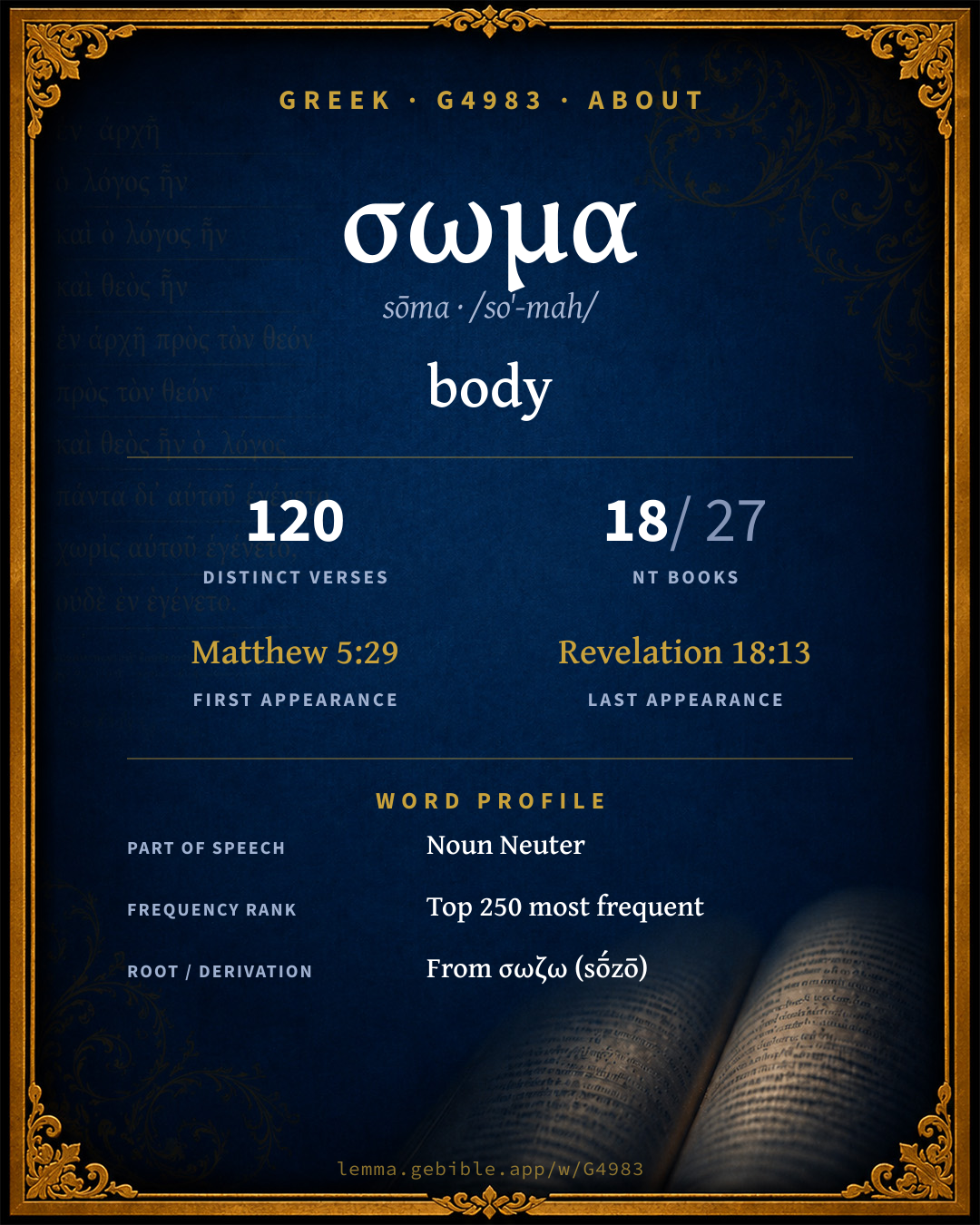
σῶμα
body
‘body’ is one of 4 main senses fuller range ↓
Full lexicon entry — Thayer's Greek Lexicon
From Thayer's Greek Lexicon
Where this word appears
See every Accusative-case word in the Greek New Testament →
Grammar key — what these labels mean
Part of speech
- Noun
- A naming word — a person, place, thing, or idea.
Case
- Nominative
- The case of the subject (and the predicate nominative).
- Genitive
- The case of source, possession, or “of” — answers “whose / from what.”
- Accusative
- The case of the direct object and of extent.
- Dative
- The case of the indirect object, means, or location — “to / for / with / in.”
Gender
- Neuter
- Grammatically neuter.
Number
- Singular
- One.
- Plural
- More than one.
1 verse where G4983 appears in the Dative case in the Book of Mark. Filtered view — show all forms. Click any verse to open its interlinear word-by-word view. Verse text shown in the World English Bible for context — . Each verse’s Greek form is shown with its reference; the English is not keyword-highlighted, since the data carries no word-level English alignment. Use “Compare translations” on any verse to read it across multiple English versions. This concordance covers the Greek New Testament; Septuagint (Greek Old Testament) occurrences of this word are not indexed here.
Mark
About this entry
At a glance — auto-summarized from this page’s data, not written by a person. Every figure links to its source below. This summary describes the numbers; it doesn’t interpret them.
At its core, σωμα (sōma) means “body.” Catalogued under 4 senses, its meaning is not single-sense. It appears 120 verses across 18 books of the Greek New Testament, among its common vocabulary. The word gravitates to 1 Corinthians (29%), then Romans and Matthew. First canonically at Matthew 5:29, it enters the text early. Each statement above links to its evidence; the full detail follows below.
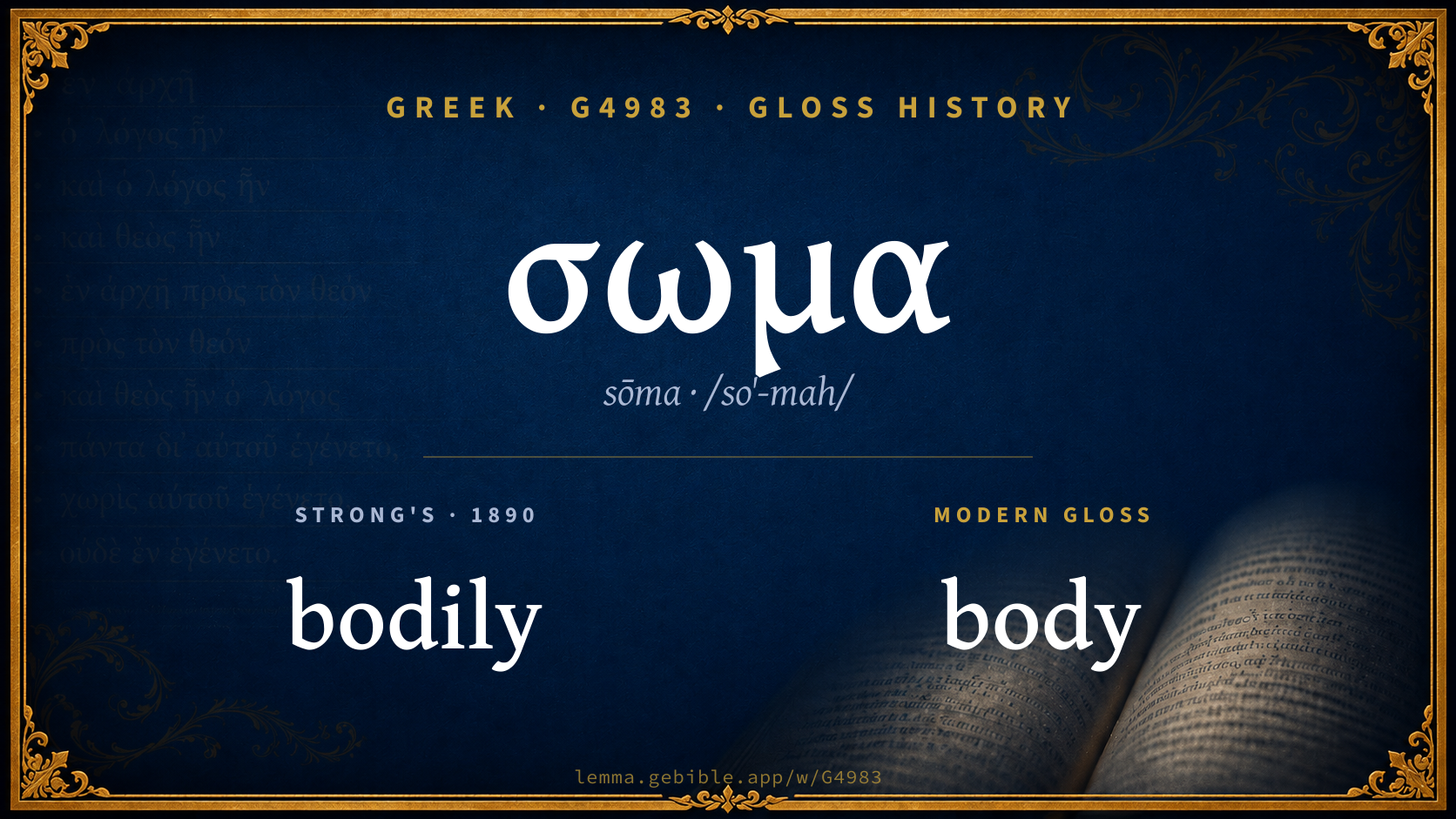
Gloss history
Strong's 1890 vs modern scholarship
About this word
Strong's G4983 catalogs a Greek word from the Greek New Testament.
These counts are not copied from any lexicon or concordance. They are computed here, from the morphology-tagged Greek New Testament. What Lemma adds →
- 120
- distinct verses
- The word appears in 120 distinct verses.
- 18 / 27
- NT books
- The word appears in 18 of 27 New Testament books.
- #119
- by frequency
- Top 250 most frequent Greek words (rank 119 of 5,347 Greek words by occurrence).
View all 120 occurrences in the concordance →
Most concentrated in
- 1 Corinthians 35 verses 29%
- Romans 13 verses 11%
- Matthew 11 verses 9%
By section of the New Testament
By traditional corpus
Conventional, traditional groupings — biblical authorship is debated, so this is a traditional corpus grouping, not an authorship claim. Some books belong to more than one corpus (Luke is in both the Gospels and the Lukan corpus, and so on), so these shares overlap and need not total 100%. Each figure is a share of the word’s 120 distinct verses.
- Pauline corpus 75 verses · 63%
- Gospels 31 verses · 26%
- Lukan (Luke–Acts) 12 verses · 10%
- General (Catholic) Epistles 7 verses · 6%
- Johannine 6 verses · 5%
- Hebrews 5 verses · 4%
- Revelation 1 verse · 1%
How translations render this word
Counts come from each version’s own published word-to-Strong’s tagging or interlinear alignment — an approximate guide to how each version renders this word, not a word-level alignment the data otherwise carries. Because each total is that version’s own tagged count, the per-version totals vary from one another and need not match the appearance or distinct-verse counts above. These counts may also differ from a printed concordance because Lemma counts each distinctly tagged rendering and does not collapse phrase taggings into a single head-word total. This is a fixed set of word-tagged versions (KJV, ASV, BSB, ULT) and does not change with the reading translation you choose elsewhere. Each version’s license is shown beside its name below (and on Sources).
- King James Version: Body 130×, Bodies 11×
- American Standard Version: Body 123×, Bodies 10×, Corpse 2×
- Berean Standard Bible: Body 116×, Bodies 14×, Physical 2×
- unfoldingWord Literal Text: Body 129×, Bodies 11×, Of 4×
King James Version Public Domain
Renders G4983 across 146 tagged occurrences — most commonly:
Plus 5 renderings that appear only once — usually multi-word phrases or single function words the recovered tagging swept in, not distinct renderings.
American Standard Version Public Domain
Renders G4983 across 148 tagged occurrences — most commonly:
Plus 13 renderings that appear only once — usually multi-word phrases or single function words the recovered tagging swept in, not distinct renderings.
Berean Standard Bible Public Domain
Renders G4983 across 135 tagged occurrences — most commonly:
Plus 3 renderings that appear only once — usually multi-word phrases or single function words the recovered tagging swept in, not distinct renderings. Not rendered by a distinct English word in 7 further occurrences.
unfoldingWord Literal Text CC BY-SA 4.0
Renders G4983 across 152 tagged occurrences — most commonly:
Plus 5 renderings that appear only once — usually multi-word phrases or single function words the recovered tagging swept in, not distinct renderings.
Senses in Thayer's
The 4 senses Thayer's distinguishes for this word, in lexicon order (not ranked by frequency or importance). The full entry — with sub-senses — is in the Lexicon Entry tab.
- the body both of men or animals
- the bodies of planets and of stars (heavenly bodies)
- is used of a (large or small) number of men closely united into one society…
- that which casts a shadow as distinguished from the shadow itself
Word origin
Derived from σωζω (sṓzō) (G4982) — to save.
From G4982 ; the body (as a sound whole) used in a very wide application literally or figuratively : - bodily body slave.
— Strong’s Exhaustive Concordance (1890), public domain.
Forms in the corpus
The 9 distinct written forms G4983 takes in the Greek New Testament, most frequent first — each parse links to that case’s occurrences in the concordance.
| Form | Parsing | Example | Uses |
|---|---|---|---|
| σῶμα sō̂ma | Noun, Nominative, Singular, Neuter | Matthew 6:25 | 55 |
| σώματος sṓmatos | Noun, Genitive, Singular, Neuter | John 2:21 | 32 |
| σώματι sṓmati | Noun, Dative, Singular, Neuter | Matthew 6:25 | 22 |
| σῶμά sō̂má | Noun, Nominative, Singular, Neuter | Matthew 5:29 | 14 |
| σώματα sṓmata | Noun, Nominative, Plural, Neuter | Matthew 27:52 | 10 |
| σώματός sṓmatós | Noun, Genitive, Singular, Neuter | Matthew 6:22 | 4 |
| σώματί sṓmatí | Noun, Dative, Singular, Neuter | Galatians 6:17 | 2 |
| σωμάτων sōmátōn | Noun, Genitive, Plural, Neuter | Revelation 18:13 | 1 |
| σώμασιν sṓmasin | Noun, Dative, Plural, Neuter | 2 Corinthians 4:10 | 1 |
Same root — word family
Other Thayer's entries built from the same root as G4983, grouped by Strong’s listed origin. These share a root / origin per the lexicon — not necessarily a shared meaning. Each links to that word’s own entry.
Derives from
Shares the same root
Derived from this word
Proper names from this root
People and places named from this root — a name, not an additional meaning of the word.
Compare all same-root words → Showing 4 of 7 — not the complete family. 2 of the same-root words are proper names (people or places). They share a root, not necessarily a meaning.
Septuagint usage
The same Greek word σωμα appears 74 times in the Greek Old Testament (Septuagint), across 66 verses in 17 books.
- 74
- LXX occurrences
- Tagged occurrences of this Greek word in the Septuagint.
- 66
- verses
- Distinct Septuagint verses containing this word.
- 17 / 39
- OT books
- The word appears in 17 of the 39 Old Testament books.
Sample Septuagint occurrences
- Genesis 15:11 σῶμα
- Leviticus 6:3 σῶμα
- Numbers 8:7 σῶμα
- Deuteronomy 21:23 σῶμα
- Joshua 8:29 σῶμα
- 1 Samuel 31:10 σῶμα
- 1 Kings 13:22 σῶμα
- 2 Kings 19:35 σῶμα
- 1 Chronicles 10:12 σῶμα
- Ezra 19:26 σῶμα
- Esther 9:14 σῶμα
- Job 3:17 σῶμα
Septuagint occurrences (same lexeme)
Every verse where the same Strong’s number (G4983) appears in the Greek Septuagint — showing the first 50 of 66. Verse text shown in the World English Bible for context; the Greek form is the matched word — the English is not keyword-highlighted.
- Genesis 15:11 σῶμα The birds of prey came down on the carcasses, and Abram drove them away.
- Genesis 34:29 σῶμα and all their wealth. They took captive all their little ones and their wives, and took as plunder everything that was in the house.
- Genesis 36:6 σῶμα Esau took his wives, his sons, his daughters, and all the members of his household, with his cattle, all his animals, and all his possessions, which he had gathered in the land of Canaan, and went into a land away from his brother Jacob.
- Genesis 47:12 σῶμα Joseph nourished his father, his brothers, and all of his father's household, with bread, according to their families.
- Genesis 47:18 σῶμα When that year was ended, they came to him the second year, and said to him, "We will not hide from my lord how our money is all spent, and the herds of cattle are my lord's. There is nothing left in the sight of my lord, but our bodies, and our lands.
- Leviticus 6:3 σῶμα or has found that which was lost, and dealt falsely therein, and swearing to a lie; in any of all these things that a man does, sinning therein;
- Leviticus 14:9 σῶμα It shall be on the seventh day, that he shall shave all his hair off his head and his beard and his eyebrows, even all his hair he shall shave off. He shall wash his clothes, and he shall bathe his body in water, then he shall be clean.
- Leviticus 15:2 σῶμα "Speak to the children of Israel, and tell them, 'When any man has a discharge from his body, because of his discharge he is unclean.
- Leviticus 15:3 σῶμα This shall be his uncleanness in his discharge: whether his body runs with his discharge, or his body has stopped from his discharge, it is his uncleanness.
- Leviticus 15:11 σῶμα "'Whoever he who has the discharge touches, without having rinsed his hands in water, he shall wash his clothes, and bathe himself in water, and be unclean until the evening.
- Leviticus 15:13 σῶμα "'When he who has a discharge is cleansed of his discharge, then he shall count to himself seven days for his cleansing, and wash his clothes; and he shall bathe his flesh in running water, and shall be clean.
- Leviticus 15:16 σῶμα "'If any man has an emission of semen, then he shall bathe all his flesh in water, and be unclean until the evening.
- Leviticus 15:19 σῶμα "'If a woman has a discharge, and her discharge in her flesh is blood, she shall be in her impurity seven days: and whoever touches her shall be unclean until the evening.
- Leviticus 15:21 σῶμα Whoever touches her bed shall wash his clothes, and bathe himself in water, and be unclean until the evening.
- Leviticus 15:27 σῶμα Whoever touches these things shall be unclean, and shall wash his clothes, and bathe himself in water, and be unclean until the evening.
- Leviticus 16:4 σῶμα He shall put on the holy linen coat, and he shall have the linen breeches on his body, and shall put on the linen sash, and he shall be dressed with the linen turban. They are the holy garments. He shall bathe his body in water, and put them on.
- Leviticus 16:24 σῶμα Then he shall bathe himself in water in a holy place, and put on his garments, and come out and offer his burnt offering and the burnt offering of the people, and make atonement for himself and for the people.
- Leviticus 16:26 σῶμα "He who lets the goat go for the scapegoat shall wash his clothes, and bathe his flesh in water, and afterward he shall come into the camp.
- Leviticus 16:28 σῶμα He who burns them shall wash his clothes, and bathe his flesh in water, and afterward he shall come into the camp.
- Leviticus 17:16 σῶμα But if he doesn't wash them, or bathe his flesh, then he shall bear his iniquity.'"
- Leviticus 19:28 σῶμα "'You shall not make any cuttings in your flesh for the dead, nor tattoo any marks on you. I am Yahweh.
- Leviticus 22:6 σῶμα the person that touches any such shall be unclean until the evening, and shall not eat of the holy things, unless he bathe his body in water.
- Numbers 8:7 σῶμα Thus shall you do to them, to cleanse them: sprinkle the water of cleansing on them, let them shave their whole bodies with a razor, and let them wash their clothes, and cleanse themselves.
- Numbers 19:7 σῶμα Then the priest shall wash his clothes, and he shall bathe his flesh in water, and afterward he shall come into the camp, and the priest shall be unclean until the even.
- Numbers 19:8 σῶμα He who burns her shall wash his clothes in water, and bathe his flesh in water, and shall be unclean until the even.
- Deuteronomy 21:23 σῶμα his body shall not remain all night on the tree, but you shall surely bury him the same day; for he who is hanged is accursed of God; that you don't defile your land which Yahweh your God gives you for an inheritance.
- Deuteronomy 23:12 σῶμα You shall have a place also outside of the camp, where you shall go forth abroad:
- Joshua 8:29 σῶμα The king of Ai he hanged on a tree until the evening: and at the going down of the sun Joshua commanded, and they took his body down from the tree, and cast it at the entrance of the gate of the city, and raised thereon a great heap of stones, to this day.
- 1 Samuel 31:10 σῶμα They put his armor in the house of the Ashtaroth; and they fastened his body to the wall of Beth-shan.
- 1 Samuel 31:12 σῶμα all the valiant men arose, and went all night, and took the body of Saul and the bodies of his sons from the wall of Beth-shan; and they came to Jabesh, and burnt them there.
- 1 Kings 13:22 σῶμα but came back, and have eaten bread and drunk water in the place of which he said to you, Eat no bread, and drink no water; your body shall not come to the tomb of your fathers.
- 1 Kings 13:24 σῶμα When he was gone, a lion met him by the way, and killed him: and his body was cast in the way, and the donkey stood by it; the lion also stood by the body.
- 1 Kings 13:28 σῶμα He went and found his body cast in the way, and the donkey and the lion standing by the body: the lion had not eaten the body, nor torn the donkey.
- 1 Kings 13:29 σῶμα The prophet took up the body of the man of God, and laid it on the donkey, and brought it back; and he came to the city of the old prophet, to mourn, and to bury him.
- 1 Kings 20:27 σῶμα The children of Israel were mustered, and were provisioned, and went against them: and the children of Israel encamped before them like two little flocks of kids; but the Syrians filled the country.
- 2 Kings 19:35 σῶμα It happened that night, that the angel of Yahweh went forth, and struck in the camp of the Assyrians one hundred eighty-five thousand: and when men arose early in the morning, behold, these were all dead bodies.
- 1 Chronicles 10:12 σῶμα all the valiant men arose, and took away the body of Saul, and the bodies of his sons, and brought them to Jabesh, and buried their bones under the oak in Jabesh, and fasted seven days.
- 1 Chronicles 28:1 σῶμα David assembled all the princes of Israel, the princes of the tribes, and the captains of the companies who served the king by division, and the captains of thousands, and the captains of hundreds, and the rulers over all the substance and possessions of the king and of his sons, with the officers, and the mighty men, even all the mighty men of valor, to Jerusalem.
- Ezra 19:26 σῶμα
- Ezra 19:37 σῶμα
- Esther 9:14 σῶμα The king commanded it so to be done: and a decree was given out in Shushan; and they hanged Haman's ten sons.
- Job 3:17 σῶμα There the wicked cease from troubling; There the weary are at rest.
- Job 6:4 σῶμα For the arrows of the Almighty are within me, My spirit drinks up their poison. The terrors of God set themselves in array against me.
- Job 7:5 σῶμα My flesh is clothed with worms and clods of dust. My skin closes up, and breaks out afresh.
- Job 13:12 σῶμα Your memorable sayings are proverbs of ashes, Your defenses are defenses of clay.
- Job 20:25 σῶμα He draws it forth, and it comes out of his body. Yes, the glittering point comes out of his liver. Terrors are on him.
- Job 33:17 σῶμα That he may withdraw man from his purpose, And hide pride from man.
- Job 33:24 σῶμα Then God is gracious to him, and says, 'Deliver him from going down to the pit, I have found a ransom.'
- Job 36:28 σῶμα Which the skies pour down And drop on man abundantly.
- Job 40:32 σῶμα
These are occurrences of the same Greek lexeme (G4983) in the Septuagint — not a translation of any one Hebrew word. The store carries no word-level Hebrew↔Greek alignment, so no Hebrew original is asserted here. Counts come from the recovered LXX Strong's tagging — high-frequency vocabulary is well covered, while rare or late forms may be untagged — so they reflect tagged occurrences and may slightly undercount.