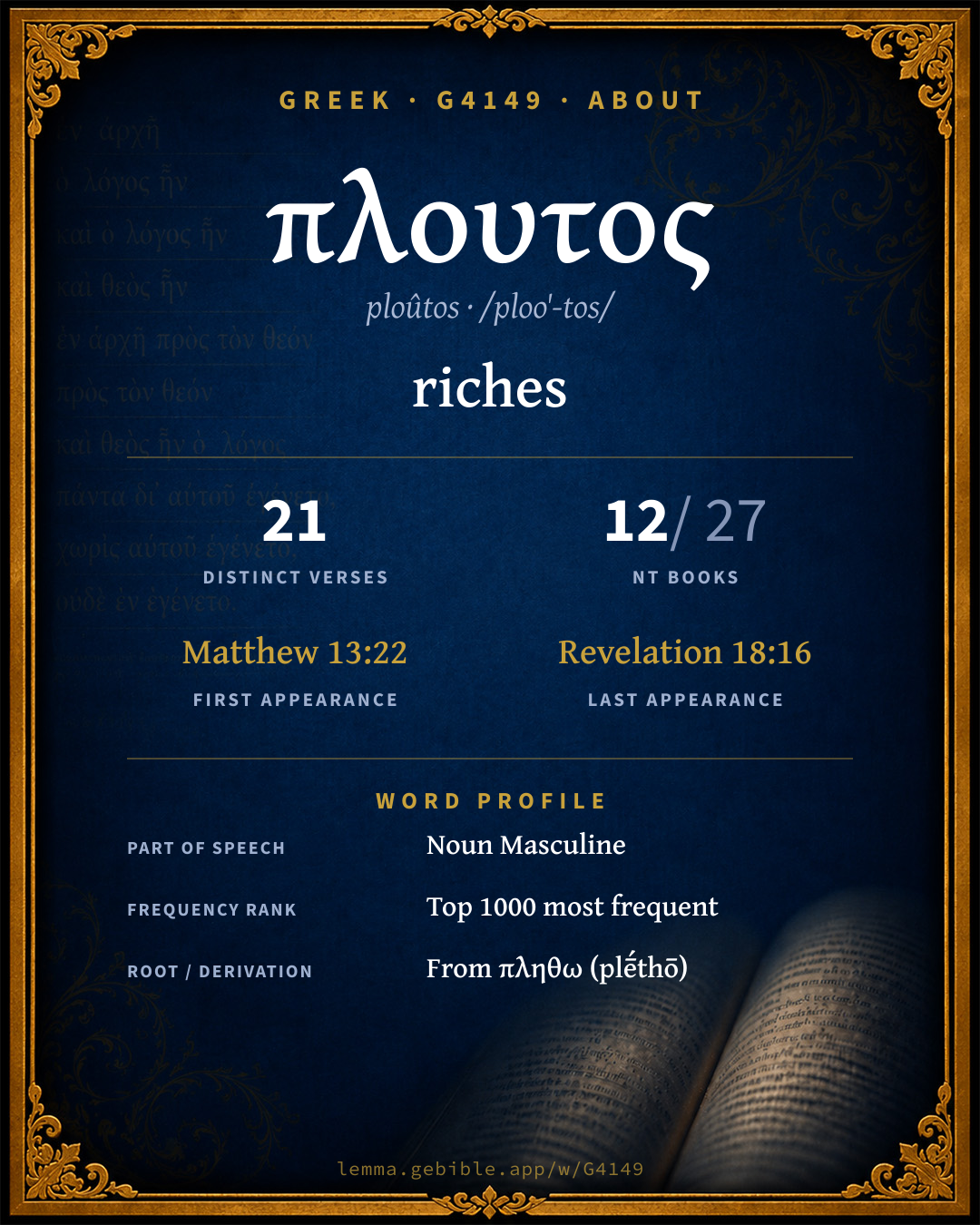
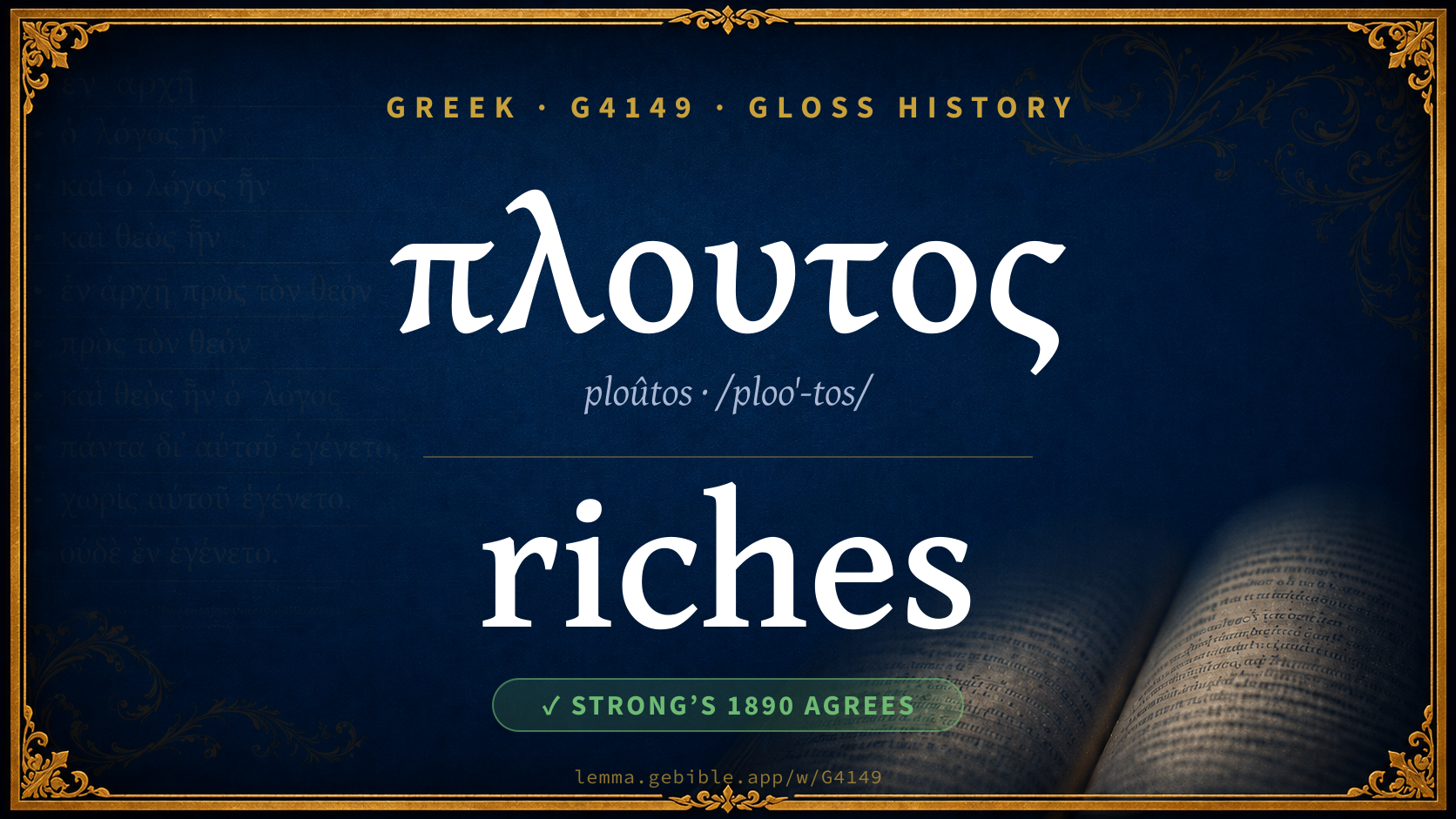
πλοῦτος
riches
Full lexicon entry — Thayer's Greek Lexicon
From Thayer's Greek Lexicon
Where this word appears
See every Accusative-case word in the Greek New Testament →
Grammar key — what these labels mean
Part of speech
- Noun
- A naming word — a person, place, thing, or idea.
Case
- Accusative
- The case of the direct object and of extent.
- Genitive
- The case of source, possession, or “of” — answers “whose / from what.”
- Nominative
- The case of the subject (and the predicate nominative).
Gender
- Neuter
- Grammatically neuter.
- Masculine
- Grammatically masculine.
Number
- Singular
- One.
Grammatical forms
- Noun, Accusative, Singular, Neuter 7 times (32%)
- Noun, Genitive, Singular, Masculine 6 times (27%)
- Noun, Accusative, Singular, Masculine 3 times (14%)
- Noun, Nominative, Singular, Masculine 3 times (14%)
- Noun, Nominative, Singular, Neuter 3 times (14%)
Parsed forms decoded from the imported morphology (Robinson–Tischendorf, public domain), counted across 22 parsed occurrences — not distinct verses.
Every verse where G4149 appears — 21 distinct verses across 12 books. Click any verse to open its interlinear word-by-word view. Verse text shown in the World English Bible for context — . Each verse’s Greek form is shown with its reference; the English is not keyword-highlighted, since the data carries no word-level English alignment. Use “Compare translations” on any verse to read it across multiple English versions. This concordance covers the Greek New Testament; Septuagint (Greek Old Testament) occurrences of this word are not indexed here.
Matthew 1 verse
Mark 1 verse
Luke 1 verse
Romans 4 verses
- Romans 2:4 πλούτου n gen sg masc Or do you despise the riches of his goodness, forbearance, and patience, not knowing that the goodness of God leads you to repentance?
- Romans 9:23 πλοῦτον n acc sg masc and that he might make known the riches of his glory on vessels of mercy, which he prepared beforehand for glory,
- Romans 11:12 πλοῦτος πλοῦτος n nom sg neut n nom sg neut Now if their fall is the riches of the world, and their loss the riches of the Gentiles; how much more their fullness?
- Romans 11:33 πλούτου n gen sg masc Oh the depth of the riches both of the wisdom and the knowledge of God! How unsearchable are his judgments, and his ways past tracing out!
2 Corinthians 1 verse
Ephesians 5 verses
- Ephesians 1:7 πλοῦτος n acc sg neut in whom we have our redemption through his blood, the forgiveness of our trespasses, according to the riches of his grace,
- Ephesians 1:18 πλοῦτος n nom sg masc having the eyes of your hearts enlightened, that you may know what is the hope of his calling, and what are the riches of the glory of his inheritance in the saints,
- Ephesians 2:7 πλοῦτος n acc sg neut that in the ages to come he might show the exceeding riches of his grace in kindness toward us in Christ Jesus;
- Ephesians 3:8 πλοῦτος n acc sg neut To me, the very least of all saints, was this grace given, to preach to the Gentiles the unsearchable riches of Christ,
- Ephesians 3:16 πλοῦτος n acc sg neut that he would grant you, according to the riches of his glory, that you may be strengthened with power through his Spirit in the inward man;
Philippians 1 verse
Colossians 2 verses
- Colossians 1:27 πλοῦτος n nom sg neut to whom God was pleased to make known what are the riches of the glory of this mystery among the Gentiles, which is Christ in you, the hope of glory;
- Colossians 2:2 πλοῦτος n acc sg neut that their hearts may be comforted, they being knit together in love, and gaining all riches of the full assurance of understanding, that they may know the mystery of God, both of the Father and of Christ,
1 Timothy 1 verse
Hebrews 1 verse
James 1 verse
Revelation 2 verses
- Revelation 5:12 πλοῦτον n acc sg masc saying with a loud voice, "Worthy is the Lamb who has been killed to receive the power, wealth, wisdom, strength, honor, glory, and blessing!"
- Revelation 18:16 πλοῦτος n nom sg masc saying, 'Woe, woe, the great city, she who was dressed in fine linen, purple, and scarlet, and decked with gold and precious stones and pearls!
About this entry
At a glance — auto-summarized from this page’s data, not written by a person. Every figure links to its source below. This summary describes the numbers; it doesn’t interpret them.
The Greek noun πλουτος centers on the idea of “riches.” Its earliest occurrence is Matthew 13:22. It appears 21 verses across 12 books of the Greek New Testament, among its uncommon vocabulary. It clusters with πληθω, πληθος and πλημμυρα under a shared root. Dig into 21-verse concordance and the renderings breakdown below.
Gloss history
Strong's 1890 vs modern scholarship
About this word
Strong's G4149 catalogs a Greek word from the Greek New Testament.
These counts are not copied from any lexicon or concordance. They are computed here, from the morphology-tagged Greek New Testament. What Lemma adds →
- 21
- distinct verses
- The word appears in 21 distinct verses.
- 12 / 27
- NT books
- The word appears in 12 of 27 New Testament books.
- #586
- by frequency
- Top 1000 most frequent Greek words (rank 586 of 5,347 Greek words by occurrence).
View all 21 occurrences in the concordance →
Most concentrated in
- Ephesians 5 verses 24%
- Romans 4 verses 19%
- Colossians 2 verses 10%
By section of the New Testament
By traditional corpus
Conventional, traditional groupings — biblical authorship is debated, so this is a traditional corpus grouping, not an authorship claim. Some books belong to more than one corpus (Luke is in both the Gospels and the Lukan corpus, and so on), so these shares overlap and need not total 100%. Each figure is a share of the word’s 21 distinct verses.
- Pauline corpus 14 verses · 67%
- Gospels 3 verses · 14%
- Johannine 2 verses · 10%
- Revelation 2 verses · 10%
- Lukan (Luke–Acts) 1 verse · 5%
- Hebrews 1 verse · 5%
- General (Catholic) Epistles 1 verse · 5%
How translations render this word
Counts come from each version’s own published word-to-Strong’s tagging or interlinear alignment — an approximate guide to how each version renders this word, not a word-level alignment the data otherwise carries. Because each total is that version’s own tagged count, the per-version totals vary from one another and need not match the appearance or distinct-verse counts above. These counts may also differ from a printed concordance because Lemma counts each distinctly tagged rendering and does not collapse phrase taggings into a single head-word total. This is a fixed set of word-tagged versions (KJV, ASV, BSB, ULT) and does not change with the reading translation you choose elsewhere. Each version’s license is shown beside its name below (and on Sources).
- King James Version: Riches 20×
- American Standard Version: Riches 19×, Is the riches 2×
- Berean Standard Bible: Riches 15×, Wealth 4×
- unfoldingWord Literal Text: Riches 14×, Wealth 6×, Is wealth 2×
King James Version Public Domain
Renders G4149 across 22 tagged occurrences — most commonly:
Plus 2 renderings that appear only once — usually multi-word phrases or single function words the recovered tagging swept in, not distinct renderings.
American Standard Version Public Domain
Renders G4149 across 22 tagged occurrences — most commonly:
Plus 1 rendering that appears only once — usually multi-word phrases or single function words the recovered tagging swept in, not distinct renderings.
Berean Standard Bible Public Domain
Renders G4149 across 21 tagged occurrences — most commonly:
Plus 2 renderings that appear only once — usually multi-word phrases or single function words the recovered tagging swept in, not distinct renderings.
unfoldingWord Literal Text CC BY-SA 4.0
Renders G4149 across 22 tagged occurrences — most commonly:
Senses in Thayer's
The 1 sense Thayer's distinguishes for this word, in lexicon order (not ranked by frequency or importance). The full entry — with sub-senses — is in the Lexicon Entry tab.
- riches, wealth
Word origin
Derived from πληθω (plḗthō) (G4130) — to fill.
From the base of G4130 ; wealth (as fulness ) that is (literally) money possessions or (figuratively) abundance richness (specifically) valuable bestowment : - riches.
— Strong’s Exhaustive Concordance (1890), public domain.
Forms in the corpus
The 3 distinct written forms G4149 takes in the Greek New Testament, most frequent first — each parse links to that case’s occurrences in the concordance.
| Form | Parsing | Example | Uses |
|---|---|---|---|
| πλοῦτος ploûtos | Noun, Accusative, Singular, Neuter | 2 Corinthians 8:2 | 13 |
| πλούτου ploútou | Noun, Genitive, Singular, Masculine | Matthew 13:22 | 6 |
| πλοῦτον ploûton | Noun, Accusative, Singular, Masculine | Romans 9:23 | 3 |
Same root — word family
Other Thayer's entries built from the same root as G4149, grouped by Strong’s listed origin. These share a root / origin per the lexicon — not necessarily a shared meaning. Each links to that word’s own entry.
Derives from
Shares the same root
- πληθος plēthos G4128 multitude
- πλημμυρα plḗmmyra G4132 flood
- πληρης plḗrēs G4134 full
- πλησμονη plēsmonḗ G4140 satiety
Derived from this word
Compare all same-root words → Showing 4 of 8 — not the complete family. They share a root, not necessarily a meaning.
Septuagint usage
The same Greek word πλουτος appears 74 times in the Greek Old Testament (Septuagint), across 71 verses in 15 books.
- 74
- LXX occurrences
- Tagged occurrences of this Greek word in the Septuagint.
- 71
- verses
- Distinct Septuagint verses containing this word.
- 15 / 39
- OT books
- The word appears in 15 of the 39 Old Testament books.
Sample Septuagint occurrences
- Genesis 31:16 πλοῦτος
- Deuteronomy 33:19 πλοῦτος
- 1 Samuel 2:10 πλοῦτος
- 1 Kings 3:11 πλοῦτος
- 1 Chronicles 29:12 πλοῦτος
- 2 Chronicles 1:11 πλοῦτος
- Esther 1:4 πλοῦτος
- Job 20:15 πλοῦτος
- Psalms 36:3 πλοῦτος
- Proverbs 3:16 πλοῦτος
- Ecclesiastes 4:8 πλοῦτος
- Isaiah 16:14 πλοῦτος
Septuagint occurrences (same lexeme)
Every verse where the same Strong’s number (G4149) appears in the Greek Septuagint — showing the first 50 of 71. Verse text shown in the World English Bible for context; the Greek form is the matched word — the English is not keyword-highlighted.
- Genesis 31:16 πλοῦτος For all the riches which God has taken away from our father, that is ours and our children's. Now then, whatever God has said to you, do."
- Deuteronomy 33:19 πλοῦτος They shall call the peoples to the mountain; There shall they offer sacrifices of righteousness: For they shall suck the abundance of the seas, The hidden treasures of the sand.
- 1 Samuel 2:10 πλοῦτος Those who strive with Yahweh shall be broken to pieces; Against them will he thunder in the sky: Yahweh will judge the ends of the earth; He will give strength to his king, Exalt the horn of his anointed.
- 1 Kings 3:11 πλοῦτος God said to him, Because you have asked this thing, and have not asked for yourself long life, neither have asked riches for yourself, nor have asked the life of your enemies, but have asked for yourself understanding to discern justice;
- 1 Kings 3:13 πλοῦτος I have also given you that which you have not asked, both riches and honor, so that there shall not be any among the kings like you, all your days.
- 1 Kings 10:23 πλοῦτος So king Solomon exceeded all the kings of the earth in riches and in wisdom.
- 1 Chronicles 29:12 πλοῦτος Both riches and honor come of you, and you rule over all; and in your hand is power and might; and it is in your hand to make great, and to give strength to all.
- 1 Chronicles 29:28 πλοῦτος He died in a good old age, full of days, riches, and honor: and Solomon his son reigned in his place.
- 2 Chronicles 1:11 πλοῦτος God said to Solomon, Because this was in your heart, and you have not asked riches, wealth, or honor, nor the life of those who hate you, neither yet have asked long life; but have asked wisdom and knowledge for yourself, that you may judge my people, over whom I have made you king:
- 2 Chronicles 1:12 πλοῦτος wisdom and knowledge is granted to you; and I will give you riches, and wealth, and honor, such as none of the kings have had who have been before you; neither shall there any after you have the like.
- 2 Chronicles 9:22 πλοῦτος So king Solomon exceeded all the kings of the earth in riches and wisdom.
- 2 Chronicles 17:5 πλοῦτος Therefore Yahweh established the kingdom in his hand; and all Judah brought to Jehoshaphat tribute; and he had riches and honor in abundance.
- 2 Chronicles 18:1 πλοῦτος Now Jehoshaphat had riches and honor in abundance; and he joined affinity with Ahab.
- 2 Chronicles 32:27 πλοῦτος Hezekiah had exceeding much riches and honor: and he provided him treasuries for silver, and for gold, and for precious stones, and for spices, and for shields, and for all manner of goodly vessels;
- Esther 1:4 πλοῦτος when he shown the riches of his glorious kingdom and the honor of his excellent majesty many days, even one hundred eighty days.
- Esther 5:9 πλοῦτος Then went Haman forth that day joyful and glad of heart: but when Haman saw Mordecai in the king's gate, that he didn't stand up nor move for him, he was filled with wrath against Mordecai.
- Esther 10:2 πλοῦτος All the acts of his power and of his might, and the full account of the greatness of Mordecai, whereunto the king advanced him, aren't they written in the book of the chronicles of the kings of Media and Persia?
- Job 20:15 πλοῦτος He has swallowed down riches, and he shall vomit them up again. God will cast them out of his belly.
- Job 20:18 πλοῦτος That for which he labored he shall restore, and shall not swallow it down; According to the substance that he has gotten, he shall not rejoice.
- Job 21:7 πλοῦτος "Why do the wicked live, Become old, yes, and grow mighty in power?
- Job 31:25 πλοῦτος If I have rejoiced because my wealth was great, And because my hand had gotten much;
- Psalms 36:3 πλοῦτος The words of his mouth are iniquity and deceit. He has ceased to be wise and to do good.
- Psalms 36:16 πλοῦτος
- Psalms 48:7 πλοῦτος With the east wind, you break the ships of Tarshish.
- Psalms 48:11 πλοῦτος Let Mount Zion be glad! Let the daughters of Judah rejoice, Because of your judgments.
- Psalms 51:9 πλοῦτος Hide your face from my sins, And blot out all of my iniquities.
- Psalms 61:11 πλοῦτος
- Psalms 72:12 πλοῦτος For he will deliver the needy when he cries; The poor, who has no helper.
- Psalms 75:6 πλοῦτος For neither from the east, nor from the west, Nor yet from the south, comes exaltation.
- Psalms 111:3 πλοῦτος His work is honor and majesty. His righteousness endures forever.
- Psalms 118:14 πλοῦτος Yah is my strength and song. He has become my salvation.
- Proverbs 3:16 πλοῦτος Length of days is in her right hand. In her left hand are riches and honor.
- Proverbs 8:18 πλοῦτος With me are riches, honor, Enduring wealth, and prosperity.
- Proverbs 11:16 πλοῦτος A gracious woman obtains honor, But violent men obtain riches.
- Proverbs 11:28 πλοῦτος He who trusts in his riches will fall, But the righteous shall flourish as the green leaf.
- Proverbs 13:7 πλοῦτος There are some who pretend to be rich, yet have nothing. There are some who pretend to be poor, yet have great wealth.
- Proverbs 13:8 πλοῦτος The ransom of a man's life is his riches, But the poor hear no threats.
- Proverbs 13:22 πλοῦτος A good man leaves an inheritance to his children's children, But the wealth of the sinner is stored for the righteous.
- Proverbs 13:23 πλοῦτος An abundance of food is in poor people's fields, But injustice sweeps it away.
- Proverbs 19:4 πλοῦτος Wealth adds many friends, But the poor is separated from his friend.
- Proverbs 21:17 πλοῦτος He who loves pleasure shall be a poor man: He who loves wine and oil shall not be rich.
- Proverbs 22:1 πλοῦτος A good name is more desirable than great riches, And loving favor is better than silver and gold.
- Proverbs 22:4 πλοῦτος The result of humility and the fear of Yahweh Is wealth, honor, and life.
- Proverbs 24:4 πλοῦτος By knowledge the rooms are filled With all rare and beautiful treasure.
- Proverbs 28:8 πλοῦτος He who increases his wealth by excessive interest Gathers it for one who has pity on the poor.
- Proverbs 29:3 πλοῦτος Whoever loves wisdom brings joy to his father; But a companion of prostitutes squanders his wealth.
- Proverbs 30:8 πλοῦτος Remove far from me falsehood and lies. Give me neither poverty nor riches. Feed me with the food that is needful for me;
- Proverbs 31:3 πλοῦτος Don't give your strength to women, Nor your ways to that which destroys kings.
- Proverbs 31:29 πλοῦτος "Many women do noble things, But you excel them all."
- Ecclesiastes 4:8 πλοῦτος There is one who is alone, and he has neither son nor brother. There is no end to all of his labor, neither are his eyes satisfied with wealth. For whom then, do I labor, and deprive my soul of enjoyment? This also is vanity, yes, it is a miserable business.
These are occurrences of the same Greek lexeme (G4149) in the Septuagint — not a translation of any one Hebrew word. The store carries no word-level Hebrew↔Greek alignment, so no Hebrew original is asserted here. Counts come from the recovered LXX Strong's tagging — high-frequency vocabulary is well covered, while rare or late forms may be untagged — so they reflect tagged occurrences and may slightly undercount.