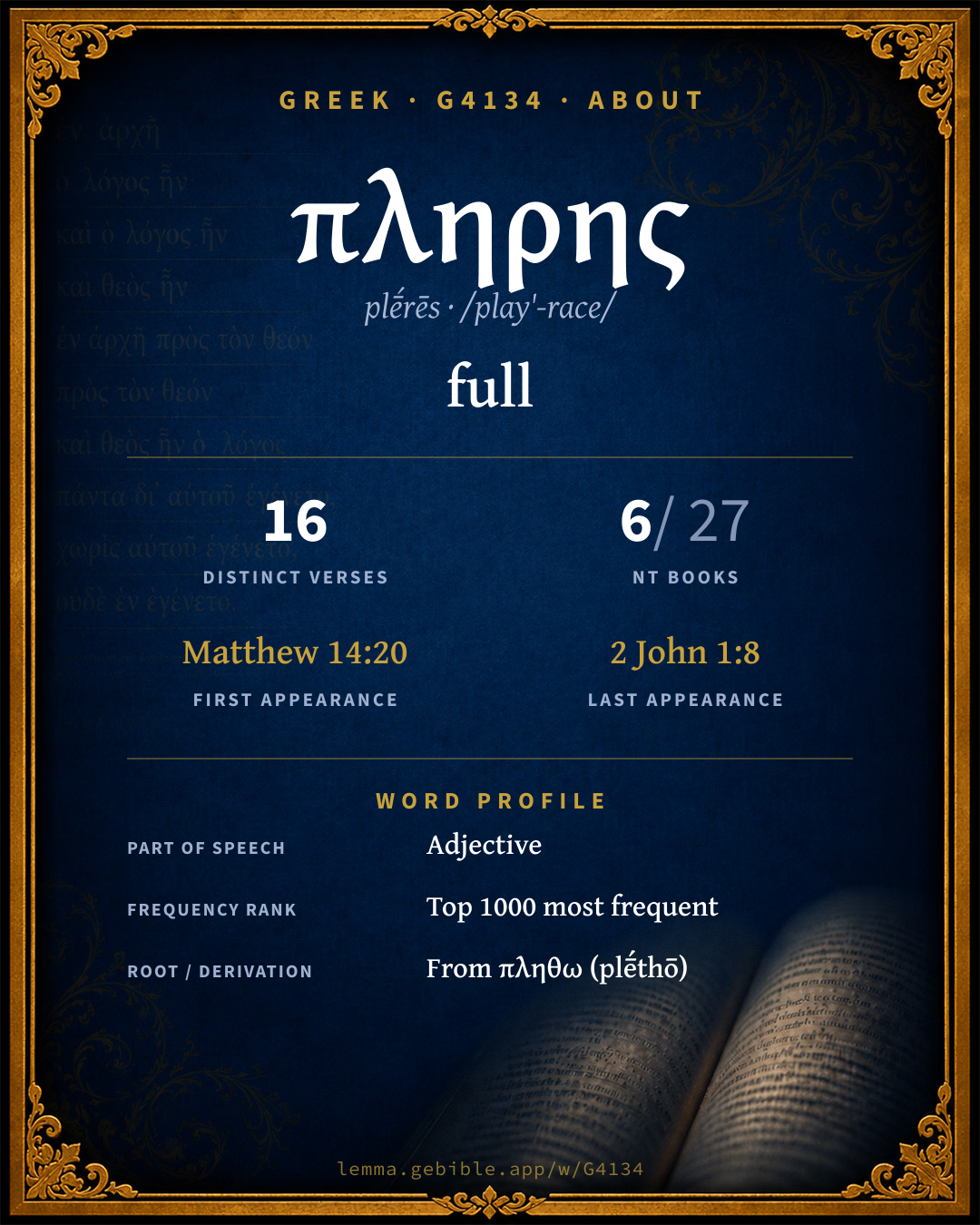
πλήρης
full
‘full’ is one of 2 main senses fuller range ↓
Full lexicon entry — Thayer's Greek Lexicon
From Thayer's Greek Lexicon
Where this word appears
See every Nominative-case word in the Greek New Testament →
Grammar key — what these labels mean
Part of speech
- Adjective
- A word that describes or qualifies a noun.
Case
- Nominative
- The case of the subject (and the predicate nominative).
- Accusative
- The case of the direct object and of extent.
Gender
- Masculine
- Grammatically masculine.
- Feminine
- Grammatically feminine.
Number
- Singular
- One.
- Plural
- More than one.
Grammatical forms
- Adjective, Nominative, Singular, Masculine 8 times (50%)
- Adjective, Accusative, Plural, Masculine 3 times (19%)
- Adjective, Accusative, Singular, Masculine 2 times (13%)
- Adjective, Accusative, Plural, Feminine 1 time (6%)
- Adjective, Nominative, Plural, Masculine 1 time (6%)
- Adjective, Nominative, Singular, Feminine 1 time (6%)
Parsed forms decoded from the imported morphology (Robinson–Tischendorf, public domain), counted across 16 parsed occurrences — not distinct verses.
Every verse where G4134 appears — 16 distinct verses across 6 books. Click any verse to open its interlinear word-by-word view. Verse text shown in the World English Bible for context — . Each verse’s Greek form is shown with its reference; the English is not keyword-highlighted, since the data carries no word-level English alignment. Use “Compare translations” on any verse to read it across multiple English versions. This concordance covers the Greek New Testament; Septuagint (Greek Old Testament) occurrences of this word are not indexed here.
Matthew 2 verses
- Matthew 14:20 πλήρεις adj acc pl masc They all ate, and were filled. They took up twelve baskets full of that which remained left over from the broken pieces.
- Matthew 15:37 πλήρεις adj acc pl fem They all ate, and were filled. They took up seven baskets full of the broken pieces that were left over.
Mark 2 verses
Luke 2 verses
- Luke 4:1 πλήρης adj nom sg masc Jesus, full of the Holy Spirit, returned from the Jordan, and was led by the Spirit into the wilderness
- Luke 5:12 πλήρης adj nom sg masc It happened, while he was in one of the cities, behold, there was a man full of leprosy. When he saw Jesus, he fell on his face, and begged him, saying, "Lord, if you want to, you can make me clean."
John 1 verse
Acts 8 verses
- Acts 6:3 πλήρεις adj acc pl masc Therefore select from among you, brothers, seven men of good report, full of the Holy Spirit and of wisdom, whom we may appoint over this business.
- Acts 6:5 πλήρη adj acc sg masc These words pleased the whole multitude. They chose Stephen, a man full of faith and of the Holy Spirit, Philip, Prochorus, Nicanor, Timon, Parmenas, and Nicolaus, a proselyte of Antioch;
- Acts 6:8 πλήρης adj nom sg masc Stephen, full of faith and power, performed great wonders and signs among the people.
- Acts 7:55 πλήρης adj nom sg masc But he, being full of the Holy Spirit, looked up steadfastly into heaven, and saw the glory of God, and Jesus standing on the right hand of God,
- Acts 9:36 πλήρης adj nom sg fem Now there was at Joppa a certain disciple named Tabitha, which when translated, means Dorcas. This woman was full of good works and acts of mercy which she did.
- Acts 11:24 πλήρης adj nom sg masc For he was a good man, and full of the Holy Spirit and of faith, and many people were added to the Lord.
- Acts 13:10 πλήρης adj nom sg masc and said, "Full of all deceit and all cunning, you son of the devil, you enemy of all righteousness, will you not cease to pervert the right ways of the Lord?
- Acts 19:28 πλήρεις adj nom pl masc When they heard this they were filled with anger, and cried out, saying, "Great is Artemis of the Ephesians!"
2 John 1 verse
About this entry
At a glance — auto-summarized from this page’s data, not written by a person. Every figure links to its source below. This summary describes the numbers; it doesn’t interpret them.
πληρης (plḗrēs) is a Greek adjective most often rendered “full.” Acts dominates its distribution — 8 of 16 verses. Spanning 16 verses in 6 books, it ranks among the uncommon words of the Greek New Testament. Scripture first uses it in Matthew 14:20. Ranging over 2 senses, it is not a single-sense word. For the data behind this summary, explore the sense tree and the renderings breakdown below.
Gloss history
Strong's 1890 vs modern scholarship
About this word
Strong's G4134 catalogs a Greek word from the Greek New Testament.
These counts are not copied from any lexicon or concordance. They are computed here, from the morphology-tagged Greek New Testament. What Lemma adds →
- 16
- distinct verses
- The word appears in 16 distinct verses.
- 6 / 27
- NT books
- The word appears in 6 of 27 New Testament books.
- #726
- by frequency
- Top 1000 most frequent Greek words (rank 726 of 5,347 Greek words by occurrence).
View all 16 occurrences in the concordance →
By section of the New Testament
By traditional corpus
Conventional, traditional groupings — biblical authorship is debated, so this is a traditional corpus grouping, not an authorship claim. Some books belong to more than one corpus (Luke is in both the Gospels and the Lukan corpus, and so on), so these shares overlap and need not total 100%. Each figure is a share of the word’s 16 distinct verses.
- Lukan (Luke–Acts) 10 verses · 63%
- Gospels 7 verses · 44%
- Johannine 2 verses · 13%
- General (Catholic) Epistles 1 verse · 6%
How translations render this word
Counts come from each version’s own published word-to-Strong’s tagging or interlinear alignment — an approximate guide to how each version renders this word, not a word-level alignment the data otherwise carries. Because each total is that version’s own tagged count, the per-version totals vary from one another and need not match the appearance or distinct-verse counts above. These counts may also differ from a printed concordance because Lemma counts each distinctly tagged rendering and does not collapse phrase taggings into a single head-word total. This is a fixed set of word-tagged versions (KJV, ASV, BSB, ULT) and does not change with the reading translation you choose elsewhere. Each version’s license is shown beside its name below (and on Sources).
- King James Version: Full 16×
- American Standard Version: Full 14×
- Berean Standard Bible: Full 8×
- unfoldingWord Literal Text: Full 15×
King James Version Public Domain
Renders G4134 across 17 tagged occurrences — most commonly:
Plus 1 rendering that appears only once — usually multi-word phrases or single function words the recovered tagging swept in, not distinct renderings.
American Standard Version Public Domain
Renders G4134 across 16 tagged occurrences — most commonly:
Plus 2 renderings that appear only once — usually multi-word phrases or single function words the recovered tagging swept in, not distinct renderings. Not rendered by a distinct English word in 1 further occurrence.
Berean Standard Bible Public Domain
Renders G4134 across 11 tagged occurrences — most commonly:
Plus 3 renderings that appear only once — usually multi-word phrases or single function words the recovered tagging swept in, not distinct renderings. Not rendered by a distinct English word in 4 further occurrences.
unfoldingWord Literal Text CC BY-SA 4.0
Renders G4134 across 16 tagged occurrences — most commonly:
Plus 1 rendering that appears only once — usually multi-word phrases or single function words the recovered tagging swept in, not distinct renderings.
Senses in Thayer's
The 2 senses Thayer's distinguishes for this word, in lexicon order (not ranked by frequency or importance). The full entry — with sub-senses — is in the Lexicon Entry tab.
- full, i.e. filled up (as opposed to empty)
- full, i.e. complete
Word origin
Derived from πληθω (plḗthō) (G4130) — to fill.
From G4130 ; replete or covered over; by analogy complete : - full.
— Strong’s Exhaustive Concordance (1890), public domain.
Forms in the corpus
The 3 distinct written forms G4134 takes in the Greek New Testament, most frequent first — each parse links to that case’s occurrences in the concordance.
| Form | Parsing | Example | Uses |
|---|---|---|---|
| πλήρης plḗrēs | Adjective, Nominative, Singular, Masculine | Mark 4:28 | 9 |
| πλήρεις plḗreis | Adjective, Accusative, Plural, Masculine | Matthew 14:20 | 5 |
| πλήρη plḗrē | Adjective, Accusative, Singular, Masculine | Acts 6:5 | 2 |
Same root — word family
Other Thayer's entries built from the same root as G4134, grouped by Strong’s listed origin. These share a root / origin per the lexicon — not necessarily a shared meaning. Each links to that word’s own entry.
Derives from
Shares the same root
- πληθος plēthos G4128 multitude
- πλημμυρα plḗmmyra G4132 flood
- πλησμονη plēsmonḗ G4140 satiety
- πλουτος ploûtos G4149 riches
Derived from this word
Compare all same-root words → Showing 4 of 8 — not the complete family. They share a root, not necessarily a meaning.
Septuagint usage
The same Greek word πληρης appears 104 times in the Greek Old Testament (Septuagint), across 102 verses in 24 books.
- 104
- LXX occurrences
- Tagged occurrences of this Greek word in the Septuagint.
- 102
- verses
- Distinct Septuagint verses containing this word.
- 24 / 39
- OT books
- The word appears in 24 of the 39 Old Testament books.
Sample Septuagint occurrences
- Genesis 25:8 πλήρης
- Exodus 9:8 πλήρης
- Leviticus 2:2 πλήρης
- Numbers 7:13 πλήρης
- Deuteronomy 6:11 πλήρης
- Judges 6:38 πλήρης
- Ruth 1:21 πλήρης
- 1 Samuel 2:5 πλήρης
- 2 Samuel 23:7 πλήρης
- 2 Kings 4:39 πλήρης
- 1 Chronicles 11:13 πλήρης
- 2 Chronicles 15:17 πλήρης
Septuagint occurrences (same lexeme)
Every verse where the same Strong’s number (G4134) appears in the Greek Septuagint — showing the first 50 of 102. Verse text shown in the World English Bible for context; the Greek form is the matched word — the English is not keyword-highlighted.
- Genesis 25:8 πλήρης Abraham gave up the spirit, and died in a good old age, an old man, and full of years, and was gathered to his people.
- Genesis 27:27 πλήρης He came near, and kissed him. He smelled the smell of his clothing, and blessed him, and said, "Behold, the smell of my son Is as the smell of a field which Yahweh has blessed.
- Genesis 35:29 πλήρης Isaac gave up the spirit, and died, and was gathered to his people, old and full of days. Esau and Jacob, his sons, buried him.
- Genesis 41:7 πλήρης The thin heads of grain swallowed up the seven healthy and full ears. Pharaoh awoke, and, behold, it was a dream.
- Genesis 41:22 πλήρης I saw in my dream, and, behold, seven heads of grain came up on one stalk, full and good:
- Genesis 41:24 πλήρης The thin heads of grain swallowed up the seven good heads of grain. I told it to the magicians; but there was no one who could explain it to me."
- Exodus 9:8 πλήρης Yahweh said to Moses and to Aaron, "Take to you handfuls of ashes of the furnace, and let Moses sprinkle it toward the sky in the sight of Pharaoh.
- Exodus 16:33 πλήρης Moses said to Aaron, "Take a pot, and put an omer-full of manna in it, and lay it up before Yahweh, to be kept throughout your generations."
- Leviticus 2:2 πλήρης He shall bring it to Aaron's sons the priests; and he shall take his handful of its fine flour, and of its oil, with all its frankincense; and the priest shall burn the memorial of it on the altar, an offering made by fire, of a sweet savor to Yahweh.
- Leviticus 5:12 πλήρης He shall bring it to the priest, and the priest shall take his handful of it as the memorial portion, and burn it on the altar, on the offerings of Yahweh made by fire. It is a sin offering.
- Leviticus 16:12 πλήρης He shall take a censer full of coals of fire from off the altar before Yahweh, and two handfuls of sweet incense beaten small, and bring it within the veil:
- Numbers 7:13 πλήρης and his offering was: one silver platter, the weight of which was one hundred thirty shekels, one silver bowl of seventy shekels, after the shekel of the sanctuary; both of them full of fine flour mixed with oil for a meal offering;
- Numbers 7:14 πλήρης one golden ladle of ten shekels, full of incense;
- Numbers 7:19 πλήρης He offered for his offering: one silver platter, the weight of which was one hundred thirty shekels, one silver bowl of seventy shekels, after the shekel of the sanctuary; both of them full of fine flour mixed with oil for a meal offering;
- Numbers 7:20 πλήρης one golden ladle of ten shekels, full of incense;
- Numbers 7:25 πλήρης gave his offering: one silver platter, the weight of which was a hundred and thirty shekels, one silver bowl of seventy shekels, after the shekel of the sanctuary; both of them full of fine flour mixed with oil for a meal offering;
- Numbers 7:26 πλήρης one golden ladle of ten shekels, full of incense;
- Numbers 7:31 πλήρης gave his offering: one silver platter, the weight of which was one hundred thirty shekels, one silver bowl of seventy shekels, after the shekel of the sanctuary; both of them full of fine flour mixed with oil for a meal offering;
- Numbers 7:32 πλήρης one golden ladle of ten shekels, full of incense;
- Numbers 7:37 πλήρης gave his offering: one silver platter, the weight of which was one hundred thirty shekels, one silver bowl of seventy shekels, after the shekel of the sanctuary; both of them full of fine flour mixed with oil for a meal offering;
- Numbers 7:38 πλήρης one golden ladle of ten shekels, full of incense;
- Numbers 7:43 πλήρης gave his offering: one silver platter, the weight of which was one hundred thirty shekels, one silver bowl of seventy shekels, after the shekel of the sanctuary; both of them full of fine flour mixed with oil for a meal offering;
- Numbers 7:44 πλήρης one golden ladle of ten shekels, full of incense;
- Numbers 7:49 πλήρης gave his offering: one silver platter, the weight of which was one hundred thirty shekels, one silver bowl of seventy shekels, after the shekel of the sanctuary; both of them full of fine flour mixed with oil for a meal offering;
- Numbers 7:50 πλήρης one golden ladle of ten shekels, full of incense;
- Numbers 7:55 πλήρης gave his offering: one silver platter, the weight of which was one hundred thirty shekels, one silver bowl of seventy shekels, after the shekel of the sanctuary; both of them full of fine flour mixed with oil for a meal offering;
- Numbers 7:56 πλήρης one golden ladle of ten shekels, full of incense;
- Numbers 7:61 πλήρης gave his offering: one silver platter, the weight of which was one hundred thirty shekels, one silver bowl of seventy shekels, after the shekel of the sanctuary; both of them full of fine flour mixed with oil for a meal offering;
- Numbers 7:62 πλήρης one golden ladle of ten shekels, full of incense;
- Numbers 7:67 πλήρης gave his offering: one silver platter, the weight of which was one hundred thirty shekels, one silver bowl of seventy shekels, after the shekel of the sanctuary; both of them full of fine flour mixed with oil for a meal offering;
- Numbers 7:68 πλήρης one golden ladle of ten shekels, full of incense;
- Numbers 7:73 πλήρης gave his offering: one silver platter, the weight of which was one hundred thirty shekels, one silver bowl of seventy shekels, after the shekel of the sanctuary; both of them full of fine flour mixed with oil for a meal offering;
- Numbers 7:74 πλήρης one golden ladle of ten shekels, full of incense;
- Numbers 7:79 πλήρης gave his offering: one silver platter, the weight of which was one hundred thirty shekels, one silver bowl of seventy shekels, after the shekel of the sanctuary; both of them full of fine flour mixed with oil for a meal offering;
- Numbers 7:80 πλήρης one golden spoon of ten shekels, full of incense;
- Numbers 7:86 πλήρης the twelve golden ladles, full of incense, weighing ten shekels apiece, after the shekel of the sanctuary; all the gold of the ladles weighed one hundred twenty shekels;
- Numbers 22:18 πλήρης Balaam answered the servants of Balak, If Balak would give me his house full of silver and gold, I can't go beyond the word of Yahweh my God, to do less or more.
- Numbers 24:13 πλήρης If Balak would give me his house full of silver and gold, I can't go beyond the word of Yahweh, to do either good or bad of my own mind; what Yahweh speaks, that will I speak?
- Deuteronomy 6:11 πλήρης and houses full of all good things, which you didn't fill, and cisterns dug out, which you didn't dig, vineyards and olive trees, which you didn't plant, and you shall eat and be full;
- Judges 6:38 πλήρης It was so; for he rose up early on the next day, and pressed the fleece together, and wrung the dew out of the fleece, a bowl full of water.
- Judges 16:27 πλήρης Now the house was full of men and women; and all the lords of the Philistines were there; and there were on the roof about three thousand men and women, who saw while Samson made sport.
- Ruth 1:21 πλήρης I went out full, and Yahweh has brought me home again empty; why do you call me Naomi, seeing Yahweh has testified against me, and the Almighty has afflicted me?"
- Ruth 2:12 πλήρης Yahweh recompense your work, and a full reward be given you of Yahweh, the God of Israel, under whose wings you are come to take refuge.
- 1 Samuel 2:5 πλήρης Those who were full have hired out themselves for bread; Those who were hungry have ceased [to hunger]: Yes, the barren has borne seven; She who has many children languishes.
- 2 Samuel 23:7 πλήρης But the man who touches them Must be armed with iron and the staff of a spear: They shall be utterly burned with fire in [their] place
- 2 Samuel 23:11 πλήρης After him was Shammah the son of Agee a Hararite. The Philistines were gathered together into a troop, where was a plot of ground full of lentils; and the people fled from the Philistines.
- 2 Kings 4:39 πλήρης One went out into the field to gather herbs, and found a wild vine, and gathered of it wild gourds his lap full, and came and shred them into the pot of stew; for they didn't recognize them.
- 2 Kings 6:17 πλήρης Elisha prayed, and said, Yahweh, Please open his eyes, that he may see. Yahweh opened the eyes of the young man; and he saw: and, behold, the mountain was full of horses and chariots of fire round about Elisha.
- 2 Kings 7:15 πλήρης They went after them to the Jordan: and, behold, all the way was full of garments and vessels, which the Syrians had cast away in their haste. The messengers returned, and told the king.
- 2 Kings 20:3 πλήρης Remember now, Yahweh, I beg you, how I have walked before you in truth and with a perfect heart, and have done that which is good in your sight. Hezekiah wept sore.
These are occurrences of the same Greek lexeme (G4134) in the Septuagint — not a translation of any one Hebrew word. The store carries no word-level Hebrew↔Greek alignment, so no Hebrew original is asserted here. Counts come from the recovered LXX Strong's tagging — high-frequency vocabulary is well covered, while rare or late forms may be untagged — so they reflect tagged occurrences and may slightly undercount.