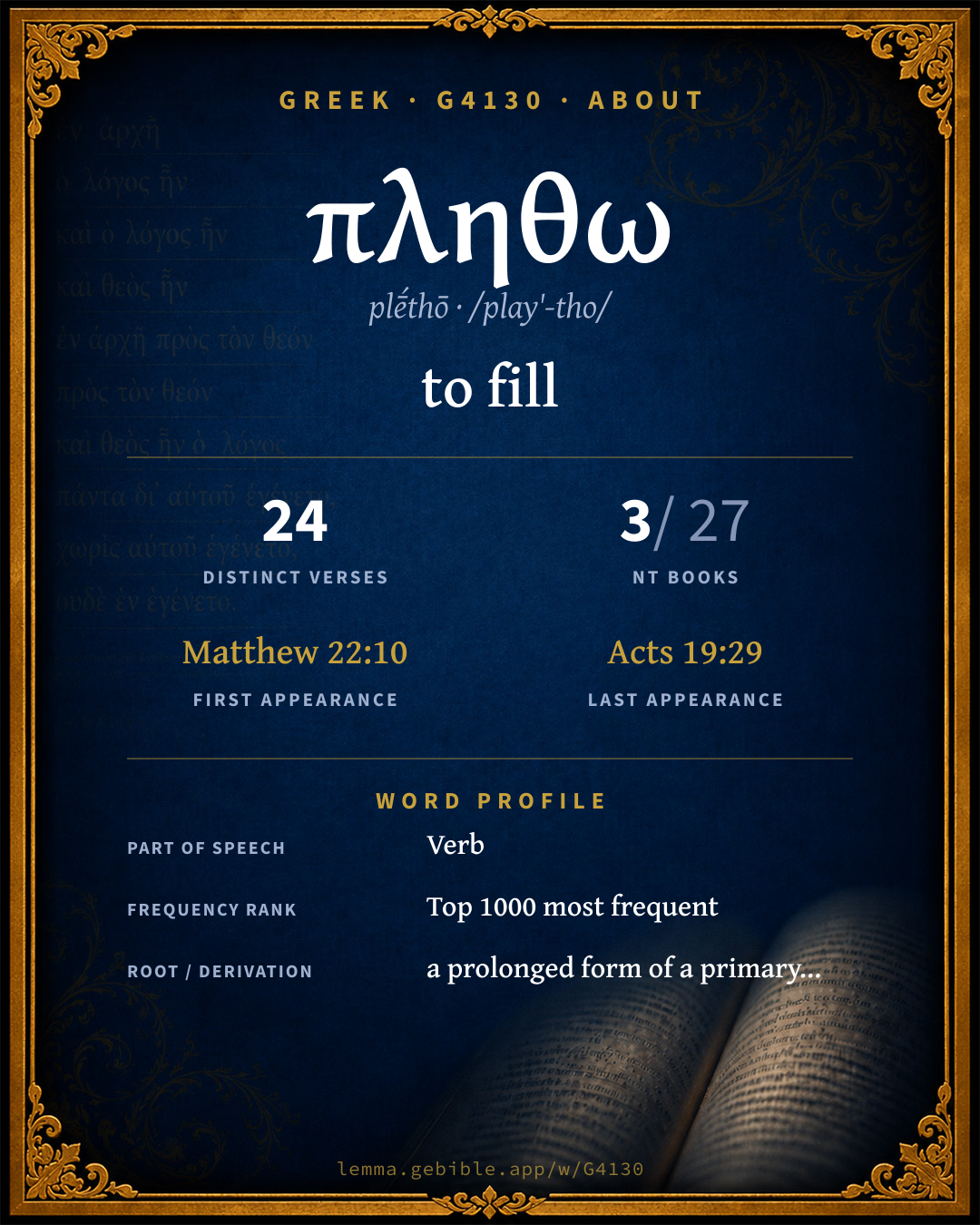
πλήθω
to fill
‘to fill’ is one of 2 main senses fuller range ↓
Full lexicon entry — Thayer's Greek Lexicon
From Thayer's Greek Lexicon
Where this word appears
See every Aorist-tense verb in the Greek New Testament →
Grammar key — what these labels mean
Part of speech
- Verb
- An action or state-of-being word.
Tense
- Aorist
- Action viewed as a simple whole, without regard to duration — often past (perfective aspect).
- Future
- Action expected in future time.
Voice
- Passive
- The subject receives the action.
- Active
- The subject performs the action.
Mood
- Indicative
- States a fact or asks a factual question (the mood of reality).
- Participle
- A verbal adjective (“writing,” “having written”).
- Infinitive
- A verbal noun (“to write”), unmarked for person or number.
- Subjunctive
- Expresses probability, purpose, or possibility (the mood of contingency).
Case
- Nominative
- The case of the subject (and the predicate nominative).
Person
- 3rd person
- The one spoken about (“he / she / it / they”).
- 2nd person
- The one addressed (“you”).
Gender
- Masculine
- Grammatically masculine.
Number
- Plural
- More than one.
- Singular
- One.
Grammatical forms
- Verb, Aorist, Passive, Indicative, 3rd person, Plural 12 times (50%)
- Verb, Aorist, Passive, Indicative, 3rd person, Singular 5 times (21%)
- Verb, Aorist, Passive, Participle, Nominative, Singular, Masculine 2 times (8%)
- Verb, Aorist, Active, Indicative, 3rd person, Plural 1 time (4%)
- Verb, Aorist, Active, Participle, Nominative, Singular, Masculine 1 time (4%)
- Verb, Aorist, Passive, Infinitive 1 time (4%)
- Verb, Aorist, Passive, Subjunctive, 2nd person, Singular 1 time (4%)
- Verb, Future, Passive, Indicative, 3rd person, Singular 1 time (4%)
Parsed forms decoded from the imported morphology (Robinson–Tischendorf, public domain), counted across 24 parsed occurrences — not distinct verses.
Every verse where G4130 appears — 24 distinct verses across 3 books. Click any verse to open its interlinear word-by-word view. Verse text shown in the World English Bible for context — . Each verse’s Greek form is shown with its reference; the English is not keyword-highlighted, since the data carries no word-level English alignment. Use “Compare translations” on any verse to read it across multiple English versions. This concordance covers the Greek New Testament; Septuagint (Greek Old Testament) occurrences of this word are not indexed here.
Matthew 2 verses
- Matthew 22:10 ἐπλήσθη aor pass ind 3sg Those servants went out into the highways, and gathered together as many as they found, both bad and good. The wedding was filled with guests.
- Matthew 27:48 πλήσας aor act ptcp nom sg masc Immediately one of them ran, and took a sponge, and filled it with vinegar, and put it on a reed, and gave him a drink.
Luke 13 verses
- Luke 1:15 πλησθήσεται fut pass ind 3sg For he will be great in the sight of the Lord, and he will drink no wine nor strong drink. He will be filled with the Holy Spirit, even from his mother's womb.
- Luke 1:23 ἐπλήσθησαν aor pass ind 3pl It happened, when the days of his service were fulfilled, he departed to his house.
- Luke 1:41 ἐπλήσθη aor pass ind 3sg It happened, when Elizabeth heard Mary's greeting, that the baby leaped in her womb, and Elizabeth was filled with the Holy Spirit.
- Luke 1:57 ἐπλήσθη aor pass ind 3sg Now the time that Elizabeth should give birth was fulfilled, and she brought forth a son.
- Luke 1:67 ἐπλήσθη aor pass ind 3sg His father, Zacharias, was filled with the Holy Spirit, and prophesied, saying,
- Luke 2:6 ἐπλήσθησαν aor pass ind 3pl It happened, while they were there, that the day had come that she should give birth.
- Luke 2:21 ἐπλήσθησαν aor pass ind 3pl When eight days were fulfilled for the circumcision of the child, his name was called Jesus, which was given by the angel before he was conceived in the womb.
- Luke 2:22 ἐπλήσθησαν aor pass ind 3pl When the days of their purification according to the law of Moses were fulfilled, they brought him up to Jerusalem, to present him to the Lord
- Luke 4:28 ἐπλήσθησαν aor pass ind 3pl They were all filled with wrath in the synagogue, as they heard these things.
- Luke 5:7 ἔπλησαν aor act ind 3pl They beckoned to their partners in the other boat, that they should come and help them. They came, and filled both boats, so that they began to sink.
- Luke 5:26 ἐπλήσθησαν aor pass ind 3pl Amazement took hold on all, and they glorified God. They were filled with fear, saying, "We have seen strange things today."
- Luke 6:11 ἐπλήσθησαν aor pass ind 3pl But they were filled with rage, and talked with one another about what they might do to Jesus.
- Luke 21:22 πλησθῆναι aor pass inf For these are days of vengeance, that all things which are written may be fulfilled.
Acts 9 verses
- Acts 2:4 ἐπλήσθησαν aor pass ind 3pl They were all filled with the Holy Spirit, and began to speak with other languages, as the Spirit gave them the ability to speak.
- Acts 3:10 ἐπλήσθησαν aor pass ind 3pl They recognized him, that it was he who used to sit begging for gifts for the needy at the Beautiful Gate of the temple. They were filled with wonder and amazement at what had happened to him.
- Acts 4:8 πλησθεὶς aor pass ptcp nom sg masc Then Peter, filled with the Holy Spirit, said to them, "You rulers of the people, and elders of Israel,
- Acts 4:31 ἐπλήσθησαν aor pass ind 3pl When they had prayed, the place was shaken where they were gathered together. They were all filled with the Holy Spirit, and they spoke the word of God with boldness.
- Acts 5:17 ἐπλήσθησαν aor pass ind 3pl But the high priest rose up, and all those who were with him (which is the sect of the Sadducees), and they were filled with jealousy,
- Acts 9:17 πλησθῇς aor pass subj 2sg Ananias departed, and entered into the house. Laying his hands on him, he said, "Brother Saul, the Lord, who appeared to you on the road by which you came, has sent me, that you may receive your sight, and be filled with the Holy Spirit."
- Acts 13:9 πλησθεὶς aor pass ptcp nom sg masc But Saul, who is also called Paul, filled with the Holy Spirit, fastened his eyes on him,
- Acts 13:45 ἐπλήσθησαν aor pass ind 3pl But when the Jews saw the multitudes, they were filled with jealousy, and contradicted the things which were spoken by Paul, and blasphemed.
- Acts 19:29 ἐπλήσθη aor pass ind 3sg The whole city was filled with confusion, and they rushed with one accord into the theater, having seized Gaius and Aristarchus, men of Macedonia, Paul's companions in travel.
About this entry
At a glance — auto-summarized from this page’s data, not written by a person. Every figure links to its source below. This summary describes the numbers; it doesn’t interpret them.
πληθω — transliterated plḗthō — is a Greek verb carrying the sense “to fill.” More than half of its appearances fall in Luke. The Greek New Testament uses it across 24 verses — uncommon. Debuting at Matthew 22:10, it then recurs through the corpus. Thayer's distinguishes 2 senses for it. Each statement above links to its evidence; the full detail follows below.
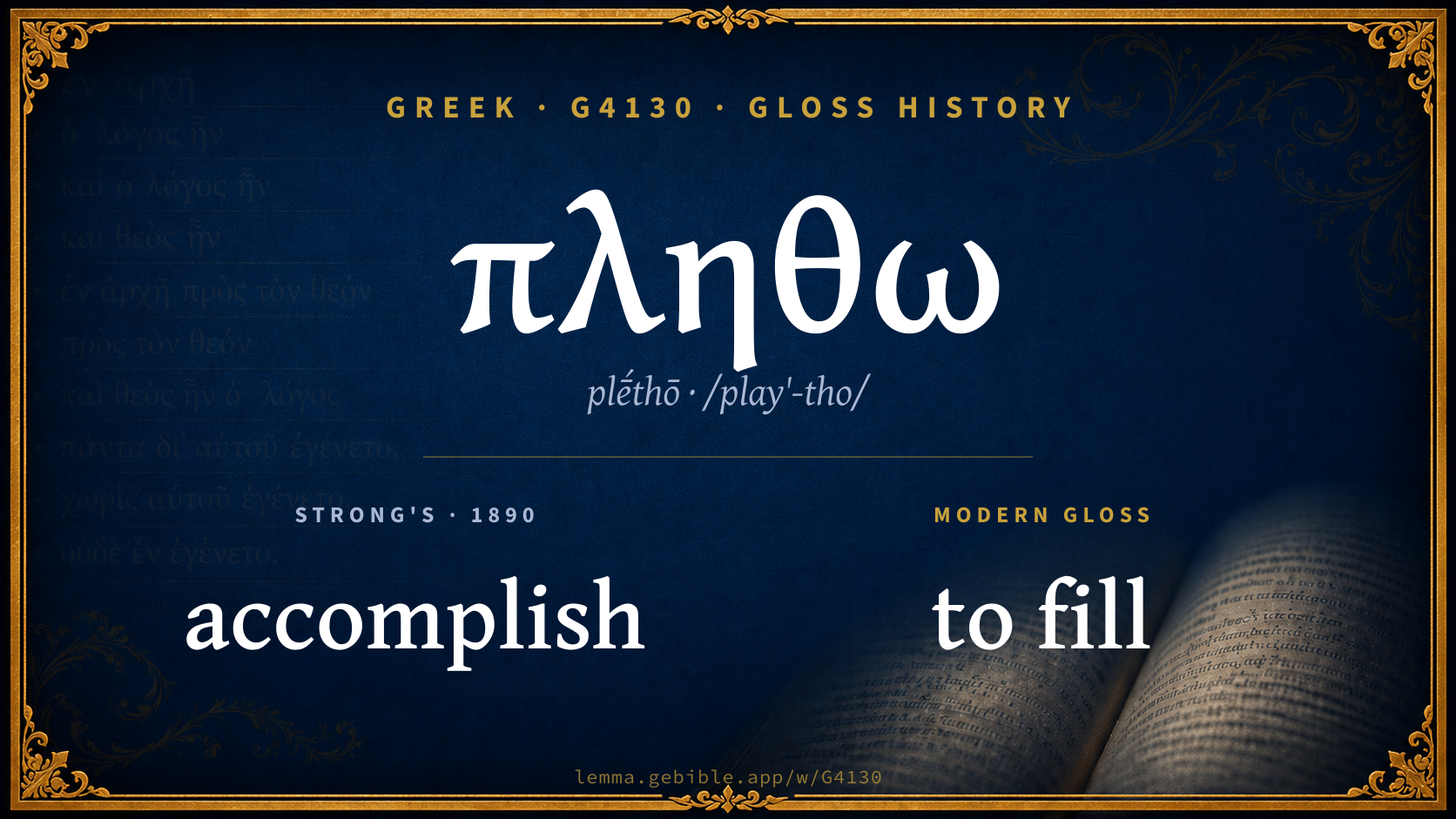
Gloss history
Strong's 1890 vs modern scholarship
About this word
Strong's G4130 catalogs a Greek word from the Greek New Testament.
These counts are not copied from any lexicon or concordance. They are computed here, from the morphology-tagged Greek New Testament. What Lemma adds →
- 24
- distinct verses
- The word appears in 24 distinct verses.
- 3 / 27
- NT books
- The word appears in 3 of 27 New Testament books.
- #548
- by frequency
- Top 1000 most frequent Greek words (rank 548 of 5,347 Greek words by occurrence).
View all 24 occurrences in the concordance →
By section of the New Testament
By traditional corpus
Conventional, traditional groupings — biblical authorship is debated, so this is a traditional corpus grouping, not an authorship claim. Some books belong to more than one corpus (Luke is in both the Gospels and the Lukan corpus, and so on), so these shares overlap and need not total 100%. Each figure is a share of the word’s 24 distinct verses.
- Lukan (Luke–Acts) 22 verses · 92%
- Gospels 15 verses · 63%
How translations render this word
Counts come from each version’s own published word-to-Strong’s tagging or interlinear alignment — an approximate guide to how each version renders this word, not a word-level alignment the data otherwise carries. Because each total is that version’s own tagged count, the per-version totals vary from one another and need not match the appearance or distinct-verse counts above. These counts may also differ from a printed concordance because Lemma counts each distinctly tagged rendering and does not collapse phrase taggings into a single head-word total. This is a fixed set of word-tagged versions (KJV, ASV, BSB, ULT) and does not change with the reading translation you choose elsewhere. Each version’s license is shown beside its name below (and on Sources).
- King James Version: Filled 5×, Were accomplished 4×, Were filled 4×
- American Standard Version: Filled 5×, They were filled 4×, Was filled 4×
- Berean Standard Bible: They were filled 3×, Was filled 3×, Came 2×
- unfoldingWord Literal Text: Filled 4×, Was filled 4×, Were filled 4×
King James Version Public Domain
Renders G4130 across 27 tagged occurrences — most commonly:
Plus 7 renderings that appear only once — usually multi-word phrases or single function words the recovered tagging swept in, not distinct renderings.
American Standard Version Public Domain
Renders G4130 across 27 tagged occurrences — most commonly:
Plus 8 renderings that appear only once — usually multi-word phrases or single function words the recovered tagging swept in, not distinct renderings.
Berean Standard Bible Public Domain
Renders G4130 across 23 tagged occurrences — most commonly:
Plus 9 renderings that appear only once — usually multi-word phrases or single function words the recovered tagging swept in, not distinct renderings.
unfoldingWord Literal Text CC BY-SA 4.0
Renders G4130 across 28 tagged occurrences — most commonly:
Plus 8 renderings that appear only once — usually multi-word phrases or single function words the recovered tagging swept in, not distinct renderings.
Senses in Thayer's
The 2 senses Thayer's distinguishes for this word, in lexicon order (not ranked by frequency or importance). The full entry — with sub-senses — is in the Lexicon Entry tab.
- to fill
- to be fulfilled, to be filled
Word origin
Origin: a prolonged form of a primary pleo pleh'-o (which appears only as an alternate in certain tenses and in the reduplicated form pimplemi)
A prolonged form of a primary word πλέω pleō (which appears only as an alternate in certain tenses and in the reduplicated form of πίμπλημι pimplē mi to fill (literally or figuratively [ imbue influence supply ]); specifically to fulfil (time): - accomplish full (... come) furnish.
— Strong’s Exhaustive Concordance (1890), public domain.
Forms in the corpus
The 8 distinct written forms G4130 takes in the Greek New Testament, most frequent first — each parse links to that tense’s occurrences in the concordance.
| Form | Parsing | Example | Uses |
|---|---|---|---|
| ἐπλήσθησαν eplḗsthēsan | Verb, Aorist, Passive, Indicative, 3rd person, Plural | Luke 1:23 | 12 |
| ἐπλήσθη eplḗsthē | Verb, Aorist, Passive, Indicative, 3rd person, Singular | Matthew 22:10 | 5 |
| πλησθεὶς plēstheìs | Verb, Aorist, Passive, Participle, Nominative, Singular, Masculine | Acts 4:8 | 2 |
| πλήσας plḗsas | Verb, Aorist, Active, Participle, Nominative, Singular, Masculine | Matthew 27:48 | 1 |
| πλησθήσεται plēsthḗsetai | Verb, Future, Passive, Indicative, 3rd person, Singular | Luke 1:15 | 1 |
| πλησθῆναι plēsthē̂nai | Verb, Aorist, Passive, Infinitive | Luke 21:22 | 1 |
| πλησθῇς plēsthē̂s | Verb, Aorist, Passive, Subjunctive, 2nd person, Singular | Acts 9:17 | 1 |
| ἔπλησαν éplēsan | Verb, Aorist, Active, Indicative, 3rd person, Plural | Luke 5:7 | 1 |
Same root — word family
Other Thayer's entries built from the same root as G4130, grouped by Strong’s listed origin. These share a root / origin per the lexicon — not necessarily a shared meaning. Each links to that word’s own entry.
Derived from this word
- πληθος plēthos G4128 multitude
- πλημμυρα plḗmmyra G4132 flood
- πληρης plḗrēs G4134 full
- πλησμονη plēsmonḗ G4140 satiety
- πλουτος ploûtos G4149 riches
Compare all same-root words → Showing 4 of 6 — not the complete family. They share a root, not necessarily a meaning.