Philippians 4:19

Greek (Tischendorf 8th ed.) Philippians 4:19 appears in the Greek New Testament. The text above is from the Tischendorf 8th edition. Each word links to its Strong’s number and a concise gloss. Click any word for its full Thayer’s Greek Lexicon entry.
Download image
Cite this verse

Philippians 4:19 (World English Bible). Public Domain. Lemma interlinear Bible study tool, https://lemma.gebible.app/v/philippians/4/19.

Show BibTeX & RIS
BibTeX
RIS
English Translation
My God will supply every need of yours according to his riches in glory in Christ Jesus.
World English Bible · Public Domain
Download a study sheet

One document with this verse’s original text, its word-by-word gloss line, the meaning frame, cross-references with their text, attributed commentary, and full source and license credits — printable, and it pastes into notes with its structure intact.

This verse Autodidact and up

Study sheet (.html) Plain text (.txt)

A passage Seminary Student

Up to 50 verses in one chapter. A passage sheet keeps up to 6 commentary sources and 12 cross-references per verse, in the order this page ranks them, and says so on the sheet whenever that leaves anything out. Ask for a single verse and you get the Autodidact verse sheet above.

Everything on this page stays free to read, with no account — the sheet is a download of what is already on screen, not access to it.

Want to remove ads? Support Godless Engineer
Compare translations 3

The same verse in 3 English versions, stacked beneath the original-language interlinear above. Click any original word for its lexicon entry.

Each is an independent rendering of the whole verse — the interlinear is not word-aligned to these translations.

Highlighted words mark where these versions differ — a whole-verse word diff, not a word-by-word alignment.

  • World English Bible Public Domain
    My God will supply every need of yours according to his riches in glory in Christ Jesus.
  • King James Version Public Domain
    But my God shall supply all your need according to his riches in glory by Christ Jesus.
  • unfoldingWord Literal Text CC BY-SA 4.0
    Now my God will fulfill all your need according to his riches in glory in Christ Jesus.

unfoldingWord Literal Text — © unfoldingWord, licensed CC BY-SA 4.0. Word-aligned USFM3 via Door43 (git.door43.org/unfoldingWord/en_ult).

Versions to compare (up to 4)

3 of 4 selected

Show all 19 translations

Every available English version of this verse, each an independent rendering of the whole verse.

  • World English Bible Public Domain
    My God will supply every need of yours according to his riches in glory in Christ Jesus.
  • Berean Standard Bible Public Domain
    And my God will supply all your needs according to His glorious riches in Christ Jesus.
  • Majority Standard Bible Public Domain
    And my God will supply all your needs according to His glorious riches in Christ Jesus.
  • King James Version Public Domain
    But my God shall supply all your need according to his riches in glory by Christ Jesus.
  • American Standard Version (1901) Public Domain
    And my God shall supply every need of yours according to his riches in glory in Christ Jesus.
  • Revised Version (1885) Public Domain
    And my God shall fulfill every need of yours according to his riches in glory in Christ Jesus.
  • Geneva Bible (1599) Public Domain
    And my God shall fulfill all your necessities through his riches with glorie in Iesus Christ.
  • Douay-Rheims (1899) Public Domain
    And may my God supply all your want, according to his riches in glory in Christ Jesus.
  • Young's Literal Translation Public Domain
    and my God shall supply all your need, according to His riches in glory in Christ Jesus;
  • Literal Standard Version CC BY-SA 4.0
    and my God will supply all your need, according to His riches in glory in Christ Jesus;
  • Unlocked Literal Bible CC BY-SA 4.0
    My God will meet all your needs according to his riches in glory in Christ Jesus.
  • unfoldingWord Literal Text CC BY-SA 4.0
    Now my God will fulfill all your need according to his riches in glory in Christ Jesus.
  • Darby Bible Public Domain
    But my God shall abundantly supply all your need according to his riches in glory in Christ Jesus.
  • World Messianic Bible Public Domain
    My God will supply every need of yours according to his riches in glory in Messiah Yeshua.
  • Webster's Bible Public Domain
    But my God will supply all your need according to his riches in glory by Christ Jesus.
  • Free Bible Version CC BY-SA 4.0
    My God will fill you with everything you need in accordance with his glorious wealth in Christ Jesus!
  • Bible in Basic English Public Domain
    And my God will give you all you have need of from the wealth of his glory in Christ Jesus.
  • Text-Critical English NT CC BY 4.0
    And my God will fully supply your every need through Christ Jesus according to his riches in glory.
  • Tyndale New Testament (1534) Public Domain
    My god fulfill all youre nedes thorow his glorious riches in Iesu Christ.

Literal Standard Version (2020), Covenant Press — licensed CC BY-SA 4.0. Text via the HelloAO Bible API (eBible.org). Unlocked Literal Bible (unfoldingWord) — licensed CC BY-SA 4.0. Text via the HelloAO Bible API (eBible.org). unfoldingWord Literal Text — © unfoldingWord, licensed CC BY-SA 4.0. Word-aligned USFM3 via Door43 (git.door43.org/unfoldingWord/en_ult). Free Bible Version, Dr. Jonathan Gallagher — licensed CC BY-SA 4.0. Text via the HelloAO Bible API (eBible.org).

Word by word

More ways to search: Search by grammar → Find every occurrence → Compare this word →

Practice this passage: Drill this verse → Learn its vocabulary →

πλοῦτος
ploûtos
G4149
“riches”
Noun, Accusative, Singular, Neuter
Part of Speech
Noun
Case
Accusative
Number
Singular
Gender
Neuter
Full Thayer's Definition

Origin: from the base of G4130

TDNT: 11:18,9

1. riches, wealth a. abundance of external possessions b. fulness, abundance, plenitude c. a good i.e. that with which one is enriched
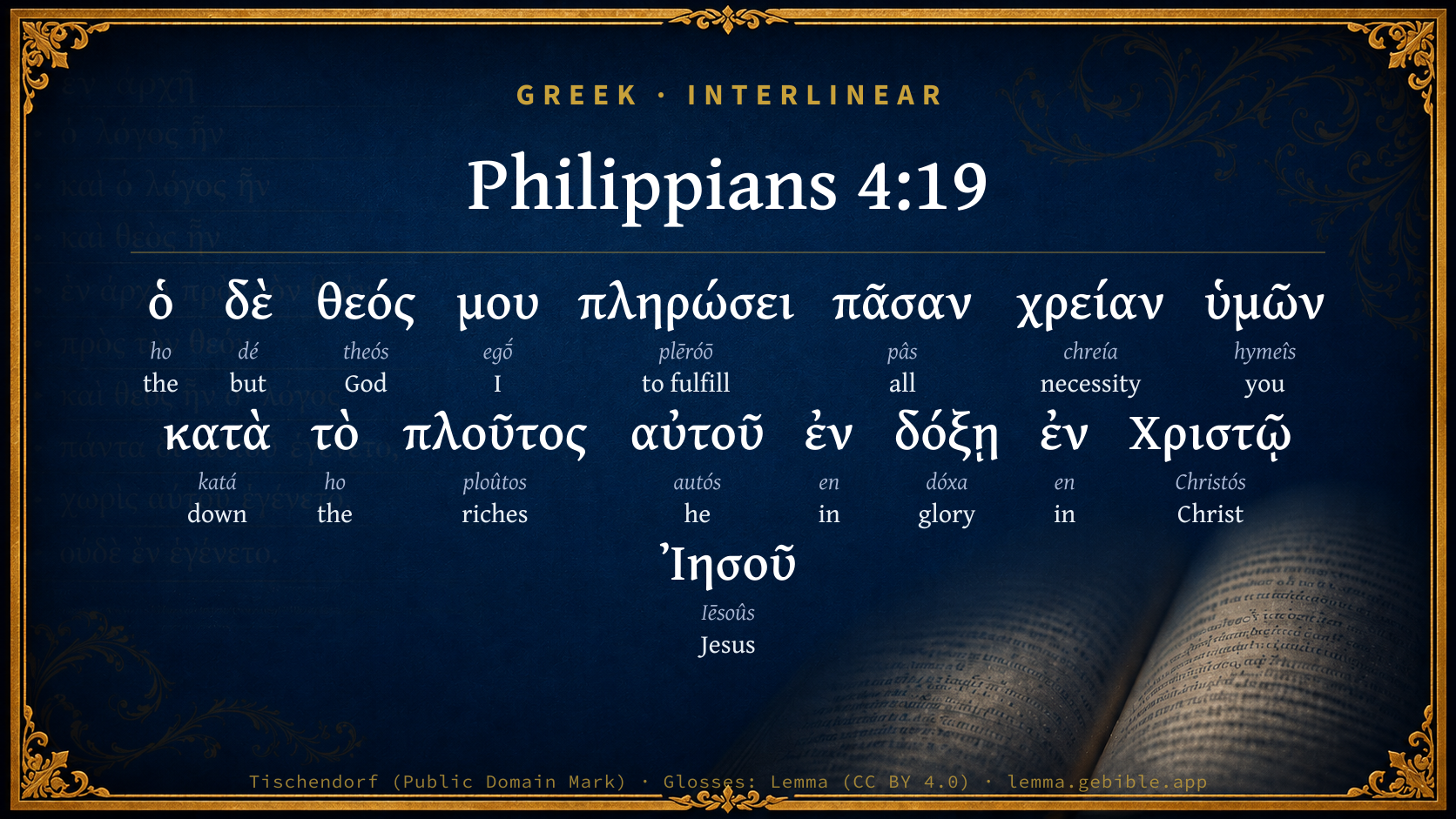
  1. ὁ ho G3588 “the” Article, Nominative, Singular, Masculine
  2. δὲ dé G1161 “but” Conjunction
  3. θεός theós G2316 “God” Noun, Nominative, Singular, Masculine
  4. μου egṓ G1473 “I” Personal pronoun, 1st person, Genitive, Singular
  5. πληρώσει plēróō G4137 “to fulfill” Verb, Future, Active, Indicative, 3rd person, Singular
  6. πᾶσαν pâs G3956 “all” Adjective, Accusative, Singular, Feminine
  7. χρείαν chreía G5532 “necessity” Noun, Accusative, Singular, Feminine
  8. ὑμῶν hymeîs G5210 “you” Personal pronoun, 2nd person, Genitive, Plural
  9. κατὰ katá G2596 “down” Preposition
  10. τὸ ho G3588 “the” Article, Accusative, Singular, Neuter
  11. αὐτοῦ autós G846 “he” Personal pronoun, Genitive, Singular, Masculine
  12. ἐν en G1722 “in” Preposition
  13. δόξῃ dóxa G1391 “glory” Noun, Dative, Singular, Feminine
  14. ἐν en G1722 “in” Preposition
  15. Χριστῷ Christós G5547 “Christ” Noun, Dative, Singular, Masculine
  16. Ἰησοῦ Iēsoûs G2424 “Jesus” Noun, Dative, Singular, Masculine

About this verse

These counts appear in no published source. They are computed here, from the morphology-tagged text and Lemma’s own curated glosses. What Lemma adds →

17
words
15
distinct lemmas
Pauline Epistles
section

Notable vocabulary

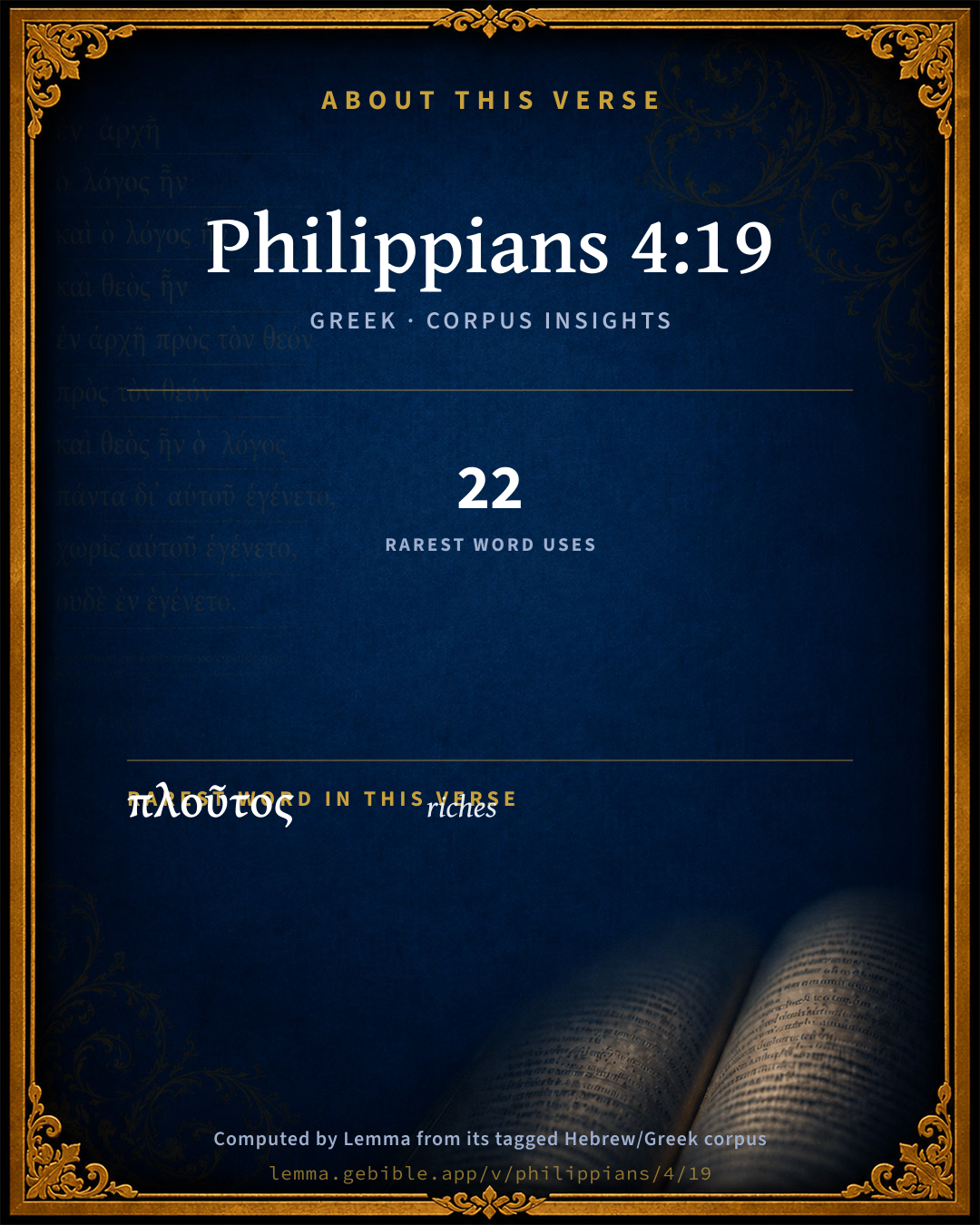
The rarest word here is πλοῦτος riches G4149 — appearing just 22 times in the whole Greek New Testament.

Shared distinctive vocabulary

πλοῦτος riches G4149 occurs in 21 verses of the Greek New Testament. Also found in:

Repetition

Words recur within this verse:

Cross-references

41

Topical passages linked to Philippians 4:19 in the Treasury of Scripture Knowledge — connected by theme and wording, ordered by reader-vote popularity; previews shown in the World English Bible.

  • 2 Corinthians 9:8–11 And God is able to make all grace abound to you, that you, always having all sufficiency in everything, may abound to every good work.
  • Psalms 84:11 For Yahweh God is a sun and a shield. Yahweh will give grace and glory. He withholds no good thing from those who walk blamelessly.
  • 1 Peter 5:10 But may the God of all grace, who called you to his eternal glory by Christ Jesus, after you have suffered a little while, perfect, establish, strengthen, and settle you.
  • Psalms 23:1–5 Yahweh is my shepherd: I shall lack nothing.
  • 1 Timothy 6:17 Charge those who are rich in this present world that they not be haughty, nor have their hope set on the uncertainty of riches, but on the living God, who richly provides us with everything to enjoy;
  • Micah 7:7 But as for me, I will look to Yahweh. I will wait for the God of my salvation. My God will hear me.
  • Proverbs 3:9–10 Honor Yahweh with your substance, With the first fruits of all your increase:
  • Deuteronomy 8:3–4 He humbled you, and allowed you to hunger, and fed you with manna, which you didn't know, neither did your fathers know; that he might make you know that man does not live by bread only, but by everything that proceeds out of the mouth of Yahweh does man live.
  • Malachi 3:10 Bring the whole tithe into the store-house, that there may be food in my house, and test me now in this," says Yahweh of hosts, "if I will not open you the windows of heaven, and pour you out a blessing, that there shall not be room enough for.
  • Luke 12:30–33 For the nations of the world seek after all of these things, but your Father knows that you need these things.
  • Proverbs 11:24–25 There is one who scatters, and increases yet more. There is one who withholds more than is appropriate, but gains poverty.
  • 2 Samuel 22:7 In my distress I called on Yahweh; Yes, I called to my God: He heard my voice out of his temple, My cry [came] into his ears.
  • Psalms 36:8 They shall be abundantly satisfied with the abundance of your house. You will make them drink of the river of your pleasures.
  • Nehemiah 9:15 and gave them bread from the sky for their hunger, and brought forth water for them out of the rock for their thirst, and commanded those who they should go in to possess the land which you had sworn to give them.
  • Ephesians 3:16 that he would grant you, according to the riches of his glory, that you may be strengthened with power through his Spirit in the inward man;
  • Colossians 3:16 Let the word of Christ dwell in you richly; in all wisdom teaching and admonishing one another with psalms, hymns, and spiritual songs, singing with grace in your heart to the Lord.
  • Colossians 1:27 to whom God was pleased to make known what are the riches of the glory of this mystery among the Gentiles, which is Christ in you, the hope of glory;
  • Psalms 41:1–3 Blessed is he who considers the poor: Yahweh will deliver him in the day of evil.
  • Psalms 112:5–9 It is well with the man who deals graciously and lends. He will maintain his cause in judgment.
  • Romans 8:18 For I consider that the sufferings of this present time are not worthy to be compared with the glory which will be revealed toward us.
  • Ephesians 1:7 in whom we have our redemption through his blood, the forgiveness of our trespasses, according to the riches of his grace,
  • Ephesians 3:8 To me, the very least of all saints, was this grace given, to preach to the Gentiles the unsearchable riches of Christ,
  • Psalms 130:7 Israel, hope in Yahweh, For with Yahweh there is loving kindness. With him is abundant redemption.
  • Romans 9:23 and that he might make known the riches of his glory on vessels of mercy, which he prepared beforehand for glory,
  • Genesis 48:15 He blessed Joseph, and said, "The God before whom my fathers Abraham and Isaac did walk, the God who has fed me all my life long to this day,
  • Psalms 104:24 Yahweh, how many are your works! In wisdom have you made them all. The earth is full of your riches.
  • 2 Corinthians 4:17 For our light affliction, which is for the moment, works for us more and more exceedingly an eternal weight of glory;
  • 2 Chronicles 18:13 Micaiah said, As Yahweh lives, what my God says, that will I speak.
  • Daniel 6:22 My God has sent his angel, and has shut the lions' mouths, and they have not hurt me; because as before him innocence was found in me; and also before you, O king, have I done no hurt.
  • Romans 2:4 Or do you despise the riches of his goodness, forbearance, and patience, not knowing that the goodness of God leads you to repentance?
  • Ephesians 1:18 having the eyes of your hearts enlightened, that you may know what is the hope of his calling, and what are the riches of the glory of his inheritance in the saints,
  • Ephesians 2:7 that in the ages to come he might show the exceeding riches of his grace in kindness toward us in Christ Jesus;
  • Romans 11:33 Oh the depth of the riches both of the wisdom and the knowledge of God! How unsearchable are his judgments, and his ways past tracing out!
  • 1 Thessalonians 2:12 to the end that you should walk worthily of God, who calls you into his own Kingdom and glory.
  • 2 Corinthians 12:21 that again when I come my God would humble me before you, and I would mourn for many of those who have sinned before now, and not repented of the uncleanness and sexual immorality and lustfulness which they committed.
  • John 20:17 Jesus said to her, "Don't touch me, for I haven't yet ascended to my Father; but go to my brothers, and tell them, 'I am ascending to my Father and your Father, to my God and your God.'"
  • John 20:27 Then he said to Thomas, "Reach here your finger, and see my hands. Reach here your hand, and put it into my side. Don't be unbelieving, but believing."
  • 1 Peter 5:1 I exhort the elders among you, as a fellow elder, and a witness of the sufferings of Christ, and who will also share in the glory that will be revealed.
  • Nehemiah 5:19 Remember to me, my God, for good, all that I have done for this people.
  • Romans 1:8 First, I thank my God through Jesus Christ for all of you, that your faith is proclaimed throughout the whole world.
  • Philemon 1:4 I thank my God always, making mention of you in my prayers,

Cross-references courtesy of OpenBible.info (CC BY 4.0).

Commentary

Notes on Philippians 4:19 from classic Christian and Jewish commentators (each source and its license shown beneath its notes). The classic Christian expositions comment on the surrounding passage and are grouped to its opening verse, so a note may address several verses; the Jewish commentaries on the Tanakh (Rashi and others) are per-verse, so they appear only where the commentator wrote on this verse.

Lemma curates 59 commentaries, every one of them public domain or Creative Commons licensed, each selected and text-cleaned for this edition rather than reprinted as found. About our sources →

The Biblical Illustrator

Joseph S. Exell

Php_4:19

My God shall supply all your need

The need and the supply

Paul declares that the contributions of his Philippian friends are pleasing to him, and acceptable to God.

He cannot requite their kindness, but declares that God can and will.

I. The extent of the supply. The emphasis is on all.

1. There are many promises of this kind even in the Old Testament. They that seek the Lord shall not want any good thing. No good thing will He withhold from them that walk uprightly, etc. But in all their fulness we find them only in the gospel, where Christ tells us that our heavenly Father knows our need, and caring as He does for sparrows and lilies will much more care for us.

2. This promise is exceeding broad. It is not restricted--

(1) In the nature of its object, but comprehends temporal and spiritual good.

(2) Nor in the absolute measure of the good it possesses; not your occasional, but your constant need; not one kind, but every kind; not a portion, but all.

3. It is possible to misinterpret the promise. We are not to make it the ground of foolish expectations. God will not do for us what we can do for ourselves, nor gratify our whims. The promise has a just and obvious limit. God will supply our need. He does more, but does not engage to do so; and He is the final and righteous Judge of what our needs are. We may not feel the want of what God sees we require. We may desire wealth, or health of body, but God may see that we need spiritual riches and health of soul, and to give the latter He may have to withhold the former. Take the case of Paul who prayed for deliverance from his thorn in the flesh. Gods response was grace to bear it, and Paul saw that his need was supplied, and then gloried in his infirmity.

II. Its means--riches in glory, or glorious riches, a phrase indicative of the wealth of Deity; but more than this, for behind the works of His hand there is the uncreated wealth of His own infinity. Here we come to an ocean without a bottom or shore. What we see gives us a small idea of the Divine possibility. Notwithstanding all that God has given, His ability to give remains undiminished.

III. Its medium. The passage is sometimes made to read out of His riches and glory. This is true, but what Paul means is that our need is supplied by a certain method. We are under a mediatorial government. By Christ God made the worlds. Through Him, too, comes daily bread and daily pardon. The promises of God are yea and amen in Christ Jesus. Apart from Him there is no mercy to anyone. Prayer is only heard as offered in His name.

IV. Its certainty. There is no doubt or contingency: God shall do it. Some one has said that the apostle here draws a bill on the exchequer of heaven that God will make the wants of the Philippians His own care. Rather let us say that he draws a bill which he is assured God will honour the moment it is presented in believing prayer. What are the grounds for this?

1. The apostle knew that God loved His own children with a peculiar love, and was therefore sure to take care of the Philippians.

2. He knew that God approved of their act, and would therefore compensate them.

3. He knew his own standing with God. We have friends for whom we can say that for our sakes they would do what we desire, and God thus puts Himself in human conditions and enables Paul to claim Him as his own. (J. Stacey, D. D.)

Our need and supply

I. Examine the scope of the promise. There is danger of fanaticism in the interpretation of truth. God promises to supply our needs, but not to gratify our wishes or whims.

II. The supply is not according to our deserts, but according to the riches of His glory: i.e., His glorious wealth. The resources of the Trinity are drawn upon. Jesus bade His disciples to ask, that their joy might be full. He does not delight in a sad, starved Church, but in one that is joyful, well fed.

III. The medium. Through Christ. But God ordains means and puts us under conditions. As in agriculture, so here, we are to work in harmony with Gods established methods, if we would secure fruits. (M. Staple, D. D.)

Mans needs and Gods wealth

I. Mans needs and Gods wealth.

1. Mans needs are--

(1) Physical. There is no creature with so many wants.

(a) The creatures far beneath him have not so long and so helpless an infancy, and acquire much sooner the means of self support.

(b) There are successive births in the same life. Man passes from one stage to another, higher and still higher; but he never reaches the platform where he finds perfection.

(c) We may learn the greatness of his nature from the character of his wants. He must have a world made for him and all things in it must serve him.

(d) His needs are constantly recurring. He has marvellous powers of receptivity. The world may empty its treasures at his feet, and yet leave crying needs.

(2) Social. Life can only develope itself by clinging to other forms of life. The affections require some object round which to twine, and thus give beauty to life. The words father, mother, brother, etc., represent the needs of his social nature. Let him be deprived of any of these and he ever after feels that he is poor.

(3) Mental. The mind in its best state is like the garden of Eden; but it may be like a wilderness which brings forth only thorns. It needs teachers, books, culture; the libraries of the world represent its needs.

(4) Moral.

(a) Man is a sinner, and that is enough to express his utter poverty. He needs nothing short of Gods great salvation. He has left his Fathers house and gone into a far country, and having spent all, he begins to be in want.

(b) With the new life there are new capacities. He wants light--the conditions of life--and God who commanded the light to shine out of darkness must shine in our heart. He wants love--God. Nothing short of the Infinite can satisfy him.

(c) There are great changes in this life which give birth to great needs.

(d) There are needs which stretch into the future. Man has time, he wants eternity; he has earth, he wants heaven; he has houses and lands, he needs an inheritance incorruptible and undefiled, and that fadeth not away. He wants the perfect life, without suffering, without sin, without sorrow.

2. Gods wealth. How poor all words are in describing the riches of God, the boundless wealth of His nature.

(1) There are some figures that help us; there is the sun. God is our Sun. The sun pours light not only on the tops of the mountains, but into the depths of the valleys; gives colourings to the countless leaves that quiver in mighty forests, and kindles the incense of the world. There are the pulsations of the ocean. In its fulness it pours its tide on our shores, and its waters flow on till they have filled every bay and creek and inlet. The pulsations of Gods goodness are felt through the universe: The Lord is good to all, and His tender mercies are over all His works.

(2) There are some titles that help us, such as the God of hope, the God of peace, the God of all comfort, the God of all grace, the Father of mercies, the Father of lights. But what a revelation of Gods wealth we have when we are told God is love. His promises represent His wealth, and are convertible into realities any day and any hour. His gospel reveals His purposes, His thoughts, His grace. Do you want mercy? He keepeth mercy; it is treasured in His nature as in a storehouse. Strength? He giveth power to the faint. Truth for your understanding? There are revelations as you are able to bear them, visions regulated by the souls capacities to see them. Love for your heart? Build a sanctuary, let its dimensions be vast, for in proportion to the greatness of the temple will be the manifestations of the Divinity. Get up into one of the worlds highest mountains and look around, and then claim all.

II. The experience of the highest life shows the connection between the needs of man and the wealth of God.

1. The life of the apostle illustrates our text. One class of needs creates another, and if the highest are supplied the others can be endured. The man who wrote the text had suffered every kind of need, and had therefore large conceptions of human want; but his need had been supplied, and therefore he had large conceptions of Gods wealth.

2. We have the best illustrations of this in his prayers. We may learn from the prayers of men how great the wealth of God must be. God is able to do exceeding abundantly above all that we ask or think. if our needs took outward form, what endless processions we should see going up to the throne of God, all asking. What prayers have gone up from tabernacle, temple, venerable sanctuaries, the pavements of which are worn by generations of kneeling worshippers. What prayers have gone up from men in the depths, from men in the height! What prayers we have heard prayed from our fathers and mothers! What prayers we have prayed. The answers to these reveal the connection between mans needs and Gods wealth.

III. With what certainty the apostle speaks. This certainty must have come from his faith in God.

1. In the affluence of the Divine life. The universe is but the outward clothing of the thought of God. The gospel with its provision for the need of man is the revelation of the heart of God, and the outpouring of its love.

2. In the benevolence of the Divine nature, wherever God proclaims His name, He makes His goodness to pass before men. If our relationship to our children is the proof of our willingness to give them good gifts, how much more so in regard to God.

3. In the inexhaustibleness of the Divine resources. God is a fountain always overflowing: if the streams should fail there would be a universal bankruptcy of life.

IV. With what intense satisfaction the apostle speaks. He had a large mind and heart, and fitly represented the genius of Christianity. There are some who think only of themselves, and appear to value the gospel all the more because they limit it to a few. If they have bread, they care not if the whole race starves; if they are saved, they care not if the whole world is lost. But this treasure was placed in the apostles hands and in ours that man may be enriched. Our need supplied is an assurance that God will supply the need of every man.

V. God supplies our needs through Jesus Christ. How much more precious gifts are when they come through the hands of those who love us. (H. J. Bevis.)

Mans need supplied from Gods riches

I. Mans necessity. Strictly speaking, all creatures are equally indigent, whether sinners or saints. Out of God there is no self-sufficiency. But circumstances, though they cannot add to our inherent emptiness and dependence, may add materially to our necessities, and that in three ways.

1. When a creature is placed in a situation unfavourable to his happiness. An infant, e.g., in his mothers arms, is as needy as want and helplessness can render it, but take it from its mother and cast it into the sea and it needs to be rescued as well as nourished; a deliverer as well as a mother.

2. When there is something within himself counteracting his welfare. A sick man needs more help than one in health; a man with a wounded spirit more comfort than one with a mind unwrung.

3. When he is destined for a high station. A monarchs son requires more care in training than a peasants. A barbarian does well enough in his native woods, but set him apart for a high state of civilization and you add to him many wants. Put these three things together and we shall have some idea of the extent and urgency of the Christians need. We are in a state unfavourable to our happiness; there is sin within us; we are designated for a station for whose pursuits we have naturally no desire. We are needy as creatures, as sinful creatures, as redeemed creatures.

II. Gods wealth. The apostle has not in his mind all the blessings which God possesses in Himself, but those which are adapted to our present state of want and our future state of exaltation--gospel blessings, the riches of His grace, the mercies offered to sinners.

1. The figure contains two ideas.

(1) Their abundance. It is not one or two pieces of gold that make a man rich, nor power to relieve one or two beggars. There must be large resources. And where is the want for which Gods gospel does not offer a remedy? Where the blessing He is not able to bestow? Millions on millions can no more exhaust His store that we with the hollow of our hand could empty the sea.

(2) Their excellence. We do not deem worthless things riches however abundant. A mass of sand would never be called a treasure. And what so precious as Gods mercies? We can no more estimate their value than their abundance. We can no more say We know their utmost worth than We have taken them all.

2. Why are they called riches in glory? Perhaps the term

(1) may refer to heaven, the storehouse of spiritual blessings.

(2) Or it may be equivalent to glorious riches. In this case it may mean that these riches

(a) are magnificent as well as excellent and abundant.

(b) That they bring glory to their possessors, and are honourably acquired and spent.

(c) That they are glorious in their tendency and use. They not only come out of glory but lead to it--whereas earthly riches are often debasing and injurious.

III. The supply for this necessity out of this wealth. This supply is--

1. Certain.

2. Abundant. Not according to our necessities but to Gods riches; suited to His character not ours; commensurate with His magnificence rather than with our poverty and meanness.

3. Adapted to our real, not imaginary need.

4. Through Christ.

(1) He purchased them for us. Ye know the grace of our Lord Jesus Christ, etc.

(2) He receives them for us as our representative.

(3) He bestows them on us. It is the connection it has with Christ that makes this supply certain, for it is the stipulated reward of His sufferings; abundant, for those sufferings were of infinite worth; glorious, because its bestowal brings glory to Him. (C. Bradley, M. A.)

Provision for the way

Joseph filled his brethrens sacks with corn, which they were to carry home with them. But in addition he gave them provision for the way. This, compared with the other, was a small thing, but the other would never have reached home without it. So we know that there is a glorious portion in the heavenly Canaan, but we have a wilderness journey to pro vide for: and Jesus, our Covenant Joseph, who has charge of the treasures of heaven, has not forgotten this.

I. The nature of this provision.

1. This is embodied in the word need. This is all that God undertakes to provide for. There are many things that others have that we should like; there are many things that we feel we could make good use of if we had them; there are many things that our pride, ambition, desire for self-indulgence prompt us to crave, but we do not find them in this provision.

2. This word need has a variety of meanings which take their shape from the character and aim of the person to whom it refers. The man who goes to business with the consciousness that by twelve oclock he has a note to take up for five thousand dollars--needs that amount of money. The mariner needs favouring breezes to aid him in reaching port. The farmer needs rain and sunshine to ripen and mature the grain. And so in the case of the Christian. His need does not take in what will minister to present gratification, but what will be useful in promoting his eternal interest. What this is God only knows and can give.

3. The psalmist teaches us the meaning of the word when he says, No good thing will God withhold from His people. But this good thing may mean disappointment, sickness, poverty. But whatever the souls interest requires is our need.

II. Its extent. This will be best illustrated by scriptural examples.

1. Jobs need could only be supplied by passing through a peculiar experience; but it was supplied. He was led into the furnace, supported through it, and brought out of it.

2. Noahs need could not be met without a demand on faith and obedience such as had never been made before. But Noah believed and obeyed God, built the ark and was saved.

3. Jacobs need could only be met by Josephs being governor of Egypt, and this involved much grief.

4. Abrahams need could only be met by the stern call to offer up his son, and the result of that action will follow him throughout eternity in untold blessings.

5. And so with Moses, David, Daniel, Jonah, and Paul.

III. The rule by which this provision is regulated. It would have been a great thing had the apostle said, According to His riches in grace. These riches are marvellous, and show us what God is doing for His people here. But riches in glory point to what He will hereafter do for us in heaven. These eye hath not seen, nor ear heard. When St. John gazed through the veil he only tells us of the foundations and walls of the heavenly home as made of precious jewels; its gates of pearls, and streets of gold; and then leaves us to infer what the riches in glory must be. Tempted, burdened, needy Christian, the riches lavished on yonder home are pledged for thy supply.

IV. The agent by whom this provision is administered. How tenderly God has considered our comfort in constituting Christ the agent. With whom could the administering of this supply be so safely left as with Him?

1. How able He is to help.

2. How willing.

3. How ready.

4. How close and always at hand.

V. Its certainty. This is the promise of the God of eternal truth. Did His promise ever fail? Can the scripture be broken. (R. Newton, D. D.)

Sure supplies

I. God is rich--gloriously rich.

1. In life. He is the living God.

2. In the power of imparting life--a fountain that can never be exhausted.

3. In strength. Is anything too hard for the Lord.

4. In knowledge and wisdom. Oh, the depth, etc.

5. In mercy. He spared not His own Son.

6. In all that constitutes goodness.

7. The earth is full of His riches--there is not a poor province in creation.

8. He is rich in possession, for all things were created by Him and for Him.

9. Rich without obligation to another, for of Him, and through Him, and to Him, are all things.

10. This gloriously rich God is our Father, and to His boundless wealth His firstborn had free access.

But they became prodigal, and all their younger children have trodden in their steps, and now we have not free access to the whole of our Fathers wealth. We now inherit Gods glorious riches by Christ Jesus, and become heirs of God by becoming joint heirs with Him.

II. The Christians supplies are sure. This is secured--

1. By the source--God.

(1) The ordinary sources of supply to us are ever changing and multiplying as we advance. The first we recognize is that which we denominate my mother; then my father; then my teachers; then my books and companions; then my trade or profession; then my husband, wife, friends, country, Church.

(2) But these are only subordinate sources of supply--cisterns which cannot long hold water. My mother and father--their days are as grass; my friends--how many are worthy of the name; my daily calling--if it yield bread enough is a weariness; the happy wife may become a widow; upon your country you may have to turn your back; the Church may be a wilderness to you. With everything you now term my you may be disappointed and disgusted.

(3) But Paul is positive that this source shall never fail, because it cannot.

2. By the channel--Christ Jesus.

(1) When our supplies fail the channel is sometimes at fault and not the source. The supply of fuel in midwinter sometimes fails, not because the coal fields are exhausted, but because the snow blocks the railways. The supply of water or gas may be insufficient, not because the reservoirs are low, but because the pipes are broken. A good scheme perishes through bad agents; and though sure of the source if we be doubtful of the channel we can never speak confidently of the supply.

(2) But in this case we are as sure of the channel as we are of the source. Jesus Christ, the same yesterday, today, and forever.

3. By the scale of distribution. According to His glorious riches.

(1) Human supplies are not always according to means. The rich husband will sometimes supply his wife so sparingly that the wife of the working man is less straitened. Not according to their wealth do some parents educate their children, but according to their niggardliness. Wealthy masters remunerate their servants according to their own selfish hearts. Offerings cast into Gods treasury are often only according to necessity. But when we find men supplying the need of others according to their resources we are sure that they are kind and liberal, and are sure to supply the need of all that are dependent upon them.

(2) Now God gives according to His glorious riches. Not as the poor give, in the abundance of their poverty; not as the rich, when they give grudgingly; not according to our low views, restrained prayer, or feeble faith; not according to any liberality we see in each other. If the gloriously rich God give according to His wealth we may say with confidence, My God shall supply, etc.

III. The knowledge of God is essential to confidence in Him. There are few things in which we are oftener disappointed than the resources of our supplies. This is especially the case with men who look for patrons to carry them forward. The power to help is overestimated: disappointment comes and confidence is wrecked. Now this man knew God, and that knowledge was the basis of his trust. He had looked to God for the supply of his need of wisdom, guidance, protection, strength, etc., and God had supplied it. With this personal experience of the riches of the Divine liberality, he says, My God shall supply all your need. (S. Martin.)

Comfort for the needy

I. Your need--is great--diversified--constant.

II. The supply--suitable--seasonable--abundant.

III. The source of supply--certain--inexhaustible--free. (J. Lyth, D. D.)

Filling the empty vessels

I. Set out the empty vessels.

1. It is not supposed that you need to borrow other peoples needs: you have enough of your own. Set them out--in a long row, all of them. Needs for your body and needs for your soul; needs for your families, for the present, for the future, for time, and for eternity. Your needs are as many as your moments and the hairs of your head.

2. Some of these empty vessels are large and are growing larger. Our wants grow upon us. One loaf sufficed once: it would not go far at your table now: the loaves vanish there like snow in the sun. You have more infirmities. You never needed so much as you do now.

3. Some of these needs, if supplied tonight, would be empty vessels tomorrow morning. Yesterdays old patience is stale stuff. You must grow more of that sweet herb in your garden. We are like the fabled vessels of mythology that were so full of holes that the fifty daughters of Danaus could never fill them.

4. Some of our needs are very pressing. Bring, then, your urgent needs. Set them all out in this row of empty pots.

II. Who is to fill these empty vessels? My God will supply all your need. Nobody else can. He can. Paul says: See, my God has supplied me. He will also supply you. Pauls God is the God of providence. He is also the God of grace. He that spared not His own Son, shall He not with Him freely give us all things? He is also the God of heaven. The riches of nations are as rags and rottenness in comparison with His resources.

III. In what style will God supply His peoples needs?

IV. By what means does the Lord fill His peoples needs? (C. H. Spurgeon.)

The Christians want and supply book

On a tradesmans table I noticed a book labelled Want Book. What a practical suggestion for a man of prayer! He should put down all his needs on the tablets of his heart, and then present his want book to his God. If we knew all our need, what a large want book we should require! How comforting to know that Jesus has a supply book, which exactly meets our want book! Promises, providences, and Divine visitations, combine to meet the necessities of all the faithful. (C. H. Spurgeon.)

God will supply our need

The Rev. Hansard Knollys was among the Christian ministers, who, in the seventeenth century, were the subjects of persecution. He was prosecuted in the High Commission Court and fled to America: whence after a time he returned. Having lived for some time in obscurity in London, he had but sixpence left, and no prospect for the support of his family. In these circumstances he prayed, encouraged his wife to remember the past goodness of God, and to reflect on the promise, I will never leave thee nor forsake thee; paid his lodging and then went out, like Abraham, not knowing whither he went. He had walked only a few steps, when he was met by a woman who told him that some Christian friends had prepared a residence for him and his family, and had sent him money and other comforts. They were impressed with this manifestation of Divine goodness to them, and his wife exclaimed, O dear husband I how sweet it is to live by faith, and trust Gods faithful word! Let us rely upon Him whilst we live, and trust Him in all straits.

The faithfulness of God

Rev. J. Brown, of Haddington, said that his epitaph might appropriately be, Here lies one of the cares of Providence, who early wanted both father and mother, and yet never missed them. (Thomas Cooper.)

Sufficiency of the Divine resources

God is satisfied with Himself, and sufficient to His own happiness. Therefore, surely, there is enough in Him to fill the creature. That which fills an ocean will fill a bucket; that which will fill a gallon will fill a pint; those revenues which will defray an emperors expenses are enough for a beggar or poor man. (T. Manton, D. D.)

The nearness of the provision

Ability and willingness to help are not sufficient of themselves. They must be always at hand just when and where we may require them. How often the help of earthly friends fails just here. We see this strikingly illustrated in the case of Hedley Vicars. He was wounded in one of those sanguinary conflicts before Sebastopol. His wound was not necessarily mortal The surgeon understood the nature of the wound perfectly. He felt sure that it could be cured, and he was perfectly ready and willing to do all he could for his suffering friend. But still Hedley Vicars died of that wound. And why? Because in the hurry and tumult of that terrible morning, on the gray heights of the Crimea, the regiment which Hedley Vicars commanded was carried far away from the tent that held the supplies. A bandage was needed to tie up the bleeding artery. But this bandage was in yon distant tent; and ere the tent could be reached, the brave Christian soldier was no more. In speaking of this circumstance afterwards, at a public meeting in England, one of the friends of the departed hero said, with the pathos of true affection, If there had been a bandage within reach--if the tent of supplies had been half a mile nearer, Hedley Vicars might have been alive today. There was knowledge, and power, and willingness to help. But just the one thing needed was not at hand, and so there was a failure to meet the pressing need. But such a thing can never occur with Him in whose hands our supply is left. (R. Newton, D. D.)

The exactness of the Divine supply

Harms of Hermannsburg, the pastor of a poor village on the Luneberg Heath in Hanover, said in his annual missionary sermon in 1857: I have expended much in the past year in sending out the ship with her fifteen passengers, for the printing house, the press, and the paper, altogether 14,781 dollars, and I have received altogether 14,796 dollars, so I have fifteen dollars over. Is not that a wonder? So much spent, and yet something over! And I thank God that He has given us the fifteen dollars overplus. Riches only makes cares. God has heard all my prayers. He has given me no riches, and I have also no debts. We have neither collected nor begged, but waited patiently on God in prayer.

Christ adapted to human need

You cannot name a noble figure, a sweet simile, a tender or attractive relationship, in which Jesus is not set forth for the comfort and encouragement of His people. Are we wounded? He is balm. Are we sick? He is medicine. Are we naked? He is clothing. Are we poor? He is wealth. Are we hungry? He is bread. Are we thirsty? He is water. Are we in debt? He is our Surety. Are we in darkness? He is our Sun. Have we a house to build? He is the Rock on which to build it. Have we a black and gathering storm to face? He is a strong tower to which we may flee and be safe. Are we to be tried? He is our Advocate. Is sentence passed, and are we under condemnation? He is our pardon. To deck Him out and set Him forth Nature culls her finest flowers, brings her choicest ornaments, and lays these treasures at His feet. The skies contribute their stars. The sea gives up its pearls. From fields, and rivers, and mountains, earth brings the tribute of her gems--her gold, her frankincense and myrrh, the lily of the valley, the clustered vine, and the fragrant rose of Sharon. (T. Guthrie, D. D.)

Mercies stilt left

There was a man who came over from New York some years ago, and threw himself down on a lounge in his house and said, Well, everythings gone. They said, What do you mean? Oh, he replied, We have had to suspend payment; our house has gone to pieces--nothing left. His little child bounded from the other side of the room and said, Papa, you have me left. And the wife, who had been very sympathetic, and very helpful, came up and said, My dear, you have me left. And the old grandmother, seated in a corner of the room, put up her spectacles on her wrinkled forehead and said, My son, you have all the promises of God left. Then the merchant burst into tears and said, What an ingrate I am! I find I have a great many things left. God, forgive me. (T. De Witt Talmage, D. D.)

The promise should inspire fearlessness in Divine service

Your business--you cannot neglect that! Call to mind the story of the rich English merchant to whom Elizabeth gave some commission of importance, and he demurred to undertake it, saying, Please, your majesty, if I obey your behests what will become of these affairs of mine? And his monarch answered, Leave those things to me; when you are employed in my service I will take charge of your business. So it will be with you. Do but surrender yourself to Christ, and He, of His own free will, takes in hand all your affairs. (C. H. Spurgeon.)

Neglect of the promise

Many years ago, an aged and ragged Indian wandered into one of our western settlements, begging for food to keep him from starving. A bright-coloured ribbon was seen round his neck, from which there hung a small dirty pouch. On being asked what it was, he said it was a charm given him in his younger days. He opened it, and took out a worn and crumpled paper, which he handed the person speaking to him for inspection. It proved, on examination, to be a regular discharge from the Federal army, entitling him to a pension for life, and signed by General Washington himself. Here was a man, with a promise duly signed, which, if presented in the right place, would have secured to him ample provision for the way; and yet he was wandering about hungry, helpless, and forlorn, and begging for bread to keep him from starving! What a picture we have here of many Christians, who, with all the promises of Jesus in their hands--with the charter of their inheritance in full possession, are yet gloomy, and sad, and starving in the wilderness! (R. Newton, D. D.)

The Biblical Illustrator, edited by Joseph S. Exell (c. 1880s–1900s) — public domain. Text from a community e-Sword module.

Bengel's Gnomon

Johann Albrecht Bengel

Php 4:19. Ὁ δὲ Θεός μου, but my God) who will recompense what is given to His servant. In Php 4:19 this particular statement regarding the liberality of the Philippians is concluded by the word δὲ, but; but in Php 4:20 the conclusion of the whole of this joyous passage is made by δὲ, but [‘now.’]—πληρώσει) may God supply, nay, He will fully supply. [We may perceive that this act of kindness on the part of the Philippians was indeed excellently laid out, if even it only produced this prayer of the apostle.—V. g.]—χρείαν, need) As you have supplied and relieved my need, what is empty of yours will not remain empty [it shall be filled, πληρώσει Θεός].—ἐν δόξῃ, in glory) This should be referred to the whole sentence. There are riches in glory, glorious riches, immediately at hand; then besides, God will fully supply in glory, i.e. gloriously.

Bengel's Gnomon of the New Testament — English translation (T&T Clark, Edinburgh, 1860) — public domain. Text from a community e-Sword module.

Meyer's Critical & Exegetical Commentary

Heinrich August Wilhelm Meyer

Php_4:19. The thought starts from τῷ Θεῷ. But God, to whom your gift stands in the relation of such a sacrifice, will recompense you.

Paul says ὁ δὲ Θεός μου (comp. Php_1:3), because he himself had been the recipient of that which they had brought as a sacrifice pleasing to God; as his God (to whom he belongs and whom he serves, comp. on Rom_1:8), therefore, will God carry out the recompense.

πληρώσει] used with significant reference to πεπλήρ., Php_4:18, according to the idea of recompense. Not, however, a wish (hence also in Codd. and in the Vulgate the reading πληρώσαι), as Chrysostom, Luther, and others take it, but a promise.

πᾶσαν χρείαν ὑμῶν] likewise corresponding to the service which the readers had rendered; for they had sent εἰς τὴν χρείαν (Php_4:16) of the apostle. To be understood as: every need which ye have, not merely bodily (so usually, following Chrysostom, who explains it as the fulfilment of the fourth petition, also van Hengel, de Wette, Wiesinger), and not merely spiritual (Pelagius, Rilliet, also mainly Weiss), but as it stands: every need. It is not, however, an earthly recompense which is meant (Hofmann), but (comp. on Php_4:17) the recompense in the Messiahs kingdom, where, in the enjoyment of the σωτηρία, the highest satisfaction of every need (comp. on πληρ. χρείαν, Thuc. i. 70. 4, and Wetstein in loc.) shall have set in amidst the full, blessed sufficiency of the eternal ζωή (comp. Rom_8:17 f.; Rev_21:4).[194] There are specifications of this satisfaction in the beatitudes of the Sermon on the Mount, Matthew 5; comp. especially the χορτασθήσεσθε and γελάσετε, Luk_6:21, also the οὐ μὴ διψήσῃ εἰς τὸν αἰῶνα in Joh_4:14, and the sarcastic κεκορεσμένοι, in 1Co_4:8. That it is the Messianic satisfaction in the ἐλευθερία τῆς δόξης τῶν τέκνων τοῦ Θεοῦ (Rom_8:21), in the possession of the πλοῦτος τῆς δόξης τῆς κληρονομίας αὐτοῦ (Eph_1:18), which is to be thought of, Paul himself states by ἐν δόξῃ, which is to be taken as instrumental (Eph_1:23; Eph_5:18) and dependent on πληρ.: with glory, whereby the Messianic is indicated. Hofmann also, though he rejects the instrumental view, comes ultimately to it: Therewith and thus will God fulfil all their need, in that He gives them glory.[195] Others, who also correctly join the words with πληρ., take them as a modal definition: in a glorious way, that is, amply, splendide, and the like. See Castalio, Beza, Calvin, and many others, including Hoelemann, van Hengel, Rilliet, de Wette, Wiesinger, Weiss. But what an indefinite yet peculiarly affected, and withalby its so habitual reference elsewhere to the final judgmentmisleading expression would this be for so simple an idea! And how far would it be from the apostles mind, considering his expectation of the nearness of the Parousia (comp. 1Co_7:29; 1Co_7:31), to promise on this side of it a hearty recompense, which was to take place, moreover, ἐν Χριστῷ Ἰησοῦ! An appeal is wrongly made to 2Co_9:8, where an increase of means for further well-doing, to be granted through Gods blessing, and not the recompense, is the point under discussion. Others erroneously join ἐν δόξῃ with τὸ πλοῦτος αὐτοῦ (Grotius, Storr, Flatt, Rheinwald, and others): pro amplissimis suis divitiis, id est, potestate sua omnia excedente, Heinrichs. It is true that ἐν δόξῃ might be attached without a connecting article (according to the combination πλουτεῖν ἐν τινι, 1Ti_6:8; comp. 1Co_1:5; 2Co_9:11); but Paul always connects πλοῦτος with the genitive of the thing, and πλοῦτος τῆς δόξης in particular, said of God, is so constantly used by him, that it seems altogether unwarranted to assume the expression πλοῦτος ἐν δόξῃ in this passage. See Rom_9:23; Eph_1:18; Eph_3:16; Col_1:27. He would have written: κατὰ τὸ πλοῦτος τῆς δόξης αὐτοῦ, comp. Rom_9:23.

κατὰ τὸ πλοῦτος αὐτοῦ] that is, in conformity with His being so rich, and consequently having so much to give. Comp. Rom_10:12; Rom_11:33. This assures what is promised.

ἐν Χριστῷ Ἰησοῦ] definition annexed to πληρώσει … δόξῃ; that which is promised has its causal ground in Christ, who by His work has acquired for believers the eternal δόξα. Christ is, in fact, ἡ ἐλπὶς τῆς δόξης, Col_1:27.

[194] Hofmann very irrelevantly objects that it is out of place to speak of want in that kingdom. But just, in fact, on that account is the bliss of the kingdom the complete satisfaction of every need. Comp. Rev_7:16 f.; 2Ti_4:7 f. Thus also is the perfect then put in the place of that which is in part. Consequently the idea of the satisfaction of every χρεία in eternal life, where man even beholds God, and where He is all in all, is anything but a monstrous thought.

[195] In order, however, to bring out of the passage, notwithstanding this ἐν δόξῃ, the idea of a recompense in this life, Hofmann makes δόξα mean the glory of the children of God which is hidden from the world, and which is the fulfilment of every want only in proportion as there is lacking in us what, either corporally or spiritually, is necessary for the completion of our divine sonship. Instead of such arbitrary inventions, let us keep clearly before us how great a weight in the very word of promise, which forms the conclusion of the epistle, lies in the fact that the grand aim of all promise and hope, i.e. the glory of eternal life (Rom_5:2; Rom_8:18; Rom_8:21; Rom_9:23; 1Co_15:43; 2Co_4:17; Col_3:4; and many other passages), is once more presented to the readers view.

Meyer — Critical and Exegetical Commentary on the New Testament — English translation by Peter Christie, edited by Frederick Crombie (T&T Clark, 1880) — public domain. Text from a community e-Sword module.

Expositor's Greek Testament

ed. W. Robertson Nicoll

Phi 4:19 . ὁ δὲ Θεός κ . τ . λ . God’s treatment of them corresponds to their treatment of Paul. They had ministered to his χρεία . so that he could say πεπλήρωμαι . That was the side of the reckoning which stood to their credit. Here is the other side. “My God shall repay what has been done to me His servant for the Gospel’s sake. He, in turn, shall satisfy to the full ( πληρώσει ) every need of yours .” τὸ πλοῦτος must be read. See crit. note supr. So also in 2Co 8:2 , Eph 1:7 ; Eph 2:7 ; Eph 3:8 ; Eph 3:16 , Col 1:27 ; Col 2:2 . But ὁ πλοῦτος in Eph 1:18 , and repeatedly both in nominative, genitive and accusative singular. Modern Greek uses πλοῦτος , βίος , θρῆνος sometimes with ὁ , sometimes with τό . LXX generally has ὁ . ἐν δόξῃ . The phrase is regarded by some ( e.g. , Beng., Ws [70] . , Eadie, etc.) as = “in a lavish, magnificent way”. This is to strain the sense. It is much more natural, comparing Rom 8:21 , Eph 1:18 ( τίς ὁ πλοῦτος τῆς δόξης τῆς κληρονομίας ), to think of it as the future Messianic glory which Paul believed to be so near (so Lft [71] . , Kl [72] . , etc.).

[70] . Weiss.

[71] Lightfoot.

[72] . Klöpper.

The Expositor's Greek Testament, edited by W. Robertson Nicoll (1897–1910) — public domain. Text from a community e-Sword module.

Jamieson, Fausset & Brown

Robert Jamieson, A. R. Fausset & David Brown

my--Paul calls God here "my God," to imply that God would reward their bounty to HIS servant, by "fully supplying" (translate so, literally, fill to the full) their every "need" (Co2 9:8), even as they had "fully" supplied his "need" (Phi 4:16, Phi 4:18). My Master will fully repay you; I cannot. The Philippians invested their bounty well since it got them such a glorious return.

according to his riches--The measure of His supply to you will be the immeasurable "riches of His grace" (Eph 1:7).

in glory--These words belong to the whole sentence. "Glory" is the element in which His rich grace operates; and it will be the element IN which He will "supply fully all your need."

by Christ Jesus--by virtue of your being "IN" (so Greek, not "by") Christ Jesus, the Giver and Mediator of all spiritual blessings.

Jamieson, Fausset & Brown — Commentary Critical and Explanatory on the Whole Bible (1871) — public domain (CC PDM 1.0). Text via the HelloAO Bible API.

Adam Clarke's Commentary

Verse 19. My God shall supply all your need] As you have given to me in my distress, God will never suffer you to want without raising up help to you, as he raised you up for help to me.

According to his riches] His fulness is infinite; and through Christ, whose followers we are, he will dispense every requisite blessing of providence, grace, and glory, to you.

Adam Clarke's Commentary on the Bible (1810–1826) — public domain. Text from a community e-Sword/MySword module.

John Calvin's Commentaries

19 My God will supply Some read impleat — in the optative — May he supply. While I do not reject this reading, I approve more of the other. He expressly makes mention of God as his, because he owns and acknowledges as done to himself whatever kindness is shewn to his servants. They had therefore been truly sowing in the Lord’s field, from which a sure and abundant harvest might be expected. Nor does he promise them merely a reward in the future life, but even in respect of the necessities of the present life: “Do not think that you have impoverished yourselves; God, whom I serve, will abundantly furnish you with everything necessary for you.” The phrase, in glory, ought to be taken in place of the adverb gloriously, as meaning magnificently, or splendidly. He adds, however, by Christ, in whose name everything that we do is acceptable to God.

John Calvin's Commentaries (1540-1563) — public domain. Text from the Calvin Translation Society English edition (1840s-50s) via the Christian Classics Ethereal Library (ccel.org). Calvin's coverage is partial (roughly two-thirds of the Bible); uncommented books and verses are honest gaps, never fabricated. The 19th-century editor's footnotes and remarks are omitted so the notes are faithfully Calvin's own voice.

Ellicott's Commentary for English Readers

(19) My God.—The expression is emphatic. St. Paul had accepted the offerings as made, not to himself, but to the God whose minister he was. Hence he adds, “my God”—the God, whom ye serve in serving me.

All your need.—Properly, every need of yours, spiritual and temporal.

In glory.—We have already noticed the constant reference to “glory” in the Epistles of the Captivity. Where the word relates to God in Himself, His “glory” is His true nature as manifested to His creatures; where it refers to man, “glory” is the perfection of man’s nature in the communion with God in Heaven. Here the latter sense is obviously to be taken. The “supplying of every need out of the riches” of God’s love can only have its consummation in the “glory” of the future. That it is “in Christ Jesus” is a matter of course; for He is to “change even our body of humiliation to be fashioned like unto the body of His glory” (Php_3:21).

A Bible Commentary for English Readers, edited by Charles John Ellicott (1878–1897) — public domain. Text from a community e-Sword module.

The Cambridge Bible for Schools and Colleges

gen. ed. J. J. S. Perowne

19. But] R.V., “And.” But surely there is a slight contrast meant, to an implied wish that he could send back some material requital of his own to alleviate their “deep poverty” (2Co_8:2).

my God] Words deeply characteristic of St Paul. See on Php_1:3 above. Bp Lightfoot well remarks that the phrase is specially in point here; the Apostle is thinking of what God on his behalf shall do for others.

shall supply] Promise, not only aspiration. He is sure of His faithfulness.—“Supply”:—lit., “fill,” pouring His bounty into the void of the “need.”

all your need] R.V., somewhat better, every need of yours. See again, 2Co_8:2, where the exceptional poverty of the converts of Northern Greece is referred to. The prominent thought here is, surely, that of temporal poverty. Cp. particularly 2Co_9:8, where the first reference seems to be to God’s ability to supply to His self-denying servants always more from which they may still spare and give. But neither here nor in 2 Cor. are we for a moment to shut out the widest and deepest applications of the truth stated.

his riches in glory] His resources, consisting in, and so lodged in, His own “glory” of Divine power and love. Cp. Rom_6:4, and note in this Series, for a similar use of the word “glory.”—Bp Lightfoot prefers to connect “shall supply, in glory, your need, according to His riches,” and he explains the thought to be, “shall supply your need by placing you in glory.” But we venture to think this construction needlessly difficult.—Anything in which God is “glorified” (see e. g. Gal_1:24) is, as it were, a reflection of His holy glory, and a result of it. Tender providential goodness to the poor Philippians would be such a result.

On St Paul’s love of the word “riches” in Divine connexions, cp. Eph_1:7, and note in this Series.

in Christ Jesus] “in whom dwelleth all the fulness of the Godhead,” “in whom” the saints are “filled,” as regards all their needs (Col_2:9-10). The “glory” of both grace and providence is lodged, for His people, in Him.

The Cambridge Bible for Schools and Colleges (gen. ed. J. J. S. Perowne; Cambridge University Press, 1878–1918) — public domain. Text from a community e-Sword module.

John Gill's Exposition

But my God shall supply all your need,.... Or "fulfil all your need": the Jews, when they would comfort any, under the loss of any worldly enjoyment, used to say, , "God fulfil", or "will fulfil thy need" (f). The Vulgate Latin, Syriac, and Arabic versions, read these words as a wish or prayer, "but may my God supply" or "fulfil all your need"; I am not able to make you any returns, but I pray that my God would recompence it to you, that as you have supplied my want, he would supply all yours; but we with others, and as the Ethiopic version, read, "shall" or "will supply"; as an assertion by way of promise, though he could not, yet his God would; he who was his God, not only as the God of nature and providence, or as the God of the Israelites, but as the God of all grace; who had loved him as such, had chosen, adopted, regenerated, and sanctified him; who was his God in Christ, and by virtue of the covenant of grace, and which was made known in the effectual calling; whose ambassador he was, and whom he had faithfully served in the Gospel of his Son; this God, who had been his God, was and would be so unto death, in whom he had an interest, and because he had an interest in him, and was thus related to him, be firmly believed, and fully assures these saints, that he would supply their wants who had been so careful of him: believers, though they need nothing as considered in Christ, being complete and filled full in him, having in him all grace, and all spiritual blessings, and under believing views of this at times, see themselves complete and wanting nothing; yet, in themselves, they are poor and needy, and often want fresh discoveries of the love of God to them, fresh supplies of grace from Christ, stand in need of more light from him, and to be quickened according to his word; they want fresh supplies of strength from him answerable to the service and work they are daily called to; and as their trials and afflictions abound, they have need of renewed comfort to support under them; and have also need of fresh manifestations and applications of pardoning grace to their souls, and fresh views of the righteousness of Christ, as their justifying righteousness before God; and, in a word, need daily food for their souls as for their bodies: now God, who is also their God, is able and willing to supply their wants; and he does so, he withholds no good thing from them, nor do they want any good thing needful for them, for he supplies "all" their need; and this they may expect, since he is the God of all grace, and a fulness of grace is in his Son; and this grace is sufficient for them, and a supply of it is given them by the Spirit,

according to his riches; God is rich not only in the perfections of his nature, which are inconceivable and incommunicable; and in the works of his hands, of creation and providence, the whole earth is full of his riches, Psa 104:24, and according to these riches of his goodness he supplies the wants of all creatures living; but he is also rich in grace and mercy, Eph 2:4, and it is according to the riches of his grace he supplies the spiritual wants of his people, and he does it like himself, according to the riches he has; he gives all things richly to enjoy, plenteously and abundantly:

in glory: in a glorious manner, so as to show himself glorious, and make his people so, to the glory of his rich grace; and "with glory", as it may be rendered, with eternal glory; he will not only give grace here, and more of it as is needful, according to the abundance of it in himself and in his Son, but glory hereafter: and all

by Christ Jesus; and through him, who is full of grace and truth; who is the Mediator in whom the fulness of it lies, and through whose hands, and by whom, it is communicated to the saints: or "with Christ Jesus"; along with him God gives all things freely, all things pertaining to life and godliness: or "for the sake of Christ Jesus"; not for any worth or merit in men, but for the sake of Christ, in whom they are accepted, and on whose account respect is had to their persons, and so to their wants,

(f) T. Bab. Betacot, fol. 16. 2. Debarim Rabba, sect. 4. fol. 239. 4.

John Gill's Exposition of the Whole Bible (1746–1763) — public domain (CC PDM 1.0). Text via the HelloAO Bible API.

Trapp's Complete Commentary

John Trapp

19 But my God shall supply all your need according to his riches in glory by Christ Jesus.

Ver. 19. But my God] Whom I serve as an ambassador in bonds, Eph 6:20, and therefore surely he will repay you the sums you have sent me.

Shall supply] Gr. πληρωσει, shall fill up, as he did the widow’s vessels: Shut the doors upon thee, saith the prophet, 2Ki 4:4. It was time to shut the doors, when one little vessel must overflow and fill up many greater.

According to his riches in glory] All God’s supplies to his come tipped and gilt with a glory upon them, saith one. Providences below, graces within, heaven above; as they have a lovely scarlet blush of Christ’s blood upon them; so they are rayed upon with a beam of divine love to them that are in Christ.

John Trapp, A Commentary or Exposition upon All the Books of the Old and New Testament (1647–1656) — public domain. Text from a community e-Sword module.

Albert Barnes' Notes on the Bible

But my God shall supply all your need - That is, “You have shown your regard for me as a friend of God, by sending to me in my distress, and I have confidence that, in return for all this, God will supply all your needs, when you are in circumstances of necessity.” Paul’s confidence in this seems not to have been founded on any express revelation; but on the general principle that God would regard their offering with favor. Nothing is lost, even in the present life, by doing good. In thousands of instances it is abundantly repaid. The benevolent are not usually poor; and if they are, God often raises up for them benefactions, and sends supplies in a manner as unexpected, and hearing proofs of divine interposition as decided, as when supplies were sent by the ravens to the prophet.

According to his riches in glory - see the notes, Eph 3:16. The word “riches” here means, His abundant fullness; His possessing all things; His inexhaustible ability to supply their needs. The phrase “in glory,” is probably to he connected with the following phrase, “in Christ Jesus;” and means that the method of imparting supplies to people was through Jesus Christ, and was a glorious method; or, that it was done in a glorious manner. It is such an expression as Paul is accustomed to use, when speaking of what God does. He is not satisfied with saying simply that it is so; but connects with it the idea that whatever God does is done in a way worthy of himself, and so as to illustrate his own perfections.

In Christ Jesus - By the medium of Christ; or through him. All the favors that Paul expected for himself, or his fellow-men, he believed would be conferred through the Redeemer. Even the supply of our temporal needs comes to us through the Saviour. Were it not for the atonement, there is no more reason to suppose that blessings would be conferred upon people than that they would be on fallen angels. For them no atonement has been made; and at the hand of justice they have received only wretchedness and woe.

Albert Barnes' Notes on the Bible (1834–1885) — public domain. Text from a community e-Sword/MySword module.

Haydock's Catholic Bible Commentary

May God supply all your wants.[4] See the Greek, which determines the signification of the Latin. (Witham)

===============================

[BIBLIOGRAPHY]

Omne desiderium vestrum; the common Greek copies, Greek: chreian; though some Greek: epithumian; some Greek: charan, gaudium; and some Greek: pharin, gratiam.

====================

George Leo Haydock (1774–1849), Haydock's Catholic Family Bible and Commentary, 1859 edition — public domain. Excludes Psalms (Douay-Rheims chapter numbering differs from Protestant) and Deuterocanonical books (Catholic canon only).

Matthew Poole's English Annotations

But my God: see Phi 4:3; he saith my God, because he imputeth and owneth that to be done to himself which is done according to his mind unto any of his ambassadors, he having received the gift from their hand by Paul.

Shall supply all your need; will, in a gracious return to Paul’s prayer, abundantly answer (yea, above all he could ask or think) all their expectations, Psa 41:1-3, with 2Co 9:8,10.

According to his riches in glory; agreeably to his own fulness and rich mercy, Psa 24:1; 1Co 10:26; Eph 2:4; gloriously, or riches of his glory, Eph 3:16, and goodness, Rom 2:4; 9:23; sustaining and defending them liberally and powerfully here, to his own glory, and taking them hereafter into everlasting glory.

By Christ Jesus; through the mediation of, and by virtue of their communion with, Christ Jesus.

Matthew Poole's English Annotations on the Holy Bible (1683–1685) — public domain. Text from a community e-Sword/MySword module.

Whedon's Commentary on the Bible

Daniel D. Whedon

19. My God shall supply—You have supplied my one need, but my God, whose I am, and for whose sake you have done it, shall supply your every need. We take the promise to include both the temporal and the spiritual, limited, on the one hand, only by our necessity in the circumstances in which we are placed, and, on the other, only by the infiniteness of his riches in his state of glory. Measure this who can! The sole condition is, in… Christ Jesus, through whose mediation all fulness is given, and in believing fellowship with whom alone can it be looked for.

Daniel D. Whedon (gen. ed.), Commentary on the Old and New Testaments (1874–1909) — public domain. Text from a community e-Sword module.

The Pulpit Commentary

But my God shall supply all your need; rather, as R.V, every need of yours, My God; the pronoun is emphatic, as in Php_1:3. God will accept your offerings as made to him; you have supplied my need, he will supply every need of yours. According to his riches in glory by Christ Jesus. Not by; it should be "in Christ Jesus." The reward is given to his saints through union with him: "Beholding as in a glass the glory of the Lord, they are changed into the same image kern glory to glory." In glory; that is, by setting them in glory the glory of holiness now, the glory of eternal life hereafter.

The true source of supply in spiritual need.

The apostle seems to say, "You have supplied all my wants; my God shall supply all yours in turn." Consider

I THE AUTHOR OF SUPPLY. "My God shall supply all your need.

1. The expressions, my God," seems to say that what the apostle had found him to be in all his wants, his converts would be sure to find him, likewise. "My God,

(1) because he is mine and I am his;

(2) because he has me wholly in charge and has all my interests committed to him.

2. The expression, implies, not merely Gods ability and willingness to supply all over need, but his obligation to do so, in virtue of the covenant between, him and his people.

II THE NEEDS OF THE CHRISTIAN.. "All your need.

1. This does not signify all that the Christian wants; only what he needs. Inour waywardness and our childishness we ask for many things which are not really needful to us, but rather hurtful.

2. Our needs are many.

a. In temporal things;

b. in spiritual things.

We need faith and its increase, love and its enlargement, hope and its brighter kindling, grace in all its fullness and variety, perseverance in grace to the end.

III THE RULE OR MEASURE OF SUPPLY. "According to his riches in glory." Not the riches of his glory, but according to his riches, which will find their full development in placing the Christian in glory. Thus there is an inexhaustible supply in God.

IV THE MEDIUM OF SUPPLY. "In Christ Jesus." In virtue of our union with him we receive of his fullness, grace for grace. That union is the guarantee of a full supply for all our needs.

V THE DOXOLOGY APPROPRIATE TO SUCH A THOUGHT. "Now to God even our Father be the glory for ever and ever. Amen." This anticipatory doxology is suggested by the pregnant thought of this passage. The glory is due to him who supplies our need. T.C.

A full supply.

The Philippians had "sent once and again unto" St. Paul"s need (Ver. 16). In return the apostle assures them that the recompense which is beyond his power will be made for him by his God, who will supply all their need. We are most enriched when we most sacrifice ourselves. (Pro_11:24) What we give to the work of Christ we shall receive back with far more than the worth of our offerings.

I WE ALL HAVE GREAT NEEDS THAT ONLY GOD CAN FULFIL. "Every need of yours." What a vast field this expression covers!

1. Earthly need. Few but are pressed by such need in some direction, and often to an extent that no human aid can satisfy. But we must observe that what God will supply is the need, not the desire; the two cover very different ground. God will not give what we wish, but what is requisite for us. Moreover, we cannot distinguish between the real need and our idea of what we need. It is the former only that God will supply.

2. Spiritual need. This is far larger and more important than all material wants. We need forgiveness, purification, strength, knowledge great and glorious graces that no man can give.

II GOD WILL FULFIL EVERY NEED OF HIS FAITHFUL SERVANTS.

1. He will fulfill the need. The fulfillment will not be as we expect it; perhaps because the need is not exactly what we imagine it to be. As God only knows the real wants of our lives, he only can rightly supply them. But not one true need will he ultimately leave unsatisfied. There is a royal abundance in the treasury of Divine grace and an unstinting generosity in the gifts from it.

2. This assurance is only for those who are faithful. St. Paul gives it to the Philippians after they have given abundant evidence of their devotion. It is not every one who can rightly be promised that his every need shall be fulfilled, nor to the unspiritual will the Divine supply of the soul"s true needs seem to be such, as they will be blind to these wants and at the same time much con-corned with fancied needs of no real importance which God will certainly not supply.

III THE SOURCE OF THE DIVINE SUPPLY IS CHRIST JESUS.

1. The riches with which to supply our poverty are found in Christ. His unsearchable riches (Eph_2:8) consist in the grace that he brings to us in his advent and the grace that he secures for us by his death and resurrection. As we receive the highest blessings for Christ"s sake they may be regarded as riches that are stored up in Christ.

2. The method of supplying our need is through sharing in the glory of Christ. The riches are in glory. They are the fruits of the triumph of Christ. Fighting under our Captain"s banner, we share his triumph, enter into the same glory with him, and so enjoy his wealth of blessings. W.F.A.

The Pulpit Commentary (1880–1919), ed. H.D.M. Spence-Jones & Joseph S. Exell — public domain. Text from a community e-Sword module.

John Wesley's Explanatory Notes

All your need - As ye have mine. According to his riches in glory - In his abundant, eternal glory.

John Wesley, Explanatory Notes Upon the Whole Bible (1754–1765) — public domain. Text via the GEBible commentary corpus.

The People's New Testament

B. W. Johnson

19. My God shall supply all your need. Since you do not forget the needs of his servants, he will not forget yours.

B. W. Johnson's The People's New Testament with Notes (1889–1891) — public domain. Electronic text from the Christian Classics Ethereal Library (CCEL) ThML edition.

Cambridge Greek Testament for Schools and Colleges

19. πληρώσει. So אOba 1:2 cKL, most cursives, copt arm æth, Chr (twice). D2*G2, 17 37, and several other cursives, vulg, Chrys (twice) Cyr Victorin and other fathers read πληρώσαι. All recent Editors -σει. In such a case it is the more likely alternative that the assertion would be softened, in copies or quotations, into an aspiration.

τὸ πλοῦτος. So א*Oba 1:2*G2, 17. Most cursives and quotations read the masc. form, τὸν πλοῦτον.

19. ὁ δὲ θεός μου. “And my God,” R.V. But there is surely a slight implied contrast, or correction; as if he said, “I would requite you if I could; but my God will do so.”

ὁ θεός μου. Words deeply characteristic of St Paul; see on Php 1:3 above. Lightfoot well remarks that they are specially in point here; the Apostle is thinking of what God will do for others on his behalf.

πληρώσει. The future of the certainty of faith. For πληροῦν χρείαν cp. Psalms 126 (Heb., 127):5, μακάριος ὃς πληρώσει τὴν ἐπιθυμίαν αὐτοῦ.

πᾶσαν χρείαν ὑμῶν. “Your every need.” See again 2Co 8:2 for the exceptional poverty (ἡ κατὰ βάθους πτωχεία) of the Macedonian converts. The main reference here is, surely, to temporal “need”; such need as the Philippians had so lovingly “filled” for St Paul. See 2Co 9:8-9, δυνατεῖ ὁ θεὸς πᾶσαν χαρίν περισσεῦσαι εἰς ὑμᾶς, ἵνα κτλ.: where the first thought seems to be of God’s ability to give His self-denying servants the means for yet further bounties for His work. But neither here nor there are we to shut out the widest and deepest applications of the promise.

κατὰ τὸ πλοῦτος αὐτοῦ ἐν δόξῃ. According to, on the scale of, those resources which reside in the δόξα of His manifested power and love; in fact, in His revealed Self. Cp. Rom 6:4 for such a use of δόξα: ἠγέρθη Χριστὸς … διὰ τῆς δόξης τοῦ πατρός.

Lightfoot explains the thought to be, “He shall supply your need by placing you in glory,” the glory of His heavenly presence. But this seems to be somewhat far-fetched, and indeed to be out of place if the explanation of χρεία given above is right.

St Paul loves the word πλοῦτος, and its cognates, in spiritual connexions. Cp. Rom 2:4; Rom 9:23; Rom 10:12; Rom 11:12; Rom 11:33; 1Co 1:5; 2Co 8:9; 2Co 9:11; Eph 1:7; Eph 1:18; Eph 2:4; Eph 2:7; Eph 3:8; Eph 3:16; Col 1:27; Col 2:2.

ἐν Χριστῷ Ἰησοῦ. Cp. Col 2:9-10, ἐστὲ ἐν αὐτῷ πεπληρωμένοι: and 1Co 1:5, ἐν παντὶ ἐπλουτίσθητε ἐν αὐτῷ. The “glory” of both grace and providence is lodged in Him for His people.

Cambridge Greek Testament for Schools and Colleges (Cambridge University Press, 1896; 21 vols, various authors incl. Carr, Maclear, Plummer, Farrar, Lumby, Moule, M. R. James, Simcox) — public domain. Text from a community e-Sword module.

Alford’s Greek Testament

Henry Alford

19.] an assurance taken up from τῷ θεῷ above, μου because he (Paul) was the receiver: this was his return to them: ‘qui quod servo ejus datur remunerabitur.’ Beng.

πληρώσει … all refers to vv. 16, 18;—as ye πεπληρώκατέ μου τὴν χρείαν. It is an assurance, not a wish (-σαι). πᾶσαν,—not only in the department alluded to, but in all. Meyer refers to the beatitudes in Mat_5 and especially St. Luke’s χορτασθήσεσθε and γελάσετε, Luk 6:21, as illustrative.

ἐν δόξῃ] to be connected with πληρώσει, not with τὸ πλοῦτος αὐτοῦ: not, gloriously, as many Commentators, which is weak and flat in the extreme: but δόξα is the instrument and element by and in which ‘all your need’ will be supplied: in glory, cf. Ps. 16:15 LXX: but not only at the coming of Christ (as Meyer, according to his wont), but in the whole glorious imparting to you of the unsearchable riches of Christ, begun and carried on here, and completed at that day.

ἐν χριστῷ Ἰησοῦ] and this filling (or, ‘this glory,’ but then perhaps τῇ would have been expressed) is, consists, and finds its sphere and element, in Christ Jesus.

Henry Alford, The Greek Testament (1849–1861) — public domain. Text from a community e-Sword module.

International Critical Commentary

19. ὁ δὲ θεὸς μου πληρώσει πᾶσαν χρείαν ὑμῶν: ‘and my God shall fulfil every need of yours.’ My God who has made you his instruments in fulfilling my need (πεπλήρωμαι, vs. 18) will fulfil every need of yours. The δὲ is not adversative, ‘but’ (Beng., De W., A.V.), which would seem to emphasise the loss incurred in sacrifice by setting over against it the promise of the divine supply. It rather adds this statement to the preceding; and this statement expresses God’s practical approval of the Philippians’ offering, and not their compensation by him. (Comp. 2Co 9:8-11.)

κατὰ τὸ πλοῦτος αὐτοῦ: ‘according to his riches.’ The measure or standard of the supply; the infinite possibility, according to which the πληρώσει will be dispensed.

ἐν δόξῃ: ‘in glory.’ The mode or manner of the fulfilment, ‘gloriously’; in such wise that his glory will be manifested. Construe with πληρώσει, not with πλοῦτος (as Grot., Rhw., Heinr., A.V., R.V.), ‘riches in glory,’ which is contrary to N.T. usage, since δόξα with πλοῦτος is invariably in the genitive. See, e.g., τὸν πλοῦτον τῆς δόξης αὐτοῦ (Rom 9:23); and comp. Eph 1:18, Eph 1:3:16; Col 1:27. Ἐν δόξῃ is always used in connection with a verb (see 2Co 3:8, 2Co 3:11; Col 3:4), and so are all similar phrases, as ἐν ἀληθείᾳ, ἐν δυνάμει, ἐν δόλῳ, ἐν ἐξουσίᾳ, ἐν ἀδικίᾳ, ἐν ἀγάπῃ, etc. There is not in the N.T. a phrase like πλοῦτος ἐν δόξῃ. Comp. πληρώσῃ ἐν δυνάμει (2Th 1:11).

Mey. makes ἐν instrumental, though dependent on πληρώσει, ‘with glory,’ or ‘in that he gives them glory,’ and characterises the explanation given above as “indefinite and peculiarly affected,” in which he is followed by Alf., who calls it “weak and flat in the extreme.” Nevertheless it is adopted by Thay., Lips., De W., Calv., Ead., Weiss, Kl. Comp. Rom 1:4, where ἐν δυνάμει is adverbial with ὁρισθέντος, and 2Co 3:7, 2Co 3:8, 2Co 3:11. Mey.’s explanation is shaped by his persistent reference to the parousia, which narrows his interpretation of πλεονάζοντα in vs. 17. He cannot conceive how Paul, with his view of the parousia as imminent, could promise, on this side of it, a glorious recompense. So Lightf. ‘by placing you in glory.’ But πληρώσει is not to be limited to the future reward. It includes, with that, all that supply which God so richly imparts in this life to those who are in Christ. (See Joh 1:16; 1Co 1:5; Eph 3:16-20; Col 2:10.)

ἐν Χριστῷ Ἰησοῦ: Not to be connected with δόξῃ, but with πληρώσει, as the domain in which alone the πληρώσει can take place.

The dignity and tact with which Paul treats this delicate subject have been remarked by all expositors from the Fathers down. Lightf. has justly observed that Paul had given to the Philippians “the surest pledge of confidence which could be given by a high-minded and sensitive man, to whom it was of the highest importance, for the sake of the great cause which he had advocated, to avoid the slightest breath of suspicion, and whose motives nevertheless were narrowly scanned and unscrupulously misrepresented. He had placed himself under pecuniary obligations to them.” With his tone of manly independence and self-respect, mingles his grateful recognition of their care for him and a delicate consideration for their feelings. He will not doubt that they have never ceased to remember him, and have never relaxed their eagerness to minister to him, although circumstances have prevented their ministry. Yet he values their gift principally as an expression of the spirit of Christ in them, and as an evidence of their Christian proficiency. He can give their generosity no higher praise, no higher mark of appreciation and gratitude, than to say that it was a sacrifice of sweet odor to God. He is not raised above human suffering. Their gift was timely and welcome; yet if it had not come, he was independent of human contingencies. They have not only given him money, but they have given him Christian love and sympathy and ministry—fruit of his apostolic work.

The promise just uttered, by its wonderful range and richness, calls forth an ascription of praise.

International Critical Commentary — older volumes (1896–1929), various authors — public domain. Text from a community e-Sword module.

Vincent's Word Studies in the New Testament

Marvin R. Vincent

In glory. This is differently connected by expositors. Some with riches, as A. V. and Rev. Others with shall supply, but with different explanations, as, shall supply your need with glory : in a glorious way : by placing you in glory. It is better to construe with shall supply, and to explain in glory as the element and instrument of the supply. The need shall be supplied in glory and by glory; by placing you in glory where you shall be partakers of glory.

Marvin R. Vincent, Word Studies in the New Testament (1887–1900) — public domain. Text from a community e-Sword/MySword module.

Lesson kit

Teaching starters — assembled from the data on this page, not authored interpretation. Every prompt links to the verse data it draws on. Edit before teaching.

Philippians, in the Pauline Epistles, opens this verse with 17 words (15 distinct Greek lemmas). Its most distinctive word is ploûtos (“riches”). A historical commentator’s framing appears above. Read the whole chapter for the surrounding context.

Discussion questions

  1. The word ploûtos carries the sense “riches.” How does it shape the verse?
  2. How does Matthew 13:22, which shares the word «riches», read alongside this verse?
  3. What does the repetition of “the” (2× in this one verse) do in this verse?
  4. The translations on this page render this verse differently — a whole-verse word diff, not a word-by-word alignment. What might account for the different wordings?
  5. Compare how The Biblical Illustrator and Bengel's Gnomon read this verse. Where do they agree or differ?

Things to notice

Reading settings

Reading text

Shown beneath each verse's original-language words.

Old Testament
Old Testament edition

Read the OT as the Masoretic Hebrew (MT) or the Greek Septuagint (LXX).

English shown for the Greek Septuagint (in the Hebrew ↔ Greek comparison).

Comparing translations? Open the Compare panel on any verse page to stack up to four side by side.