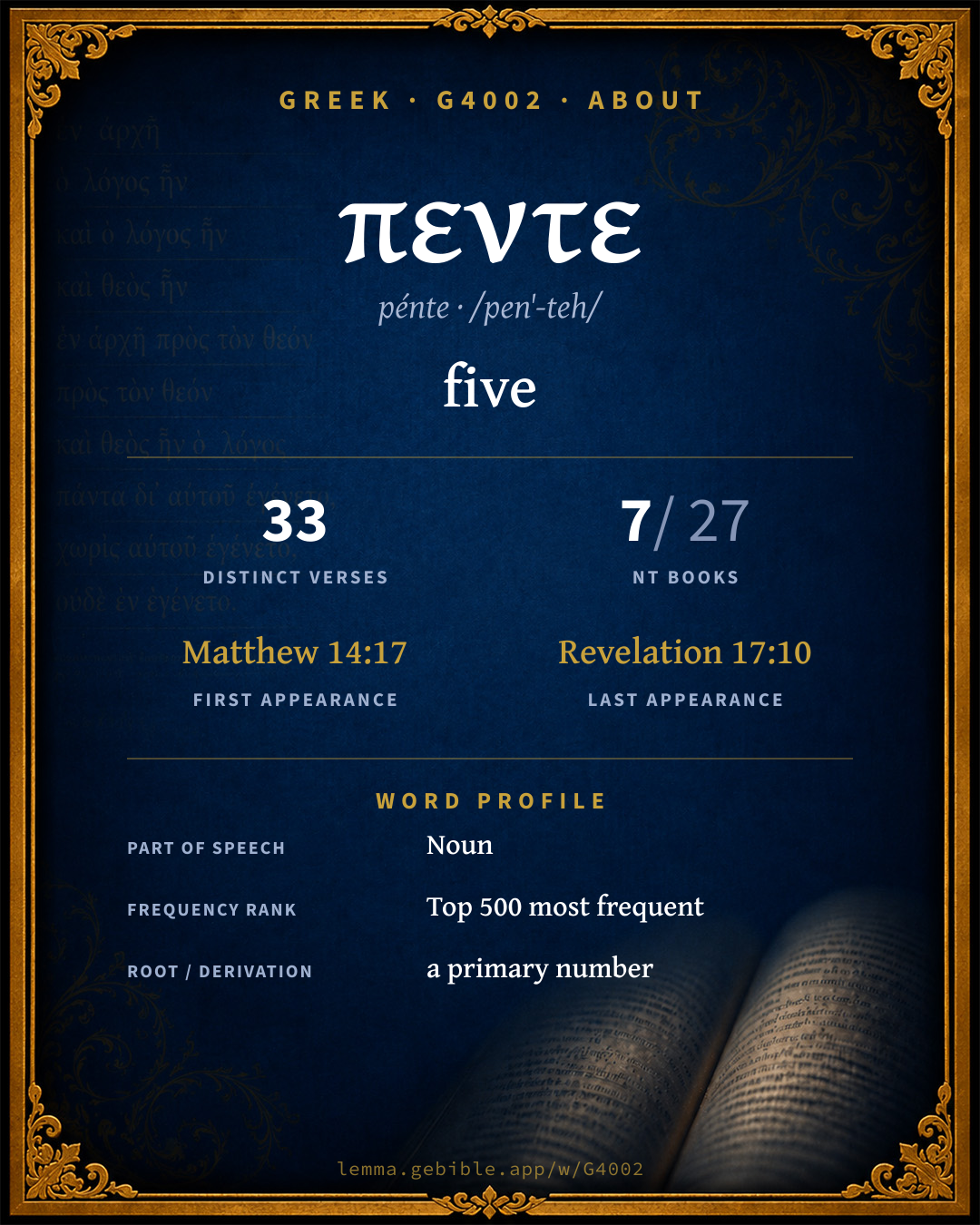
πέντε
five
Full lexicon entry — Thayer's Greek Lexicon
From Thayer's Greek Lexicon
Where this word appears
Every verse where G4002 appears — 33 distinct verses across 7 books. Click any verse to open its interlinear word-by-word view. Verse text shown in the World English Bible for context — . Each verse’s Greek form is shown with its reference; the English is not keyword-highlighted, since the data carries no word-level English alignment. Use “Compare translations” on any verse to read it across multiple English versions. This concordance covers the Greek New Testament; Septuagint (Greek Old Testament) occurrences of this word are not indexed here.
Matthew 7 verses
- Matthew 14:17 πέντε adj num indecl They told him, "We only have here five loaves and two fish."
- Matthew 14:19 πέντε adj num indecl He commanded the multitudes to sit down on the grass; and he took the five loaves and the two fish, and looking up to heaven, he blessed, broke and gave the loaves to the disciples, and the disciples gave to the multitudes.
- Matthew 16:9 πέντε adj num indecl Don't you yet perceive, neither remember the five loaves for the five thousand, and how many baskets you took up?
- Matthew 25:2 πέντε πέντε adj num indecl adj num indecl Five of them were foolish, and five were wise.
- Matthew 25:15 πέντε adj num indecl To one he gave five talents, to another two, to another one; to each according to his own ability. Then he went on his journey.
- Matthew 25:16 πέντε πέντε adj num indecl adj num indecl Immediately he who received the five talents went and traded with them, and made another five talents.
- Matthew 25:20 πέντε πέντε πέντε πέντε adj num indecl adj num indecl adj num indecl adj num indecl He who received the five talents came and brought another five talents, saying, 'Lord, you delivered to me five talents. Behold, I have gained another five talents besides them.'
Mark 3 verses
- Mark 6:38 πέντε adj num indecl He said to them, "How many loaves do you have? Go see." When they knew, they said, "Five, and two fish."
- Mark 6:41 πέντε adj num indecl He took the five loaves and the two fish, and looking up to heaven, he blessed and broke the loaves, and he gave to his disciples to set before them, and he divided the two fish among them all.
- Mark 8:19 πέντε adj num indecl When I broke the five loaves among the five thousand, how many baskets full of broken pieces did you take up?" They told him, "Twelve."
Luke 9 verses
- Luke 1:24 πέντε adj num indecl After these days Elizabeth, his wife, conceived, and she hid herself five months, saying,
- Luke 9:13 πέντε adj num indecl But he said to them, "You give them something to eat." They said, "We have no more than five loaves and two fish, unless we should go and buy food for all these people."
- Luke 9:16 πέντε adj num indecl He took the five loaves and the two fish, and looking up to the sky, he blessed them, and broke them, and gave them to the disciples to set before the multitude.
- Luke 12:6 πέντε adj num indecl "Aren't five sparrows sold for two assaria coins? Not one of them is forgotten by God.
- Luke 12:52 πέντε adj num indecl For from now on, there will be five in one house divided, three against two, and two against three.
- Luke 14:19 πέντε adj num indecl "Another said, 'I have bought five yoke of oxen, and I must go try them out. Please have me excused.'
- Luke 16:28 πέντε adj num indecl for I have five brothers, that he may testify to them, so they won't also come into this place of torment.'
- Luke 19:18 πέντε adj num indecl "The second came, saying, 'Your mina, Lord, has made five minas.'
- Luke 19:19 πέντε adj num indecl "So he said to him, 'And you are to be over five cities.'
John 5 verses
- John 4:18 πέντε adj num indecl for you have had five husbands; and he whom you now have is not your husband. This you have said truly."
- John 5:2 πέντε adj num indecl Now in Jerusalem by the sheep gate, there is a pool, which is called in Hebrew, "Bethesda," having five porches.
- John 6:9 πέντε adj num indecl "There is a boy here who has five barley loaves and two fish, but what are these among so many?"
- John 6:13 πέντε adj num indecl So they gathered them up, and filled twelve baskets with broken pieces from the five barley loaves, which were left over by those who had eaten.
- John 6:19 πέντε adj num indecl When therefore they had rowed about twenty-five or thirty stadia, they saw Jesus walking on the sea, and drawing near to the boat; and they were afraid.
Acts 5 verses
- Acts 4:4 πέντε adj num indecl But many of those who heard the word believed, and the number of the men came to be about five thousand.
- Acts 7:14 πέντε adj num indecl Joseph sent, and summoned Jacob, his father, and all his relatives, seventy-five souls.
- Acts 19:19 πέντε adj num indecl Many of those who practiced magical arts brought their books together and burned them in the sight of all. They counted the price of them, and found it to be fifty thousand pieces of silver.
- Acts 20:6 πέντε adj num indecl We sailed away from Philippi after the days of Unleavened Bread, and came to them at Troas in five days, where we stayed seven days.
- Acts 24:1 πέντε adj num indecl After five days, the high priest, Ananias, came down with certain elders and an orator, one Tertullus. They informed the governor against Paul.
1 Corinthians 1 verse
Revelation 3 verses
- Revelation 9:5 πέντε adj num indecl They were given power not to kill them, but to torment them for five months. Their torment was like the torment of a scorpion, when it strikes a person.
- Revelation 9:10 πέντε adj num indecl They have tails like those of scorpions, and stings. In their tails they have power to harm men for five months.
- Revelation 17:10 πέντε adj num indecl They are seven kings. Five have fallen, the one is, the other has not yet come. When he comes, he must continue a little while.
About this entry
At a glance — auto-summarized from this page’s data, not written by a person. Every figure links to its source below. This summary describes the numbers; it doesn’t interpret them.
“five” is the headline sense of the Greek noun πεντε (pénte). Its earliest occurrence is Matthew 14:17. The Greek New Testament uses it across 33 verses — moderately common. More than a quarter of its appearances fall in Luke. Related forms include πεμπτος, πεντακις and πεντακοσιοι. See the sense tree, 33-verse concordance, and the renderings breakdown below.
Gloss history
Strong's 1890 vs modern scholarship
About this word
Strong's G4002 catalogs a Greek word from the Greek New Testament.
These counts are not copied from any lexicon or concordance. They are computed here, from the morphology-tagged Greek New Testament. What Lemma adds →
- 33
- distinct verses
- The word appears in 33 distinct verses.
- 7 / 27
- NT books
- The word appears in 7 of 27 New Testament books.
- #392
- by frequency
- Top 500 most frequent Greek words (rank 392 of 5,347 Greek words by occurrence).
View all 33 occurrences in the concordance →
By section of the New Testament
By traditional corpus
Conventional, traditional groupings — biblical authorship is debated, so this is a traditional corpus grouping, not an authorship claim. Some books belong to more than one corpus (Luke is in both the Gospels and the Lukan corpus, and so on), so these shares overlap and need not total 100%. Each figure is a share of the word’s 33 distinct verses.
- Gospels 24 verses · 73%
- Lukan (Luke–Acts) 14 verses · 42%
- Johannine 8 verses · 24%
- Revelation 3 verses · 9%
- Pauline corpus 1 verse · 3%
How translations render this word
Counts come from each version’s own published word-to-Strong’s tagging or interlinear alignment — an approximate guide to how each version renders this word, not a word-level alignment the data otherwise carries. Because each total is that version’s own tagged count, the per-version totals vary from one another and need not match the appearance or distinct-verse counts above. These counts may also differ from a printed concordance because Lemma counts each distinctly tagged rendering and does not collapse phrase taggings into a single head-word total. This is a fixed set of word-tagged versions (KJV, ASV, BSB, ULT) and does not change with the reading translation you choose elsewhere. Each version’s license is shown beside its name below (and on Sources).
- King James Version: Five 36×
- American Standard Version: Five 37×
- Berean Standard Bible: Five 35×
- unfoldingWord Literal Text: Five 35×
King James Version Public Domain
Renders G4002 across 38 tagged occurrences — most commonly:
Plus 2 renderings that appear only once — usually multi-word phrases or single function words the recovered tagging swept in, not distinct renderings.
American Standard Version Public Domain
Renders G4002 across 39 tagged occurrences — most commonly:
Plus 2 renderings that appear only once — usually multi-word phrases or single function words the recovered tagging swept in, not distinct renderings.
Berean Standard Bible Public Domain
Renders G4002 across 36 tagged occurrences — most commonly:
Plus 1 rendering that appears only once — usually multi-word phrases or single function words the recovered tagging swept in, not distinct renderings. Not rendered by a distinct English word in 2 further occurrences.
unfoldingWord Literal Text CC BY-SA 4.0
Renders G4002 across 35 tagged occurrences — most commonly:
Not rendered by a distinct English word in 3 further occurrences.
Senses in Thayer's
The 1 sense Thayer's distinguishes for this word, in lexicon order (not ranked by frequency or importance). The full entry — with sub-senses — is in the Lexicon Entry tab.
- five
Word origin
Origin: a primary number
A primary number; five : - five.
— Strong’s Exhaustive Concordance (1890), public domain.
Same root — word family
Other Thayer's entries built from the same root as G4002, grouped by Strong’s listed origin. These share a root / origin per the lexicon — not necessarily a shared meaning. Each links to that word’s own entry.
Derived from this word
- πεμπτος pémptos G3991 fifth
- πεντακις pentákis G3999 five times
- πεντακοσιοι pentakósioi G4001 five hundred
- πεντεκαιδεκατος pentekaidékatos G4003 fifteenth
- πεντηκοντα pentḗkonta G4004 fifty
Compare all same-root words → Showing 4 of 6 — not the complete family. They share a root, not necessarily a meaning.
Septuagint usage
The same Greek word πεντε appears 242 times in the Greek Old Testament (Septuagint), across 185 verses in 18 books.
- 242
- LXX occurrences
- Tagged occurrences of this Greek word in the Septuagint.
- 185
- verses
- Distinct Septuagint verses containing this word.
- 18 / 39
- OT books
- The word appears in 18 of the 39 Old Testament books.
Sample Septuagint occurrences
- Genesis 5:6 πέντε
- Exodus 1:5 πέντε
- Leviticus 26:8 πέντε
- Numbers 1:35 πέντε
- Joshua 10:5 πέντε
- Judges 3:3 πέντε
- 1 Samuel 6:4 πέντε
- 2 Samuel 4:4 πέντε
- 1 Kings 6:2 πέντε
- 2 Kings 6:25 πέντε
- 1 Chronicles 2:4 πέντε
- 2 Chronicles 3:11 πέντε
Septuagint occurrences (same lexeme)
Every verse where the same Strong’s number (G4002) appears in the Greek Septuagint — showing the first 50 of 185. Verse text shown in the World English Bible for context; the Greek form is the matched word — the English is not keyword-highlighted.
- Genesis 5:6 πέντε Seth lived one hundred five years, and became the father of Enosh.
- Genesis 5:10 πέντε Enosh lived after he became the father of Kenan, eight hundred fifteen years, and became the father of sons and daughters.
- Genesis 5:11 πέντε All the days of Enosh were nine hundred five years, then he died.
- Genesis 5:15 πέντε Mahalalel lived sixty-five years, and became the father of Jared.
- Genesis 5:17 πέντε All the days of Mahalalel were eight hundred ninety-five years, then he died.
- Genesis 5:21 πέντε Enoch lived sixty-five years, and became the father of Methuselah.
- Genesis 5:23 πέντε all the days of Enoch were three hundred sixty-five years.
- Genesis 5:30 πέντε Lamech lived after he became the father of Noah five hundred ninety-five years, and became the father of sons and daughters.
- Genesis 7:20 πέντε The waters prevailed fifteen cubits upward, and the mountains were covered.
- Genesis 11:12 πέντε Arpachshad lived thirty-five years, and became the father of Shelah.
- Genesis 11:32 πέντε The days of Terah were two hundred five years. Terah died in Haran.
- Genesis 12:4 πέντε So Abram went, as Yahweh had spoken to him. Lot went with him. Abram was seventy-five years old when he departed out of Haran.
- Genesis 14:9 πέντε against Chedorlaomer king of Elam, and Tidal king of Goiim, and Amraphel king of Shinar, and Arioch king of Ellasar; four kings against the five.
- Genesis 18:28 πέντε What if there will lack five of the fifty righteous? Will you destroy all the city for lack of five?" He said, "I will not destroy it, if I find forty-five there."
- Genesis 25:7 πέντε These are the days of the years of Abraham's life which he lived: one hundred seventy-five years.
- Genesis 45:6 πέντε For these two years the famine has been in the land, and there are yet five years, in which there will be neither plowing nor harvest.
- Genesis 45:11 πέντε There I will nourish you; for there are yet five years of famine; lest you come to poverty, you, and your household, and all that you have."'
- Genesis 45:22 πέντε To all of them he gave each man changes of clothing, but to Benjamin he gave three hundred pieces of silver and five changes of clothing.
- Genesis 46:27 πέντε The sons of Joseph, who were born to him in Egypt, were two souls. All the souls of the house of Jacob, who came into Egypt, were seventy.
- Genesis 47:2 πέντε From among his brothers he took five men, and presented them to Pharaoh.
- Exodus 1:5 πέντε All the souls who came out of the Jacob's body were seventy souls, and Joseph was in Egypt already.
- Exodus 21:37 πέντε
- Exodus 26:3 πέντε Five curtains shall be coupled together one to another; and the other five curtains shall be coupled one to another.
- Exodus 26:9 πέντε You shall couple five curtains by themselves, and six curtains by themselves, and shall double over the sixth curtain in the forefront of the tent.
- Exodus 26:26 πέντε "You shall make bars of acacia wood: five for the boards of the one side of the tent,
- Exodus 26:27 πέντε and five bars for the boards of the other side of the tent, and five bars for the boards of the side of the tent, for the far part westward.
- Exodus 26:37 πέντε You shall make for the screen five pillars of acacia, and overlay them with gold: their hooks shall be of gold: and you shall cast five sockets of brass for them.
- Exodus 27:1 πέντε "You shall make the altar of acacia wood, five cubits long, and five cubits broad; the altar shall be foursquare: and its height shall be three cubits.
- Exodus 27:15 πέντε For the other side shall be hangings of fifteen cubits; their pillars three, and their sockets three.
- Exodus 27:18 πέντε The length of the court shall be one hundred cubits, and the breadth fifty every where, and the height five cubits, of fine twined linen, and their sockets of brass.
- Exodus 37:6 πέντε He made a mercy seat of pure gold. Its length was two and a half cubits, and a cubit and a half its breadth.
- Exodus 37:16 πέντε He made the vessels which were on the table, its dishes, its spoons, its bowls, and its pitchers with which to pour out, of pure gold.
- Exodus 39:2 πέντε He made the ephod of gold, blue, purple, scarlet, and fine twined linen.
- Exodus 39:5 πέντε The skillfully woven band that was on it, with which to fasten it on, was of the same piece, like its work; of gold, of blue, purple, scarlet, and fine twined linen; as Yahweh commanded Moses.
- Leviticus 26:8 πέντε Five of you shall chase a hundred, and a hundred of you shall chase ten thousand; and your enemies shall fall before you by the sword.
- Leviticus 27:6 πέντε If the person is from a month old even to five years old, then your valuation shall be for a male five shekels of silver, and for a female your valuation shall be three shekels of silver.
- Numbers 1:35 πέντε those who were numbered of them, of the tribe of Manasseh, were thirty-two thousand two hundred.
- Numbers 1:37 πέντε those who were numbered of them, of the tribe of Benjamin, were thirty-five thousand four hundred.
- Numbers 2:15 πέντε His division, and those who were numbered of them, were forty-five thousand six hundred fifty.
- Numbers 2:23 πέντε His host, and those who were numbered of them, were thirty-five thousand four hundred.
- Numbers 3:47 πέντε you shall take five shekels apiece for each one; after the shekel of the sanctuary you shall take them (the shekel is twenty gerahs):
- Numbers 3:50 πέντε from the firstborn of the children of Israel he took the money, one thousand three hundred sixty-five shekels, after the shekel of the sanctuary:
- Numbers 4:3 πέντε from thirty years old and upward even until fifty years old, all who enter into the service, to do the work in the Tent of Meeting.
- Numbers 7:17 πέντε and for the sacrifice of peace offerings, two oxen, five rams, five male goats, and five male lambs a year old. This was the offering of Nahshon the son of Amminadab.
- Numbers 7:23 πέντε and for the sacrifice of peace offerings, two oxen, five rams, five male goats, five male lambs a year old. This was the offering of Nethanel the son of Zuar.
- Numbers 7:29 πέντε and for the sacrifice of peace offerings, two oxen, five rams, five male goats, and five male lambs a year old. This was the offering of Eliab the son of Helon.
- Numbers 7:35 πέντε and for the sacrifice of peace offerings, two oxen, five rams, five male goats, and five male lambs a year old. This was the offering of Elizur the son of Shedeur.
- Numbers 7:41 πέντε and for the sacrifice of peace offerings, two oxen, five rams, five male goats, and five male lambs a year old: this was the offering of Shelumiel the son of Zurishaddai.
- Numbers 7:47 πέντε and for the sacrifice of peace offerings, two oxen, five rams, five male goats, and five male lambs a year old. This was the offering of Eliasaph the son of Deuel.
- Numbers 7:53 πέντε and for the sacrifice of peace offerings, two oxen, five rams, five male goats, and five male lambs a year old. This was the offering of Elishama the son of Ammihud.
These are occurrences of the same Greek lexeme (G4002) in the Septuagint — not a translation of any one Hebrew word. The store carries no word-level Hebrew↔Greek alignment, so no Hebrew original is asserted here. Counts come from the recovered LXX Strong's tagging — high-frequency vocabulary is well covered, while rare or late forms may be untagged — so they reflect tagged occurrences and may slightly undercount.