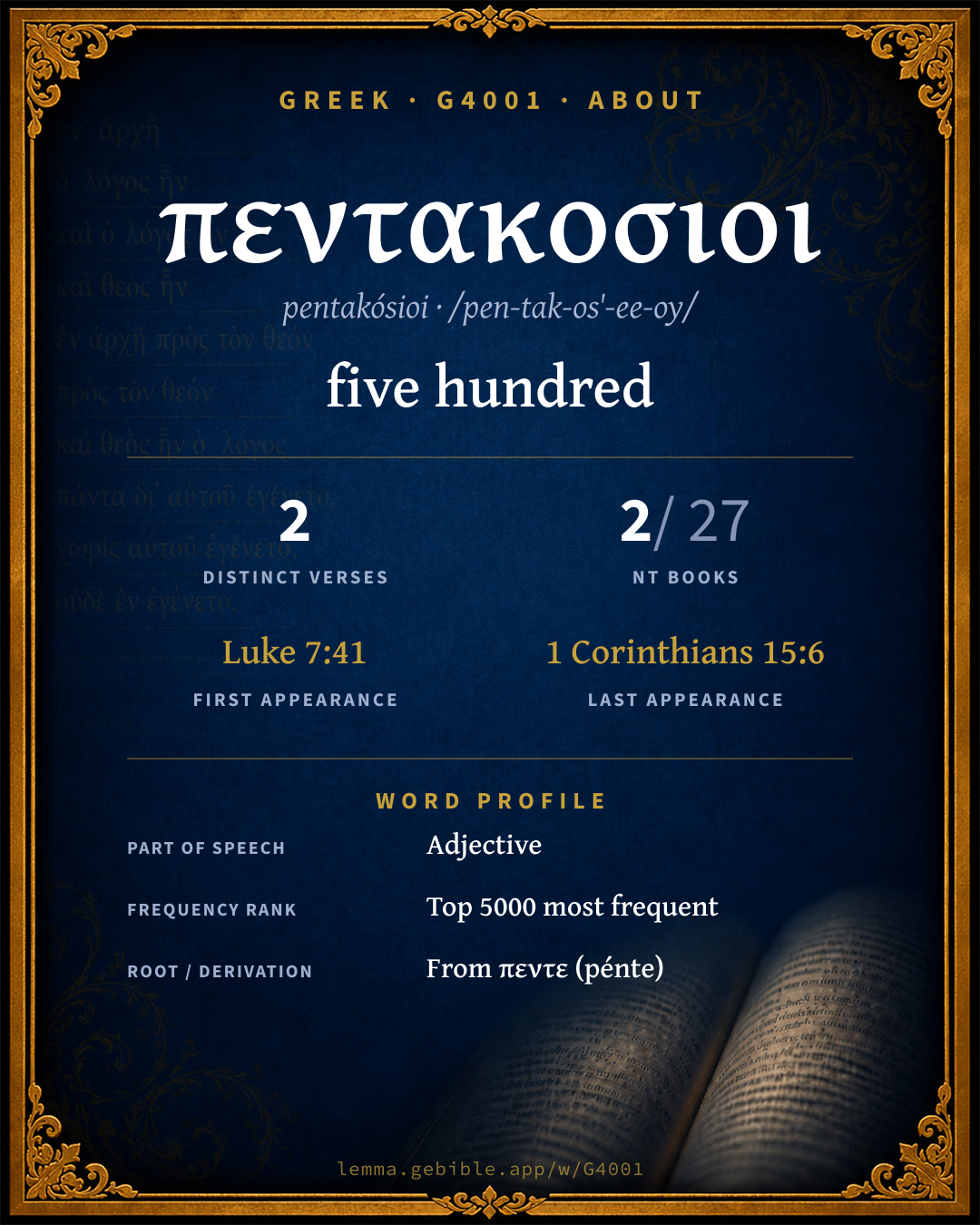
πεντακόσιοι
five hundred
Full lexicon entry — Thayer's Greek Lexicon
From Thayer's Greek Lexicon
Where this word appears
See every Accusative-case word in the Greek New Testament →
Grammar key — what these labels mean
Part of speech
- Adjective
- A word that describes or qualifies a noun.
Case
- Accusative
- The case of the direct object and of extent.
- Dative
- The case of the indirect object, means, or location — “to / for / with / in.”
Gender
- Neuter
- Grammatically neuter.
- Masculine
- Grammatically masculine.
Number
- Plural
- More than one.
Grammatical forms
- Adjective, Accusative, Plural, Neuter 1 time (50%)
- Adjective, Dative, Plural, Masculine 1 time (50%)
Parsed forms decoded from the imported morphology (Robinson–Tischendorf, public domain), counted across 2 parsed occurrences — not distinct verses.
Every verse where G4001 appears — 2 distinct verses across 2 books. Click any verse to open its interlinear word-by-word view. Verse text shown in the World English Bible for context — . Each verse’s Greek form is shown with its reference; the English is not keyword-highlighted, since the data carries no word-level English alignment. Use “Compare translations” on any verse to read it across multiple English versions. This concordance covers the Greek New Testament; Septuagint (Greek Old Testament) occurrences of this word are not indexed here.
Luke 1 verse
1 Corinthians 1 verse
About this entry
At a glance — auto-summarized from this page’s data, not written by a person. Every figure links to its source below. This summary describes the numbers; it doesn’t interpret them.
At its core, πεντακοσιοι (pentakósioi) means “five hundred.” The Greek New Testament uses it only 2 verses. Its uses cluster heavily in Luke (50% of all occurrences). It first appears in Luke 7:41. Sharing its root, it stands alongside πεντε, πεμπτος and πεντακις. Each statement above links to its evidence; the full detail follows below.
Gloss history
Strong's 1890 vs modern scholarship
About this word
Strong's G4001 catalogs a Greek word from the Greek New Testament.
These counts are not copied from any lexicon or concordance. They are computed here, from the morphology-tagged Greek New Testament. What Lemma adds →
- 2
- distinct verses
- The word appears in 2 distinct verses.
- 2 / 27
- NT books
- The word appears in 2 of 27 New Testament books.
- #2,678
- by frequency
- Top 5000 most frequent Greek words (rank 2,678 of 5,347 Greek words by occurrence).
View all 2 occurrences in the concordance →
Most concentrated in
- Luke 1 verse 50%
- 1 Corinthians 1 verse 50%
By section of the New Testament
By traditional corpus
Conventional, traditional groupings — biblical authorship is debated, so this is a traditional corpus grouping, not an authorship claim. Some books belong to more than one corpus (Luke is in both the Gospels and the Lukan corpus, and so on), so these shares overlap and need not total 100%. Each figure is a share of the word’s 2 distinct verses.
- Gospels 1 verse · 50%
- Lukan (Luke–Acts) 1 verse · 50%
- Pauline corpus 1 verse · 50%
How translations render this word
Counts come from each version’s own published word-to-Strong’s tagging or interlinear alignment — an approximate guide to how each version renders this word, not a word-level alignment the data otherwise carries. Because each total is that version’s own tagged count, the per-version totals vary from one another and need not match the appearance or distinct-verse counts above. These counts may also differ from a printed concordance because Lemma counts each distinctly tagged rendering and does not collapse phrase taggings into a single head-word total. This is a fixed set of word-tagged versions (KJV, ASV, BSB, ULT) and does not change with the reading translation you choose elsewhere. Each version’s license is shown beside its name below (and on Sources).
- King James Version: Five hundred 2×
- American Standard Version: Five hundred 2×
- Berean Standard Bible: Five hundred 2×
- unfoldingWord Literal Text: not separately translated
King James Version Public Domain
Renders G4001 across 2 tagged occurrences — most commonly:
American Standard Version Public Domain
Renders G4001 across 2 tagged occurrences — most commonly:
Berean Standard Bible Public Domain
Renders G4001 across 2 tagged occurrences — most commonly:
unfoldingWord Literal Text CC BY-SA 4.0
Does not render G4001 with a distinct English word (not separately translated in its 2 tagged occurrences).
Senses in Thayer's
The 1 sense Thayer's distinguishes for this word, in lexicon order (not ranked by frequency or importance). The full entry — with sub-senses — is in the Lexicon Entry tab.
- five hundred
Word origin
Derived from πεντε (pénte) (G4002) — five.
Forms in the corpus
The 2 distinct written forms G4001 takes in the Greek New Testament, most frequent first — each parse links to that case’s occurrences in the concordance.
| Form | Parsing | Example | Uses |
|---|---|---|---|
| πεντακοσίοις pentakosíois | Adjective, Dative, Plural, Masculine | 1 Corinthians 15:6 | 1 |
| πεντακόσια pentakósia | Adjective, Accusative, Plural, Neuter | Luke 7:41 | 1 |
Same root — word family
Other Thayer's entries built from the same root as G4001, grouped by Strong’s listed origin. These share a root / origin per the lexicon — not necessarily a shared meaning. Each links to that word’s own entry.
Derives from
Shares the same root
- πεμπτος pémptos G3991 fifth
- πεντακις pentákis G3999 five times
- πεντεκαιδεκατος pentekaidékatos G4003 fifteenth
- πεντηκοντα pentḗkonta G4004 fifty
Compare all same-root words → Showing 4 of 6 — not the complete family. They share a root, not necessarily a meaning.
Septuagint usage
The same Greek word πεντακοσιοι appears 52 times in the Greek Old Testament (Septuagint), across 46 verses in 10 books.
- 52
- LXX occurrences
- Tagged occurrences of this Greek word in the Septuagint.
- 46
- verses
- Distinct Septuagint verses containing this word.
- 10 / 39
- OT books
- The word appears in 10 of the 39 Old Testament books.
Sample Septuagint occurrences
- Genesis 5:30 πεντακόσιοι
- Exodus 30:23 πεντακόσιοι
- Numbers 1:21 πεντακόσιοι
- Judges 8:26 πεντακόσιοι
- 2 Samuel 24:9 πεντακόσιοι
- 1 Chronicles 4:42 πεντακόσιοι
- 2 Chronicles 13:17 πεντακόσιοι
- Esther 9:6 πεντακόσιοι
- Job 1:3 πεντακόσιοι
- Ezekiel 42:16 πεντακόσιοι
Septuagint occurrences (same lexeme)
Every verse where the same Strong’s number (G4001) appears in the Greek Septuagint. Verse text shown in the World English Bible for context; the Greek form is the matched word — the English is not keyword-highlighted.
- Genesis 5:30 πεντακόσιοι Lamech lived after he became the father of Noah five hundred ninety-five years, and became the father of sons and daughters.
- Genesis 5:32 πεντακόσιοι Noah was five hundred years old, and Noah became the father of Shem, Ham, and Japheth.
- Genesis 11:11 πεντακόσιοι Shem lived after he became the father of Arpachshad five hundred years, and became the father of sons and daughters.
- Exodus 30:23 πεντακόσιοι "Also take fine spices: of liquid myrrh, five hundred shekels; and of fragrant cinnamon half as much, even two hundred and fifty; and of fragrant cane, two hundred and fifty;
- Exodus 30:24 πεντακόσιοι and of cassia five hundred, after the shekel of the sanctuary; and a hin of olive oil.
- Exodus 39:3 πεντακόσιοι They beat the gold into thin plates, and cut it into wires, to work it in the blue, in the purple, in the scarlet, and in the fine linen, the work of the skillful workman.
- Exodus 39:6 πεντακόσιοι They worked the onyx stones, enclosed in settings of gold, engraved with the engravings of a signet, according to the names of the children of Israel.
- Numbers 1:21 πεντακόσιοι those who were numbered of them, of the tribe of Reuben, were forty-six thousand five hundred.
- Numbers 1:31 πεντακόσιοι those who were numbered of them, of the tribe of Zebulun, were fifty-seven thousand four hundred.
- Numbers 1:41 πεντακόσιοι those who were numbered of them, of the tribe of Asher, were forty-one thousand five hundred.
- Numbers 1:46 πεντακόσιοι even all those who were numbered were six hundred three thousand five hundred fifty.
- Numbers 2:11 πεντακόσιοι His division, and those who were numbered of it, were forty-six thousand five hundred.
- Numbers 2:19 πεντακόσιοι His division, and those who were numbered of them, were forty thousand five hundred.
- Numbers 2:28 πεντακόσιοι His division, and those who were numbered of them, were forty-one thousand and five hundred.
- Numbers 2:32 πεντακόσιοι These are those who were numbered of the children of Israel by their fathers' houses. All who were numbered of the camps according to their hosts were six hundred three thousand five hundred fifty.
- Numbers 3:22 πεντακόσιοι Those who were numbered of them, according to the number of all the males, from a month old and upward, even those who were numbered of them were seven thousand five hundred.
- Numbers 4:48 πεντακόσιοι even those who were numbered of them, were eight thousand five hundred eighty.
- Numbers 26:18 πεντακόσιοι These are the families of the sons of Gad according to those who were numbered of them, forty thousand and five hundred.
- Numbers 26:23 πεντακόσιοι The sons of Issachar after their families: [of] Tola, the family of the Tolaites; of Puvah, the family of the Punites;
- Numbers 26:27 πεντακόσιοι These are the families of the Zebulunites according to those who were numbered of them, sixty thousand five hundred.
- Numbers 26:41 πεντακόσιοι These are the sons of Benjamin after their families; and those who were numbered of them were forty-five thousand six hundred.
- Numbers 31:28 πεντακόσιοι Levy a tribute to Yahweh of the men of war who went out to battle: one soul of five hundred, [both] of the persons, and of the oxen, and of the donkeys, and of the flocks:
- Numbers 31:36 πεντακόσιοι The half, which was the portion of those who went out to war, was in number three hundred thirty-seven thousand five hundred sheep:
- Numbers 31:39 πεντακόσιοι The donkeys were thirty thousand five hundred; of which Yahweh's tribute was sixty-one.
- Numbers 31:43 πεντακόσιοι (now the congregation's half was three hundred thirty-seven thousand five hundred sheep,
- Numbers 31:45 πεντακόσιοι and thirty thousand five hundred donkeys,
- Judges 8:26 πεντακόσιοι The weight of the golden ear-rings that he requested was one thousand and seven hundred [shekels] of gold, besides the crescents, and the pendants, and the purple clothing that was on the kings of Midian, and besides the chains that were about their camels' necks.
- 2 Samuel 24:9 πεντακόσιοι Joab gave up the sum of the numbering of the people to the king: and there were in Israel eight hundred thousand valiant men who drew the sword; and the men of Judah were five hundred thousand men.
- 1 Chronicles 4:42 πεντακόσιοι Some of them, even of the sons of Simeon, five hundred men, went to Mount Seir, having for their captains Pelatiah, and Neariah, and Rephaiah, and Uzziel, the sons of Ishi.
- 2 Chronicles 13:17 πεντακόσιοι Abijah and his people killed them with a great slaughter: so there fell down slain of Israel five hundred thousand chosen men.
- 2 Chronicles 26:13 πεντακόσιοι Under their hand was an army, three hundred thousand and seven thousand and five hundred, who made war with mighty power, to help the king against the enemy.
- 2 Chronicles 35:9 πεντακόσιοι Conaniah also, and Shemaiah and Nethanel, his brothers, and Hashabiah and Jeiel and Jozabad, the chiefs of the Levites, gave to the Levites for the Passover offerings five thousand [small cattle], and five hundred oxen.
- Esther 9:6 πεντακόσιοι In Shushan the palace the Jews killed and destroyed five hundred men.
- Esther 9:12 πεντακόσιοι The king said to Esther the queen, The Jews have slain and destroyed five hundred men in Shushan the palace, and the ten sons of Haman; what then have they done in the rest of the king's provinces! Now what is your petition? and it shall be granted you: or what is your request further? and it shall be done.
- Job 1:3 πεντακόσιοι His possessions also were seven thousand sheep, three thousand camels, five hundred yoke of oxen, five hundred she-donkeys, and a very great household; so that this man was the greatest of all the children of the east.
- Ezekiel 42:16 πεντακόσιοι He measured on the east side with the measuring reed five hundred reeds, with the measuring reed round about.
- Ezekiel 42:17 πεντακόσιοι He measured on the north side five hundred reeds with the measuring reed round about.
- Ezekiel 42:18 πεντακόσιοι He measured on the south side five hundred reeds with the measuring reed.
- Ezekiel 42:19 πεντακόσιοι He turned about to the west side, and measured five hundred reeds with the measuring reed.
- Ezekiel 42:20 πεντακόσιοι He measured it on the four sides: it had a wall round about, the length five hundred, and the breadth five hundred, to make a separation between that which was holy and that which was common.
- Ezekiel 45:2 πεντακόσιοι Of this there shall be for the holy place five hundred [in length] by five hundred [in breadth], square round about; and fifty cubits for the suburbs of it round about.
- Ezekiel 48:16 πεντακόσιοι These shall be the measures of it: the north side four thousand and five hundred, and the south side four thousand and five hundred, and on the east side four thousand and five hundred, and the west side four thousand and five hundred.
- Ezekiel 48:30 πεντακόσιοι These are the exits of the city: On the north side four thousand and five hundred [reeds] by measure;
- Ezekiel 48:32 πεντακόσιοι At the east side four thousand and five hundred [reeds], and three gates: even the gate of Joseph, one; the gate of Benjamin, one; the gate of Dan, one.
- Ezekiel 48:33 πεντακόσιοι At the south side four thousand and five hundred [reeds] by measure, and three gates: the gate of Simeon, one; the gate of Issachar, one; the gate of Zebulun, one.
- Ezekiel 48:34 πεντακόσιοι At the west side four thousand and five hundred [reeds], with their three gates: the gate of Gad, one; the gate of Asher, one; the gate of Naphtali, one.
These are occurrences of the same Greek lexeme (G4001) in the Septuagint — not a translation of any one Hebrew word. The store carries no word-level Hebrew↔Greek alignment, so no Hebrew original is asserted here. Counts come from the recovered LXX Strong's tagging — high-frequency vocabulary is well covered, while rare or late forms may be untagged — so they reflect tagged occurrences and may slightly undercount.