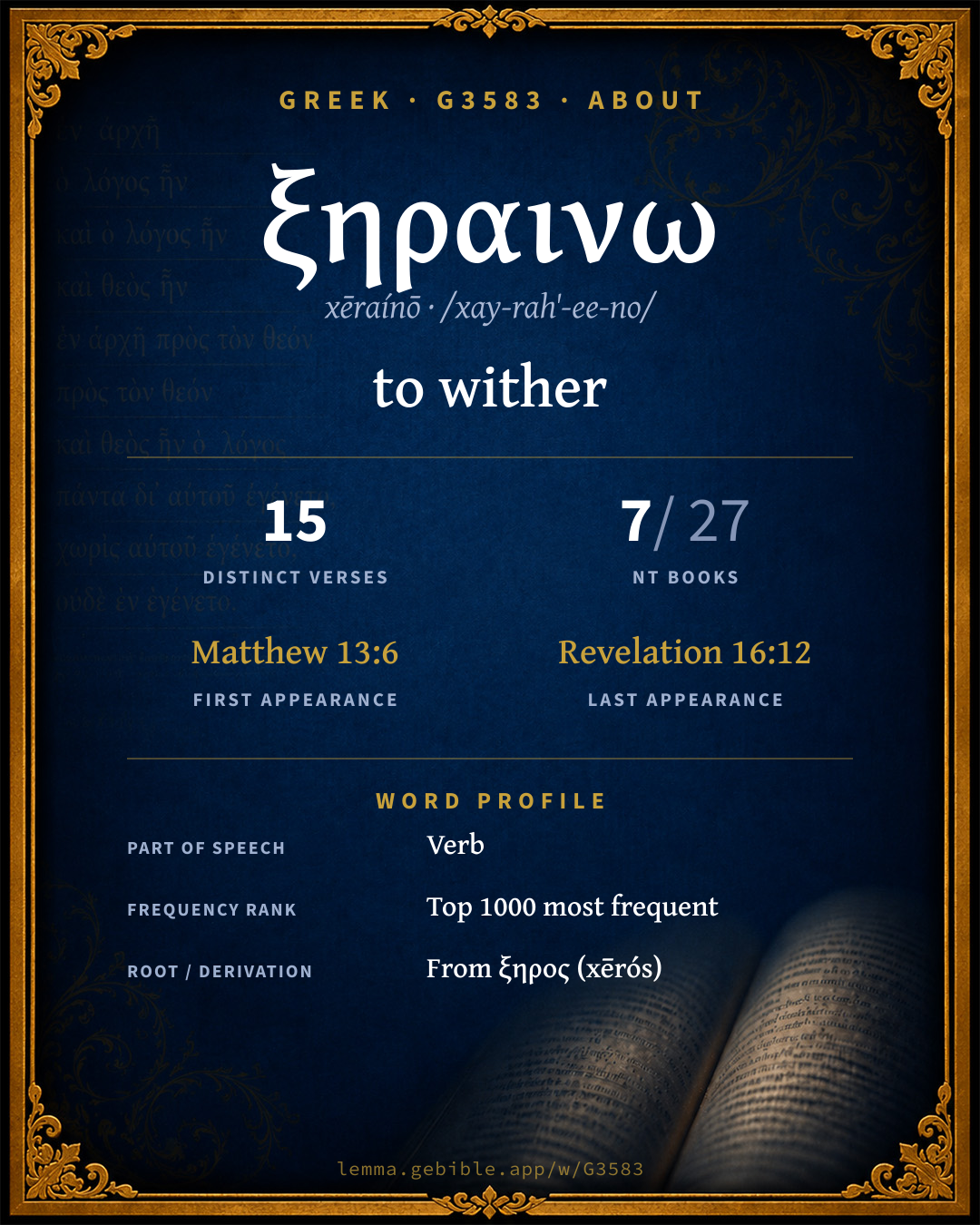
ξηραίνω
to wither
‘to wither’ is one of 3 main senses fuller range ↓
Full lexicon entry — Thayer's Greek Lexicon
From Thayer's Greek Lexicon
Where this word appears
See every Aorist-tense verb in the Greek New Testament →
Grammar key — what these labels mean
Part of speech
- Verb
- An action or state-of-being word.
Tense
- Aorist
- Action viewed as a simple whole, without regard to duration — often past (perfective aspect).
- Perfect
- A completed past action with continuing present results.
- Present
- Ongoing or general action in present time (imperfective aspect).
Voice
- Passive
- The subject receives the action.
- Active
- The subject performs the action.
Mood
- Indicative
- States a fact or asks a factual question (the mood of reality).
- Participle
- A verbal adjective (“writing,” “having written”).
Case
- Accusative
- The case of the direct object and of extent.
Person
- 3rd person
- The one spoken about (“he / she / it / they”).
Gender
- Feminine
- Grammatically feminine.
Number
- Singular
- One.
Grammatical forms
- Verb, Aorist, Passive, Indicative, 3rd person, Singular 10 times (67%)
- Verb, Perfect, Passive, Participle, Accusative, Singular, Feminine 2 times (13%)
- Verb, Aorist, Active, Indicative, 3rd person, Singular 1 time (7%)
- Verb, Present, Passive, Indicative, 3rd person, Singular 1 time (7%)
- Verb, Perfect, Passive, Indicative, 3rd person, Singular 1 time (7%)
Parsed forms decoded from the imported morphology (Robinson–Tischendorf, public domain), counted across 15 parsed occurrences — not distinct verses.
Every verse where G3583 appears — 15 distinct verses across 7 books. Click any verse to open its interlinear word-by-word view. Verse text shown in the World English Bible for context — . Each verse’s Greek form is shown with its reference; the English is not keyword-highlighted, since the data carries no word-level English alignment. Use “Compare translations” on any verse to read it across multiple English versions. This concordance covers the Greek New Testament; Septuagint (Greek Old Testament) occurrences of this word are not indexed here.
Matthew 3 verses
- Matthew 13:6 ἐξηράνθη aor pass ind 3sg When the sun had risen, they were scorched. Because they had no root, they withered away.
- Matthew 21:19 ἐξηράνθη aor pass ind 3sg Seeing a fig tree by the road, he came to it, and found nothing on it but leaves. He said to it, "Let there be no fruit from you forever!" Immediately the fig tree withered away.
- Matthew 21:20 ἐξηράνθη aor pass ind 3sg When the disciples saw it, they marveled, saying, "How did the fig tree immediately wither away?"
Mark 6 verses
- Mark 3:1 ἐξηραμμένην perf pass ptcp acc sg fem He entered again into the synagogue, and there was a man there who had his hand withered.
- Mark 4:6 ἐξηράνθη aor pass ind 3sg When the sun had risen, it was scorched; and because it had no root, it withered away.
- Mark 5:29 ἐξηράνθη aor pass ind 3sg Immediately the flow of her blood was dried up, and she felt in her body that she was healed of her affliction.
- Mark 9:18 ξηραίνεται pres pass ind 3sg and wherever it seizes him, it throws him down, and he foams at the mouth, and grinds his teeth, and wastes away. I asked your disciples to cast it out, and they weren't able."
- Mark 11:20 ἐξηραμμένην perf pass ptcp acc sg fem As they passed by in the morning, they saw the fig tree withered away from the roots.
- Mark 11:21 ἐξήρανται perf pass ind 3sg Peter, remembering, said to him, "Rabbi, look! The fig tree which you cursed has withered away."
Luke 1 verse
John 1 verse
James 1 verse
1 Peter 1 verse
Revelation 2 verses
- Revelation 14:15 ἐξηράνθη aor pass ind 3sg Another angel came out from the temple, crying with a loud voice to him who sat on the cloud, "Send forth your sickle, and reap; for the hour to reap has come; for the harvest of the earth is ripe!"
- Revelation 16:12 ἐξηράνθη aor pass ind 3sg The sixth poured out his bowl on the great river, the Euphrates. Its water was dried up, that the way might be made ready for the kings that come from the sunrise.
About this entry
At a glance — auto-summarized from this page’s data, not written by a person. Every figure links to its source below. This summary describes the numbers; it doesn’t interpret them.
ξηραινω — transliterated xēraínō — is a Greek verb carrying the sense “to wither.” Debuting at Matthew 13:6, it then recurs through the corpus. Spanning 15 verses in 7 books, it ranks among the uncommon words of the Greek New Testament. Its uses concentrate in Mark (40% of all occurrences). Its lexical range runs to 3 senses. See the sense tree, 15-verse concordance, and the renderings breakdown below.
Gloss history
Strong's 1890 vs modern scholarship

About this word
Strong's G3583 catalogs a Greek word from the Greek New Testament.
These counts are not copied from any lexicon or concordance. They are computed here, from the morphology-tagged Greek New Testament. What Lemma adds →
- 15
- distinct verses
- The word appears in 15 distinct verses.
- 7 / 27
- NT books
- The word appears in 7 of 27 New Testament books.
- #768
- by frequency
- Top 1000 most frequent Greek words (rank 768 of 5,347 Greek words by occurrence).
View all 15 occurrences in the concordance →
Most concentrated in
- Mark 6 verses 40%
- Matthew 3 verses 20%
- Revelation 2 verses 13%
By section of the New Testament
By traditional corpus
Conventional, traditional groupings — biblical authorship is debated, so this is a traditional corpus grouping, not an authorship claim. Some books belong to more than one corpus (Luke is in both the Gospels and the Lukan corpus, and so on), so these shares overlap and need not total 100%. Each figure is a share of the word’s 15 distinct verses.
- Gospels 11 verses · 73%
- Johannine 3 verses · 20%
- General (Catholic) Epistles 2 verses · 13%
- Revelation 2 verses · 13%
- Lukan (Luke–Acts) 1 verse · 7%
How translations render this word
Counts come from each version’s own published word-to-Strong’s tagging or interlinear alignment — an approximate guide to how each version renders this word, not a word-level alignment the data otherwise carries. Because each total is that version’s own tagged count, the per-version totals vary from one another and need not match the appearance or distinct-verse counts above. These counts may also differ from a printed concordance because Lemma counts each distinctly tagged rendering and does not collapse phrase taggings into a single head-word total. This is a fixed set of word-tagged versions (KJV, ASV, BSB, ULT) and does not change with the reading translation you choose elsewhere. Each version’s license is shown beside its name below (and on Sources).
- King James Version: Withered away 4×, Was dried up 2×, Withered 2×
- American Standard Version: Withered away 4×, Was dried up 2×, Withered 2×
- Berean Standard Bible: Withered 4×, Withers 3×, They withered 2×
- unfoldingWord Literal Text: Withered 5×, Was dried up 3×
King James Version Public Domain
Renders G3583 across 16 tagged occurrences — most commonly:
Plus 6 renderings that appear only once — usually multi-word phrases or single function words the recovered tagging swept in, not distinct renderings.
American Standard Version Public Domain
Renders G3583 across 17 tagged occurrences — most commonly:
Plus 7 renderings that appear only once — usually multi-word phrases or single function words the recovered tagging swept in, not distinct renderings.
Berean Standard Bible Public Domain
Renders G3583 across 15 tagged occurrences — most commonly:
Plus 6 renderings that appear only once — usually multi-word phrases or single function words the recovered tagging swept in, not distinct renderings.
unfoldingWord Literal Text CC BY-SA 4.0
Renders G3583 across 16 tagged occurrences — most commonly:
Plus 8 renderings that appear only once — usually multi-word phrases or single function words the recovered tagging swept in, not distinct renderings.
Senses in Thayer's
The 3 senses Thayer's distinguishes for this word, in lexicon order (not ranked by frequency or importance). The full entry — with sub-senses — is in the Lexicon Entry tab.
- to make dry, dry up, wither
- to become dry, to be dry, be withered
- to waste away, pine away, i.e. a withered hand
Word origin
Derived from ξηρος (xērós) (G3584) — dry.
From G3584 ; to desiccate ; by implication to shrivel to mature : - dry up pine away be ripe wither (away).
— Strong’s Exhaustive Concordance (1890), public domain.
Forms in the corpus
The 5 distinct written forms G3583 takes in the Greek New Testament, most frequent first — each parse links to that tense’s occurrences in the concordance.
| Form | Parsing | Example | Uses |
|---|---|---|---|
| ἐξηράνθη exēránthē | Verb, Aorist, Passive, Indicative, 3rd person, Singular | Matthew 13:6 | 10 |
| ἐξηραμμένην exēramménēn | Verb, Perfect, Passive, Participle, Accusative, Singular, Feminine | Mark 3:1 | 2 |
| ξηραίνεται xēraínetai | Verb, Present, Passive, Indicative, 3rd person, Singular | Mark 9:18 | 1 |
| ἐξήρανεν exḗranen | Verb, Aorist, Active, Indicative, 3rd person, Singular | James 1:11 | 1 |
| ἐξήρανται exḗrantai | Verb, Perfect, Passive, Indicative, 3rd person, Singular | Mark 11:21 | 1 |
Same root — word family
Other Thayer's entries built from the same root as G3583, grouped by Strong’s listed origin. These share a root / origin per the lexicon — not necessarily a shared meaning. Each links to that word’s own entry.
Derives from
Shares the same root
Compare all same-root words → They share a root, not necessarily a meaning.
Septuagint usage
The same Greek word ξηραινω appears 56 times in the Greek Old Testament (Septuagint), across 52 verses in 16 books.
- 56
- LXX occurrences
- Tagged occurrences of this Greek word in the Septuagint.
- 52
- verses
- Distinct Septuagint verses containing this word.
- 16 / 39
- OT books
- The word appears in 16 of the 39 Old Testament books.
Sample Septuagint occurrences
- Genesis 8:7 ξηραίνω
- Joshua 9:12 ξηραίνω
- 1 Kings 13:4 ξηραίνω
- Job 4:21 ξηραίνω
- Psalms 21:16 ξηραίνω
- Proverbs 17:22 ξηραίνω
- Isaiah 19:5 ξηραίνω
- Jeremiah 12:4 ξηραίνω
- Lamentations 4:8 ξηραίνω
- Ezekiel 17:9 ξηραίνω
- Daniel 7:8 ξηραίνω
- Hosea 9:16 ξηραίνω
Septuagint occurrences (same lexeme)
Every verse where the same Strong’s number (G3583) appears in the Greek Septuagint — showing the first 50 of 52. Verse text shown in the World English Bible for context; the Greek form is the matched word — the English is not keyword-highlighted.
- Genesis 8:7 ξηραίνω and he sent forth a raven. It went back and forth, until the waters were dried up from off the earth.
- Genesis 8:14 ξηραίνω In the second month, on the twenty-seventh day of the month, the earth was dry.
- Joshua 9:12 ξηραίνω This our bread we took hot for our provision out of our houses on the day we came forth to go to you; but now, behold, it is dry, and is become moldy:
- 1 Kings 13:4 ξηραίνω It happened, when the king heard the saying of the man of God, which he cried against the altar in Bethel, that Jeroboam put forth his hand from the altar, saying, Lay hold on him. His hand, which he put forth against him, dried up, so that he could not draw it back again to him.
- 1 Kings 17:7 ξηραίνω It happened after a while, that the brook dried up, because there was no rain in the land.
- Job 4:21 ξηραίνω Isn't their tent-cord plucked up within them? They die, and that without wisdom.'
- Job 8:12 ξηραίνω While it is yet in its greenness, not cut down, It withers before any other reed.
- Job 12:15 ξηραίνω Behold, he withholds the waters, and they dry up; Again, he sends them out, and they overturn the earth.
- Job 14:11 ξηραίνω As the waters fail from the sea, And the river wastes and dries up,
- Job 18:16 ξηραίνω His roots shall be dried up beneath, Above shall his branch be cut off.
- Psalms 21:16 ξηραίνω
- Psalms 73:15 ξηραίνω If I had said, "I will speak thus;" Behold, I would have betrayed the generation of your children.
- Psalms 89:6 ξηραίνω For who in the skies can be compared to Yahweh? Who among the sons of the heavenly beings is like Yahweh,
- Psalms 101:5 ξηραίνω I will silence whoever secretly slanders his neighbor. I won't tolerate one who is haughty and conceited.
- Psalms 101:12 ξηραίνω
- Psalms 105:9 ξηραίνω The covenant which he made with Abraham, His oath to Isaac,
- Psalms 128:6 ξηραίνω Yes, may you see your children's children. Peace be upon Israel.
- Proverbs 17:22 ξηραίνω A cheerful heart makes good medicine, But a crushed spirit dries up the bones.
- Isaiah 19:5 ξηραίνω The waters shall fail from the sea, and the river shall be wasted and become dry.
- Isaiah 19:6 ξηραίνω The rivers shall become foul; the streams of Egypt shall be diminished and dried up; the reeds and flags shall wither away.
- Isaiah 19:7 ξηραίνω The meadows by the Nile, by the brink of the Nile, and all the sown fields of the Nile, shall become dry, be driven away, and be no more.
- Isaiah 27:11 ξηραίνω When the boughs of it are withered, they shall be broken off; the women shall come, and set them on fire; for it is a people of no understanding: therefore he who made them will not have compassion on them, and he who formed them will show them no favor.
- Isaiah 37:27 ξηραίνω Therefore their inhabitants were of small power, they were dismayed and confounded; they were as the grass of the field, and as the green herb, as the grass on the housetops, and as a field [of grain] before it is grown up.
- Isaiah 40:7 ξηραίνω The grass withers, the flower fades, because the breath of Yahweh blows on it; surely the people is grass.
- Isaiah 40:24 ξηραίνω Yes, they have not been planted; yes, they have not been sown; yes, their stock has not taken root in the earth: moreover he blows on them, and they wither, and the whirlwind takes them away as stubble.
- Isaiah 41:17 ξηραίνω The poor and needy seek water, and there is none, and their tongue fails for thirst; I, Yahweh, will answer them, I, the God of Israel, will not forsake them.
- Isaiah 42:14 ξηραίνω I have long time held my peace; I have been still, and refrained myself: [now] will I cry out like a travailing woman; I will gasp and pant together.
- Isaiah 42:15 ξηραίνω I will lay waste mountains and hills, and dry up all their herbs; and I will make the rivers islands, and will dry up the pools.
- Isaiah 44:11 ξηραίνω Behold, all his fellows shall be disappointed; and the workmen, they are of men: let them all be gathered together, let them stand up; they shall fear, they shall be put to shame together.
- Isaiah 44:27 ξηραίνω who says to the deep, Be dry, and I will dry up your rivers;
- Isaiah 50:2 ξηραίνω Why, when I came, was there no man? when I called, was there none to answer? Is my hand shortened at all, that it can't redeem? or have I no power to deliver? Behold, at my rebuke I dry up the sea, I make the rivers a wilderness: their fish stink, because there is no water, and die for thirst.
- Isaiah 51:12 ξηραίνω I, even I, am he who comforts you: who are you, that you are afraid of man who shall die, and of the son of man who shall be made as grass;
- Jeremiah 12:4 ξηραίνω How long shall the land mourn, and the herbs of the whole country wither? for the wickedness of those who dwell therein, the animals are consumed, and the birds; because they said, He shall not see our latter end.
- Jeremiah 23:10 ξηραίνω For the land is full of adulterers; for because of swearing the land mourns; the pastures of the wilderness are dried up. Their course is evil, and their might is not right;
- Jeremiah 28:36 ξηραίνω
- Lamentations 4:8 ξηραίνω Their visage is blacker than a coal; they are not known in the streets: Their skin cleaves to their bones; it is withered, it is become like a stick.
- Ezekiel 17:9 ξηραίνω Say you, Thus says the Lord Yahweh: Shall it prosper? shall he not pull up the roots of it, and cut off the fruit of it, that it may wither; that all its fresh springing leaves may wither? and not by a strong arm or much people can it be raised from the roots of it.
- Ezekiel 17:10 ξηραίνω Yes, behold, being planted, shall it prosper? shall it not utterly wither, when the east wind touches it? it shall wither in the beds where it grew.
- Ezekiel 17:24 ξηραίνω All the trees of the field shall know that I, Yahweh, have brought down the high tree, have exalted the low tree, have dried up the green tree, and have made the dry tree to flourish; I, Yahweh, have spoken and have done it.
- Ezekiel 19:12 ξηραίνω But it was plucked up in fury, it was cast down to the ground, and the east wind dried up its fruit: its strong rods were broken off and withered; the fire consumed them.
- Daniel 7:8 ξηραίνω I considered the horns, and, behold, there came up among them another horn, a little one, before which three of the first horns were plucked up by the roots: and, behold, in this horn were eyes like the eyes of a man, and a mouth speaking great things.
- Hosea 9:16 ξηραίνω Ephraim is struck. Their root has dried up. They will bear no fruit. Even though they bring forth, yet I will kill the beloved ones of their womb."
- Joel 1:10 ξηραίνω The field is laid waste. The land mourns, for the grain is destroyed, The new wine has dried up, And the oil languishes.
- Joel 1:11 ξηραίνω Be confounded, you farmers! Wail, you vineyard keepers; For the wheat and for the barley; For the harvest of the field has perished.
- Joel 1:12 ξηραίνω The vine has dried up, and the fig tree withered; the pomegranate tree, the palm tree also, and the apple tree, Even all of the trees of the field are withered; For joy has withered away from the sons of men.
- Joel 1:17 ξηραίνω The seeds rot under their clods. The granaries are laid desolate. The barns are broken down, for the grain has withered.
- Joel 1:20 ξηραίνω Yes, the animals of the field pant to you, For the water brooks have dried up, And the fire has devoured the pastures of the wilderness.
- Amos 1:2 ξηραίνω He said: "Yahweh will roar from Zion, And utter his voice from Jerusalem; And the pastures of the shepherds will mourn, And the top of Carmel will wither."
- Amos 4:7 ξηραίνω "I also have withheld the rain from you, When there were yet three months to the harvest; And I caused it to rain on one city, And caused it not to rain on another city. One place was rained on, And the piece where it didn't rain withered.
- Nahum 1:4 ξηραίνω He rebukes the sea, and makes it dry, and dries up all the rivers. Bashan languishes, and Carmel; and the flower of Lebanon languishes.
These are occurrences of the same Greek lexeme (G3583) in the Septuagint — not a translation of any one Hebrew word. The store carries no word-level Hebrew↔Greek alignment, so no Hebrew original is asserted here. Counts come from the recovered LXX Strong's tagging — high-frequency vocabulary is well covered, while rare or late forms may be untagged — so they reflect tagged occurrences and may slightly undercount.