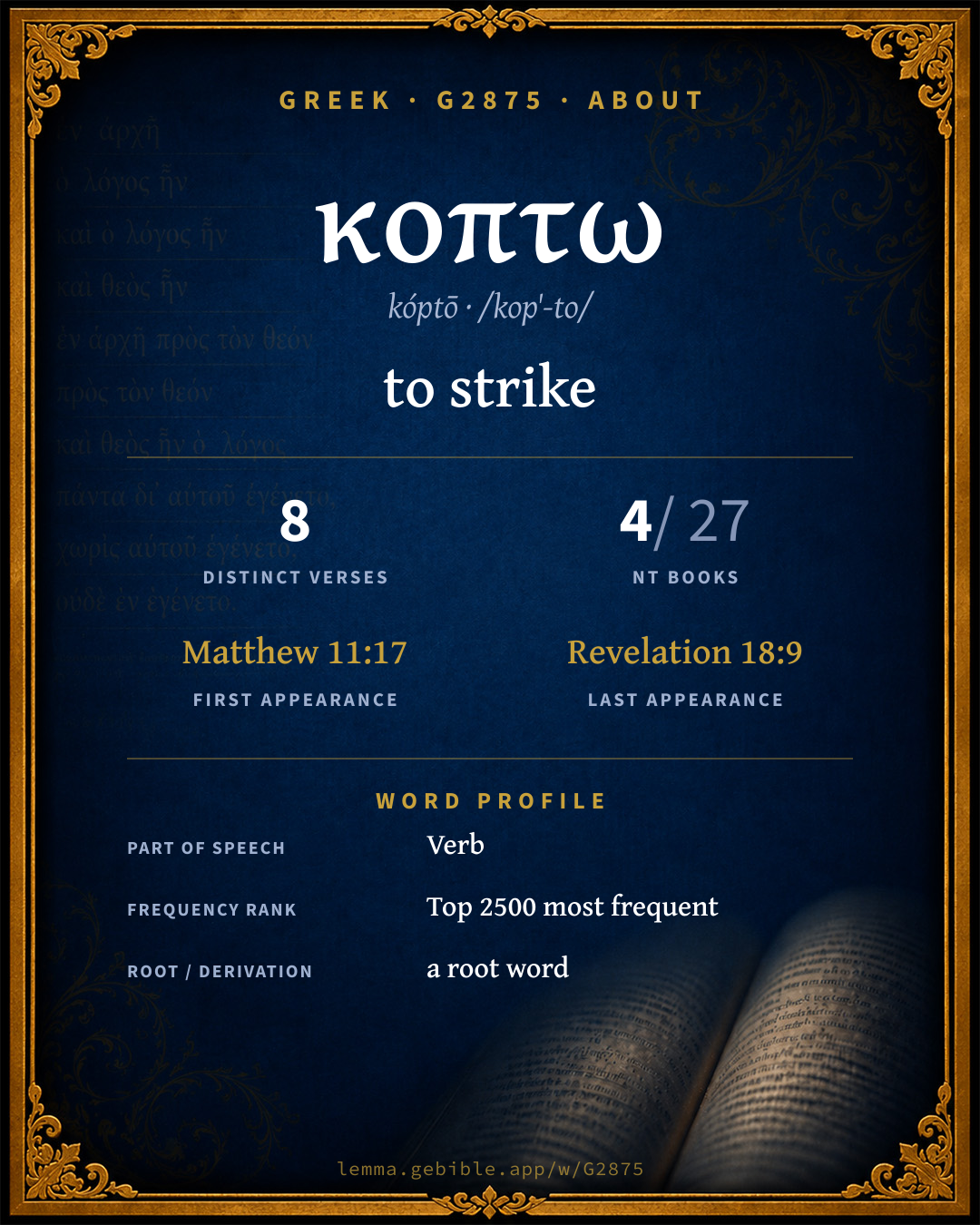
κόπτω
to strike
‘to strike’ is one of 3 main senses fuller range ↓
Full lexicon entry — Thayer's Greek Lexicon
From Thayer's Greek Lexicon
Where this word appears
See every Future-tense verb in the Greek New Testament →
Grammar key — what these labels mean
Part of speech
- Verb
- An action or state-of-being word.
Tense
- Future
- Action expected in future time.
- Imperfect
- Continuous or repeated action in past time (“was writing”).
- Aorist
- Action viewed as a simple whole, without regard to duration — often past (perfective aspect).
Voice
- Middle deponent
- Middle in form but active in meaning.
- Middle
- The subject acts on or for itself, or with special interest in the action.
- Active
- The subject performs the action.
Mood
- Indicative
- States a fact or asks a factual question (the mood of reality).
- Participle
- A verbal adjective (“writing,” “having written”).
Case
- Nominative
- The case of the subject (and the predicate nominative).
Person
- 3rd person
- The one spoken about (“he / she / it / they”).
- 2nd person
- The one addressed (“you”).
Gender
- Masculine
- Grammatically masculine.
Number
- Plural
- More than one.
Grammatical forms
- Verb, Future, Middle deponent, Indicative, 3rd person, Plural 3 times (38%)
- Verb, Imperfect, Middle, Indicative, 3rd person, Plural 2 times (25%)
- Verb, Aorist, Active, Participle, Nominative, Plural, Masculine 1 time (13%)
- Verb, Aorist, Middle, Indicative, 2nd person, Plural 1 time (13%)
- Verb, Imperfect, Active, Indicative, 3rd person, Plural 1 time (13%)
Parsed forms decoded from the imported morphology (Robinson–Tischendorf, public domain), counted across 8 parsed occurrences — not distinct verses.
Every verse where G2875 appears — 8 distinct verses across 4 books. Click any verse to open its interlinear word-by-word view. Verse text shown in the World English Bible for context — . Each verse’s Greek form is shown with its reference; the English is not keyword-highlighted, since the data carries no word-level English alignment. Use “Compare translations” on any verse to read it across multiple English versions. This concordance covers the Greek New Testament; Septuagint (Greek Old Testament) occurrences of this word are not indexed here.
Matthew 3 verses
- Matthew 11:17 ἐκόψασθε aor mid ind 2pl and say, 'We played the flute for you, and you didn't dance. We mourned for you, and you didn't lament.'
- Matthew 21:8 ἔκοπτον impf act ind 3pl A very great multitude spread their clothes on the road. Others cut branches from the trees, and spread them on the road.
- Matthew 24:30 κόψονται fut mid.dep ind 3pl and then the sign of the Son of Man will appear in the sky. Then all the tribes of the earth will mourn, and they will see the Son of Man coming on the clouds of the sky with power and great glory.
Mark 1 verse
Luke 2 verses
Revelation 2 verses
- Revelation 1:7 κόψονται fut mid.dep ind 3pl Behold, he is coming with the clouds, and every eye will see him, including those who pierced him. All the tribes of the earth will mourn over him. Even so, Amen.
- Revelation 18:9 κόψονται fut mid.dep ind 3pl The kings of the earth, who committed sexual immorality and lived wantonly with her, will weep and wail over her, when they look at the smoke of her burning,
About this entry
At a glance — auto-summarized from this page’s data, not written by a person. Every figure links to its source below. This summary describes the numbers; it doesn’t interpret them.
At its core, κοπτω (kóptō) means “to strike.” First canonically at Matthew 11:17, it enters the text early. It appears 8 verses across 4 books of the Greek New Testament, among its uncommon vocabulary. The word gravitates to Matthew (38%), then Luke and Revelation. Catalogued under 3 senses, its meaning is not single-sense. Dig into 8-verse concordance and the renderings breakdown below.
Gloss history
Strong's 1890 vs modern scholarship

About this word
Strong's G2875 catalogs a Greek word from the Greek New Testament.
These counts are not copied from any lexicon or concordance. They are computed here, from the morphology-tagged Greek New Testament. What Lemma adds →
- 8
- distinct verses
- The word appears in 8 distinct verses.
- 4 / 27
- NT books
- The word appears in 4 of 27 New Testament books.
- #1,240
- by frequency
- Top 2500 most frequent Greek words (rank 1,240 of 5,347 Greek words by occurrence).
View all 8 occurrences in the concordance →
Most concentrated in
- Matthew 3 verses 38%
- Luke 2 verses 25%
- Revelation 2 verses 25%
By section of the New Testament
By traditional corpus
Conventional, traditional groupings — biblical authorship is debated, so this is a traditional corpus grouping, not an authorship claim. Some books belong to more than one corpus (Luke is in both the Gospels and the Lukan corpus, and so on), so these shares overlap and need not total 100%. Each figure is a share of the word’s 8 distinct verses.
- Gospels 6 verses · 75%
- Lukan (Luke–Acts) 2 verses · 25%
- Johannine 2 verses · 25%
- Revelation 2 verses · 25%
How translations render this word
Counts come from each version’s own published word-to-Strong’s tagging or interlinear alignment — an approximate guide to how each version renders this word, not a word-level alignment the data otherwise carries. Because each total is that version’s own tagged count, the per-version totals vary from one another and need not match the appearance or distinct-verse counts above. These counts may also differ from a printed concordance because Lemma counts each distinctly tagged rendering and does not collapse phrase taggings into a single head-word total. This is a fixed set of word-tagged versions (KJV, ASV, BSB, ULT) and does not change with the reading translation you choose elsewhere. Each version’s license is shown beside its name below (and on Sources).
- King James Version: Bewailed 2×, Cut down 2×
- American Standard Version: Mourn 2×
- Berean Standard Bible: Will mourn 2×
- unfoldingWord Literal Text: Will mourn 2×
King James Version Public Domain
Renders G2875 across 10 tagged occurrences — most commonly:
Plus 6 renderings that appear only once — usually multi-word phrases or single function words the recovered tagging swept in, not distinct renderings.
American Standard Version Public Domain
Renders G2875 across 9 tagged occurrences — most commonly:
Plus 7 renderings that appear only once — usually multi-word phrases or single function words the recovered tagging swept in, not distinct renderings.
Berean Standard Bible Public Domain
Renders G2875 across 8 tagged occurrences — most commonly:
Plus 6 renderings that appear only once — usually multi-word phrases or single function words the recovered tagging swept in, not distinct renderings.
unfoldingWord Literal Text CC BY-SA 4.0
Renders G2875 across 10 tagged occurrences — most commonly:
Plus 8 renderings that appear only once — usually multi-word phrases or single function words the recovered tagging swept in, not distinct renderings.
Senses in Thayer's
The 3 senses Thayer's distinguishes for this word, in lexicon order (not ranked by frequency or importance). The full entry — with sub-senses — is in the Lexicon Entry tab.
- to cut, strike, smite
- to cut from, cut off
- to beat one's breast for grief
Word origin
Origin: a root word
A primary verb; to chop; specifically to beat the breast in grief : - cut down lament mourn (be-) wail. Compare the base of G5114 .
— Strong’s Exhaustive Concordance (1890), public domain.
Forms in the corpus
The 5 distinct written forms G2875 takes in the Greek New Testament, most frequent first — each parse links to that tense’s occurrences in the concordance.
| Form | Parsing | Example | Uses |
|---|---|---|---|
| κόψονται kópsontai | Verb, Future, Middle deponent, Indicative, 3rd person, Plural | Matthew 24:30 | 3 |
| ἐκόπτοντο ekóptonto | Verb, Imperfect, Middle, Indicative, 3rd person, Plural | Luke 8:52 | 2 |
| κόψαντες kópsantes | Verb, Aorist, Active, Participle, Nominative, Plural, Masculine | Mark 11:8 | 1 |
| ἐκόψασθε ekópsasthe | Verb, Aorist, Middle, Indicative, 2nd person, Plural | Matthew 11:17 | 1 |
| ἔκοπτον ékopton | Verb, Imperfect, Active, Indicative, 3rd person, Plural | Matthew 21:8 | 1 |
Same root — word family
Other Thayer's entries built from the same root as G2875, grouped by Strong’s listed origin. These share a root / origin per the lexicon — not necessarily a shared meaning. Each links to that word’s own entry.
Derived from this word
- κοπετος kopetós G2870 lamentation
- κοπη kopḗ G2871 cutting
- κοπος kópos G2873 beating
- κοπρια kopría G2874 dung
- κωφος kōphós G2974 dull
- τομωτερος tomṓteros G5114 sharper
Compare all same-root words → Showing 4 of 7 — not the complete family. They share a root, not necessarily a meaning.
Septuagint usage
The same Greek word κοπτω appears 78 times in the Greek Old Testament (Septuagint), across 77 verses in 21 books.
- 78
- LXX occurrences
- Tagged occurrences of this Greek word in the Septuagint.
- 77
- verses
- Distinct Septuagint verses containing this word.
- 21 / 39
- OT books
- The word appears in 21 of the 39 Old Testament books.
Sample Septuagint occurrences
- Genesis 23:2 κόπτω
- Exodus 27:20 κόπτω
- Leviticus 24:2 κόπτω
- Numbers 13:23 κόπτω
- Deuteronomy 19:5 κόπτω
- Joshua 10:20 κόπτω
- Judges 1:4 κόπτω
- 1 Samuel 25:1 κόπτω
- 2 Samuel 1:12 κόπτω
- 1 Kings 5:20 κόπτω
- 2 Kings 19:23 κόπτω
- 2 Chronicles 2:7 κόπτω
Septuagint occurrences (same lexeme)
Every verse where the same Strong’s number (G2875) appears in the Greek Septuagint — showing the first 50 of 77. Verse text shown in the World English Bible for context; the Greek form is the matched word — the English is not keyword-highlighted.
- Genesis 23:2 κόπτω Sarah died in Kiriath Arba (the same is Hebron), in the land of Canaan. Abraham came to mourn for Sarah, and to weep for her.
- Genesis 50:10 κόπτω They came to the threshing floor of Atad, which is beyond the Jordan, and there they lamented with a very great and sore lamentation. He mourned for his father seven days.
- Exodus 27:20 κόπτω "You shall command the children of Israel, that they bring to you pure olive oil beaten for the light, to cause a lamp to burn continually.
- Exodus 29:40 κόπτω and with the one lamb a tenth part of an ephah of fine flour mixed with the fourth part of a hin of beaten oil, and the fourth part of a hin of wine for a drink-offering.
- Leviticus 24:2 κόπτω "Command the children of Israel, that they bring to you pure olive oil beaten for the light, to cause a lamp to burn continually.
- Numbers 13:23 κόπτω They came to the valley of Eshcol, and cut down from there a branch with one cluster of grapes, and they bore it on a staff between two; [they brought] also of the pomegranates, and of the figs.
- Numbers 13:24 κόπτω That place was called the valley of Eshcol, because of the cluster which the children of Israel cut down from there.
- Deuteronomy 19:5 κόπτω as when a man goes into the forest with his neighbor to hew wood, and his hand fetches a stroke with the axe to cut down the tree, and the head slips from the handle, and lights on his neighbor, so that he dies; he shall flee to one of these cities and live:
- Deuteronomy 25:18 κόπτω how he met you by the way, and struck the hindmost of you, all who were feeble behind you, when you were faint and weary; and he didn't fear God.
- Joshua 10:20 κόπτω It happened, when Joshua and the children of Israel had made an end of killing them with a very great slaughter, until they were consumed, and the remnant which remained of them had entered into the fortified cities,
- Joshua 11:8 κόπτω Yahweh delivered them into the hand of Israel, and they struck them, and chased them to great Sidon, and to Misrephoth Maim, and to the valley of Mizpeh eastward; and they struck them, until they left them none remaining.
- Judges 1:4 κόπτω Judah went up; and Yahweh delivered the Canaanites and the Perizzites into their hand: and they struck of them in Bezek ten thousand men.
- Judges 1:5 κόπτω They found Adoni-bezek in Bezek; and they fought against him, and they struck the Canaanites and the Perizzites.
- Judges 1:17 κόπτω Judah went with Simeon his brother, and they struck the Canaanites who inhabited Zephath, and utterly destroyed it. The name of the city was called Hormah.
- Judges 9:48 κόπτω Abimelech got him up to Mount Zalmon, he and all the people who were with him; and Abimelech took an axe in his hand, and cut down a bough from the trees, and took it up, and laid it on his shoulder: and he said to the people who were with him, What you have seen me do, make haste, and do as I have done.
- Judges 9:49 κόπτω All the people likewise cut down every man his bough, and followed Abimelech, and put them to the stronghold, and set the stronghold on fire on them; so that all the men of the tower of Shechem died also, about a thousand men and women.
- 1 Samuel 25:1 κόπτω Samuel died; and all Israel gathered themselves together, and lamented him, and buried him in his house at Ramah. David arose, and went down to the wilderness of Paran.
- 1 Samuel 28:3 κόπτω Now Samuel was dead, and all Israel had lamented him, and buried him in Ramah, even in his own city. Saul had put away those who had familiar spirits, and the wizards, out of the land.
- 2 Samuel 1:12 κόπτω and they mourned, and wept, and fasted until even, for Saul, and for Jonathan his son, and for the people of Yahweh, and for the house of Israel; because they were fallen by the sword.
- 2 Samuel 3:31 κόπτω David said to Joab, and to all the people who were with him, Tear your clothes, and gird you with sackcloth, and mourn before Abner. King David followed the bier.
- 2 Samuel 5:20 κόπτω David came to Baal Perazim, and David struck them there; and he said, Yahweh has broken my enemies before me, like the breach of waters. Therefore he called the name of that place Baal Perazim.
- 2 Samuel 5:24 κόπτω It shall be, when you hear the sound of marching in the tops of the mulberry trees, that then you shall bestir yourself; for then is Yahweh gone out before you to strike the host of the Philistines.
- 2 Samuel 11:26 κόπτω When the wife of Uriah heard that Uriah her husband was dead, she made lamentation for her husband.
- 1 Kings 5:20 κόπτω
- 1 Kings 5:25 κόπτω
- 1 Kings 11:15 κόπτω For it happened, when David was in Edom, and Joab the captain of the host was gone up to bury the slain, and had struck every male in Edom
- 1 Kings 12:24 κόπτω Thus says Yahweh, You shall not go up, nor fight against your brothers the children of Israel: return every man to his house; for this thing is of me. So they listened to the word of Yahweh, and returned and went their way, according to the word of Yahweh.
- 1 Kings 13:30 κόπτω He laid his body in his own grave; and they mourned over him, [saying], Alas, my brother!
- 1 Kings 13:31 κόπτω It happened, after he had buried him, that he spoke to his sons, saying, When I am dead, then bury me in the tomb in which the man of God is buried; lay my bones beside his bones.
- 2 Kings 19:23 κόπτω By your messengers you have defied the Lord, and have said, With the multitude of my chariots am I come up to the height of the mountains, to the innermost parts of Lebanon; and I will cut down the tall cedars of it, and the choice fir trees of it; and I will enter into his farthest lodging-place, the forest of his fruitful field.
- 2 Chronicles 2:7 κόπτω Now therefore send me a man skillful to work in gold, and in silver, and in brass, and in iron, and in purple, and crimson, and blue, and who knows how to engrave [all manner of] engravings, [to be] with the skillful men who are with me in Judah and in Jerusalem, whom David my father did provide.
- 2 Chronicles 2:9 κόπτω even to prepare me timber in abundance; for the house which I am about to build shall be great and wonderful.
- 2 Chronicles 2:15 κόπτω Now therefore the wheat and the barley, the oil and the wine, which my lord has spoken of, let him send to his servants:
- 2 Chronicles 34:4 κόπτω They broke down the altars of the Baals in his presence; and the sun-images that were on high above them he hewed down; and the Asherim, and the engraved images, and the molten images, he broke in pieces, and made dust of them, and strewed it on the graves [of those] who had sacrificed to them.
- 2 Chronicles 34:7 κόπτω He broke down the altars, and beat the Asherim and the engraved images into powder, and hewed down all the sun-images throughout all the land of Israel, and returned to Jerusalem.
- Esther 5:12 κόπτω Haman said moreover, Yes, Esther the queen did let no man come in with the king to the banquet that she had prepared but myself; and tomorrow also am I invited by her together with the king.
- Ecclesiastes 3:4 κόπτω A time to weep, And a time to laugh; A time to mourn, And a time to dance;
- Ecclesiastes 12:5 κόπτω Yes, they shall be afraid of heights, And terrors will be in the way; And the almond tree shall blossom, And the grasshopper shall be a burden, And desire shall fail; Because man goes to his everlasting home, And the mourners go about the streets:
- Isaiah 10:15 κόπτω Shall the axe boast itself against him who hews therewith? Shall the saw magnify itself against him who wields it? as if a rod should wield those who lift it up, [or] as if a staff should lift up [him who is] not wood.
- Isaiah 14:8 κόπτω Yes, the fir trees rejoice at you, [and] the cedars of Lebanon, [saying], Since you are laid low, no lumberjack is come up against us.
- Isaiah 15:3 κόπτω In their streets they gird themselves with sackcloth; on their housetops, and in their broad places, everyone wails, weeping abundantly.
- Isaiah 32:12 κόπτω They shall strike on the breasts for the pleasant fields, for the fruitful vine.
- Isaiah 37:24 κόπτω By your servants have you defied the Lord, and have said, With the multitude of my chariots am I come up to the height of the mountains, to the innermost parts of Lebanon; and I will cut down the tall cedars of it, and the choice fir trees of it; and I will enter into its farthest height, the forest of its fruitful field;
- Isaiah 44:14 κόπτω He cuts down cedars for himself, and takes the cypress and the oak, and strengthens for himself one among the trees of the forest: he plants a fir tree, and the rain nourishes it.
- Jeremiah 4:8 κόπτω For this gird you with sackcloth, lament and wail; for the fierce anger of Yahweh hasn't turned back from us.
- Jeremiah 8:2 κόπτω and they shall spread them before the sun, and the moon, and all the host of the sky, which they have loved, and which they have served, and after which they have walked, and which they have sought, and which they have worshiped: they shall not be gathered, nor be buried, they shall be for dung on the surface of the earth.
- Jeremiah 16:4 κόπτω They shall die grievous deaths: they shall not be lamented, neither shall they be buried; they shall be as dung on the surface of the ground; and they shall be consumed by the sword, and by famine; and their dead bodies shall be food for the birds of the sky, and for the animals of the earth.
- Jeremiah 16:5 κόπτω For thus says Yahweh, Don't enter into the house of mourning, neither go to lament, neither bemoan them; for I have taken away my peace from this people, says Yahweh, even loving kindness and tender mercies.
- Jeremiah 16:6 κόπτω Both great and small shall die in this land; they shall not be buried, neither shall men lament for them, nor cut themselves, nor make themselves bald for them;
- Jeremiah 22:18 κόπτω Therefore thus says Yahweh concerning Jehoiakim the son of Josiah, king of Judah: they shall not lament for him, [saying], Ah my brother! or, Ah sister! They shall not lament for him, [saying] Ah lord! or, Ah his glory!
These are occurrences of the same Greek lexeme (G2875) in the Septuagint — not a translation of any one Hebrew word. The store carries no word-level Hebrew↔Greek alignment, so no Hebrew original is asserted here. Counts come from the recovered LXX Strong's tagging — high-frequency vocabulary is well covered, while rare or late forms may be untagged — so they reflect tagged occurrences and may slightly undercount.