Jeremiah 4:8

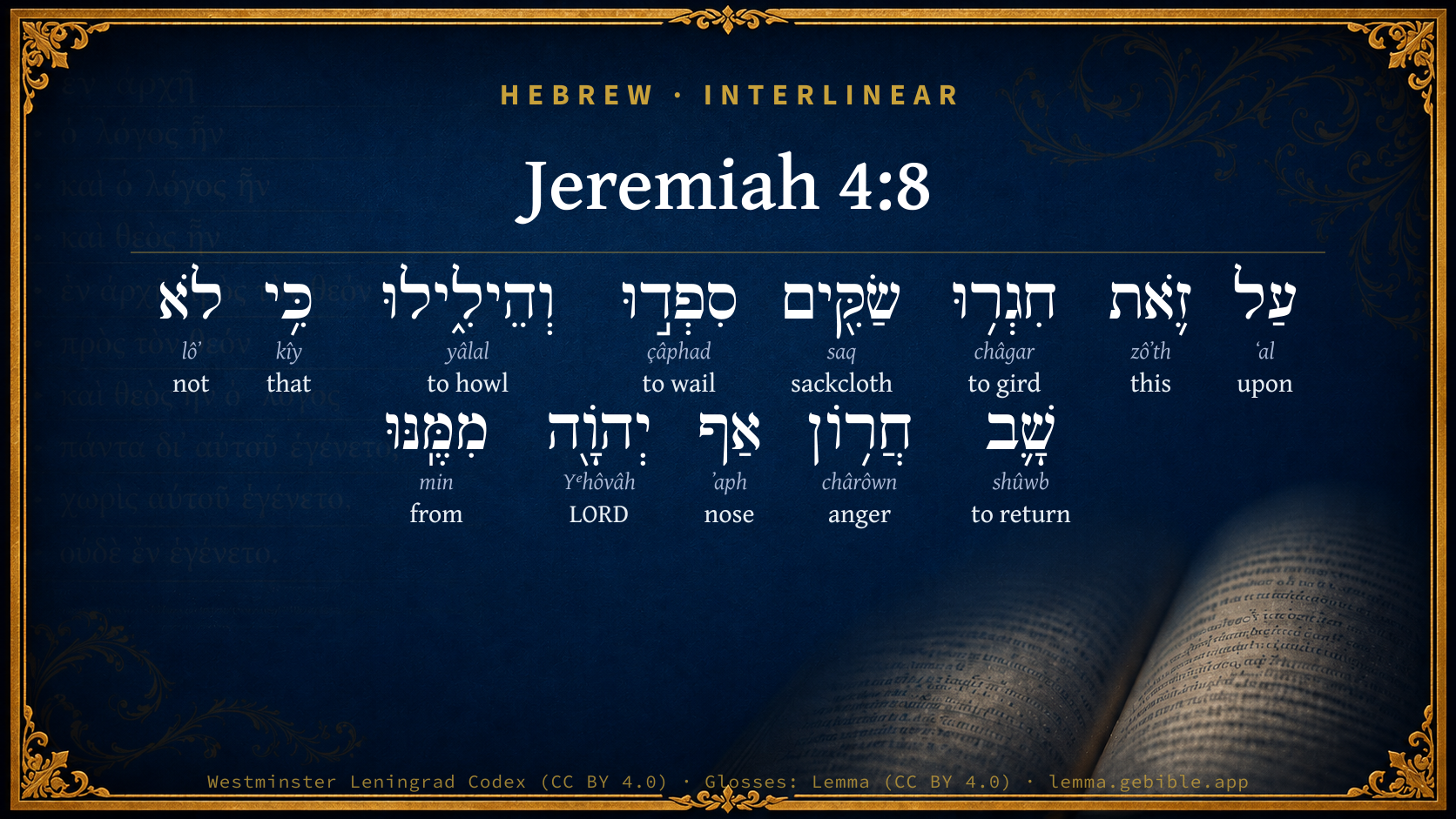
Hebrew (Westminster Leningrad Codex) Jeremiah 4:8 appears in the Hebrew Old Testament. The text above is from the Westminster Leningrad Codex. Each word links to its Strong’s number, a concise gloss, and parsing drawn from the Open Scriptures Hebrew Bible morphology. Click any word for its full Brown-Driver-Briggs (BDB) entry.
Download image
Cite this verse

Jeremiah 4:8 (World English Bible). Public Domain. Lemma interlinear Bible study tool, https://lemma.gebible.app/v/jeremiah/4/8.

Show BibTeX & RIS
BibTeX
RIS
English Translation
For this gird you with sackcloth, lament and wail; for the fierce anger of Yahweh hasn't turned back from us.
World English Bible · Public Domain
Download a study sheet

One document with this verse’s original text, its word-by-word gloss line, the meaning frame, cross-references with their text, attributed commentary, and full source and license credits — printable, and it pastes into notes with its structure intact.

This verse Autodidact and up

Study sheet (.html) Plain text (.txt)

A passage Seminary Student

Up to 50 verses in one chapter. A passage sheet keeps up to 6 commentary sources and 12 cross-references per verse, in the order this page ranks them, and says so on the sheet whenever that leaves anything out. Ask for a single verse and you get the Autodidact verse sheet above.

Everything on this page stays free to read, with no account — the sheet is a download of what is already on screen, not access to it.

Want to remove ads? Support Godless Engineer
Compare translations 3

The same verse in 3 English versions, stacked beneath the original-language interlinear above. Click any original word for its lexicon entry.

Each is an independent rendering of the whole verse — the interlinear is not word-aligned to these translations.

Highlighted words mark where these versions differ — a whole-verse word diff, not a word-by-word alignment.

  • World English Bible Public Domain
    For this gird you with sackcloth, lament and wail; for the fierce anger of Yahweh hasn't turned back from us.
  • King James Version Public Domain
    For this gird you with sackcloth, lament and howl: for the fierce anger of the LORD is not turned back from us.
  • unfoldingWord Literal Text CC BY-SA 4.0
    Because of this, gird yourselves sackcloth, lament and wail! For the force of the nose of Yahweh has not turned away from us.

unfoldingWord Literal Text — © unfoldingWord, licensed CC BY-SA 4.0. Word-aligned USFM3 via Door43 (git.door43.org/unfoldingWord/en_ult).

Versions to compare (up to 4)

3 of 4 selected

Show all 18 translations

Every available English version of this verse, each an independent rendering of the whole verse.

  • World English Bible Public Domain
    For this gird you with sackcloth, lament and wail; for the fierce anger of Yahweh hasn't turned back from us.
  • Berean Standard Bible Public Domain
    So put on sackcloth, mourn and wail, for the fierce anger of the LORD has not turned away from us.”
  • Majority Standard Bible Public Domain
    So put on sackcloth, mourn and wail, for the fierce anger of the LORD has not turned away from us.”
  • King James Version Public Domain
    For this gird you with sackcloth, lament and howl: for the fierce anger of the LORD is not turned back from us.
  • American Standard Version (1901) Public Domain
    For this gird you with sackcloth, lament and wail; for the fierce anger of Jehovah is not turned back from us.
  • Revised Version (1885) Public Domain
    For this gird you with sackcloth, lament and howl: for the fierce anger of the LORD is not turned back from us.
  • Geneva Bible (1599) Public Domain
    Wherefore girde you with sackecloth: lament, and howle, for the fierce wrath of the Lord is not turned backe from vs.
  • Douay-Rheims (1899) Public Domain
    For this gird yourselves with haircloth, lament and howl: for the fierce anger of the Lord is not turned away from us.
  • Young's Literal Translation Public Domain
    For this, gird on sackcloth, lament and howl, For the fierce anger of Jehovah hath not turned back from us.
  • Literal Standard Version CC BY-SA 4.0
    For this, gird on sackcloth, lament and howl, || For the fierce anger of YHWH has not turned back from us.
  • Unlocked Literal Bible CC BY-SA 4.0
    Because of this, wrap yourself in sackcloth, lament and wail. For the force of Yahweh's anger has not turned away from us.
  • unfoldingWord Literal Text CC BY-SA 4.0
    Because of this, gird yourselves sackcloth, lament and wail! For the force of the nose of Yahweh has not turned away from us.
  • Darby Bible Public Domain
    For this, gird you with sackcloth, lament and howl! for the fierce anger of Jehovah is not turned away from us.
  • World Messianic Bible Public Domain
    For this, clothe yourself with sackcloth, lament and wail; for the fierce anger of the LORD hasn’t turned back from us.
  • Webster's Bible Public Domain
    For this gird you with sackcloth, lament and howl for the fierce anger of the LORD is not turned back from us.
  • Free Bible Version CC BY-SA 4.0
    Wear clothes made of sackcloth, weep and wail, crying out, “The Lord's furious anger against us hasn't stopped.”
  • Bible in Basic English Public Domain
    For this put on haircloth, with weeping and loud crying: for the burning wrath of the Lord is not turned back from us.
  • JPS Tanakh (1917) Public Domain
    For this gird you with sackcloth, lament and wail; for the fierce anger of the LORD is not turned back from us.

Literal Standard Version (2020), Covenant Press — licensed CC BY-SA 4.0. Text via the HelloAO Bible API (eBible.org). Unlocked Literal Bible (unfoldingWord) — licensed CC BY-SA 4.0. Text via the HelloAO Bible API (eBible.org). unfoldingWord Literal Text — © unfoldingWord, licensed CC BY-SA 4.0. Word-aligned USFM3 via Door43 (git.door43.org/unfoldingWord/en_ult). Free Bible Version, Dr. Jonathan Gallagher — licensed CC BY-SA 4.0. Text via the HelloAO Bible API (eBible.org).

Word by word

More ways to search: Search by grammar → Find every occurrence → Compare this word →

Practice this passage: Drill this verse → Learn its vocabulary →

וְהֵילִ֑ילוּ
yâlal
H3213
“and · howl”
Conjunction + Verb, Hiphil, Imperative, 2nd Person, Masculine, Plural
Part of Speech
Conjunction + Verb
Stem
Hiphil
Form
Imperative
Person
2nd Person
Gender
Masculine
Number
Plural
Full BDB Definition

Origin: a primitive root

TWOT: 868

(Hiphil) to howl, wail, make a howling
  1. עַל ʻal H5921 “upon” Preposition
  2. זֹ֛את zôʼth H2063 “this” Pronoun, Demonstrative, Feminine, Singular
  3. חִגְר֥וּ châgar H2296 “gird” Verb, Qal, Imperative, 2nd Person, Masculine, Plural
  4. שַׂקִּ֖ים saq H8242 “sacks” Noun, Common, Masculine, Plural, Absolute
  5. סִפְד֣וּ çâphad H5594 “wail” Verb, Qal, Imperative, 2nd Person, Masculine, Plural
  6. כִּ֥י kîy H3588 “that” Conjunction
  7. לֹא lôʼ H3808 “not” Particle, Negative
  8. שָׁ֛ב shûwb H7725 “to return” Verb, Qal, Perfect, 3rd Person, Masculine, Singular
  9. חֲר֥וֹן chârôwn H2740 “anger of” Noun, Common, Masculine, Singular, Construct
  10. אַף ʼaph H639 “nose” Particle, Accusative
  11. יְהֹוָ֖ה Yᵉhôvâh H3068 “LORD” Noun, Proper
  12. מִמֶּֽנּוּ min H4480 “from · us” Preposition + Suffix, Personal, 1st Person, Common, Plural

About this verse

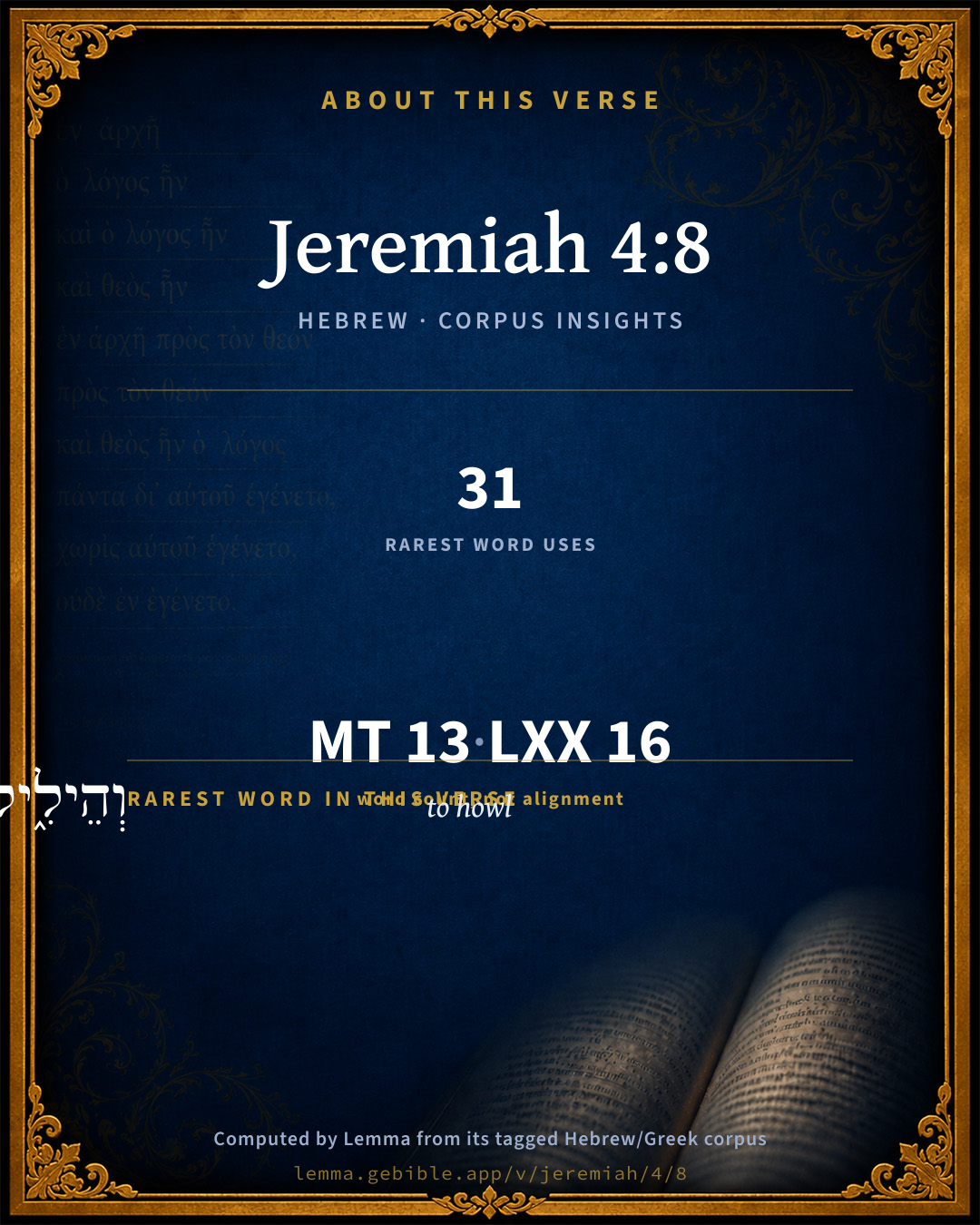
These counts appear in no published source. They are computed here, from the morphology-tagged text and Lemma’s own curated glosses. What Lemma adds →

13
words
13
distinct lemmas
Prophets
section

Shared distinctive vocabulary

וְהֵילִ֑ילוּ to howl H3213 occurs in 28 verses of the Hebrew Bible. Also found in:

Grammatical profile

  • 4 verbs
  • 3 nouns
  • 1 pronoun
  • 2 prepositions
  • 1 conjunction
  • 2 particles

Verb forms

  • חִגְר֥וּ Qal · Imperative
  • סִפְד֣וּ Qal · Imperative
  • וְהֵילִ֑ילוּ Hiphil · Imperative
  • שָׁ֛ב Qal · Perfect

Hebrew & Septuagint length

In the original languages it is 13 Hebrew tokens and 16 Greek tokens — but the two are counted differently (Hebrew bundles its prefixes and suffixes into one token; the Greek is in lemma form), so that isn’t a like-for-like length.

Cross-references

18

Topical passages linked to Jeremiah 4:8 in the Treasury of Scripture Knowledge — connected by theme and wording, ordered by reader-vote popularity; previews shown in the World English Bible.

  • Isaiah 22:12 In that day did the Lord, Yahweh of Hosts, call to weeping, and to mourning, and to baldness, and to girding with sackcloth:
  • Jeremiah 6:26 Daughter of my people, gird you with sackcloth, and wallow yourself in ashes: make you mourning, as for an only son, most bitter lamentation; for the destroyer shall suddenly come on us.
  • Isaiah 5:25 Therefore Yahweh's anger burns against his people, And he has stretched out his hand against them, and has struck them. The mountains tremble, And their dead bodies are as refuse in the midst of the streets. For all this, his anger is not turned away, But his hand is still stretched out.
  • Isaiah 10:4 They shall only bow down under the prisoners, and shall fall under the slain. For all this his anger is not turned away, but his hand is stretched out still.
  • Isaiah 32:11 Tremble, you women who are at ease; be troubled, you careless ones; strip yourselves, and make yourselves naked, and gird [sackcloth] on your loins.
  • Numbers 25:4 Yahweh said to Moses, Take all the chiefs of the people, and hang them up to Yahweh before the sun, that the fierce anger of Yahweh may turn away from Israel.
  • Psalms 78:49 He threw on them the fierceness of his anger, Wrath, indignation, and trouble, And a band of angels of evil.
  • Isaiah 9:12 the Syrians before, and the Philistines behind; and they shall devour Israel with open mouth. For all this his anger is not turned away, but his hand is stretched out still.
  • Isaiah 9:17 Therefore the Lord will not rejoice over their young men, neither will he have compassion on their fatherless and widows; for everyone is profane and an evil-doer, and every mouth speaks folly. For all this his anger is not turned away, but his hand is stretched out still.
  • Isaiah 9:21 Manasseh, Ephraim; and Ephraim, Manasseh; and they together shall be against Judah. For all this his anger is not turned away, but his hand is stretched out still.
  • Isaiah 13:6 Wail; for the day of Yahweh is at hand; as destruction from the Almighty shall it come.
  • Isaiah 15:2–3 They are gone up to Bayith, and to Dibon, to the high places, to weep: Moab wails over Nebo, and over Medeba; on all their heads is baldness, every beard is cut off.
  • Jeremiah 30:24 The fierce anger of Yahweh shall not return, until he has executed, and until he have performed the intents of his heart: in the latter days you shall understand it.
  • Jeremiah 48:20 Moab is disappointed; for it is broken down: wail and cry; tell you it by the Arnon, that Moab is laid waste.
  • Ezekiel 21:12 Cry and wail, son of man; for it is on my people, it is on all the princes of Israel: they are delivered over to the sword with my people; strike therefore on your thigh.
  • Ezekiel 30:2 Son of man, prophesy, and say, Thus says the Lord Yahweh: Wail, Alas for the day!
  • Joel 2:12–13 "Yet even now," says Yahweh, "turn to me with all your heart, And with fasting, and with weeping, and with mourning."
  • Amos 8:10 I will turn your feasts into mourning, And all your songs into lamentation; And I will make you wear sackcloth on all your bodies, And baldness on every head. I will make it like the mourning for an only son, And the end of it like a bitter day.

Cross-references courtesy of OpenBible.info (CC BY 4.0).

Hebrew and Greek witnesses Masoretic Hebrew ↔ Greek Septuagint

The same verse in the two great witnesses to the Old Testament, shown verse-for-verse.

These are two independent witnesses, not word-aligned to each other, and the Septuagint is shown in lemma (dictionary) form.

Hebrew Jeremiah 4:8 Masoretic · Westminster Leningrad Codex

עַל זֹ֛את חִגְר֥וּ שַׂקִּ֖ים סִפְד֣וּ וְהֵילִ֑ילוּ כִּ֥י לֹא שָׁ֛ב חֲר֥וֹן אַף יְהֹוָ֖ה מִמֶּֽנּוּ

For this gird you with sackcloth, lament and wail; for the fierce anger of Yahweh hasn't turned back from us.

World English Bible · Public Domain

Greek LXX Structure differs

In the Septuagint, Jeremiah is about an eighth shorter than the Hebrew and arranges its material differently — the Oracles Against the Nations (Hebrew chapters 46–51) appear in the middle of the Greek book, after 25:13. Because the chapter and verse boundaries do not line up, a verse-for-verse comparison with the Hebrew is not shown.

A verse-for-verse comparison isn’t shown here because the chapters and verses don’t line up. Switch to the LXX edition with the MT / LXX toggle above to read the Greek directly.

On this verse, John Gill's Exposition discusses the Septuagint’s reading. Read the note in Commentary ↓

Hebrew: Westminster Leningrad Codex (CC BY 4.0). Greek: Septuagint (public domain); English from a public-domain English Septuagint. How the Septuagint differs from the Hebrew →

Targum (Aramaic paraphrase)

1

The Targum is the ancient Jewish Aramaic paraphrase of the Hebrew Scriptures — an interpretive translation, not the Hebrew text itself. Onkelos (literal) and Pseudo-Jonathan (expansive) render the Torah, and Jonathan the Prophets. Coverage is partial: where no permissively-licensed English translation exists for a verse, only the Aramaic is shown. This is verse-level text, not a word-by-word alignment to the Hebrew.

  1. Targum Jonathan Prophets (Joshua–Malachi)
    עַל דָא יֵיסְרוּן סַקִין יִסְפְּדוּן וְיֵילְלוּן אֲרֵי לָא תַב תְּקוֹף רוּגְזָא דַייָ מִנָנָא:

    (no public-domain English translation for this verse)

    Targum Jonathan — Aramaic: “Mikraot Gedolot” (public domain). English: “Sefaria Community Translation” (CC0 1.0 (public-domain dedication)); “London "Chaldee Paraphrase," 1871” (public domain). Text via Sefaria.

Commentary

Notes on Jeremiah 4:8 from classic Christian and Jewish commentators (each source and its license shown beneath its notes). The classic Christian expositions comment on the surrounding passage and are grouped to its opening verse, so a note may address several verses; the Jewish commentaries on the Tanakh (Rashi and others) are per-verse, so they appear only where the commentator wrote on this verse.

Lemma curates 59 commentaries, every one of them public domain or Creative Commons licensed, each selected and text-cleaned for this edition rather than reprinted as found. About our sources →

Trapp's Complete Commentary

John Trapp

Jer 4:8 For this gird you with sackcloth, lament and howl: for the fierce anger of the LORD is not turned back from us.

Ver. 8. For this, gird you with sackcloth.] Repent, if at least it be not too late, as the next words hint that now it was.

For the fierce wrath of the Lord is not turned back from us.] Or, Because the fierce wrath of the Lord will not turn from us; it will have its full forth. See Zep 2:2. {See Trapp on "Zec 2:2"}

John Trapp, A Commentary or Exposition upon All the Books of the Old and New Testament (1647–1656) — public domain. Text from a community e-Sword module.

Tyndale Open Study Notes

Tyndale Open Resources

4:8 The Israelites were in trouble with the Lord and needed to make things right with him. Putting an army in the field or organizing guerrilla bands would be futile. Instead, Jeremiah called for the people to repent by mourning and by weeping with broken hearts (Isa 22:12). By using the pronoun us, the prophet seems to include himself in the need for repentance (see Jer 10:24).

Tyndale Open Study Notes — © Tyndale Open Resources, licensed CC BY-SA 4.0. Text via the HelloAO Bible API.

Jamieson, Fausset & Brown

Robert Jamieson, A. R. Fausset & David Brown

Nothing is left to the Jews but to bewail their desperate condition.

anger . . . not turned back-- (Isa 9:12, Isa 9:17, Isa 9:21).

Jamieson, Fausset & Brown — Commentary Critical and Explanatory on the Whole Bible (1871) — public domain (CC PDM 1.0). Text via the HelloAO Bible API.

Adam Clarke's Commentary

Verse 8. Lament and howl] הילילו heililu. The aboriginal Irish had a funeral song called the Caoinian, still continued among their descendants, one part of which is termed the ulaloo: this is sung responsively or alternately, and is accompanied with a full chorus of sighs and groans. It has been thought that Ireland was originally peopled by the Phoenicians: if so, this will account for the similarity of many words and customs among both these people.

Adam Clarke's Commentary on the Bible (1810–1826) — public domain. Text from a community e-Sword/MySword module.

John Calvin's Commentaries

The Prophet seems not yet to exhort his own nation to repent: a more gracious doctrine will presently follow; but here he only reminds them that a most grievous mourning was nigh at hand; for he saw that they were hypocrites, immersed in their own delusions, and could not be assailed by any fear. Hence he says, that they were greatly mistaken, if they thought themselves safe while God was angry with them.

Gird yourselves in sackcloth, he says, lament and howl; and then follows the reason, because the fury of God’s wrath was not turned away from them. We indeed know, that the ungodly are wont to make God subservient to themselves, as though they could by their perverseness turn aside or drive afar off his judgment, and restrain, as it were, his hand from acting. As, then, hypocrites are insolent towards God, the Prophet says expressly that the fury of his wrath was not turned away: and thus he warns them, that they would be in every way miserable until they were reconciled to God.

We now understand the design of the Prophet; for he confirms what the last verse contains, when he said that a lion had come forth, and that a desolator was already nigh; yea, he confirms what he had said, for there was no hope to them without having God propitious, and he declares that God was angry. Hence it follows, that all things would prove infelicitous to them.

John Calvin's Commentaries (1540-1563) — public domain. Text from the Calvin Translation Society English edition (1840s-50s) via the Christian Classics Ethereal Library (ccel.org). Calvin's coverage is partial (roughly two-thirds of the Bible); uncommented books and verses are honest gaps, never fabricated. The 19th-century editor's footnotes and remarks are omitted so the notes are faithfully Calvin's own voice.

Ellicott's Commentary for English Readers

(8) Gird you with sackcloth.—From the earliest times the outward sign of mourning, and therefore of repentance (Joe_1:8; Isa_22:12).

A Bible Commentary for English Readers, edited by Charles John Ellicott (1878–1897) — public domain. Text from a community e-Sword module.

John Gill's Exposition

For this gird you with sackcloth, lament and howl,.... That is, because of this destruction threatened, which was so near at hand, and so sure and certain:

for the fierce anger of the Lord is not turned back from us. The Septuagint, Syriac, and Arabic versions, render it "from you" and some render it "from it" (u); from his purpose and design to destroy the Jews. Jarchi interprets this of Josiah, and his times, who, though he turned to the Lord with all his heart, yet the Lord turned not from the fierceness of his wrath and anger against Judah, Kg2 23:25.

(u) "ab illo", i.e. "ab illo proposito", Cocceius; "ab eo", Montanus.

John Gill's Exposition of the Whole Bible (1746–1763) — public domain (CC PDM 1.0). Text via the HelloAO Bible API.

Albert Barnes' Notes on the Bible

Is not turned ... - As long as their sins are unrepented of, so long must their punishment continue.

Albert Barnes' Notes on the Bible (1834–1885) — public domain. Text from a community e-Sword/MySword module.

Matthew Poole's English Annotations

Gird you with sackcloth; the usual habit of mourners, especially in those days, Isa 22:12; Jer 6:26; it is a calling upon them to repent.

Lament and howl: probably these expressions do import the several ways that men have to set forth their bitter complaints and sorrows of the mind, both by the gestures of the body, Jer 2:37; Luk 18:13, and expressions of the tongue, Psa 32:3; Isa 59:11.

Is not turned back from us; neither will it, until it have accomplished its ends, Jer 30:24.

Matthew Poole's English Annotations on the Holy Bible (1683–1685) — public domain. Text from a community e-Sword/MySword module.

Whedon's Commentary on the Bible

Daniel D. Whedon

8. Gird you with sackcloth — This calamity, which on its surface would seem to be merely human, attributable solely to the ambition and rapacity of the Babylonish nation, is here referred to as an expression of the fierce anger of God: thus illustrating the truth so often brought out in the Old Testament, that God has a purpose even in the actions of evil agents. The grand condition of safety is harmony with God. His favour is the only defence which man’s hate cannot beat down.

Daniel D. Whedon (gen. ed.), Commentary on the Old and New Testaments (1874–1909) — public domain. Text from a community e-Sword module.

The Pulpit Commentary

Is not turned back from us. As we in our folly believed. (Jer_2:35)

The Pulpit Commentary (1880–1919), ed. H.D.M. Spence-Jones & Joseph S. Exell — public domain. Text from a community e-Sword module.

Keil & Delitzsch

C. F. Keil & F. Delitzsch

For this calamity the people was to mourn deeply. For the description of the mourning, cf. Joe 1:13; Mic 1:8. For the wrath of the Lord has not turned from us, as in blind self-delusion ye imagine, Jer 2:35. The heath of Jahveh's anger is the burning wrath on account of the sins of Manasseh, with which the people has been threatened by the prophets. This wrath has not turned itself away, because even under Josiah the people has not sincerely returned to its God.

Keil & Delitzsch — Biblical Commentary on the Old Testament (1861–1891) — public domain (CC PDM 1.0). Text via the HelloAO Bible API. (Old Testament only.)

Rashi

Rabbi Shlomo Yitzchaki (Rashi)

Because of this What is “this?” “For the fierce anger etc.” Although he spoke above concerning Nebuchadnezzar in regards to the destruction, here he returns to speak of the death of Josiah.

for the fierce anger of the Lord etc. Although Josiah repented wholeheartedly, it is stated concerning him. (II Kings 23:26)... “the Lord did not turn back from his great wrath...because of all the provocations that Manasseh had provoked Him.”

Rashi on the Tanakh — English translations: “The Judaica Press complete Tanach with Rashi, translated by A. J. Rosenberg” (CC BY 4.0); “Pentateuch with Rashi's commentary by M. Rosenbaum and A.M. Silbermann, 1929-1934” (public domain); “The Metsudah Tanach series, Lakewood, N.J” (CC BY 4.0); and “The Book of Joshua, Metsudah Publications, 1997” (CC BY 4.0). Text via Sefaria.

Lesson kit

Teaching starters — assembled from the data on this page, not authored interpretation. Every prompt links to the verse data it draws on. Edit before teaching.

Jeremiah, in the Prophets, opens this verse with 13 words (13 distinct Hebrew lemmas). Its most distinctive word is yâlal (“to howl”). A historical commentator’s framing appears above. Read the whole chapter for the surrounding context.

Discussion questions

  1. What does “to howl” (yâlal) contribute to the verse as a whole?
  2. How does Isaiah 13:6, which shares the word «to howl», read alongside this verse?
  3. The translations on this page render this verse differently — a whole-verse word diff, not a word-by-word alignment. What might account for the different wordings?
  4. «חִגְר֥וּ» is a Qal Imperative verb. How does that grammatical form shape the action described?
  5. Compare how Trapp's Complete Commentary and Tyndale Open Study Notes read this verse. Where do they agree or differ?

Things to notice

Reading settings

Reading text

Shown beneath each verse's original-language words.

Old Testament
Old Testament edition

Read the OT as the Masoretic Hebrew (MT) or the Greek Septuagint (LXX).

English shown for the Greek Septuagint (in the Hebrew ↔ Greek comparison).

Comparing translations? Open the Compare panel on any verse page to stack up to four side by side.