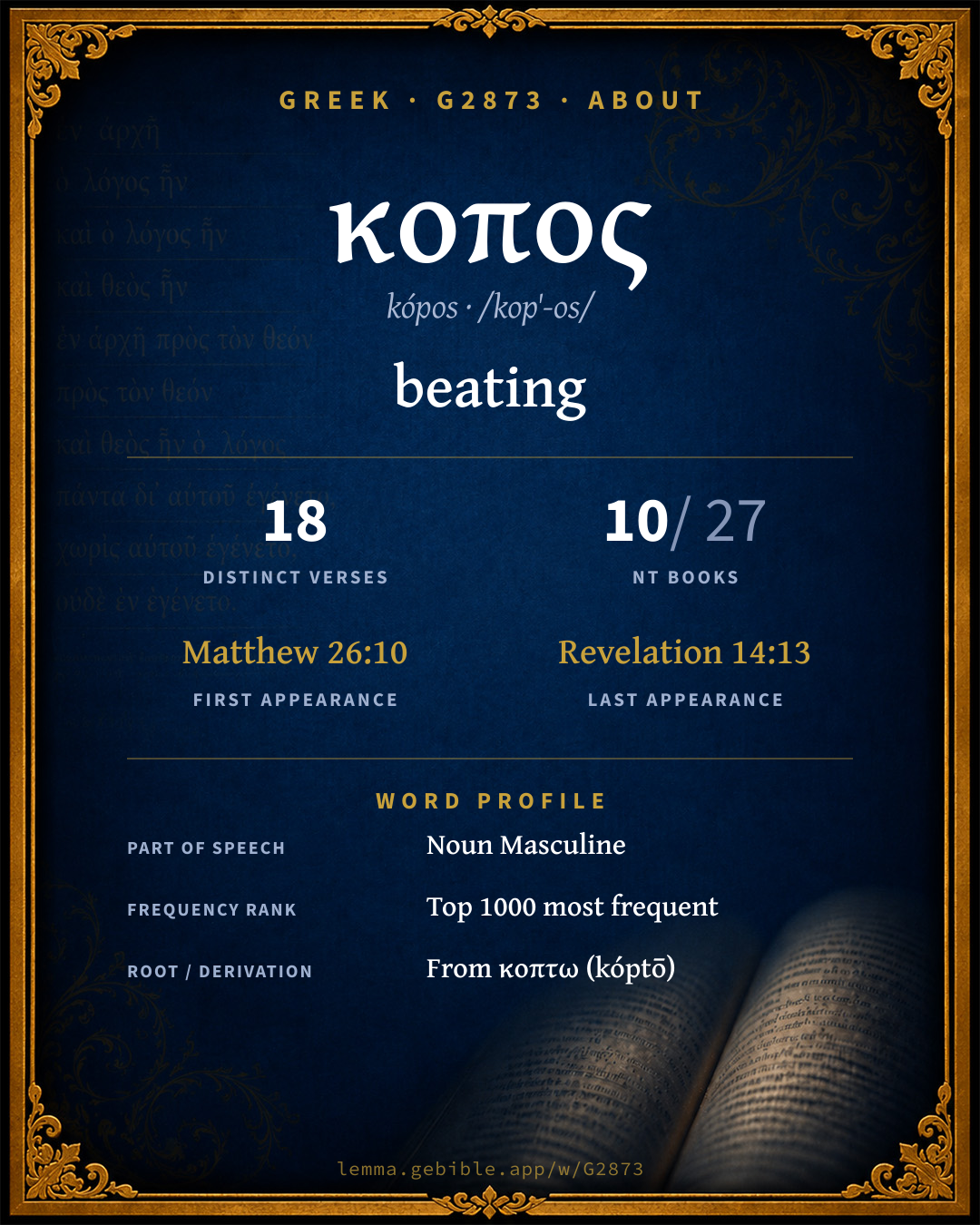
κόπος
beating
‘beating’ is one of 3 main senses fuller range ↓
Full lexicon entry — Thayer's Greek Lexicon
From Thayer's Greek Lexicon
Where this word appears
See every Accusative-case word in the Greek New Testament →
Grammar key — what these labels mean
Part of speech
- Noun
- A naming word — a person, place, thing, or idea.
Case
- Accusative
- The case of the direct object and of extent.
- Dative
- The case of the indirect object, means, or location — “to / for / with / in.”
- Nominative
- The case of the subject (and the predicate nominative).
- Genitive
- The case of source, possession, or “of” — answers “whose / from what.”
Gender
- Masculine
- Grammatically masculine.
Number
- Singular
- One.
- Plural
- More than one.
Grammatical forms
- Noun, Accusative, Singular, Masculine 5 times (28%)
- Noun, Accusative, Plural, Masculine 4 times (22%)
- Noun, Dative, Plural, Masculine 3 times (17%)
- Noun, Dative, Singular, Masculine 2 times (11%)
- Noun, Nominative, Singular, Masculine 2 times (11%)
- Noun, Genitive, Plural, Masculine 1 time (6%)
- Noun, Genitive, Singular, Masculine 1 time (6%)
Parsed forms decoded from the imported morphology (Robinson–Tischendorf, public domain), counted across 18 parsed occurrences — not distinct verses.
Every verse where G2873 appears — 18 distinct verses across 10 books. Click any verse to open its interlinear word-by-word view. Verse text shown in the World English Bible for context — . Each verse’s Greek form is shown with its reference; the English is not keyword-highlighted, since the data carries no word-level English alignment. Use “Compare translations” on any verse to read it across multiple English versions. This concordance covers the Greek New Testament; Septuagint (Greek Old Testament) occurrences of this word are not indexed here.
Matthew 1 verse
Mark 1 verse
Luke 2 verses
- Luke 11:7 κόπους n acc pl masc and he from within will answer and say, 'Don't bother me. The door is now shut, and my children are with me in bed. I can't get up and give it to you'?
- Luke 18:5 κόπον n acc sg masc yet because this widow bothers me, I will defend her, or else she will wear me out by her continual coming.'"
John 1 verse
1 Corinthians 2 verses
- 1 Corinthians 3:8 κόπον n acc sg masc Now he who plants and he who waters are the same, but each will receive his own reward according to his own labor.
- 1 Corinthians 15:58 κόπος n nom sg masc Therefore, my beloved brothers, be steadfast, immovable, always abounding in the Lord's work, because you know that your labor is not in vain in the Lord.
2 Corinthians 4 verses
- 2 Corinthians 6:5 κόποις n dat pl masc in beatings, in imprisonments, in riots, in labors, in watchings, in fastings;
- 2 Corinthians 10:15 κόποις n dat pl masc not boasting beyond proper limits in other men's labors, but having hope that as your faith grows, we will be abundantly enlarged by you in our sphere of influence,
- 2 Corinthians 11:23 κόποις n dat pl masc Are they servants of Christ? (I speak as one beside himself) I am more so; in labors more abundantly, in prisons more abundantly, in stripes above measure, in deaths often.
- 2 Corinthians 11:27 κόπῳ n dat sg masc in labor and travail, in watchings often, in hunger and thirst, in fastings often, and in cold and nakedness.
Galatians 1 verse
1 Thessalonians 3 verses
- 1 Thessalonians 1:3 κόπου n gen sg masc remembering without ceasing your work of faith and labor of love and patience of hope in our Lord Jesus Christ, before our God and Father.
- 1 Thessalonians 2:9 κόπον n acc sg masc For you remember, brothers, our labor and travail; for working night and day, that we might not burden any of you, we preached to you the Gospel of God.
- 1 Thessalonians 3:5 κόπος n nom sg masc For this cause I also, when I couldn't stand it any longer, sent that I might know your faith, for fear that by any means the tempter had tempted you, and our labor would have been in vain.
2 Thessalonians 1 verse
Revelation 2 verses
- Revelation 2:2 κόπον n acc sg masc "I know your works, and your toil and perseverance, and that you can't tolerate evil men, and have tested those who call themselves apostles, and they are not, and found them false.
- Revelation 14:13 κόπων n gen pl masc I heard the voice from heaven saying, "Write, 'Blessed are the dead who die in the Lord from now on.'" "Yes," says the Spirit, "that they may rest from their labors; for their works follow with them."
About this entry
At a glance — auto-summarized from this page’s data, not written by a person. Every figure links to its source below. This summary describes the numbers; it doesn’t interpret them.
The Greek noun κοπος centers on the idea of “beating.” Older and newer Bibles part ways — “labour” in the King James Version, “labor” (Berean Standard Bible) in modern versions. See the renderings breakdown. It appears 18 verses across 10 books of the Greek New Testament, among its uncommon vocabulary. Its earliest occurrence is Matthew 26:10. Lexicons map it across 3 senses. For the data behind this summary, explore the sense tree and the renderings breakdown below.
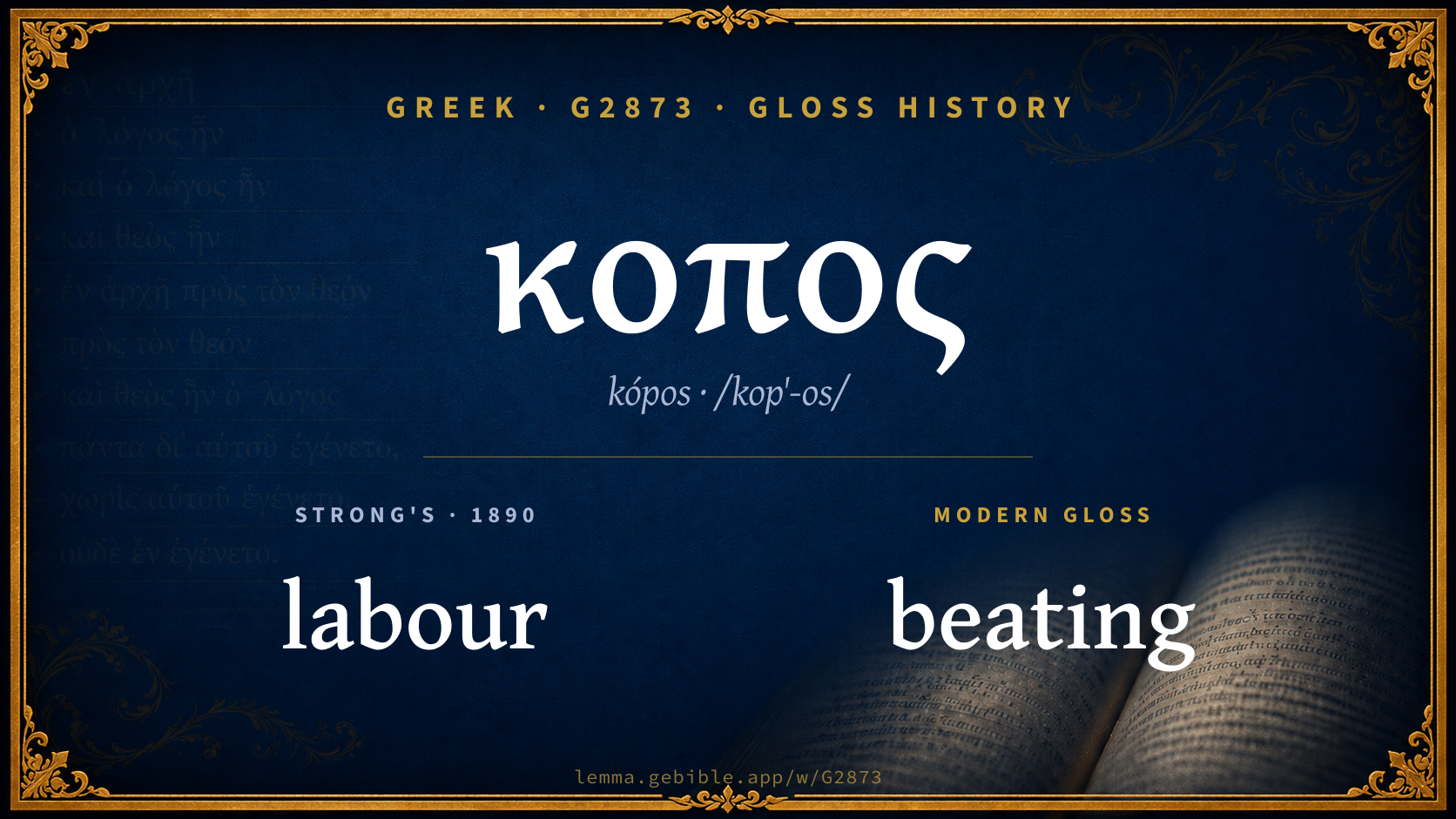
Gloss history
Strong's 1890 vs modern scholarship
About this word
Strong's G2873 catalogs a Greek word from the Greek New Testament.
These counts are not copied from any lexicon or concordance. They are computed here, from the morphology-tagged Greek New Testament. What Lemma adds →
- 18
- distinct verses
- The word appears in 18 distinct verses.
- 10 / 27
- NT books
- The word appears in 10 of 27 New Testament books.
- #664
- by frequency
- Top 1000 most frequent Greek words (rank 664 of 5,347 Greek words by occurrence).
View all 18 occurrences in the concordance →
Most concentrated in
- 2 Corinthians 4 verses 22%
- 1 Thessalonians 3 verses 17%
- Luke 2 verses 11%
By section of the New Testament
By traditional corpus
Conventional, traditional groupings — biblical authorship is debated, so this is a traditional corpus grouping, not an authorship claim. Some books belong to more than one corpus (Luke is in both the Gospels and the Lukan corpus, and so on), so these shares overlap and need not total 100%. Each figure is a share of the word’s 18 distinct verses.
- Pauline corpus 11 verses · 61%
- Gospels 5 verses · 28%
- Johannine 3 verses · 17%
- Lukan (Luke–Acts) 2 verses · 11%
- Revelation 2 verses · 11%
How translations render this word
Counts come from each version’s own published word-to-Strong’s tagging or interlinear alignment — an approximate guide to how each version renders this word, not a word-level alignment the data otherwise carries. Because each total is that version’s own tagged count, the per-version totals vary from one another and need not match the appearance or distinct-verse counts above. These counts may also differ from a printed concordance because Lemma counts each distinctly tagged rendering and does not collapse phrase taggings into a single head-word total. This is a fixed set of word-tagged versions (KJV, ASV, BSB, ULT) and does not change with the reading translation you choose elsewhere. Each version’s license is shown beside its name below (and on Sources).
- King James Version: Labour 8×, Labours 5×, Trouble ye 2×
- American Standard Version: Labor 7×, Labors 3×, Trouble 3×
- Berean Standard Bible: Labor 11×, Labors 2×
- unfoldingWord Literal Text: Labor 7×, Trouble 5×, Hard work 2×
King James Version Public Domain
Renders G2873 across 18 tagged occurrences — most commonly:
Plus 3 renderings that appear only once — usually multi-word phrases or single function words the recovered tagging swept in, not distinct renderings. Not rendered by a distinct English word in 1 further occurrence.
American Standard Version Public Domain
Renders G2873 across 17 tagged occurrences — most commonly:
Plus 4 renderings that appear only once — usually multi-word phrases or single function words the recovered tagging swept in, not distinct renderings.
Berean Standard Bible Public Domain
Renders G2873 across 15 tagged occurrences — most commonly:
Plus 2 renderings that appear only once — usually multi-word phrases or single function words the recovered tagging swept in, not distinct renderings. Not rendered by a distinct English word in 3 further occurrences.
unfoldingWord Literal Text CC BY-SA 4.0
Renders G2873 across 18 tagged occurrences — most commonly:
Plus 2 renderings that appear only once — usually multi-word phrases or single function words the recovered tagging swept in, not distinct renderings.
Senses in Thayer's
The 3 senses Thayer's distinguishes for this word, in lexicon order (not ranked by frequency or importance). The full entry — with sub-senses — is in the Lexicon Entry tab.
- a beating
- a beating of the breast with grief, sorrow
- labour
Word origin
Derived from κοπτω (kóptō) (G2875) — to strike.
From G2875 ; a cut that is (by analogy) toil (as reducing the strength) literally or figuratively; by implication pains : - labour + trouble weariness.
— Strong’s Exhaustive Concordance (1890), public domain.
Forms in the corpus
The 7 distinct written forms G2873 takes in the Greek New Testament, most frequent first — each parse links to that case’s occurrences in the concordance.
| Form | Parsing | Example | Uses |
|---|---|---|---|
| κόπον kópon | Noun, Accusative, Singular, Masculine | Luke 18:5 | 5 |
| κόπους kópous | Noun, Accusative, Plural, Masculine | Matthew 26:10 | 4 |
| κόποις kópois | Noun, Dative, Plural, Masculine | 2 Corinthians 6:5 | 3 |
| κόπος kópos | Noun, Nominative, Singular, Masculine | 1 Corinthians 15:58 | 2 |
| κόπῳ kópō | Noun, Dative, Singular, Masculine | 2 Corinthians 11:27 | 2 |
| κόπου kópou | Noun, Genitive, Singular, Masculine | 1 Thessalonians 1:3 | 1 |
| κόπων kópōn | Noun, Genitive, Plural, Masculine | Revelation 14:13 | 1 |
Same root — word family
Other Thayer's entries built from the same root as G2873, grouped by Strong’s listed origin. These share a root / origin per the lexicon — not necessarily a shared meaning. Each links to that word’s own entry.
Derives from
Shares the same root
- κοπετος kopetós G2870 lamentation
- κοπη kopḗ G2871 cutting
- κοπρια kopría G2874 dung
- κωφος kōphós G2974 dull
- τομωτερος tomṓteros G5114 sharper
Derived from this word
Compare all same-root words → Showing 4 of 9 — not the complete family. They share a root, not necessarily a meaning.
Septuagint usage
The same Greek word κοπος appears 26 times in the Greek Old Testament (Septuagint), across 26 verses in 12 books.
- 26
- LXX occurrences
- Tagged occurrences of this Greek word in the Septuagint.
- 26
- verses
- Distinct Septuagint verses containing this word.
- 12 / 39
- OT books
- The word appears in 12 of the 39 Old Testament books.
Sample Septuagint occurrences
- Genesis 31:42 κόπος
- Deuteronomy 1:12 κόπος
- Judges 10:16 κόπος
- Ezra 15:13 κόπος
- Job 4:2 κόπος
- Psalms 9:28 κόπος
- Jeremiah 20:18 κόπος
- Hosea 12:4 κόπος
- Micah 2:1 κόπος
- Habakkuk 1:3 κόπος
- Zechariah 10:2 κόπος
- Malachi 2:13 κόπος
Septuagint occurrences (same lexeme)
Every verse where the same Strong’s number (G2873) appears in the Greek Septuagint. Verse text shown in the World English Bible for context; the Greek form is the matched word — the English is not keyword-highlighted.
- Genesis 31:42 κόπος Unless the God of my father, the God of Abraham, and the fear of Isaac, had been with me, surely now you would have sent me away empty. God has seen my affliction and the labor of my hands, and rebuked you last night."
- Deuteronomy 1:12 κόπος How can I myself alone bear your encumbrance, and your burden, and your strife?
- Judges 10:16 κόπος They put away the foreign gods from among them, and served Yahweh; and his soul was grieved for the misery of Israel.
- Ezra 15:13 κόπος
- Job 4:2 κόπος "If someone ventures to talk with you, will you be grieved? But who can withhold himself from speaking?
- Job 5:6 κόπος For affliction doesn't come forth from the dust, Neither does trouble spring out of the ground;
- Job 5:7 κόπος But man is born to trouble, As the sparks fly upward.
- Job 11:16 κόπος For you shall forget your misery; You shall remember it as waters that are passed away,
- Psalms 9:28 κόπος
- Psalms 24:18 κόπος
- Psalms 54:11 κόπος
- Psalms 72:5 κόπος They shall fear you while the sun endures; And as long as the moon, throughout all generations.
- Psalms 72:16 κόπος There shall be abundance of grain throughout the land. Its fruit sways like Lebanon. Let it flourish, thriving like the grass of the field.
- Psalms 87:16 κόπος
- Psalms 89:10 κόπος You have broken Rahab in pieces, like one of the slain. You have scattered your enemies with your mighty arm.
- Psalms 93:20 κόπος
- Psalms 106:12 κόπος Then they believed his words. They sang his praise.
- Psalms 139:10 κόπος Even there your hand will lead me, And your right hand will hold me.
- Jeremiah 20:18 κόπος Why came I forth out of the womb to see labor and sorrow, that my days should be consumed with shame?
- Jeremiah 51:33 κόπος For thus says Yahweh of hosts, the God of Israel: The daughter of Babylon is like a threshing floor at the time when it is trodden; yet a little while, and the time of harvest shall come for her.
- Hosea 12:4 κόπος Indeed, he had power over the angel, and prevailed; He wept, and made supplication to him. He found him at Bethel, and there he spoke with us,
- Micah 2:1 κόπος Woe to those who devise iniquity And work evil on their beds! When the morning is light, they practice it, Because it is in the power of their hand.
- Habakkuk 1:3 κόπος Why do you show me iniquity, and look at perversity? For destruction and violence are before me. There is strife, and contention rises up.
- Habakkuk 3:7 κόπος I saw the tents of Cushan in affliction. The dwellings of the land of Midian trembled.
- Zechariah 10:2 κόπος For the teraphim have spoken vanity, and the diviners have seen a lie; And they have told false dreams. They comfort in vain. Therefore they go their way like sheep. They are oppressed, because there is no shepherd.
- Malachi 2:13 κόπος This again you do: you cover the altar of Yahweh with tears, with weeping, and with sighing, because he doesn't regard the offering any more, neither receives it with good will at your hand.
These are occurrences of the same Greek lexeme (G2873) in the Septuagint — not a translation of any one Hebrew word. The store carries no word-level Hebrew↔Greek alignment, so no Hebrew original is asserted here. Counts come from the recovered LXX Strong's tagging — high-frequency vocabulary is well covered, while rare or late forms may be untagged — so they reflect tagged occurrences and may slightly undercount.