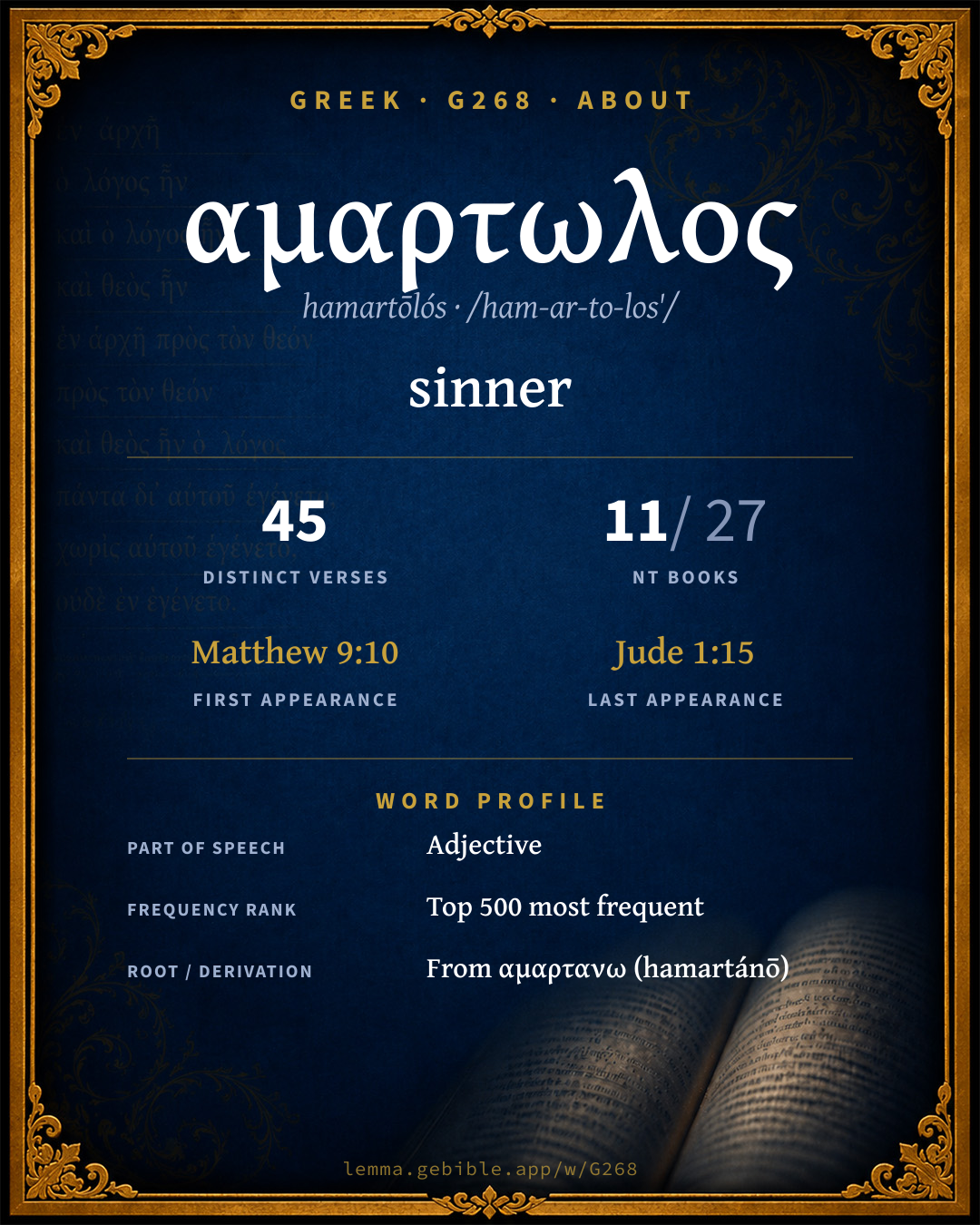
ἁμαρτωλός
sinner
Full lexicon entry — Thayer's Greek Lexicon
From Thayer's Greek Lexicon
Where this word appears
See every Nominative-case word in the Greek New Testament →
Grammar key — what these labels mean
Part of speech
- Adjective
- A word that describes or qualifies a noun.
Case
- Genitive
- The case of source, possession, or “of” — answers “whose / from what.”
- Nominative
- The case of the subject (and the predicate nominative).
- Accusative
- The case of the direct object and of extent.
- Dative
- The case of the indirect object, means, or location — “to / for / with / in.”
- Vocative
- The case of direct address (“O Lord”).
Gender
- Masculine
- Grammatically masculine.
- Feminine
- Grammatically feminine.
Number
- Plural
- More than one.
- Singular
- One.
8 verses where G268 appears in the Nominative case in the Book of Luke. Filtered view — show all forms. Click any verse to open its interlinear word-by-word view. Verse text shown in the World English Bible for context — . Each verse’s Greek form is shown with its reference; the English is not keyword-highlighted, since the data carries no word-level English alignment. Use “Compare translations” on any verse to read it across multiple English versions. This concordance covers the Greek New Testament; Septuagint (Greek Old Testament) occurrences of this word are not indexed here.
Luke
- Luke 5:8 ἁμαρτωλός adj nom sg masc But Simon Peter, when he saw it, fell down at Jesus' knees, saying, "Depart from me, for I am a sinful man, Lord."
- Luke 6:32 ἁμαρτωλοὶ adj nom pl masc If you love those who love you, what credit is that to you? For even sinners love those who love them.
- Luke 6:33 ἁμαρτωλοὶ adj nom pl masc If you do good to those who do good to you, what credit is that to you? For even sinners do the same.
- Luke 6:34 ἁμαρτωλοὶ ἁμαρτωλοῖς adj nom pl masc adj dat pl masc If you lend to those from whom you hope to receive, what credit is that to you? Even sinners lend to sinners, to receive back as much.
- Luke 7:37 ἁμαρτωλός adj nom sg fem Behold, a woman in the city who was a sinner, when she knew that he was reclining in the Pharisee's house, she brought an alabaster jar of ointment.
- Luke 7:39 ἁμαρτωλός adj nom sg fem Now when the Pharisee who had invited him saw it, he said to himself, "This man, if he were a prophet, would have perceived who and what kind of woman this is who touches him, that she is a sinner."
- Luke 13:2 ἁμαρτωλοὶ adj nom pl masc Jesus answered them, "Do you think that these Galileans were worse sinners than all the other Galileans, because they suffered such things?
- Luke 15:1 ἁμαρτωλοὶ adj nom pl masc Now all the tax collectors and sinners were coming close to him to hear him.
About this entry
At a glance — auto-summarized from this page’s data, not written by a person. Every figure links to its source below. This summary describes the numbers; it doesn’t interpret them.
“sinner” is the headline sense of the Greek adjective αμαρτωλος (hamartōlós). Its earliest occurrence is Matthew 9:10. It turns up in 45 verses across 11 books, a moderately common footprint. It concentrates in Luke, which alone accounts for 38% of its uses. It clusters with αμαρτανω, αμαρτημα and αμαρτια under a shared root. The sections below give every sense, occurrence, and version rendering.
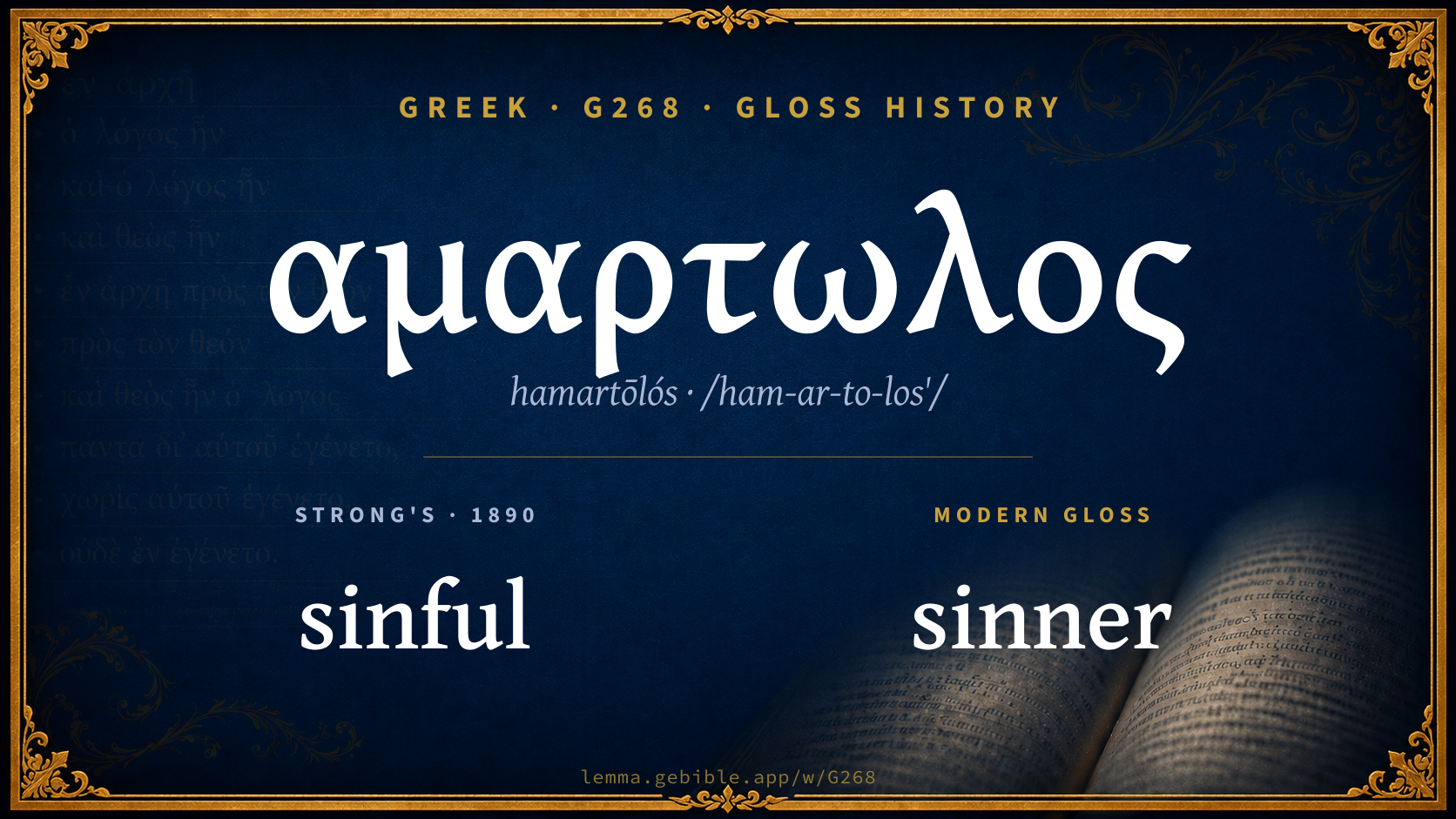
Gloss history
Strong's 1890 vs modern scholarship
About this word
Strong's G268 catalogs a Greek word from the Greek New Testament.
These counts are not copied from any lexicon or concordance. They are computed here, from the morphology-tagged Greek New Testament. What Lemma adds →
- 45
- distinct verses
- The word appears in 45 distinct verses.
- 11 / 27
- NT books
- The word appears in 11 of 27 New Testament books.
- #326
- by frequency
- Top 500 most frequent Greek words (rank 326 of 5,347 Greek words by occurrence).
View all 45 occurrences in the concordance →
By section of the New Testament
By traditional corpus
Conventional, traditional groupings — biblical authorship is debated, so this is a traditional corpus grouping, not an authorship claim. Some books belong to more than one corpus (Luke is in both the Gospels and the Lukan corpus, and so on), so these shares overlap and need not total 100%. Each figure is a share of the word’s 45 distinct verses.
- Gospels 31 verses · 69%
- Lukan (Luke–Acts) 17 verses · 38%
- Pauline corpus 8 verses · 18%
- Johannine 4 verses · 9%
- General (Catholic) Epistles 4 verses · 9%
- Hebrews 2 verses · 4%
How translations render this word
Counts come from each version’s own published word-to-Strong’s tagging or interlinear alignment — an approximate guide to how each version renders this word, not a word-level alignment the data otherwise carries. Because each total is that version’s own tagged count, the per-version totals vary from one another and need not match the appearance or distinct-verse counts above. These counts may also differ from a printed concordance because Lemma counts each distinctly tagged rendering and does not collapse phrase taggings into a single head-word total. This is a fixed set of word-tagged versions (KJV, ASV, BSB, ULT) and does not change with the reading translation you choose elsewhere. Each version’s license is shown beside its name below (and on Sources).
- King James Version: Sinners 30×, Sinner 10×, Sinful 4×
- American Standard Version: Sinners 29×, Sinner 10×, Sinful 4×
- Berean Standard Bible: Sinners 29×, Sinner 9×, Sinful 8×
- unfoldingWord Literal Text: Sinners 27×, Sinner 11×, Sinful 7×
King James Version Public Domain
Renders G268 across 47 tagged occurrences — most commonly:
Plus 1 rendering that appears only once — usually multi-word phrases or single function words the recovered tagging swept in, not distinct renderings.
American Standard Version Public Domain
Renders G268 across 46 tagged occurrences — most commonly:
Plus 1 rendering that appears only once — usually multi-word phrases or single function words the recovered tagging swept in, not distinct renderings.
Berean Standard Bible Public Domain
Renders G268 across 46 tagged occurrences — most commonly:
unfoldingWord Literal Text CC BY-SA 4.0
Renders G268 across 48 tagged occurrences — most commonly:
Plus 3 renderings that appear only once — usually multi-word phrases or single function words the recovered tagging swept in, not distinct renderings.
Senses in Thayer's
The 1 sense Thayer's distinguishes for this word, in lexicon order (not ranked by frequency or importance). The full entry — with sub-senses — is in the Lexicon Entry tab.
- devoted to sin, a sinner
Word origin
Derived from αμαρτανω (hamartánō) (G264) — to sin.
From G264 ; sinful that is a sinner : - sinful sinner.
— Strong’s Exhaustive Concordance (1890), public domain.
Forms in the corpus
The 10 distinct written forms G268 takes in the Greek New Testament, most frequent first — each parse links to that case’s occurrences in the concordance.
| Form | Parsing | Example | Uses |
|---|---|---|---|
| ἁμαρτωλῶν hamartōlō̂n | Adjective, Genitive, Plural, Masculine | Matthew 9:11 | 13 |
| ἁμαρτωλοὶ hamartōloì | Adjective, Nominative, Plural, Masculine | Matthew 9:10 | 9 |
| ἁμαρτωλῷ hamartōlō̂ | Adjective, Dative, Singular, Masculine | Luke 15:7 | 5 |
| ἁμαρτωλός hamartōlós | Adjective, Nominative, Singular, Masculine | Luke 5:8 | 5 |
| ἁμαρτωλὸς hamartōlòs | Adjective, Nominative, Singular, Masculine | John 9:16 | 4 |
| ἁμαρτωλοί hamartōloí | Adjective, Nominative, Plural, Masculine | Galatians 2:15 | 3 |
| ἁμαρτωλοὺς hamartōloùs | Adjective, Accusative, Plural, Masculine | Luke 5:32 | 3 |
| ἁμαρτωλούς hamartōloús | Adjective, Accusative, Plural, Masculine | Matthew 9:13 | 2 |
| ἁμαρτωλοῖς hamartōloîs | Adjective, Dative, Plural, Masculine | Luke 6:34 | 2 |
| ἁμαρτωλὸν hamartōlòn | Adjective, Accusative, Singular, Masculine | James 5:20 | 1 |
Same root — word family
Other Thayer's entries built from the same root as G268, grouped by Strong’s listed origin. These share a root / origin per the lexicon — not necessarily a shared meaning. Each links to that word’s own entry.
Derives from
Shares the same root
Compare all same-root words → They share a root, not necessarily a meaning.
Septuagint usage
The same Greek word αμαρτωλος appears 91 times in the Greek Old Testament (Septuagint), across 88 verses in 11 books.
- 91
- LXX occurrences
- Tagged occurrences of this Greek word in the Septuagint.
- 88
- verses
- Distinct Septuagint verses containing this word.
- 11 / 39
- OT books
- The word appears in 11 of the 39 Old Testament books.
Sample Septuagint occurrences
- Genesis 13:13 ἁμαρτωλός
- Numbers 17:3 ἁμαρτωλός
- Deuteronomy 29:18 ἁμαρτωλός
- 1 Kings 1:21 ἁμαρτωλός
- 2 Chronicles 19:2 ἁμαρτωλός
- Psalms 1:1 ἁμαρτωλός
- Proverbs 11:31 ἁμαρτωλός
- Isaiah 1:4 ἁμαρτωλός
- Ezekiel 33:8 ἁμαρτωλός
- Daniel 12:10 ἁμαρτωλός
- Amos 9:8 ἁμαρτωλός
Septuagint occurrences (same lexeme)
Every verse where the same Strong’s number (G268) appears in the Greek Septuagint — showing the first 50 of 88. Verse text shown in the World English Bible for context; the Greek form is the matched word — the English is not keyword-highlighted.
- Genesis 13:13 ἁμαρτωλός Now the men of Sodom were exceedingly wicked and sinners against Yahweh.
- Numbers 17:3 ἁμαρτωλός You shall write Aaron's name on the rod of Levi; for there shall be one rod for each head of their fathers' houses.
- Numbers 32:14 ἁμαρτωλός Behold, you are risen up in your fathers' place, an increase of sinful men, to augment yet the fierce anger of Yahweh toward Israel.
- Deuteronomy 29:18 ἁμαρτωλός lest there should be among you man, or woman, or family, or tribe, whose heart turns away this day from Yahweh our God, to go to serve the gods of those nations; lest there should be among you a root that bears gall and wormwood;
- 1 Kings 1:21 ἁμαρτωλός Otherwise it will happen, when my lord the king shall sleep with his fathers, that I and my son Solomon shall be counted offenders.
- 2 Chronicles 19:2 ἁμαρτωλός Jehu the son of Hanani the seer went out to meet him, and said to king Jehoshaphat, Should you help the wicked, and love those who hate Yahweh? for this thing wrath is on you from before Yahweh.
- Psalms 1:1 ἁμαρτωλός Blessed is the man who doesn't walk in the counsel of the wicked, Nor stand in the way of sinners, Nor sit in the seat of scoffers;
- Psalms 1:5 ἁμαρτωλός Therefore the wicked shall not stand in the judgment, Nor sinners in the congregation of the righteous.
- Psalms 3:8 ἁμαρτωλός Salvation belongs to Yahweh. Your blessing be on your people. Selah.
- Psalms 7:10 ἁμαρτωλός My shield is with God, Who saves the upright in heart.
- Psalms 9:17 ἁμαρτωλός The wicked shall be turned back to Sheol, Even all the nations that forget God.
- Psalms 9:18 ἁμαρτωλός For the needy shall not always be forgotten, Nor the hope of the poor perish forever.
- Psalms 9:24 ἁμαρτωλός
- Psalms 9:25 ἁμαρτωλός
- Psalms 9:36 ἁμαρτωλός
- Psalms 10:2 ἁμαρτωλός In arrogance, the wicked hunt down the weak; They are caught in the schemes that they devise.
- Psalms 10:6 ἁμαρτωλός He says in his heart, "I shall not be shaken; For generations I shall have no trouble."
- Psalms 27:3 ἁμαρτωλός Though a host should encamp against me, My heart shall not fear. Though war should rise against me, Even then I will be confident.
- Psalms 31:10 ἁμαρτωλός For my life is spent with sorrow, My years with sighing. My strength fails because of my iniquity. My bones are wasted away.
- Psalms 33:22 ἁμαρτωλός Let your loving kindness be on us, Yahweh, Since we have hoped in you.
- Psalms 35:12 ἁμαρτωλός They reward me evil for good, To the bereaving of my soul.
- Psalms 36:10 ἁμαρτωλός Oh continue your loving kindness to those who know you, Your righteousness to the upright in heart.
- Psalms 36:12 ἁμαρτωλός There the workers of iniquity are fallen. They are thrust down, and shall not be able to rise.
- Psalms 36:14 ἁμαρτωλός
- Psalms 36:16 ἁμαρτωλός
- Psalms 36:17 ἁμαρτωλός
- Psalms 36:20 ἁμαρτωλός
- Psalms 36:21 ἁμαρτωλός
- Psalms 36:32 ἁμαρτωλός
- Psalms 36:34 ἁμαρτωλός
- Psalms 36:40 ἁμαρτωλός
- Psalms 38:2 ἁμαρτωλός For your arrows have pierced me, Your hand presses hard on me.
- Psalms 49:16 ἁμαρτωλός Don't be afraid when a man is made rich, When the glory of his house is increased.
- Psalms 54:4 ἁμαρτωλός Behold, God is my helper. The Lord is the one who sustains my soul.
- Psalms 57:4 ἁμαρτωλός My soul is among lions. I lie among those who are set on fire, Even the sons of men, whose teeth are spears and arrows, And their tongue a sharp sword.
- Psalms 57:11 ἁμαρτωλός Be exalted, God, above the heavens. Let your glory be over all the earth.
- Psalms 67:3 ἁμαρτωλός Let the peoples praise you, God. Let all the peoples praise you.
- Psalms 70:4 ἁμαρτωλός Let all those who seek you rejoice and be glad in you. Let those who love your salvation continually say, "Let God be exalted!"
- Psalms 72:3 ἁμαρτωλός The mountains shall bring prosperity to the people. The hills bring the fruit of righteousness.
- Psalms 72:12 ἁμαρτωλός For he will deliver the needy when he cries; The poor, who has no helper.
- Psalms 74:9 ἁμαρτωλός We see no miraculous signs. There is no longer any prophet, Neither is there among us anyone who knows how long.
- Psalms 74:11 ἁμαρτωλός Why do you draw back your hand, even your right hand? Take it out of your pocket and consume them!
- Psalms 81:2 ἁμαρτωλός Raise a song, and bring here the tambourine, The pleasant lyre with the harp.
- Psalms 81:4 ἁμαρτωλός For it is a statute for Israel, An ordinance of the God of Jacob.
- Psalms 83:11 ἁμαρτωλός Make their nobles like Oreb and Zeeb; Yes, all their princes like Zebah and Zalmunna;
- Psalms 90:8 ἁμαρτωλός You have set our iniquities before you, Our secret sins in the light of your presence.
- Psalms 91:8 ἁμαρτωλός You will only look with your eyes, And see the recompense of the wicked.
- Psalms 93:3 ἁμαρτωλός The floods have lifted up, Yahweh, The floods have lifted up their voice. The floods lift up their waves.
- Psalms 93:13 ἁμαρτωλός
- Psalms 96:10 ἁμαρτωλός Say among the nations, "Yahweh reigns." The world is also established. It can't be moved. He will judge the peoples with equity.
These are occurrences of the same Greek lexeme (G268) in the Septuagint — not a translation of any one Hebrew word. The store carries no word-level Hebrew↔Greek alignment, so no Hebrew original is asserted here. Counts come from the recovered LXX Strong's tagging — high-frequency vocabulary is well covered, while rare or late forms may be untagged — so they reflect tagged occurrences and may slightly undercount.