

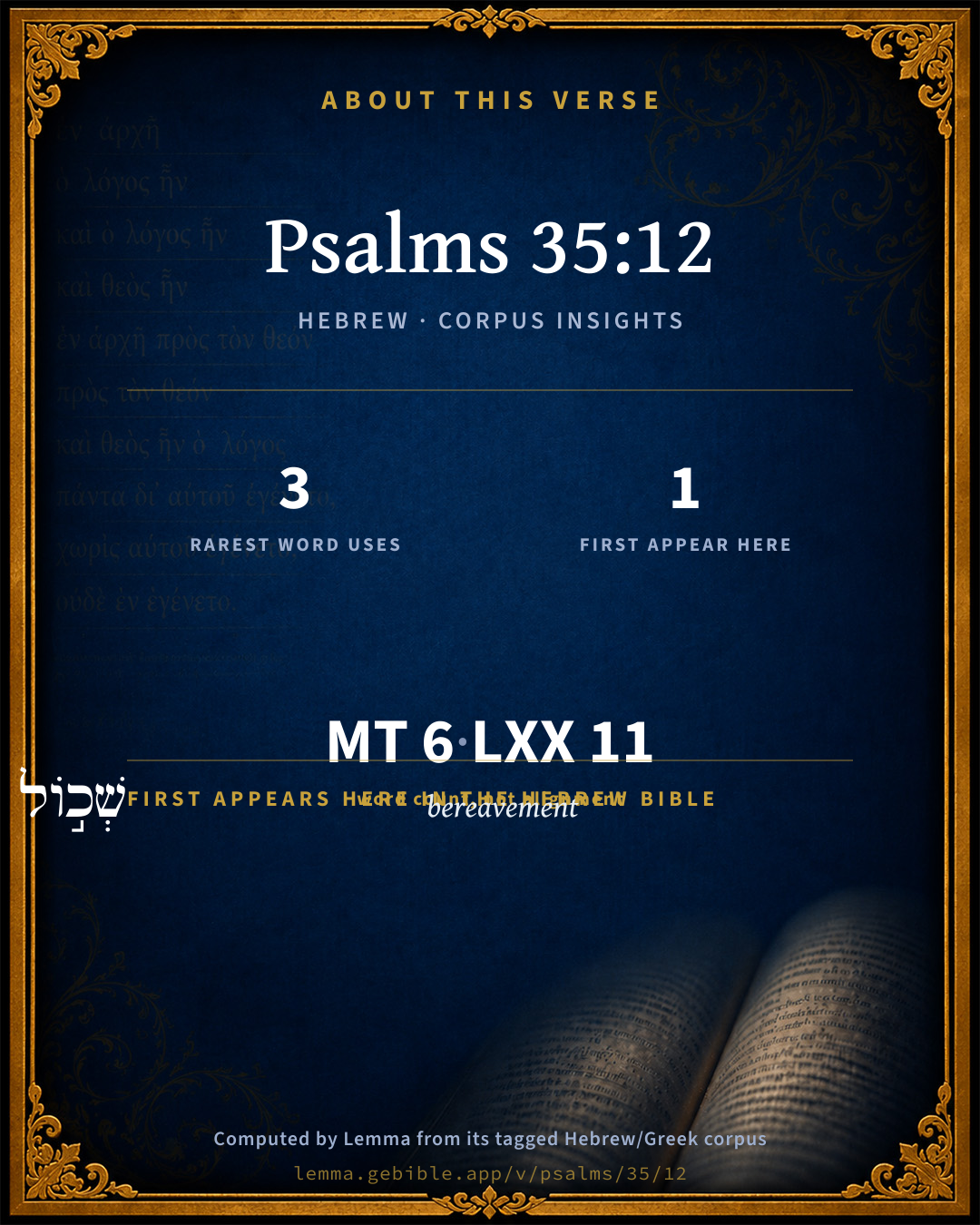
Psalms 35:12

Hebrew (Westminster Leningrad Codex) Psalms 35:12 appears in the Hebrew Old Testament. The text above is from the Westminster Leningrad Codex. Each word links to its Strong’s number, a concise gloss, and parsing drawn from the Open Scriptures Hebrew Bible morphology. Click any word for its full Brown-Driver-Briggs (BDB) entry.
Download image
Cite this verse

Psalms 35:12 (World English Bible). Public Domain. Lemma interlinear Bible study tool, https://lemma.gebible.app/v/psalms/35/12.

Show BibTeX & RIS
BibTeX
RIS
English Translation
They reward me evil for good, To the bereaving of my soul.
World English Bible · Public Domain
Highlights
  • 1 first appearance in the Hebrew Bible
Full analysis ↓
Download a study sheet

One document with this verse’s original text, its word-by-word gloss line, the meaning frame, cross-references with their text, attributed commentary, and full source and license credits — printable, and it pastes into notes with its structure intact.

This verse Autodidact and up

Study sheet (.html) Plain text (.txt)

A passage Seminary Student

Up to 50 verses in one chapter. A passage sheet keeps up to 6 commentary sources and 12 cross-references per verse, in the order this page ranks them, and says so on the sheet whenever that leaves anything out. Ask for a single verse and you get the Autodidact verse sheet above.

Everything on this page stays free to read, with no account — the sheet is a download of what is already on screen, not access to it.

Want to remove ads? Support Godless Engineer
Compare translations 3

The same verse in 3 English versions, stacked beneath the original-language interlinear above. Click any original word for its lexicon entry.

Each is an independent rendering of the whole verse — the interlinear is not word-aligned to these translations.

Highlighted words mark where these versions differ — a whole-verse word diff, not a word-by-word alignment.

  • World English Bible Public Domain
    They reward me evil for good, To the bereaving of my soul.
  • King James Version Public Domain
    They rewarded me evil for good to the spoiling of my soul.
  • unfoldingWord Literal Text CC BY-SA 4.0
    They repay me evil in place of good— bereavement to my soul.

unfoldingWord Literal Text — © unfoldingWord, licensed CC BY-SA 4.0. Word-aligned USFM3 via Door43 (git.door43.org/unfoldingWord/en_ult).

Versions to compare (up to 4)

3 of 4 selected

Show all 18 translations

Every available English version of this verse, each an independent rendering of the whole verse.

  • World English Bible Public Domain
    They reward me evil for good, To the bereaving of my soul.
  • Berean Standard Bible Public Domain
    They repay me evil for good, to the bereavement of my soul.
  • Majority Standard Bible Public Domain
    They repay me evil for good, to the bereavement of my soul.
  • King James Version Public Domain
    They rewarded me evil for good to the spoiling of my soul.
  • American Standard Version (1901) Public Domain
    They reward me evil for good, `To' the bereaving of my soul.
  • Revised Version (1885) Public Domain
    They reward me evil for good, to the bereaving of my soul.
  • Geneva Bible (1599) Public Domain
    They rewarded me euill for good, to haue spoyled my soule.
  • Douay-Rheims (1899) Public Domain
    They repaid me evil for good: to the depriving me of my soul.
  • Young's Literal Translation Public Domain
    They pay me evil for good, bereaving my soul,
  • Literal Standard Version CC BY-SA 4.0
    They pay me evil for good, bereaving my soul,
  • Unlocked Literal Bible CC BY-SA 4.0
    They repay me evil for good. I am sorrowful.
  • unfoldingWord Literal Text CC BY-SA 4.0
    They repay me evil in place of good— bereavement to my soul.
  • Darby Bible Public Domain
    They reward me evil for good, [to] the bereavement of my soul.
  • World Messianic Bible Public Domain
    They reward me evil for good, to the bereaving of my soul.
  • Webster's Bible Public Domain
    They rewarded me evil for good to the spoiling of my soul.
  • Free Bible Version CC BY-SA 4.0
    They pay me back with evil instead of good. I feel like giving up.
  • Bible in Basic English Public Domain
    They gave me back evil for good, troubling my soul.
  • JPS Tanakh (1917) Public Domain
    They repay me evil for good; bereavement is come to my soul.

Literal Standard Version (2020), Covenant Press — licensed CC BY-SA 4.0. Text via the HelloAO Bible API (eBible.org). Unlocked Literal Bible (unfoldingWord) — licensed CC BY-SA 4.0. Text via the HelloAO Bible API (eBible.org). unfoldingWord Literal Text — © unfoldingWord, licensed CC BY-SA 4.0. Word-aligned USFM3 via Door43 (git.door43.org/unfoldingWord/en_ult). Free Bible Version, Dr. Jonathan Gallagher — licensed CC BY-SA 4.0. Text via the HelloAO Bible API (eBible.org).

Word by word

More ways to search: Search by grammar → Find every occurrence → Compare this word →

Practice this passage: Drill this verse → Learn its vocabulary →

About this verse

These counts appear in no published source. They are computed here, from the morphology-tagged text and Lemma’s own curated glosses. What Lemma adds →

6
words
6
distinct lemmas
Wisdom
section

Notable vocabulary

The rarest word here is שְׁכ֣וֹל bereavement H7908 — appearing just 3 times in the whole Hebrew Bible.

First appearance in Scripture

This word makes its first canonical appearance in the Hebrew Bible here:

  • שְׁכ֣וֹל bereavement H7908

Shared distinctive vocabulary

שְׁכ֣וֹל bereavement H7908 occurs in 3 verses of the Hebrew Bible. Also found in:

Grammatical profile

  • 1 verb
  • 3 nouns
  • 1 adjective
  • 1 preposition

Verb forms

  • יְשַׁלְּמ֣וּנִי Piel · Imperfect

Hebrew & Septuagint length

In English translation the verse runs 12 words from the Hebrew and 11 from the Septuagint (LXX English) — closely comparable.

A rough comparison of the two English renderings, which tokenize alike — not a word-level alignment.

Word counts can differ between the Hebrew and the Greek without any difference in meaning — e.g. the Hebrew direct-object marker אֵת has no separate Greek word, and Greek often adds the article ὁ.

In the original languages it is 6 Hebrew tokens and 11 Greek tokens — but the two are counted differently (Hebrew bundles its prefixes and suffixes into one token; the Greek is in lemma form), so that isn’t a like-for-like length.

Cross-references

10

Topical passages linked to Psalms 35:12 in the Treasury of Scripture Knowledge — connected by theme and wording, ordered by reader-vote popularity; previews shown in the World English Bible.

  • John 10:32 Jesus answered them, "I have shown you many good works from my Father. For which of those works do you stone me?"
  • Jeremiah 18:20 Shall evil be recompensed for good? for they have dug a pit for my soul. Remember how I stood before you to speak good for them, to turn away your wrath from them.
  • Psalms 38:20 They who also render evil for good are adversaries to me, Because I follow what is good.
  • Proverbs 17:13 Whoever rewards evil for good, Evil shall not depart from his house.
  • Luke 23:21–23 but they shouted, saying, "Crucify! Crucify him!"
  • Psalms 109:3–5 They have also surrounded me with words of hatred, And fought against me without a cause.
  • 1 Samuel 20:31–33 For as long as the son of Jesse lives on the earth, you shall not be established, nor your kingdom. Therefore now send and bring him to me, for he shall surely die.
  • 1 Samuel 19:4–5 Jonathan spoke good of David to Saul his father, and said to him, Don't let the king sin against his servant, against David; because he has not sinned against you, and because his works have been very good toward you:
  • 1 Samuel 19:15 Saul sent the messengers to see David, saying, Bring him up to me in the bed, that I may kill him.
  • 1 Samuel 22:13–14 Saul said to him, Why have you conspired against me, you and the son of Jesse, in that you have given him bread, and a sword, and have inquired of God for him, that he should rise against me, to lie in wait, as at this day?

Cross-references courtesy of OpenBible.info (CC BY 4.0).

Hebrew and Greek witnesses Masoretic Hebrew ↔ Greek Septuagint

The same verse in the two great witnesses to the Old Testament, shown verse-for-verse.

You’re reading Greek Psalm 34 (Hebrew Psalm 35). The Septuagint counts the superscription, so verse numbers can differ from the Hebrew — chapter-level alignment, not verse-by-verse. Numbering follows Rahlfs.

These are two independent witnesses, not word-aligned to each other, and the Septuagint is shown in lemma (dictionary) form.

Hebrew Psalms 35:12 Masoretic · Westminster Leningrad Codex

יְשַׁלְּמ֣וּנִי רָ֭עָה תַּ֥חַת טוֹבָ֗ה שְׁכ֣וֹל לְנַפְשִֽׁי

They reward me evil for good, To the bereaving of my soul.

World English Bible · Public Domain

Greek LXX Greek Psalm 34:12 Septuagint · lemma form

ἀντι ἀποδίδωμι ἐγώ πονηρός ἀντί καλός καί ἀτεκνία ὁ ψυχή ἐγώ

They rewarded me evil for good, and bereavement to my soul.

LXX2012 (modern English Septuagint) · Public Domain

Hebrew: Westminster Leningrad Codex (CC BY 4.0). Greek: Septuagint (public domain); English from LXX2012 (modern English Septuagint) (Public Domain). How the Septuagint differs from the Hebrew →

Commentary

Notes on Psalms 35:12 from classic Christian and Jewish commentators (each source and its license shown beneath its notes). The classic Christian expositions comment on the surrounding passage and are grouped to its opening verse, so a note may address several verses; the Jewish commentaries on the Tanakh (Rashi and others) are per-verse, so they appear only where the commentator wrote on this verse.

Lemma curates 59 commentaries, every one of them public domain or Creative Commons licensed, each selected and text-cleaned for this edition rather than reprinted as found. About our sources →

Trapp's Complete Commentary

John Trapp

Psa 35:12 They rewarded me evil for good [to] the spoiling of my soul.

Ver. 12. They rewarded me evil for good] To render good for evil is divine, good for good is human, evil for evil is brutish; but evil for good is devilish.

To the spoiling of my soul] i.e. To the depriving me of that life which I have so often hazarded to save theirs. Intentant caedem (Kimchi). Or, this their devilish dealing with me, erat mihi quasi mors amarum, was as bitter as death to me.

John Trapp, A Commentary or Exposition upon All the Books of the Old and New Testament (1647–1656) — public domain. Text from a community e-Sword module.

J. A. Alexander on Psalms

Joseph Addison Alexander

12. (Psa 35:12) They repay me evil for good—bereavement to my soul. "If given up to them, I have nething to expect but a continued recompence of evil for good, extending even to the loss of what is most essential to my being and well-being." The word translated bereavement commonly means loss of children, but is here used metaphorically for the most extreme and lamentable destitution.

Joseph Addison Alexander, The Psalms Translated and Explained (1850) — public domain. Text from a community e-Sword module.

Geneva Bible (1599)

Geneva Bible translators

To have taken from me all comfort and brought me into despair.

Geneva Bible (1599) marginal notes — public domain. Text via Bolls.life.

Jamieson, Fausset & Brown

Robert Jamieson, A. R. Fausset & David Brown

Though they rendered evil for good, he showed a tender sympathy in their affliction.

spoiling--literally, "bereavement." The usual modes of showing grief are made, as figures, to express his sorrow.

Jamieson, Fausset & Brown — Commentary Critical and Explanatory on the Whole Bible (1871) — public domain (CC PDM 1.0). Text via the HelloAO Bible API.

Adam Clarke's Commentary

Verse 12. To the spoiling of my soul] To destroy my life; so נפש nephesh should be translated in a multitude of places, where our translators have used the word soul.

Adam Clarke's Commentary on the Bible (1810–1826) — public domain. Text from a community e-Sword/MySword module.

John Calvin's Commentaries

12. They render me evil for good. David again shows that the malice of his enemies was of a very aggravated character, because they not only oppressed him wrongfully, seeing he was innocent, and had given them no occasion of offense, but also because even those who had received much enjoyment and many favors from him, recompensed him in a very strange and ungrateful manner. Such disgraceful conduct wounds the feelings of good men very severely, and seems quite intolerable. But it is an inexpressibly great consolation when we can testify before God, that we have attempted by every means in our power to soothe the minds of our enemies, and to bow them to gentleness, although, notwithstanding, they are hurried on by insatiable cruelty in desiring our hurt; for God will not suffer this barbarous and brutal ingratitude to pass unpunished. Their cruelty is farther expressed when it is said that they endeavored to bereave (for so it is properly in the Hebrew “Ont tasch, de rendre orpheline car il y a ainsi proprement en Hebrieu.” — Fr.

“When the Orientals,” says Boothroyd, “pray seriously in grief, they hide their face in their bosom: and to this custom the Psalmist here alludes. Rabbi Levi, Dathe, and others, explain it in like manner.”

John Calvin's Commentaries (1540-1563) — public domain. Text from the Calvin Translation Society English edition (1840s-50s) via the Christian Classics Ethereal Library (ccel.org). Calvin's coverage is partial (roughly two-thirds of the Bible); uncommented books and verses are honest gaps, never fabricated. The 19th-century editor's footnotes and remarks are omitted so the notes are faithfully Calvin's own voice.

Ellicott's Commentary for English Readers

(12) To the spoiling of my soul.—Literally, desolation to my soul. We may paraphrase,

“They rewarded me evil for good,

Which to me was desolation.”

A Bible Commentary for English Readers, edited by Charles John Ellicott (1878–1897) — public domain. Text from a community e-Sword module.

The Cambridge Bible for Schools and Colleges

gen. ed. J. J. S. Perowne

12. They rewarded &c.] Better, as R.V., they reward. As in the preceding verse he speaks of what is still going on. His enemies are guilty of the basest ingratitude. Cp. Psa_38:20; Psa_109:5; Pro_17:13. Saul confessed that he had treated David thus (1Sa_24:17 ff.).

to the spoiling of my soul] Render as R.V., to the bereaving of my soul: or perhaps, it is bereavement to my soul. Such conduct makes him feel as desolate as the childless mother.

The Cambridge Bible for Schools and Colleges (gen. ed. J. J. S. Perowne; Cambridge University Press, 1878–1918) — public domain. Text from a community e-Sword module.

John Gill's Exposition

They rewarded me evil for good,.... For the good David did in killing Goliath, and slaying his ten thousands of the Philistines, and thereby saving his king and country, Saul and his courtiers envied him, and sought to slay him: so our Lord Jesus Christ, for all the good he did to the Jews, by healing their bodies of diseases, and preaching the Gospel to them for the benefit of their souls, was rewarded with reproaches and persecutions, and at last with the shameful death of the cross; and in like manner are his people used; but this is an evil that shall not go unpunished; see Pro 17:13. It is added,

to the spoiling of my soul; or "to the bereaving of it" (t); causing it to be fatherless; that is, to the bereaving it of its joy, peace, and comfort; so fatherless is put for comfortless, Joh 14:18; or to the taking away of his soul, which being separated from the body, its companion is left alone, as one that is fatherless.

(t) "orbitatem", Montanus, Vatablus, Junius & Tremellius, Piscator, Cocceius, Gejerus, Michaelis; so Ainsworth.

John Gill's Exposition of the Whole Bible (1746–1763) — public domain (CC PDM 1.0). Text via the HelloAO Bible API.

Albert Barnes' Notes on the Bible

They rewarded me evil for good - They recompensed, or returned evil instead of good. The manner in which they did it he states in the following verses.

To the spoiling of my soul - Margin, “depriving.” The Hebrew word means “the being forsaken,” or “abandoned.” The idea is, that owing to this conduct he was forsaken or abandoned by all in whom he might have put confidence.

Albert Barnes' Notes on the Bible (1834–1885) — public domain. Text from a community e-Sword/MySword module.

Matthew Poole's English Annotations

For good; for the good offices which did to divers of them when I had favour and power in Saul’s court and camp.

To the spoiling of my soul, i.e. to the stripping of my person of all my comforts and hopes, and of my life itself.

Matthew Poole's English Annotations on the Holy Bible (1683–1685) — public domain. Text from a community e-Sword/MySword module.

The Treasury of David

Charles H. Spurgeon

Ver. 12. They rewarded me evil for good. This is devilish; but men have learned the lesson well of the old Destroyer, and practise it most perfectly. To the spoiling of my soul. They robbed him of comfort, and even would have taken his life had it not been for special rescues from the hand of God. The wicked would strip the righteous naked to their very soul: they know no pity. There are only such limits to human malice as God himself may see fit to place.

Ver. 12. They rewarded me evil for good. For the good David did in killing Goliath, and slaying his ten thousands of Philistines, and thereby saving his king and country, Saul and his courtiers envied him, and sought to slay him: so our Lord Jesus Christ, for all the good he did to the Jews, by healing their bodies of diseases, and preaching the gospel to them for the benefit of their souls, was rewarded with reproaches and persecutions, and at last with the shameful death of the cross; and in like manner are his people used, but this is an evil that shall not go unpunished: see Pr 17:13. John Gill.

Ver. 12. To the spoiling of my soul. They robbed not his body of goods but his soul of consolation. They bereaved his soul (that is the word), like a widow who loses her children in whom she delighted and found succour. They were not content with injuring his estate, but they were for ruining the man himself by their undeserved malice, they attacked him in name and reputation, which were as dear to him as his sons and daughters, or even as his soul. It is evermore an injury to the soul to be attacked with slander, it puts a man into a warring attitude, endangers his peace of mind, imperils his enjoyment of quiet contemplation, and tends to interrupt his communion with God. Thus the spiritual nature is despoiled and suffers bereavement. C. H. S.

Ver. 12. How a soul may be robbed.

Psalms 35:13*

Charles H. Spurgeon's The Treasury of David (1869–1885) — public domain. Psalms only. Text from a community e-Sword/MySword module.

Whedon's Commentary on the Bible

Daniel D. Whedon

12. Spoiling of my soul—Bereaving “my soul.” The word is used only of the bereavement of a mother of her children, or a wild beast of her young.

Daniel D. Whedon (gen. ed.), Commentary on the Old and New Testaments (1874–1909) — public domain. Text from a community e-Sword module.

The Pulpit Commentary

They rewarded me evil for good (comp. ver. 13). Among those who slandered him were persons with whose troubles he had sympathized, and for whom he had prayed with fasting when they were sick. His worst persecutor, Saul, admitted the charge here made. "Thou art more righteous than I," he said; "for thou hast rewarded me good, whereas I have rewarded thee evil". (1Sa_24:17) To the spoiling of my soul; or, the desolating of my soul. The result of his enemies" machinations against him was to make him a fugitive and a wanderer, to separate him from the friend whom he tenderly loved, from his wife, his parents, and the greater part of his acquaintance.

The Pulpit Commentary (1880–1919), ed. H.D.M. Spence-Jones & Joseph S. Exell — public domain. Text from a community e-Sword module.

Lesson kit

Teaching starters — assembled from the data on this page, not authored interpretation. Every prompt links to the verse data it draws on. Edit before teaching.

Psalms, in the Wisdom, opens this verse with 6 words (6 distinct Hebrew lemmas). Its most distinctive word is shᵉkôwl (“bereavement”). A historical commentator’s framing appears above. Read the whole chapter for the surrounding context.

Discussion questions

  1. The word shᵉkôwl carries the sense “bereavement.” How does it shape the verse?
  2. This is the first place “bereavement” appears in Scripture (first appears here). What does its debut here establish?
  3. How does Isaiah 47:8, which shares the word «bereavement», read alongside this verse?
  4. These translations render this verse differently. What is at stake in choosing one wording over another?
  5. «יְשַׁלְּמ֣וּנִי» is a Piel Imperfect verb. How does that grammatical form shape the action described?
  6. Compare how Trapp's Complete Commentary and J. A. Alexander on Psalms read this verse. Where do they agree or differ?

Things to notice

Reading settings

Reading text

Shown beneath each verse's original-language words.

Old Testament
Old Testament edition

Read the OT as the Masoretic Hebrew (MT) or the Greek Septuagint (LXX).

English shown for the Greek Septuagint (in the Hebrew ↔ Greek comparison).

Comparing translations? Open the Compare panel on any verse page to stack up to four side by side.