
Psalms 10:6

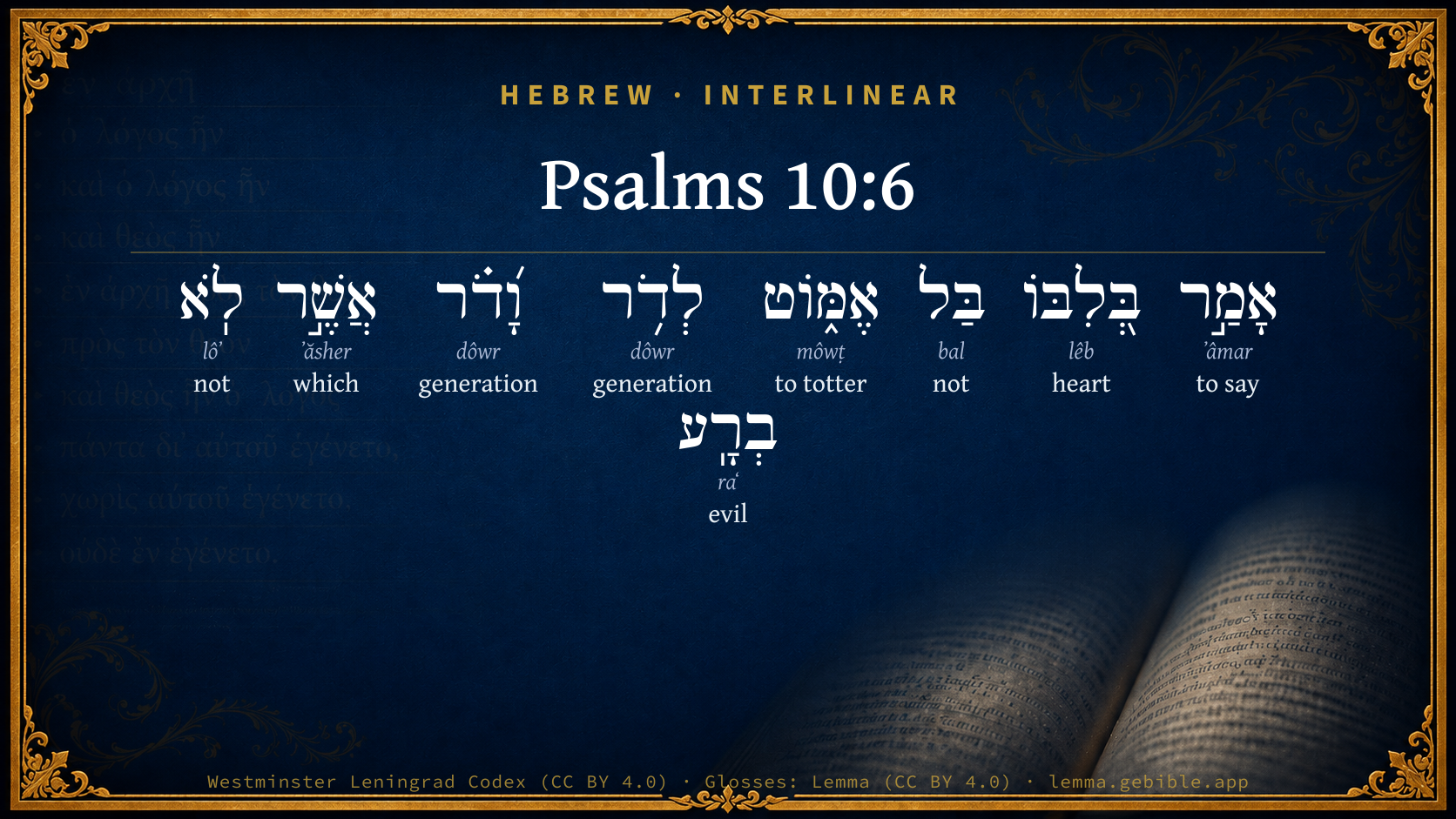
Hebrew (Westminster Leningrad Codex) Psalms 10:6 appears in the Hebrew Old Testament. The text above is from the Westminster Leningrad Codex. Each word links to its Strong’s number, a concise gloss, and parsing drawn from the Open Scriptures Hebrew Bible morphology. Click any word for its full Brown-Driver-Briggs (BDB) entry.
Download image
Cite this verse

Psalms 10:6 (World English Bible). Public Domain. Lemma interlinear Bible study tool, https://lemma.gebible.app/v/psalms/10/6.

Show BibTeX & RIS
BibTeX
RIS
English Translation
He says in his heart, "I shall not be shaken; For generations I shall have no trouble."
World English Bible · Public Domain
Download a study sheet

One document with this verse’s original text, its word-by-word gloss line, the meaning frame, cross-references with their text, attributed commentary, and full source and license credits — printable, and it pastes into notes with its structure intact.

This verse Autodidact and up

Study sheet (.html) Plain text (.txt)

A passage Seminary Student

Up to 50 verses in one chapter. A passage sheet keeps up to 6 commentary sources and 12 cross-references per verse, in the order this page ranks them, and says so on the sheet whenever that leaves anything out. Ask for a single verse and you get the Autodidact verse sheet above.

Everything on this page stays free to read, with no account — the sheet is a download of what is already on screen, not access to it.

Want to remove ads? Support Godless Engineer
Compare translations 3

The same verse in 3 English versions, stacked beneath the original-language interlinear above. Click any original word for its lexicon entry.

Each is an independent rendering of the whole verse — the interlinear is not word-aligned to these translations.

Highlighted words mark where these versions differ — a whole-verse word diff, not a word-by-word alignment.

  • World English Bible Public Domain
    He says in his heart, "I shall not be shaken; For generations I shall have no trouble."
  • King James Version Public Domain
    He hath said in his heart, I shall not be moved: for I shall never be in adversity.
  • unfoldingWord Literal Text CC BY-SA 4.0
    He says in his heart, “I will not be shaken; to generation and generation who not in distress.”

unfoldingWord Literal Text — © unfoldingWord, licensed CC BY-SA 4.0. Word-aligned USFM3 via Door43 (git.door43.org/unfoldingWord/en_ult).

Versions to compare (up to 4)

3 of 4 selected

Show all 17 translations

Every available English version of this verse, each an independent rendering of the whole verse.

  • World English Bible Public Domain
    He says in his heart, "I shall not be shaken; For generations I shall have no trouble."
  • Berean Standard Bible Public Domain
    He says to himself, “I will not be moved; from age to age I am free of distress.”
  • Majority Standard Bible Public Domain
    He says to himself, “I will not be moved; from age to age I am free of distress.”
  • King James Version Public Domain
    He hath said in his heart, I shall not be moved: for I shall never be in adversity.
  • American Standard Version (1901) Public Domain
    He saith in his heart, I shall not be moved; To all generations I shall not be in adversity.
  • Revised Version (1885) Public Domain
    He saith in his heart, I shall not be moved: to all generations I shall not be in adversity.
  • Geneva Bible (1599) Public Domain
    He saith in his heart, I shall neuer be moued, nor be in danger.
  • Young's Literal Translation Public Domain
    He hath said in his heart, `I am not moved,' To generation and generation not in evil.
  • Literal Standard Version CC BY-SA 4.0
    He has said in his heart, “I am not moved, || [And am] not in calamity to generation and generation.”
  • Unlocked Literal Bible CC BY-SA 4.0
    He says in his heart,” I will never fail; throughout all generations I will not meet adversity.”
  • unfoldingWord Literal Text CC BY-SA 4.0
    He says in his heart, “I will not be shaken; to generation and generation who not in distress.”
  • Darby Bible Public Domain
    He saith in his heart, I shall not be moved; from generation to generation I shall be in no adversity.
  • World Messianic Bible Public Domain
    He says in his heart, “I shall not be shaken. For generations I shall have no trouble.”
  • Webster's Bible Public Domain
    He hath said in his heart, I shall not be moved: for I shall never be in adversity.
  • Free Bible Version CC BY-SA 4.0
    They tell themselves, “Nothing bad is going to happen to me. I'll never be in trouble!”
  • Bible in Basic English Public Domain
    He has said in his heart, I will not be moved: through all generations I will never be in trouble.
  • JPS Tanakh (1917) Public Domain
    He saith in his heart: 'I shall not be moved, I who to all generations shall not be in adversity.'

Literal Standard Version (2020), Covenant Press — licensed CC BY-SA 4.0. Text via the HelloAO Bible API (eBible.org). Unlocked Literal Bible (unfoldingWord) — licensed CC BY-SA 4.0. Text via the HelloAO Bible API (eBible.org). unfoldingWord Literal Text — © unfoldingWord, licensed CC BY-SA 4.0. Word-aligned USFM3 via Door43 (git.door43.org/unfoldingWord/en_ult). Free Bible Version, Dr. Jonathan Gallagher — licensed CC BY-SA 4.0. Text via the HelloAO Bible API (eBible.org).

Word by word

More ways to search: Search by grammar → Find every occurrence → Compare this word →

Practice this passage: Drill this verse → Learn its vocabulary →

About this verse

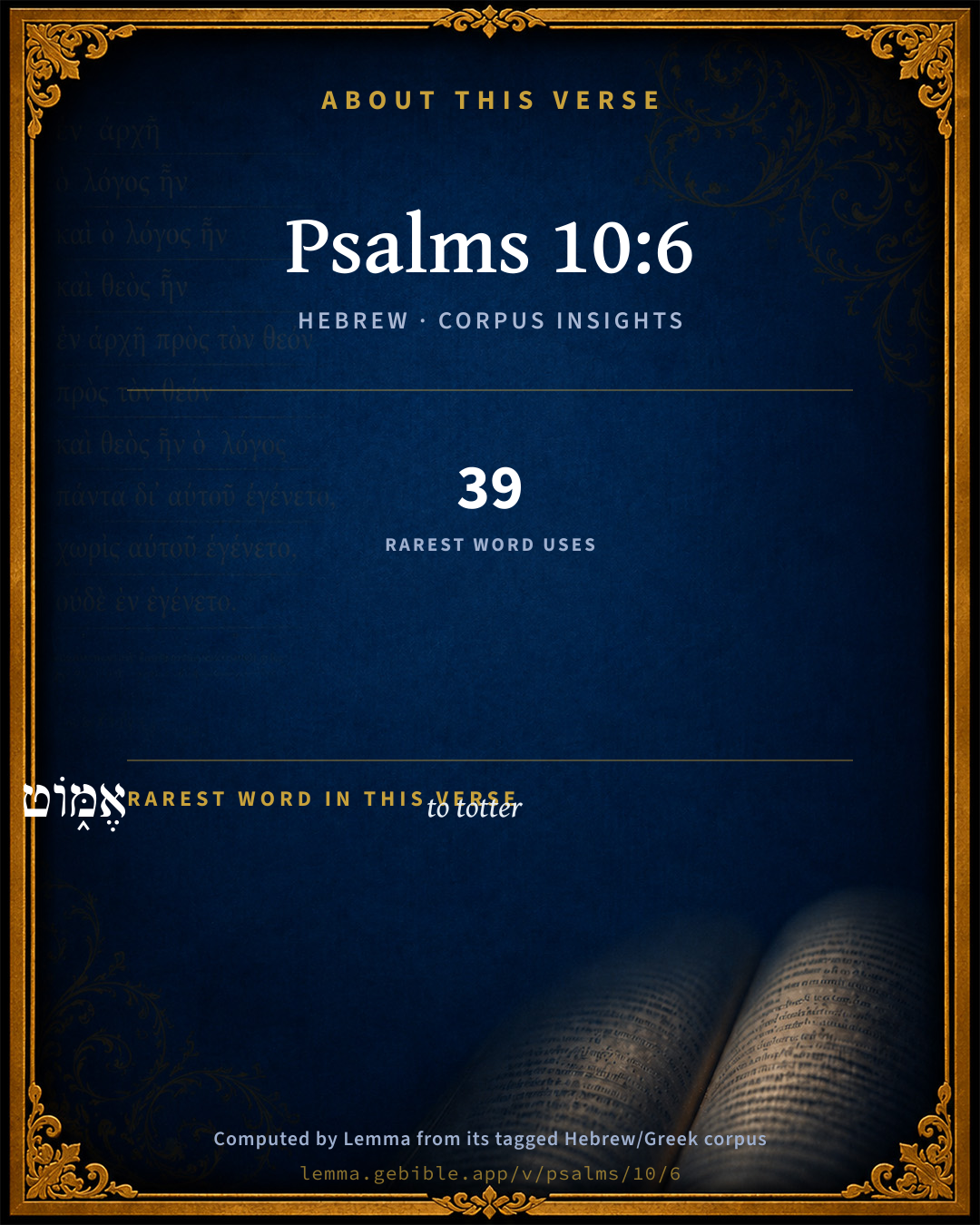
These counts appear in no published source. They are computed here, from the morphology-tagged text and Lemma’s own curated glosses. What Lemma adds →

9
words
8
distinct lemmas
Wisdom
section

Shared distinctive vocabulary

אֶמּ֑וֹט to totter H4131 occurs in 36 verses of the Hebrew Bible. Also found in:

Grammatical profile

  • 2 verbs
  • 3 nouns
  • 1 adjective
  • 3 particles

Verb forms

  • אָמַ֣ר Qal · Perfect
  • אֶמּ֑וֹט Niphal · Imperfect

Repetition

A word recurs within this verse — often emphatic in Hebrew:

  • לְדֹ֥ר generation H1755 ×2

Hebrew & Septuagint length

In English translation the verse runs 17 words from the Hebrew and 21 from the Septuagint (LXX English) — closely comparable.

A rough comparison of the two English renderings, which tokenize alike — not a word-level alignment.

Word counts can differ between the Hebrew and the Greek without any difference in meaning — e.g. the Hebrew direct-object marker אֵת has no separate Greek word, and Greek often adds the article ὁ.

Cross-references

11

Topical passages linked to Psalms 10:6 in the Treasury of Scripture Knowledge — connected by theme and wording, ordered by reader-vote popularity; previews shown in the World English Bible.

  • Ecclesiastes 8:11 Because sentence against an evil work is not executed speedily, therefore the heart of the sons of men is fully set in them to do evil.
  • Isaiah 56:12 Come you, [say they], I will get wine, and we will fill ourselves with strong drink; and tomorrow shall be as this day, [a day] great beyond measure.
  • Matthew 24:48 But if that evil servant should say in his heart, 'My lord is delaying his coming,'
  • Psalms 11:1 In Yahweh, I take refuge. How can you say to my soul, "Flee as a bird to your mountain!"
  • Psalms 14:1 The fool has said in his heart, "There is no God." They are corrupt. They have done abominable works. There is none who does good.
  • Psalms 15:5 He who doesn't lend out his money for usury, Nor take a bribe against the innocent. He who does these things shall never be shaken.
  • Nahum 1:10 For entangled like thorns, and drunken as with their drink, they are consumed utterly like dry stubble.
  • 1 Thessalonians 5:3 For when they are saying, "Peace and safety," then sudden destruction will come on them, like birth pains on a pregnant woman; and they will in no way escape.
  • Revelation 18:7 However much she glorified herself, and grew wanton, so much give her of torment and mourning. For she says in her heart, 'I sit a queen, and am no widow, and will in no way see mourning.'
  • Psalms 30:6 As for me, I said in my prosperity, "I shall never be moved."
  • Isaiah 47:7 You said, I shall be mistress forever; so that you did not lay these things to your heart, neither did remember the latter end of it.

Cross-references courtesy of OpenBible.info (CC BY 4.0).

Hebrew and Greek witnesses Masoretic Hebrew ↔ Greek Septuagint

The same verse in the two great witnesses to the Old Testament, shown verse-for-verse.

You’re reading Greek Psalm 9 (Hebrew Psalm 10). The Septuagint counts the superscription, so verse numbers can differ from the Hebrew — chapter-level alignment, not verse-by-verse. Numbering follows Rahlfs.

These are two independent witnesses, not word-aligned to each other, and the Septuagint is shown in lemma (dictionary) form.

Hebrew Psalms 10:6 Masoretic · Westminster Leningrad Codex

אָמַ֣ר בְּ֭לִבּוֹ בַּל אֶמּ֑וֹט לְדֹ֥ר וָ֝דֹ֗ר אֲשֶׁ֣ר לֹֽא בְרָֽע

He says in his heart, "I shall not be shaken; For generations I shall have no trouble."

World English Bible · Public Domain

Greek LXX Greek Psalm 9:6 Septuagint · lemma form

ἐπιτιμάω ἔθνος καί ἀποὀλλύω ὁ ἀσεβής ὁ ὄνομα αὐτός ἐκἀλείφω εἰς ὁ αἰών καί εἰς ὁ αἰών ὁ αἰών

The swords of the enemy have failed utterly; and you have destroyed cities: their memorial has been destroyed with a noise,

LXX2012 (modern English Septuagint) · Public Domain

On this verse, Ellicott's Commentary for English Readers discusses the Septuagint’s reading. Read the note in Commentary ↓

Hebrew: Westminster Leningrad Codex (CC BY 4.0). Greek: Septuagint (public domain); English from LXX2012 (modern English Septuagint) (Public Domain). How the Septuagint differs from the Hebrew →

Commentary

Notes on Psalms 10:6 from classic Christian and Jewish commentators (each source and its license shown beneath its notes). The classic Christian expositions comment on the surrounding passage and are grouped to its opening verse, so a note may address several verses; the Jewish commentaries on the Tanakh (Rashi and others) are per-verse, so they appear only where the commentator wrote on this verse.

Lemma curates 59 commentaries, every one of them public domain or Creative Commons licensed, each selected and text-cleaned for this edition rather than reprinted as found. About our sources →

Trapp's Complete Commentary

John Trapp

Psa 10:6 He hath said in his heart, I shall not be moved: for [I shall] never [be] in adversity.

Ver. 6. He hath said in his heart, I shall not be moved] So said a better man once, Psa 30:6, but he was quickly confuted. If a believer conclude, by the force of his faith, that he shall never be moved from that good estate in which Christ hath set him, this is the triumph of trust, and not the vain vaunt of presumption.

For I shall never be in adversity] The Chaldee hath it, Quoniam non sum in malo; and understandeth it as the evil of sin, as Exo 32:22, and then the sense is, because the wicked man suffereth not the punishment of sin, therefore he conceiveth that he is innocent, and without sin. See Hos 12:8, {See Trapp on "Hos 12:8"}

John Trapp, A Commentary or Exposition upon All the Books of the Old and New Testament (1647–1656) — public domain. Text from a community e-Sword module.

The Biblical Illustrator

Joseph S. Exell

Psa_10:6

The wicked hath said in his heart, I shall not be moved.

Godless confidence--its mad arrogance

The wicked man said a good many wrong things in his heart. The tacit assumptions on which a life is based, though they may never come to consciousness, and still less to utterance, are the really important things. I daresay this wicked man with his lips was a good Jew, and said his prayers all properly, but in his heart he had two working beliefs. One is thus expressed, As for all his enemies, he puffeth at them. He hath said in his heart, I shall not be moved. The other is put into words thus, He hath said in his heart, God hath forgotten, He hideth His face, He will never see it. That is to say, the only explanation of a godless life, unless the man is an idiot, is that there lie beneath it, as formative principles and unspoken assumptions, guiding and shaping it, one or both of these two thoughts--either There is no God, or He does not care what I do, and I am safe to go on for evermore in the present fashion. It might seem as if a man, with the facts of human life before him, could not, even in the insanest arrogance, say, I shall not be moved, for I shall never be in adversity. But we have an awful power--and the fact that we exercise, and choose to exercise, it is one of the strange riddles of our enigmatical existence and characters--of ignoring unwelcome facts, and going cheerily on as though we had annihilated them, because we do not reflect upon them. So this man, in the midst of a world in which there is no stay, and whilst he saw all around him the most startling and tragical instances of sudden change and complete collapse, stands quietly and says, Ah! I shall never be moved; God doth not require it. That absurdity is the basis of every life that is not a life of consecration and devotion--so far as it has a basis of conviction at all. The wicked mans true faith is this, absurd as it may sound when you drag it out into clear distinct utterance, whatever may be his professions. I wonder if there are any of us whose life can only be acquitted of being utterly unreasonable and ridiculous, by the assumption, I shall never be moved. Have you a lease of your goods? Do you think you are tenants at will, or owners? Which? Is there any reason why any of us should escape, as some of us live as if we believed we should escape, the certain fate of all others? If there is not, what about the sanity of the man whose whole life is built upon a blunder? He is convicted of the grossest folly, unless he be assured that either there is no God, or that He does not care one rush about what we do, and that consequently we are certain of a continuance in our present state. Do you say in your heart, I shall never be moved? Then you must be strong enough to resist every tempest that beats against you. Is that so? I shall never be moved. Then nothing that contributes to your well-being will ever slip from your grasp, but you will be able to hold it tight. Is that so? I shall never be moved. Then there is no grave waiting for you. Is that so? Unless these three assumptions be warranted, every godless man is making a hideous blunder, and his character is the sentence pronounced by the loving lips of incarnate truth on the rich man who thought that he had much goods laid up for many years, and had only to be merry--Thou fool! Thou fool! If an engineer builds a bridge across a river without due calculation of the force of the winds that blow down the gorge, the bridge will be at the bottom of the stream some stormy night, and the train piled on the fragments of it in hideous ruin. And with equal certainty the end of the first utterer of this speech can be calculated, and is foretold in this Psalm, The Lord is King forever and ever. The godless are perished out of the land. (A. Maclaren, D. D.)

The false security of the wicked

Carnal security opens the door for all impiety to enter into the soul. Pompey, when he had in vain assaulted a city and could not take it by: force, devised this stratagem in way of agreement; he told them he would leave the siege and make peace with them, upon condition that they would let in a few weak, sick, and wounded soldiers among them to be cured. They let in the soldiers, and when the city was secure the soldiers let in Pompeys army. A carnal settled security will let in a whole army of lusts into the soul. (Thomas Brooks.)

The Biblical Illustrator, edited by Joseph S. Exell (c. 1880s–1900s) — public domain. Text from a community e-Sword module.

Joseph Benson's Commentary

Psa 10:6. He hath said in his heart — He thinks and persuades himself; I shall not be moved — From my place and happy state: I shall never be in adversity — Because I am not in adversity, I never shall be in it. His present prosperity makes him secure for the future. Compare Rev 18:7. “Prosperity,” says Dr. Horne, “begets presumption, and he who has been long accustomed to see his designs succeed, begins to think it impossible they should ever do otherwise. The long-suffering of God, instead of leading such a one to repentance, only hardens him in his iniquity.”

Joseph Benson's Commentary on the Old and New Testaments (1811–1818) — public domain. Text from a community e-Sword module.

MacLaren's Expositions of Holy Scripture

Alexander MacLaren

Psalms

ONE SAYING FROM THREE MEN

Psa 10:6. - Psa 16:8. - Psa 30:6.

How differently the same things sound when said by different men! Here are three people giving utterance to almost the same sentiment of confidence. A wicked man says it, and it is insane presumption and defiance. A good man says it, having been lulled into false security by easy times, and it is a mistake that needs chastisement. A humble believing soul says it, and it is the expression of a certain and blessed truth. ‘The wicked saith in his heart, I shall not be moved.’ A good man, led astray by his prosperity, said, ‘I shall not be moved,’ and the last of the three put a little clause in which makes all the difference, ‘because He is at my right hand, I shall never be moved.’ So, then, we have the mad arrogance of godless confidence, the mistake of a good man that needs correction, and the warranted confidence of a believing soul.

I. The mad arrogance of godless confidence.

The ‘wicked’ man, in the psalm from which our first text comes, said a good many wrong things ‘in his heart.’ The tacit assumptions on which a life is based, though they may never come to consciousness, and still less to utterance, are the really important things. I dare say this ‘wicked man’ was a good Jew with his lips, and said his prayers all properly, but in his heart he had two working beliefs. One is thus expressed: ‘As for all his enemies, he puffeth at them. He hath said in his heart, I shall not be moved.’ The other is put into words thus: ‘He hath said in his heart, God hath forgotten, He hideth His face. He will never see it.’

That is to say, the only explanation of a godless life, unless the man is an idiot, is that there lie beneath it, as formative principles and unspoken assumptions, guiding and shaping it, one or both of these two thoughts: either ‘There is no God,’ or ‘He does not care what I do, and I am safe to go on for evermore in the present fashion.’ It might seem as if a man with the facts of human life before him, could not, even in the insanest arrogance, say, ‘I shall not be moved, for I shall never be in adversity.’ But we have an awful power-and the fact that we exercise, and choose to exercise, it is one of the strange riddles of our enigmatical existence and characters-of ignoring unwelcome facts, and going cheerily on as though we had annihilated them, because we do not reflect upon them. So this man, in the midst of a world in which there is no stay, and whilst he saw all round him the most startling and tragical instances of sudden change and complete collapse, stands quietly and says, ‘Ah! I shall never be moved’; ‘God doth not require it.’

That absurdity is the basis of every life that is not a life of consecration and devotion-so far as it has a basis of conviction at all. The ‘wicked’ man’s true faith is this, absurd as it may sound when you drag it out into clear, distinct utterance, whatever may be his professions. I wonder if there are any of us whose life can only be acquitted of being utterly unreasonable and ridiculous by the assumption, ‘I shall never be moved’?

Have you a lease of your goods? Do you think you are tenants at will or owners? Which? Is there any reason why any of us should escape, as some of us live as if we believed we should escape, the certain fate of all others? If there is not, what about the sanity of the man whose whole life is built upon a blunder? He is convicted of the grossest folly, unless he be assured that either there is no God, or that He does not care one rush about what we do, and that consequently we are certain of a continuance in our present state.

Do you say in your heart, ‘I shall never be moved’? Then you must be strong enough to resist every tempest that beats against you. Is that so? ‘I shall never be moved’-then nothing that contributes to your well-being will ever slip from your grasp, but you will be able to hold it tight. Is that so? ‘I shall never be moved’-then there is no grave waiting for you. Is that so? Unless these three assumptions be warranted, every godless man is making a hideous blunder, and his character is the sentence pronounced by the loving lips of Incarnate Truth on the rich man who thought that he had ‘much goods laid up for many years,’ and had only to be merry-’Thou fool! Thou fool!’ If an engineer builds a bridge across a river without due calculation of the force of the winds that blow down the gorge, the bridge will be at the bottom of the stream some stormy night, and the train piled on the fragments of it in hideous ruin. And with equal certainty the end of the first utterer of this speech can be calculated, and is foretold in the psalm, ‘The Lord is King for ever and ever. . . . The godless are perished out of the land.’

II. We have in our second text the mistake of a good man who has been lulled into false confidence.

The Psalmist admits his error by the acknowledgment that he spoke ‘in my prosperity’; or, as the word might be rendered, ‘in my security.’ This suggests to us the mistake into which even good men, lulled by the quiet continuance of peaceful days, are certain to fall, unless there be continual watchfulness exercised by them.

It is a very significant fact that the word which is translated in our Authorised Version ‘prosperity’ is often rendered ‘security,’ meaning thereby, not safety, but a belief that I am safe. A man who is prosperous, or at ease, is sure to drop into the notion that ‘to-morrow will be as this day, and much more abundant,’ unless he keeps up unslumbering watchfulness against the insidious illusion of permanence. If he yields to the temptation, in his foolish security, forgetting how fragile are its foundations, and what a host of enemies surround him threatening it, then there is nothing for it but that the merciful discipline, which this Psalmist goes on to tell us he had to pass through by reason of his fall, shall be brought to bear upon him. The writer gives us a page of his own autobiography. ‘In my security I said, I shall never be moved.’ ‘Lord! by Thy favour Thou hast made my mountain to stand strong. Thou didst hide Thy face.’ What about the security then? What about ‘I shall never be moved’ then? ‘I was troubled. I cried to Thee, O Lord!’-and then it was all right, his prayer was heard, and he was in ‘security’-that is, safety-far more really when he was ‘troubled’ and sore beset than when he had been, as he fancied, sure of not being moved.

Long peace rusts the cannon, and is apt to make it unfit for war. Our lack of imagination, and our present sense of comfort and well-being, tend to make us fancy that we shall go on for ever in the quiet jog-trot of settled life without any very great calamities or changes. But there was once a village at the bottom of the crater of Vesuvius, and great trees, that had grown undisturbed there for a hundred years, and green pastures, and happy homes and flocks. And then, one day, a rumble and a rush, and what became of the village? It went up in smoke-clouds. The quiescence of the volcano is no sign of its extinction. And as surely as we live, so sure is it that there will come a ‘to-morrow’ to us all which shall not be as this day. No man has any right to calculate upon anything beyond the present moment, and there is no basis whatever, either for the philosophical assertion that the order of nature is fixed, and that therefore there are no miracles, or for the practical translation of the assertion into our daily lives, that we may reasonably expect to go on as we are without changes or calamities. There is no reason capable of being put into logical shape for believing that, because the sun has risen ever since the beginning of things, it will rise to-morrow, for there will come a to-morrow when it will not rise. In like manner, the longest possession of our mercies is no reason for forgetting the precarious tenure on which we hold them all.

So, Christian men and women! let us try to keep vivid that consciousness which is so apt to get dull, that nothing continueth in one stay, and that we shall be moved, as far as the outward life and its circumstances are concerned. If we forget it, we shall need, and we shall get, the loving Fatherly discipline, which my second text tells us followed the false security of this good man. The sea is kept from putrefying by storms. Wine poured from vessel to vessel is purified thereby. It is an old truth and a wholesome one, to be always remembered, ‘because they have no changes therefore they fear not God .’

III. Lastly, we have the same thing said by another man in another key.

‘Because He is at my right hand, I shall not be moved.’ The prelude to the assertion makes all the difference. Here is the warranted confidence of a simple faith.

The man who clasps God’s hand, and has Him standing by his side, as his Ally, his Companion, his Guide, his Defence-that man does not need to fear change. For all the things which convict the arrogant or mistaken confidences of the other men as being insanity or a lapse from faith prove the confidence of the trustful soul to be the very perfection of reason and common sense.

We may be confident of our power to resist anything that can come against us, if He be at our side. The man that stands with his back against an oak-tree is held firm, not because of his own strength, but because of that on which he leans. There is a beautiful story of some heathen convert who said to a missionary’s wife, who had felt faint and asked that she might lean for a space on her stronger arm, ‘If you love me, lean hard.’ That is what God says to us, ‘If you love Me, lean hard.’ And if you do, because He is at your right hand, you will not be moved. It is not insanity; it is not arrogance; it is simple faith, to look our enemies in the eyes, and to feel sure that they cannot touch us, ‘Trust in Jehovah; so shall ye be established.’ Rest on the Lord, and ye shall rest indeed.

In like manner the man who has God at his right hand may be sure of the unalterable continuance of all his proper good. Outward things may come or go, as it pleases Him, but that which makes the life of our life will never depart from us as long as He stands there. And whilst He is there, if only our hearts are knit to Him, we can say, ‘My heart and my flesh faileth, but God is the strength of my heart, and my portion for ever. I shall not be moved. Though all that can go goes, He abides; and in Him I have all riches.’ Trust not in the uncertainty of outward good, but in the living God, who giveth us richly all things to enjoy.

The wicked man was defiantly arrogant, and the forgetful good man was criminally self-confident, when they each said, ‘I shall not be moved.’ We are only taking up the privileges that belong to us if, exercising faith in Him, we venture to say, ‘Take what Thou wilt; leave me Thyself; I have enough.’ And the man who says, ‘Because God is at my right hand, I shall not be moved,’ has the right to anticipate an unbroken continuance of personal being, and an unchanged continuance of the very life of his life. That which breaks off all other lives abruptly is no breach in the continuity, either of the consciousness or of the avocations of a devout man. For, on the other side of the flood, he does what he does on this side, only more perfectly and more continually. ‘He that doeth the will of God abideth for ever,’ and it makes comparatively little difference to him whether his place be on this or on the other side of Jordan. We ‘shall not be moved,’ even when we change our station from earth to heaven, and the sublime fulfilment of the warranted confidence of the trustful soul comes when the ‘to-morrow’ of the skies is as the ‘to-day’ of earth, only ‘much more abundant.’

Alexander MacLaren, Expositions of Holy Scripture (1904–1910) — public domain. Text from a community e-Sword module.

Tyndale Open Study Notes

Tyndale Open Resources

10:6-7 Despite their evil ways (5:9; 28:3; Rom 3:14), the wicked expect a future free of trouble such as the righteous will enjoy.

Tyndale Open Study Notes — © Tyndale Open Resources, licensed CC BY-SA 4.0. Text via the HelloAO Bible API.

Geneva Bible (1599)

Geneva Bible translators

The evil shall not touch me, Isa. 28:15, or else he speaketh thus because he never felt evil.

Or, not be moved, because he was never in evil.

Geneva Bible (1599) marginal notes — public domain. Text via Bolls.life.

Adam Clarke's Commentary

Verse 6. I shall not be moved] I have whatever I covet. I hold whatsoever I have gotten. I have money and goods to procure me every gratification.

Adam Clarke's Commentary on the Bible (1810–1826) — public domain. Text from a community e-Sword/MySword module.

John Calvin's Commentaries

The Psalmist confirms these statements in the next verse, where he tells us that the persons of whom he speaks are fully persuaded in their hearts that they are beyond all danger of change. He saith in his heart, I shall not be moved from generation to generation The ungodly often pour forth proud language to this effect. David, however, only touches the hidden ulcer of their vile arrogance, which they cherish in their own breasts, and therefore he does not say what they speak with their mouth, but what they persuade themselves of in their hearts. It may here be asked, Why does David blame in others what he professes concerning himself in so many places? Psalm 3:7; 23:4; 27:3, etc. — Fr.

“Il ose dire hardiment qu’il ne redoute nuls dangers et les desfie tous.” — Fr. “He courageously declares that he is not afraid of any dangers, and defies them all.”

“Et se fait a croire qu’il sera tousjours a son aise et repos.” — Fr.

“Toutesfois pource qu’il s’appuye du tout sur la grace de Dieu, et s’y confie, porte patienment toutes molestes et ennuis et se console en ses afflictions.” — Fr.

“Se retirent de bonne heure vers la grace de Dieu pour se mettre au sauvete comme en un lien de refuge et asseurance.”— Fr. “Betake themselves with all haste to the grace of God, to put themselves in safety as in a place of refuge and security.”

“Au bruit des fueilles qui tombent des arbres.” — Fr. “At the noise of leaves falling from the trees.”

“When the overflowing scourge shall pass through, it shall not come upon us.”

John Calvin's Commentaries (1540-1563) — public domain. Text from the Calvin Translation Society English edition (1840s-50s) via the Christian Classics Ethereal Library (ccel.org). Calvin's coverage is partial (roughly two-thirds of the Bible); uncommented books and verses are honest gaps, never fabricated. The 19th-century editor's footnotes and remarks are omitted so the notes are faithfully Calvin's own voice.

Ellicott's Commentary for English Readers

(6) I shall not.—The meaning of the verse is clear, but the construction is involved. Literally, I shall not be moved to generation and generation, which not in evil. The LXX. and Vulg. omit the relative altogether. The best rendering is, “I shall never be moved at any time: I who am without ill.”

A Bible Commentary for English Readers, edited by Charles John Ellicott (1878–1897) — public domain. Text from a community e-Sword module.

The Cambridge Bible for Schools and Colleges

gen. ed. J. J. S. Perowne

6. He hath said] R.V. he saith, and so in Psa_10:11; Psa_10:13. He presumes in his carnal self-confidence to use language which the righteous man employs in faithful dependence upon God (Psa_16:8, &c.).

for I shall never &c.] R.V., To all generations I shall not be in adversity. Hardly in the sense that “pride stifles reason,” and “he expects to live for ever” (Cheyne); but rather that he identifies his descendants with himself, and looks forward to the uninterrupted continuance of their prosperity. Cp. Psa_49:11; and the promise to the righteous man in Psa_37:27-29.

The Cambridge Bible for Schools and Colleges (gen. ed. J. J. S. Perowne; Cambridge University Press, 1878–1918) — public domain. Text from a community e-Sword module.

John Gill's Exposition

He hath said in his heart,.... To and within himself, he thought in his own mind; for the thought is the word or speech of the mind, ;

I shall not be moved; from his prosperous and happy condition, abounding: with riches and honours; from his seat of empire, over kings, princes, and the nations of the world; flattering himself that it would never be otherwise with him than it is: even "to generation and generation", I shall not be moved; so the words may be rendered;

for I shall never be in adversity, or "in evil" (d): meaning either the evil of sin; so asserting his innocence, wiping himself clean of all iniquity, claiming to himself the title of "holiness" itself, and the character of infallibility; giving out that he is impeccable, and cannot err; when he is not only almost, but altogether, in all evil; and is , the lawless and wicked one, the man of sin, who is nothing but sin itself. The Targum paraphrases the whole thus; "I shall not be moved from generation to generation from doing evil"; and so it is a boast of impiety, and that none can restrain him from it, no one having a superior power over him; see Psa 12:4. Or the evil of affliction, or calamity; wherefore we render it "adversity", so Jarchi and Aben Ezra understand it: the note of the former is,

"evil shall not come upon me in my generation,''

or for ever; and the latter compares it with Num 11:15; Kimchi and Ben Melech interpret it of long life. It is a vaunt of antichrist, promising himself a continuance of his grandeur, ease, peace, and prosperity; in which he will be wretchedly disappointed. The language and sense are much the same with that of the antichristian Babylon, Rev 18:7.

(d) "in malo", Montanus, Junius & Tremellius, Piscator, Cocceius, Gejerus; so Ainsworth.

John Gill's Exposition of the Whole Bible (1746–1763) — public domain (CC PDM 1.0). Text via the HelloAO Bible API.

Albert Barnes' Notes on the Bible

He hath said in his heart - The phrase, “he hath said,” means that this was his deliberate and settled character. What is here described was no sudden thing. It was not the freak of passion; it was a deliberately-formed purpose. The phrase, “in his heart,” means that he had purposed this; he had said this to himself in a spirit of self-gratulation and confidence.

I shall not be moved - That is, he was confident in his present condition, and he apprehended no changes. He had formed his plans so wisely, that he believed he had nothing to apprehend; he feared neither sickness nor adversity; he dreaded not the power of his enemies; he feared nothing even from the providence of God; he supposed that he had laid the foundation for permanent prosperity. This feeling of self-confidence and of security is sometimes found, to an extent that cannot be justified, in the hearts of even good people (compare the note at Job 29:18); and it is common among the wicked. See Psa 49:11; Job 21:9.

For I shall never be in adversity - Margin, “unto generation and generation.” The margin expresses the correct sense. The idea of the wicked, as expressed here, is that they and their families would continue to be prosperous; that a permanent foundation was laid for honor and success, and for transmitting accumulated wealth and honors down to far distant times. It is a common feeling among wicked men that they can make permanent their titles, and possessions, and rank, and that nothing will occur to reduce them to the humble condition of others. Nothing more cleverly shows the pride and atheism of the heart than this; and in nothing are the anticipations and plans of human beings more signally disappointed. Compare the case of Shebna; see the note at Isa 22:15 ff.

Albert Barnes' Notes on the Bible (1834–1885) — public domain. Text from a community e-Sword/MySword module.

Matthew Poole's English Annotations

He hath said in his heart; he thinketh or persuadeth himself. I shall not be moved; or, removed, to wit, from my place and happy state.

For I shall never be in adversity; or, because I am not in adversity, therefore I never shall be in it. His present prosperity makes him secure for the future. Compare Rev 18:7. Or, yea, (for this particle sometimes hath no other signification or use but only to amplify or aggravate, as it is also taken 1Sa 15:20; 24:11) I shall never be in evil. So the sense of the place is, I shall not only be kept from total ruin, or a removal from my place and estate, but I shall not meet with the least cross or trouble. For this evil is not the evil of sin, as some here understand it, in which he knew that he was, and was resolved, ever to continue; but the evil of punishment, which was the only thing that he feared or regarded.

Matthew Poole's English Annotations on the Holy Bible (1683–1685) — public domain. Text from a community e-Sword/MySword module.

The Treasury of David

Charles H. Spurgeon

Ver. 6. The testimony of the sixth verse concludes the evidence against the prisoner upon the first charge of pride, and certainly it is conclusive in the highest degree. The present witness has been prying into the secret chambers of the heart, and has come to tell us what he has heard.

He hath said in his heart, I shall not be moved: for I shall never be in adversity. O impertinence runs to seed! The man thinks himself immutable, and omnipotent too, for he, he is never to be in adversity. He counts himself a privileged man. He sits alone, and shall see no sorrow. His nest is in the stars, and he dreams not of a hand that shall pluck him thence. But let us remember that this man's house is built upon the sand, upon a foundation no more substantial than the rolling waves of the sea. He that is too secure is never safe. Boastings are not buttresses, and self confidence is a sorry bulwark. This is the ruin of fools, that when they succeed they become too big, and swell with self conceit, as if their summer would last for ever, and their flowers bloom on eternally. Be humble, O man! for thou art mortal, and thy lot is mutable. The second crime is now to be proved. The fact that the man is proud and arrogant may go a long way to prove that he is vindicative and cruel. Haman's pride was the father of a cruel design to murder all the Jews. Nebuchadnezzar builds an idol; in pride he commands all men to bow before it; and then cruelly stands ready to heat the furnace seven times hotter for those who will not yield to his imperious will. Every proud thought is twin brother to a cruel thought. He who exalts himself will despise others, and one step further will make him a tyrant.

Ver. 6. He hath said in his heart, I shall not be moved: for I shall never be in adversity. Carnal security opens the door for all impiety to enter into the soul. Pompey, when he had in vain assaulted a city, and could not take it by force, devised this stratagem in way of agreement; he told them he would leave the siege and make peace with them, upon condition that they would let in a few weak, sick, and wounded soldiers among them to be cured. They let in the soldiers, and when the city was secure, the soldiers let in Pompey's army. A carnal settled security will let in a whole army of lusts into the soul. Thomas Brooks.

Ver. 6. He hath said in his heart, I shall not be moved: for I shall never be in adversity. To consider religion always on the comfortable side; to congratulate one's self for having obtained the end before we have made use of the means; to stretch the hands to receive the crown of righteousness before they have been employed to fight the battle; to be content with a false peace, and to use no effort to obtain the graces to which true consolation is annexed: this is a dreadful calm, like that which some voyagers describe, and which is a very singular forerunner of a very terrible event. All on a sudden, in the wide ocean, the sea becomes calm, the surface of the water clear as a crystal, smooth as glass the air serene; the unskilled passenger becomes tranquil and happy, but the old mariner trembles. In an instant the waves froth, the winds murmur, the heavens kindle, a thousand gulfs open, a frightful light inflames the air, and every wave threatens sudden death. This is an image of many men's assurance of salvation. James Saurin, 1677-1730.

Ver. 6. The vain confidence of sinners.

Charles H. Spurgeon's The Treasury of David (1869–1885) — public domain. Psalms only. Text from a community e-Sword/MySword module.

Whedon's Commentary on the Bible

Daniel D. Whedon

6. Never be in adversity—To generation and generation I shall not be in evil: not be troubled.

Daniel D. Whedon (gen. ed.), Commentary on the Old and New Testaments (1874–1909) — public domain. Text from a community e-Sword module.

The Pulpit Commentary

He hath said in his heart, I shall not be moved. (comp. Psa_30:6) The idea of continuance is instinctive in the human mind. "The thing that has been, it is that which shall be". (Ecc_1:9) We expect the sun to rise each day, solely because in the past it has always risen (see Butler"s "Analogy," part 1. ch. 1). The wicked man, who has always prospered, expects to prosper in the future; he has no anticipation of coming change; he supposes that his "house will continue for ever, dud his dwelling-place to all generations"; (Psa_49:11) he thinks that "tomorrow will be as to-day, and much more abundant". (Isa_56:12) For I shall never be in adversity; rather, unto generation and generation, I am he who will be exempt from calamity. The wicked man has no thought of dying he will be prosperous, he thinks, age after age.

The Pulpit Commentary (1880–1919), ed. H.D.M. Spence-Jones & Joseph S. Exell — public domain. Text from a community e-Sword module.

Keil & Delitzsch

C. F. Keil & F. Delitzsch

Then in his boundless carnal security he gives free course to his wicked tongue. That which the believer can say by reason of his fellowship with God, בּל־אמּוט (Psa 30:7; Psa 16:8), is said by him in godless self-confidence. He looks upon himself in age after age, i.e., in the endless future, as אשׁר לא ברע, i.e., as one who (אשׁר as in Isa 8:20) will never be in evil case (ברע as in Exo 5:19; Sa2 16:8). It might perhaps also be interpreted according to Zac 8:20, Zac 8:23 (vid., Kצhler, in loc.): in all time to come (it will come to pass) that I am not in misfortune. But then the personal pronoun (אני or הוּא) ought not be omitted; whereas with our interpretation it is supplied from אמּוט, and there is no need to supply anything if the clause is taken as an apposition: in all time to come he who.... In connection with such unbounded self-confidence his mouth is full of אלה, cursing, execratio (not perjury, perjurium, a meaning the word never has), מרמות, deceit and craft of every kind, and תּך, oppression, violence. And that which he has under his tongue, and consequently always in readiness for being put forth (Psa 140:4, cf. Psa 66:17), is trouble for others, and in itself matured wickedness. Paul has made use of this Psa 10:7 in his contemplative description of the corruptness of mankind, Rom 3:14.

Keil & Delitzsch — Biblical Commentary on the Old Testament (1861–1891) — public domain (CC PDM 1.0). Text via the HelloAO Bible API. (Old Testament only.)

J. A. Alexander on Psalms

Joseph Addison Alexander

6. He hath said in his heart, I shall not be moved; to generation and generation, (I am one) who (shall) not (be) in evil, or as the same Hebrew phrase is rendered in the English version of Exo 5:19, in evil case, i.e. in trouble, in distress. This is a natural expression of the proud security engendered in the natural man by great prosperity. He hath said, implying that the cause has already been in operation long enough to shew its natural effect. In his heart, to himself, in a spirit of self-gratulation and self-confidence. To age and age, throughout all ages or all generations. The strength of this expression shews that the speaker is not a real person, but the ideal type of a whole class. The sinner, who thus says in his heart, is not the sinner of one period or country, but the sinner of all times and places, one who never disappears, or ceases thus to feel and act. —The form of the last clause in Hebrew is peculiar and emphatic. He does not simply say, I shall never be in evil or adversity, but I am he, I am the man, who shall never be in evil, as if the very supposition of such a contingency, however justified by general experience, would be not only groundless but absurd in this one case. (Compare Isa 47:8-10.) There could scarcely be a stronger expression of the self-relying spirit of the sinner, as contrasted with the saints' implicit confidence in God's will and power, not only to preserve him from falling, but to raise him when he does fall.

Joseph Addison Alexander, The Psalms Translated and Explained (1850) — public domain. Text from a community e-Sword module.

unfoldingWord translationNotes

Door43 World Missions Community

He says

"The wicked man says"

throughout all generations

This probably simply means "forever."

I will not meet adversity

Experiencing adversity is spoken of as meeting it. AT: "I will not have any troubles" (See: Metaphor)

His mouth is full of cursing and deceptive, harmful words

What people say is spoken of as being in their mouth. AT: "He always curses people and says things that are deceptive and harmful" or "He always curses people, tells lies, and threatens to harm people" (See: Metonymy)

his tongue injures and destroys

Here the tongue represents speaking. AT: or "what he says injures and destroys people" or "he speaks words that threaten and hurt people" (See: Metonymy)

translationWords

heart

generation

deceive

tongue

unfoldingWord translationNotes — © Distant Shores Media and the Door43 World Missions Community, licensed CC BY-SA 4.0. Source: git.door43.org/Door43/en_tn.

Rashi

Rabbi Shlomo Yitzchaki (Rashi)

“for all generations I will not be in adversity” Adversity will not befall me throughout my generations.

Rashi on the Tanakh — English translations: “The Judaica Press complete Tanach with Rashi, translated by A. J. Rosenberg” (CC BY 4.0); “Pentateuch with Rashi's commentary by M. Rosenbaum and A.M. Silbermann, 1929-1934” (public domain); “The Metsudah Tanach series, Lakewood, N.J” (CC BY 4.0); and “The Book of Joshua, Metsudah Publications, 1997” (CC BY 4.0). Text via Sefaria.

Radak

Rabbi David Kimhi (Radak)

He says in his heart, I shall not be moved: – He thinks in his heart I shall not ever be moved; I shall never be moved from my greatness.

generation after generation not be in adversity: – For generation after generation shall I live, for I shall not be in, nor see, adversity; therefore I shall live a long time.

Radak on the Tanakh — English translations: “Sefaria Community Translation” (CC0 1.0 (public-domain dedication)); “Eliyahu Munk, HaChut Hameshulash” (CC BY 4.0); “Rabbi Mike Feuer, Jerusalem Anthology” (CC BY 4.0); and “R. David Kimhi on the first book of Psalms, Translated by R.G. Finch, London, 1919” (public domain). Text via Sefaria.

Lesson kit

Teaching starters — assembled from the data on this page, not authored interpretation. Every prompt links to the verse data it draws on. Edit before teaching.

Psalms, in the Wisdom, opens this verse with 9 words (8 distinct Hebrew lemmas). Its most distinctive word is môwṭ (“to totter”). A historical commentator’s framing appears above. Read the whole chapter for the surrounding context.

Discussion questions

  1. How does “to totter” (môwṭ) shape what this verse is saying?
  2. How does Leviticus 25:35, which shares the word «to totter», read alongside this verse?
  3. What does the repetition of “generation” (2× in this one verse) do in this verse?
  4. These translations render this verse differently. What is at stake in choosing one wording over another?
  5. «אָמַ֣ר» is a Qal Perfect verb. How does that grammatical form shape the action described?
  6. Compare how Trapp's Complete Commentary and The Biblical Illustrator read this verse. Where do they agree or differ?

Things to notice

  • These translations choose different wording for 14 words in this verse.
  • “generation” occurs 2× in this single verse.
  • 8 distinct Hebrew lemmas span 9 words in this verse.

Reading settings

Reading text

Shown beneath each verse's original-language words.

Old Testament
Old Testament edition

Read the OT as the Masoretic Hebrew (MT) or the Greek Septuagint (LXX).

English shown for the Greek Septuagint (in the Hebrew ↔ Greek comparison).

Comparing translations? Open the Compare panel on any verse page to stack up to four side by side.