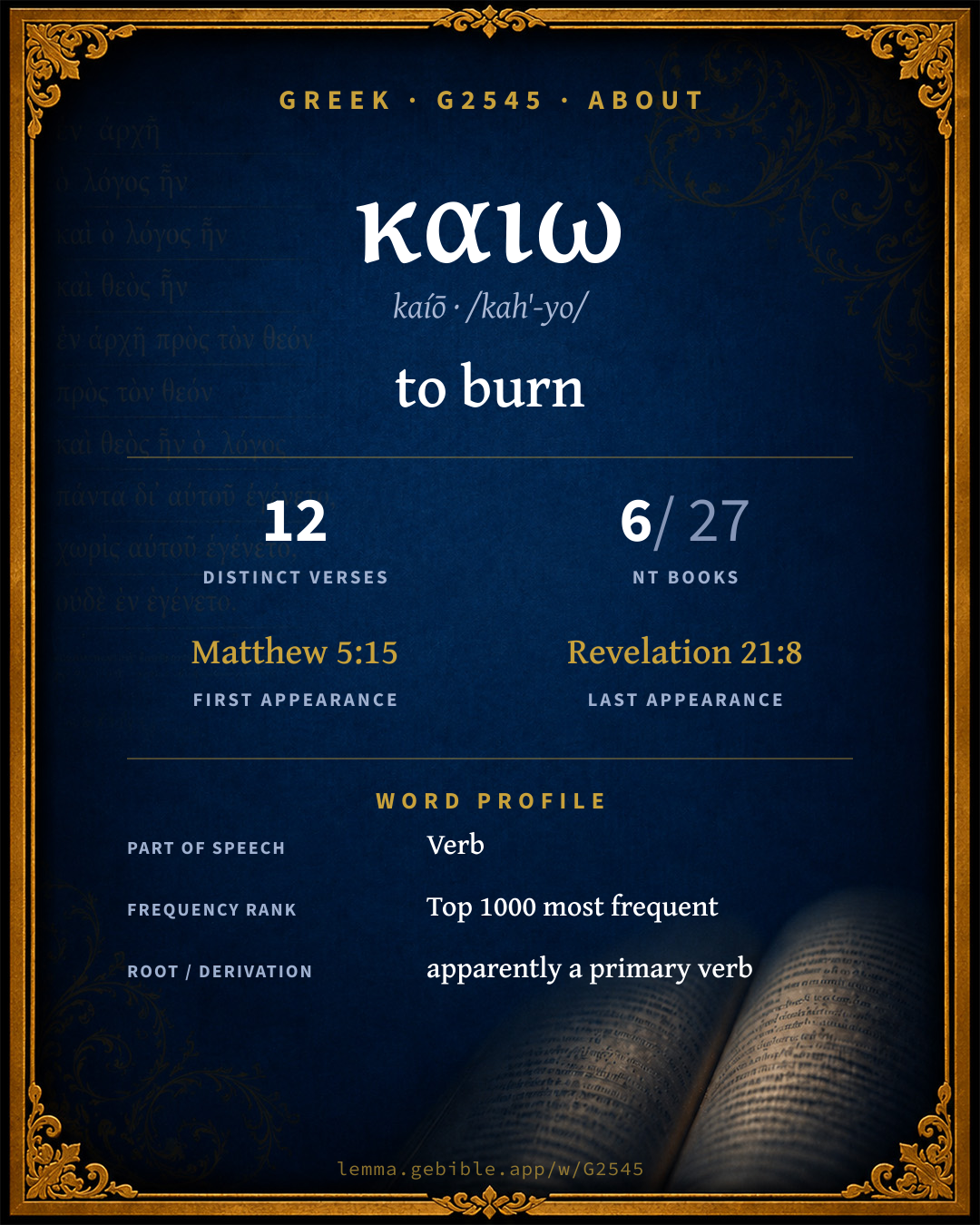
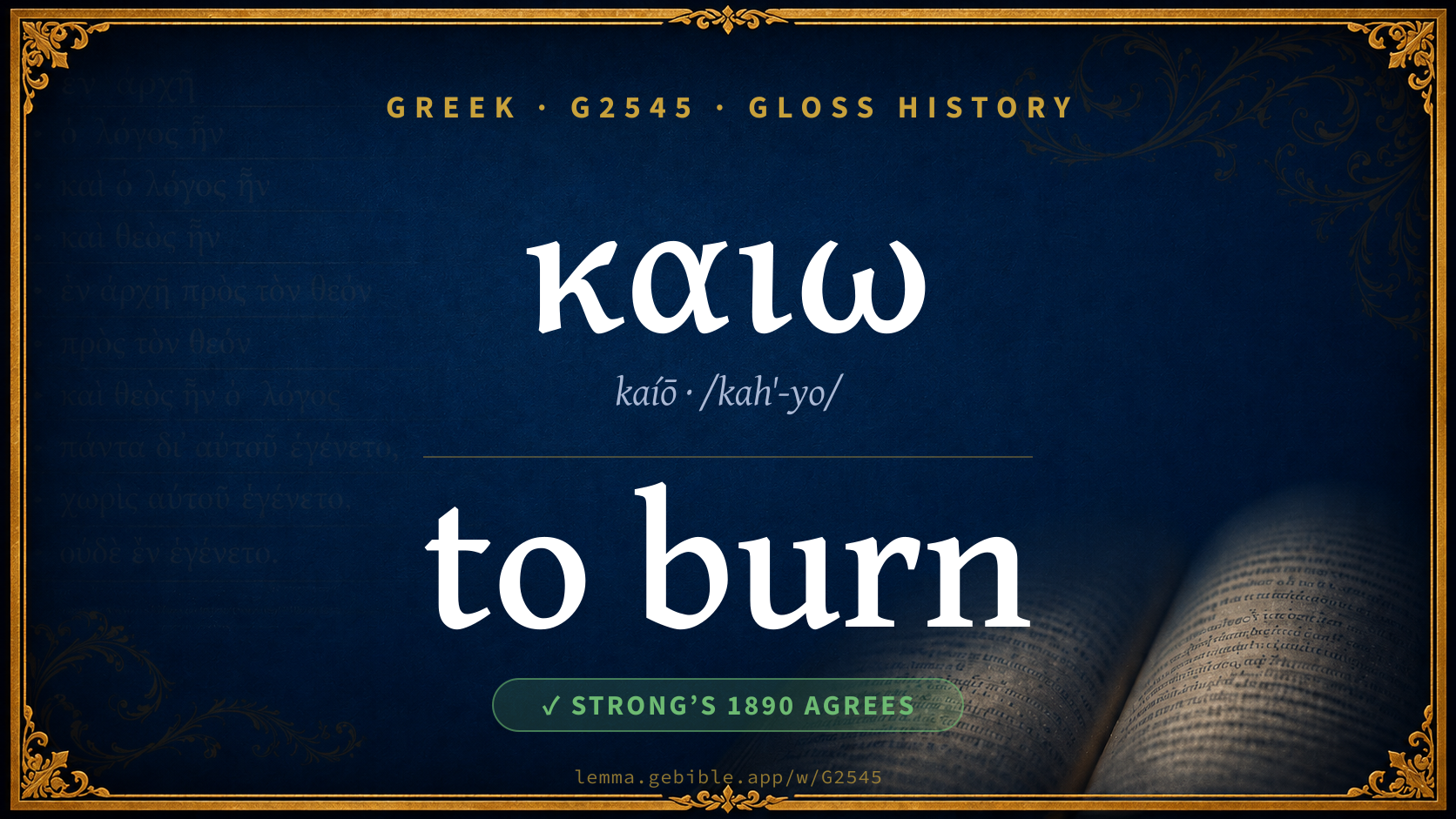
καίω
to burn
‘to burn’ is one of 2 main senses fuller range ↓
Full lexicon entry — Thayer's Greek Lexicon
From Thayer's Greek Lexicon
Where this word appears
See every Present-tense verb in the Greek New Testament →
Grammar key — what these labels mean
Part of speech
- Verb
- An action or state-of-being word.
Tense
- Present
- Ongoing or general action in present time (imperfective aspect).
- Future
- Action expected in future time.
- Perfect
- A completed past action with continuing present results.
Voice
- Passive
- The subject receives the action.
- Active
- The subject performs the action.
Mood
- Participle
- A verbal adjective (“writing,” “having written”).
- Indicative
- States a fact or asks a factual question (the mood of reality).
Case
- Nominative
- The case of the subject (and the predicate nominative).
- Dative
- The case of the indirect object, means, or location — “to / for / with / in.”
- Genitive
- The case of source, possession, or “of” — answers “whose / from what.”
Person
- 1st person
- The speaker (“I / we”).
- 3rd person
- The one spoken about (“he / she / it / they”).
Gender
- Masculine
- Grammatically masculine.
- Feminine
- Grammatically feminine.
- Neuter
- Grammatically neuter.
Number
- Singular
- One.
- Plural
- More than one.
Grammatical forms 11 distinct
- Verb, Present, Passive, Participle, Nominative, Singular, Masculine 2 times (17%)
- Verb, Future, Passive, Indicative, 1st person, Singular 1 time (8%)
- Verb, Present, Active, Indicative, 3rd person, Plural 1 time (8%)
- Verb, Present, Passive, Indicative, 3rd person, Singular 1 time (8%)
- Verb, Present, Passive, Participle, Dative, Singular, Feminine 1 time (8%)
- Verb, Present, Passive, Participle, Genitive, Singular, Feminine 1 time (8%)
- Verb, Present, Passive, Participle, Nominative, Plural, Feminine 1 time (8%)
- Verb, Present, Passive, Participle, Nominative, Plural, Masculine 1 time (8%)
+3 more forms (3 occurrences)
Parsed forms decoded from the imported morphology (Robinson–Tischendorf, public domain), counted across 12 parsed occurrences — not distinct verses.
Every verse where G2545 appears — 12 distinct verses across 6 books. Click any verse to open its interlinear word-by-word view. Verse text shown in the World English Bible for context — . Each verse’s Greek form is shown with its reference; the English is not keyword-highlighted, since the data carries no word-level English alignment. Use “Compare translations” on any verse to read it across multiple English versions. This concordance covers the Greek New Testament; Septuagint (Greek Old Testament) occurrences of this word are not indexed here.
Matthew 1 verse
Luke 2 verses
John 2 verses
- John 5:35 καιόμενος pres pass ptcp nom sg masc He was the burning and shining lamp, and you were willing to rejoice for a while in his light.
- John 15:6 καίεται pres pass ind 3sg If a man doesn't remain in me, he is thrown out as a branch, and is withered; and they gather them, throw them into the fire, and they are burned.
1 Corinthians 1 verse
Hebrews 1 verse
Revelation 5 verses
- Revelation 4:5 καιόμεναι pres pass ptcp nom pl fem Out of the throne proceed lightnings, sounds, and thunders. There were seven lamps of fire burning before his throne, which are the seven Spirits of God.
- Revelation 8:8 καιόμενον pres pass ptcp nom sg neut The second angel sounded, and something like a great burning mountain was thrown into the sea. One third of the sea became blood,
- Revelation 8:10 καιόμενος pres pass ptcp nom sg masc The third angel sounded, and a great star fell from the sky, burning like a torch, and it fell on one third of the rivers, and on the springs of the waters.
- Revelation 19:20 καιομένης pres pass ptcp gen sg fem The beast was taken, and with him the false prophet who worked the signs in his sight, with which he deceived those who had received the mark of the beast and those who worshiped his image. These two were thrown alive into the lake of fire that burns with sulfur.
- Revelation 21:8 καιομένῃ pres pass ptcp dat sg fem But for the cowardly, unbelieving, sinners, abominable, murderers, sexually immoral, sorcerers, idolaters, and all liars, their part is in the lake that burns with fire and sulfur, which is the second death."
About this entry
At a glance — auto-summarized from this page’s data, not written by a person. Every figure links to its source below. This summary describes the numbers; it doesn’t interpret them.
“to burn” is the headline sense of the Greek verb καιω (kaíō). First canonically at Matthew 5:15, it enters the text early. The Greek New Testament uses it across 12 verses — uncommon. More than a third of its appearances fall in Revelation. Catalogued under 2 senses, its meaning is not single-sense. See the sense tree, 12-verse concordance, and the renderings breakdown below.
Gloss history
Strong's 1890 vs modern scholarship
About this word
Strong's G2545 catalogs a Greek word from the Greek New Testament.
These counts are not copied from any lexicon or concordance. They are computed here, from the morphology-tagged Greek New Testament. What Lemma adds →
- 12
- distinct verses
- The word appears in 12 distinct verses.
- 6 / 27
- NT books
- The word appears in 6 of 27 New Testament books.
- #904
- by frequency
- Top 1000 most frequent Greek words (rank 904 of 5,347 Greek words by occurrence).
View all 12 occurrences in the concordance →
Most concentrated in
- Revelation 5 verses 42%
- Luke 2 verses 17%
- John 2 verses 17%
By section of the New Testament
By traditional corpus
Conventional, traditional groupings — biblical authorship is debated, so this is a traditional corpus grouping, not an authorship claim. Some books belong to more than one corpus (Luke is in both the Gospels and the Lukan corpus, and so on), so these shares overlap and need not total 100%. Each figure is a share of the word’s 12 distinct verses.
- Johannine 7 verses · 58%
- Gospels 5 verses · 42%
- Revelation 5 verses · 42%
- Lukan (Luke–Acts) 2 verses · 17%
- Pauline corpus 1 verse · 8%
- Hebrews 1 verse · 8%
How translations render this word
Counts come from each version’s own published word-to-Strong’s tagging or interlinear alignment — an approximate guide to how each version renders this word, not a word-level alignment the data otherwise carries. Because each total is that version’s own tagged count, the per-version totals vary from one another and need not match the appearance or distinct-verse counts above. These counts may also differ from a printed concordance because Lemma counts each distinctly tagged rendering and does not collapse phrase taggings into a single head-word total. This is a fixed set of word-tagged versions (KJV, ASV, BSB, ULT) and does not change with the reading translation you choose elsewhere. Each version’s license is shown beside its name below (and on Sources).
- King James Version: Burning 6×
- American Standard Version: Burning 5×, Burneth 3×
- Berean Standard Bible: Burning 5×, Burned 3×
- unfoldingWord Literal Text: Burning 5×
King James Version Public Domain
Renders G2545 across 12 tagged occurrences — most commonly:
Plus 6 renderings that appear only once — usually multi-word phrases or single function words the recovered tagging swept in, not distinct renderings.
American Standard Version Public Domain
Renders G2545 across 12 tagged occurrences — most commonly:
Plus 4 renderings that appear only once — usually multi-word phrases or single function words the recovered tagging swept in, not distinct renderings.
Berean Standard Bible Public Domain
Renders G2545 across 11 tagged occurrences — most commonly:
Plus 3 renderings that appear only once — usually multi-word phrases or single function words the recovered tagging swept in, not distinct renderings.
unfoldingWord Literal Text CC BY-SA 4.0
Renders G2545 across 11 tagged occurrences — most commonly:
Plus 6 renderings that appear only once — usually multi-word phrases or single function words the recovered tagging swept in, not distinct renderings.
Senses in Thayer's
The 2 senses Thayer's distinguishes for this word, in lexicon order (not ranked by frequency or importance). The full entry — with sub-senses — is in the Lexicon Entry tab.
- to set on fire, light, burning
- to burn, consume with fire
Word origin
Origin: apparently a primary verb
Apparently a primary verb; to set on fire that is kindle or (by implication) consume : - burn light.
— Strong’s Exhaustive Concordance (1890), public domain.
Forms in the corpus
The 11 distinct written forms G2545 takes in the Greek New Testament, most frequent first — each parse links to that tense’s occurrences in the concordance.
Same root — word family
Other Thayer's entries built from the same root as G2545, grouped by Strong’s listed origin. These share a root / origin per the lexicon — not necessarily a shared meaning. Each links to that word’s own entry.
Derived from this word
- καμινος káminos G2575 furnace
- καυμα kaûma G2738 heat
- καυσις kaûsis G2740 burning
- καυτηριαζω kautēriázō G2743 to brand
Compare all same-root words → Showing 4 of 5 — not the complete family. They share a root, not necessarily a meaning.
Septuagint usage
The same Greek word καιω appears 71 times in the Greek Old Testament (Septuagint), across 64 verses in 14 books.
- 71
- LXX occurrences
- Tagged occurrences of this Greek word in the Septuagint.
- 64
- verses
- Distinct Septuagint verses containing this word.
- 14 / 39
- OT books
- The word appears in 14 of the 39 Old Testament books.
Sample Septuagint occurrences
- Exodus 3:2 καίω
- Leviticus 4:12 καίω
- Deuteronomy 4:11 καίω
- Judges 15:5 καίω
- 2 Samuel 23:7 καίω
- 1 Kings 13:2 καίω
- Job 15:34 καίω
- Psalms 7:14 καίω
- Isaiah 4:5 καίω
- Jeremiah 7:18 καίω
- Ezekiel 1:13 καίω
- Daniel 3:6 καίω
Septuagint occurrences (same lexeme)
Every verse where the same Strong’s number (G2545) appears in the Greek Septuagint — showing the first 50 of 64. Verse text shown in the World English Bible for context; the Greek form is the matched word — the English is not keyword-highlighted.
- Exodus 3:2 καίω The angel of Yahweh appeared to him in a flame of fire out of the midst of a bush. He looked, and behold, the bush burned with fire, and the bush was not consumed.
- Exodus 27:20 καίω "You shall command the children of Israel, that they bring to you pure olive oil beaten for the light, to cause a lamp to burn continually.
- Exodus 27:21 καίω In the tent of meeting, outside the veil which is before the testimony, Aaron and his sons shall keep it in order from evening to morning before Yahweh: it shall be a statute forever throughout their generations on the behalf of the children of Israel.
- Exodus 35:3 καίω You shall kindle no fire throughout your habitations on the Sabbath day.'"
- Leviticus 4:12 καίω even the whole bull shall he carry forth outside the camp to a clean place, where the ashes are poured out, and burn it on wood with fire. Where the ashes are poured out it shall be burned.
- Leviticus 6:2 καίω "If anyone sins, and commits a trespass against Yahweh, and deals falsely with his neighbor in a matter of deposit, or of bargain, or of robbery, or has oppressed his neighbor,
- Leviticus 6:5 καίω or any thing about which he has sworn falsely; he shall restore it even in full, and shall add a fifth part more to it. To him to whom it belongs he shall give it, in the day of his being found guilty.
- Leviticus 6:6 καίω He shall bring his trespass offering to Yahweh, a ram without blemish from the flock, according to your estimation, for a trespass offering, to the priest.
- Leviticus 24:2 καίω "Command the children of Israel, that they bring to you pure olive oil beaten for the light, to cause a lamp to burn continually.
- Leviticus 24:3 καίω Outside of the veil of the Testimony, in the Tent of Meeting, shall Aaron keep it in order from evening to morning before Yahweh continually: it shall be a statute forever throughout your generations.
- Leviticus 24:4 καίω He shall keep in order the lamps on the pure gold lampstand before Yahweh continually.
- Deuteronomy 4:11 καίω You came near and stood under the mountain; and the mountain burned with fire to the heart of the sky, with darkness, cloud, and thick darkness.
- Deuteronomy 5:23 καίω It happened, when you heard the voice out of the midst of the darkness, while the mountain was burning with fire, that you came near to me, even all the heads of your tribes, and your elders;
- Deuteronomy 9:15 καίω So I turned and came down from the mountain, and the mountain was burning with fire: and the two tables of the covenant were in my two hands.
- Deuteronomy 32:22 καίω For a fire is kindled in my anger, Burns to the lowest Sheol, Devours the earth with its increase, Sets on fire the foundations of the mountains.
- Judges 15:5 καίω When he had set the brands on fire, he let them go into the standing grain of the Philistines, and burnt up both the shocks and the standing grain, and also the olive groves.
- 2 Samuel 23:7 καίω But the man who touches them Must be armed with iron and the staff of a spear: They shall be utterly burned with fire in [their] place
- 1 Kings 13:2 καίω He cried against the altar by the word of Yahweh, and said, altar, altar, thus says Yahweh: Behold, a son shall be born to the house of David, Josiah by name; and on you shall he sacrifice the priests of the high places who burn incense on you, and men's bones shall they burn on you.
- Job 15:34 καίω For the company of the godless shall be barren, And fire shall consume the tents of bribery.
- Job 27:21 καίω The east wind carries him away, and he departs; It sweeps him out of his place.
- Job 31:12 καίω For it is a fire that consumes to destruction, And would root out all my increase.
- Job 41:11 καίω Who has first given to me, that I should repay him? Everything under the heavens is mine.
- Job 41:12 καίω "I will not keep silence concerning his limbs, Nor his mighty strength, nor his goodly frame.
- Psalms 7:14 καίω Behold, he travails with iniquity; Yes, he has conceived mischief, And brought forth falsehood.
- Psalms 49:3 καίω My mouth will speak words of wisdom. My heart shall utter understanding.
- Isaiah 4:5 καίω Yahweh will create over the whole habitation of Mount Zion, and over her assemblies, a cloud and smoke by day, and the shining of a flaming fire by night; for over all the glory will be a canopy.
- Isaiah 5:24 καίω Therefore as the tongue of fire devours the stubble, And as the dry grass sinks down in the flame, So their root shall be as rottenness, And their blossom shall go up as dust; Because they have rejected the law of Yahweh of Hosts, And despised the word of the Holy One of Israel.
- Isaiah 9:17 καίω Therefore the Lord will not rejoice over their young men, neither will he have compassion on their fatherless and widows; for everyone is profane and an evil-doer, and every mouth speaks folly. For all this his anger is not turned away, but his hand is stretched out still.
- Isaiah 10:16 καίω Therefore will the Lord, Yahweh of Hosts, send among his fat ones leanness; and under his glory there shall be kindled a burning like the burning of fire.
- Isaiah 10:17 καίω The light of Israel will be for a fire, and his Holy One for a flame; and it will burn and devour his thorns and his briers in one day.
- Isaiah 10:18 καίω He will consume the glory of his forest, and of his fruitful field, both soul and body: and it shall be as when a standard-bearer faints.
- Isaiah 30:27 καίω Behold, the name of Yahweh comes from far, burning with his anger, and in thick rising smoke: his lips are full of indignation, and his tongue is as a devouring fire;
- Isaiah 30:33 καίω For a Topheth is prepared of old; yes, for the king it is made ready; he has made it deep and large; the pile of it is fire and much wood; the breath of Yahweh, like a stream of sulfur, does kindle it.
- Isaiah 33:14 καίω The sinners in Zion are afraid; trembling has seized the godless ones: Who among us can dwell with the devouring fire? who among us can dwell with everlasting burning?
- Isaiah 34:9 καίω The streams of [Edom] shall be turned into pitch, and the dust of it into sulfur, and the land of it shall become burning pitch.
- Isaiah 44:15 καίω Then shall it be for a man to burn; and he takes of it, and warms himself; yes, he kindles it, and bakes bread: yes, he makes a god, and worships it; he makes it an engraved image, and falls down to it.
- Isaiah 44:16 καίω He burns part of it in the fire; with part of it he eats flesh; he roasts roast, and is satisfied; yes, he warms himself, and says, Aha, I am warm, I have seen the fire.
- Isaiah 50:11 καίω Behold, all you who kindle a fire, who gird yourselves about with firebrands; walk you in the flame of your fire, and among the brands that you have kindled. This shall you have of my hand; you shall lie down in sorrow.
- Isaiah 62:1 καίω For Zion's sake will I not hold my peace, and for Jerusalem's sake I will not rest, until her righteousness go forth as brightness, and her salvation as a lamp that burns.
- Isaiah 65:5 καίω who say, Stand by yourself, don't come near to me, for I am holier than you. These are a smoke in my nose, a fire that burns all the day.
- Jeremiah 7:18 καίω The children gather wood, and the fathers kindle the fire, and the women knead the dough, to make cakes to the queen of the sky, and to pour out drink-offerings to other gods, that they may provoke me to anger.
- Jeremiah 7:20 καίω Therefore thus says the Lord Yahweh: Behold, my anger and my wrath shall be poured out on this place, on man, and on animal, and on the trees of the field, and on the fruit of the ground; and it shall burn, and shall not be quenched.
- Jeremiah 15:14 καίω I will make [them] to pass with your enemies into a land which you don't know; for a fire is kindled in my anger, which shall burn on you.
- Jeremiah 20:9 καίω If I say, I will not make mention of him, nor speak any more in his name, then there is in my heart as it were a burning fire shut up in my bones, and I am weary with forbearing, and I can't [contain].
- Jeremiah 21:12 καίω House of David, thus says Yahweh, Execute justice in the morning, and deliver him who is robbed out of the hand of the oppressor, lest my wrath go forth like fire, and burn so that none can quench it, because of the evil of your doings.
- Jeremiah 30:33 καίω
- Jeremiah 39:29 καίω
- Jeremiah 41:2 καίω Then arose Ishmael the son of Nethaniah, and the ten men who were with him, and struck Gedaliah the son of Ahikam the son of Shaphan with the sword, and killed him, whom the king of Babylon had made governor over the land.
- Jeremiah 44:8 καίω in that you provoke me to anger with the works of your hands, burning incense to other gods in the land of Egypt, where you are gone to sojourn; that you may be cut off, and that you may be a curse and a reproach among all the nations of the earth?
- Jeremiah 44:10 καίω They are not humbled even to this day, neither have they feared, nor walked in my law, nor in my statutes, that I set before you and before your fathers.
These are occurrences of the same Greek lexeme (G2545) in the Septuagint — not a translation of any one Hebrew word. The store carries no word-level Hebrew↔Greek alignment, so no Hebrew original is asserted here. Counts come from the recovered LXX Strong's tagging — high-frequency vocabulary is well covered, while rare or late forms may be untagged — so they reflect tagged occurrences and may slightly undercount.