Revelation 4:5

Greek (Tischendorf 8th ed.) Revelation 4:5 appears in the Greek New Testament. The text above is from the Tischendorf 8th edition. Each word links to its Strong’s number and a concise gloss. Click any word for its full Thayer’s Greek Lexicon entry.
Download image
Cite this verse

Revelation 4:5 (World English Bible). Public Domain. Lemma interlinear Bible study tool, https://lemma.gebible.app/v/revelation/4/5.

Show BibTeX & RIS
BibTeX
RIS
English Translation
Out of the throne proceed lightnings, sounds, and thunders. There were seven lamps of fire burning before his throne, which are the seven Spirits of God.
World English Bible · Public Domain
Download a study sheet

One document with this verse’s original text, its word-by-word gloss line, the meaning frame, cross-references with their text, attributed commentary, and full source and license credits — printable, and it pastes into notes with its structure intact.

This verse Autodidact and up

Study sheet (.html) Plain text (.txt)

A passage Seminary Student

Up to 50 verses in one chapter. A passage sheet keeps up to 6 commentary sources and 12 cross-references per verse, in the order this page ranks them, and says so on the sheet whenever that leaves anything out. Ask for a single verse and you get the Autodidact verse sheet above.

Everything on this page stays free to read, with no account — the sheet is a download of what is already on screen, not access to it.

Want to remove ads? Support Godless Engineer
Compare translations 3

The same verse in 3 English versions, stacked beneath the original-language interlinear above. Click any original word for its lexicon entry.

Each is an independent rendering of the whole verse — the interlinear is not word-aligned to these translations.

Highlighted words mark where these versions differ — a whole-verse word diff, not a word-by-word alignment.

  • World English Bible Public Domain
    Out of the throne proceed lightnings, sounds, and thunders. There were seven lamps of fire burning before his throne, which are the seven Spirits of God.
  • King James Version Public Domain
    And out of the throne proceeded lightnings and thunderings and voices: and there were seven lamps of fire burning before the throne, which are the seven Spirits of God.
  • unfoldingWord Literal Text CC BY-SA 4.0
    And from the throne come out lightnings and sounds and thunders, and seven lamps of fire burn before the throne, which are the seven spirits of God.

unfoldingWord Literal Text — © unfoldingWord, licensed CC BY-SA 4.0. Word-aligned USFM3 via Door43 (git.door43.org/unfoldingWord/en_ult).

Versions to compare (up to 4)

3 of 4 selected

Show all 19 translations

Every available English version of this verse, each an independent rendering of the whole verse.

  • World English Bible Public Domain
    Out of the throne proceed lightnings, sounds, and thunders. There were seven lamps of fire burning before his throne, which are the seven Spirits of God.
  • Berean Standard Bible Public Domain
    From the throne came flashes of lightning, and rumblings, and peals of thunder. Before the throne burned seven torches of fire. These are the seven Spirits of God.
  • Majority Standard Bible Public Domain
    From the throne came flashes of lightning, rumblings, and peals of thunder. Before the throne burned seven torches of fire. These are the seven spirits of God.
  • King James Version Public Domain
    And out of the throne proceeded lightnings and thunderings and voices: and there were seven lamps of fire burning before the throne, which are the seven Spirits of God.
  • American Standard Version (1901) Public Domain
    And out of the throne proceed lightnings and voices and thunders. And `there was' seven lamps of fire burning before the throne, which are the seven Spirits of God;
  • Revised Version (1885) Public Domain
    And out of the throne proceed lightnings and voices and thunders. And there were seven lamps of fire burning before the throne, which are the seven Spirits of God;
  • Geneva Bible (1599) Public Domain
    And out of the throne proceeded lightnings, and thundrings, and voyces, and there were seuen lampes of fire burning before the throne, which are the seuen spirits of God.
  • Douay-Rheims (1899) Public Domain
    And from the throne proceeded lightnings, and voices, and thunders; and there were seven lamps burning before the throne, which are the seven spirits of God.
  • Young's Literal Translation Public Domain
    and out of the throne proceed do lightnings, and thunders, and voices; and seven lamps of fire are burning before the throne, which are the Seven Spirits of God,
  • Literal Standard Version CC BY-SA 4.0
    and out of the throne proceed lightnings, and thunders, and voices; and seven lamps of fire are burning before the throne, which are the Seven Spirits of God,
  • Unlocked Literal Bible CC BY-SA 4.0
    From the throne came flashes of lightning, rumblings, and crashes of thunder. Seven lamps were burning in front of the throne, lamps that were the seven spirits of God.
  • unfoldingWord Literal Text CC BY-SA 4.0
    And from the throne come out lightnings and sounds and thunders, and seven lamps of fire burn before the throne, which are the seven spirits of God.
  • Darby Bible Public Domain
    And out of the throne go forth lightnings, and voices, and thunders; and seven lamps of fire, burning before the throne, which are the seven Spirits of God;
  • World Messianic Bible Public Domain
    Out of the throne proceed lightnings, sounds, and thunders. There were seven lamps of fire burning before his throne, which are the seven Spirits of God.
  • Webster's Bible Public Domain
    And out of the throne proceeded lightnings and thunderings and voices. And there were seven lamps of fire burning before the throne, which are the seven Spirits of God.
  • Free Bible Version CC BY-SA 4.0
    From the throne lightning flashed and thunder roared. Seven torches blazed in front of the throne—these are the seven Spirits of God.
  • Bible in Basic English Public Domain
    And out of the high seat came flames and voices and thunders. And seven lights of fire were burning before the high seat, which are the seven Spirits of God;
  • Text-Critical English NT CC BY 4.0
    From the throne came flashes of lightning, rumblings, and peals of thunder, and there were seven flaming torches burning before the throne, which are the seven spirits of God.
  • Tyndale New Testament (1534) Public Domain
    And out of the seate proceded lightnynges and thundrynges and voyces and there wer vii. lampes of fyre burninge before the seate which are the vii. sprettes of God.

Literal Standard Version (2020), Covenant Press — licensed CC BY-SA 4.0. Text via the HelloAO Bible API (eBible.org). Unlocked Literal Bible (unfoldingWord) — licensed CC BY-SA 4.0. Text via the HelloAO Bible API (eBible.org). unfoldingWord Literal Text — © unfoldingWord, licensed CC BY-SA 4.0. Word-aligned USFM3 via Door43 (git.door43.org/unfoldingWord/en_ult). Free Bible Version, Dr. Jonathan Gallagher — licensed CC BY-SA 4.0. Text via the HelloAO Bible API (eBible.org).

Word by word

More ways to search: Search by grammar → Find every occurrence → Compare this word →

Practice this passage: Drill this verse → Learn its vocabulary →

ἀστραπαὶ
astrapḗ
G796
“lightning”
Noun, Nominative, Plural, Feminine
Part of Speech
Noun
Case
Nominative
Number
Plural
Gender
Feminine
Full Thayer's Definition

Origin: from G797

TDNT: 09:25,9

1. lightning a. of the gleam of a lamp
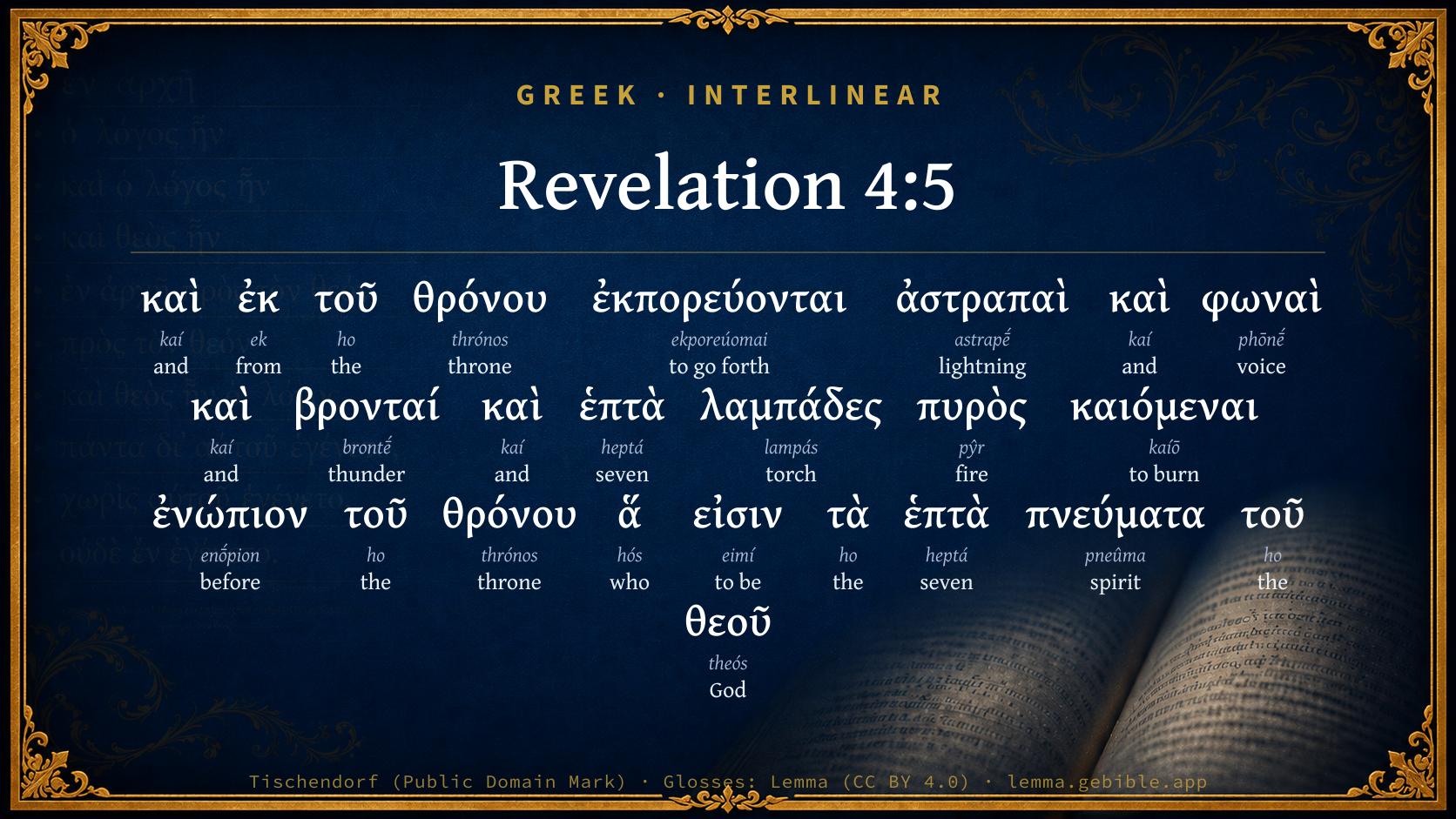
  1. καὶ kaí G2532 “and” Conjunction
  2. ἐκ ek G1537 “from” Preposition
  3. τοῦ ho G3588 “the” Article, Genitive, Singular, Masculine
  4. θρόνου thrónos G2362 “throne” Noun, Genitive, Singular, Masculine
  5. ἐκπορεύονται ekporeúomai G1607 “to go forth” Verb, Present, Middle or Passive deponent, Indicative, 3rd person, Plural
  6. καὶ kaí G2532 “and” Conjunction
  7. φωναὶ phōnḗ G5456 “voice” Noun, Nominative, Plural, Feminine
  8. καὶ kaí G2532 “and” Conjunction
  9. βρονταί brontḗ G1027 “thunder” Noun, Nominative, Plural, Feminine
  10. καὶ kaí G2532 “and” Conjunction
  11. ἑπτὰ heptá G2033 “seven” Adjective, Numeral (indeclinable)
  12. λαμπάδες lampás G2985 “torch” Noun, Nominative, Plural, Feminine
  13. πυρὸς pŷr G4442 “fire” Noun, Genitive, Singular, Neuter
  14. καιόμεναι kaíō G2545 “to burn” Verb, Present, Passive, Participle, Nominative, Plural, Feminine
  15. ἐνώπιον enṓpion G1799 “before” Adverb
  16. τοῦ ho G3588 “the” Article, Genitive, Singular, Masculine
  17. θρόνου thrónos G2362 “throne” Noun, Genitive, Singular, Masculine
  18. ἅ hós G3739 “who” Relative pronoun, Nominative, Plural, Neuter
  19. εἰσιν eimí G1510 “to be” Verb, Present, Active, Indicative, 3rd person, Plural
  20. τὰ ho G3588 “the” Article, Nominative, Plural, Neuter
  21. ἑπτὰ heptá G2033 “seven” Adjective, Numeral (indeclinable)
  22. πνεύματα pneûma G4151 “spirit” Noun, Nominative, Plural, Neuter
  23. τοῦ ho G3588 “the” Article, Genitive, Singular, Masculine
  24. θεοῦ theós G2316 “God” Noun, Genitive, Singular, Masculine

About this verse

These counts appear in no published source. They are computed here, from the morphology-tagged text and Lemma’s own curated glosses. What Lemma adds →

25
words
17
distinct lemmas
Revelation
section

Notable vocabulary

The rarest word here is ἀστραπαὶ lightning G796 — appearing just 9 times in the whole Greek New Testament.

Shared distinctive vocabulary

ἀστραπαὶ lightning G796 occurs in 9 verses of the Greek New Testament. Also found in:

Repetition

Words recur within this verse:

  • θρόνου throne G2362 ×2
  • ἑπτὰ seven G2033 ×2
  • καὶ and G2532 ×4
  • τοῦ the G3588 ×4

Cross-references

19

Topical passages linked to Revelation 4:5 in the Treasury of Scripture Knowledge — connected by theme and wording, ordered by reader-vote popularity; previews shown in the World English Bible.

  • Revelation 11:19 God's temple that is in heaven was opened, and the ark of the Lord's covenant was seen in his temple. Lightnings, sounds, thunders, an earthquake, and great hail followed.
  • Revelation 8:5 The angel took the censer, and he filled it with the fire of the altar, and threw it on the earth. There followed thunders, sounds, lightnings, and an earthquake.
  • Revelation 1:4 John, to the seven assemblies that are in Asia: Grace to you and peace, from God, who is and who was and who is to come; and from the seven Spirits who are before his throne;
  • Revelation 5:6 I saw in the midst of the throne and of the four living creatures, and in the midst of the elders, a Lamb standing, as though it had been slain, having seven horns, and seven eyes, which are the seven Spirits of God, sent out into all the earth.
  • Revelation 16:17–18 The seventh poured out his bowl into the air. A loud voice came forth out of the temple of heaven, from the throne, saying, "It is done!"
  • Exodus 19:16 It happened on the third day, when it was morning, that there were thunders and lightnings, and a thick cloud on the mountain, and the sound of an exceedingly loud trumpet; and all the people who were in the camp trembled.
  • Revelation 3:1 "And to the angel of the assembly in Sardis write: He who has the seven Spirits of God, and the seven stars says these things: "I know your works, that you have a reputation of being alive, but you are dead.
  • Zechariah 4:2 He said to me, "What do you see?" I said, "I have seen, and, behold, a lampstand all of gold, with its bowl on the top of it, and its seven lamps thereon; there are seven pipes to each of the lamps, which are on the top of it;
  • Exodus 20:18 All the people perceived the thunderings, the lightnings, the sound of the trumpet, and the mountain smoking. When the people saw it, they trembled, and stayed at a distance.
  • Joel 3:16 Yahweh will roar from Zion, And thunder from Jerusalem; And the heavens and the earth will shake; But Yahweh will be a refuge to his people, And a stronghold to the children of Israel.
  • Exodus 37:23 He made its seven lamps, and its snuffers, and its snuff dishes, of pure gold.
  • 2 Chronicles 4:20 and the lampstands with their lamps, to burn according to the ordinance before the oracle, of pure gold;
  • Psalms 18:13–14 Yahweh also thundered in the sky, The Most High uttered his voice: Hailstones and coals of fire.
  • Psalms 68:35 You are awesome, God, in your sanctuaries. The God of Israel gives strength and power to his people. Praise be to God!
  • Ezekiel 1:13 As for the likeness of the living creatures, their appearance was like burning coals of fire, like the appearance of torches: [the fire] went up and down among the living creatures; and the fire was bright, and out of the fire went forth lightning.
  • Hebrews 12:18–29 For you have not come to a mountain that might be touched, and that burned with fire, and to blackness, darkness, tempest,
  • Zechariah 4:11–14 Then I asked him, "What are these two olive trees on the right side of the lampstand and on the left side of it?"
  • Matthew 3:11 I indeed baptize you in water for repentance, but he who comes after me is mightier than I, whose shoes I am not worthy to carry. He will baptize you in the Holy Spirit.
  • Acts 2:3 Tongues like fire appeared and were distributed to them, and one sat on each of them.

Cross-references courtesy of OpenBible.info (CC BY 4.0).

Where the printed editions differ

1 variant

Places in this verse where the major printed Greek editions disagree on the wording in a way that affects the translation — a comparison of editions, not a manuscript-by-manuscript collation. The editions are the modern critical texts (Nestlé-Aland 28/27, SBL, Westcott-Hort, Tregelles, Tyndale House) and the traditional texts behind the KJV (the Textus Receptus and the Byzantine/Majority text). It is not a claim about which reading is original.

  1. Extra text
    αὐτοῦ

    “of him”

    In Byz Not in NA28NA27TynSBLWHTregTR

    αὐτοῦ (autou) 'of him' is only in a few manuscripts (Byz)

Textual data: Translators Amalgamated Greek New Testament (STEPBible TAGNT) · CC BY 4.0.

Commentary

Notes on Revelation 4:5 from classic Christian and Jewish commentators (each source and its license shown beneath its notes). The classic Christian expositions comment on the surrounding passage and are grouped to its opening verse, so a note may address several verses; the Jewish commentaries on the Tanakh (Rashi and others) are per-verse, so they appear only where the commentator wrote on this verse.

Lemma curates 59 commentaries, every one of them public domain or Creative Commons licensed, each selected and text-cleaned for this edition rather than reprinted as found. About our sources →

Tyndale Open Study Notes

Tyndale Open Resources

4:5 The thunder that follows flashes of lightning is God’s call to attention (see 8:5; 11:19; 16:18). • in front of the throne were seven torches: In ancient times, torches were set before rulers to show their authority. These torches with burning flames represent the perfect Spirit of God.

Tyndale Open Study Notes — © Tyndale Open Resources, licensed CC BY-SA 4.0. Text via the HelloAO Bible API.

Bengel's Gnomon

Johann Albrecht Bengel

Rev 4:5. Ἀστραπαὶ καὶ φωναὶ καὶ βρονταὶ[59]) In ch. Rev 8:5 there are mentioned ΒΡΟΝΤΑῚ ΚΑῚ ἈΣΤΡΑΠΑῚ ΚΑῚ ΦΩΝΑῚ ΚΑῚ ΣΕΙΣΜῸς; in Rev 11:19, ἈΣΤΡΑΠΑῚ ΚΑῚ ΦΩΝΑῚ ΚΑῚ ΒΡΟΝΤΑῚ ΚΑἸ ΣΕΙΣΜῸς ΚΑῚ ΧΆΛΑΖΑ ΜΕΓΆΛΗ; and again with Epitasis, as far as relates to ΣΕΙΣΜῸΝ ΚΑῚ ΧΆΛΑΖΑΝ, in ch. Rev 16:18; Rev 16:21. It occasions inconvenience, that the copyists have written lightnings and voices and thunderings, in these four passages, with so little attention to the order: yet in ch. Rev 4:5, Rev 11:19, all place lightnings first in order; in Rev 16:18, almost all; in Rev 8:5, not one.—ἑπτὰ λαμπάδες, seven lamps) The Holy Spirit, economically, as Wisdom, חבמות, in the plural number. ch. Rev 5:6, the text explains itself.

[59] AB Vulg. have φωναὶ καὶ βρονταί: Rec. Text, without good authority, βρονταὶ καὶ φωναί.—E.

Bengel's Gnomon of the New Testament — English translation (T&T Clark, Edinburgh, 1860) — public domain. Text from a community e-Sword module.

Meyer's Critical & Exegetical Commentary

Heinrich August Wilhelm Meyer

Rev_4:5. The throne of God corresponds in its appearance to the majesty of the king sitting thereon. As in Psalms 29.,[1743] the regal[1744] omnipotence of God is made visible in the violence of the thunder-storm, so John here uses the same image in order to describe the unlimited omnipotence of the enthroned one, particularly as exercised in judgment. The throne itself, out of which proceeded the lightnings, thunderings, and voices, appears filled with this sign of the Divine omnipotence. The φωναί which are here distinguished from the βρονταίso that passages as Rev_6:1, Rev_10:3, Rev_14:2,[1745] must not be here compared,have[1746] to be regarded as the roar which in a storm accompanies the thunder and lightning.[1747] The misunderstandings of the description depend upon the crudeness and arbitrariness of the exposition. So in N. de Lyra:[1748] The coruscation of miracles, and declaration of rewards for good and the terror of punishments for evil deeds. Solely on account of the ἐκπορεύονται,[1749] Aretius understood by the ἀστραπ., φων., and βροντ., even, the Holy Ghost. De Wette[1750] discerns in the lightning, etc., figures of Gods manifestations of power and life in nature, which are to be distinguished, as critical and powerful revelations of God, from the seven lamps as his calm and perpetual influences; while in Rev_4:6-8, nature itself, or the realm of the living, and finally in Rev_4:9-11, the harmony of creation with redeemed humanity, and thus God in his living efficiency and reality, are brought into consideration. But this interpretation is in more than one respect without foundation. The lightning, voices, and thunder are, according to the O. T. view, on which the present description depends,[1751] not figures of the revelation of God in nature as distinct from another revelation, but of the unlimited power of God, especially as judging;[1752] only we dare not, with Grot., understand the ἀστρ. and βροντ. of general threats, but the φων. of particular afflictions. The throne whence the lightning, etc., proceeds, agrees with that whose form appears to be not only like jasper, but also like a sardine stone.

καῖ ἑπτὰ λαμπάδες πυρὸς, κ.τ.λ. The authentic explanation immediately follows: αἵ εἰσι τὰ ἑπτὰ πνεύματα τοῦ θεοῦ. Cf., besides, Rev_1:4. The pragmatic significance of the Spirit of God in this connection is not that the Spirit of God is the principle of the psychical[1753] and spiritual life, and that through him the inner influence of God on nature and the human world occurs;[1754] for the idea of the λαμπάδες πυρός does not suit the explanation of the closely connected first half of the verse. But Hengstenb. also, who very arbitrarily combines the seven of the Spirit with the three of the lightning, voices, and thunder, into a ten, and herein finds indicated a connection of the Spirit with that lightning, etc., improperly thinks only of an operation of the Spirit, bringing corruption, punishing, and annihilating. If also the idea of the work of the Spirit in judging[1755] dare not be left out of consideration, partly because of what precedes, and partly because of the expression, πυρός; on the one hand, the expression λαμπάδες, and, on the other, the parallel Rev_5:6 (ὀφθαλμοί), indicate that the Spirit is to be regarded chiefly as illuminating, seeing, searching all things,[1756] and just on that account everywhere[1757] active in his holy judgments. Essentially the seven lamps of fire burning before the throne of God indicate nothing else than the eyes of the Lord as a flame of fire in Rev_1:14.[1758]

[1743] Cf. Psa_97:1 sqq., Rev_18:8 sqq.

[1744] Psa_29:10.

[1745] Hengstenb.

[1746] Cf. Exo_19:16.

[1747] Cf. Vitr., Ew., Hengstenb.

[1748] Cf. already Primas, Beda; also Zeger.

[1749] Cf. Joh_15:26.

[1750] Cf. also Ebrard.

[1751] Cf. Rev_8:5, Rev_11:19, Rev_16:18.

[1752] Vitr., Hengstenb., etc.

[1753] Gen_1:2; Psa_104:30.

[1754] De Wette, Ebrard.

[1755] Cf. Isa_4:4; Joh_16:8.

[1756] Cf. 1Co_2:10.

[1757] Cf. Rev_5:6; Psa_139:7.

[1758] Cf. Dan_10:6.

Meyer — Critical and Exegetical Commentary on the New Testament — English translation by Peter Christie, edited by Frederick Crombie (T&T Clark, 1880) — public domain. Text from a community e-Sword module.

Expositor's Greek Testament

ed. W. Robertson Nicoll

Rev 4:5 . The impression of awe is heightened by traits from the primitive Semitic theophany which, especially in judgment, was commonly associated with a thunderstorm ( φωναί = the shrieks and roaring blasts of the storm). Thunder in the Apocalypse is either a sort of chorus in praise of God (as here) or punitive ( e.g. , Rev 16:18 ); in Enoch lix. 1 the seer beholds the secrets of the thunder, “how it ministers unto well-being and blessing, or serves for a curse before the Lord of Spirits”. For the “torches of fire” (seven being a sacred number = collective and manifold power, Jastrow 265, Trench 62 70) cf. Eze 1:13 ὡς ὄψις λαμπάδων συστρεφομένων ἀναμέσον τῶν ζῴων καὶ φέγγος τοῦ πυρὸς καὶ ἐκ τοῦ πυρὸς ἐξεπορεύετο ἀστραπή , and Apoc. Bar. xxi. 6, where “holy living creatures, without number, of flame and fire” surround the throne. Fulness, intensity, energy, are implied in the figure, which reflects the traditional association (in the primitive mind) of fire and flame with the divinity, and especially with the divine purity or holiness of which they were regarded as an outward expression. There may be an allusion to the ignes aeterni or sempiterni of Roman mythology, an equivalent for the heavenly bodies; but Jewish eschatology had for over two centuries been familiar with the seven watchers of the heavenly court and their counterparts in Persian and Babylonian mythology. The combination of fire and crystal (Rev 4:6 , see also Rev 15:2 ) goes back originally to Exo 24:9-10 ; Exo 24:17 , and Eze 1:22 ; Eze 1:27 , mediated by passages like En. xiv. 9, 17 f. , 21 23; while the groundwork of the symbol answers to the seven Persian councillors (Ezr 7:14 , Est 1:14 ) who formed the immediate circle of the monarch, a counterpart of the divine Amshaspands, as well as to the sacred fire of Ormuzd, which (on Zoroastrian principles) was to be kept constantly burning. Seven burning altars, evidently representing a planetary symbolism, also occur in the cult of Mithra, while in the imageless temple of Melcarth at Gades fires always burned upon the altar, tended by whiterobed priests. 5 c reads like an editorial comment or a liturgical gloss; the πρεσβύτεροι , e.g. , are undefined.

The Expositor's Greek Testament, edited by W. Robertson Nicoll (1897–1910) — public domain. Text from a community e-Sword module.

Geneva Bible (1599)

Geneva Bible translators

By effects, in that most mightily he speaketh all things by his voice and word, as Ps. 29:3, and with the light of his spirit and providence peruseth and passes through all.

Geneva Bible (1599) marginal notes — public domain. Text via Bolls.life.

Jamieson, Fausset & Brown

Robert Jamieson, A. R. Fausset & David Brown

proceeded--Greek, "proceed."

thunderings and voices--The two oldest manuscripts transpose, "voices and thunderings." Compare at the giving of the law on Sinai, Exo 19:16. "The thunderings express God's threats against the ungodly: there are voices in the thunders (Rev 10:3), that is, not only does He threaten generally, but also predicts special judgments" [GROTIUS].

seven lamps . . . seven Spirits--The Holy Spirit in His sevenfold operation, as the light-and-life Giver (compare Rev 5:6, seven eyes . . . the seven Spirits of God; Rev 1:4; Rev 21:23; Psa 119:105) and fiery purifier of the godly, and consumer of the ungodly (Mat 3:11).

Jamieson, Fausset & Brown — Commentary Critical and Explanatory on the Whole Bible (1871) — public domain (CC PDM 1.0). Text via the HelloAO Bible API.

Adam Clarke's Commentary

Verse 5. Seven lamps of fire] Seven angels, the attendants and ministers of the supreme King. See Re 1:4, and the note there.

Adam Clarke's Commentary on the Bible (1810–1826) — public domain. Text from a community e-Sword/MySword module.

Ellicott's Commentary for English Readers

(5) And out of the throne proceeded (rather, proceed; there is a change in the tense used) lightnings and thunderings and voices.—These are viewed by some as the indications of approaching judgments. Perhaps it is better to view them as the tokens of God’s power of judgment than as hints of immediately approaching judgments. The scene at Sinai (Exo_19:16) was no doubt in the prophet’s mind. There the clouds and lightnings were not so much tokens of coming judgment as the symbols of that righteous power which can show itself in judgment. “Clouds and darkness are round about Him; righteousness and judgment are the habitation of His throne” (Psa_97:2). They are the constant tokens of that power of God

“Which makes the darkness and the light,

And dwells not in the light alone,

But in the darkness and the cloud

As over Sinai's peaks of old.”

And there were seven lamps (or, torches) of fire burning before the throne, which are the seven Spirits of God.—See Rev_3:1. The Spirit of God in His manifold powers is thus described under emblems of fire. Not merely as a fire of judgment. The baptism of the Holy Spirit is a baptism of fire (Mat_3:11-12). The flaming presence purges the spirit from sin. The Holy Spirit consumes evil. It is an unquenchable fire against all evils, whether in men’s hearts or in men’s lives, or in the world. (Comp. 1Co_3:13, and Heb_12:29.) May there not be allusion to the covenant with Abraham, which was ratified by fire? Lamps, or torches, of fire (lampades puros, LXX., same as in this passage) went between the divided pieces of the heifer and the she-goat. If this be correct, the vision of this chapter reminds us that God is ever mindful of His covenant. The rainbow, the token of the covenant with Noah; the flaming torches, tokens of the covenant with Abraham; and the thunderings and lightnings, the tokens of the covenant at Sinai, are ever with Him. (Comp, also Eze_1:4.)

A Bible Commentary for English Readers, edited by Charles John Ellicott (1878–1897) — public domain. Text from a community e-Sword module.

The Cambridge Bible for Schools and Colleges

gen. ed. J. J. S. Perowne

5. seven] Typified by the seven lamps of the candlestick in the Tabernacle, and represented by the “seven golden candlesticks” of the Church on earth: see on Rev_1:20. The significance of the seven-branched candlestick in relation especially to the Spirit is suggested in Zechariah 4.

seven Spirits] See the last note on Rev_1:4.

The Cambridge Bible for Schools and Colleges (gen. ed. J. J. S. Perowne; Cambridge University Press, 1878–1918) — public domain. Text from a community e-Sword module.

John Gill's Exposition

And out of the throne proceeded lightnings and thunderings,

and voices,.... Which may be understood either of the doctrines of the Gospel which come out of Zion, and out of Jerusalem, the church of God, where he has his throne; and which are comparable to "lightning", both for the light and knowledge they give, and for the swiftness with which they were spread over the world, by the apostles of Christ; and to "thunderings", for the awfulness, authority, and majesty of them, especially as they were delivered out by the Boanergeses, or sons of thunder; and as the prophesies of the prophets are called "the voices" of the prophets, Act 13:27; so may the doctrines of the Gospel be called "voices", as they are the voice of God, and of Christ, and of his ministers; and are voices of love, grace, mercy, peace, pardon, righteousness, and eternal life. The allusion is to the giving of the law on Mount Sinai, when such things were seen and heard, Exo 19:16 or else the judgments of God, and the punishments inflicted upon his enemies, and the enemies of his church and people, and his awful threatenings of them, may be designed; see Psa 18:13; with which compare Rev 8:5.

And there were seven lamps of burning fire before the throne,

which are the seven spirits of God; in allusion to the seven lamps in the tabernacle and temple, which were trimmed by the priests, and always kept burning, and are expressive of the Spirit, and his gifts; and these being signified by the number "seven", denote the fulness and perfection of them; and being said to be "before the throne", show that there is always a sufficiency of them for the supply of the churches in all ages, to fit and qualify proper persons to minister the word, and administer ordinances; and these being called "lamps of burning fire", point at the light the Spirit of God in his gifts communicates to the churches; and that warmth and heat, comfort and refreshment; conveyed to them, through the preaching of the Gospel, and the dispensation of the ordinances of it, under his illuminating and quickening influences.

John Gill's Exposition of the Whole Bible (1746–1763) — public domain (CC PDM 1.0). Text via the HelloAO Bible API.

Trapp's Complete Commentary

John Trapp

5 And out of the throne proceeded lightnings and thunderings and voices: and there were seven lamps of fire burning before the throne, which are the seven Spirits of God.

Ver. 5. Lightnings and thunderings] Is not destruction to the wicked? and a strange punishment to persecutors? Job 31:3. Who ever hardened himself against God’s Church and prospered? Job 9:4. Have these workers of iniquity no knowledge, who eat up God’s people as they eat bread? Psa 14:4. Surely, if they had but so much wit for themselves as Pilate’s wife had in a dream, they would take heed of having anything to do with just men. If any man will hurt God’s witnesses, fire proceedeth out of their mouth and devoureth their enemies, Rev 11:5. It was therefore no ill counsel that a martyr gave his persecutors, If thou wilt not spare us, yet spare thyself. It is a fearful thing to fall into the punishing hands of the living God.

The seven spirits] See Rev 1:4.

John Trapp, A Commentary or Exposition upon All the Books of the Old and New Testament (1647–1656) — public domain. Text from a community e-Sword module.

Albert Barnes' Notes on the Bible

And out of the throne proceeded lightnings and thunderings and voices - Expressive of the majesty and glory of Him that sat upon it. We are at once reminded by this representation of the sublime scene that occurred at Sinai Exo 19:16, where “there were thunders and lightnings, and a thick cloud upon the mount, and the voice of the trumpet exceeding loud.” Compare Eze 1:13, Eze 1:24. So Milton:

“Forth rushed with whirlwind sound.

The chariot of Paternal Deity,

Flashing thick flames.”

“And from about him fierce effusion rolled.

Of smoke, and lightning flame, and sparkles dire.”

Par. Lost, b. vi.

The word “voices” here connected with “thunders” perhaps means “voices even thunders” - referring to the sound made by the thunder. The meaning is, that these were echoing and re-echoing sounds, as it were a multitude of voices that seemed to speak on every side.

And there were seven lamps of fire burning before the throne - Seven burning lamps that constantly shone there, illuminating the whole scene. These steadily burning lamps would add much to the beauty of the vision.

Which are the seven Spirits of God - Which represent, or are emblematic of, the seven Spirits of God. On the meaning of the phrase, “the seven Spirits of God,” see the notes on Rev 1:4. If these lamps are designed to be symbols of the Holy Spirit, according to the interpretation proposed in Rev 1:4, it may be perhaps in the following respects:

They may represent the manifold influences of that Spirit in the world - as imparting light; giving consolation; creating the heart anew; sanctifying the soul, etc.

(2)They may denote that all the operations of that Spirit are of the nature of light, dissipating darkness, and vivifying and animating all things.

(3)Perhaps their being placed here before the throne, in the midst of thunder and lightning, may be designed to represent the idea that - amidst all the scenes of magnificence and grandeur; all the storms, agitations, and tempests on the earth; all the political changes; all the convulsions of empire under the providence of God; and all the commotions in the soul of man, produced by the thunders of the law - the Spirit of God beams calmly and serenely, shedding a steady influence over all, like lamps burning in the very midst of lightnings, and thunderings, and voices. In all the scenes of majesty and commotion that occur on the earth, the Spirit of God is present, shedding a constant light, and undisturbed in his influence by all the agitations that are abroad.

Albert Barnes' Notes on the Bible (1834–1885) — public domain. Text from a community e-Sword/MySword module.

Haydock's Catholic Bible Commentary

Lightnings, a symbol of God’s majesty and power. --- Seven lamps burning, which signified the seven spirits of God, the chief spirits that attend his throne. See chap. i. 4. (Witham) --- The lightnings, loud voices, and thunders, which come from the throne of God, announce alarms and severe hardships, such as persecutions, heresies, calamities, &c. by which he tries the fidelity of his servants on earth. And the seven spirits of God, who appear under the form of burning lamps, are seven Angels, as before mention, (Chap. i. 4.) standing ready to execute the Divine commands. (Walmesley)

George Leo Haydock (1774–1849), Haydock's Catholic Family Bible and Commentary, 1859 edition — public domain. Excludes Psalms (Douay-Rheims chapter numbering differs from Protestant) and Deuterocanonical books (Catholic canon only).

Matthew Poole's English Annotations

And out of the throne proceeded lightnings and thunderings and voices: these words denote a very glorious and terrible appearance of God, denoting his majesty, and power over his enemies. There is, possibly, an allusion to God’s appearance at the giving of the law, Exo 19:16; only we read there but of one voice, and that of a trumpet, inarticulate. The lamps of fire before the throne, have a correspondence with the seven lamps of the tabernacle, which gave light to the whole house of God, Exo 27:20; and are here expounded to be

the seven Spirits of God, that is, the Holy Spirit in his seven-fold (that is, manifold) dispensations of grace, 1Co 12:4,5, by which he enlighteneth, quickeneth, healeth, and comforteth the several souls that are the true members of his church. See Poole on "Rev 1:4".

Matthew Poole's English Annotations on the Holy Bible (1683–1685) — public domain. Text from a community e-Sword/MySword module.

Whedon's Commentary on the Bible

Daniel D. Whedon

5. Proceeded—Greek, in the present tense, go forth, as an ordinary or constant phenomenon. The lightnings, thunderings, and voices, (for such is the order of the words by the best reading,) are symbols of God’s omnipotence.

Seven lamps—Torches.

Fire—The emblem of the searching, purifying power of the Spirit. Note Mat_3:11. The Sitter on the throne, the seven Spirits, and the Lamb, present the three divine personalities.

Seven spirits—See note on Rev_1:4.

Daniel D. Whedon (gen. ed.), Commentary on the Old and New Testaments (1874–1909) — public domain. Text from a community e-Sword module.

The Pulpit Commentary

And out of the throne proceeded lightnings and thundering and voices. The present tense (see on ver. 4). The whole symbolical of the power and majesty of God, as of old he manifested his presence on Sinai. "There were thunders and lightnings and... the voice of the trumpet". (Exo_19:16) And there were seven lamps of fire burning before the throne, which are the seven Spirits of God. The Holy Spirit, represented in his sevenfold operation, by lamps, which illumine. The same idea is expressed under another figure in Rev_5:6, where the searching, enlightening power of the Holy Spirit is typified by seven eyes.

The Pulpit Commentary (1880–1919), ed. H.D.M. Spence-Jones & Joseph S. Exell — public domain. Text from a community e-Sword module.

John Wesley's Explanatory Notes

And out of the throne go forth lightnings - Which affect the sight. Voices - Which affect the hearing. Thunderings - Which cause the whole body to tremble. Weak men account all this terrible; but to the inhabitants of heaven it is a mere source of joy and pleasure, mixed with reverence to the Divine Majesty. Even to the saints on earth these convey light and protection; but to their enemies, terror and destruction.

John Wesley, Explanatory Notes Upon the Whole Bible (1754–1765) — public domain. Text via the GEBible commentary corpus.

Burkitt's Expository Notes on the New Testament

William Burkitt

By the throne God is represented as a judge: by the thunderings, and lightnings, and voices, is represented the terribleness of God in judging sinners. As the law was delivered upon mount Sinai in lightning and thunder, so will there be the same, nay, far greater dread and terror, when God comes to judge and plead with sinners for their willful and repeated transgressions of that law.

By the seven lamps of fire burning before the throne, some understand the Holy Spirit of God in its manifold gifts and graces; enlightening, quickening, warming, comforting the church of God; others understand the holy angels, who are continually waiting upon this judge, and attending of this judicature, who are as his eyes and feet, that is, his ready instruments to execute his pleasure. God, in the judgment of the great day, will be attended by his saints as assessors, by his angels as assistants.

William Burkitt's Expository Notes on the New Testament (1700–1703) — public domain. Text from a community e-Sword module.

The People's New Testament

B. W. Johnson

5. Lightnings and voices and thunders. These seem to portray the threatenings and judgments which proceed from the throne. Seven lamps of fire. These bright light-giving lamps symbolize the Holy Spirit in the fulness of its manifestation, indicated by the seven Spirits of God. See note on 1:4.

B. W. Johnson's The People's New Testament with Notes (1889–1891) — public domain. Electronic text from the Christian Classics Ethereal Library (CCEL) ThML edition.

Cambridge Greek Testament for Schools and Colleges

5. φωναὶ καὶ βρονταί. Text. Rec[155] with 1 … reads βρονταὶ καὶ φωναί; see note on Rev 3:18.

[155] Rec. Textus Receptus as printed by Scrivener.

ἅ εἰσιν. With אc (א* omits from ἅ to ἐνώπιον τοῦ θρόνου) P 1; Text. Rec[156] reads αἵ εἰσιν with B2; A reads ἅ ἐστιν ὡς θάλασσα; Text. Rec[157] omits ὡς with 1 arm[158] æth[159] Primas[160]

[156] Rec. Textus Receptus as printed by Scrivener.

[157] Rec. Textus Receptus as printed by Scrivener.

[158] Armenian.

[159] Aethiopic Version.

[160] Primasius, edited by Haussleiter.

5. ἑπτὰ λαμπάδες. Typified by the seven lamps of the candlestick in the Tabernacle, and represented by the “seven golden candlesticks” of the Church on earth: see on Rev 1:20. The significance of the seven-branched candlestick in relation especially to the Spirit is suggested in Zechariah 4.

ἑπτὰ πνεύματα. See the last note but one on Rev 1:4.

Cambridge Greek Testament for Schools and Colleges (Cambridge University Press, 1896; 21 vols, various authors incl. Carr, Maclear, Plummer, Farrar, Lumby, Moule, M. R. James, Simcox) — public domain. Text from a community e-Sword module.

Alford’s Greek Testament

Henry Alford

5.] And out of the throne go forth (the tense is changed, and the narrative assumes the direct form, which, however, is immediately dropped again, and the accumulation of details resumed) lightnings and voices and thunders (the imagery seems to be in analogy with that in the Old Testament, where God’s presence to give His law was thus accompanied: cf. Exo 19:16; where ἀστραπαί and φωναί occur in juxtaposition as here. If this idea be correct, then we have here represented the sovereignty and almightiness of God. And nearly so Vitr., Hengstb., Düsterd., al. De Wette and Ebrard understand God’s power over nature, De W. uniting it with what follows: see below. Grot. says, “Fulgura et tonitrua significant minas Dei contra impios: voces sunt in ipsis tonitrubus, infra x. 3, i. e. non generaliter tantum minatur, sed et speciales pœnas prædicit.” But there seems no ground for this): and seven lamps (the former construction is resumed) of fire burning before the throne [itself] (or, before his throne, viz. the throne of the καθήμενος), which are the seven spirits of God (see notes on ch. 1:4, 5:6. These seem to represent the Holy Spirit in his sevenfold working: in his enlightening and cheering as well as his purifying and consuming agency. So most Commentators. De W. and Ebrard regard the representation as that of the Holy Spirit, the principle of physical and spiritual life, which appears only wrong by being too limited. Hengstenb. is quite beside the mark in confidently (as usual) confining the interpretation of the lamps of fire to the consuming power of the Spirit in judgment. The fact of the parallel ch. 5:6 speaking of ἑπτὰ ὀφθαλμοί, and such texts as ch. 21:23; Psa 119:105, should have kept him from this mistake. The whole of this glorious vision is of a composite and twofold nature: comfort is mingled with terror, the fire of love with the fire of judgment): and before the throne as it were a sea (the ὡς belongs to θάλ. ὑαλ., not to ὑαλ. alone as Bengel: so also in the parallel place, ch. 15:2) of glass (not, “glassy,” as rendered by Elliott: ὑαλίνη describes not the appearance, but the material, of the sea: it appeared like a sea of glass—so clear, and so calm) like to crystal (and that not common glass, which among the ancients was as we see from its remains, cloudy and semi-opaque, but like rock crystal for transparency and beauty, as Victorinus, “aquam mundam, stabilem, non vento agitatam.” Compare by way of contrast, ἡ καθημένη ἐπὶ [τῶν] ὑδάτων [τῶν] πολλῶν, the multitudinous and turbulent waters, ch. 17:1.

In seeking the explanation of this, we must first track the image from its O. T. earlier usage. There, in Exo 24:10, we have καὶ εἶδον τὸν τόπον οὗ εἱστήκει ὁ θεὸς τοῦ Ἰσραήλ· καὶ τὰ ὑπὸ τοὺς πόδας αὐτοῦ ὡσεὶ ἔργον πλίνθου σαπφείρου, καὶ ὥσπερ εἶδος στερεώματος τοῦ οὐρανοῦ τῇ καθαριότητι. Compare with this Eze 1:22, καὶ ὁμοίωμα ὑπὲρ κεφαλῆς αὐτῶν[αὐτοῖς Α] τῶν ζώων ὡσεὶ στερέωμα, ὡς ὅρασις κρυστάλλου, ἐκτεταμένον ἐπὶ τῶν πτερύγων αὐτῶν ἐπάνωθεν. In Job 37:18 also, where the LXX appear to have gone quite astray, the sky is said to be “as a molten looking-glass.” If we are to follow these indices, the primary reference will be to the clear ether in which the throne of God is upborne: and the intent of setting this space in front of the throne will be, to betoken its separation and insulation from the place where the Seer stood, and indeed from all else around it. The material and appearance of this pavement of the throne seem chosen to indicate majestic repose and ethereal purity.

All kinds of symbolic interpretations, more or less fanciful, have been given. Such are those of Victorinus (“donum baptismi”), Tichonius, Primas., Bede, Lyra, Calov., al.,—of Joachim (“in mari vitreo sacrum designatur scripturarum volumen”),—of Alcas. (repentance), of Ribera (“ego mare vitreum dici arbitror multitudinem hominum in terra viventium”), Paræus, al.,—of Vitringa (“id, quo clare intelligimus regnum Dei in Christo Jesu niti et fundari: id vero est α) certa et constans Dei voluntas, qua constituit regnum gratiæ habere inter homines.… β) jus certum et liquidum ejusmodi regnum gratiæ inter homines erigendi …”), Herder, al.,—of Bengel and Hengstb., that the sea of glass, on account of its being described as mixed with fire in ch. 15:2, is “das Product der sieben Feuerlampen,” and (Psa 36:6, “Thy judgments are a great deep”) betokens the great and wonderful works of God, His righteous and holy ways. But as Düsterd. remarks, the parallel place, ch. 5:6, where the seven lamps are seven eyes, precludes this:—of Aretius, Grot., and Ebrard, who, because the sea, in its stormy and agitated state, represents (ch. 17:15) the nations of the earth in their godless state, therefore the pure and calm sea represents (Ebr.) the creatures in their proper relation to their Creator, or (Aret.) “cœtum ecclesiæ triumphantis,” or as Grot. strangely, and as De W. remarks, most unfelicitously, “summa puritas plebis Hierosolymitanæ ejus quæ Christo nomen dederat: quæ puritas describitur Act. ii. et iv.” Düsterd. connects it, and in fact identifies it, with the river of the water of life, λαμπρ. ὡς κρύσταλλον, which, ch. 22:1, proceeded out of the throne of God and the Lamb. But the whole vision there is quite distinct from this, and each one has its own propriety in detail. To identify the two, is to confound them: nor does ch. 15:2 at all justify this interpretation. There, as here, it is the purity, calmness, and majesty of God’s rule which are signified by the figure). And in the midst of the throne (not, as Hengstb., under the throne: their movements are free, cf. ch. 15:7. See below), and round about the throne (i. e. so that in the Apostle’s view they partly hid the throne, partly overlapped the throne, being symmetrically arranged with regard to it, i. e. as the number necessitates, one in the midst of each side), four living-beings (the E. V., “beasts,” is the most unfortunate word that could be imagined. A far better one is that now generally adopted, “living creatures:” the only objection to it being that when we come to vv. 9, 11, we give the idea, in conjoining “living-creatures” and “created” (ἔκτισας), of a close relation which is not found in the Greek. I have therefore preferred living-beings) full of eyes before and behind (this, from their respective positions, could be seen by St. John: their faces being naturally towards the throne. On the symbolism, see below). And the first living-being like to a lion, and the second living-being like to a steer (μόσχος is not necessarily to be pressed to its proper primary meaning, as indicating the young calf in distinction from the grown bullock: the LXX use it for an ox generally, in Exo 22:1; Lev 22:23: also Exo 29:10, and Gen 12:16), and the third living-being having its face as of a man (or, the face of a man), and the fourth living-being like to a flying eagle. And the four living-beings, each (reff.) of them having (ἔχων, the gender being conformed to that of the thing signified, see on φωνὴ … λέγων, ver. 1) six wings apiece (for the distributive ἀνά, see reff.). All round and within (I prefer much putting a period at ἕξ, to carrying on the construction; as more in accord with the general style of this description.

Understand, after both κυκλόθεν, and ἔσωθεν,—τῶν πτερύγων: the object of St. John being to shew, that the six wings in each case did not interfere with that which he had before declared, viz. that they were full of eyes before and behind. Round the outside of each wing, and up the inside of each (half-expanded) wing, and of the part of the body also which was in that inside recess) they are full of eyes: and they have no rest by day and by night (ἡμέρας καὶ νυκτός may belong either to ἀνάπ. οὐκ ἔλ., or to λέγοντες. Partly on account of the καί, partly as a matter of the mere judgment of the ear, I prefer joining it with the latter) saying (the gender, see as above), Holy Holy Holy Lord God Almighty (so far is identical with the seraphim’s ascription of praise in Isa 6:3: παντοκράτωρ answering usually in the LXX to צְבָאוֹת, though not in that place. See Bengel’s remarks in note on Rom 9:29), which was, and which is, and which is to come (see on reff.).

These four living-beings are in the main identical with the cherubim of the O. T. (compare Eze 1:5-10, Eze 10:20), which are called by the same name of living creatures (חַיּוֹת), and are similarly described. We may trace however some differences. In Ezekiel’s vision, each living-being has all four faces, Eze 1:6, whereas here the four belong severally, one to each. Again in Ezekiel’s vision, it is apparently the wheels which are full of eyes, Eze 1:18; though in id. 10:12, it would appear as if the animals also were included. Again, the having six wings apiece is not found in the cherubim of Ezekiel, which have four, Eze 1:6,—but belongs to the seraphim described in Isa 6:2, to whom also (see above) belongs the ascription of praise here given. So that these are forms compounded out of the most significant particulars of more than one O. T. vision.

In enquiring after their symbolic import, we are met by the most remarkable diversity of interpretation. 1) Our earliest Commentator, Victorinus, may serve as the type of those who have understood them to symbolize the Four Evangelists, or rather, Gospels:—“Simile leoni animal, Evangelium secundum Marcum, in quo vox leonis in eremo rugientis auditur, vox clamantis in deserto, Parate viam Domini. Hominis autem figura Matthæus enititur enunciare nobis genus Mariæ unde carnem accepit Christus. Ergo dum enumerat ab Abraham usque ad David et usque ad Joseph, tanquam de homine locutus est. Ideo prædicatio ejus hominis effigiem ostendit. Lucas sacerdotium Zachariæ offerentis hostiam pro populo, et apparentem sibi angelum dum enarrat, propter sacerdotium, et hostiæ conscriptionem, vituli imaginationem tenet. Joannes Evangelista aquilæ similis, assumptis pennis ad altiora festinans, de verbo Dei disputat.” I have cited this comment at length, to shew on what fanciful and untenable ground it rests. For with perhaps the one exception of the last of the four, not one of the Evangelists has any inner or substantial accordance with the character thus assigned. Consequently these characteristics are found varied, and that in the earliest writer in whom the view can be traced, viz. Irenæus, who (iii. 11. 8, p. 190) makes the lion to be the gospel of St. John, which τὴν ἀπὸ τοῦ πατρὸς ἡγεμονικὴν αὐτοῦ.… καὶ ἔνδοξον γενεὰν διηγεῖται: the steer that of St. Luke, as above: the man, that of St. Matthew: the eagle, that of St. Mark, who ἀπὸ τοῦ προφητικοῦ πνεύματος τοῦ ἐξ ὕψους ἐπιόντος τοῖς ἀνθρώποις τὴν ἀρχὴν ἐποιήσατο. So also Andreas in Catena. But again Augustine, de cons. evv. i. 6, vol. iii. p. 1046, attributes the lion to St. Matthew, the man to St. Mark, the steer to St. Luke, and the eagle to St. John. These notices may again serve to shew with what uncertainty the whole view is beset. It has nevertheless been adopted by Jerome (Prolog. ad ev. Matth., vol. vii. p. 5, 6), Primas., Bede, and many others of old, and among the moderns by Williams (on the Study of the Gospels, pp. 1-92), Scott (Interpretation of the Apocalypse, p. 132, but making, as above, the lion = St. Matthew, the man = St. Mark, the ox = St. Luke, and the eagle = St. John), Wordsworth (Lectures on the Apoc. p. 116, see also his note here, who, as in his statements on the other details, so here, ascribes unanimity (but see below) to the ancients: “in them the ancient church beheld a figure of the four gospels”), &c. The principal of the other interpretations have been: 2) the 4 elements; so some mentioned in the Catena; 3) the 4 cardinal virtues: so Arethas, as cited by Corn.-a-lap., and generally: but not in the Catena: 4) the 4 faculties and powers of the human soul; “homo est vis rationalis, leo irascibilis, bos concupiscibilis, aquila est conscientia, sive spiritus;”—so Corn.-a-lap. refers to Sixtus Senensis as citing Greg. from Hom. 1 on Ezekiel, vol. iii. p. 361 f.: 5) Our Lord in the fourfold great events of Redemption: so a conjecture in the Catena (ἴσως δὲ καὶ διὰ τούτων ἡ οἰκονομία χριστοῦ δηλοῦται· διὰ τοῦ λέοντος, ὡς βασιλεύς· διὰ δὲ τοῦ μόσχου, ὡς ἱερεύς, μᾶλλον δὲ καὶ ἱερεῖον· διὰ δὲ τοῦ ἀνθρώπου, ὡς διʼ ἡμᾶς ἀνδρωθείς· διὰ τοῦ ἀετοῦ, ὡς χορηγὸς τοῦ ζωοποίου πνεύματος καὶ ἐπὶ πάντας καταπτάντος), Aretius, Ansbert (inter alia: for he tries to combine all possible interpretations which can relate to Christ and the Church); 6) the 4 patriarchal-churches: so Lyra, explaining the lion = Jerusalem, “propter constantiam ibi existentium,” citing Act 5:29: the ox = Antioch, “quia fuit parata obedire mandatis Apostolorum in Judæa existentium, et quia (?) primo in ea vocati sunt discipuli Christiani:” the man = Alexandria, “nam in ea a principio fuerunt doctores docti non solum in literis divinis sed etiam humanis:” the eagle = Constantinople, “nam in ea fuerunt viri per contemplationem elevati, ut Gregorius Naz. et plures alii.” This is referred to by Corn.-a-lap., who ends characteristically, “Hæ quatuor sunt in circuitu throni Dei, id est, Cathedræ Romanæ, in qua sedet vicarius Dei:” 7) the 4 great Apostles, Peter, “fervens animo et in hoc leoni similis:” James the Lord’s brother, because “bos patientiam significat:” Matthew, “bonitate homo antecedit animantia cætera. Puto designari Matthæum qui diu dicitur mansisse in Judæa” (?): Paul, because the eagle “celeritatem ministerii significat, quod certe Paulo proprium qui sæpius Hierosolymis fuit. Et bene πετομένῳ, quia semper erat in cursu:” so Grotius: 8) all the doctors of the church: so Vitringa, al.: 9) “in quatuor animalibus istis quatuor speciales ordines designati sunt, quorum primus pastorum est, secundus diaconorum, tertius doctorum, quartus contemplantium,” Joachim: 10) the 4 representatives of the N. T. church, as the four standards of the tribes Reuben, Judah, Ephraim, and Dan, which are traditionally thus reported (see also Num_2), were of the O. T. church. So Mede and many others: 11) the 4 virtues of the Apostles, “magnanimitas, beneficentia, æquitas sapientia,”—Alcasar (in De W.): 12) the 4 principal angels, Corn.-a-lap., Laun., al.: 13) the angelic, or is-angelic, state of the glorified church: so Elliott, vol. i. p. 87. But thus we have no account given of the peculiar symbolism of these living-beings, nor of the part which they perform in the act of praise below. There are many other interpretations and ramifications of interpretation, hardly worth recounting. But the one which above all these seems to me to require our notice is that which is indicated in the rabbinical sentence cited by Schöttgen here: “Quatuor sunt qui principatum in hoc mundo tenent. Inter creaturas homo, inter aves aquila, inter pecora bos, inter bestias leo.” The four cherubic forms are the representatives of animated nature—of God’s sentient creation. In Ezekiel, each form is compounded of the four. Here, the four forms are distinct. There (28:12), where the prince of Tyrus is compared to one of them, it is called the impression of similitude, and the crown of beauty: in Isa_6, where the seraphim, which enter into the composition of these living beings, ascribe holiness to Jehovah, they cry, “His glory is the fulness of the whole earth.” With this view, every thing that follows is in accordance. For when these, and the 24 elders, in vv. 9-11, fall down before the throne, the part which these living-beings bear in the great chorus of praise is sufficiently indicated by the reason which is given for their ἄξιος εἶ, viz. ὅτι σὺ ἔκτισας τὰ πάντα, καὶ διὰ τὸ θέλημά σου ἦσαν καὶ ἐκτίσθησαν. The objection brought against this view by Ebrard, viz. that Behemoth, the king of the waters, is not here represented, is mere trifling. He forgets that in the record of creation, the noblest of the creatures sprung from the waters are not fishes, but birds; and that the eagle represents both. It is in strict accordance also with this view, that these living-beings are full of eyes, ever wakeful, ever declaring the glory of God: that they have each six wings, which doubtless are to be taken as in Isa_6 from which the figure comes—“with twain he covered his face (reverence, in not venturing to look on the divine majesty), and with twain he covered his feet (humility, hiding his own created form from the glory of the Creator), and with twain he did fly (obedience, readiness to perform the divine commands). This view is taken by the best of the modern Commentators: by Herder, De Wette, Rinck, Hengstb., Düsterd. Ebrard differs only in this, that he regards them as symbolic not of creation itself, but of the creative power of God. Stern, whose commentary on this whole passage is very able and beautiful, inclines rather to take them as representing the power of divine grace within the church of God: but in his usual interpretation (see in p. 209, on ὅταν δώσουσιν, κ.τ.λ.) treats them as “alles creaturliche Leben der Natur.” See also my Hulsean Lectures for 1841, vol. i. Lecture ii.

We have thus the throne of God surrounded by His Church and His animated world: the former represented by the 24 elders, the latter by the four living-beings.

Henry Alford, The Greek Testament (1849–1861) — public domain. Text from a community e-Sword module.

Vincent's Word Studies in the New Testament

Marvin R. Vincent

Proceeded [εκπορευονται] . Rev., proceed. The tense is graphically changed to the present.

Lightnings and thunderings and voices. Compare Exo 19:16. Variously interpreted of God 's might, His judgment, His power over nature, and His indignation against the wicked.

Lamps [λαμπαδες] . The origin of our lamp, but, properly, a torch; the word for lamp being lucnov, a hand - lamp filled with oil (Mt 5:15; Luk 8:16; Joh 5:35). See on Mt 25:1. Trench says : "The true Hindoo way of lighting up, is by torches, held by men who feed the flame with oil from a sort of bottle constructed for the purpose." Seven Spirits of God. See on chapter Rev 1:4.

Marvin R. Vincent, Word Studies in the New Testament (1887–1900) — public domain. Text from a community e-Sword/MySword module.

Lesson kit

Teaching starters — assembled from the data on this page, not authored interpretation. Every prompt links to the verse data it draws on. Edit before teaching.

Revelation, in the Revelation, opens this verse with 25 words (17 distinct Greek lemmas). Its most distinctive word is astrapḗ (“lightning”). A historical commentator’s framing appears above. Read the whole chapter for the surrounding context.

Discussion questions

  1. How does “lightning” (astrapḗ) shape what this verse is saying?
  2. Matthew 24:27 shares the word «lightning» with this verse. How do the two illuminate each other?
  3. “throne” occurs 2× in this one verse. What is the effect of the repetition?
  4. These translations render this verse differently; the difference is in the English rendering, not the original. What questions does that raise?
  5. Reading how Tyndale Open Study Notes and Bengel's Gnomon read this verse, where do the two commentators agree and where do they part?

Things to notice

Reading settings

Reading text

Shown beneath each verse's original-language words.

Old Testament
Old Testament edition

Read the OT as the Masoretic Hebrew (MT) or the Greek Septuagint (LXX).

English shown for the Greek Septuagint (in the Hebrew ↔ Greek comparison).

Comparing translations? Open the Compare panel on any verse page to stack up to four side by side.