
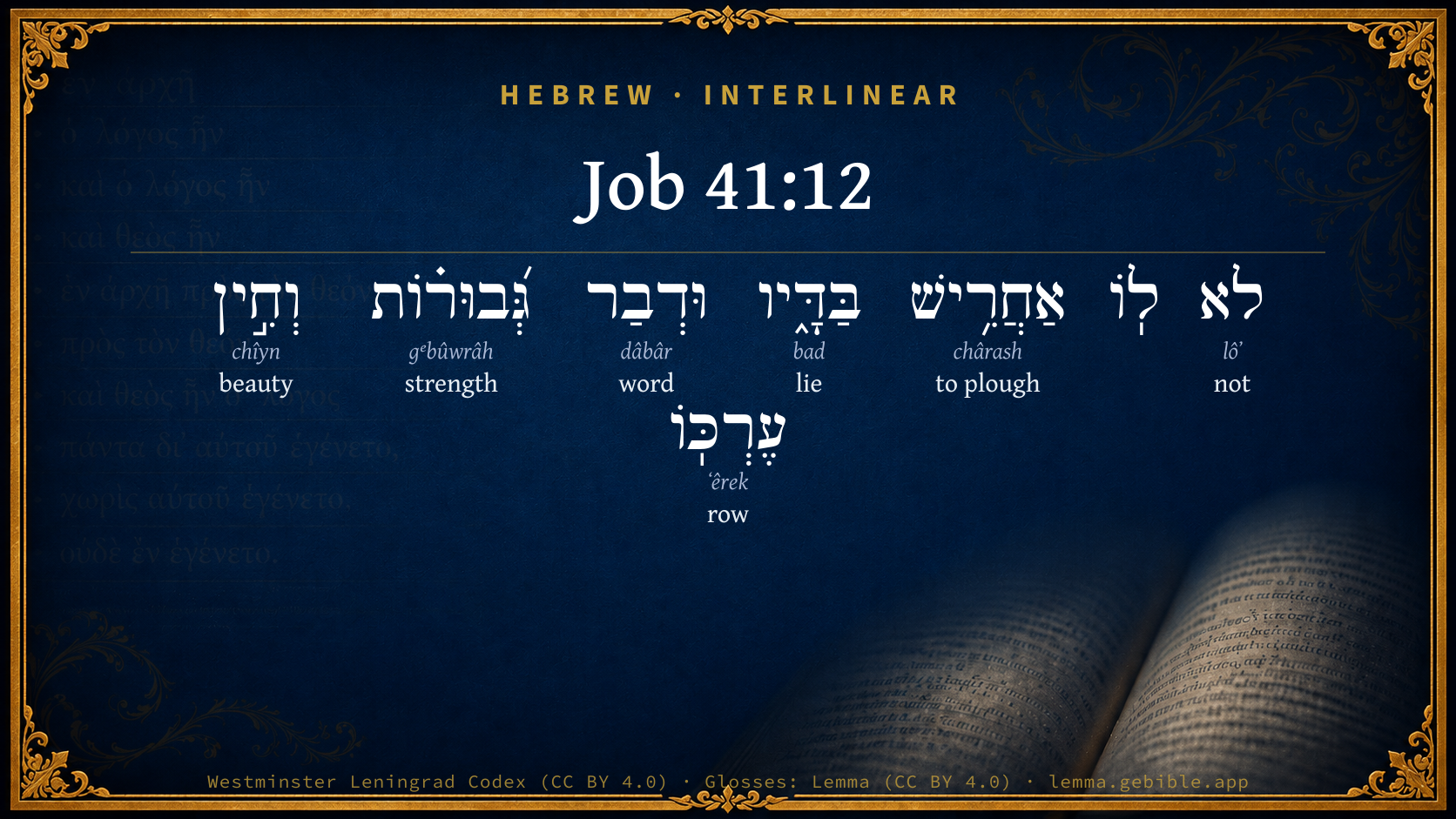
Job 41:12

Hebrew (Westminster Leningrad Codex) Job 41:12 appears in the Hebrew Old Testament. The text above is from the Westminster Leningrad Codex. Each word links to its Strong’s number, a concise gloss, and parsing drawn from the Open Scriptures Hebrew Bible morphology. Click any word for its full Brown-Driver-Briggs (BDB) entry.
Download image
Cite this verse

Job 41:12 (World English Bible). Public Domain. Lemma interlinear Bible study tool, https://lemma.gebible.app/v/job/41/12.

Show BibTeX & RIS
BibTeX
RIS
English Translation
"I will not keep silence concerning his limbs, Nor his mighty strength, nor his goodly frame.
World English Bible · Public Domain
Highlights
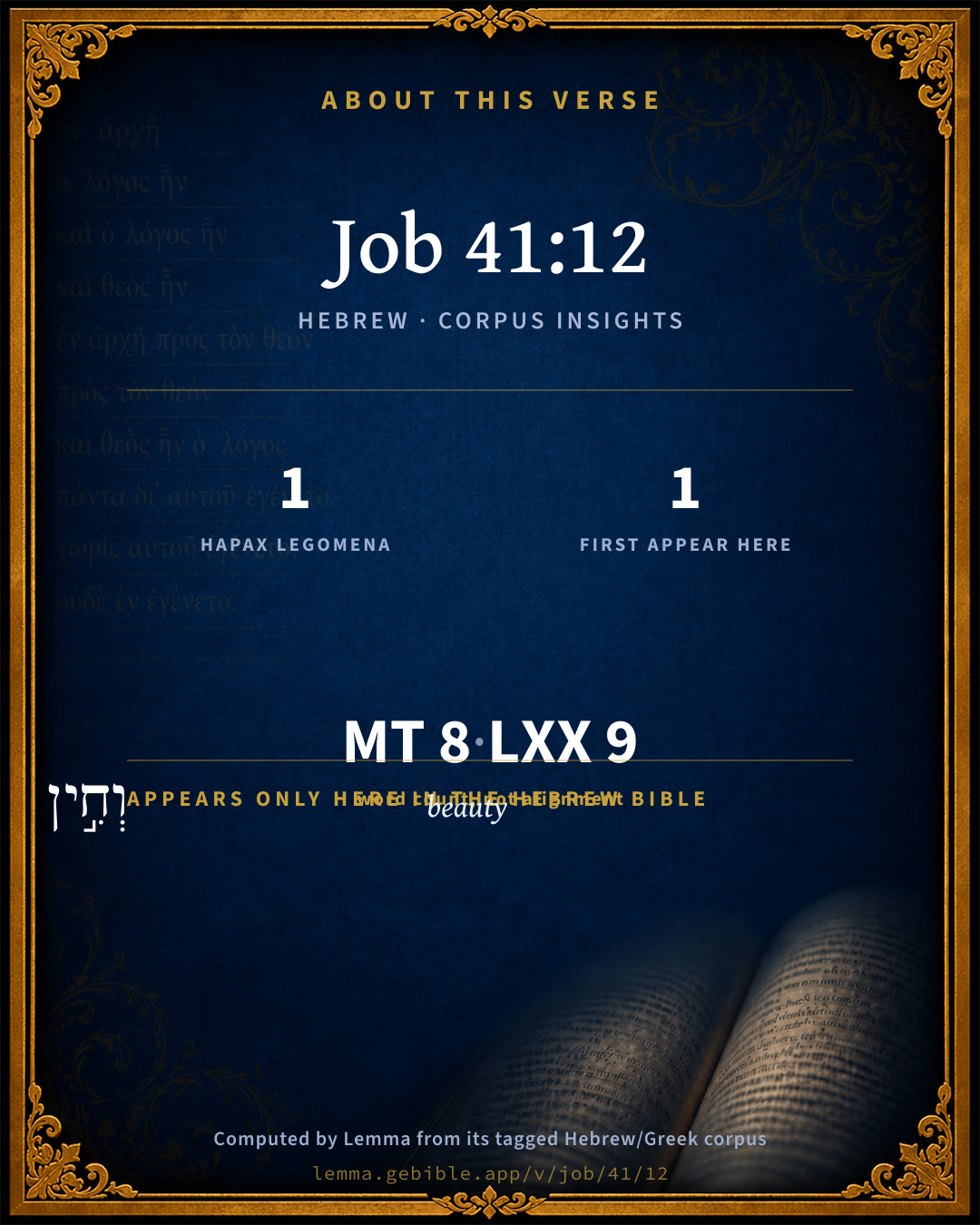
  • 1 hapax legomenon — only here in the Hebrew Bible
  • 1 first appearance in the Hebrew Bible
Full analysis ↓
Download a study sheet

One document with this verse’s original text, its word-by-word gloss line, the meaning frame, cross-references with their text, attributed commentary, and full source and license credits — printable, and it pastes into notes with its structure intact.

This verse Autodidact and up

Study sheet (.html) Plain text (.txt)

A passage Seminary Student

Up to 50 verses in one chapter. A passage sheet keeps up to 6 commentary sources and 12 cross-references per verse, in the order this page ranks them, and says so on the sheet whenever that leaves anything out. Ask for a single verse and you get the Autodidact verse sheet above.

Everything on this page stays free to read, with no account — the sheet is a download of what is already on screen, not access to it.

Want to remove ads? Support Godless Engineer
Compare translations 3

The same verse in 3 English versions, stacked beneath the original-language interlinear above. Click any original word for its lexicon entry.

Each is an independent rendering of the whole verse — the interlinear is not word-aligned to these translations.

Highlighted words mark where these versions differ — a whole-verse word diff, not a word-by-word alignment.

  • World English Bible Public Domain
    "I will not keep silence concerning his limbs, Nor his mighty strength, nor his goodly frame.
  • King James Version Public Domain
    I will not conceal his parts, nor his power, nor his comely proportion.
  • unfoldingWord Literal Text CC BY-SA 4.0
    I will not keep silent its limbs or the matter of its strengths or the beauty of its form.

unfoldingWord Literal Text — © unfoldingWord, licensed CC BY-SA 4.0. Word-aligned USFM3 via Door43 (git.door43.org/unfoldingWord/en_ult).

Versions to compare (up to 4)

3 of 4 selected

Show all 18 translations

Every available English version of this verse, each an independent rendering of the whole verse.

  • World English Bible Public Domain
    "I will not keep silence concerning his limbs, Nor his mighty strength, nor his goodly frame.
  • Berean Standard Bible Public Domain
    I cannot keep silent about his limbs, his power and graceful form.
  • Majority Standard Bible Public Domain
    I cannot keep silent about his limbs, his power and graceful form.
  • King James Version Public Domain
    I will not conceal his parts, nor his power, nor his comely proportion.
  • American Standard Version (1901) Public Domain
    I will not keep silence concerning his limbs, Nor his mighty strength, nor his goodly frame.
  • Revised Version (1885) Public Domain
    I will not keep silence concerning his limbs, nor his mighty strength, nor his comely proportion.
  • Geneva Bible (1599) Public Domain
    His breath maketh the coales burne: for a flame goeth out of his mouth.
  • Douay-Rheims (1899) Public Domain
    His breath kindleth coals, and a flame cometh forth out of his mouth.
  • Young's Literal Translation Public Domain
    I do not keep silent concerning his parts, And the matter of might, And the grace of his arrangement.
  • Literal Standard Version CC BY-SA 4.0
    I do not keep silent concerning his parts, || And the matter of might, || And the grace of his arrangement.
  • Unlocked Literal Bible CC BY-SA 4.0
    I will not keep silent concerning Leviathan's legs, nor about the matter of his strength, nor about his graceful form.
  • unfoldingWord Literal Text CC BY-SA 4.0
    I will not keep silent its limbs or the matter of its strengths or the beauty of its form.
  • Darby Bible Public Domain
    I will not be silent as to his parts, the story of his power, and the beauty of his structure.
  • World Messianic Bible Public Domain
    “I will not keep silence concerning his limbs, nor his mighty strength, nor his goodly frame.
  • Webster's Bible Public Domain
    \\41:21\\His breath kindleth coals, and a flame issueth from his mouth.
  • Free Bible Version CC BY-SA 4.0
    Let me tell you about Leviathan: its powerful legs and graceful proportions.
  • Bible in Basic English Public Domain
    His breath puts fire to coals, and a flame goes out of his mouth.
  • JPS Tanakh (1917) Public Domain
    (41-4) Would I keep silence concerning his boastings, or his proud talk, or his fair array of words?

Literal Standard Version (2020), Covenant Press — licensed CC BY-SA 4.0. Text via the HelloAO Bible API (eBible.org). Unlocked Literal Bible (unfoldingWord) — licensed CC BY-SA 4.0. Text via the HelloAO Bible API (eBible.org). unfoldingWord Literal Text — © unfoldingWord, licensed CC BY-SA 4.0. Word-aligned USFM3 via Door43 (git.door43.org/unfoldingWord/en_ult). Free Bible Version, Dr. Jonathan Gallagher — licensed CC BY-SA 4.0. Text via the HelloAO Bible API (eBible.org).

Word by word

More ways to search: Search by grammar → Find every occurrence → Compare this word →

Practice this passage: Drill this verse → Learn its vocabulary →

About this verse

These counts appear in no published source. They are computed here, from the morphology-tagged text and Lemma’s own curated glosses. What Lemma adds →

8
words
7
distinct lemmas
Wisdom
section

Notable vocabulary

1 hapax legomenon — a word that appears only here in the entire Hebrew Bible:

  • וְחִ֣ין beauty H2433

First appearance in Scripture

This word makes its first canonical appearance in the Hebrew Bible here:

  • וְחִ֣ין beauty H2433

Shared distinctive vocabulary

בַּדָּ֑יו lie H907 occurs in 6 verses of the Hebrew Bible. Also found in:

Grammatical profile

  • 1 verb
  • 5 nouns
  • 1 preposition
  • 1 particle

Verb forms

  • אַחֲרִ֥ישׁ Hiphil · Imperfect

Hebrew & Septuagint length

In English translation the verse runs 16 words from the Hebrew and 14 from the Septuagint (LXX English) — closely comparable.

A rough comparison of the two English renderings, which tokenize alike — not a word-level alignment.

Word counts can differ between the Hebrew and the Greek without any difference in meaning — e.g. the Hebrew direct-object marker אֵת has no separate Greek word, and Greek often adds the article ὁ.

In the original languages it is 8 Hebrew tokens and 9 Greek tokens — but the two are counted differently (Hebrew bundles its prefixes and suffixes into one token; the Greek is in lemma form), so that isn’t a like-for-like length.

Cross-references

1

Topical passages linked to Job 41:12 in the Treasury of Scripture Knowledge — connected by theme and wording, ordered by reader-vote popularity; previews shown in the World English Bible.

  • Genesis 1:25 God made the animals of the earth after their kind, and the cattle after their kind, and everything that creeps on the ground after its kind. God saw that it was good.

Cross-references courtesy of OpenBible.info (CC BY 4.0).

Hebrew and Greek witnesses Masoretic Hebrew ↔ Greek Septuagint

The same verse in the two great witnesses to the Old Testament, shown verse-for-verse.

These are two independent witnesses, not word-aligned to each other, and the Septuagint is shown in lemma (dictionary) form.

Hebrew Job 41:12 Masoretic · Westminster Leningrad Codex

לא לֽוֹ אַחֲרִ֥ישׁ בַּדָּ֑יו וּדְבַר גְּ֝בוּר֗וֹת וְחִ֣ין עֶרְכּֽוֹ

"I will not keep silence concerning his limbs, Nor his mighty strength, nor his goodly frame.

World English Bible · Public Domain

Greek LXX Job 41:12 Septuagint · lemma form

ἐκ μυκτήρ αὐτός ἐκπορεύομαι καπνός κάμινος καίω πῦρ ἄνθραξ

His breath is as live coals, and a flame goes out of his mouth.

LXX2012 (modern English Septuagint) · Public Domain

Hebrew: Westminster Leningrad Codex (CC BY 4.0). Greek: Septuagint (public domain); English from LXX2012 (modern English Septuagint) (Public Domain). How the Septuagint differs from the Hebrew →

Commentary

Notes on Job 41:12 from classic Christian and Jewish commentators (each source and its license shown beneath its notes). The classic Christian expositions comment on the surrounding passage and are grouped to its opening verse, so a note may address several verses; the Jewish commentaries on the Tanakh (Rashi and others) are per-verse, so they appear only where the commentator wrote on this verse.

Lemma curates 59 commentaries, every one of them public domain or Creative Commons licensed, each selected and text-cleaned for this edition rather than reprinted as found. About our sources →

Trapp's Complete Commentary

John Trapp

Job 41:12 I will not conceal his parts, nor his power, nor his comely proportion.

Ver. 12. I will not conceal his parts, nor his power] That therein, as in a picture of the most principal piece of my workmanship, thou mayest behold how great and how glorious a God I am. In the year of grace 1577, July 2nd, the shipmen took a whale not far from Antwerp, the picture whereof was printed and published to this effect: His hide was without scales, and of a leaden colour. He was eighty-five feet long and sixteen feet high. From his mouth to his eyes was fifteen feet; from his eyes to his fins four feet and three fingers, &c. Such a kind of picture or character of this sea monster we have here, from the most skilful hand of heaven. Pliny observeth that pictures of things, exact and excellent, are seldom drawn but with great disadvantage. Not so this in the text, as will appear in the sequel.

Nor his comely proportion] Heb. Nor the grace of his disposition, i.e. Dicam quam egregio et concinne membra eius composita sint, I will declare how finely and fitly all his parts are proportioned and put together (Vatab.). In the most deformed creatures (as we count them) there is no part superfluous, useless, or uncomely. Deus est magnus in minimis, nec parvus in maximis. God is great in the smallest things and not small in the greatest things.

John Trapp, A Commentary or Exposition upon All the Books of the Old and New Testament (1647–1656) — public domain. Text from a community e-Sword module.

Joseph Benson's Commentary

Job 41:12. I will not conceal his parts — That is, I will particularly speak of them. Hebrew, בדיו, bad-dav, his bars, or the members of his body, which are strong like bars of iron. R. Levi interprets it of his strength; nor his power — ודבר גבורות, udebar geburoth, nec verbum fortitudinum, nor the word, or the matter, of his fortitude; nor his comely proportion — Which is more remarkable and admirable in a creature of such vast bulk: Hebrew, וחין ערכו, vechin gnercho, nor the gracefulness of his disposition, that is, the disposition or adjustment of his parts.

Joseph Benson's Commentary on the Old and New Testaments (1811–1818) — public domain. Text from a community e-Sword module.

Whedon's Commentary on the Bible

Daniel D. Whedon

β — The divine Speaker resumes the description of leviathan, in order that he may dwell more at large upon the artistic skill and the esthetic wisdom displayed in the making of a reptile whose eyes, mouth, nostrils and breath are a source of terror: and show that even so insignificant a thing as his garment has been exquisitely elaborated, so as to serve the twofold object of covering and martial defence, Job_41:12-22.

12. Conceal his parts — Hebrews, baddim; pass in silence his members. Same as in Job_18:13. See note. The divine Being has thus far spoken of the invincibility of leviathan; he will now speak of his bodily structure and mode of life.

Nor his power — Literally, and the word of powers. דבר, word, Vaihinger understands to mean “fame;” Delitzsch, “proportion.”

Daniel D. Whedon (gen. ed.), Commentary on the Old and New Testaments (1874–1909) — public domain. Text from a community e-Sword module.

Jamieson, Fausset & Brown

Robert Jamieson, A. R. Fausset & David Brown

I will not conceal--a resumption of the description broken off by the digression, which formed an agreeable change.

his power--literally, "the way," that is, true proportion or expression of his strength (so Hebrew, Deu 19:4).

comely proportion--literally, "the comeliness of his structure" (his apparatus: so "suit of apparel" Jdg 17:10) [MAURER]. UMBREIT translates, "his armor." But that follows after.

Jamieson, Fausset & Brown — Commentary Critical and Explanatory on the Whole Bible (1871) — public domain (CC PDM 1.0). Text via the HelloAO Bible API.

Adam Clarke's Commentary

Verse 12. I will not conceal his parts] This is most certainly no just translation of the original. The Vulgate is to this effect: I will not spare him: nor yield to his powerful words, framed for the purpose of entreaty. Mr. Good applies it to leviathan: -

"I cannot be confounded at his limbs and violence;

The strength and structure of his frame."

The Creator cannot be intimidated at the most formidable of his own works: man may and should tremble; GOD cannot.

Adam Clarke's Commentary on the Bible (1810–1826) — public domain. Text from a community e-Sword/MySword module.

The Cambridge Bible for Schools and Colleges

gen. ed. J. J. S. Perowne

12–34. Description of the parts of Leviathan.

The Cambridge Bible for Schools and Colleges (gen. ed. J. J. S. Perowne; Cambridge University Press, 1878–1918) — public domain. Text from a community e-Sword module.

John Gill's Exposition

I will not conceal his parts,.... The parts of the leviathan; or "his bars", the members of his body, which are like bars of iron:

nor his power; which is very great, whether of the crocodile or the whale:

nor his comely proportion; the symmetry of his body, and the members of it; which, though large, every part is in just proportion to each other.

John Gill's Exposition of the Whole Bible (1746–1763) — public domain (CC PDM 1.0). Text via the HelloAO Bible API.

Albert Barnes' Notes on the Bible

I will not conceal his parts - This is the commencement of a more particular description of the animal than had been before given. In the previous part of the chapter, the remarks are general, speaking of it merely as one of great power, and not to be taken by any of the ordinary methods. A description follows of the various parts of the animal, all tending to confirm this general impression, and to fill the hearer with a deep conviction of his formidable character. The words rendered, “I will not conceal,” mean, “I will not be silent;” that is, he would speak of them. The description which follows of the “parts” of the animal refers particularly to his mouth, his teeth, his scales, his eyelids, his nostrils, his neck, and his heart.

Nor his comely proportion - The crocodile is not an object of beauty, and the animal described here is not spoken of as one of beauty, but as one of great power and fierceness. The phrase used here (ערכוּ חין chı̂yn ‛êrekô) means properly “the grace of his armature,” or the beauty of his armor. It does not refer to the beauty of the animal as such, but to the armor or defense which it had. Though there might be no beauty in an animal like the one here described, yet there might be a “grace” or fitness in its means of defense which could not fail to attract admiration. This is the idea in the passage. So Gesenius, Umbreit, and Noyes render it.

Albert Barnes' Notes on the Bible (1834–1885) — public domain. Text from a community e-Sword/MySword module.

Haydock's Catholic Bible Commentary

Breath, like bellows, ver. 10. (Menochius)

George Leo Haydock (1774–1849), Haydock's Catholic Family Bible and Commentary, 1859 edition — public domain. Excludes Psalms (Douay-Rheims chapter numbering differs from Protestant) and Deuterocanonical books (Catholic canon only).

Matthew Poole's English Annotations

i.e. I will particularly speak of them. Here is a meiosis, as there is Job 14:11; 15:18, and oft elsewhere.

His parts, Heb. His bars, i.e. the members of his body, which are strong, like bars of iron.

His comely proportion, which is more amiable and admirable in so vast a bulk.

Matthew Poole's English Annotations on the Holy Bible (1683–1685) — public domain. Text from a community e-Sword/MySword module.

The Pulpit Commentary

I will not conceal his parts, nor his power, nor his comely proportion. The further description is introduced by this formal announcement, which is perhaps best rendered, I will not keep silence concerning his limbs" nor concerning the matter of his might" or the comeliness of his proportion (see the Revised Version); i.e. I will enter upon these points seriatim" and set them forth severally.

The Pulpit Commentary (1880–1919), ed. H.D.M. Spence-Jones & Joseph S. Exell — public domain. Text from a community e-Sword module.

Keil & Delitzsch

C. F. Keil & F. Delitzsch

12 I will not keep silence about his members,

The proportion of his power and the comeliness of his structure.

13 Who could raise the front of his coat of mail?

Into his double teeth-who cometh therein?

14 The doors of his face-who openeth them?

Round about his teeth is terror.

The Ker לו authorized by the Masora assumes an interrogative rendering: as to it, should I be silent about its members (לו at the head of the clause, as Lev 7:7-9; Isa 9:2), - what perhaps might appear more poetic to many. החרישׁ (once, Job 11:3, to cause to keep silence) here, as usually: to be silent. בּדּיו, as Job 18:13. דּבר signifies the relation of the matter, a matter of fact, as דּברי, facts, Psa 65:4; Psa 105:27; Psa 145:5. חין (compared by Ew. with הין, a measure) signifies grace, χάρις (as synon. חסד), here delicate regularity, and is made easy of pronunciation from חנן, just as the more usual חן; the language has avoided the form חנן, as observed above. לבוּשׁ . clothing, we have translated "coat of mail," which the Arab. libâs usually signifies; פּני לבוּשׁו is not its face's covering (Schlottm.), which ought to be לבוּשׁ פּניו; but פּני is the upper or front side turned to the observer (comp. Isa 25:7), as Arab. wjh, (wag'h), si rem desuper spectes, summa ejus pars, si ex adverso, prima (Fleischer, Glossae, i. 57). That which is the "doubled of its mouth" (רסן, prop. a bit in the mouth, then the mouth itself) is its upper and lower jaws armed with powerful teeth. The "doors of the face" are the jaws; the jaws are divided back to the ears, the teeth are not covered by lips; the impression of the teeth is therefore the more terrible, which the substantival clause, Job 41:14 (comp. Job 39:20), affirms. שׁנּיו gen. subjecti: the circle, ἓρκος, which is formed by its teeth (Hahn).

Keil & Delitzsch — Biblical Commentary on the Old Testament (1861–1891) — public domain (CC PDM 1.0). Text via the HelloAO Bible API. (Old Testament only.)

Rashi

Rabbi Shlomo Yitzchaki (Rashi)

From his nostrils smoke goes forth like a bubbling pot on the fire, which raises smoke.

and an earthenware vessel ואגמן. Its interpretation is according to its context: an expression of an earthenware vessel, like a bubbling pot; according to the matter that is stated (Jer. 1:13): “I see a bubbling pot.”

Rashi on the Tanakh — English translations: “The Judaica Press complete Tanach with Rashi, translated by A. J. Rosenberg” (CC BY 4.0); “Pentateuch with Rashi's commentary by M. Rosenbaum and A.M. Silbermann, 1929-1934” (public domain); “The Metsudah Tanach series, Lakewood, N.J” (CC BY 4.0); and “The Book of Joshua, Metsudah Publications, 1997” (CC BY 4.0). Text via Sefaria.

Lesson kit

Teaching starters — assembled from the data on this page, not authored interpretation. Every prompt links to the verse data it draws on. Edit before teaching.

Job, in the Wisdom, opens this verse with 8 words (7 distinct Hebrew lemmas). Its most distinctive word is chîyn (“beauty”). A historical commentator’s framing appears above. Read the whole chapter for the surrounding context.

Discussion questions

  1. The word chîyn carries the sense “beauty.” How does it shape the verse?
  2. 1 word here appears nowhere else in the Hebrew Bible. Why might the author reach for such rare wording?
  3. This is the first place “beauty” appears in Scripture (first appears here). What does its debut here establish?
  4. How does Job 11:3, which shares the word «lie», read alongside this verse?
  5. These translations render this verse differently; the difference is in the English rendering, not the original. What questions does that raise?
  6. «אַחֲרִ֥ישׁ» is a Hiphil Imperfect verb. How does that grammatical form shape the action described?
  7. Compare how Trapp's Complete Commentary and Joseph Benson's Commentary read this verse. Where do they agree or differ?

Things to notice

Reading settings

Reading text

Shown beneath each verse's original-language words.

Old Testament
Old Testament edition

Read the OT as the Masoretic Hebrew (MT) or the Greek Septuagint (LXX).

English shown for the Greek Septuagint (in the Hebrew ↔ Greek comparison).

Comparing translations? Open the Compare panel on any verse page to stack up to four side by side.