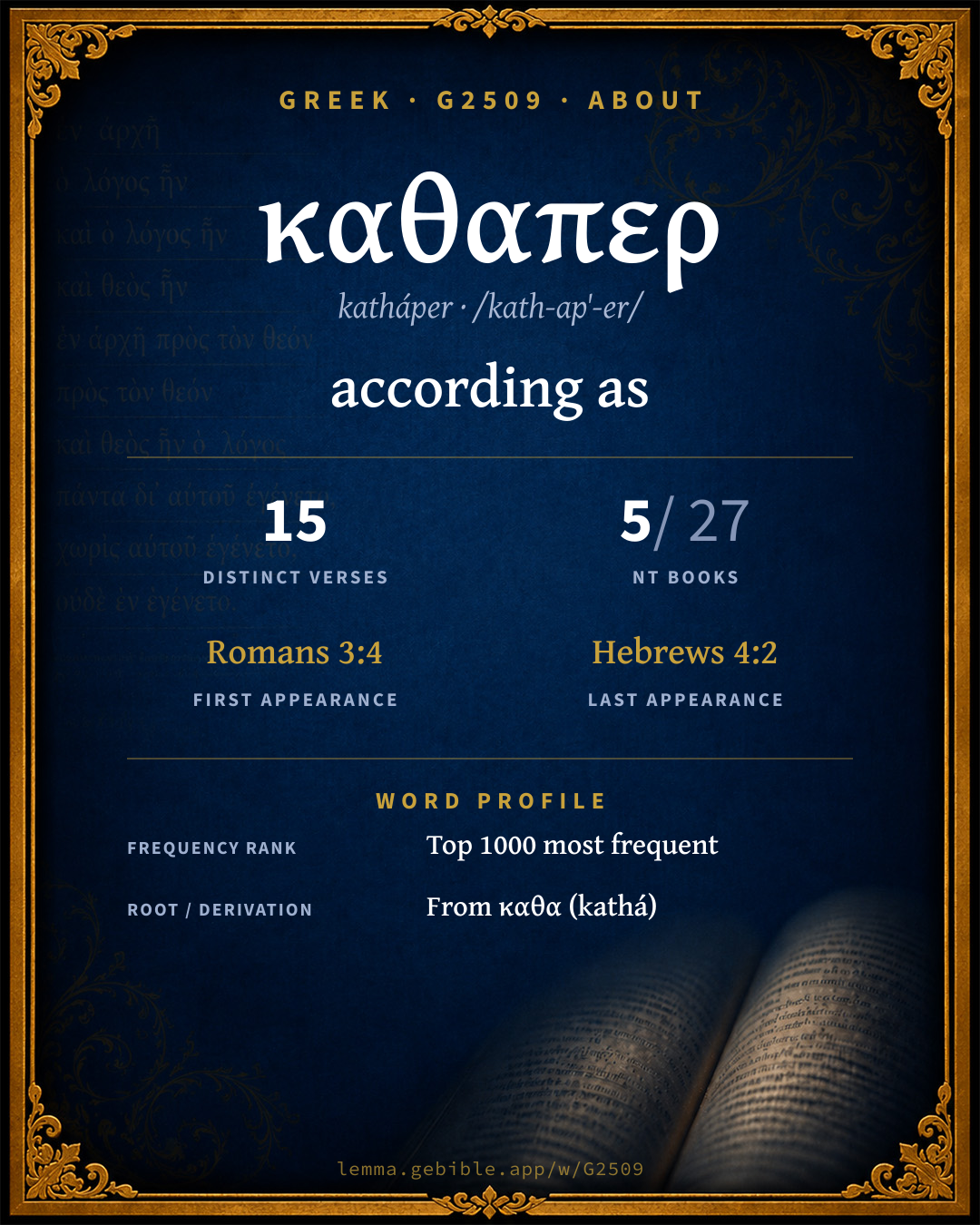
καθάπερ
according as
Full lexicon entry — Thayer's Greek Lexicon
From Thayer's Greek Lexicon
Where this word appears
Grammar key — what these labels mean
Part of speech
- Adverb
- A word that modifies a verb, adjective, or other adverb.
Every verse where G2509 appears — 15 distinct verses across 5 books. Click any verse to open its interlinear word-by-word view. Verse text shown in the World English Bible for context — . Each verse’s Greek form is shown with its reference; the English is not keyword-highlighted, since the data carries no word-level English alignment. Use “Compare translations” on any verse to read it across multiple English versions. This concordance covers the Greek New Testament; Septuagint (Greek Old Testament) occurrences of this word are not indexed here.
Romans 4 verses
- Romans 3:4 καθάπερ adv May it never be! Yes, let God be found true, but every man a liar. As it is written, "That you might be justified in your words, And might prevail when you come into judgment."
- Romans 4:6 καθάπερ adv Even as David also pronounces blessing on the man to whom God counts righteousness apart from works,
- Romans 11:8 καθάπερ adv According as it is written, "God gave them a spirit of stupor, eyes that they should not see, and ears that they should not hear, to this very day."
- Romans 12:4 καθάπερ adv For even as we have many members in one body, and all the members don't have the same function,
1 Corinthians 2 verses
2 Corinthians 4 verses
- 2 Corinthians 1:14 καθάπερ adv as also you acknowledged us in part, that we are your boasting, even as you also are ours, in the day of our Lord Jesus.
- 2 Corinthians 3:13 καθάπερ adv and not as Moses, who put a veil on his face, that the children of Israel wouldn't look steadfastly on the end of that which was passing away.
- 2 Corinthians 3:18 καθάπερ adv But we all, with unveiled face beholding as in a mirror the glory of the Lord, are transformed into the same image from glory to glory, even as from the Lord, the Spirit.
- 2 Corinthians 8:11 καθάπερ adv But now complete the doing also, that as there was the readiness to be willing, so there may be the completion also out of your ability.
1 Thessalonians 4 verses
- 1 Thessalonians 2:11 καθάπερ adv As you know how we exhorted, comforted, and implored every one of you, as a father does his own children,
- 1 Thessalonians 3:6 καθάπερ adv But when Timothy came just now to us from you, and brought us glad news of your faith and love, and that you have good memories of us always, longing to see us, even as we also long to see you;
- 1 Thessalonians 3:12 καθάπερ adv and the Lord make you to increase and abound in love one toward another, and toward all men, even as we also do toward you,
- 1 Thessalonians 4:5 καθάπερ adv not in the passion of lust, even as the Gentiles who don't know God;
Hebrews 1 verse
About this entry
At a glance — auto-summarized from this page’s data, not written by a person. Every figure links to its source below. This summary describes the numbers; it doesn’t interpret them.
καθαπερ (katháper) is a Greek word most often rendered “according as.” Translators differ — “as” in the King James Version, then “just as” (Berean Standard Bible), as the renderings breakdown shows. It turns up in 15 verses across 5 books, an uncommon footprint. It concentrates in Romans, which alone accounts for 27% of its uses. It first appears in Romans 3:4. The sections below give every sense, occurrence, and version rendering.
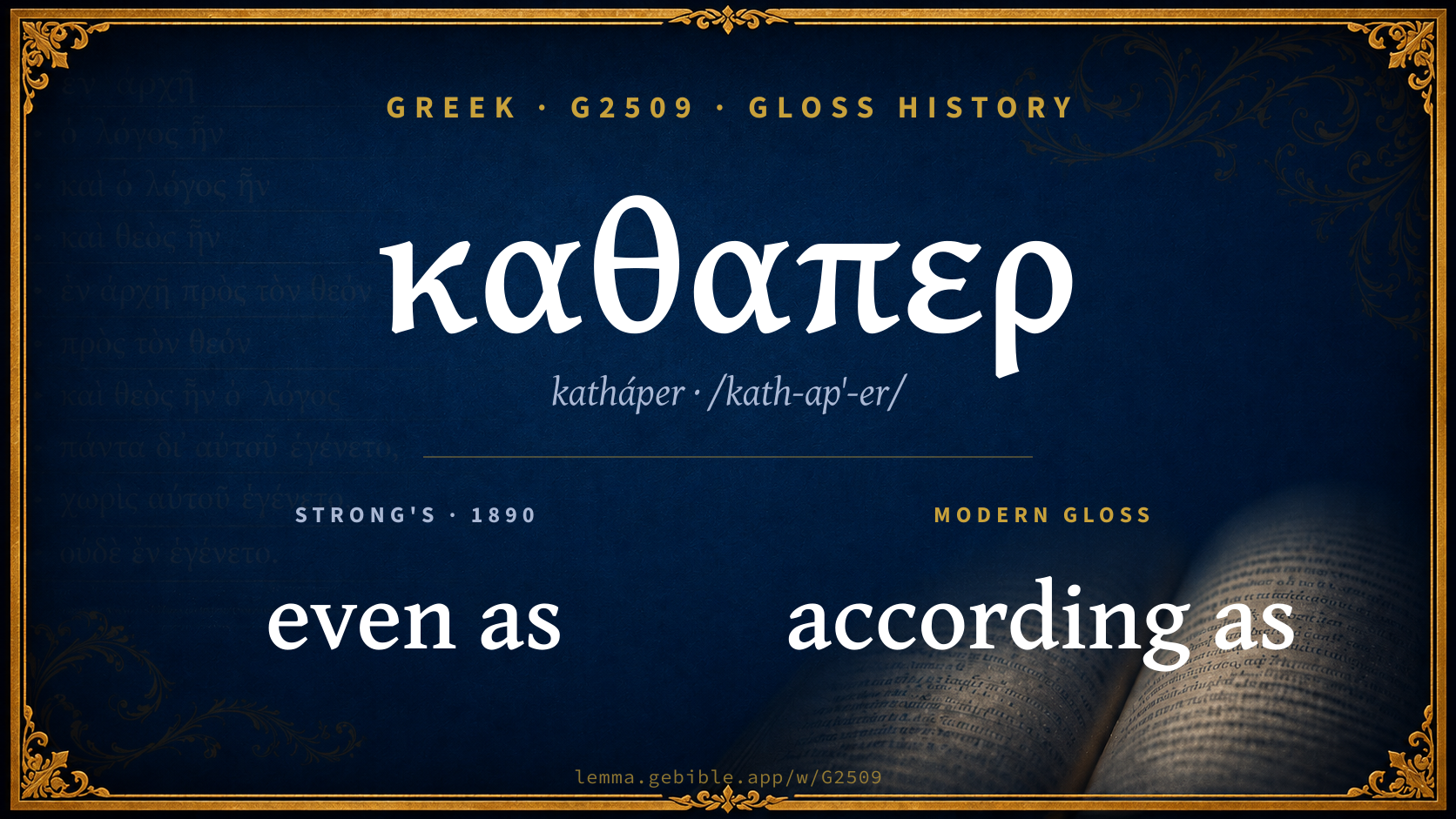
Gloss history
Strong's 1890 vs modern scholarship
About this word
Strong's G2509 catalogs a Greek word from the Greek New Testament.
These counts are not copied from any lexicon or concordance. They are computed here, from the morphology-tagged Greek New Testament. What Lemma adds →
- 15
- distinct verses
- The word appears in 15 distinct verses.
- 5 / 27
- NT books
- The word appears in 5 of 27 New Testament books.
- #768
- by frequency
- Top 1000 most frequent Greek words (rank 768 of 5,347 Greek words by occurrence).
View all 15 occurrences in the concordance →
Most concentrated in
- Romans 4 verses 27%
- 2 Corinthians 4 verses 27%
- 1 Thessalonians 4 verses 27%
By section of the New Testament
By traditional corpus
Conventional, traditional groupings — biblical authorship is debated, so this is a traditional corpus grouping, not an authorship claim. Some books belong to more than one corpus (Luke is in both the Gospels and the Lukan corpus, and so on), so these shares overlap and need not total 100%. Each figure is a share of the word’s 15 distinct verses.
- Pauline corpus 14 verses · 93%
- Hebrews 1 verse · 7%
How translations render this word
Counts come from each version’s own published word-to-Strong’s tagging or interlinear alignment — an approximate guide to how each version renders this word, not a word-level alignment the data otherwise carries. Because each total is that version’s own tagged count, the per-version totals vary from one another and need not match the appearance or distinct-verse counts above. These counts may also differ from a printed concordance because Lemma counts each distinctly tagged rendering and does not collapse phrase taggings into a single head-word total. This is a fixed set of word-tagged versions (KJV, ASV, BSB, ULT) and does not change with the reading translation you choose elsewhere. Each version’s license is shown beside its name below (and on Sources).
- King James Version: As 12×
- American Standard Version: As 12×
- Berean Standard Bible: Just as 5×, Like 2×
- unfoldingWord Literal Text: Just as 10×, As 3×
King James Version Public Domain
Renders G2509 across 13 tagged occurrences — most commonly:
Plus 1 rendering that appears only once — usually multi-word phrases or single function words the recovered tagging swept in, not distinct renderings.
American Standard Version Public Domain
Renders G2509 across 13 tagged occurrences — most commonly:
Plus 1 rendering that appears only once — usually multi-word phrases or single function words the recovered tagging swept in, not distinct renderings.
Berean Standard Bible Public Domain
Renders G2509 across 12 tagged occurrences — most commonly:
Plus 5 renderings that appear only once — usually multi-word phrases or single function words the recovered tagging swept in, not distinct renderings. Not rendered by a distinct English word in 1 further occurrence.
unfoldingWord Literal Text CC BY-SA 4.0
Renders G2509 across 15 tagged occurrences — most commonly:
Plus 2 renderings that appear only once — usually multi-word phrases or single function words the recovered tagging swept in, not distinct renderings.
Senses in Thayer's
The 1 sense Thayer's distinguishes for this word, in lexicon order (not ranked by frequency or importance). The full entry — with sub-senses — is in the Lexicon Entry tab.
- according as, just as, even as
Word origin
Derived from καθα (kathá) (G2505) — according as.
Forms in the corpus
The 2 distinct written forms G2509 takes in the Greek New Testament, most frequent first — each parse links to that case’s occurrences in the concordance.
| Form | Parsing | Example | Uses |
|---|---|---|---|
| καθάπερ katháper | Adverb | Romans 3:4 | 14 |
| Καθάπερ Katháper | Adverb | 1 Corinthians 12:12 | 1 |
Septuagint usage
The same Greek word καθαπερ appears 59 times in the Greek Old Testament (Septuagint), across 58 verses in 11 books.
- 59
- LXX occurrences
- Tagged occurrences of this Greek word in the Septuagint.
- 58
- verses
- Distinct Septuagint verses containing this word.
- 11 / 39
- OT books
- The word appears in 11 of the 39 Old Testament books.
Sample Septuagint occurrences
- Genesis 12:4 καθάπερ
- Exodus 5:7 καθάπερ
- Leviticus 8:13 καθάπερ
- Numbers 14:19 καθάπερ
- Deuteronomy 6:3 καθάπερ
- Joshua 4:8 καθάπερ
- 2 Samuel 16:19 καθάπερ
- Psalms 32:22 καθάπερ
- Isaiah 58:11 καθάπερ
- Jeremiah 13:11 καθάπερ
- Daniel 2:8 καθάπερ
Septuagint occurrences (same lexeme)
Every verse where the same Strong’s number (G2509) appears in the Greek Septuagint — showing the first 50 of 58. Verse text shown in the World English Bible for context; the Greek form is the matched word — the English is not keyword-highlighted.
- Genesis 12:4 καθάπερ So Abram went, as Yahweh had spoken to him. Lot went with him. Abram was seventy-five years old when he departed out of Haran.
- Genesis 50:6 καθάπερ Pharaoh said, "Go up, and bury your father, just like he made you swear."
- Exodus 5:7 καθάπερ "You shall no longer give the people straw to make brick, as before. Let them go and gather straw for themselves.
- Exodus 5:13 καθάπερ The taskmasters were urgent saying, "Fulfill your work quota daily, as when there was straw!"
- Exodus 5:14 καθάπερ The officers of the children of Israel, whom Pharaoh's taskmasters had set over them, were beaten, and demanded, "Why haven't you fulfilled your quota both yesterday and today, in making brick as before?"
- Exodus 7:6 καθάπερ Moses and Aaron did so. As Yahweh commanded them, so they did.
- Exodus 7:10 καθάπερ Moses and Aaron went in to Pharaoh, and they did so, as Yahweh had commanded: and Aaron cast down his rod before Pharaoh and before his servants, and it became a serpent.
- Exodus 7:13 καθάπερ Pharaoh's heart was hardened, and he didn't listen to them; as Yahweh had spoken.
- Exodus 7:20 καθάπερ Moses and Aaron did so, as Yahweh commanded; and he lifted up the rod, and struck the waters that were in the river, in the sight of Pharaoh, and in the sight of his servants; and all the waters that were in the river were turned to blood.
- Exodus 7:22 καθάπερ The magicians of Egypt did in like manner with their enchantments; and Pharaoh's heart was hardened, and he didn't listen to them; as Yahweh had spoken.
- Exodus 8:9 καθάπερ Moses said to Pharaoh, "I give you the honor of setting the time that I should pray for you, and for your servants, and for your people, that the frogs be destroyed from you and your houses, and remain in the river only."
- Exodus 8:11 καθάπερ The frogs shall depart from you, and from your houses, and from your servants, and from your people. They shall remain in the river only."
- Exodus 8:15 καθάπερ But when Pharaoh saw that there was a respite, he hardened his heart, and didn't listen to them, as Yahweh had spoken.
- Exodus 8:23 καθάπερ I will put a division between my people and your people: by tomorrow shall this sign be."'"
- Exodus 8:27 καθάπερ We will go three days' journey into the wilderness, and sacrifice to Yahweh our God, as he shall command us."
- Exodus 9:35 καθάπερ The heart of Pharaoh was hardened, and he didn't let the children of Israel go, just as Yahweh had spoken through Moses.
- Exodus 16:24 καθάπερ They laid it up until the morning, as Moses asked, and it didn't become foul, neither was there any worm in it.
- Exodus 17:10 καθάπερ So Joshua did as Moses had told him, and fought with Amalek; and Moses, Aaron, and Hur went up to the top of the hill.
- Exodus 23:15 καθάπερ You shall observe the feast of unleavened bread. Seven days you shall eat unleavened bread, as I commanded you, at the time appointed in the month Abib (for in it you came out from Egypt), and no one shall appear before me empty.
- Exodus 34:4 καθάπερ He chiseled two tablets of stone like the first; and Moses rose up early in the morning, and went up to Mount Sinai, as Yahweh had commanded him, and took in his hand two stone tablets.
- Exodus 34:18 καθάπερ "You shall keep the feast of unleavened bread. Seven days you shall eat unleavened bread, as I commanded you, at the time appointed in the month Abib; for in the month Abib you came out from Egypt.
- Exodus 38:27 καθάπερ The one hundred talents of silver were for casting the sockets of the sanctuary, and the sockets of the veil; one hundred sockets for the one hundred talents, a talent for a socket.
- Exodus 40:27 καθάπερ and he burnt incense of sweet spices on it, as Yahweh commanded Moses.
- Leviticus 8:13 καθάπερ Moses brought Aaron's sons, and clothed them with coats, and tied sashes on them, and put headbands on them; as Yahweh commanded Moses.
- Leviticus 8:21 καθάπερ He washed the innards and the legs with water; and Moses burned the whole ram on the altar. It was a burnt offering for a sweet savor. It was an offering made by fire to Yahweh; as Yahweh commanded Moses.
- Leviticus 8:34 καθάπερ What has been done this day, so Yahweh has commanded to do, to make atonement for you.
- Leviticus 9:7 καθάπερ Moses said to Aaron, "Draw near to the altar, and offer your sin offering, and your burnt offering, and make atonement for yourself, and for the people; and offer the offering of the people, and make atonement for them; as Yahweh commanded."
- Leviticus 15:25 καθάπερ "'If a woman has a discharge of her blood many days not in the time of her period, or if she has a discharge beyond the time of her period; all the days of the discharge of her uncleanness shall be as in the days of her period: she is unclean.
- Leviticus 16:34 καθάπερ "This shall be an everlasting statute for you, to make atonement for the children of Israel once in the year because of all their sins." It was done as Yahweh commanded Moses.
- Leviticus 27:8 καθάπερ But if he is poorer than your valuation, then he shall be set before the priest, and the priest shall value him; according to the ability of him who vowed shall the priest value him.
- Numbers 14:19 καθάπερ Pardon, Please, the iniquity of this people according to the greatness of your loving kindness, and according as you have forgiven this people, from Egypt even until now.
- Numbers 17:12 καθάπερ The children of Israel spoke to Moses, saying, Behold, we perish, we are undone, we are all undone.
- Numbers 23:30 καθάπερ Balak did as Balaam had said, and offered up a bull and a ram on every altar.
- Numbers 27:23 καθάπερ and he laid his hands on him, and gave him a charge, as Yahweh spoke by Moses.
- Deuteronomy 6:3 καθάπερ Hear therefore, Israel, and observe to do it; that it may be well with you, and that you may increase mightily, as Yahweh, the God of your fathers, has promised to you, in a land flowing with milk and honey.
- Deuteronomy 9:3 καθάπερ Know therefore this day, that Yahweh your God is he who goes over before you as a devouring fire; he will destroy them, and he will bring them down before you: so shall you drive them out, and make them to perish quickly, as Yahweh has spoken to you.
- Deuteronomy 9:18 καθάπερ I fell down before Yahweh, as at the first, forty days and forty nights; I did neither eat bread nor drink water; because of all your sin which you sinned, in doing that which was evil in the sight of Yahweh, to provoke him to anger.
- Deuteronomy 12:20 καθάπερ When Yahweh your God shall enlarge your border, as he has promised you, and you shall say, I will eat flesh, because your soul desires to eat flesh; you may eat flesh, after all the desire of your soul.
- Deuteronomy 26:18 καθάπερ and Yahweh has declared you this day to be a people for his own possession, as he has promised you, and that you should keep all his commandments;
- Joshua 4:8 καθάπερ The children of Israel did so as Joshua commanded, and took up twelve stones out of the midst of the Jordan, as Yahweh spoke to Joshua, according to the number of the tribes of the children of Israel; and they carried them over with them to the place where they lodged, and laid them down there.
- Joshua 4:12 καθάπερ The children of Reuben, and the children of Gad, and the half-tribe of Manasseh, passed over armed before the children of Israel, as Moses spoke to them:
- Joshua 4:23 καθάπερ For Yahweh your God dried up the waters of the Jordan from before you, until you were passed over, as Yahweh your God did to the Red Sea, which he dried up from before us, until we were passed over;
- Joshua 8:5 καθάπερ and I, and all the people who are with me, will approach to the city. It shall happen, when they come out against us, as at the first, that we will flee before them;
- Joshua 9:21 καθάπερ The princes said to them, Let them live: so they became wood cutters and drawers of water to all the congregation, as the princes had spoken to them.
- Joshua 23:8 καθάπερ but cleave to Yahweh your God, as you have done to this day.
- Joshua 23:10 καθάπερ One man of you shall chase a thousand; for Yahweh your God, he it is who fights for you, as he spoke to you.
- 2 Samuel 16:19 καθάπερ Again, whom should I serve? Shouldn't I serve in the presence of his son? as I have served in your father's presence, so will I be in your presence.
- Psalms 32:22 καθάπερ
- Psalms 47:9 καθάπερ The princes of the peoples are gathered together, The people of the God of Abraham. For the shields of the earth belong to God. He is greatly exalted!
- Psalms 55:7 καθάπερ Behold, then I would wander far off. I would lodge in the wilderness." Selah.
These are occurrences of the same Greek lexeme (G2509) in the Septuagint — not a translation of any one Hebrew word. The store carries no word-level Hebrew↔Greek alignment, so no Hebrew original is asserted here. Counts come from the recovered LXX Strong's tagging — high-frequency vocabulary is well covered, while rare or late forms may be untagged — so they reflect tagged occurrences and may slightly undercount.