
Joshua 23:8

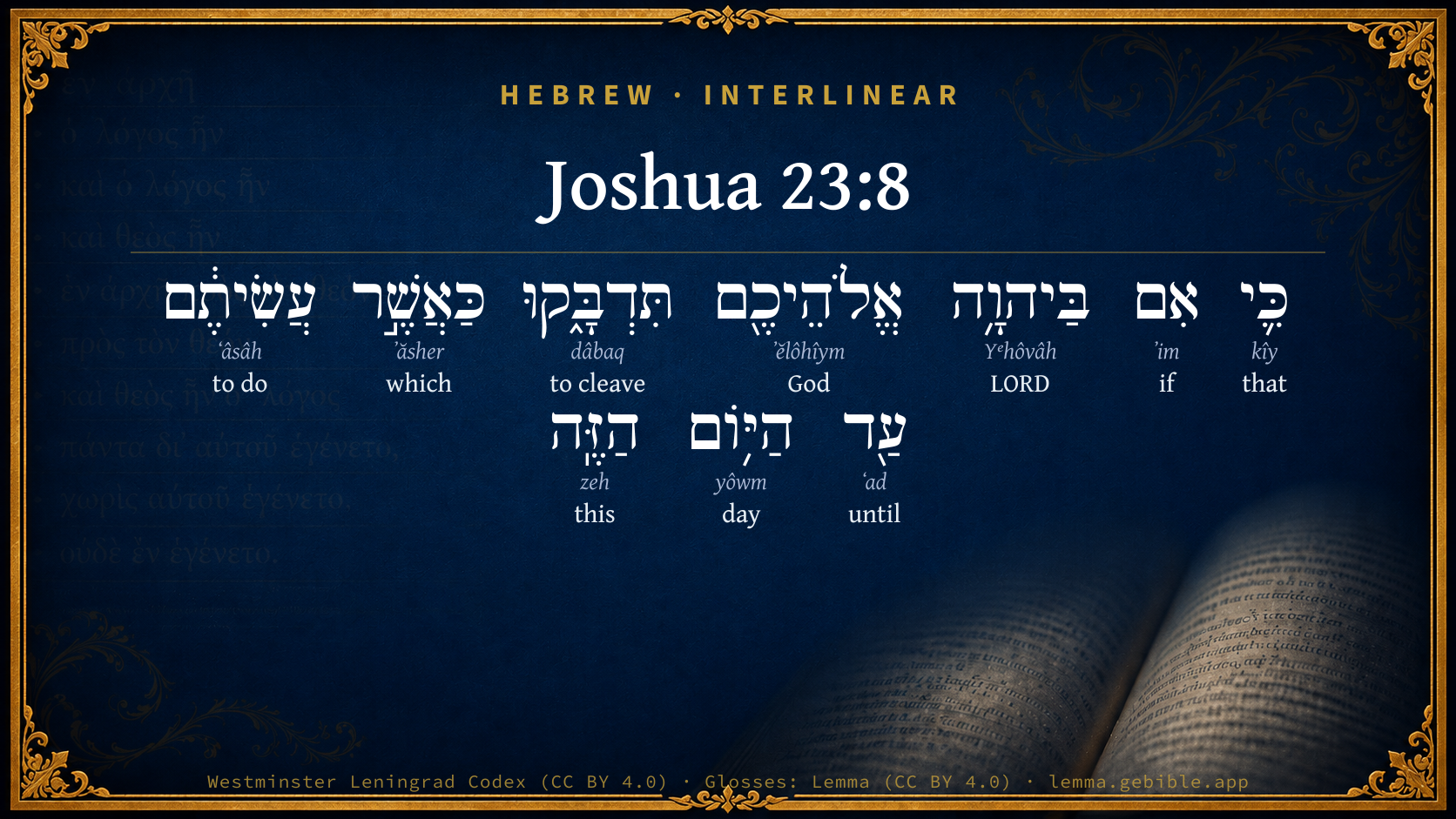
Hebrew (Westminster Leningrad Codex) Joshua 23:8 appears in the Hebrew Old Testament. The text above is from the Westminster Leningrad Codex. Each word links to its Strong’s number, a concise gloss, and parsing drawn from the Open Scriptures Hebrew Bible morphology. Click any word for its full Brown-Driver-Briggs (BDB) entry.
Download image
Cite this verse

Joshua 23:8 (World English Bible). Public Domain. Lemma interlinear Bible study tool, https://lemma.gebible.app/v/joshua/23/8.

Show BibTeX & RIS
BibTeX
RIS
English Translation
but cleave to Yahweh your God, as you have done to this day.
World English Bible · Public Domain
Download a study sheet

One document with this verse’s original text, its word-by-word gloss line, the meaning frame, cross-references with their text, attributed commentary, and full source and license credits — printable, and it pastes into notes with its structure intact.

This verse Autodidact and up

Study sheet (.html) Plain text (.txt)

A passage Seminary Student

Up to 50 verses in one chapter. A passage sheet keeps up to 6 commentary sources and 12 cross-references per verse, in the order this page ranks them, and says so on the sheet whenever that leaves anything out. Ask for a single verse and you get the Autodidact verse sheet above.

Everything on this page stays free to read, with no account — the sheet is a download of what is already on screen, not access to it.

Want to remove ads? Support Godless Engineer
Compare translations 3

The same verse in 3 English versions, stacked beneath the original-language interlinear above. Click any original word for its lexicon entry.

Each is an independent rendering of the whole verse — the interlinear is not word-aligned to these translations.

Highlighted words mark where these versions differ — a whole-verse word diff, not a word-by-word alignment.

  • World English Bible Public Domain
    but cleave to Yahweh your God, as you have done to this day.
  • King James Version Public Domain
    But cleave unto the LORD your God, as ye have done unto this day.
  • unfoldingWord Literal Text CC BY-SA 4.0
    If not to Yahweh your God you shall cling, just as you have done to this day.

unfoldingWord Literal Text — © unfoldingWord, licensed CC BY-SA 4.0. Word-aligned USFM3 via Door43 (git.door43.org/unfoldingWord/en_ult).

Versions to compare (up to 4)

3 of 4 selected

Show all 18 translations

Every available English version of this verse, each an independent rendering of the whole verse.

  • World English Bible Public Domain
    but cleave to Yahweh your God, as you have done to this day.
  • Berean Standard Bible Public Domain
    Instead, you shall hold fast to the LORD your God, as you have done to this day.
  • Majority Standard Bible Public Domain
    Instead, you shall hold fast to the LORD your God, as you have done to this day.
  • King James Version Public Domain
    But cleave unto the LORD your God, as ye have done unto this day.
  • American Standard Version (1901) Public Domain
    but cleave unto Jehovah your God, as ye have done unto this day.
  • Revised Version (1885) Public Domain
    but cleave unto the LORD your God, as ye have done unto this day.
  • Geneva Bible (1599) Public Domain
    But sticke fast vnto the Lord your God, as ye haue done vnto this day.
  • Douay-Rheims (1899) Public Domain
    But cleave ye unto the Lord your God: as you have done until this day.
  • Young's Literal Translation Public Domain
    but to Jehovah your God ye do cleave, as ye have done till this day.
  • Literal Standard Version CC BY-SA 4.0
    but you cleave to your God YHWH, as you have done until this day.
  • Unlocked Literal Bible CC BY-SA 4.0
    Instead, you must cling to Yahweh your God just as you have done to this day.
  • unfoldingWord Literal Text CC BY-SA 4.0
    If not to Yahweh your God you shall cling, just as you have done to this day.
  • Darby Bible Public Domain
    but ye shall cleave unto Jehovah your God, as ye have done unto this day.
  • World Messianic Bible Public Domain
    but hold fast to the LORD your God, as you have done to this day.
  • Webster's Bible Public Domain
    But cleave to the LORD your God, as ye have done to this day.
  • Free Bible Version CC BY-SA 4.0
    Stay close to the Lord your God, as you have done up to now.
  • Bible in Basic English Public Domain
    But be true to the Lord your God as you have been till this day.
  • JPS Tanakh (1917) Public Domain
    but cleave unto the LORD your God, as ye have done unto this day;

Literal Standard Version (2020), Covenant Press — licensed CC BY-SA 4.0. Text via the HelloAO Bible API (eBible.org). Unlocked Literal Bible (unfoldingWord) — licensed CC BY-SA 4.0. Text via the HelloAO Bible API (eBible.org). unfoldingWord Literal Text — © unfoldingWord, licensed CC BY-SA 4.0. Word-aligned USFM3 via Door43 (git.door43.org/unfoldingWord/en_ult). Free Bible Version, Dr. Jonathan Gallagher — licensed CC BY-SA 4.0. Text via the HelloAO Bible API (eBible.org).

Word by word

More ways to search: Search by grammar → Find every occurrence → Compare this word →

Practice this passage: Drill this verse → Learn its vocabulary →

תִּדְבָּ֑קוּ
dâbaq
H1692
“to cleave”
Verb, Qal, Imperfect, 2nd Person, Masculine, Plural
Part of Speech
Verb
Stem
Qal
Form
Imperfect
Person
2nd Person
Gender
Masculine
Number
Plural
Full BDB Definition

Origin: a primitive root

TWOT: 398

to cling, stick, stay close, cleave, keep close, stick to, stick with, follow closely, join to, overtake, catch - (Qal) - to cling, cleave to - to stay with - (Pual) to be joined together - (Hiphil) - to cause to cleave to - to pursue closely - to overtake - (Hophal) to be made to cleave
  1. כִּ֛י kîy H3588 “that” Conjunction
  2. אִם ʼim H518 “if” Conjunction
  3. בַּיהוָ֥ה Yᵉhôvâh H3068 “in/at · LORD” Preposition + Noun, Proper
  4. אֱלֹהֵיכֶ֖ם ʼĕlôhîym H430 “God(s) · your” Noun, Common, Masculine, Plural, Construct + Suffix, Personal, 2nd Person, Masculine, Plural
  5. כַּאֲשֶׁ֣ר ʼăsher H834 “like/as · which” Preposition + Particle, Relative
  6. עֲשִׂיתֶ֔ם ʻâsâh H6213 “to do” Verb, Qal, Perfect, 2nd Person, Masculine, Plural
  7. עַ֖ד ʻad H5704 “until” Preposition
  8. הַיּ֥וֹם yôwm H3117 “the · day” Particle, Definite Article + Noun, Common, Masculine, Singular, Absolute
  9. הַזֶּֽה zeh H2088 “the · this” Particle, Definite Article + Pronoun, Demonstrative, Masculine, Singular

About this verse

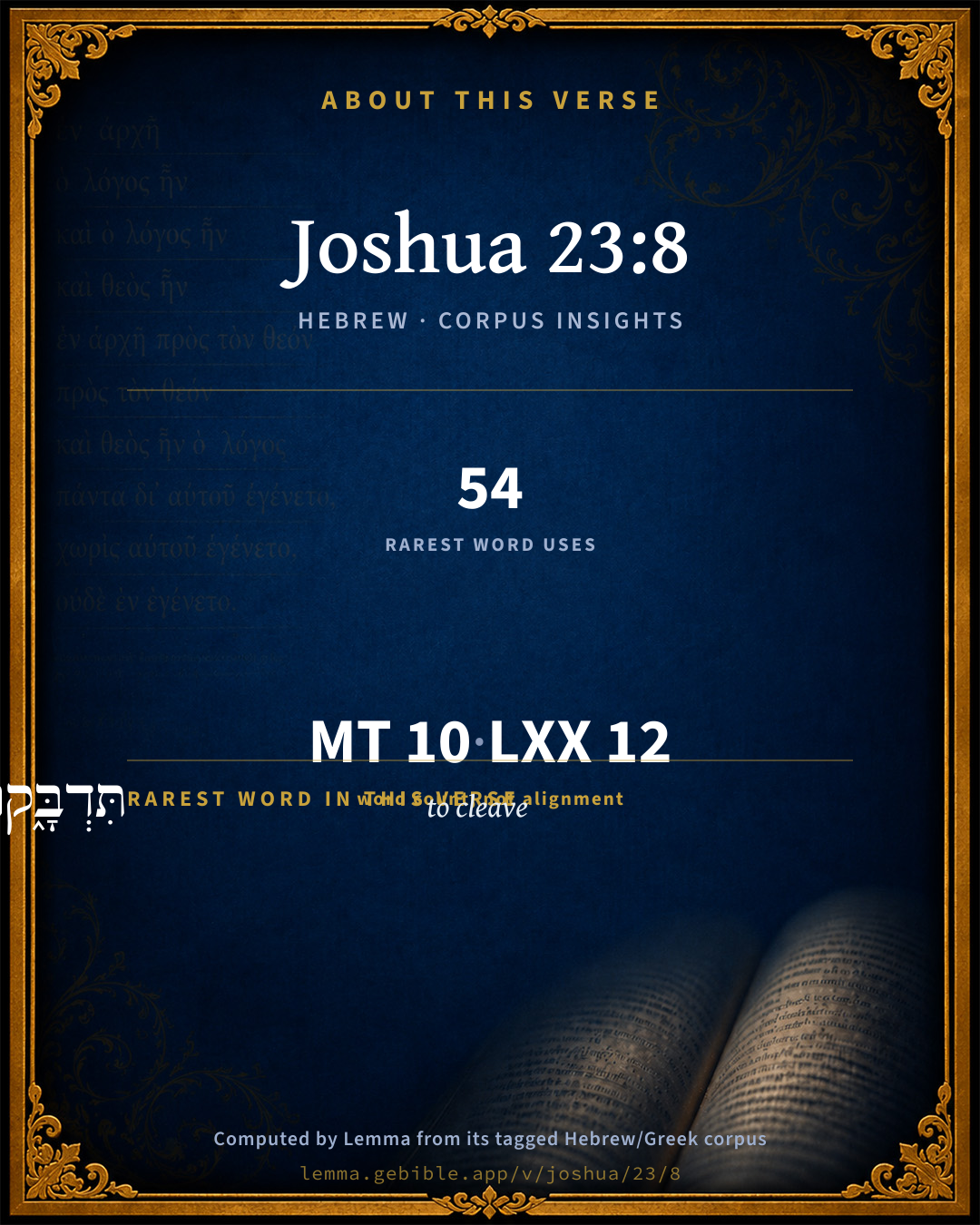
These counts appear in no published source. They are computed here, from the morphology-tagged text and Lemma’s own curated glosses. What Lemma adds →

10
words
10
distinct lemmas
Historical
section

Shared distinctive vocabulary

תִּדְבָּ֑קוּ to cleave H1692 occurs in 52 verses of the Hebrew Bible. Also found in:

Grammatical profile

  • 2 verbs
  • 3 nouns
  • 1 pronoun
  • 1 preposition
  • 2 conjunctions
  • 1 particle

Verb forms

  • תִּדְבָּ֑קוּ Qal · Imperfect
  • עֲשִׂיתֶ֔ם Qal · Perfect

Hebrew & Septuagint length

In English translation the verse runs 13 words from the Hebrew and 16 from the Septuagint (LXX English) — closely comparable.

A rough comparison of the two English renderings, which tokenize alike — not a word-level alignment.

Word counts can differ between the Hebrew and the Greek without any difference in meaning — e.g. the Hebrew direct-object marker אֵת has no separate Greek word, and Greek often adds the article ὁ.

In the original languages it is 10 Hebrew tokens and 12 Greek tokens — but the two are counted differently (Hebrew bundles its prefixes and suffixes into one token; the Greek is in lemma form), so that isn’t a like-for-like length.

Cross-references

6

Topical passages linked to Joshua 23:8 in the Treasury of Scripture Knowledge — connected by theme and wording, ordered by reader-vote popularity; previews shown in the World English Bible.

  • Deuteronomy 10:20 You shall fear Yahweh your God; him shall you serve; and to him shall you cleave, and by his name shall you swear.
  • Joshua 22:5 Only take diligent heed to do the commandment and the law which Moses the servant of Yahweh commanded you, to love Yahweh your God, and to walk in all his ways, and to keep his commandments, and to cleave to him, and to serve him with all your heart and with all your soul.
  • Deuteronomy 11:22 For if you shall diligently keep all this commandment which I command you, to do it, to love Yahweh your God, to walk in all his ways, and to cleave to him;
  • Deuteronomy 13:4 You shall walk after Yahweh your God, and fear him, and keep his commandments, and obey his voice, and you shall serve him, and cleave to him.
  • Acts 11:23 who, when he had come, and had seen the grace of God, was glad. He exhorted them all, that with purpose of heart they should remain near to the Lord.
  • Deuteronomy 4:4 But you who did cleave to Yahweh your God are alive everyone of you this day.

Cross-references courtesy of OpenBible.info (CC BY 4.0).

Hebrew and Greek witnesses Masoretic Hebrew ↔ Greek Septuagint

The same verse in the two great witnesses to the Old Testament, shown verse-for-verse.

These are two independent witnesses, not word-aligned to each other, and the Septuagint is shown in lemma (dictionary) form.

Hebrew Joshua 23:8 Masoretic · Westminster Leningrad Codex

כִּ֛י אִם בַּיהוָ֥ה אֱלֹהֵיכֶ֖ם תִּדְבָּ֑קוּ כַּאֲשֶׁ֣ר עֲשִׂיתֶ֔ם עַ֖ד הַיּ֥וֹם הַזֶּֽה

but cleave to Yahweh your God, as you have done to this day.

World English Bible · Public Domain

Greek LXX Joshua 23:8 Septuagint · lemma form

ἀλλά κύριος ὁ θεός σύ προςκολλάω καθάπερ ποιέω ἕως ὁ ἡμέρα οὗτος

But you⌃ shall cleave to the Lord our God, as you⌃ have done until this day.

LXX2012 (modern English Septuagint) · Public Domain

Hebrew: Westminster Leningrad Codex (CC BY 4.0). Greek: Septuagint (public domain); English from LXX2012 (modern English Septuagint) (Public Domain). How the Septuagint differs from the Hebrew →

Targum (Aramaic paraphrase)

1

The Targum is the ancient Jewish Aramaic paraphrase of the Hebrew Scriptures — an interpretive translation, not the Hebrew text itself. Onkelos (literal) and Pseudo-Jonathan (expansive) render the Torah, and Jonathan the Prophets. Coverage is partial: where no permissively-licensed English translation exists for a verse, only the Aramaic is shown. This is verse-level text, not a word-by-word alignment to the Hebrew.

  1. Targum Jonathan Prophets (Joshua–Malachi)
    אֱלָהֵן בְּדַחַלְתָּא דַייָ אֱלָהָכוֹן תִּדְבְּקוּן כְּמָא דַעֲבַדְתּוּן עַד יוֹמָא הָדֵין:

    (no public-domain English translation for this verse)

    Targum Jonathan — Aramaic: “Mikraot Gedolot” (public domain). English: “Sefaria Community Translation” (CC0 1.0 (public-domain dedication)); “London "Chaldee Paraphrase," 1871” (public domain). Text via Sefaria.

Commentary

Notes on Joshua 23:8 from classic Christian and Jewish commentators (each source and its license shown beneath its notes). The classic Christian expositions comment on the surrounding passage and are grouped to its opening verse, so a note may address several verses; the Jewish commentaries on the Tanakh (Rashi and others) are per-verse, so they appear only where the commentator wrote on this verse.

Lemma curates 59 commentaries, every one of them public domain or Creative Commons licensed, each selected and text-cleaned for this edition rather than reprinted as found. About our sources →

Trapp's Complete Commentary

John Trapp

Jos 23:8 But cleave unto the LORD your God, as ye have done unto this day.

Ver. 8. As ye have done unto this day,] viz., Since I have had the governance of you, Vita Principis censura est, imo Cynosura: the life of the prince is the loade star of the Commonwealth, Magnates magnetes; good governors make good people: and on the contrary, Qualis rix, talis grex.

John Trapp, A Commentary or Exposition upon All the Books of the Old and New Testament (1647–1656) — public domain. Text from a community e-Sword module.

The Biblical Illustrator

Joseph S. Exell

Jos_23:8-9

Cleave unto the Lord your God, as ye have done unto this day.

The necessity of every ones cleaving to God who wishes well to the support of his country

I. Sin has naturally in itself a tendency to the ruin of any nation. We may easily see that when a people grow regardless of the laws of God they want the greatest obligations of obedience to the laws of men.

II. Sin makes god an enemy. God presides with a peculiar providence over societies and communities of men. We may learn from the history of all past ages and the frequent smart of our own that the government of God is ever administered according to the nature of mens actions; that He dispenses His favour to a people, or withdraws it from them, as virtue or vice, religion or impiety, respectively prevail among them. But perhaps it may be said by some who are ready to impute all successes to themselves, What need we to call in Providence in all difficulties? Now this, give me leave to prove more particularly, by considering those three main props on which the weight of states and empires may seem to them, who look not far into things and their causes, wholly to rely; that is, worldly providence, or policy in contriving; courage and force in executing great designs; and a wise improvement of both these, by firm and well-grounded confederacies. But alas! in these, barely considered, there can be no safety, because no human foresight can reach those many accidents, the least of which may alter the best-laid counsels; nor any human courage, though never so well seconded, be sure to execute them, since the very execution of them is attended with so many circumstances as may produce effects quite different from what they proposed.

III. The obligation, which lies on everybody who loves his country to do his duty to god, from which such universal virtue and piety will result, as will most certainly engage god on our sloe.

1. That all national favours flow purely from God, I will presume has been sufficiently proved, as being beyond the single or united force of human policy, courage, or the firmest alliances: if so, what is it more than our bounden duty, and justice, to acknowledge unfeignedly the gift to God, who desires no more for the giving it? He is not bettered by our thanksgivings, yet is pleased with the gratitude.

2. We ought to break off the course of those sins which will estrange God from us, and deprive us hereafter of all such extraordinary successes. (Bp. Trelawney.)

Religious stability enforced

I. THE duty the text recommends. Cleaving unto the Lord evidently implies--

1. Previous union with Him.

2. Faithful adherence to Him. Our religion must be uniform and constant; we must not only come to the Lord as humble penitents, but also adhere to Him as His indefatigable servants.

(1) We should cleave to His name; as the fountain of all goodness, from whom we receive every blessing; and therefore should continue to love, obey, hope, and trust in Him, as the God of our salvation (Isa_12:2; Hab_3:18).

(2) We should cleave to His Word; by faithfully reading its contents, imbibing its doctrines, obeying its precepts, and by making it the perpetual subject of our meditation and prayers, and the infallible rule of our faith and conduct (Psa_119:18; Psa_119:148; Joh_5:39; 2Ti_3:16-17).

(3) We should cleave to His ways; by diligently discharging all personal and relative duties, constantly attending all the means of grace, working out our salvation with fear and trembling, and by walking in all the commandments and ordinances blameless.

(4) We should cleave to Him at all times: in prosperity and adversity, in tribulation and distress, in health and affliction, in life and death; implicitly trusting in the Lord for ever; for in the Lord Jehovah is everlasting strength.

II. The importance the text involves. This evidently appears, both from the solemnity of the occasion on which it was delivered, and the fervency of the manner in which it was urged on the tribes of Israel.

1. This duty is reasonable (Joh_6:67-69; Rom_12:1-2).

2. This duty is honourable. Instability in religion is peculiarly disgraceful (2Pe_2:20-22). It is extremely weak and childish, and should be carefully avoided, as displeasing to God, and dishonourable to our holy profession (Eph_4:14).

3. This duty is profitable. It is only by cleaving unto the Lord that we can maintain personal piety, overcome our enemies, encounter difficulties, rejoice evermore, triumph over death, and lay hold on eternal life (Deu_4:3-4; Psa_57:7; 2Ti_4:7-8).

4. This duty is indispensable. Final perseverance is necessary to final salvation. He only that endures to the end shall be saved (1Co_15:2; Rom_2:7; 2Pe_1:10-11).

III. The motives to this duty. (Sketches Four Hundred Sermons.)

The Biblical Illustrator, edited by Joseph S. Exell (c. 1880s–1900s) — public domain. Text from a community e-Sword module.

Joseph Benson's Commentary

Jos 23:8. But cleave to the Lord — By constant obedience, entire affection, faithful service, and worship of him alone. As ye have done to this day — To wit, since you came into Canaan; since which time the body of the people (for of them he speaks, not of every particular person) had behaved themselves much better than they did in the wilderness, and had not been guilty of any gross and general apostacy from God, or rebellion against him.

Joseph Benson's Commentary on the Old and New Testaments (1811–1818) — public domain. Text from a community e-Sword module.

Tyndale Open Study Notes

Tyndale Open Resources

23:8 To cling tightly or passionately to God would render impotent the temptation to stray off toward other gods. This same verb described a man clinging to his wife (Gen 2:24) and Ruth clinging to Naomi (Ruth 1:14).

Tyndale Open Study Notes — © Tyndale Open Resources, licensed CC BY-SA 4.0. Text via the HelloAO Bible API.

John Gill's Exposition

But cleave unto the Lord your God,.... To his word, worship, and ordinances; externally, by close adherence to them, and strict observation of them; and internally, by strong affection to him, hope, trust, and confidence in him, expectation of all good things from him, and constant application to him for help in all times of need, and a fixed dependence on him:

as ye have done unto this day; that is, since they came into the land of Canaan, and had been under the government of Joshua; for otherwise, while in the wilderness, they frequently revolted from God, and murmured against him; and this is to be understood not of individuals, who doubtless were guilty of various failings and sins, but of the whole body, and with respect to any notorious offence, particularly idolatry, which they had not fallen into since they came into the land of Canaan, and had very lately shown great zeal against it; not only the tribes on this side, but those on the other side Jordan, as the preceding chapter largely relates.

John Gill's Exposition of the Whole Bible (1746–1763) — public domain (CC PDM 1.0). Text via the HelloAO Bible API.

Haydock's Catholic Bible Commentary

Day. Those who had formerly given way to idolatry were all cut off, and all Israel had lately given a proof of their attachment unto the Lord. (Haydock)

George Leo Haydock (1774–1849), Haydock's Catholic Family Bible and Commentary, 1859 edition — public domain. Excludes Psalms (Douay-Rheims chapter numbering differs from Protestant) and Deuterocanonical books (Catholic canon only).

Matthew Poole's English Annotations

Cleave unto the Lord, by firm affiance, constant obedience, entire affection, faithful service and worship of him alone.

As ye have done unto this day, to wit since you came into Canaan; since which time the body of the people for of them he speaks, not of every particular person) had behaved themselves much better than they did in the wilderness, and had not been guilty or any gross and general apostacy from God, or rebellion against him.

Matthew Poole's English Annotations on the Holy Bible (1683–1685) — public domain. Text from a community e-Sword/MySword module.

Whedon's Commentary on the Bible

Daniel D. Whedon

8. Cleave unto the Lord — Cling unto him with a grip which no force can loosen. Fidelity to God always costs strenuous effort. “Strive to enter in at the strait gate.”

As ye have done — As a nation, with individual exceptions.

Daniel D. Whedon (gen. ed.), Commentary on the Old and New Testaments (1874–1909) — public domain. Text from a community e-Sword module.

The Pulpit Commentary

But cleave unto the Lord your God. Or, ye shall cleave unto Jehovah your God. The phrase denotes the intimate union between God and the soul. (see above, and Gen_2:24)

The Pulpit Commentary (1880–1919), ed. H.D.M. Spence-Jones & Joseph S. Exell — public domain. Text from a community e-Sword module.

John Wesley's Explanatory Notes

Cleave to the Lord - By constant obedience, entire affection, faithful service and worship of him alone. To this day - To wit, since you came in to Canaan; since which time the body of the people (for of them he speaks, not of every particular person) had behaved themselves much better than they did in the wilderness, and had not been guilty of any gross and general apostacy from God, or rebellion against him.

John Wesley, Explanatory Notes Upon the Whole Bible (1754–1765) — public domain. Text via the GEBible commentary corpus.

Lesson kit

Teaching starters — assembled from the data on this page, not authored interpretation. Every prompt links to the verse data it draws on. Edit before teaching.

Joshua, in the Historical, opens this verse with 10 words (10 distinct Hebrew lemmas). Its most distinctive word is dâbaq (“to cleave”). A historical commentator’s framing appears above. Read the whole chapter for the surrounding context.

Discussion questions

  1. What does “to cleave” (dâbaq) contribute to the verse as a whole?
  2. How does Genesis 2:24, which shares the word «to cleave», read alongside this verse?
  3. These translations render this verse differently; the difference is in the English rendering, not the original. What questions does that raise?
  4. «תִּדְבָּ֑קוּ» is a Qal Imperfect verb. How does that grammatical form shape the action described?
  5. Compare how Trapp's Complete Commentary and The Biblical Illustrator read this verse. Where do they agree or differ?

Things to notice

Reading settings

Reading text

Shown beneath each verse's original-language words.

Old Testament
Old Testament edition

Read the OT as the Masoretic Hebrew (MT) or the Greek Septuagint (LXX).

English shown for the Greek Septuagint (in the Hebrew ↔ Greek comparison).

Comparing translations? Open the Compare panel on any verse page to stack up to four side by side.