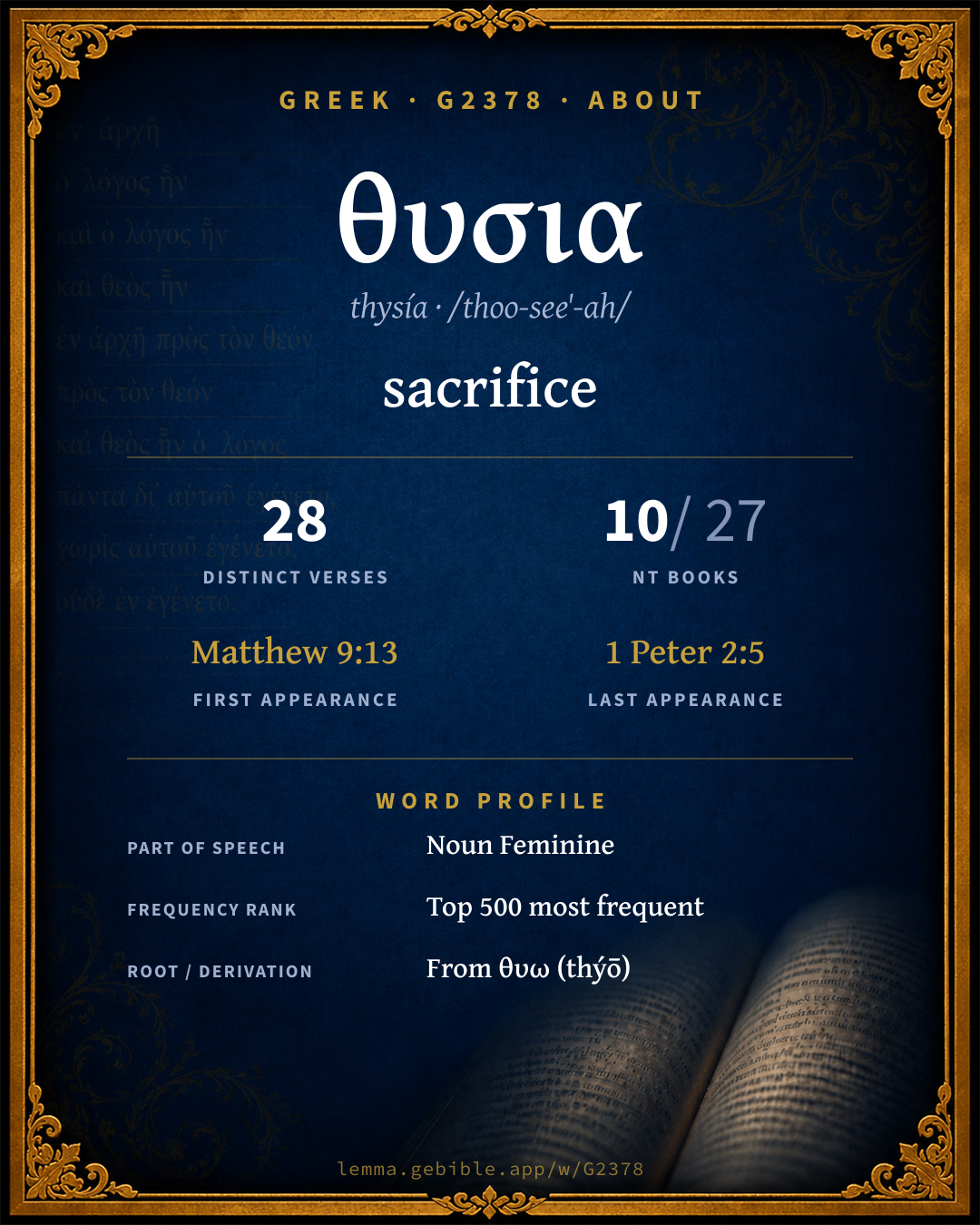
θυσία
sacrifice
Full lexicon entry — Thayer's Greek Lexicon
From Thayer's Greek Lexicon
Where this word appears
See every Accusative-case word in the Greek New Testament →
Grammar key — what these labels mean
Part of speech
- Noun
- A naming word — a person, place, thing, or idea.
Case
- Accusative
- The case of the direct object and of extent.
- Dative
- The case of the indirect object, means, or location — “to / for / with / in.”
- Genitive
- The case of source, possession, or “of” — answers “whose / from what.”
- Nominative
- The case of the subject (and the predicate nominative).
Gender
- Feminine
- Grammatically feminine.
Number
- Singular
- One.
- Plural
- More than one.
3 distinct verses where G2378 appears in the Genitive case, across 3 books. Filtered view — show all forms. Click any verse to open its interlinear word-by-word view. Verse text shown in the World English Bible for context — . Each verse’s Greek form is shown with its reference; the English is not keyword-highlighted, since the data carries no word-level English alignment. Use “Compare translations” on any verse to read it across multiple English versions. This concordance covers the Greek New Testament; Septuagint (Greek Old Testament) occurrences of this word are not indexed here.
Mark 1 verse
Luke 1 verse
Hebrews 1 verse
About this entry
At a glance — auto-summarized from this page’s data, not written by a person. Every figure links to its source below. This summary describes the numbers; it doesn’t interpret them.
θυσια — transliterated thysía — is a Greek noun carrying the sense “sacrifice.” More than half of its appearances fall in Hebrews. The Greek New Testament uses it across 28 verses — moderately common. It first appears in Matthew 9:13. Related forms include θυω, θυελλα and θυινος. See the sense tree, 28-verse concordance, and the renderings breakdown below.
Gloss history
Strong's 1890 vs modern scholarship
About this word
Strong's G2378 catalogs a Greek word from the Greek New Testament.
These counts are not copied from any lexicon or concordance. They are computed here, from the morphology-tagged Greek New Testament. What Lemma adds →
- 28
- distinct verses
- The word appears in 28 distinct verses.
- 10 / 27
- NT books
- The word appears in 10 of 27 New Testament books.
- #485
- by frequency
- Top 500 most frequent Greek words (rank 485 of 5,347 Greek words by occurrence).
View all 28 occurrences in the concordance →
By section of the New Testament
By traditional corpus
Conventional, traditional groupings — biblical authorship is debated, so this is a traditional corpus grouping, not an authorship claim. Some books belong to more than one corpus (Luke is in both the Gospels and the Lukan corpus, and so on), so these shares overlap and need not total 100%. Each figure is a share of the word’s 28 distinct verses.
- Hebrews 15 verses · 54%
- Gospels 5 verses · 18%
- Pauline corpus 5 verses · 18%
- Lukan (Luke–Acts) 4 verses · 14%
- General (Catholic) Epistles 1 verse · 4%
How translations render this word
Counts come from each version’s own published word-to-Strong’s tagging or interlinear alignment — an approximate guide to how each version renders this word, not a word-level alignment the data otherwise carries. Because each total is that version’s own tagged count, the per-version totals vary from one another and need not match the appearance or distinct-verse counts above. These counts may also differ from a printed concordance because Lemma counts each distinctly tagged rendering and does not collapse phrase taggings into a single head-word total. This is a fixed set of word-tagged versions (KJV, ASV, BSB, ULT) and does not change with the reading translation you choose elsewhere. Each version’s license is shown beside its name below (and on Sources).
- King James Version: Sacrifice 17×, Sacrifices 12×
- American Standard Version: Sacrifices 14×, Sacrifice 13×
- Berean Standard Bible: Sacrifices 14×, Sacrifice 12×
- unfoldingWord Literal Text: Sacrifice 14×, Sacrifices 13×, A 2×
King James Version Public Domain
Renders G2378 across 29 tagged occurrences — most commonly:
American Standard Version Public Domain
Renders G2378 across 30 tagged occurrences — most commonly:
Plus 3 renderings that appear only once — usually multi-word phrases or single function words the recovered tagging swept in, not distinct renderings.
Berean Standard Bible Public Domain
Renders G2378 across 28 tagged occurrences — most commonly:
Plus 2 renderings that appear only once — usually multi-word phrases or single function words the recovered tagging swept in, not distinct renderings.
unfoldingWord Literal Text CC BY-SA 4.0
Renders G2378 across 33 tagged occurrences — most commonly:
Plus 4 renderings that appear only once — usually multi-word phrases or single function words the recovered tagging swept in, not distinct renderings.
Senses in Thayer's
The 1 sense Thayer's distinguishes for this word, in lexicon order (not ranked by frequency or importance). The full entry — with sub-senses — is in the Lexicon Entry tab.
- a sacrifice, victim
Word origin
Derived from θυω (thýō) (G2380) — to sacrifice.
From G2380 ; sacrifice (the act or the victim literally or figuratively): - sacrifice.
— Strong’s Exhaustive Concordance (1890), public domain.
Forms in the corpus
The 7 distinct written forms G2378 takes in the Greek New Testament, most frequent first — each parse links to that case’s occurrences in the concordance.
| Form | Parsing | Example | Uses |
|---|---|---|---|
| θυσίαν thysían | Noun, Accusative, Singular, Feminine | Matthew 9:13 | 11 |
| θυσίας thysías | Noun, Accusative, Plural, Feminine | Acts 7:42 | 9 |
| θυσίαις thysíais | Noun, Dative, Plural, Feminine | Hebrews 9:23 | 3 |
| θυσιῶν thysiō̂n | Noun, Genitive, Plural, Feminine | Mark 12:33 | 2 |
| θυσία thysía | Noun, Nominative, Singular, Feminine | Hebrews 10:26 | 1 |
| θυσίαι thysíai | Noun, Nominative, Plural, Feminine | Hebrews 9:9 | 1 |
| θυσίᾳ thysía | Noun, Dative, Singular, Feminine | Philippians 2:17 | 1 |
Same root — word family
Other Thayer's entries built from the same root as G2378, grouped by Strong’s listed origin. These share a root / origin per the lexicon — not necessarily a shared meaning. Each links to that word’s own entry.
Derives from
Shares the same root
- θυελλα thýella G2366 tempest
- θυινος thýïnos G2367 citrus tree
- θυμιαω thymiáō G2370 to burn incense
- θυμος thymós G2372 anger
Derived from this word
Compare all same-root words → Showing 4 of 7 — not the complete family. They share a root, not necessarily a meaning.
Septuagint usage
The same Greek word θυσια appears 329 times in the Greek Old Testament (Septuagint), across 297 verses in 29 books.
- 329
- LXX occurrences
- Tagged occurrences of this Greek word in the Septuagint.
- 297
- verses
- Distinct Septuagint verses containing this word.
- 29 / 39
- OT books
- The word appears in 29 of the 39 Old Testament books.
Sample Septuagint occurrences
- Genesis 4:3 θυσία
- Exodus 10:25 θυσία
- Leviticus 1:9 θυσία
- Numbers 4:16 θυσία
- Deuteronomy 12:27 θυσία
- Joshua 9:2 θυσία
- Judges 6:18 θυσία
- 1 Samuel 1:21 θυσία
- 2 Samuel 14:17 θυσία
- 1 Kings 8:62 θυσία
- 2 Kings 3:20 θυσία
- 1 Chronicles 9:31 θυσία
Septuagint occurrences (same lexeme)
Every verse where the same Strong’s number (G2378) appears in the Greek Septuagint — showing the first 50 of 297. Verse text shown in the World English Bible for context; the Greek form is the matched word — the English is not keyword-highlighted.
- Genesis 4:3 θυσία As time passed, it happened that Cain brought an offering to Yahweh from the fruit of the ground.
- Genesis 4:5 θυσία but he didn't respect Cain and his offering. Cain was very angry, and the expression on his face fell.
- Genesis 31:54 θυσία Jacob offered a sacrifice in the mountain, and called his relatives to eat bread. They ate bread, and stayed all night in the mountain.
- Genesis 46:1 θυσία Israel traveled with all that he had, and came to Beersheba, and offered sacrifices to the God of his father, Isaac.
- Exodus 10:25 θυσία Moses said, "You must also give into our hand sacrifices and burnt-offerings, that we may sacrifice to Yahweh our God.
- Exodus 12:27 θυσία that you shall say, 'It is the sacrifice of Yahweh's Passover, who passed over the houses of the children of Israel in Egypt, when he struck the Egyptians, and spared our houses.'" The people bowed their heads and worshiped.
- Exodus 18:12 θυσία Jethro, Moses' father-in-law, took a burnt offering and sacrifices for God. Aaron came with all of the elders of Israel, to eat bread with Moses' father-in-law before God.
- Exodus 24:5 θυσία He sent young men of the children of Israel, who offered burnt offerings and sacrificed peace-offerings of oxen to Yahweh.
- Exodus 29:34 θυσία If anything of the flesh of the consecration, or of the bread, remains to the morning, then you shall burn the remainder with fire: it shall not be eaten, because it is holy.
- Exodus 29:41 θυσία The other lamb you shall offer at evening, and shall do to it according to the meal-offering of the morning, and according to its drink-offering, for a sweet savor, an offering made by fire to Yahweh.
- Exodus 29:42 θυσία It shall be a continual burnt offering throughout your generations at the door of the tent of meeting before Yahweh, where I will meet with you, to speak there to you.
- Exodus 30:9 θυσία You shall offer no strange incense on it, nor burnt offering, nor meal-offering; and you shall pour no drink-offering on it.
- Exodus 32:6 θυσία They rose up early on the next day, and offered burnt offerings, and brought peace-offerings; and the people sat down to eat and to drink, and rose up to play.
- Leviticus 1:9 θυσία but its innards and its legs he shall wash with water. The priest shall burn the whole on the altar, for a burnt offering, an offering made by fire, of a sweet savor to Yahweh.
- Leviticus 1:13 θυσία but the innards and the legs he shall wash with water. The priest shall offer the whole, and burn it on the altar. It is a burnt offering, an offering made by fire, of a sweet savor to Yahweh.
- Leviticus 1:17 θυσία He shall tear it by its wings, but shall not divide it apart. The priest shall burn it on the altar, on the wood that is on the fire. It is a burnt offering, an offering made by fire, of a sweet savor to Yahweh.
- Leviticus 2:1 θυσία "'When anyone offers an offering of a meal offering to Yahweh, his offering shall be of fine flour; and he shall pour oil on it, and put frankincense on it.
- Leviticus 2:2 θυσία He shall bring it to Aaron's sons the priests; and he shall take his handful of its fine flour, and of its oil, with all its frankincense; and the priest shall burn the memorial of it on the altar, an offering made by fire, of a sweet savor to Yahweh.
- Leviticus 2:3 θυσία That which is left of the meal offering shall be Aaron's and his sons'. It is a most holy thing of the offerings of Yahweh made by fire.
- Leviticus 2:4 θυσία "'When you offer an offering of a meal offering baked in the oven, it shall be unleavened cakes of fine flour mixed with oil, or unleavened wafers anointed with oil.
- Leviticus 2:5 θυσία If your offering is a meal offering of the baking pan, it shall be of unleavened fine flour, mixed with oil.
- Leviticus 2:6 θυσία You shall cut it in pieces, and pour oil on it. It is a meal offering.
- Leviticus 2:7 θυσία If your offering is a meal offering of the frying pan, it shall be made of fine flour with oil.
- Leviticus 2:8 θυσία You shall bring the meal offering that is made of these things to Yahweh: and it shall be presented to the priest, and he shall bring it to the altar.
- Leviticus 2:9 θυσία The priest shall take from the meal offering its memorial, and shall burn it on the altar, an offering made by fire, of a sweet savor to Yahweh.
- Leviticus 2:10 θυσία That which is left of the meal offering shall be Aaron's and his sons'. It is a thing most holy of the offerings of Yahweh made by fire.
- Leviticus 2:11 θυσία "'No meal offering, which you shall offer to Yahweh, shall be made with yeast; for you shall burn no yeast, nor any honey, as an offering made by fire to Yahweh.
- Leviticus 2:13 θυσία Every offering of your meal offering you shall season with salt; neither shall you allow the salt of the covenant of your God to be lacking from your meal offering. With all your offerings you shall offer salt.
- Leviticus 2:14 θυσία "'If you offer a meal offering of first fruits to Yahweh, you shall offer for the meal offering of your first fruits grain in the ear parched with fire, bruised grain of the fresh ear.
- Leviticus 2:15 θυσία You shall put oil on it, and lay frankincense on it: it is a meal offering.
- Leviticus 3:1 θυσία "'If his offering is a sacrifice of peace offerings; if he offers it from the herd, whether male or female, he shall offer it without blemish before Yahweh.
- Leviticus 3:3 θυσία He shall offer of the sacrifice of peace offerings an offering made by fire to Yahweh; the fat that covers the innards, and all the fat that is on the innards,
- Leviticus 3:6 θυσία "'If his offering for a sacrifice of peace offerings to Yahweh is from the flock; male or female, he shall offer it without blemish.
- Leviticus 3:9 θυσία He shall offer from the sacrifice of peace offerings an offering made by fire to Yahweh; its fat, the entire tail fat, he shall take away close to the backbone; and the fat that covers the inwards, and all the fat that is on the inwards,
- Leviticus 4:10 θυσία as it is taken off of the ox of the sacrifice of peace offerings. The priest shall burn them on the altar of burnt offering.
- Leviticus 4:26 θυσία All its fat he shall burn on the altar, like the fat of the sacrifice of peace offerings; and the priest shall make atonement for him concerning his sin, and he will be forgiven.
- Leviticus 4:31 θυσία All its fat he shall take away, like the fat is taken away from off of the sacrifice of peace offerings; and the priest shall burn it on the altar for a sweet savor to Yahweh; and the priest shall make atonement for him, and he will be forgiven.
- Leviticus 4:35 θυσία All its fat he shall take away, like the fat of the lamb is taken away from the sacrifice of peace offerings; and the priest shall burn them on the altar, on the offerings of Yahweh made by fire; and the priest shall make atonement for him concerning his sin that he has sinned, and he will be forgiven.
- Leviticus 5:13 θυσία The priest shall make atonement for him concerning his sin that he has sinned in any of these things, and he will be forgiven; and the rest shall be the priest's, as the meal offering.'"
- Leviticus 6:7 θυσία The priest shall make atonement for him before Yahweh, and he will be forgiven concerning whatever he does to become guilty."
- Leviticus 6:8 θυσία Yahweh spoke to Moses, saying,
- Leviticus 6:13 θυσία Fire shall be kept burning on the altar continually; it shall not go out.
- Leviticus 6:14 θυσία "'This is the law of the meal offering: the sons of Aaron shall offer it before Yahweh, before the altar.
- Leviticus 6:16 θυσία That which is left of it Aaron and his sons shall eat. It shall be eaten without yeast in a holy place. They shall eat it in the court of the Tent of Meeting
- Leviticus 7:9 θυσία Every meal offering that is baked in the oven, and all that is dressed in the frying pan, and on the baking pan, shall be the priest's who offers it.
- Leviticus 7:10 θυσία Every meal offering, mixed with oil or dry, belongs to all the sons of Aaron, one as well as another.
- Leviticus 7:11 θυσία "'This is the law of the sacrifice of peace offerings, which one shall offer to Yahweh.
- Leviticus 7:12 θυσία If he offers it for a thanksgiving, then he shall offer with the sacrifice of thanksgiving unleavened cakes mixed with oil, and unleavened wafers anointed with oil, and cakes mixed with oil.
- Leviticus 7:13 θυσία With cakes of leavened bread he shall offer his offering with the sacrifice of his peace offerings for thanksgiving.
- Leviticus 7:15 θυσία The flesh of the sacrifice of his peace offerings for thanksgiving shall be eaten on the day of his offering. He shall not leave any of it until the morning.
These are occurrences of the same Greek lexeme (G2378) in the Septuagint — not a translation of any one Hebrew word. The store carries no word-level Hebrew↔Greek alignment, so no Hebrew original is asserted here. Counts come from the recovered LXX Strong's tagging — high-frequency vocabulary is well covered, while rare or late forms may be untagged — so they reflect tagged occurrences and may slightly undercount.