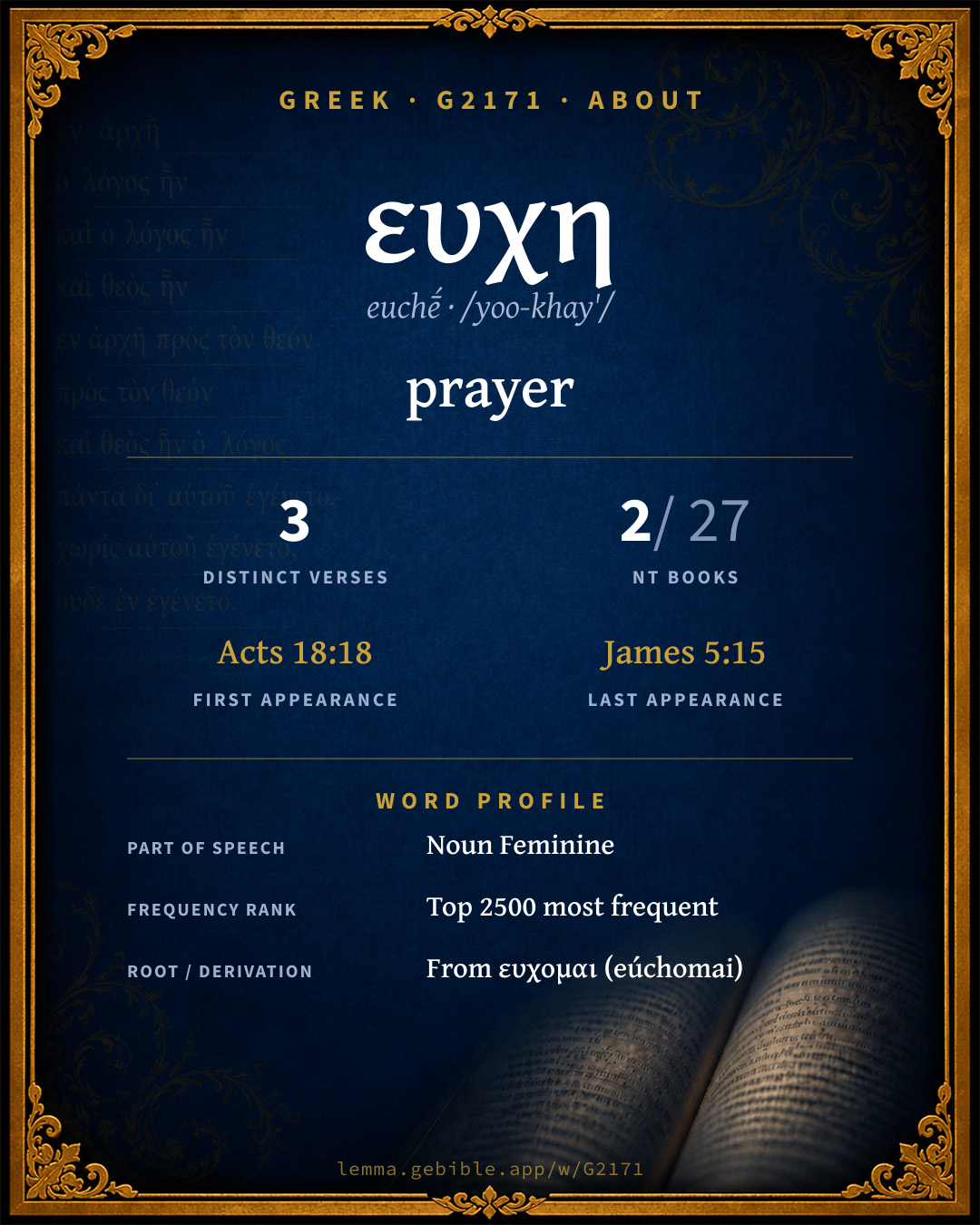
εὐχή
prayer
‘prayer’ is one of 2 main senses fuller range ↓
Full lexicon entry — Thayer's Greek Lexicon
From Thayer's Greek Lexicon
Where this word appears
See every Accusative-case word in the Greek New Testament →
Grammar key — what these labels mean
Part of speech
- Noun
- A naming word — a person, place, thing, or idea.
Case
- Accusative
- The case of the direct object and of extent.
- Nominative
- The case of the subject (and the predicate nominative).
Gender
- Feminine
- Grammatically feminine.
Number
- Singular
- One.
Grammatical forms
- Noun, Accusative, Singular, Feminine 2 times (67%)
- Noun, Nominative, Singular, Feminine 1 time (33%)
Parsed forms decoded from the imported morphology (Robinson–Tischendorf, public domain), counted across 3 parsed occurrences — not distinct verses.
Every verse where G2171 appears — 3 distinct verses across 2 books. Click any verse to open its interlinear word-by-word view. Verse text shown in the World English Bible for context — . Each verse’s Greek form is shown with its reference; the English is not keyword-highlighted, since the data carries no word-level English alignment. Use “Compare translations” on any verse to read it across multiple English versions. This concordance covers the Greek New Testament; Septuagint (Greek Old Testament) occurrences of this word are not indexed here.
Acts 2 verses
- Acts 18:18 εὐχήν n acc sg fem Paul, having stayed after this many more days, took his leave of the brothers, and sailed from there for Syria, together with Priscilla and Aquila. He shaved his head in Cenchreae, for he had a vow.
- Acts 21:23 εὐχὴν n acc sg fem Therefore do what we tell you. We have four men who have taken a vow.
James 1 verse
About this entry
At a glance — auto-summarized from this page’s data, not written by a person. Every figure links to its source below. This summary describes the numbers; it doesn’t interpret them.
The Greek noun ευχη centers on the idea of “prayer.” A scarce word — 3 verses in all of the Greek New Testament. Acts dominates its distribution — 2 of 3 verses. Its earliest occurrence is Acts 18:18. Thayer's distinguishes 2 senses for it. Dig into 3-verse concordance and the renderings breakdown below.
Gloss history
Strong's 1890 vs modern scholarship
About this word
Strong's G2171 catalogs a Greek word from the Greek New Testament.
These counts are not copied from any lexicon or concordance. They are computed here, from the morphology-tagged Greek New Testament. What Lemma adds →
- 3
- distinct verses
- The word appears in 3 distinct verses.
- 2 / 27
- NT books
- The word appears in 2 of 27 New Testament books.
- #2,203
- by frequency
- Top 2500 most frequent Greek words (rank 2,203 of 5,347 Greek words by occurrence).
View all 3 occurrences in the concordance →
By traditional corpus
Conventional, traditional groupings — biblical authorship is debated, so this is a traditional corpus grouping, not an authorship claim. Some books belong to more than one corpus (Luke is in both the Gospels and the Lukan corpus, and so on), so these shares overlap and need not total 100%. Each figure is a share of the word’s 3 distinct verses.
- Lukan (Luke–Acts) 2 verses · 67%
- General (Catholic) Epistles 1 verse · 33%
How translations render this word
Counts come from each version’s own published word-to-Strong’s tagging or interlinear alignment — an approximate guide to how each version renders this word, not a word-level alignment the data otherwise carries. Because each total is that version’s own tagged count, the per-version totals vary from one another and need not match the appearance or distinct-verse counts above. These counts may also differ from a printed concordance because Lemma counts each distinctly tagged rendering and does not collapse phrase taggings into a single head-word total. This is a fixed set of word-tagged versions (KJV, ASV, BSB, ULT) and does not change with the reading translation you choose elsewhere. Each version’s license is shown beside its name below (and on Sources).
- King James Version: Have 1×, Prayer 1×, Vow 1×
- American Standard Version: Vow 2×
- Berean Standard Bible: Vow 2×
- unfoldingWord Literal Text: Vow 2×
King James Version Public Domain
Renders G2171 across 3 tagged occurrences — most commonly:
American Standard Version Public Domain
Renders G2171 across 3 tagged occurrences — most commonly:
Plus 1 rendering that appears only once — usually multi-word phrases or single function words the recovered tagging swept in, not distinct renderings.
Berean Standard Bible Public Domain
Renders G2171 across 3 tagged occurrences — most commonly:
Plus 1 rendering that appears only once — usually multi-word phrases or single function words the recovered tagging swept in, not distinct renderings.
unfoldingWord Literal Text CC BY-SA 4.0
Renders G2171 across 3 tagged occurrences — most commonly:
Plus 1 rendering that appears only once — usually multi-word phrases or single function words the recovered tagging swept in, not distinct renderings.
Senses in Thayer's
The 2 senses Thayer's distinguishes for this word, in lexicon order (not ranked by frequency or importance). The full entry — with sub-senses — is in the Lexicon Entry tab.
- a prayer to God
- a vow
Word origin
Derived from ευχομαι (eúchomai) (G2172) — to pray.
From G2172 ; properly a wish expressed as a petition to God or in votive obligation : - prayer vow.
— Strong’s Exhaustive Concordance (1890), public domain.
Forms in the corpus
The 3 distinct written forms G2171 takes in the Greek New Testament, most frequent first — each parse links to that case’s occurrences in the concordance.
| Form | Parsing | Example | Uses |
|---|---|---|---|
| εὐχήν euchḗn | Noun, Accusative, Singular, Feminine | Acts 18:18 | 1 |
| εὐχὴ euchḕ | Noun, Nominative, Singular, Feminine | James 5:15 | 1 |
| εὐχὴν euchḕn | Noun, Accusative, Singular, Feminine | Acts 21:23 | 1 |
Same root — word family
Other Thayer's entries built from the same root as G2171, grouped by Strong’s listed origin. These share a root / origin per the lexicon — not necessarily a shared meaning. Each links to that word’s own entry.
Derives from
Shares the same root
Compare all same-root words → They share a root, not necessarily a meaning.
Septuagint usage
The same Greek word ευχη appears 77 times in the Greek Old Testament (Septuagint), across 74 verses in 17 books.
- 77
- LXX occurrences
- Tagged occurrences of this Greek word in the Septuagint.
- 74
- verses
- Distinct Septuagint verses containing this word.
- 17 / 39
- OT books
- The word appears in 17 of the 39 Old Testament books.
Sample Septuagint occurrences
- Genesis 28:20 εὐχή
- Leviticus 7:16 εὐχή
- Numbers 6:2 εὐχή
- Deuteronomy 12:6 εὐχή
- Judges 11:30 εὐχή
- 1 Samuel 1:11 εὐχή
- 2 Samuel 15:7 εὐχή
- Job 11:17 εὐχή
- Psalms 21:26 εὐχή
- Proverbs 7:14 εὐχή
- Ecclesiastes 5:3 εὐχή
- Isaiah 19:21 εὐχή
Septuagint occurrences (same lexeme)
Every verse where the same Strong’s number (G2171) appears in the Greek Septuagint — showing the first 50 of 74. Verse text shown in the World English Bible for context; the Greek form is the matched word — the English is not keyword-highlighted.
- Genesis 28:20 εὐχή Jacob vowed a vow, saying, "If God will be with me, and will keep me in this way that I go, and will give me bread to eat, and clothing to put on,
- Genesis 31:13 εὐχή I am the God of Bethel, where you anointed a pillar, where you vowed a vow to me. Now arise, get out from this land, and return to the land of your birth."
- Leviticus 7:16 εὐχή "'But if the sacrifice of his offering is a vow, or a freewill offering, it shall be eaten on the day that he offers his sacrifice; and on the next day what remains of it shall be eaten:
- Leviticus 22:21 εὐχή Whoever offers a sacrifice of peace offerings to Yahweh to accomplish a vow, or for a freewill offering, of the herd or of the flock, it shall be perfect to be accepted; there shall be no blemish therein.
- Leviticus 22:23 εὐχή Either a bull or a lamb that has any deformity or lacking in his parts, that you may offer for a freewill offering; but for a vow it shall not be accepted.
- Leviticus 22:29 εὐχή "When you sacrifice a sacrifice of thanksgiving to Yahweh, you shall sacrifice it so that you may be accepted.
- Leviticus 23:38 εὐχή besides the Sabbaths of Yahweh, and besides your gifts, and besides all your vows, and besides all your freewill offerings, which you give to Yahweh.
- Leviticus 27:2 εὐχή "Speak to the children of Israel, and say to them, 'When a man makes a vow, the persons shall be for Yahweh by your valuation.
- Numbers 6:2 εὐχή "Speak to the children of Israel, and tell them: When either man or woman shall make a special vow, the vow of a Nazirite, to separate himself to Yahweh,
- Numbers 6:4 εὐχή All the days of his separation he shall eat nothing that is made of the grapevine, from the seeds even to the skins.
- Numbers 6:5 εὐχή "All the days of his vow of separation there shall no razor come on his head, until the days are fulfilled, in which he separates himself to Yahweh. He shall be holy. He shall let the locks of the hair of his head grow long.
- Numbers 6:6 εὐχή "All the days that he separates himself to Yahweh he shall not go near a dead body.
- Numbers 6:7 εὐχή He shall not make himself unclean for his father, or for his mother, for his brother, or for his sister, when they die; because his separation to God is on his head.
- Numbers 6:8 εὐχή All the days of his separation he is holy to Yahweh.
- Numbers 6:9 εὐχή "If any man dies very suddenly beside him, and he defiles the head of his separation; then he shall shave his head in the day of his cleansing. On the seventh day he shall shave it.
- Numbers 6:12 εὐχή He shall separate to Yahweh the days of his separation, and shall bring a male lamb a year old for a trespass offering; but the former days shall be void, because his separation was defiled.
- Numbers 6:13 εὐχή "This is the law of the Nazirite: when the days of his separation are fulfilled, he shall be brought to the door of the Tent of Meeting,
- Numbers 6:18 εὐχή The Nazirite shall shave the head of his separation at the door of the Tent of Meeting, and shall take the hair of the head of his separation, and put it on the fire which is under the sacrifice of peace offerings.
- Numbers 6:19 εὐχή The priest shall take the boiled shoulder of the ram, and one unleavened cake out of the basket, and one unleavened wafer, and shall put them on the hands of the Nazirite, after he has shaved the head of his separation;
- Numbers 6:21 εὐχή "This is the law of the Nazirite who vows, and of his offering to Yahweh for his separation, besides that which he is able to get. According to his vow which he vows, so he must do after the law of his separation."
- Numbers 15:3 εὐχή and will make an offering by fire to Yahweh, a burnt offering, or a sacrifice, to accomplish a vow, or as a freewill-offering, or in your set feasts, to make a sweet savor to Yahweh, of the herd, or of the flock;
- Numbers 15:8 εὐχή When you prepare a bull for a burnt offering, or for a sacrifice, to accomplish a vow, or for peace-offerings to Yahweh;
- Numbers 21:2 εὐχή Israel vowed a vow to Yahweh, and said, If you will indeed deliver this people into my hand, then I will utterly destroy their cities.
- Numbers 29:39 εὐχή These you shall offer to Yahweh in your set feasts, besides your vows, and your freewill-offerings, for your burnt offerings, and for your meal-offerings, and for your drink-offerings, and for your peace-offerings.
- Numbers 30:3 εὐχή Also when a woman vows a vow to Yahweh, and binds herself by a bond, being in her father's house, in her youth,
- Numbers 30:4 εὐχή and her father hears her vow, and her bond with which she has bound her soul, and her father holds his peace at her; then all her vows shall stand, and every bond with which she has bound her soul shall stand.
- Numbers 30:5 εὐχή But if her father disallow her in the day that he hears, none of her vows, or of her bonds with which she has bound her soul, shall stand: and Yahweh will forgive her, because her father disallowed her.
- Numbers 30:6 εὐχή If she be [married] to a husband, while her vows are on her, or the rash utterance of her lips, with which she has bound her soul,
- Numbers 30:7 εὐχή and her husband hear it, and hold his peace at her in the day that he hears it; then her vows shall stand, and her bonds with which she has bound her soul shall stand.
- Numbers 30:8 εὐχή But if her husband disallow her in the day that he hears it, then he shall make void her vow which is on her, and the rash utterance of her lips, with which she has bound her soul: and Yahweh will forgive her.
- Numbers 30:9 εὐχή But the vow of a widow, or of her who is divorced, [even] everything with which she has bound her soul, shall stand against her.
- Numbers 30:10 εὐχή If she vowed in her husband's house, or bound her soul by a bond with an oath,
- Numbers 30:11 εὐχή and her husband heard it, and held his peace at her, and didn't disallow her; then all her vows shall stand, and every bond with which she bound her soul shall stand.
- Numbers 30:12 εὐχή But if her husband made them null and void in the day that he heard them, then whatever proceeded out of her lips concerning her vows, or concerning the bond of her soul, shall not stand: her husband has made them void; and Yahweh will forgive her.
- Numbers 30:13 εὐχή Every vow, and every binding oath to afflict the soul, her husband may establish it, or her husband may make it void.
- Numbers 30:14 εὐχή But if her husband altogether hold his peace at her from day to day, then he establishes all her vows, or all her bonds, which are on her: he has established them, because he held his peace at her in the day that he heard them.
- Numbers 30:15 εὐχή But if he shall make them null and void after that he has heard them, then he shall bear her iniquity.
- Deuteronomy 12:6 εὐχή and there you shall bring your burnt offerings, and your sacrifices, and your tithes, and the heave-offering of your hand, and your vows, and your freewill-offerings, and the firstborn of your herd and of your flock:
- Deuteronomy 12:17 εὐχή You may not eat within your gates the tithe of your grain, or of your new wine, or of your oil, or the firstborn of your herd or of your flock, nor any of your vows which you vow, nor your freewill-offerings, nor the heave-offering of your hand;
- Deuteronomy 12:26 εὐχή Only your holy things which you have, and your vows, you shall take, and go to the place which Yahweh shall choose:
- Deuteronomy 23:19 εὐχή You shall not lend on interest to your brother; interest of money, interest of food, interest of anything that is lent on interest:
- Deuteronomy 23:22 εὐχή But if you shall forbear to vow, it shall be no sin in you.
- Judges 11:30 εὐχή Jephthah vowed a vow to Yahweh, and said, If you will indeed deliver the children of Ammon into my hand,
- Judges 11:39 εὐχή It happened at the end of two months, that she returned to her father, who did with her according to his vow which he had vowed: and she was a virgin. It was a custom in Israel,
- 1 Samuel 1:11 εὐχή She vowed a vow, and said, Yahweh of hosts, if you will indeed look on the affliction of your handmaid, and remember me, and not forget your handmaid, but will give to your handmaid a man-child, then I will give him to Yahweh all the days of his life, and there shall no razor come on his head.
- 1 Samuel 1:21 εὐχή The man Elkanah, and all his house, went up to offer to Yahweh the yearly sacrifice, and his vow.
- 1 Samuel 2:9 εὐχή He will keep the feet of his holy ones; But the wicked shall be put to silence in darkness; For by strength shall no man prevail.
- 2 Samuel 15:7 εὐχή It happened at the end of forty years, that Absalom said to the king, please let me go and pay my vow, which I have vowed to Yahweh, in Hebron.
- 2 Samuel 15:8 εὐχή For your servant vowed a vow while I abode at Geshur in Syria, saying, If Yahweh shall indeed bring me again to Jerusalem, then I will serve Yahweh.
- Job 11:17 εὐχή Life shall be clearer than the noonday; Though there is darkness, it shall be as the morning.
These are occurrences of the same Greek lexeme (G2171) in the Septuagint — not a translation of any one Hebrew word. The store carries no word-level Hebrew↔Greek alignment, so no Hebrew original is asserted here. Counts come from the recovered LXX Strong's tagging — high-frequency vocabulary is well covered, while rare or late forms may be untagged — so they reflect tagged occurrences and may slightly undercount.