
Deuteronomy 23:22

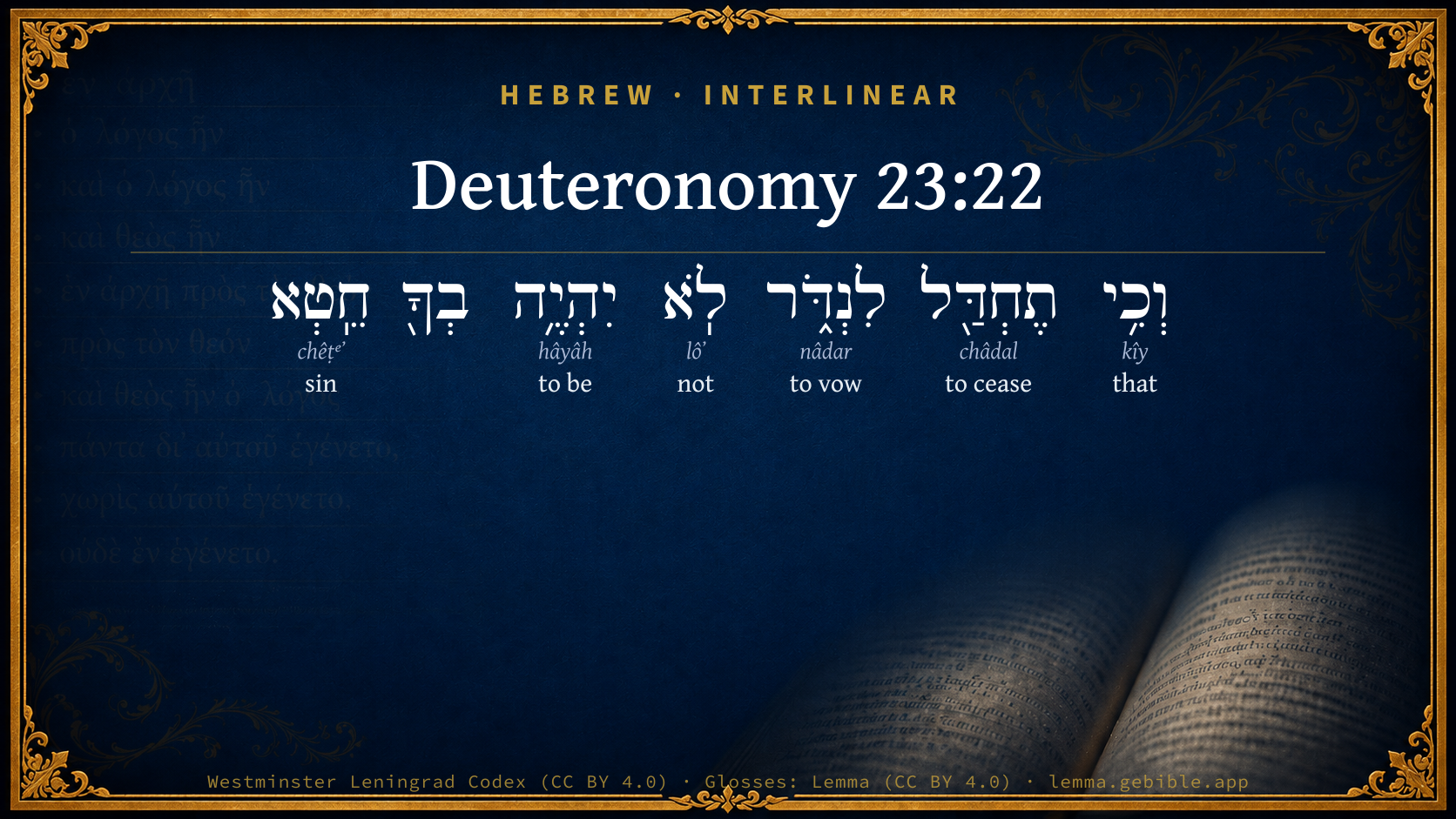
Hebrew (Westminster Leningrad Codex) Deuteronomy 23:22 appears in the Hebrew Old Testament. The text above is from the Westminster Leningrad Codex. Each word links to its Strong’s number, a concise gloss, and parsing drawn from the Open Scriptures Hebrew Bible morphology. Click any word for its full Brown-Driver-Briggs (BDB) entry.
Download image
Cite this verse

Deuteronomy 23:22 (World English Bible). Public Domain. Lemma interlinear Bible study tool, https://lemma.gebible.app/v/deuteronomy/23/22.

Show BibTeX & RIS
BibTeX
RIS
English Translation
But if you shall forbear to vow, it shall be no sin in you.
World English Bible · Public Domain
Download a study sheet

One document with this verse’s original text, its word-by-word gloss line, the meaning frame, cross-references with their text, attributed commentary, and full source and license credits — printable, and it pastes into notes with its structure intact.

This verse Autodidact and up

Study sheet (.html) Plain text (.txt)

A passage Seminary Student

Up to 50 verses in one chapter. A passage sheet keeps up to 6 commentary sources and 12 cross-references per verse, in the order this page ranks them, and says so on the sheet whenever that leaves anything out. Ask for a single verse and you get the Autodidact verse sheet above.

Everything on this page stays free to read, with no account — the sheet is a download of what is already on screen, not access to it.

Want to remove ads? Support Godless Engineer
Compare translations 3

The same verse in 3 English versions, stacked beneath the original-language interlinear above. Click any original word for its lexicon entry.

Each is an independent rendering of the whole verse — the interlinear is not word-aligned to these translations.

Highlighted words mark where these versions differ — a whole-verse word diff, not a word-by-word alignment.

  • World English Bible Public Domain
    But if you shall forbear to vow, it shall be no sin in you.
  • King James Version Public Domain
    But if thou shalt forbear to vow, it shall be no sin in thee.
  • unfoldingWord Literal Text CC BY-SA 4.0
    And if you refrain from vowing, it will not be sin for you.

unfoldingWord Literal Text — © unfoldingWord, licensed CC BY-SA 4.0. Word-aligned USFM3 via Door43 (git.door43.org/unfoldingWord/en_ult).

Versions to compare (up to 4)

3 of 4 selected

Show all 18 translations

Every available English version of this verse, each an independent rendering of the whole verse.

  • World English Bible Public Domain
    But if you shall forbear to vow, it shall be no sin in you.
  • Berean Standard Bible Public Domain
    But if you refrain from making a vow, you will not be guilty of sin.
  • Majority Standard Bible Public Domain
    But if you refrain from making a vow, you will not be guilty of sin.
  • King James Version Public Domain
    But if thou shalt forbear to vow, it shall be no sin in thee.
  • American Standard Version (1901) Public Domain
    But if thou shalt forbear to vow, it shall be no sin in thee.
  • Revised Version (1885) Public Domain
    But if thou shalt forbear to vow, it shall be no sin in thee.
  • Geneva Bible (1599) Public Domain
    But when thou absteinest from vowing, it shalbe no sinne vnto thee.
  • Douay-Rheims (1899) Public Domain
    If thou wilt not promise, thou shalt be without sin.
  • Young's Literal Translation Public Domain
    `And when thou forbearest to vow, it is not in thee a sin.
  • Literal Standard Version CC BY-SA 4.0
    And when you refrain to vow, it is not sin in you.
  • Unlocked Literal Bible CC BY-SA 4.0
    But if you will refrain from making a vow, it will be no sin for you.
  • unfoldingWord Literal Text CC BY-SA 4.0
    And if you refrain from vowing, it will not be sin for you.
  • Darby Bible Public Domain
    But if thou forbear to vow, it shall be no sin in thee.
  • World Messianic Bible Public Domain
    But if you refrain from making a vow, it shall be no sin in you.
  • Webster's Bible Public Domain
    But if thou shalt forbear to vow, it shall be no sin in thee.
  • Free Bible Version CC BY-SA 4.0
    If you don't make such promises then you won't be guilty of sin.
  • Bible in Basic English Public Domain
    But if you take no oath, there will be no sin.
  • JPS Tanakh (1917) Public Domain
    (23-23) But if thou shalt forbear to vow, it shall be no sin in thee.

Literal Standard Version (2020), Covenant Press — licensed CC BY-SA 4.0. Text via the HelloAO Bible API (eBible.org). Unlocked Literal Bible (unfoldingWord) — licensed CC BY-SA 4.0. Text via the HelloAO Bible API (eBible.org). unfoldingWord Literal Text — © unfoldingWord, licensed CC BY-SA 4.0. Word-aligned USFM3 via Door43 (git.door43.org/unfoldingWord/en_ult). Free Bible Version, Dr. Jonathan Gallagher — licensed CC BY-SA 4.0. Text via the HelloAO Bible API (eBible.org).

Word by word

More ways to search: Search by grammar → Find every occurrence → Compare this word →

Practice this passage: Drill this verse → Learn its vocabulary →

About this verse

These counts appear in no published source. They are computed here, from the morphology-tagged text and Lemma’s own curated glosses. What Lemma adds →

7
words
6
distinct lemmas
Pentateuch
section

Shared distinctive vocabulary

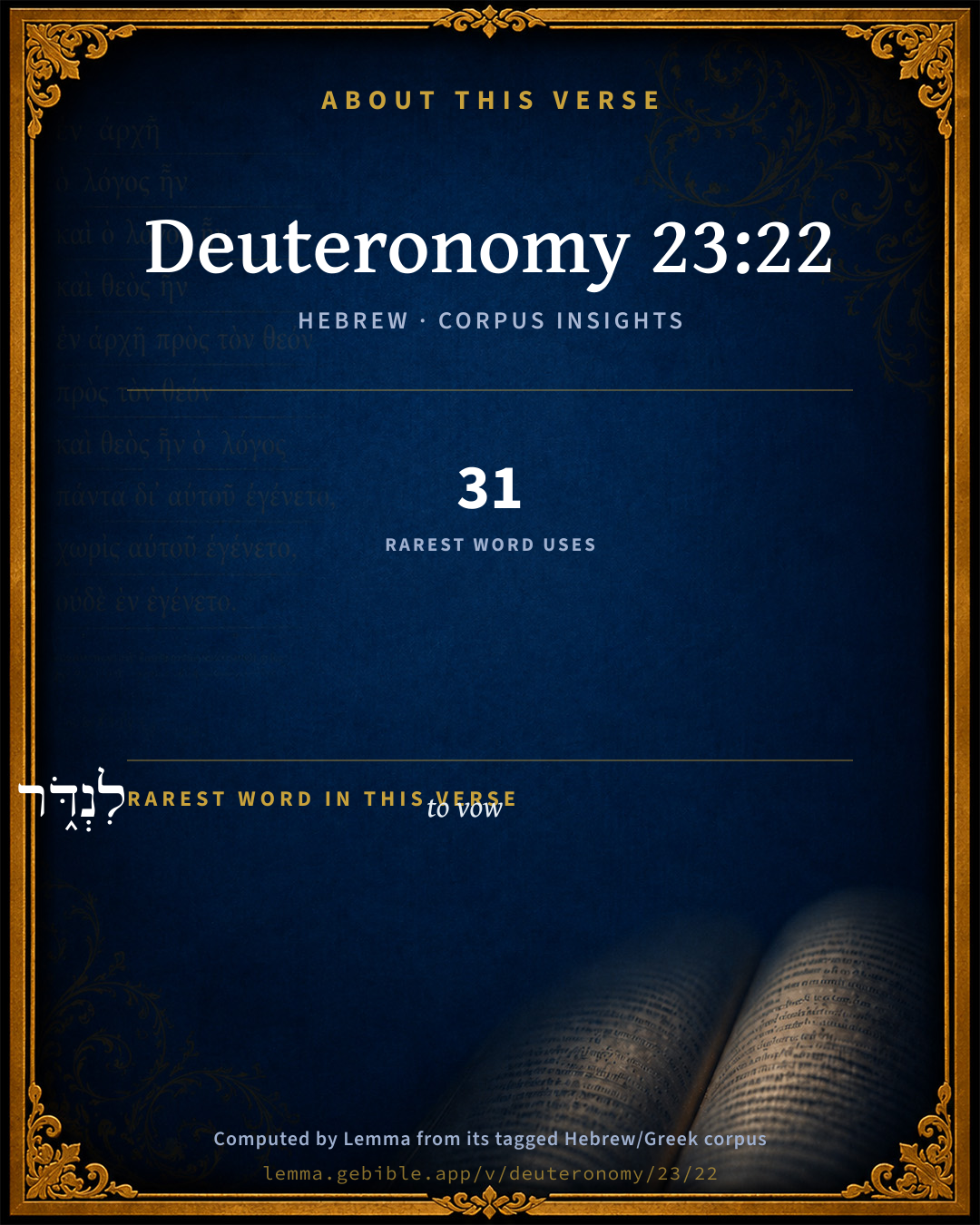
לִנְדֹּ֑ר to vow H5087 occurs in 28 verses of the Hebrew Bible. Also found in:

Grammatical profile

  • 3 verbs
  • 1 noun
  • 1 preposition
  • 1 conjunction
  • 1 particle

Verb forms

  • תֶחְדַּ֖ל Qal · Imperfect
  • לִנְדֹּ֑ר Qal · Infinitive Construct
  • יִהְיֶ֥ה Qal · Imperfect

Hebrew & Septuagint length

In English translation the verse runs 14 words from the Hebrew and 14 from the Septuagint (LXX English) — the same length.

A rough comparison of the two English renderings, which tokenize alike — not a word-level alignment.

Word counts can differ between the Hebrew and the Greek without any difference in meaning — e.g. the Hebrew direct-object marker אֵת has no separate Greek word, and Greek often adds the article ὁ.

Hebrew and Greek witnesses Masoretic Hebrew ↔ Greek Septuagint

The same verse in the two great witnesses to the Old Testament, shown verse-for-verse.

These are two independent witnesses, not word-aligned to each other, and the Septuagint is shown in lemma (dictionary) form.

Hebrew Deuteronomy 23:22 Masoretic · Westminster Leningrad Codex

וְכִ֥י תֶחְדַּ֖ל לִנְדֹּ֑ר לֹֽא יִהְיֶ֥ה בְךָ֖ חֵֽטְא

But if you shall forbear to vow, it shall be no sin in you.

World English Bible · Public Domain

Greek LXX Deuteronomy 23:22 Septuagint · lemma form

ἐάν δέ εὔχομαι εὐχή κύριος ὁ θεός σύ οὐ χρονίζω ἀποδίδωμι αὐτός ὅτι ἐκζητέω ἐκζητέω κύριος ὁ θεός σύ παρά σύ καί εἰμί ἐν σύ ἁμαρία

But if you should be unwilling to vow, it is not sin in you.

LXX2012 (modern English Septuagint) · Public Domain

Hebrew: Westminster Leningrad Codex (CC BY 4.0). Greek: Septuagint (public domain); English from LXX2012 (modern English Septuagint) (Public Domain). How the Septuagint differs from the Hebrew →

Targum (Aramaic paraphrase)

2

The Targum is the ancient Jewish Aramaic paraphrase of the Hebrew Scriptures — an interpretive translation, not the Hebrew text itself. Onkelos (literal) and Pseudo-Jonathan (expansive) render the Torah, and Jonathan the Prophets. Coverage is partial: where no permissively-licensed English translation exists for a verse, only the Aramaic is shown. This is verse-level text, not a word-by-word alignment to the Hebrew.

  1. Targum Onkelos Torah (Genesis–Deuteronomy)
    אֲרֵי תִדַר נְדַר קֳדָם יְיָ אֱלָהָךְ לָא תְאַחַר לְשַׁלָמוּתֵהּ אֲרֵי מִתְבַּע יִתְבְּעִנֵהּ יְיָ אֱלָהָךְ מִנָךְ וִיהֵי בָךְ חוֹבָא

    (no public-domain English translation for this verse)

    Targum Onkelos — Aramaic: “Onkelos Genesis” (public domain); “Onkelos Exodus” (public domain); “Onkelos Leviticus” (public domain); “Onkelos Numbers” (public domain); “Onkelos Deuteronomy” (public domain). English: “Sefaria Community Translation” (CC0 1.0 (public-domain dedication)); “J.W. Etheridge. The Targums of Onkelos and Jonathan Ben Uzziel on the Pentateuch. London: Longmans, Green, 1862” (public domain). Text via Sefaria.

  2. Targum Pseudo-Jonathan Torah (Genesis–Deuteronomy)
    אֲרוּם תִּידְרוּן נִדְרָא קֳדָם יְיָ אֱלָהָכוֹן לָא תוֹחֲרוּן לְשַׁלְמוּתֵיהּ תְּלַת חַגִּין אֲרוּם מִתְבַּע יִתְבְּעִינֵיהּ יְיָ אֱלָהָכוֹן בְּקוּרְבָּנָא לָא יְהֵי חוֹב וּפְסוּלָא דִבְהַפְתִּיק מָרֵי עַלְמָא קָאִי וְלָא יְהֵי בָךְ חוֹבַת עִכּוּב נִדְרָא

    When you vow a vow before the Lord your God, delay not to fulfil it in (one of) the three festivals; for the Lord your God requiring will require it. And in the oblation there shall not be any fault or blemish, for in the prescription of the Lord of the world it is so ordained. And thou shalt not be guilty of keeping back (delaying) thy vow:

    Targum Pseudo-Jonathan — Aramaic: “Targum Jonathan on Genesis” (public domain); “Targum Jonathan on Exodus” (public domain); “Targum Jonathan on Leviticus” (public domain); “Targum Jonathan on Numbers” (public domain); “Targum Jonathan on Deuteronomy” (public domain). English: “The Targum of Jonathan ben Uzziel, trans. J. W. Etheridge, London, 1862” (public domain). Text via Sefaria.

Commentary

Notes on Deuteronomy 23:22 from classic Christian and Jewish commentators (each source and its license shown beneath its notes). The classic Christian expositions comment on the surrounding passage and are grouped to its opening verse, so a note may address several verses; the Jewish commentaries on the Tanakh (Rashi and others) are per-verse, so they appear only where the commentator wrote on this verse.

Lemma curates 59 commentaries, every one of them public domain or Creative Commons licensed, each selected and text-cleaned for this edition rather than reprinted as found. About our sources →

Trapp's Complete Commentary

John Trapp

Deu 23:22 But if thou shalt forbear to vow, it shall be no sin in thee.

Ver. 22. It shall be no sin in thee,] i.e., No such great sin; as Joh 9:41, so Joh 15:22; Joh 15:24 Jas 4:17. See Ecc 5:5. Vovere nusquam est praeceptum, saith Bellarmine: We are nowhere in Scripture commanded to vow. And Fateor quod Deus non praecipit, sed tantum consulit nobis ut aliquid illi voveamus, saith another Popish writer. {a} I confess God nowhere commandeth, but only counselleth us to make vows. But what will they say to Psa 76:11; - "Vow and perform to the Lord your God, bring presents" &c.? And are not the nine lepers condemned by Christ for their negligence and unthankfulness? {Luk 17:17-18}

{a} Alphons. de Castro., De Monach, lib. ii. cap. 16.

John Trapp, A Commentary or Exposition upon All the Books of the Old and New Testament (1647–1656) — public domain. Text from a community e-Sword module.

The Biblical Illustrator

Joseph S. Exell

Deu_23:22

If thou shalt forbear to vow.

Extraordinary and particular vows considered as not necessary under the Mosaic or expedient under the Christian institution

I. The nature of vows under the Jewish dispensation: which, as they are particularly voluntary engagements, we ought to observe when made, though we cannot infer a necessity of making them from the Divine law or the nature of things. It would seem but an ill consequence should we thus argue: God has commanded us in general to honour Him with our substance, and therefore we ought to make ourselves liable to His judgments, if in such a particular case, at such a particular time, and to such a particular degree we do it not. This I say would be but an ill consequence, though there may be some fit reasons assigned why such particular vows were used by good and pious men under the circumcision (Gen_28:20; Jdg_11:20; Jdg_11:31; 2Sa_15:7-8). Hence we observe that things consecrated or desecrated, though they are in a vulgar sense styled devoted, are not always reducible under the general nature of a vow, in the proper and scriptural sense of the word, and there seems to be a greater difference than is commonly apprehended between them. Thus much may suffice to determine the notion of vows as they are distinguished from other sacrifices under the Jewish dispensation; but it will still be more clear from some further reflections upon the lawful matter of them. For this we need only in general observe that everything which was not appropriated to God, which was not profaned, or which was not properly under the right or arbitrament of another, was the subject matter of them. From whence it follows that tenths in the first place were, under the Mosaic law, excluded from it, and that these could not be vowed to the Almighty, or be accepted by Him as a freely promised offering, because they were properly His before both by prescription and command. Again, nothing which was profaned or unclean, unless as it was redeemable, could be the matter of a vow. The heathens, for the generality, had more exalted notions than to think their gods would be gratified with such sacrifices as were held in contempt by themselves, and were in their kind of least estimation with them. Lastly, whatsoever was under the right and power of another was excluded from the matter of a vow, and therefore those who were subject to the authority of fathers or husbands were by the law not obliged to the performance of vows made without their consent during their right and power over them.

II. Under the Gospel the Christians vows are comprehended under the sacramental, and therefore particular vows are neither necessary nor expedient. It may be proper to give a fit instance or two of particular vows in order to settle what are so. We are, in general, by our baptismal covenant, obliged to renounce all the sinful lusts of the flesh, and in consequence of this are obliged to make use of the means prescribed, suppose mortification by fasting. But should we by a solemn promise to God Almighty oblige ourselves to abstain such a number of days or hours, this circumstance nowhere enjoined would make it a particular vow. Again, we are obliged by our general vow to acts of charity and piety; but should we make a voluntary promise to God to bestow at such a future time such a certain sum to such an assigned use in view of such a desired blessing, this would also be a particular vow. And these are the vows which I undertake to prove neither necessary nor expedient. If they had been necessary, we might reasonably suppose that as our Saviour appointed that grand one for the initiation of His followers, He would also have prescribed the other, either by precept or practice, for the perfection of them, that so the use of them might have been derived by authority to the Christian Church, as it was to the Jews from the patriarchs. But we have no instance of this kind, either from our Saviour, His apostles, or followers, in the New Testament. And if we take them, under the general notion, as acts of gratitude, by which the good Christian promises to God the acknowledgment of a blessing by a suitable offering and oblation, though it is lawful and not absurd, as Calvin expresses it, to enter into such engagements, yet what advantage this method of acknowledgment has above others is not easily discerned. Should the pious Christian be made a peculiar favourite of heaven, and blessed with extraordinary advantages, either in prospect or possession, he may by his free gifts and offerings give a more noble and generous instance of his pious resentment, which under the law were always deemed the most acceptable sacrifices, and must recommend to the favour of the Almighty, who loveth a cheerful giver, whereas he, who lays a constraint upon himself, may give afterwards with an unwilling mind, and though he pays the vow, may not answer the end of it. And it is for these reasons, I presume, that the Jewish doctors discouraged and deterred their scholars from such kind of vows. But were they ever so expedient, the ill use which has been made of the doctrine of particular vows by the Church of Rome would be enough to give us a prejudice against them. (T. Silvester, M. A.)

The Biblical Illustrator, edited by Joseph S. Exell (c. 1880s–1900s) — public domain. Text from a community e-Sword module.

John Gill's Exposition

But if thou shalt forbear to vow,.... That a man might do, though there was ability; it was expected indeed that men should vow and bring freewill offerings in proportion to their ability; whether they were of the greater sort, of the herd and flock, or of fowls, or even of fine flour, these were acceptable to the Lord: but if they were not vowed and brought:

it shall be no sin in thee; no charge of guilt be brought or punishment laid; it should not be reckoned a crime, nor be punishable in any respect, and especially where there was a willing mind and no ability; otherwise negligence, niggardliness, and ingratitude, are not well pleasing in the sight of God.

John Gill's Exposition of the Whole Bible (1746–1763) — public domain (CC PDM 1.0). Text via the HelloAO Bible API.

Rashi

Rabbi Shlomo Yitzchaki (Rashi)

לא תאחר לשלמו [WHEN THOU SHALT VOW A VOW UNTO THE LORD THY GOD] THOU SHALT NOT DELAY TO PAY IT — beyond three festivals after the vow has been made. Our Rabbis have deduced it (the fact that one does not transgress the prohibition before three festivals elapse) from a Scriptural text (Rosh Hashanah 4b).

Rashi on the Tanakh — English translations: “The Judaica Press complete Tanach with Rashi, translated by A. J. Rosenberg” (CC BY 4.0); “Pentateuch with Rashi's commentary by M. Rosenbaum and A.M. Silbermann, 1929-1934” (public domain); “The Metsudah Tanach series, Lakewood, N.J” (CC BY 4.0); and “The Book of Joshua, Metsudah Publications, 1997” (CC BY 4.0). Text via Sefaria.

Lesson kit

Teaching starters — assembled from the data on this page, not authored interpretation. Every prompt links to the verse data it draws on. Edit before teaching.

Deuteronomy, in the Pentateuch, opens this verse with 7 words (6 distinct Hebrew lemmas). Its most distinctive word is nâdar (“to vow”). A historical commentator’s framing appears above. Read the whole chapter for the surrounding context.

Discussion questions

  1. What does “to vow” (nâdar) contribute to the verse as a whole?
  2. Genesis 28:20 shares the word «to vow» with this verse. How do the two illuminate each other?
  3. The translations on this page render this verse differently — a whole-verse word diff, not a word-by-word alignment. What might account for the different wordings?
  4. The verb «תֶחְדַּ֖ל» is Qal Imperfect. How does its form color the action?
  5. Reading how Trapp's Complete Commentary and The Biblical Illustrator read this verse, where do the two commentators agree and where do they part?

Things to notice

Reading settings

Reading text

Shown beneath each verse's original-language words.

Old Testament
Old Testament edition

Read the OT as the Masoretic Hebrew (MT) or the Greek Septuagint (LXX).

English shown for the Greek Septuagint (in the Hebrew ↔ Greek comparison).

Comparing translations? Open the Compare panel on any verse page to stack up to four side by side.