Leviticus 22:23

Hebrew (Westminster Leningrad Codex) Leviticus 22:23 appears in the Hebrew Old Testament. The text above is from the Westminster Leningrad Codex. Each word links to its Strong’s number, a concise gloss, and parsing drawn from the Open Scriptures Hebrew Bible morphology. Click any word for its full Brown-Driver-Briggs (BDB) entry.
Download image
Cite this verse

Leviticus 22:23 (World English Bible). Public Domain. Lemma interlinear Bible study tool, https://lemma.gebible.app/v/leviticus/22/23.

Show BibTeX & RIS
BibTeX
RIS
English Translation
Either a bull or a lamb that has any deformity or lacking in his parts, that you may offer for a freewill offering; but for a vow it shall not be accepted.
World English Bible · Public Domain
Highlights
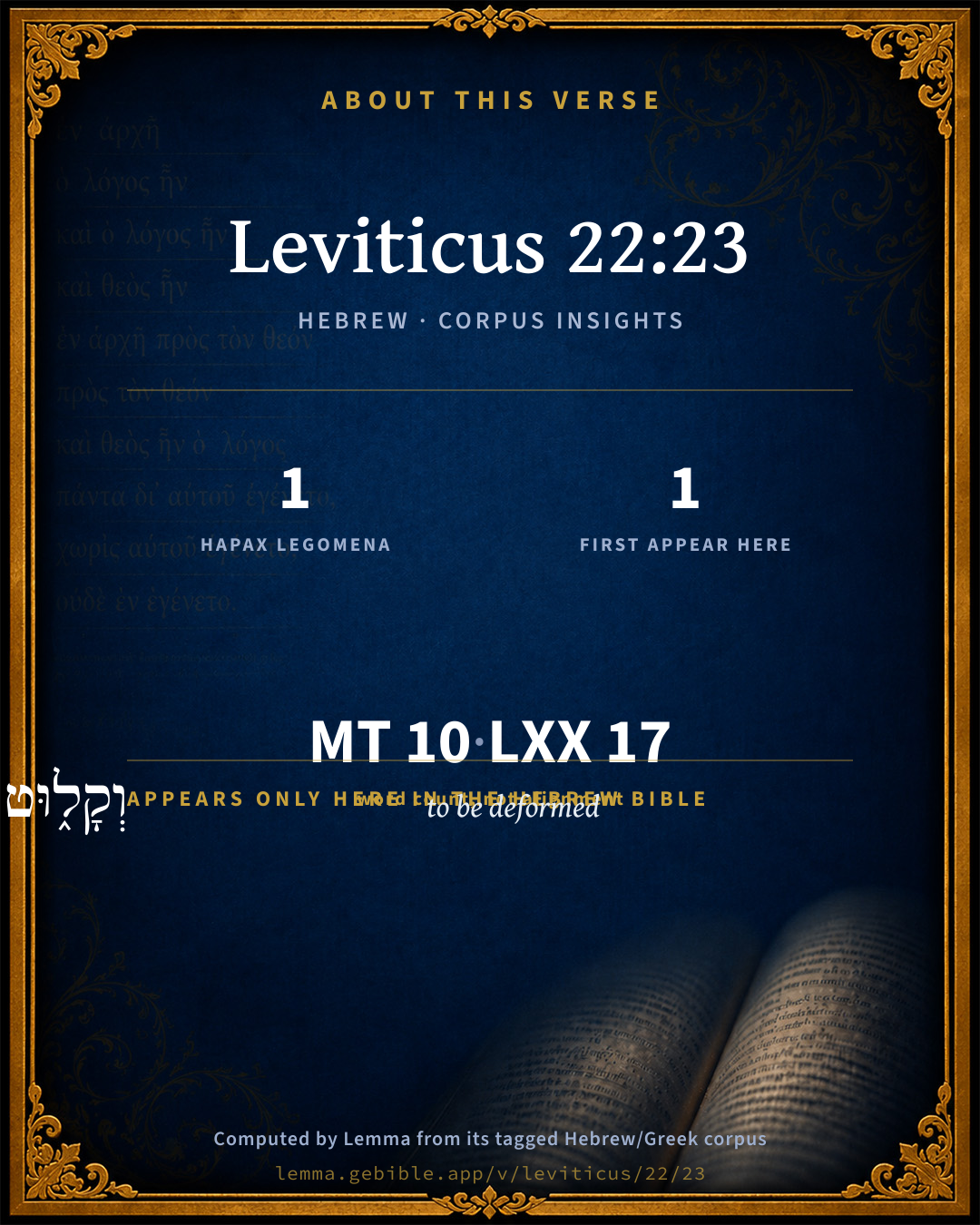
  • 1 hapax legomenon — only here in the Hebrew Bible
  • 1 first appearance in the Hebrew Bible
Full analysis ↓
Download a study sheet

One document with this verse’s original text, its word-by-word gloss line, the meaning frame, cross-references with their text, attributed commentary, and full source and license credits — printable, and it pastes into notes with its structure intact.

This verse Autodidact and up

Study sheet (.html) Plain text (.txt)

A passage Seminary Student

Up to 50 verses in one chapter. A passage sheet keeps up to 6 commentary sources and 12 cross-references per verse, in the order this page ranks them, and says so on the sheet whenever that leaves anything out. Ask for a single verse and you get the Autodidact verse sheet above.

Everything on this page stays free to read, with no account — the sheet is a download of what is already on screen, not access to it.

Want to remove ads? Support Godless Engineer
Compare translations 3

The same verse in 3 English versions, stacked beneath the original-language interlinear above. Click any original word for its lexicon entry.

Each is an independent rendering of the whole verse — the interlinear is not word-aligned to these translations.

Highlighted words mark where these versions differ — a whole-verse word diff, not a word-by-word alignment.

  • World English Bible Public Domain
    Either a bull or a lamb that has any deformity or lacking in his parts, that you may offer for a freewill offering; but for a vow it shall not be accepted.
  • King James Version Public Domain
    Either a bullock or a lamb that hath any thing superfluous or lacking in his parts, that mayest thou offer for a freewill offering; but for a vow it shall not be accepted.
  • unfoldingWord Literal Text CC BY-SA 4.0
    But an ox or a lamb, extended or stunted, you may make it a freewill offering, but it will not be accepted for a vow.

unfoldingWord Literal Text — © unfoldingWord, licensed CC BY-SA 4.0. Word-aligned USFM3 via Door43 (git.door43.org/unfoldingWord/en_ult).

Versions to compare (up to 4)

3 of 4 selected

Show all 18 translations

Every available English version of this verse, each an independent rendering of the whole verse.

  • World English Bible Public Domain
    Either a bull or a lamb that has any deformity or lacking in his parts, that you may offer for a freewill offering; but for a vow it shall not be accepted.
  • Berean Standard Bible Public Domain
    You may present as a freewill offering an ox or sheep that has a deformed or stunted limb, but it is not acceptable in fulfillment of a vow.
  • Majority Standard Bible Public Domain
    You may present as a freewill offering an ox or sheep that has a deformed or stunted limb, but it is not acceptable in fulfillment of a vow.
  • King James Version Public Domain
    Either a bullock or a lamb that hath any thing superfluous or lacking in his parts, that mayest thou offer for a freewill offering; but for a vow it shall not be accepted.
  • American Standard Version (1901) Public Domain
    Either a bullock or a lamb that hath anything superfluous or lacking in his parts, that mayest thou offer for a freewill-offering; but for a vow it shall not be accepted.
  • Revised Version (1885) Public Domain
    Either a bullock or a lamb that hath any thing superfluous or lacking in his parts, that mayest thou offer for a freewill offering; but for a vow it shall not be accepted.
  • Geneva Bible (1599) Public Domain
    Yet a bullocke, or a sheepe that hath any member superfluous, or lacking, such mayest thou present for a free offring, but for a vowe it shall not be accepted.
  • Douay-Rheims (1899) Public Domain
    An ox or a sheep, that hath the ear and the tail cut off, thou mayst offer voluntarily: but a vow may not be paid with them.
  • Young's Literal Translation Public Domain
    `As to an ox or a sheep enlarged or dwarfed -- a willing-offering ye do make it, but for a vow it is not pleasing.
  • Literal Standard Version CC BY-SA 4.0
    As for an ox or sheep [that] is deformed or stunted—you make it a willing-offering, but it is not pleasing for a vow.
  • Unlocked Literal Bible CC BY-SA 4.0
    You may present as a freewill offering an ox or a lamb that is deformed or small, but an offering like that will not be accepted for a vow.
  • unfoldingWord Literal Text CC BY-SA 4.0
    But an ox or a lamb, extended or stunted, you may make it a freewill offering, but it will not be accepted for a vow.
  • Darby Bible Public Domain
    A bullock and a sheep that hath a member too long or too short, that mayest thou offer as a voluntary offering; but as a vow it shall not be accepted.
  • World Messianic Bible Public Domain
    Either a bull or a lamb that has any deformity or lacking in his parts, that you may offer for a free will offering; but for a vow it shall not be accepted.
  • Webster's Bible Public Domain
    Either a bullock, or a lamb that hath any thing superfluous or lacking in his parts, that mayest thou offer for a free-will-offering; but for a vow it shall not be accepted.
  • Free Bible Version CC BY-SA 4.0
    However, you can present a freewill offering of a bull or sheep that has a leg that is too long or too short, but not if it is a sacrifice to fulfill a promise.
  • Bible in Basic English Public Domain
    An ox or a lamb which has more or less than its natural parts, may be given as a free offering; but it will not be taken in payment of an oath.
  • JPS Tanakh (1917) Public Domain
    Either a bullock or a lamb that hath any thing too long or too short, that mayest thou offer for a freewill-offering; but for a vow it shall not be accepted.

Literal Standard Version (2020), Covenant Press — licensed CC BY-SA 4.0. Text via the HelloAO Bible API (eBible.org). Unlocked Literal Bible (unfoldingWord) — licensed CC BY-SA 4.0. Text via the HelloAO Bible API (eBible.org). unfoldingWord Literal Text — © unfoldingWord, licensed CC BY-SA 4.0. Word-aligned USFM3 via Door43 (git.door43.org/unfoldingWord/en_ult). Free Bible Version, Dr. Jonathan Gallagher — licensed CC BY-SA 4.0. Text via the HelloAO Bible API (eBible.org).

Word by word

More ways to search: Search by grammar → Find every occurrence → Compare this word →

Practice this passage: Drill this verse → Learn its vocabulary →

וְקָל֑וּט
qâlaṭ
H7038
“and · deformed”
Conjunction + Verb, Qal, Participle Passive, Masculine, Singular, Absolute
Part of Speech
Conjunction + Verb
Stem
Qal
Form
Participle Passive
Gender
Masculine
Number
Singular
State
Absolute
Full BDB Definition

Origin: a primitive root

TWOT: 2027

(Qal) to be stunted, be handicapped, be deformed (of a sacrificial animal lacking body parts)
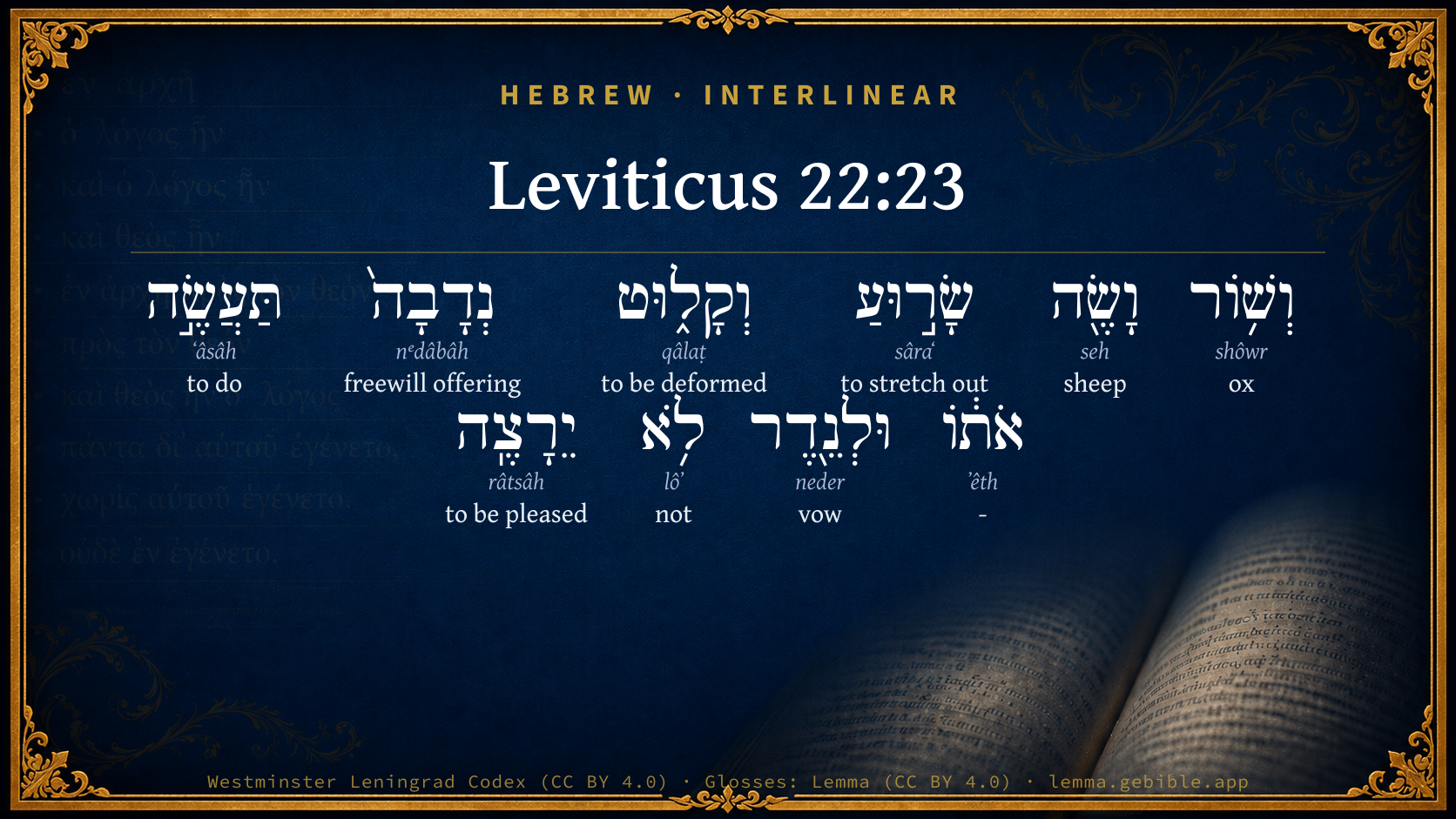
  1. וְשׁ֥וֹר shôwr H7794 “and · ox” Conjunction + Noun, Common, Masculine, Singular, Absolute
  2. וָשֶׂ֖ה seh H7716 “and · sheep” Conjunction + Noun, Common, Both, Singular, Absolute
  3. שָׂר֣וּעַ sâraʻ H8311 “stretched out” Verb, Qal, Participle Passive, Masculine, Singular, Absolute
  4. נְדָבָה֙ nᵉdâbâh H5071 “freewill offering” Noun, Common, Feminine, Singular, Absolute
  5. תַּעֲשֶׂ֣ה ʻâsâh H6213 “to do” Verb, Qal, Imperfect, 2nd Person, Masculine, Singular
  6. אֹת֔וֹ ʼêth H853 “- · him” Particle, Direct Object + Suffix, Personal, 3rd Person, Masculine, Singular
  7. וּלְנֵ֖דֶר neder H5088 “and · to/for · vow” Conjunction + Preposition + Noun, Common, Masculine, Singular, Absolute
  8. לֹ֥א lôʼ H3808 “not” Particle, Negative
  9. יֵרָצֶֽה râtsâh H7521 “to be pleased” Verb, Niphal, Imperfect, 3rd Person, Masculine, Singular

About this verse

These counts appear in no published source. They are computed here, from the morphology-tagged text and Lemma’s own curated glosses. What Lemma adds →

10
words
10
distinct lemmas
Pentateuch
section

Notable vocabulary

1 hapax legomenon — a word that appears only here in the entire Hebrew Bible:

  • וְקָל֑וּט to be deformed H7038

First appearance in Scripture

This word makes its first canonical appearance in the Hebrew Bible here:

  • וְקָל֑וּט to be deformed H7038

Shared distinctive vocabulary

שָׂר֣וּעַ to stretch out H8311 occurs in 3 verses of the Hebrew Bible. Also found in:

Grammatical profile

  • 4 verbs
  • 4 nouns
  • 2 particles

Verb forms

  • שָׂר֣וּעַ Qal · Participle Passive
  • וְקָל֑וּט Qal · Participle Passive
  • תַּעֲשֶׂ֣ה Qal · Imperfect
  • יֵרָצֶֽה Niphal · Imperfect

Hebrew & Septuagint length

In English translation the verse runs 32 words from the Hebrew and 32 from the Septuagint (LXX English) — the same length.

A rough comparison of the two English renderings, which tokenize alike — not a word-level alignment.

Word counts can differ between the Hebrew and the Greek without any difference in meaning — e.g. the Hebrew direct-object marker אֵת has no separate Greek word, and Greek often adds the article ὁ.

In the original languages it is 10 Hebrew tokens and 17 Greek tokens — but the two are counted differently (Hebrew bundles its prefixes and suffixes into one token; the Greek is in lemma form), so that isn’t a like-for-like length.

Cross-references

1

Topical passages linked to Leviticus 22:23 in the Treasury of Scripture Knowledge — connected by theme and wording, ordered by reader-vote popularity; previews shown in the World English Bible.

  • Leviticus 21:18 For whatever man he is that has a blemish, he shall not draw near: a blind man, or a lame, or he who has a flat nose, or any deformity,

Cross-references courtesy of OpenBible.info (CC BY 4.0).

Hebrew and Greek witnesses Masoretic Hebrew ↔ Greek Septuagint

The same verse in the two great witnesses to the Old Testament, shown verse-for-verse.

These are two independent witnesses, not word-aligned to each other, and the Septuagint is shown in lemma (dictionary) form.

Hebrew Leviticus 22:23 Masoretic · Westminster Leningrad Codex

וְשׁ֥וֹר וָשֶׂ֖ה שָׂר֣וּעַ וְקָל֑וּט נְדָבָה֙ תַּעֲשֶׂ֣ה אֹת֔וֹ וּלְנֵ֖דֶר לֹ֥א יֵרָצֶֽה

Either a bull or a lamb that has any deformity or lacking in his parts, that you may offer for a freewill offering; but for a vow it shall not be accepted.

World English Bible · Public Domain

Greek LXX Leviticus 22:23 Septuagint · lemma form

καί μόσχος ἤ πρόβατον ὠτότμητος ἤ κολοβόκερκος σφάγιον ποιέω αὐτός σεαυτοῦ εἰς δέ εὐχή σύ οὐ δέχομαι

And a calf or a sheep with the ears cut off, or that has lost its tail, you shall kill them for yourself; but they shall not be accepted for your vow.

LXX2012 (modern English Septuagint) · Public Domain

On this verse, Haydock's Catholic Bible Commentary discusses the Septuagint’s reading. Read the note in Commentary ↓

Hebrew: Westminster Leningrad Codex (CC BY 4.0). Greek: Septuagint (public domain); English from LXX2012 (modern English Septuagint) (Public Domain). How the Septuagint differs from the Hebrew →

Targum (Aramaic paraphrase)

2

The Targum is the ancient Jewish Aramaic paraphrase of the Hebrew Scriptures — an interpretive translation, not the Hebrew text itself. Onkelos (literal) and Pseudo-Jonathan (expansive) render the Torah, and Jonathan the Prophets. Coverage is partial: where no permissively-licensed English translation exists for a verse, only the Aramaic is shown. This is verse-level text, not a word-by-word alignment to the Hebrew.

  1. Targum Onkelos Torah (Genesis–Deuteronomy)
    וְתוֹר וְאִמַר יַתִּיר וְחַסִיר נְדַבְתָּא תַּעְבֵּד יָתֵהּ וּלְנִדְרָא לָא יְהֵי לְרַעֲוָא

    (no public-domain English translation for this verse)

    Targum Onkelos — Aramaic: “Onkelos Genesis” (public domain); “Onkelos Exodus” (public domain); “Onkelos Leviticus” (public domain); “Onkelos Numbers” (public domain); “Onkelos Deuteronomy” (public domain). English: “Sefaria Community Translation” (CC0 1.0 (public-domain dedication)); “J.W. Etheridge. The Targums of Onkelos and Jonathan Ben Uzziel on the Pentateuch. London: Longmans, Green, 1862” (public domain). Text via Sefaria.

  2. Targum Pseudo-Jonathan Torah (Genesis–Deuteronomy)
    וְתוֹר וְאִימַר יַתִּיר כּוּלְיָא אוֹ דְחָסִיר כּוּלְיָא נְסִיבָא תַעֲבֵיד יָתֵיהּ וּלְנִידְרָא לָא יְהֵי לְרַעֲוָא

    A bullock or a ram that hath superfluity or deficiency of the testicles, you may make a free will offering, but for a vow it will not be acceptable.

    Targum Pseudo-Jonathan — Aramaic: “Targum Jonathan on Genesis” (public domain); “Targum Jonathan on Exodus” (public domain); “Targum Jonathan on Leviticus” (public domain); “Targum Jonathan on Numbers” (public domain); “Targum Jonathan on Deuteronomy” (public domain). English: “The Targum of Jonathan ben Uzziel, trans. J. W. Etheridge, London, 1862” (public domain). Text via Sefaria.

Commentary

Notes on Leviticus 22:23 from classic Christian and Jewish commentators (each source and its license shown beneath its notes). The classic Christian expositions comment on the surrounding passage and are grouped to its opening verse, so a note may address several verses; the Jewish commentaries on the Tanakh (Rashi and others) are per-verse, so they appear only where the commentator wrote on this verse.

Lemma curates 59 commentaries, every one of them public domain or Creative Commons licensed, each selected and text-cleaned for this edition rather than reprinted as found. About our sources →

Trapp's Complete Commentary

John Trapp

Lev 22:23 Either a bullock or a lamb that hath any thing superfluous or lacking in his parts, that mayest thou offer [for] a freewill offering; but for a vow it shall not be accepted.

Ver. 23. That mayest thou offer.] Though it have some kind of defect, yet, in free will offerings, it might pass. This was to signify that our imperfect obedience after that we are once in Christ, is accepted by Christ, who is without all blame and blemish.

John Trapp, A Commentary or Exposition upon All the Books of the Old and New Testament (1647–1656) — public domain. Text from a community e-Sword module.

Joseph Benson's Commentary

Lev 22:23. That mayest thou offer — The Hebrew here will bear a different translation, which, indeed, seems necessary to reconcile this with the twenty-first verse, namely, Shouldest thou offer it for a free-will-offering or for a vow, it would not be accepted.

Joseph Benson's Commentary on the Old and New Testaments (1811–1818) — public domain. Text from a community e-Sword module.

Tyndale Open Study Notes

Tyndale Open Resources

22:23 The requirements for the voluntary offering were more lenient, allowing the use of a deformed animal. Fulfilling a vow, however, still required an animal that was not maimed or diseased. In no case would God accept a sacrifice that could not be eaten by a person or that was not a whole animal.

Tyndale Open Study Notes — © Tyndale Open Resources, licensed CC BY-SA 4.0. Text via the HelloAO Bible API.

Jamieson, Fausset & Brown

Robert Jamieson, A. R. Fausset & David Brown

that mayest thou offer, &c.--The passage should be rendered thus: "if thou offer it either for a freewill offering, or for a vow, it shall not be accepted." This sacrifice being required to be "without blemish" [Lev 22:19], symbolically implied that the people of God were to dedicate themselves wholly with sincere purposes of heart, and its being required to be "perfect to be accepted" [Lev 22:21], led them typically to Him without whom no sacrifice could be offered acceptable to God.

Jamieson, Fausset & Brown — Commentary Critical and Explanatory on the Whole Bible (1871) — public domain (CC PDM 1.0). Text via the HelloAO Bible API.

Adam Clarke's Commentary

Verse 23. That hath anything superfluous or lacking] The term שרוע sarua signifies any thing extended beyond the usual size, and the term קלוט kalut signifies any thing unusually contracted; and both mean any monstrosity, whether in redundance or defect. Such things, it seems, might be offered for a freewill-offering, because that was not prescribed by the law; God left it to a man's piety and gratitude to offer such additional gifts as he could: what the law required was indispensably necessary, because it pointed out the Gospel economy; but he that made a vow to offer such a sacrifice as the law had not required, could of course bring an imperfect offering. Some contend that the last clause of this verse should be thus read: If thou offer it either for a freewill-offering, or for a vow, it shall not be accepted. It was the opinion of the Jews, and it appears to be correct, that none of these imperfect animals were ever offered on the altar; but the person who made the freewill-offering of such things as he had, sold the animal, and gave its price for the support of the sanctuary.

Adam Clarke's Commentary on the Bible (1810–1826) — public domain. Text from a community e-Sword/MySword module.

Ellicott's Commentary for English Readers

(23) Either a bullock or a lamb.—Better, And bullock and one of the flock.

That hath any thing superfluous.—That is one member of the animal being more elongated or contracted than the other, being out of proportion. The same blemish also unfitted the priest for performing sacerdotal functions (see Lev_21:18).

Or lacking in his parts.—This, according to the authorities during the second Temple, denotes contracted hoofs, or undivided hoofs, making them resemble those of an ass or horse.

That mayest thou offer for a freewill offering.—Better, that thou mayest make a freewill offering. As Lev_22:18-20 most emphatically declare that an animal with any blemish whatsoever must not be offered “for any manner of freewill offering,” it is hardly conceivable that the lawgiver would contradict this enactment within the space of three verses, and say “that the animals with those serious organic defects enumerated in the verse before us, thou mayest offer for a freewill offering.” Hence, during the second Temple, the passage before us was interpreted to mean that the animals in question were only allowed to be consecrated for the maintenance and repair of the sanctuary, but not to be offered as a sacrifice on the altar. They were sold, or the offerer paid the value himself, and the money was applied to these sacred purposes. The opinion that a freewill offering was of less importance than a vow, and that therefore the lawgiver allows animals with the two kinds of defects here described to be offered for a freewill offering but not for a vow, is contrary to the regulations laid down in Lev_22:18-20, and is against the practice during the second Temple (see Lev_7:16). It is far more probable that the text is disarranged, and that it originally was, “that thou mayest not offer for a freewill offering, and for a vow it shall not be accepted.”

A Bible Commentary for English Readers, edited by Charles John Ellicott (1878–1897) — public domain. Text from a community e-Sword module.

The Cambridge Bible for Schools and Colleges

gen. ed. J. J. S. Perowne

23. but for a vow] The three varieties included under the name Peace-Offering were, as has been noticed (see on Lev_7:11), (a) Thank-Offerings (here mentioned as a separate item in Lev_22:29, (b) Votive-Offerings, and (c) Freewill-Offerings. The first (see W.P.Paterson, HDB, Art. Sacrifice, p. 338) was offered in acknowledgment of benefits received, the second and third were combined with prayer for blessings hoped for. These two differed thus, that the Freewill-Offering was simply in support of the prayer, and was made in anticipation of the benefit asked. The vow was promised on fulfilment of the prayer, and thus, unlike the Freewill-Offering, need not be offered if the prayer remained unfulfilled. According to this v., gratitude for the answer was to be indicated by the greater stringency of the regulation as to the nature of the animal to be offered in acknowledgment of the mercy vouchsafed.

For the general prohibition to offer a sacrifice that had a blemish, cp. the rebuke in Mal_1:8; Mal_1:13.

The Cambridge Bible for Schools and Colleges (gen. ed. J. J. S. Perowne; Cambridge University Press, 1878–1918) — public domain. Text from a community e-Sword module.

John Gill's Exposition

Ye shall not offer unto the Lord that which bruised, or crushed, or broken, or cut,.... The Targum of Jonathan is, whose testicles are pressed and bruised, and whose nerves are corrupted and bruised, and so most Jewish writers interpret it:

neither shall you make any offering thereof in your land; any offering of any sort, either burnt offering or peace offering, or any other; or ye shall not do, that is, any such thing as here suggested, not bruise, or crush, or break, or cut the testicles of any creature; so the above writers.

John Gill's Exposition of the Whole Bible (1746–1763) — public domain (CC PDM 1.0). Text via the HelloAO Bible API.

Haydock's Catholic Bible Commentary

CHAPTER XXII.

Ear....cut. Hebrew saruang, which is translated a crooked nose, chap. xxi. 18. The Septuagint and Syriac agree here with the Vulgate: but the moderns generally adopt the interpretation of the Rabbins, who say the word is applied to those animals whose double members, feet, ears, &c., are disproportionately long; as kolut, means too short. (Bochart) (Calmet) --- Voluntarily, for the use of the priests, but not for any sacrifice, ver. 21. (Du Hamel)

George Leo Haydock (1774–1849), Haydock's Catholic Family Bible and Commentary, 1859 edition — public domain. Excludes Psalms (Douay-Rheims chapter numbering differs from Protestant) and Deuterocanonical books (Catholic canon only).

Matthew Poole's English Annotations

That mayest thou offer; either,

1. To the priest, who might, according to the rules given by God, either convert it to his own use, or sell it, and lay out the price of it upon the temple or sacrifices. But in this sense any of the other kinds, as blind, or broken, &c., might be offered, which yet are forbidden to be offered Lev 22:22. Or rather,

2. To the Lord, as is expressed Lev 22:22,24, this being put down by way of opposition to those defects, Lev 22:22, and by way of exception from the general rule, Lev 22:21.

Matthew Poole's English Annotations on the Holy Bible (1683–1685) — public domain. Text from a community e-Sword/MySword module.

Whedon's Commentary on the Bible

Daniel D. Whedon

23. A freewill offering — Since this is a gift, and not a debt, an animal having a member too many or too few may be used. This is the significance of superfluous. See Lev_21:18, note.

Daniel D. Whedon (gen. ed.), Commentary on the Old and New Testaments (1874–1909) — public domain. Text from a community e-Sword module.

Keil & Delitzsch

C. F. Keil & F. Delitzsch

As a voluntary peace-offering they might indeed offer an ox or sheep that was רקלוּט שׂרוּע, "stretched out and drawn together," i.e., with the whole body or certain limbs either too large or too small;

(Note: In explanation of these words Knobel very properly remarks, that with the Greeks the sacrificial animal was required to be ἀφελής (Pollux i. 1, 26), upon which Hesychius observes, μήτε πλεονάζων μήτε δέων τι τοῦ σώματος.)

but such an animal could not be acceptable as a votive offering.

Keil & Delitzsch — Biblical Commentary on the Old Testament (1861–1891) — public domain (CC PDM 1.0). Text via the HelloAO Bible API. (Old Testament only.)

Rashi

Rabbi Shlomo Yitzchaki (Rashi)

שרוע is an animal that has one limb larger than its fellow-limb (Bekhorot 40a).

וקלוט is an animal which has uncloven hoofs (the sign of uncleaness; cf. Leviticus 11:4—6. It is a שור or a שה which, being a clean animal, is fitted to be sacrificed, but abnormally its hoofs are uncloven) (Bekhorot 40a).

נדבה תעשה אתו THOU MAYEST DESIGNATE IT FOR A FREE-WILL OFFERING for the purpose of repairing the breaches in the Temple from the proceeds of its sale,

ולנדר BUT AS A VOW — i. e. as an animal vowed for the altar (for sacrifice), it shall not be accepted.

לא ירצה [BUT AS A נדר] THERE SHALL NOT BE PROPITIATION — What dedicated thing is it that is intended to effect propiation? You must admit that it is something dedicated to the altar. Consequently נדר can only mean a sacrifice for the altar (Sifra, Emor, Chapter 7 6).

Rashi on the Tanakh — English translations: “The Judaica Press complete Tanach with Rashi, translated by A. J. Rosenberg” (CC BY 4.0); “Pentateuch with Rashi's commentary by M. Rosenbaum and A.M. Silbermann, 1929-1934” (public domain); “The Metsudah Tanach series, Lakewood, N.J” (CC BY 4.0); and “The Book of Joshua, Metsudah Publications, 1997” (CC BY 4.0). Text via Sefaria.

Ramban (Nachmanides)

Rabbi Moshe ben Nachman (Ramban / Nachmanides)

ANY OF THE HERD OR FLOCK THAT HATH A LIMB TOO LARGE OR TOO SMALL, THAT MAYEST THOU MAKE FOR ‘NEDAVAH’ (A FREEWILL-OFFERING) — “for keeping the Temple in repair.” here not as a freewill-offering for the altar [as we have understood the word till now], but as a freewill gift for the Temple repair. Ramban will further on afford a satisfactory explanation for this interpretation. ‘UL’NEDER’ (BUT FOR A VOW-OFFERING) IT SHALL NOT BE ACCEPTED — “for the altar. What hallowed thing is it that effects propitiation? I must say that it is something dedicated to the altar.” This is Rashi’s language. But according to this explanation, we must interpret the verse, that mayest thou make for ‘nedavah’ (a freewill-offering), ‘ul’neder’ (but for a vow-offering) it shall not be accepted as stating: that [a blemished animal] may be given as a freewill gift or as a vow [to be sold so that its money is used] for the Temple repair, but not for acceptance [to be offered up itself] on the altar; for there is no difference between a neder (vow-offering) and nedevah (freewill-offering) in this respect at all, both being permissible for the Temple repair and prohibited for the altar [on account of the blemish in them], and Scripture has already mentioned this in the case of the burnt-offering, whether it be any of their vow-offerings, or any of their freewill-offerings, and in the case of the peace-offering, in fulfillment of a vow-offering clearly uttered, or for a freewill-offering. And such is the interpretation of our Rabbis in the Torath Kohanim. 7:6.It is possible that we can improve the explanation as to the language of Scripture [i.e., why it uses here the term nedavah for a freewill gift for Temple repair]. For since most freewill gifts are given for Temple repair, as it is said with reference to the Tabernacle, all that were ‘n’div leiv’ (willing-hearted) … brought the Eternal’s offering, Verse 24. and similarly with reference to the Sanctuary it is said, As for me, in the uprightness of my heart ‘hithnadavti’ (I have willingly offered) all these things, and so also in connection with the Second Temple it is said, beside ‘ha’nedavah’ (the freewill-offering) for the House of G-d, and it is likewise written about the Temple repair, all the money that cometh into any man’s heart to bring into the House of the Eternal, therefore it is [called] the freewill gift [without qualification, and Scripture here uses the term nedavah as referring not to a type of offering, but to the freewill gift for Temple repair]. And the reason for [this expression] is that there is nothing in connection with gifts for Temple repair which is obligatory, for [they are all brought only as a consequence of] willingness of the soul, and the custom of those who give a donation for Temple repair is that they bring it with [the language used in offering a] freewill-offering, “‘This is’ for the building.” Therefore wherever Scripture mentions nedavah without any qualification, it is for Temple repair, unless [the donor] expressly says that it is for a burnt-offering, or an offering of peace-offerings, as mentioned above. But the term neder (vow) without any qualification is said with reference to the holy things of the altar: I will offer to Thee the offering of thanksgiving … I will pay ‘nedarai’ (my vows) unto the Eternal, yea in the presence of all His people, in the courts of the Eternal’s House; I will come into Thy House with burnt-offerings, I will perform unto Thee ‘nedarai’ (my vows);, 66:13. ‘Nedarecha’ (Thy vows) are upon me, O G-d; I will render thanks-offerings unto Thee., 56:13. And those who give for the altar bring [their animals] with [the language used in offering a vow-offering], saying, “If G-d will prosper me, I will come before Him with a burnt-offering.” It is for this reason that Scripture says here, Any of the herd or flock that hath a limb too large or too small, that mayest thou make ‘nedavah’ (a freewill gift) [for Temple repair], for whatever his heart offers freewillingly, but for a ‘neder’ (a vow) for G-d [i.e., for His altar] it shall not be accepted, just as He said, that ye shall not bring, for it shall not be acceptable for you. For Scripture did not say here, “nedavah ‘takriv’ otho (thou mayest ‘offer’ it as a freewill-offering),” which would have been similar to the expression [of thakrivu — “they shall offer” on the altar] used in this whole section, are used. Now these words signify the bringing of an offering. But not so ta’aseh (thou shalt “make”), as Ramban continues to explain. Hence since it states here: “a freewill-offering ta’aseh otho,” the reference is not to making it an offering, but that we may make a gift of a blemished animal to the Temple treasury for necessary repairs. Rashi’s interpretation [“that mayest thou make for a freewill-offering — for keeping the Temple in repair”], is thus well-founded in the language of the verse. but instead it says ‘ta’aseh otho’ (thou mayest ‘make’ it) — meaning to say, you may make of it whatever thy hand attaineth to do by thy strength — but for a vow-offering it shall not be accepted. Now [the reason] the Sages were forced to say this [interpretation, i.e., that nedavah ta’aseh otho here means that you may give the blemished animal as a gift to the Temple treasury, but may not bring it as an offering] is because it is in no way whatsoever possible to say that [an animal suffering from] any blemishes [mentioned in the preceding verses], namely, scabbed and scurvy, or even one whose testicles are bruised or crushed, be forbidden for any kind of offering, whether as a vow-offering or a freewill-offering, and then an animal which has any limb too long or too short [as mentioned in the verse before us] be forbidden for use only for some offerings, [i.e., vow-offerings] and permissible for others [i.e., freewill-offerings]! Such a distinction [between the kinds of offering] is not found in the Torah with reference to blemishes or impurity in those who perform the rites of the offerings [i.e., the priests]!It is possible that He said that any of the herd or flock that hath a limb too large or too small, one may make into a freewill-offering [for the Temple repairs] by saying, “This shall be [nedavah — a gift];” but if he had vowed [for the Temple repairs by saying] “I pledge myself [to donate] of the herd or flock,” then if he brings a blemished animal it will not be acceptable for him, and he is not freed of his vow. We may thus say in accordance with the way [of interpretation] of our Rabbis that both [nedavah and neder mentioned in the verse before us] refer to gifts for the Temple repairs, since the expression ‘ta’aseh otho’ (thou mayest ‘make’ it) is unlike takriv otho [“thou mayest ‘offer’ it” on the altar]. This is without doubt the truth.Now Scripture mentioned the permissibility of making a gift for the Temple repairs in the case of an animal that has a limb too long or too short, which are congenital blemishes in the formation of the animal, and it follows all the more so that an animal having small blemishes by [later] occurrence, such as avereth which is blindness [caused] by the dimming of the eye, or a broken animal, and needless to say [an animal that is] scabbed or [suffering from] scurvy, [may be given as gifts for the Temple repairs]. It is possible that the verse [before us] is connected [with the preceding verse, thus]: “Blind, or broken, or maimed, or having a wart, or scabbed, or scurvy … and all herd or flock that hath any thing too long or too short, thou mayest make a freewill gift of any of these, but for a vow-offering [for the altar] none of these will be acceptable” for him, meaning that even if they had been taken up to the altar, they must be brought down. And in the Torath Kohanim [it is written]: 7:5. “Whence do we know to include all disqualifications in the herd or flock? ). From the verse, any of the herd or flock ] mentioned here at all, when it would have sufficed to state “and one that has a limb too large etc.”? The Torath Kohanim answers that it forms a sort of “similar expression” with Verse 28 further on, stating: And whether it be one of the herd or flock, ye shall not slaughter it and its young both in one day, this being a case of “lacking time,” and the verse before us thus establishes the principle that anything disqualified for offering in the herd or flock, must not be brought as an offering. that hath a limb too large or too small, which includes all disqualifications of the herd or flock.” Our Rabbis have further included [a principle] within the expression that mayest thou make for a freewill gift, meaning that he may make [a blemished animal] as a gift for whatever [purpose in the Temple that] he pleases, but not unblemished animals, so that one who dedicates unblemished animals [which are fit for the altar] for Temple repairs, transgresses a positive commandment. [for Temple repairs], it teaches that only a blemished animal we may so dedicate, but not an unblemished animal, and a negative commandment derived from a positive commandment carries the force of the positive commandment” (Temurah 7b).

Ramban (Nachmanides) on the Tanakh — English translation: “Commentary on the Torah by Ramban (Nachmanides). Translated and annotated by Charles B. Chavel. New York, Shilo Pub. House, 1971-1976” (CC BY 4.0). Text via Sefaria.

Sforno

Rabbi Ovadia Sforno

You shall make (offer) it as a free-will-offering. Although these animals have very visible blemishes, and someone might think that they are not even fit for the repair of the Temple, the Torah declares they are fit for the Temple’s repair, as we find in the Tradition. Since the animal does not belong to the Altar at all, and the only holiness it has is the consecration for its value, it is sold [and the proceeds go for the upkeep of the Temple] and the animal becomes un-consecrated.

Sforno on the Tanakh — English translation: “Yalkut, Sifsei Chachomim Chumash, Metsudah Publications, 2009” (CC BY 4.0). Text via Sefaria.

Lesson kit

Teaching starters — assembled from the data on this page, not authored interpretation. Every prompt links to the verse data it draws on. Edit before teaching.

Leviticus, in the Pentateuch, opens this verse with 10 words (10 distinct Hebrew lemmas). Its most distinctive word is qâlaṭ (“to be deformed”). A historical commentator’s framing appears above. Read the whole chapter for the surrounding context.

Discussion questions

  1. How does “to be deformed” (qâlaṭ) shape what this verse is saying?
  2. 1 word here appears nowhere else in the Hebrew Bible. Why might the author reach for such rare wording?
  3. This is the first place “to be deformed” appears in Scripture (first appears here). What does its debut here establish?
  4. How does Leviticus 21:18, which shares the word «to stretch out», read alongside this verse?
  5. The translations on this page render this verse differently — a whole-verse word diff, not a word-by-word alignment. What might account for the different wordings?
  6. «שָׂר֣וּעַ» is a Qal Participle Passive verb. How does that grammatical form shape the action described?
  7. Compare how Trapp's Complete Commentary and Joseph Benson's Commentary read this verse. Where do they agree or differ?

Things to notice

Reading settings

Reading text

Shown beneath each verse's original-language words.

Old Testament
Old Testament edition

Read the OT as the Masoretic Hebrew (MT) or the Greek Septuagint (LXX).

English shown for the Greek Septuagint (in the Hebrew ↔ Greek comparison).

Comparing translations? Open the Compare panel on any verse page to stack up to four side by side.