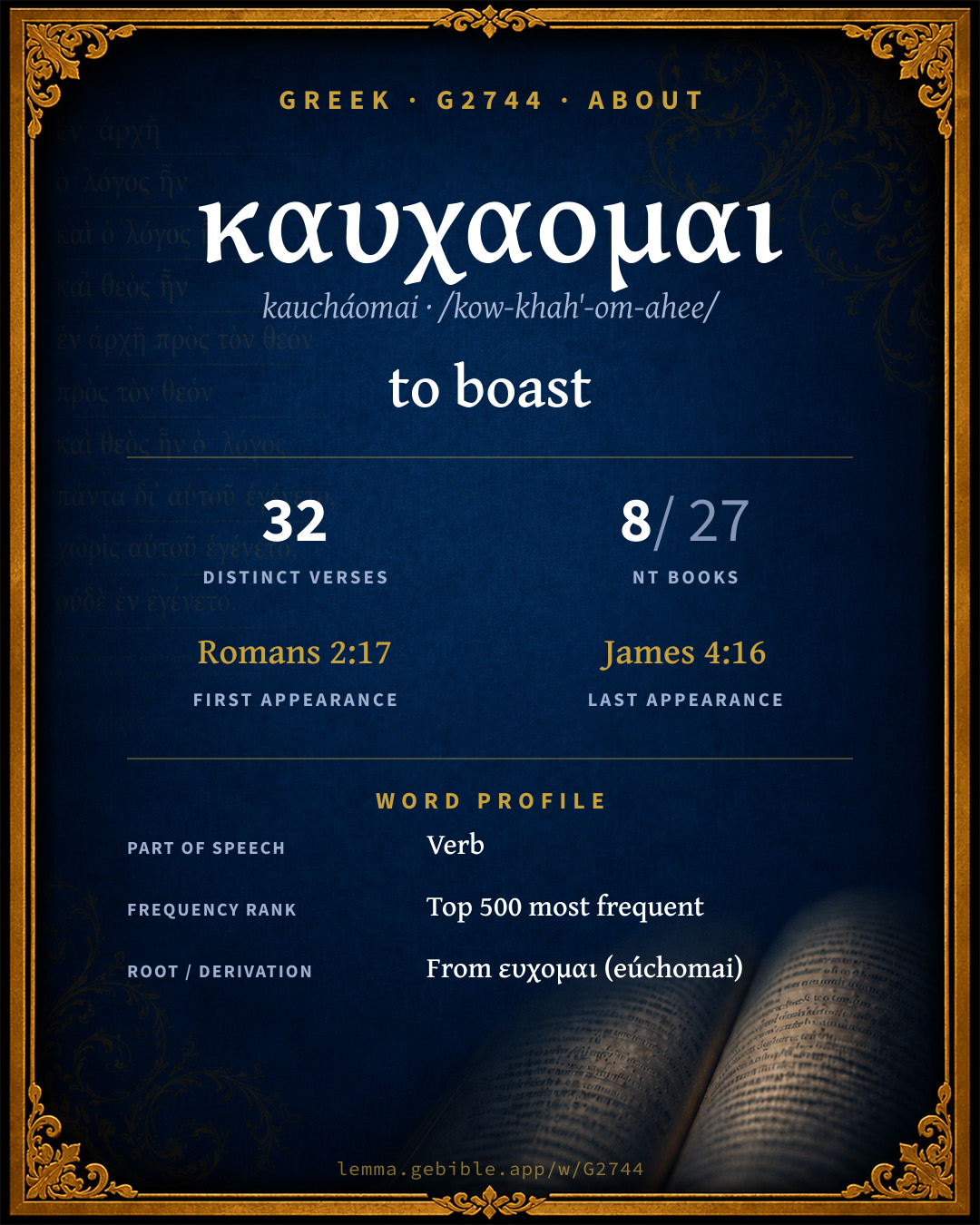
καυχάομαι
to boast
‘to boast’ is one of 3 main senses fuller range ↓
Full lexicon entry — Thayer's Greek Lexicon
From Thayer's Greek Lexicon
Where this word appears
See every Present-tense verb in the Greek New Testament →
Grammar key — what these labels mean
Part of speech
- Verb
- An action or state-of-being word.
Tense
- Future
- Action expected in future time.
- Present
- Ongoing or general action in present time (imperfective aspect).
- Aorist
- Action viewed as a simple whole, without regard to duration — often past (perfective aspect).
- Perfect
- A completed past action with continuing present results.
Voice
- Middle deponent
- Middle in form but active in meaning.
- Middle or Passive deponent
- Middle/passive in form but active in meaning.
Mood
- Indicative
- States a fact or asks a factual question (the mood of reality).
- Imperative
- Expresses a command or request.
- Infinitive
- A verbal noun (“to write”), unmarked for person or number.
- Participle
- A verbal adjective (“writing,” “having written”).
- Subjunctive
- Expresses probability, purpose, or possibility (the mood of contingency).
Case
- Nominative
- The case of the subject (and the predicate nominative).
- Accusative
- The case of the direct object and of extent.
Person
- 1st person
- The speaker (“I / we”).
- 3rd person
- The one spoken about (“he / she / it / they”).
- 2nd person
- The one addressed (“you”).
Gender
- Masculine
- Grammatically masculine.
Number
- Singular
- One.
- Plural
- More than one.
Grammatical forms 17 distinct
- Verb, Future, Middle deponent, Indicative, 1st person, Singular 6 times (16%)
- Verb, Present, Middle or Passive deponent, Imperative, 3rd person, Singular 4 times (11%)
- Verb, Present, Middle or Passive deponent, Infinitive 4 times (11%)
- Verb, Present, Middle or Passive deponent, Indicative, 2nd person, Singular 3 times (8%)
- Verb, Present, Middle or Passive deponent, Participle, Nominative, Plural, Masculine 3 times (8%)
- Verb, Aorist, Middle deponent, Infinitive 2 times (5%)
- Verb, Aorist, Middle deponent, Subjunctive, 3rd person, Singular 2 times (5%)
- Verb, Present, Middle or Passive deponent, Indicative, 1st person, Plural 2 times (5%)
+9 more forms (11 occurrences)
Parsed forms decoded from the imported morphology (Robinson–Tischendorf, public domain), counted across 37 parsed occurrences — not distinct verses.
Every verse where G2744 appears — 32 distinct verses across 8 books. Click any verse to open its interlinear word-by-word view. Verse text shown in the World English Bible for context — . Each verse’s Greek form is shown with its reference; the English is not keyword-highlighted, since the data carries no word-level English alignment. Use “Compare translations” on any verse to read it across multiple English versions. This concordance covers the Greek New Testament; Septuagint (Greek Old Testament) occurrences of this word are not indexed here.
Romans 5 verses
- Romans 2:17 καυχᾶσαι pres mid/pass.dep ind 2sg Indeed you bear the name of a Jew, and rest on the law, and glory in God,
- Romans 2:23 καυχᾶσαι pres mid/pass.dep ind 2sg You who glory in the law, through your disobedience of the law do you dishonor God?
- Romans 5:2 καυχώμεθα pres mid/pass.dep ind 1pl through whom we also have our access by faith into this grace in which we stand. We rejoice in hope of the glory of God.
- Romans 5:3 καυχώμεθα pres mid/pass.dep ind 1pl Not only this, but we also rejoice in our sufferings, knowing that suffering works perseverance;
- Romans 5:11 καυχώμενοι pres mid/pass.dep ptcp nom pl masc Not only so, but we also rejoice in God through our Lord Jesus Christ, through whom we have now received the reconciliation.
1 Corinthians 4 verses
- 1 Corinthians 1:29 καυχήσηται aor mid.dep subj 3sg that no flesh should boast before God.
- 1 Corinthians 1:31 καυχώμενος καυχάσθω pres mid/pass.dep ptcp nom sg masc pres mid/pass.dep impv 3sg that, according as it is written, "He who boasts, let him boast in the Lord."
- 1 Corinthians 3:21 καυχάσθω pres mid/pass.dep impv 3sg Therefore let no one boast in men. For all things are yours,
- 1 Corinthians 4:7 καυχᾶσαι pres mid/pass.dep ind 2sg For who makes you different? And what do you have that you didn't receive? But if you did receive it, why do you boast as if you had not received it?
2 Corinthians 16 verses
- 2 Corinthians 5:12 καυχωμένους pres mid/pass.dep ptcp acc pl masc For we are not commending ourselves to you again, but speak as giving you occasion of boasting on our behalf, that you may have something to answer those who boast in appearance, and not in heart.
- 2 Corinthians 7:14 κεκαύχημαι perf mid/pass.dep ind 1sg For if in anything I have boasted to him on your behalf, I was not disappointed. But as we spoke all things to you in truth, so our glorying also which I made before Titus was found to be truth.
- 2 Corinthians 9:2 καυχῶμαι pres mid/pass.dep ind 1sg for I know your readiness, of which I boast on your behalf to them of Macedonia, that Achaia has been prepared for a year past. Your zeal has stirred up very many of them.
- 2 Corinthians 10:8 καυχήσομαι fut mid.dep ind 1sg For though I should boast somewhat abundantly concerning our authority, (which the Lord gave for building you up, and not for casting you down) I will not be disappointed,
- 2 Corinthians 10:13 καυχησόμεθα fut mid.dep ind 1pl But we will not boast beyond proper limits, but within the boundaries with which God appointed to us, which reach even to you.
- 2 Corinthians 10:15 καυχώμενοι pres mid/pass.dep ptcp nom pl masc not boasting beyond proper limits in other men's labors, but having hope that as your faith grows, we will be abundantly enlarged by you in our sphere of influence,
- 2 Corinthians 10:16 καυχήσασθαι aor mid.dep inf so as to preach the Gospel even to the parts beyond you, not to boast in what someone else has already done.
- 2 Corinthians 10:17 καυχώμενος καυχάσθω pres mid/pass.dep ptcp nom sg masc pres mid/pass.dep impv 3sg But "he who boasts, let him boast in the Lord."
- 2 Corinthians 11:12 καυχῶνται pres mid/pass.dep ind 3pl But what I do, that I will do, that I may cut off occasion from them that desire an occasion, that in which they boast, they may be found even as we.
- 2 Corinthians 11:16 καυχήσωμαι aor mid.dep subj 1sg I say again, let no one think me foolish. But if so, yet receive me as foolish, that I also may boast a little.
- 2 Corinthians 11:18 καυχῶνται καυχήσομαι pres mid/pass.dep ind 3pl fut mid.dep ind 1sg Seeing that many boast after the flesh, I will also boast.
- 2 Corinthians 11:30 καυχᾶσθαι καυχήσομαι pres mid/pass.dep inf fut mid.dep ind 1sg If I must boast, I will boast of the things that concern my weakness.
- 2 Corinthians 12:1 Καυχᾶσθαι pres mid/pass.dep inf It is doubtless not profitable for me to boast. For I will come to visions and revelations of the Lord.
- 2 Corinthians 12:5 καυχήσομαι καυχήσομαι fut mid.dep ind 1sg fut mid.dep ind 1sg On behalf of such a one I will boast, but on my own behalf I will not boast, except in my weaknesses.
- 2 Corinthians 12:6 καυχήσασθαι aor mid.dep inf For if I would desire to boast, I will not be foolish; for I will speak the truth. But I forbear, so that no man may account of me above that which he sees in me, or hears from me.
- 2 Corinthians 12:9 καυχήσομαι fut mid.dep ind 1sg He has said to me, "My grace is sufficient for you, for my power is made perfect in weakness." Most gladly therefore I will rather glory in my weaknesses, that the power of Christ may rest on me.
Galatians 2 verses
- Galatians 6:13 καυχήσωνται aor mid.dep subj 3pl For even they who receive circumcision don't keep the law themselves, but they desire to have you circumcised, that they may boast in your flesh.
- Galatians 6:14 καυχᾶσθαι pres mid/pass.dep inf But far be it from me to boast, except in the cross of our Lord Jesus Christ, through which the world has been crucified to me, and I to the world.
Ephesians 1 verse
Philippians 1 verse
2 Thessalonians 1 verse
James 2 verses
About this entry
At a glance — auto-summarized from this page’s data, not written by a person. Every figure links to its source below. This summary describes the numbers; it doesn’t interpret them.
At its core, καυχαομαι (kaucháomai) means “to boast.” Its uses cluster heavily in 2 Corinthians (50% of all occurrences). Spanning 32 verses in 8 books, it ranks among the moderately common words of the Greek New Testament. Catalogued under 3 senses, its meaning is not single-sense. The King James Version usually renders it “glory,” while modern versions prefer “boast” (Berean Standard Bible) — see the renderings breakdown. Dig into 32-verse concordance and the renderings breakdown below.
Gloss history
Strong's 1890 vs modern scholarship
About this word
Strong's G2744 catalogs a Greek word from the Greek New Testament.
These counts are not copied from any lexicon or concordance. They are computed here, from the morphology-tagged Greek New Testament. What Lemma adds →
- 32
- distinct verses
- The word appears in 32 distinct verses.
- 8 / 27
- NT books
- The word appears in 8 of 27 New Testament books.
- #397
- by frequency
- Top 500 most frequent Greek words (rank 397 of 5,347 Greek words by occurrence).
View all 32 occurrences in the concordance →
Most concentrated in
- 2 Corinthians 16 verses 50%
- Romans 5 verses 16%
- 1 Corinthians 4 verses 13%
By section of the New Testament
By traditional corpus
Conventional, traditional groupings — biblical authorship is debated, so this is a traditional corpus grouping, not an authorship claim. Some books belong to more than one corpus (Luke is in both the Gospels and the Lukan corpus, and so on), so these shares overlap and need not total 100%. Each figure is a share of the word’s 32 distinct verses.
- Pauline corpus 30 verses · 94%
- General (Catholic) Epistles 2 verses · 6%
How translations render this word
Counts come from each version’s own published word-to-Strong’s tagging or interlinear alignment — an approximate guide to how each version renders this word, not a word-level alignment the data otherwise carries. Because each total is that version’s own tagged count, the per-version totals vary from one another and need not match the appearance or distinct-verse counts above. These counts may also differ from a printed concordance because Lemma counts each distinctly tagged rendering and does not collapse phrase taggings into a single head-word total. This is a fixed set of word-tagged versions (KJV, ASV, BSB, ULT) and does not change with the reading translation you choose elsewhere. Each version’s license is shown beside its name below (and on Sources).
- King James Version: Glory 8×, Rejoice 3×, Boast 2×
- American Standard Version: Glory 12×, Gloriest 2×, Glorieth 2×
- Berean Standard Bible: Boast 8×, I will boast 3×, Boasts 2×
- unfoldingWord Literal Text: Boast 16×, Boasting 5×, Let 4×
King James Version Public Domain
Renders G2744 across 43 tagged occurrences — most commonly:
Plus 18 renderings that appear only once — usually multi-word phrases or single function words the recovered tagging swept in, not distinct renderings.
American Standard Version Public Domain
Renders G2744 across 38 tagged occurrences — most commonly:
Plus 16 renderings that appear only once — usually multi-word phrases or single function words the recovered tagging swept in, not distinct renderings. Not rendered by a distinct English word in 1 further occurrence.
Berean Standard Bible Public Domain
Renders G2744 across 38 tagged occurrences — most commonly:
Plus 21 renderings that appear only once — usually multi-word phrases or single function words the recovered tagging swept in, not distinct renderings.
unfoldingWord Literal Text CC BY-SA 4.0
Renders G2744 across 48 tagged occurrences — most commonly:
Plus 13 renderings that appear only once — usually multi-word phrases or single function words the recovered tagging swept in, not distinct renderings.
Senses in Thayer's
The 3 senses Thayer's distinguishes for this word, in lexicon order (not ranked by frequency or importance). The full entry — with sub-senses — is in the Lexicon Entry tab.
- to glory (whether with reason or without)
- to glory on account of a thing
- to glory in a thing
Word origin
Derived from ευχομαι (eúchomai) (G2172) — to pray.
From some (obsolete) base akin to that of αὐχέω aucheō (to boast ) and G2172 ; to vaunt (in a good or a bad sense): - (make) boast glory joy rejoice.
— Strong’s Exhaustive Concordance (1890), public domain.
Forms in the corpus
The 20 distinct written forms G2744 takes in the Greek New Testament, most frequent first — each parse links to that tense’s occurrences in the concordance.
Same root — word family
Other Thayer's entries built from the same root as G2744, grouped by Strong’s listed origin. These share a root / origin per the lexicon — not necessarily a shared meaning. Each links to that word’s own entry.
Derives from
Shares the same root
Derived from this word
Compare all same-root words → Showing 4 of 5 — not the complete family. They share a root, not necessarily a meaning.
Septuagint usage
The same Greek word καυχαομαι appears 24 times in the Greek Old Testament (Septuagint), across 17 verses in 8 books.
- 24
- LXX occurrences
- Tagged occurrences of this Greek word in the Septuagint.
- 17
- verses
- Distinct Septuagint verses containing this word.
- 8 / 39
- OT books
- The word appears in 8 of the 39 Old Testament books.
Sample Septuagint occurrences
- Judges 7:2 καυχάομαι
- 1 Samuel 2:3 καυχάομαι
- 1 Kings 21:11 καυχάομαι
- 1 Chronicles 16:35 καυχάομαι
- Psalms 5:12 καυχάομαι
- Proverbs 20:9 καυχάομαι
- Jeremiah 9:22 καυχάομαι
- Daniel 4:29 καυχάομαι
Septuagint occurrences (same lexeme)
Every verse where the same Strong’s number (G2744) appears in the Greek Septuagint. Verse text shown in the World English Bible for context; the Greek form is the matched word — the English is not keyword-highlighted.
- Judges 7:2 καυχάομαι Yahweh said to Gideon, The people who are with you are too many for me to give the Midianites into their hand, lest Israel vaunt themselves against me, saying, My own hand has saved me.
- 1 Samuel 2:3 καυχάομαι Talk no more so exceeding proudly; Don't let arrogance come out of your mouth; For Yahweh is a God of knowledge, By him actions are weighed.
- 1 Samuel 2:10 καυχάομαι Those who strive with Yahweh shall be broken to pieces; Against them will he thunder in the sky: Yahweh will judge the ends of the earth; He will give strength to his king, Exalt the horn of his anointed.
- 1 Kings 21:11 καυχάομαι The men of his city, even the elders and the nobles who lived in his city, did as Jezebel had sent to them, according as it was written in the letters which she had sent to them.
- 1 Chronicles 16:35 καυχάομαι Say you, Save us, God of our salvation, Gather us together and deliver us from the nations, To give thanks to your holy name, To triumph in your praise.
- Psalms 5:12 καυχάομαι For you will bless the righteous. Yahweh, you will surround him with favor as with a shield.
- Psalms 31:11 καυχάομαι Because of all my adversaries I have become utterly contemptible to my neighbors, A fear to my acquaintances. Those who saw me on the street fled from me.
- Psalms 48:7 καυχάομαι With the east wind, you break the ships of Tarshish.
- Psalms 93:3 καυχάομαι The floods have lifted up, Yahweh, The floods have lifted up their voice. The floods lift up their waves.
- Psalms 149:5 καυχάομαι Let the saints rejoice in honor. Let them sing for joy on their beds.
- Proverbs 20:9 καυχάομαι Who can say, "I have made my heart pure. I am clean and without sin?"
- Proverbs 25:14 καυχάομαι As clouds and wind without rain, So is he who boasts of gifts deceptively.
- Proverbs 27:1 καυχάομαι Don't boast about tomorrow; For you don't know what a day may bring forth.
- Jeremiah 9:22 καυχάομαι Speak, Thus says Yahweh, The dead bodies of men shall fall as dung on the open field, and as the handful after the harvester; and none shall gather [them].
- Jeremiah 9:23 καυχάομαι Thus says Yahweh, Don't let the wise man glory in his wisdom, neither let the mighty man glory in his might, don't let the rich man glory in his riches;
- Daniel 4:29 καυχάομαι At the end of twelve months he was walking in the royal palace of Babylon.
- Daniel 5:6 καυχάομαι Then the king's face was changed in him, and his thoughts troubled him; and the joints of his loins were loosened, and his knees struck one against another.
These are occurrences of the same Greek lexeme (G2744) in the Septuagint — not a translation of any one Hebrew word. The store carries no word-level Hebrew↔Greek alignment, so no Hebrew original is asserted here. Counts come from the recovered LXX Strong's tagging — high-frequency vocabulary is well covered, while rare or late forms may be untagged — so they reflect tagged occurrences and may slightly undercount.