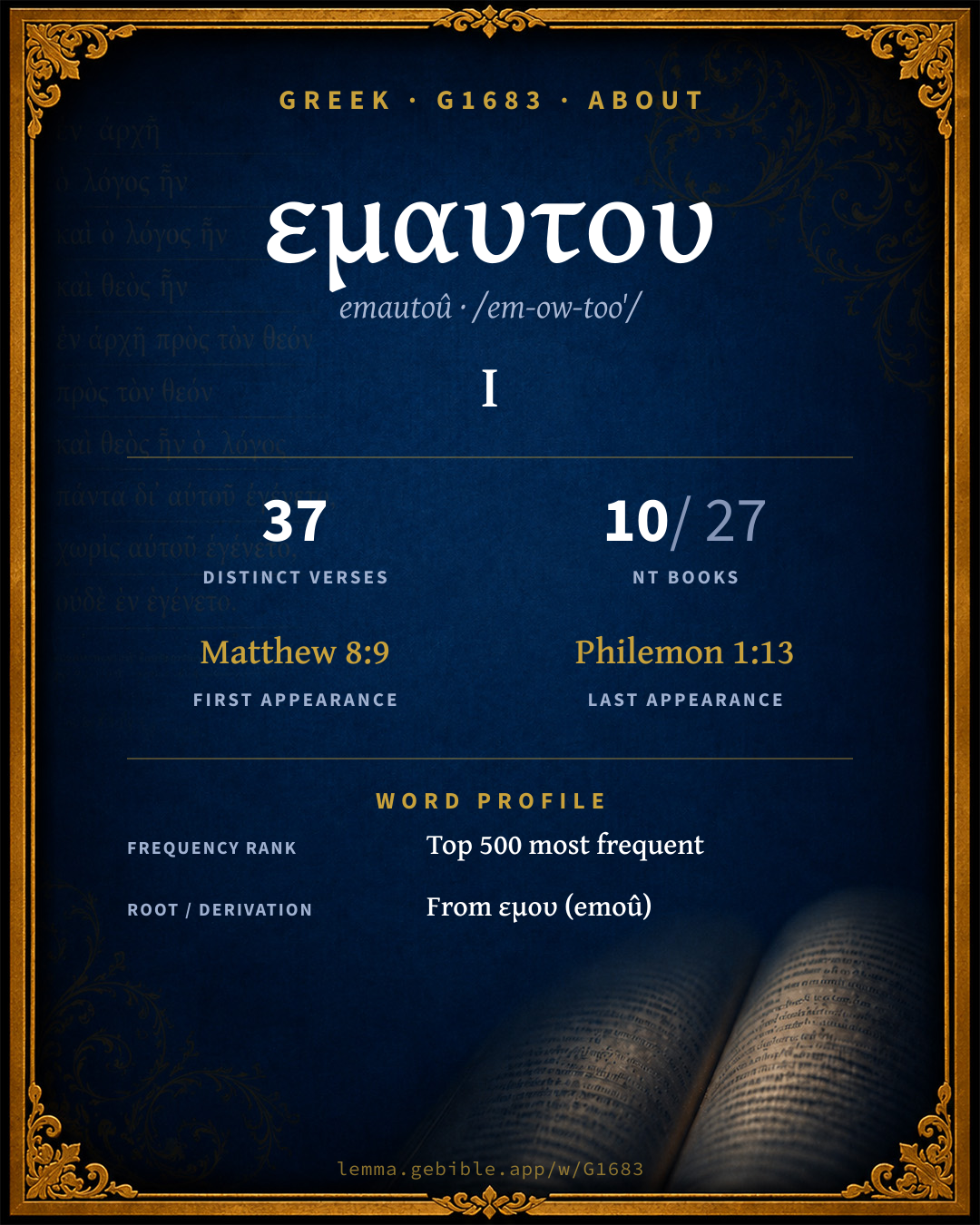
εμαυτου
I
Full lexicon entry — Thayer's Greek Lexicon
From Thayer's Greek Lexicon
Where this word appears
See every Accusative-case word in the Greek New Testament →
Grammar key — what these labels mean
Part of speech
- Reflexive pronoun
- Refers the action back to the subject (“himself”).
Case
- Accusative
- The case of the direct object and of extent.
- Genitive
- The case of source, possession, or “of” — answers “whose / from what.”
- Dative
- The case of the indirect object, means, or location — “to / for / with / in.”
Person
- 1st person
- The speaker (“I / we”).
Gender
- Masculine
- Grammatically masculine.
Number
- Singular
- One.
Grammatical forms
- Reflexive pronoun, 1st person, Accusative, Singular, Masculine 18 times (49%)
- Reflexive pronoun, 1st person, Genitive, Singular, Masculine 14 times (38%)
- Reflexive pronoun, 1st person, Dative, Singular, Masculine 5 times (14%)
Parsed forms decoded from the imported morphology (Robinson–Tischendorf, public domain), counted across 37 parsed occurrences — not distinct verses.
Every verse where G1683 appears — 37 distinct verses across 10 books. Click any verse to open its interlinear word-by-word view. Verse text shown in the World English Bible for context — . Each verse’s Greek form is shown with its reference; the English is not keyword-highlighted, since the data carries no word-level English alignment. Use “Compare translations” on any verse to read it across multiple English versions. This concordance covers the Greek New Testament; Septuagint (Greek Old Testament) occurrences of this word are not indexed here.
Matthew 1 verse
Luke 2 verses
- Luke 7:7 ἐμαυτὸν refl.pron 1 acc sg masc Therefore I didn't even think myself worthy to come to you; but say the word, and my servant will be healed.
- Luke 7:8 ἐμαυτὸν refl.pron 1 acc sg masc For I also am a man placed under authority, having under myself soldiers. I tell this one, 'Go!' and he goes; and to another, 'Come!' and he comes; and to my servant, 'Do this,' and he does it."
John 16 verses
- John 5:30 ἐμαυτοῦ refl.pron 1 gen sg masc I can of myself do nothing. As I hear, I judge, and my judgment is righteous; because I don't seek my own will, but the will of my Father who sent me.
- John 5:31 ἐμαυτοῦ refl.pron 1 gen sg masc "If I testify about myself, my witness is not valid.
- John 7:17 ἐμαυτοῦ refl.pron 1 gen sg masc If anyone desires to do his will, he will know about the teaching, whether it is from God, or if I am speaking from myself.
- John 7:28 ἐμαυτοῦ refl.pron 1 gen sg masc Jesus therefore cried out in the temple, teaching and saying, "You both know me, and know where I am from. I have not come of myself, but he who sent me is true, whom you don't know.
- John 8:14 ἐμαυτοῦ refl.pron 1 gen sg masc Jesus answered them, "Even if I testify about myself, my testimony is true, for I know where I came from, and where I am going; but you don't know where I came from, or where I am going.
- John 8:18 ἐμαυτοῦ refl.pron 1 gen sg masc I am one who testifies about myself, and the Father who sent me testifies about me."
- John 8:28 ἐμαυτοῦ refl.pron 1 gen sg masc Jesus therefore said to them, "When you have lifted up the Son of Man, then you will know that I am he, and I do nothing of myself, but as my Father taught me, I say these things.
- John 8:42 ἐμαυτοῦ refl.pron 1 gen sg masc Therefore Jesus said to them, "If God were your Father, you would love me, for I came out and have come from God. For I haven't come of myself, but he sent me.
- John 8:54 ἐμαυτόν refl.pron 1 acc sg masc Jesus answered, "If I glorify myself, my glory is nothing. It is my Father who glorifies me, of whom you say that he is our God.
- John 10:18 ἐμαυτοῦ refl.pron 1 gen sg masc No one takes it away from me, but I lay it down by myself. I have power to lay it down, and I have power to take it again. I received this commandment from my Father."
- John 12:32 ἐμαυτόν refl.pron 1 acc sg masc And I, if I am lifted up from the earth, will draw all people to myself."
- John 12:49 ἐμαυτοῦ refl.pron 1 gen sg masc For I spoke not from myself, but the Father who sent me, he gave me a commandment, what I should say, and what I should speak.
- John 14:3 ἐμαυτόν refl.pron 1 acc sg masc If I go and prepare a place for you, I will come again, and will receive you to myself; that where I am, you may be there also.
- John 14:10 ἐμαυτοῦ refl.pron 1 gen sg masc Don't you believe that I am in the Father, and the Father in me? The words that I tell you, I speak not from myself; but the Father who lives in me does his works.
- John 14:21 ἐμαυτόν refl.pron 1 acc sg masc One who has my commandments, and keeps them, that person is one who loves me. One who loves me will be loved by my Father, and I will love him, and will reveal myself to him."
- John 17:19 ἐμαυτόν refl.pron 1 acc sg masc For their sakes I sanctify myself, that they themselves also may be sanctified in truth.
Acts 4 verses
- Acts 20:24 ἐμαυτῷ refl.pron 1 dat sg masc But these things don't count; nor do I hold my life dear to myself, so that I may finish my race with joy, and the ministry which I received from the Lord Jesus, to fully testify to the Gospel of the grace of God.
- Acts 24:10 ἐμαυτοῦ refl.pron 1 gen sg masc When the governor had beckoned to him to speak, Paul answered, "Because I know that you have been a judge of this nation for many years, I cheerfully make my defense,
- Acts 26:2 ἐμαυτὸν refl.pron 1 acc sg masc "I think myself happy, King Agrippa, that I am to make my defense before you this day concerning all the things that I am accused by the Jews,
- Acts 26:9 ἐμαυτῷ refl.pron 1 dat sg masc "I myself most assuredly thought that I ought to do many things contrary to the name of Jesus of Nazareth.
Romans 1 verse
1 Corinthians 6 verses
- 1 Corinthians 4:3 ἐμαυτὸν refl.pron 1 acc sg masc But with me it is a very small thing that I should be judged by you, or by man's judgment. Yes, I don't judge my own self.
- 1 Corinthians 4:4 ἐμαυτῷ refl.pron 1 dat sg masc For I know nothing against myself. Yet I am not justified by this, but he who judges me is the Lord.
- 1 Corinthians 4:6 ἐμαυτὸν refl.pron 1 acc sg masc Now these things, brothers, I have in a figure transferred to myself and Apollos for your sakes, that in us you might learn not to think beyond the things which are written, that none of you be puffed up against one another.
- 1 Corinthians 7:7 ἐμαυτόν refl.pron 1 acc sg masc Yet I wish that all men were like me. However each man has his own gift from God, one of this kind, and another of that kind.
- 1 Corinthians 9:19 ἐμαυτὸν refl.pron 1 acc sg masc For though I was free from all, I brought myself under bondage to all, that I might gain the more.
- 1 Corinthians 10:33 ἐμαυτοῦ refl.pron 1 gen sg masc even as I also please all men in all things, not seeking my own profit, but the profit of the many, that they may be saved.
2 Corinthians 4 verses
- 2 Corinthians 2:1 ἐμαυτῷ refl.pron 1 dat sg masc But I determined this for myself, that I would not come to you again in sorrow.
- 2 Corinthians 11:7 ἐμαυτὸν refl.pron 1 acc sg masc Or did I commit a sin in humbling myself that you might be exalted, because I preached to you God's Gospel free of charge?
- 2 Corinthians 11:9 ἐμαυτὸν refl.pron 1 acc sg masc When I was present with you and was in need, I wasn't a burden on anyone, for the brothers, when they came from Macedonia, supplied the measure of my need. In everything I kept myself from being burdensome to you, and I will continue to do so.
- 2 Corinthians 12:5 ἐμαυτοῦ refl.pron 1 gen sg masc On behalf of such a one I will boast, but on my own behalf I will not boast, except in my weaknesses.
Galatians 1 verse
Philippians 1 verse
Philemon 1 verse
About this entry
At a glance — auto-summarized from this page’s data, not written by a person. Every figure links to its source below. This summary describes the numbers; it doesn’t interpret them.
“I” is the headline sense of the Greek name εμαυτου (emautoû). It first appears in Matthew 8:9. The Greek New Testament uses it across 37 verses — moderately common. More than a third of its appearances fall in John. For the data behind this summary, explore 37-verse concordance and the renderings breakdown below.
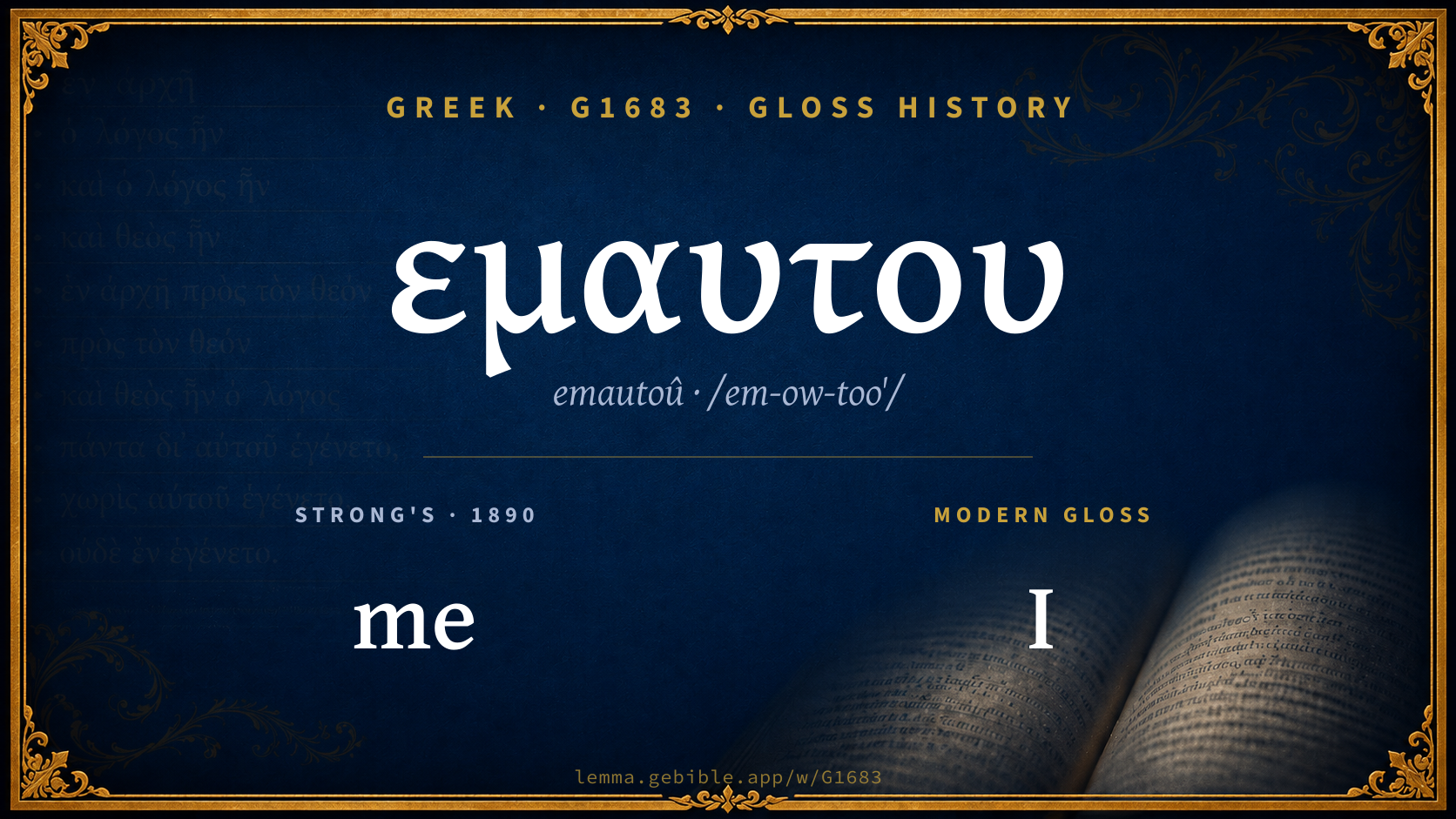
Gloss history
Strong's 1890 vs modern scholarship
About this word
Strong's G1683 catalogs a Greek word from the Greek New Testament.
These counts are not copied from any lexicon or concordance. They are computed here, from the morphology-tagged Greek New Testament. What Lemma adds →
- 37
- distinct verses
- The word appears in 37 distinct verses.
- 10 / 27
- NT books
- The word appears in 10 of 27 New Testament books.
- #397
- by frequency
- Top 500 most frequent Greek words (rank 397 of 5,347 Greek words by occurrence).
View all 37 occurrences in the concordance →
Most concentrated in
- John 16 verses 43%
- 1 Corinthians 6 verses 16%
- Acts 4 verses 11%
By section of the New Testament
By traditional corpus
Conventional, traditional groupings — biblical authorship is debated, so this is a traditional corpus grouping, not an authorship claim. Some books belong to more than one corpus (Luke is in both the Gospels and the Lukan corpus, and so on), so these shares overlap and need not total 100%. Each figure is a share of the word’s 37 distinct verses.
- Gospels 19 verses · 51%
- Johannine 16 verses · 43%
- Pauline corpus 14 verses · 38%
- Lukan (Luke–Acts) 6 verses · 16%
How translations render this word
Counts come from each version’s own published word-to-Strong’s tagging or interlinear alignment — an approximate guide to how each version renders this word, not a word-level alignment the data otherwise carries. Because each total is that version’s own tagged count, the per-version totals vary from one another and need not match the appearance or distinct-verse counts above. These counts may also differ from a printed concordance because Lemma counts each distinctly tagged rendering and does not collapse phrase taggings into a single head-word total. This is a fixed set of word-tagged versions (KJV, ASV, BSB, ULT) and does not change with the reading translation you choose elsewhere. Each version’s license is shown beside its name below (and on Sources).
- King James Version: Myself 29×, Me 4×, Own self 2×
- American Standard Version: Myself 28×
- Berean Standard Bible: Myself 16×, Own 5×, Me 4×
- unfoldingWord Literal Text: Myself 31×, Me 4×
King James Version Public Domain
Renders G1683 across 37 tagged occurrences — most commonly:
Plus 2 renderings that appear only once — usually multi-word phrases or single function words the recovered tagging swept in, not distinct renderings.
American Standard Version Public Domain
Renders G1683 across 36 tagged occurrences — most commonly:
Plus 8 renderings that appear only once — usually multi-word phrases or single function words the recovered tagging swept in, not distinct renderings.
Berean Standard Bible Public Domain
Renders G1683 across 30 tagged occurrences — most commonly:
Plus 3 renderings that appear only once — usually multi-word phrases or single function words the recovered tagging swept in, not distinct renderings. Not rendered by a distinct English word in 7 further occurrences.
unfoldingWord Literal Text CC BY-SA 4.0
Renders G1683 across 37 tagged occurrences — most commonly:
Plus 2 renderings that appear only once — usually multi-word phrases or single function words the recovered tagging swept in, not distinct renderings.
Senses in Thayer's
The 1 sense Thayer's distinguishes for this word, in lexicon order (not ranked by frequency or importance). The full entry — with sub-senses — is in the Lexicon Entry tab.
- I, me, myself etc.
Word origin
Derived from εμου (emoû) (G1700) — me.
Forms in the corpus
The 4 distinct written forms G1683 takes in the Greek New Testament, most frequent first — each parse links to that case’s occurrences in the concordance.
| Form | Parsing | Example | Uses |
|---|---|---|---|
| ἐμαυτοῦ emautoû | Reflexive pronoun, 1st person, Genitive, Singular, Masculine | John 5:30 | 14 |
| ἐμαυτὸν emautòn | Reflexive pronoun, 1st person, Accusative, Singular, Masculine | Matthew 8:9 | 12 |
| ἐμαυτόν emautón | Reflexive pronoun, 1st person, Accusative, Singular, Masculine | John 8:54 | 6 |
| ἐμαυτῷ emautō̂ | Reflexive pronoun, 1st person, Dative, Singular, Masculine | Acts 20:24 | 5 |
Same root — word family
Other Thayer's entries built from the same root as G1683, grouped by Strong’s listed origin. These share a root / origin per the lexicon — not necessarily a shared meaning. Each links to that word’s own entry.
Derives from
Proper names from this root
People and places named from this root — a name, not an additional meaning of the word.
Compare all same-root words → 1 of the same-root words is a proper name (a person or place). They share a root, not necessarily a meaning.
Septuagint usage
The same Greek word εμαυτου appears 44 times in the Greek Old Testament (Septuagint), across 42 verses in 18 books.
- 44
- LXX occurrences
- Tagged occurrences of this Greek word in the Septuagint.
- 42
- verses
- Distinct Septuagint verses containing this word.
- 18 / 39
- OT books
- The word appears in 18 of the 39 Old Testament books.
Sample Septuagint occurrences
- Genesis 12:19 ἐμαυτοῦ
- Exodus 6:7 ἐμαυτοῦ
- Numbers 24:13 ἐμαυτοῦ
- Deuteronomy 17:14 ἐμαυτοῦ
- Ruth 4:6 ἐμαυτοῦ
- 1 Samuel 2:35 ἐμαυτοῦ
- 2 Samuel 17:1 ἐμαυτοῦ
- 1 Kings 11:36 ἐμαυτοῦ
- 1 Chronicles 13:12 ἐμαυτοῦ
- 2 Chronicles 7:12 ἐμαυτοῦ
- Job 7:13 ἐμαυτοῦ
- Psalms 41:7 ἐμαυτοῦ
Septuagint occurrences (same lexeme)
Every verse where the same Strong’s number (G1683) appears in the Greek Septuagint. Verse text shown in the World English Bible for context; the Greek form is the matched word — the English is not keyword-highlighted.
- Genesis 12:19 ἐμαυτοῦ Why did you say, 'She is my sister,' so that I took her to be my wife? Now therefore, see your wife, take her, and go your way."
- Genesis 22:16 ἐμαυτοῦ and said, "I have sworn by myself, says Yahweh, because you have done this thing, and have not withheld your son, your only son,
- Genesis 27:12 ἐμαυτοῦ What if my father touches me? I will seem to him as a deceiver, and I would bring a curse on myself, and not a blessing."
- Genesis 30:30 ἐμαυτοῦ For it was little which you had before I came, and it has increased to a multitude. Yahweh has blessed you wherever I turned. Now when will I provide for my own house also?"
- Genesis 31:39 ἐμαυτοῦ That which was torn of animals, I didn't bring to you. I bore the loss of it. Of my hand you required it, whether stolen by day or stolen by night.
- Genesis 50:5 ἐμαυτοῦ 'My father made me swear, saying, "Behold, I am dying. Bury me in my grave which I have dug for myself in the land of Canaan." Now therefore, please let me go up and bury my father, and I will come again.'"
- Exodus 6:7 ἐμαυτοῦ and I will take you to me for a people, and I will be to you a God; and you shall know that I am Yahweh your God, who brings you out from under the burdens of the Egyptians.
- Exodus 19:4 ἐμαυτοῦ 'You have seen what I did to the Egyptians, and how I bore you on eagles' wings, and brought you to myself.
- Numbers 24:13 ἐμαυτοῦ If Balak would give me his house full of silver and gold, I can't go beyond the word of Yahweh, to do either good or bad of my own mind; what Yahweh speaks, that will I speak?
- Deuteronomy 17:14 ἐμαυτοῦ When you are come to the land which Yahweh your God gives you, and shall possess it, and shall dwell therein, and shall say, I will set a king over me, like all the nations that are round about me;
- Ruth 4:6 ἐμαυτοῦ The near kinsman said, I can't redeem it for myself, lest I mar my own inheritance: take my right of redemption on you; for I can't redeem it.
- Ruth 4:10 ἐμαυτοῦ Moreover Ruth the Moabitess, the wife of Mahlon, have I purchased to be my wife, to raise up the name of the dead on his inheritance, that the name of the dead not be cut off from among his brothers, and from the gate of his place: you are witnesses this day.
- 1 Samuel 2:35 ἐμαυτοῦ I will raise me up a faithful priest, that shall do according to that which is in my heart and in my mind: and I will build him a sure house; and he shall walk before my anointed forever.
- 2 Samuel 17:1 ἐμαυτοῦ Moreover Ahithophel said to Absalom, Let me now choose out twelve thousand men, and I will arise and pursue after David this night:
- 1 Kings 11:36 ἐμαυτοῦ To his son will I give one tribe, that David my servant may have a lamp always before me in Jerusalem, the city which I have chosen me to put my name there.
- 1 Kings 17:12 ἐμαυτοῦ She said, As Yahweh your God lives, I don't have a cake, but a handful of meal in the jar, and a little oil in the jar: and, behold, I am gathering two sticks, that I may go in and bake it for me and my son, that we may eat it, and die.
- 1 Chronicles 13:12 ἐμαυτοῦ David was afraid of God that day, saying, How shall I bring the ark of God home to me?
- 2 Chronicles 7:12 ἐμαυτοῦ Yahweh appeared to Solomon by night, and said to him, I have heard your prayer, and have chosen this place to myself for a house of sacrifice.
- Job 7:13 ἐμαυτοῦ When I say, 'My bed shall comfort me, My couch shall ease my complaint;'
- Job 19:27 ἐμαυτοῦ Whom I, even I, shall see on my side. My eyes shall see, and not as a stranger. "My heart is consumed within me.
- Job 23:4 ἐμαυτοῦ I would set my cause in order before him, And fill my mouth with arguments.
- Job 27:6 ἐμαυτοῦ I hold fast to my righteousness, and will not let it go. My heart shall not reproach me so long as I live.
- Job 30:24 ἐμαυτοῦ "However doesn't one stretch out a hand in his fall? Or in his calamity therefore cry for help?
- Job 32:6 ἐμαυτοῦ Elihu the son of Barachel the Buzite answered, "I am young, and you are very old; Therefore I held back, and didn't dare show you my opinion.
- Job 34:32 ἐμαυτοῦ Teach me that which I don't see. If I have done iniquity, I will do it no more'?
- Job 42:6 ἐμαυτοῦ Therefore I abhor myself, And repent in dust and ashes."
- Psalms 41:7 ἐμαυτοῦ All who hate me whisper together against me. They imagine the worst for me.
- Song of Solomon 4:6 ἐμαυτοῦ Until the day is cool, and the shadows flee away, I will go to the mountain of myrrh, To the hill of frankincense.
- Isaiah 21:2 ἐμαυτοῦ A grievous vision is declared to me; the treacherous man deals treacherously, and the destroyer destroys. Go up, Elam; besiege, Media; all the sighing of it have I made to cease.
- Isaiah 45:23 ἐμαυτοῦ By myself have I sworn, the word is gone forth from my mouth [in] righteousness, and shall not return, that to me every knee shall bow, every tongue shall swear.
- Jeremiah 13:11 ἐμαυτοῦ For as the belt cleaves to the loins of a man, so have I caused to cleave to me the whole house of Israel and the whole house of Judah, says Yahweh; that they may be to me for a people, and for a name, and for a praise, and for a glory: but they would not hear.
- Jeremiah 22:5 ἐμαυτοῦ But if you will not hear these words, I swear by myself, says Yahweh, that this house shall become a desolation.
- Jeremiah 30:7 ἐμαυτοῦ Alas! for that day is great, so that none is like it: it is even the time of Jacob's trouble; but he shall be saved out of it.
- Ezekiel 12:7 ἐμαυτοῦ I did so as I was commanded: I brought forth my stuff by day, as stuff for removing, and in the even I dug through the wall with my hand; I brought it forth in the dark, and bore it on my shoulder in their sight.
- Ezekiel 27:3 ἐμαυτοῦ and tell Tyre, you who dwell at the entry of the sea, who are the merchant of the peoples to many isles, thus says the Lord Yahweh: You, Tyre, have said, I am perfect in beauty.
- Hosea 2:21 ἐμαυτοῦ It will happen in that day, I will respond," says Yahweh, I will respond to the heavens, And they will respond to the earth;
- Hosea 2:22 ἐμαυτοῦ And the earth will respond to the grain, and the new wine, and the oil; And they will respond to Jezreel.
- Hosea 2:25 ἐμαυτοῦ
- Hosea 3:2 ἐμαυτοῦ So I bought her for myself for fifteen pieces of silver and a homer and a half of barley.
- Hosea 12:9 ἐμαυτοῦ "But I am Yahweh your God from the land of Egypt. I will yet again make you to dwell in tents, As in the days of the solemn feast.
- Zechariah 9:13 ἐμαυτοῦ For indeed I bend Judah as a bow for me. I have filled the bow with Ephraim; And I will stir up your sons, Zion, Against your sons, Greece, And will make you like the sword of a mighty man.
- Zechariah 11:7 ἐμαυτοῦ So I fed the flock of slaughter, especially the oppressed of the flock. I took for myself two staffs. The one I called "Favor," and the other I called "Union," and I fed the flock.
These are occurrences of the same Greek lexeme (G1683) in the Septuagint — not a translation of any one Hebrew word. The store carries no word-level Hebrew↔Greek alignment, so no Hebrew original is asserted here. Counts come from the recovered LXX Strong's tagging — high-frequency vocabulary is well covered, while rare or late forms may be untagged — so they reflect tagged occurrences and may slightly undercount.