
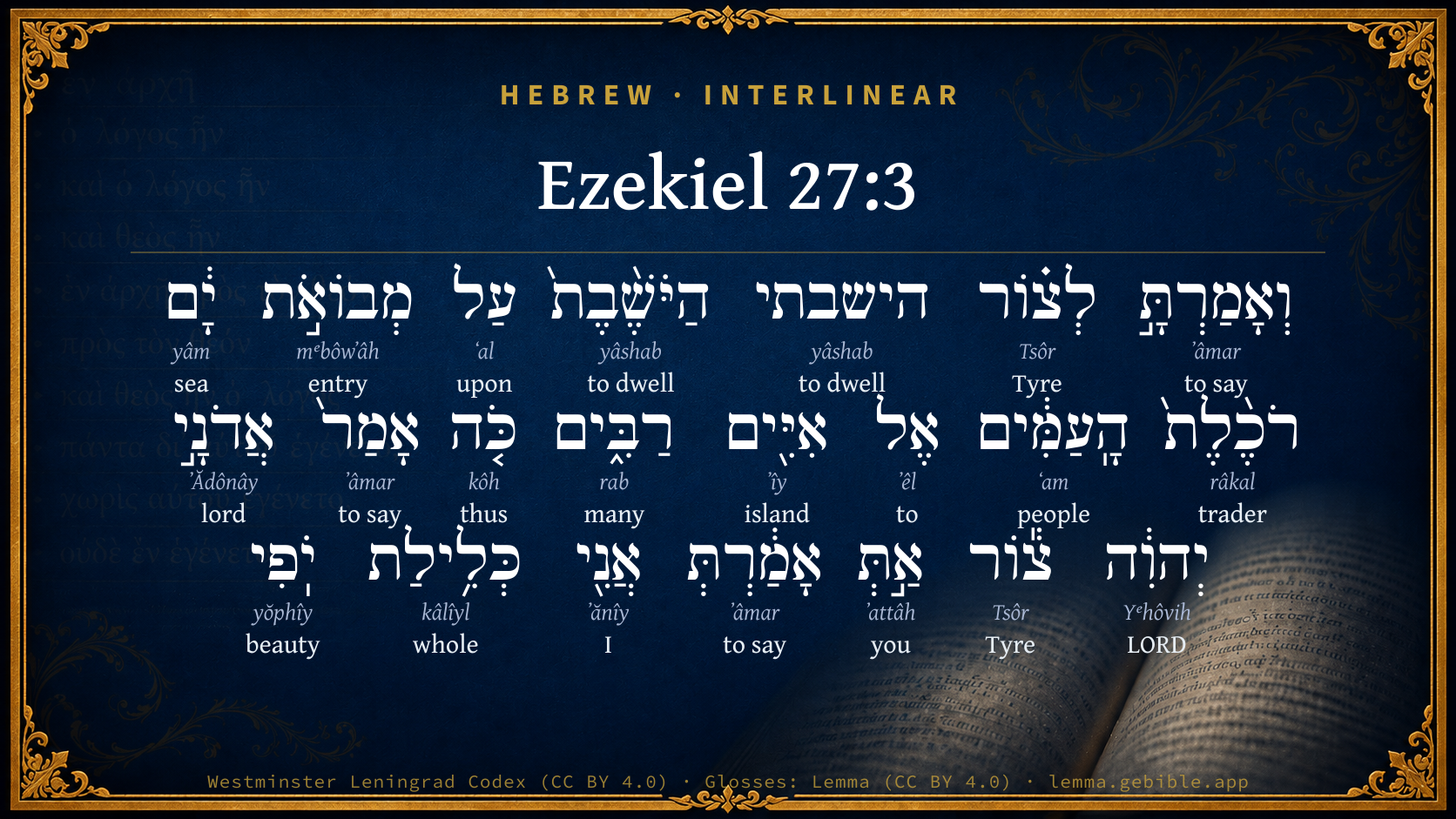
Ezekiel 27:3

Hebrew (Westminster Leningrad Codex) Ezekiel 27:3 appears in the Hebrew Old Testament. The text above is from the Westminster Leningrad Codex. Each word links to its Strong’s number, a concise gloss, and parsing drawn from the Open Scriptures Hebrew Bible morphology. Click any word for its full Brown-Driver-Briggs (BDB) entry.
Download image
Cite this verse

Ezekiel 27:3 (World English Bible). Public Domain. Lemma interlinear Bible study tool, https://lemma.gebible.app/v/ezekiel/27/3.

Show BibTeX & RIS
BibTeX
RIS
English Translation
and tell Tyre, you who dwell at the entry of the sea, who are the merchant of the peoples to many isles, thus says the Lord Yahweh: You, Tyre, have said, I am perfect in beauty.
World English Bible · Public Domain
Highlights
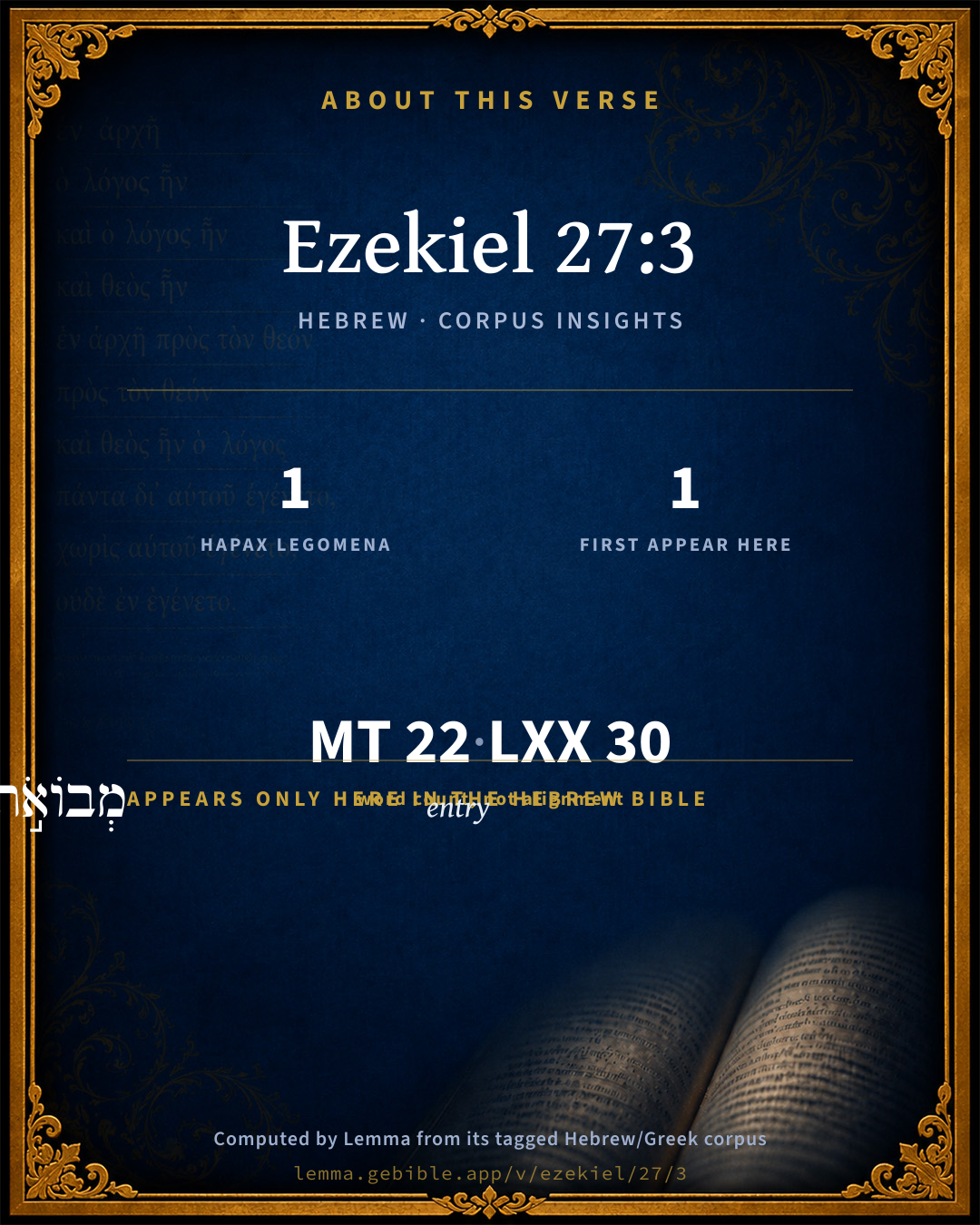
  • 1 hapax legomenon — only here in the Hebrew Bible
  • 1 first appearance in the Hebrew Bible
Full analysis ↓
Download a study sheet

One document with this verse’s original text, its word-by-word gloss line, the meaning frame, cross-references with their text, attributed commentary, and full source and license credits — printable, and it pastes into notes with its structure intact.

This verse Autodidact and up

Study sheet (.html) Plain text (.txt)

A passage Seminary Student

Up to 50 verses in one chapter. A passage sheet keeps up to 6 commentary sources and 12 cross-references per verse, in the order this page ranks them, and says so on the sheet whenever that leaves anything out. Ask for a single verse and you get the Autodidact verse sheet above.

Everything on this page stays free to read, with no account — the sheet is a download of what is already on screen, not access to it.

Want to remove ads? Support Godless Engineer
Compare translations 3

The same verse in 3 English versions, stacked beneath the original-language interlinear above. Click any original word for its lexicon entry.

Each is an independent rendering of the whole verse — the interlinear is not word-aligned to these translations.

Highlighted words mark where these versions differ — a whole-verse word diff, not a word-by-word alignment.

  • World English Bible Public Domain
    and tell Tyre, you who dwell at the entry of the sea, who are the merchant of the peoples to many isles, thus says the Lord Yahweh: You, Tyre, have said, I am perfect in beauty.
  • King James Version Public Domain
    And say unto Tyrus, O thou that art situate at the entry of the sea, which art a merchant of the people for many isles, Thus saith the Lord GOD; O Tyrus, thou hast said, I am of perfect beauty.
  • unfoldingWord Literal Text CC BY-SA 4.0
    and say to Tyre, who lives within the gates of the sea, merchants of peoples to many islands, the Lord Yahweh says this to you: Tyre, you have said, ‘I am perfect in beauty.’

unfoldingWord Literal Text — © unfoldingWord, licensed CC BY-SA 4.0. Word-aligned USFM3 via Door43 (git.door43.org/unfoldingWord/en_ult).

Versions to compare (up to 4)

3 of 4 selected

Show all 18 translations

Every available English version of this verse, each an independent rendering of the whole verse.

  • World English Bible Public Domain
    and tell Tyre, you who dwell at the entry of the sea, who are the merchant of the peoples to many isles, thus says the Lord Yahweh: You, Tyre, have said, I am perfect in beauty.
  • Berean Standard Bible Public Domain
    Tell Tyre, who dwells at the gateway to the sea, merchant of the peoples on many coasts, that this is what the Lord GOD says: You have said, O Tyre, ‘I am perfect in beauty.’
  • Majority Standard Bible Public Domain
    Tell Tyre, who dwells at the gateway to the sea, merchant of the peoples on many coasts, that this is what the Lord GOD says: You have said, O Tyre, ‘I am perfect in beauty.’
  • King James Version Public Domain
    And say unto Tyrus, O thou that art situate at the entry of the sea, which art a merchant of the people for many isles, Thus saith the Lord GOD; O Tyrus, thou hast said, I am of perfect beauty.
  • American Standard Version (1901) Public Domain
    and say unto Tyre, O thou that dwellest at the entry of the sea, that art the merchant of the peoples unto many isles, thus saith the Lord Jehovah: Thou, O Tyre, hast said, I am perfect in beauty.
  • Revised Version (1885) Public Domain
    and say unto Tyre, O thou that dwellest at the entry of the sea, which art the merchant of the peoples unto many isles, thus saith the Lord GOD: Thou, O Tyre, hast said, I am perfect in beauty.
  • Geneva Bible (1599) Public Domain
    And say vnto Tyrus, that is situate at the entrie of the sea, which is the marte of the people for many yles, Thus sayeth the Lord God, O Tyrus, thou hast said, I am of perfite beautie.
  • Douay-Rheims (1899) Public Domain
    And say to Tyre that dwelleth at the entry of the sea, being the mart of the people for many islands: Thus saith the Lord God: O Tyre, thou hast said: I am of perfect beauty,
  • Young's Literal Translation Public Domain
    O dweller on the entrances of the sea, Merchant of the peoples unto many isles, Thus said the Lord Jehovah: O Tyre, thou -- thou hast said: I `am' the perfection of beauty.
  • Literal Standard Version CC BY-SA 4.0
    O dweller on the entrances of the sea, || Merchant of the peoples to many islands, Thus said Lord YHWH: O Tyre, you have said, || I [am] the perfection of beauty.
  • Unlocked Literal Bible CC BY-SA 4.0
    and say to Tyre, who lives within the gates of the sea, merchants of peoples to many islands, the Lord Yahweh says this to you: Tyre, you have said, 'I am perfect in beauty.'
  • unfoldingWord Literal Text CC BY-SA 4.0
    and say to Tyre, who lives within the gates of the sea, merchants of peoples to many islands, the Lord Yahweh says this to you: Tyre, you have said, ‘I am perfect in beauty.’
  • Darby Bible Public Domain
    and say unto Tyre: O thou that art situate at the entries of the sea, and traffickest with the peoples in many isles, thus saith the Lord Jehovah: Thou, Tyre, hast said, I am perfect in beauty.
  • World Messianic Bible Public Domain
    and tell Tyre, ‘You who dwell at the entry of the sea, who are the merchant of the peoples to many islands, the Lord GOD says: “You, Tyre, have said, ‘I am perfect in beauty.’
  • Webster's Bible Public Domain
    And say to Tyre, O thou that art situated at the entry of the sea, which art a merchant of the people for many isles, Thus saith the Lord GOD; O Tyre, thou hast said, I am of perfect beauty.
  • Free Bible Version CC BY-SA 4.0
    Tell Tyre, the city that stands at the gateway to the sea, supplying goods to many overseas nations, that this is what the Lord God says: Tyre, you say to yourself, ‘I'm so beautiful!’
  • Bible in Basic English Public Domain
    And say to Tyre, O you who are seated at the doorway of the sea, trading for the peoples with the great sea-lands, these are the words of the Lord: You, O Tyre, have said, I am a ship completely beautiful.
  • JPS Tanakh (1917) Public Domain
    and say unto Tyre, that dwelleth at the entry of the sea, that is the merchant of the peoples unto many isles: Thus saith the Lord GOD: Thou, O Tyre, hast said: I am of perfect beauty.

Literal Standard Version (2020), Covenant Press — licensed CC BY-SA 4.0. Text via the HelloAO Bible API (eBible.org). Unlocked Literal Bible (unfoldingWord) — licensed CC BY-SA 4.0. Text via the HelloAO Bible API (eBible.org). unfoldingWord Literal Text — © unfoldingWord, licensed CC BY-SA 4.0. Word-aligned USFM3 via Door43 (git.door43.org/unfoldingWord/en_ult). Free Bible Version, Dr. Jonathan Gallagher — licensed CC BY-SA 4.0. Text via the HelloAO Bible API (eBible.org).

Word by word

More ways to search: Search by grammar → Find every occurrence → Compare this word →

Practice this passage: Drill this verse → Learn its vocabulary →

מְבוֹאֹ֣ת
mᵉbôwʼâh
H3997
“entries of”
Noun, Common, Masculine, Plural, Construct
Part of Speech
Noun
Type
Common
Gender
Masculine
Number
Plural
State
Construct
Full BDB Definition

Origin: from H3996

TWOT: 212b

entry, entrance, a coming in, entering
  1. וְאָמַרְתָּ֣ ʼâmar H559 “and · to say” Conjunction + Verb, Qal, Sequential Perfect, 2nd Person, Masculine, Singular
  2. לְצ֗וֹר Tsôr H6865 “to/for · Tyre” Preposition + Noun, Proper
  3. הישבתי yâshab H3427 “the · dwelling” Particle, Definite Article + Verb, Qal, Participle Active, Feminine, Singular, Absolute
  4. הַיֹּשֶׁ֨בֶת֙ yâshab H3427 “the · dwelling” Particle, Definite Article + Verb, Qal, Participle Active, Feminine, Singular, Absolute
  5. עַל ʻal H5921 “upon” Preposition
  6. יָ֔ם yâm H3220 “sea” Noun, Common, Masculine, Singular, Absolute
  7. רֹכֶ֨לֶת֙ râkal H7402 “trader” Verb, Qal, Participle Active, Feminine, Singular, Construct
  8. הָֽעַמִּ֔ים ʻam H5971 “the · peoples” Particle, Definite Article + Noun, Common, Masculine, Plural, Absolute
  9. אֶל ʼêl H413 “to” Preposition
  10. אִיִּ֖ים ʼîy H339 “islands” Noun, Common, Masculine, Plural, Absolute
  11. רַבִּ֑ים rab H7227 “many” Adjective, Adjective, Masculine, Plural, Absolute
  12. כֹּ֤ה kôh H3541 “thus” Adverb
  13. אָמַר֙ ʼâmar H559 “to say” Verb, Qal, Perfect, 3rd Person, Masculine, Singular
  14. אֲדֹנָ֣י ʼĂdônây H136 “Lord · my” Noun, Common, Masculine, Plural, Construct + Suffix, Personal, 1st Person, Common, Singular
  15. יְהוִ֔ה Yᵉhôvih H3069 “LORD” Noun, Proper
  16. צ֕וֹר Tsôr H6865 “Tyre” Noun, Proper
  17. אַ֣תְּ ʼattâh H859 “you” Pronoun, Personal, 2nd Person, Feminine, Singular
  18. אָמַ֔רְתְּ ʼâmar H559 “to say” Verb, Qal, Perfect, 2nd Person, Feminine, Singular
  19. אֲנִ֖י ʼănîy H589 “I” Pronoun, Personal, 1st Person, Common, Singular
  20. כְּלִ֥ילַת kâlîyl H3632 “whole of” Adjective, Adjective, Feminine, Singular, Construct
  21. יֹֽפִי yŏphîy H3308 “beauty” Noun, Common, Masculine, Singular, Absolute

About this verse

These counts appear in no published source. They are computed here, from the morphology-tagged text and Lemma’s own curated glosses. What Lemma adds →

22
words
18
distinct lemmas
Prophets
section

Notable vocabulary

1 hapax legomenon — a word that appears only here in the entire Hebrew Bible:

  • מְבוֹאֹ֣ת entry H3997

First appearance in Scripture

This word makes its first canonical appearance in the Hebrew Bible here:

  • מְבוֹאֹ֣ת entry H3997

Shared distinctive vocabulary

כְּלִ֥ילַת whole H3632 occurs in 15 verses of the Hebrew Bible. Also found in:

Grammatical profile

  • 6 verbs
  • 9 nouns
  • 2 adjectives
  • 2 pronouns
  • 2 prepositions
  • 1 adverb

Verb forms

  • וְאָמַרְתָּ֣ Qal · Sequential Perfect
  • הישבתי Qal · Participle Active
  • הַיֹּשֶׁ֨בֶת֙ Qal · Participle Active
  • רֹכֶ֨לֶת֙ Qal · Participle Active
  • אָמַר֙ Qal · Perfect
  • אָמַ֔רְתְּ Qal · Perfect

Repetition

Words recur within this verse — often emphatic in Hebrew:

  • וְאָמַרְתָּ֣ to say H559 ×3
  • לְצ֗וֹר Tyre H6865 ×2
  • הישבתי to dwell H3427 ×2

Hebrew & Septuagint length

In English translation the verse runs 36 words from the Hebrew and 40 from the Septuagint (LXX English) — closely comparable.

A rough comparison of the two English renderings, which tokenize alike — not a word-level alignment.

Word counts can differ between the Hebrew and the Greek without any difference in meaning — e.g. the Hebrew direct-object marker אֵת has no separate Greek word, and Greek often adds the article ὁ.

In the original languages it is 22 Hebrew tokens and 30 Greek tokens — but the two are counted differently (Hebrew bundles its prefixes and suffixes into one token; the Greek is in lemma form), so that isn’t a like-for-like length.

Cross-references

11

Topical passages linked to Ezekiel 27:3 in the Treasury of Scripture Knowledge — connected by theme and wording, ordered by reader-vote popularity; previews shown in the World English Bible.

  • Ezekiel 27:4 Your borders are in the heart of the seas; your builders have perfected your beauty.
  • Psalms 50:2 Out of Zion, the perfection of beauty, God shines forth.
  • Isaiah 23:2–3 Be still, you inhabitants of the coast, you whom the merchants of Sidon, that pass over the sea, have replenished.
  • Isaiah 23:8–9 Who has purposed this against Tyre, the giver of crowns, whose merchants are princes, whose traffickers are the honorable of the earth?
  • Isaiah 23:11 He has stretched out his hand over the sea, he has shaken the kingdoms: Yahweh has given commandment concerning Canaan, to destroy the strongholds of it.
  • Ezekiel 26:17 They shall take up a lamentation over you, and tell you, How are you destroyed, who were inhabited by seafaring men, the renowned city, who was strong in the sea, she and her inhabitants, who caused their terror to be on all who lived there!
  • Ezekiel 27:10–36 Persia and Lud and Put were in your army, your men of war: they hanged the shield and helmet in you; they set forth your comeliness.
  • Ezekiel 28:2–3 Son of man, tell the prince of Tyre, Thus says the Lord Yahweh: Because your heart is lifted up, and you have said, I am a god, I sit in the seat of God, in the midst of the seas; yet you are man, and not God, though you did set your heart as the heart of God;-
  • Revelation 18:3 For all the nations have drunk of the wine of the wrath of her sexual immorality, the kings of the earth committed sexual immorality with her, and the merchants of the earth grew rich from the abundance of her luxury."
  • Revelation 18:11–15 The merchants of the earth weep and mourn over her, for no one buys their merchandise any more;
  • Ezekiel 28:12–17 Son of man, take up a lamentation over the king of Tyre, and tell him, Thus says the Lord Yahweh: You seal up the sum, full of wisdom, and perfect in beauty.

Cross-references courtesy of OpenBible.info (CC BY 4.0).

Hebrew and Greek witnesses Masoretic Hebrew ↔ Greek Septuagint

The same verse in the two great witnesses to the Old Testament, shown verse-for-verse.

These are two independent witnesses, not word-aligned to each other, and the Septuagint is shown in lemma (dictionary) form.

Hebrew Ezekiel 27:3 Masoretic · Westminster Leningrad Codex

וְאָמַרְתָּ֣ לְצ֗וֹר הישבתי הַיֹּשֶׁ֨בֶת֙ עַל מְבוֹאֹ֣ת יָ֔ם רֹכֶ֨לֶת֙ הָֽעַמִּ֔ים אֶל אִיִּ֖ים רַבִּ֑ים כֹּ֤ה אָמַר֙ אֲדֹנָ֣י יְהוִ֔ה צ֕וֹר אַ֣תְּ אָמַ֔רְתְּ אֲנִ֖י כְּלִ֥ילַת יֹֽפִי

and tell Tyre, you who dwell at the entry of the sea, who are the merchant of the peoples to many isles, thus says the Lord Yahweh: You, Tyre, have said, I am perfect in beauty.

World English Bible · Public Domain

Greek LXX Ezekiel 27:3 Septuagint · lemma form

καί εἶπον ὁ σορ ὁ καταοἰκέω ἐπί ὁ εἴσοδος ὁ θάλασσα ὁ ἐμπόριον ὁ λαός ἀπό νήσος πολύς ὅδε λέγω κύριος ὁ σορ σύ εἶπον ἐγώ περιτίθημι ἐμαυτοῦ κάλλος ἐγώ

and you shall say to Sor that dwells at the entrance of the sea, to the mart of the nations coming from many islands, Thus says the Lord to Sor; You have said, I have clothed myself with my beauty.

LXX2012 (modern English Septuagint) · Public Domain

Hebrew: Westminster Leningrad Codex (CC BY 4.0). Greek: Septuagint (public domain); English from LXX2012 (modern English Septuagint) (Public Domain). How the Septuagint differs from the Hebrew →

Targum (Aramaic paraphrase)

1

The Targum is the ancient Jewish Aramaic paraphrase of the Hebrew Scriptures — an interpretive translation, not the Hebrew text itself. Onkelos (literal) and Pseudo-Jonathan (expansive) render the Torah, and Jonathan the Prophets. Coverage is partial: where no permissively-licensed English translation exists for a verse, only the Aramaic is shown. This is verse-level text, not a word-by-word alignment to the Hebrew.

  1. Targum Jonathan Prophets (Joshua–Malachi)
    וְתֵימַר לְצוֹר דְיַתְבָא עַל מִגְרַשׁ מָחוֹזֵי יַמָא מְסַפְּקָא סְחוֹרָא לְעַמְמַיָא לְנַגְוָן סַגִיאִין כִּדְנַן אֲמַר יְיָ אֱלֹהִים צוֹר אַתְּ אֲמַרְתְּ אֲנָא מְשַׁכְלְלָא בְּשׁוּפְרִי:

    (no public-domain English translation for this verse)

    Targum Jonathan — Aramaic: “Mikraot Gedolot” (public domain). English: “Sefaria Community Translation” (CC0 1.0 (public-domain dedication)); “London "Chaldee Paraphrase," 1871” (public domain). Text via Sefaria.

Commentary

Notes on Ezekiel 27:3 from classic Christian and Jewish commentators (each source and its license shown beneath its notes). The classic Christian expositions comment on the surrounding passage and are grouped to its opening verse, so a note may address several verses; the Jewish commentaries on the Tanakh (Rashi and others) are per-verse, so they appear only where the commentator wrote on this verse.

Lemma curates 59 commentaries, every one of them public domain or Creative Commons licensed, each selected and text-cleaned for this edition rather than reprinted as found. About our sources →

The Cambridge Bible for Schools and Colleges

gen. ed. J. J. S. Perowne

3. entry of the sea] lit. entries, reference possibly being to the two harbours of Tyre, one of which was to the N.-E. of the island, called the Sidonian harbour, because looking towards Sidon; and the other on the S. or S.-E. of the island, the exact position of which is uncertain owing to the silting which has taken place. See plate in Rawlinson, Phœnicia, p. 71.

people for many isles] peoples unto many coasts, or, countries, cf. Eze_27:3; Eze_27:6; Eze_27:15. Her traffic with the peoples extended to many and distant coastlands.

The Cambridge Bible for Schools and Colleges (gen. ed. J. J. S. Perowne; Cambridge University Press, 1878–1918) — public domain. Text from a community e-Sword module.

Trapp's Complete Commentary

John Trapp

Eze 27:3 And say unto Tyrus, O thou that art situate at the entry of the sea, [which art] a merchant of the people for many isles, Thus saith the Lord GOD; O Tyrus, thou hast said, I [am] of perfect beauty.

Ver. 3. O thou that art situated at the entry of the sea.] As now the city of Venice is,

“ Media insuperabilis unda. ”

Environed with her embracing Neptune, to whom (as the ceremony of throwing a ring into the sea implieth, saith one) she marrieth herself with yearly nuptials. But hath she so learned Christ? and doth not the Nebuchadnezzar of Constantinople now threaten her sore?

Thou hast said, I am of perfect beauty.] So that nothing can be added to me: I am ocellus orbis. But who made thee to differ? Is not all thy beauty borrowed? will not this thy bulging wall down ere long?

John Trapp, A Commentary or Exposition upon All the Books of the Old and New Testament (1647–1656) — public domain. Text from a community e-Sword module.

Geneva Bible (1599)

Geneva Bible translators

Which servest all the world with thy merchandise.

Geneva Bible (1599) marginal notes — public domain. Text via Bolls.life.

Jamieson, Fausset & Brown

Robert Jamieson, A. R. Fausset & David Brown

situate at the entry of the sea--literally, plural, "entrances," that is, ports or havens; referring to the double port of Tyre, at which vessels entered round the north and south ends of the island, so that ships could find a ready entrance from whatever point the wind might blow (compare Eze 28:2).

merchant of . . . people for many isles--that is, a mercantile emporium of the peoples of many seacoasts, both from the east and from the west (Isa 23:3), "a mart of nations."

of perfect beauty-- (Eze 28:12).

Jamieson, Fausset & Brown — Commentary Critical and Explanatory on the Whole Bible (1871) — public domain (CC PDM 1.0). Text via the HelloAO Bible API.

Adam Clarke's Commentary

Verse 3. The entry of the sea] Tyre was a small island, or rather rock, in the sea, at a short distance from the main land. We have already seen that there was another Tyre on the main land; but they are both considered as one city.

Adam Clarke's Commentary on the Bible (1810–1826) — public domain. Text from a community e-Sword/MySword module.

Ellicott's Commentary for English Readers

(3) At the entry of the sea.—The word for “entry” in the original is plural, and means the approaches to the sea, or harbours. Tyre had two of these, both remarkably good: the “Egyptian,” facing the south, and the “Sidonian,” facing the north, the latter having also an outer harbour or roadstead, formed by a ledge off the north-west extremity of the island. The former is now completely, and the latter nearly, filled up with sand and ruins.

A Bible Commentary for English Readers, edited by Charles John Ellicott (1878–1897) — public domain. Text from a community e-Sword module.

John Gill's Exposition

Thy borders are in the midst of the seas, Fixed by the Lord himself, and which could never be removed. Tyre stood about half a mile from the continent, surrounded with the waters of the sea, till it was made a peninsula by Alexander:

thy builders have perfected thy beauty. The Sidonians were the first builders of the city, as Justin (q) says; who began and carried on the building of it to the utmost of their knowledge and skill; and which was afterwards perfected by other builders, who made it the most beautiful city in all those parts; unless this is to be understood of her shipbuilders, who brought the art of building ships in her to such a perfection, as made her famous throughout the world; since they are immediately spoken of without any other antecedent.

(q) Ex Trago, l. 18. c. 3.

John Gill's Exposition of the Whole Bible (1746–1763) — public domain (CC PDM 1.0). Text via the HelloAO Bible API.

Albert Barnes' Notes on the Bible

Entry - literally, “entries.” Ancient Tyre had two ports, that called the Sidonian to the north, the Egyptian to the south; the former exists to the present day. The term “entry of the sea” is naturally enough applied to a harbor as a place from which ships enter and return from the sea. The city was known in the earliest times as “Tyre the port.”

Albert Barnes' Notes on the Bible (1834–1885) — public domain. Text from a community e-Sword/MySword module.

Haydock's Catholic Bible Commentary

Entry, whence merchants may proceed from an excellent harbour to any place.

George Leo Haydock (1774–1849), Haydock's Catholic Family Bible and Commentary, 1859 edition — public domain. Excludes Psalms (Douay-Rheims chapter numbering differs from Protestant) and Deuterocanonical books (Catholic canon only).

Matthew Poole's English Annotations

Personate Tyre as near thee, and hearing what thou sayest unto or of her; describe her, that she may know thou speakest to her.

That art situate; that dwellest, so the Hebrew.

The entry, Heb. entrances, she was but four furlongs, or five hundred paces, or half our English mile, from the continent, as it were in the very door of the sea, far enough off to have convenient harbors between her and the continent, and to be out of danger of sudden or easy surprises.

A merchant; a rich and populous emporium or mart for all commodities, either to vend or buy to islanders, or those that dwell on firm land.

Thou hast said; in thy riches, strength, alliances, and trade, thou art grown proud, thou hast thought and said too a great deal more than becomes a changeable state.

I am of perfect beauty: thou hast boasted of the excellency of thy government, the strength of thy city, the inaccessibleness of thy situation, nearness, strength, and obligations of thy allies, and as if nothing were wanting to perpetuate thy glory and happiness, poor self-flattering Tyre! But let us view particulars.

Matthew Poole's English Annotations on the Holy Bible (1683–1685) — public domain. Text from a community e-Sword/MySword module.

Whedon's Commentary on the Bible

Daniel D. Whedon

3. At the entry — Literally, entries. Tyre was built on an island having a double harbor.

A merchant — See note Eze_26:2.

I am of perfect beauty — This was the verdict of all antiquity. Travelers tried in vain to describe this princess of the seas. (Compare Nonnus, Dionysiaca, 40:311, etc.) “Greatly Dionysus rejoiced when he saw the city which the ocean god had bound with the liquid girdle of the waves. In shape she was like the crescent moon. As he looked it seemed a double wonder, since Tyre lies in the sea and is bound by the waves and yet belongs to the land. She seemed like a maiden floating motionless, half submerged in the waters.” A letter written in the fourteenth century B.C. reads, “Behold the palace of the city of Tyre: there is no palace of any other governor like unto it.” (For further description of Tyre see notes Eze_26:2; Eze_28:2; Eze_28:12. Compare Scholar Gypsy, Arnold.)

Daniel D. Whedon (gen. ed.), Commentary on the Old and New Testaments (1874–1909) — public domain. Text from a community e-Sword module.

The Pulpit Commentary

We begin with the picture of the city, situate at the entry (Hebrew, entries), or harbors of the sea. Of these Tyro had two the northern, known as the Sidonian; the southern, as the Egyptian. There she dwelt, a merchant of the peoples, that came, in the wider sense of the word, (see Eze_26:15) from the isles of the Mediterranean. I am perfect in beauty. The boast here put into the mouth of the city appears afterwards as the utterance of its ruler, or as applied to him. (Eze_28:2, Eze_28:15-17) We are reminded of Genoa, la superba.

Ver. 3 (last clause, "Thou hast said, I am of perfect beauty"). AEstheticism as a religion.

The craze for aestheticism has been exalted into the creed of a new religion. It is well so see once for all what this means, and how hollow, foolish, and fatal are its pretensions.

I AeSTHETICISM AS A RELIGION IS THE WORSHIP OF BEAUTY.

1. It is more than the enjoyment of beauty, which is innocent and even helpful to a right appreciation of God"s wonderful works. Beauty implies harmony and refinement; it excludes everything harsh and coarse. So far it is good.

2. Aestheticism is more than the effort to produce beauty. This aim of art is good.

3. It is more also than the consecration of beauty to the service of religion. This is right; we should bring our best to God; religion should be honored with the homage rendered to it by art.

4. But aestheticism as a religion makes an idol of the sacrifice, by putting the beauty, which should be enlisted in the service of God, in the place of God himself. It is bowing the knee to beauty. It sees nothing higher than the perfection of grace and color and melody. This is as much idolatry as the Hottentot"s adoration of a hideous fetish.

II AeSTHETICISM AS A RELIGION MAY BE JOINED TO THE GREATEST ERRORS. The beautiful is not always the true. There are lovely lies and there are ugly truths. By exalting the idea of the beautiful above all else, we sacrifice truth wherever the two do not agree. Thus the sterner facts of life are ignored and its less attractive duties left out of account.

III AeSTHETICISM AS A RELIGION RISKS MORALITY. It is satisfied with something lower than the beauty of holiness. If it rose to the celestial beauty, it could not afford to discard goodness, for all beauty that admits evil is corrupted with moral ugliness; but this is not perceived by the religion of aestheticism. Therefore there is a degradation of the very idea of beauty. Too often this is in danger of falling even lower, till Beauty becomes a tempter to sin.

IV AeSTHETICISM AS A RELIGION WILL NOT SATISFY THE SOUL. A man cannot live on the perpetual contemplation of a lily. Too much beauty cloys. The soul needs the sustenance of solid truth. It requires inward spiritual grace. In the hour of temptation and in the season of great sorrow the religion of beauty utterly fails. It may charm the sentimental; it has no spell for the suffering; it cannot save the fallen; it has no evangel.

V AeSTHETICISM AS A RELIGION CANNOT AVERT RUIN. Tyre was proud of her beauty and confident in it. But this was only a piece of senseless self-deception. Her imposing palaces did not keep back the invader; they rather invited his ruthless armies. She found no security in the vain boast, "I am of perfect beauty." There is no redemption in aestheticism. The sinner will not find here any refuge from the doom of his guilt. It would be a poor diet for unfallen angels; for fallen men it is assuredly no healing balm. Beauty has been brought down to shame and suffering. No culture of art or literature will lift the refined mind out of the danger that threatens "the common herd" of sinners. Cultured and rough people must come through the same strait gate of penitence and walk the same narrow way of the footsteps of Christ if they would hope for salvation.

The Pulpit Commentary (1880–1919), ed. H.D.M. Spence-Jones & Joseph S. Exell — public domain. Text from a community e-Sword module.

John Wesley's Explanatory Notes

At the entry - Hebrew. Entrances. She was about four furlongs, or half an English mile from the continent, as it were in the very door of the sea.

John Wesley, Explanatory Notes Upon the Whole Bible (1754–1765) — public domain. Text via the GEBible commentary corpus.

Rashi

Rabbi Shlomo Yitzchaki (Rashi)

on the seaport [Heb. מְבוֹאֹת יָם, lit. by the entrance of the sea.] By the port where the ships come up to the wall and the gates. Many large cities are situated by the sea, but they are not a [good] place for a port, and the ships cannot approach them.

מְבוֹאֹת יָם is port in Old French, seaport.

trafficker of the peoples So was their custom: the merchants who came there this one from the north, that one from the south were not allowed to conduct commerce with one another. Rather, the inhabitants of the city would purchase from this one and sell to that one.

you said, I am the perfection of beauty Until now, all [were] saying about Jerusalem (Lam. 2:15): “the perfection of beauty”; (ibid.) “the joy of all the earth.” Now you boast, saying, “I am the perfection of beauty,” the ultimate extreme of beauty is incorporated in me.

Rashi on the Tanakh — English translations: “The Judaica Press complete Tanach with Rashi, translated by A. J. Rosenberg” (CC BY 4.0); “Pentateuch with Rashi's commentary by M. Rosenbaum and A.M. Silbermann, 1929-1934” (public domain); “The Metsudah Tanach series, Lakewood, N.J” (CC BY 4.0); and “The Book of Joshua, Metsudah Publications, 1997” (CC BY 4.0). Text via Sefaria.

Lesson kit

Teaching starters — assembled from the data on this page, not authored interpretation. Every prompt links to the verse data it draws on. Edit before teaching.

Ezekiel, in the Prophets, opens this verse with 22 words (18 distinct Hebrew lemmas). Its most distinctive word is mᵉbôwʼâh (“entry”). A historical commentator’s framing appears above. Read the whole chapter for the surrounding context.

Discussion questions

  1. How does “entry” (mᵉbôwʼâh) shape what this verse is saying?
  2. 1 word here appears nowhere else in the Hebrew Bible. Why might the author reach for such rare wording?
  3. This is the first place “entry” appears in Scripture (first appears here). What does its debut here establish?
  4. How does Exodus 28:31, which shares the word «whole», read alongside this verse?
  5. What does the repetition of “to say” (3× in this one verse) do in this verse?
  6. These translations render this verse differently; the difference is in the English rendering, not the original. What questions does that raise?
  7. «וְאָמַרְתָּ֣» is a Qal Sequential Perfect verb. How does that grammatical form shape the action described?
  8. Compare how The Cambridge Bible for Schools and Colleges and Trapp's Complete Commentary read this verse. Where do they agree or differ?

Things to notice

  • 1 word in this verse appears nowhere else in the Hebrew Bible.
  • 1 word makes its first canonical appearance in Scripture here.
  • This verse counts 22 Hebrew ↔ 30 Greek words.
  • These translations choose different wording for 25 words in this verse.
  • “to say” occurs 3× in this single verse.

Reading settings

Reading text

Shown beneath each verse's original-language words.

Old Testament
Old Testament edition

Read the OT as the Masoretic Hebrew (MT) or the Greek Septuagint (LXX).

English shown for the Greek Septuagint (in the Hebrew ↔ Greek comparison).

Comparing translations? Open the Compare panel on any verse page to stack up to four side by side.