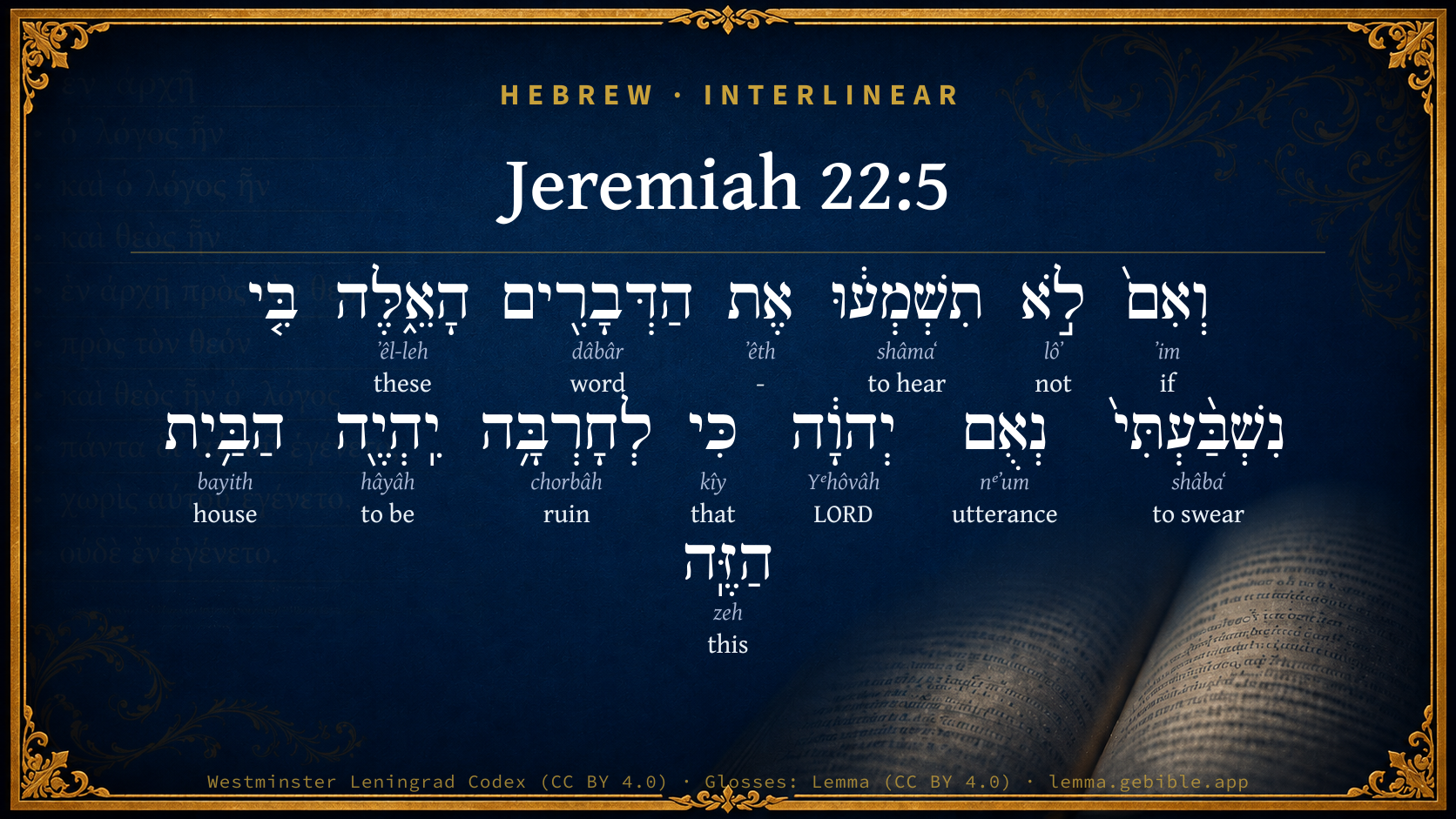
Jeremiah 22:5

Hebrew (Westminster Leningrad Codex) Jeremiah 22:5 appears in the Hebrew Old Testament. The text above is from the Westminster Leningrad Codex. Each word links to its Strong’s number, a concise gloss, and parsing drawn from the Open Scriptures Hebrew Bible morphology. Click any word for its full Brown-Driver-Briggs (BDB) entry.
Download image
Cite this verse

Jeremiah 22:5 (World English Bible). Public Domain. Lemma interlinear Bible study tool, https://lemma.gebible.app/v/jeremiah/22/5.

Show BibTeX & RIS
BibTeX
RIS
English Translation
But if you will not hear these words, I swear by myself, says Yahweh, that this house shall become a desolation.
World English Bible · Public Domain
Download a study sheet

One document with this verse’s original text, its word-by-word gloss line, the meaning frame, cross-references with their text, attributed commentary, and full source and license credits — printable, and it pastes into notes with its structure intact.

This verse Autodidact and up

Study sheet (.html) Plain text (.txt)

A passage Seminary Student

Up to 50 verses in one chapter. A passage sheet keeps up to 6 commentary sources and 12 cross-references per verse, in the order this page ranks them, and says so on the sheet whenever that leaves anything out. Ask for a single verse and you get the Autodidact verse sheet above.

Everything on this page stays free to read, with no account — the sheet is a download of what is already on screen, not access to it.

Want to remove ads? Support Godless Engineer
Compare translations 3

The same verse in 3 English versions, stacked beneath the original-language interlinear above. Click any original word for its lexicon entry.

Each is an independent rendering of the whole verse — the interlinear is not word-aligned to these translations.

Highlighted words mark where these versions differ — a whole-verse word diff, not a word-by-word alignment.

  • World English Bible Public Domain
    But if you will not hear these words, I swear by myself, says Yahweh, that this house shall become a desolation.
  • King James Version Public Domain
    But if ye will not hear these words, I swear by myself, saith the LORD, that this house shall become a desolation.
  • unfoldingWord Literal Text CC BY-SA 4.0
    But if you will not hear these words, by myself I have sworn”—the declaration of Yahweh—“that this house will become a ruin.’”

unfoldingWord Literal Text — © unfoldingWord, licensed CC BY-SA 4.0. Word-aligned USFM3 via Door43 (git.door43.org/unfoldingWord/en_ult).

Versions to compare (up to 4)

3 of 4 selected

Show all 18 translations

Every available English version of this verse, each an independent rendering of the whole verse.

  • World English Bible Public Domain
    But if you will not hear these words, I swear by myself, says Yahweh, that this house shall become a desolation.
  • Berean Standard Bible Public Domain
    But if you do not obey these words, then I swear by Myself, declares the LORD, that this house will become a pile of rubble.’”
  • Majority Standard Bible Public Domain
    But if you do not obey these words, then I swear by Myself, declares the LORD, that this house will become a pile of rubble.’”
  • King James Version Public Domain
    But if ye will not hear these words, I swear by myself, saith the LORD, that this house shall become a desolation.
  • American Standard Version (1901) Public Domain
    But if ye will not hear these words, I swear by myself, saith Jehovah, that this house shall become a desolation.
  • Revised Version (1885) Public Domain
    But if ye will not hear these words, I swear by myself, saith the LORD, that this house shall become a desolation.
  • Geneva Bible (1599) Public Domain
    But if ye will not heare these wordes, I sweare by my selfe, saith the Lord, that this House shalbe waste.
  • Douay-Rheims (1899) Public Domain
    But if you will not hearken to these words: I swear by myself, saith the Lord, that this house shall become a desolation.
  • Young's Literal Translation Public Domain
    And if ye do not hear these words, By myself I have sworn -- an affirmation of Jehovah, That this house is for a desolation.
  • Literal Standard Version CC BY-SA 4.0
    And if you do not hear these words, || I have sworn by Myself,” || A declaration of YHWH, || “That this house is for a desolation.”
  • Unlocked Literal Bible CC BY-SA 4.0
    But if you do not listen to these words from me that I have announced—this is Yahweh's declaration—then this royal house will become a ruin.”'
  • unfoldingWord Literal Text CC BY-SA 4.0
    But if you will not hear these words, by myself I have sworn”—the declaration of Yahweh—“that this house will become a ruin.’”
  • Darby Bible Public Domain
    But if ye will not hear these words, I have sworn by myself, saith Jehovah, that this house shall become a waste.
  • World Messianic Bible Public Domain
    But if you will not hear these words, I swear by myself,” says the LORD, “that this house will become a desolation.”’”
  • Webster's Bible Public Domain
    But if ye will not hear these words, I swear by myself, saith the LORD, that this house shall become a desolation.
  • Free Bible Version CC BY-SA 4.0
    But if you refuse to obey what I say, then I swear by myself, declares the Lord, that this palace will be turned into rubble.
  • Bible in Basic English Public Domain
    But if you do not give ear to these words, I give you my oath by myself, says the Lord, that this house will become a waste.
  • JPS Tanakh (1917) Public Domain
    But if ye will not hear these words, I swear by Myself, saith the LORD, that this house shall become a desolation.

Literal Standard Version (2020), Covenant Press — licensed CC BY-SA 4.0. Text via the HelloAO Bible API (eBible.org). Unlocked Literal Bible (unfoldingWord) — licensed CC BY-SA 4.0. Text via the HelloAO Bible API (eBible.org). unfoldingWord Literal Text — © unfoldingWord, licensed CC BY-SA 4.0. Word-aligned USFM3 via Door43 (git.door43.org/unfoldingWord/en_ult). Free Bible Version, Dr. Jonathan Gallagher — licensed CC BY-SA 4.0. Text via the HelloAO Bible API (eBible.org).

Word by word

More ways to search: Search by grammar → Find every occurrence → Compare this word →

Practice this passage: Drill this verse → Learn its vocabulary →

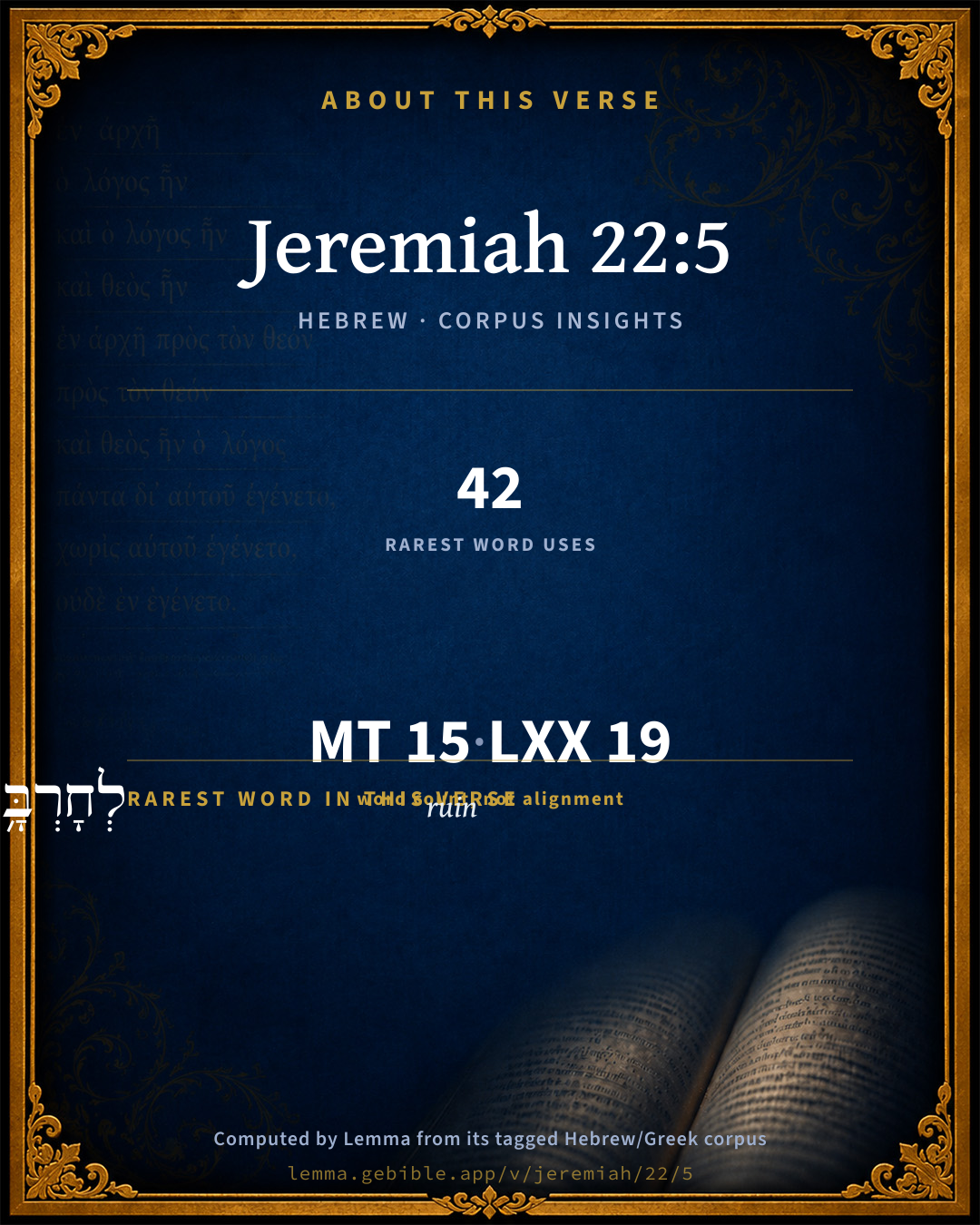
לְחָרְבָּ֥ה
chorbâh
H2723
“to/for · ruin”
Preposition + Noun, Common, Feminine, Singular, Absolute
Part of Speech
Preposition + Noun
Type
Common
Gender
Feminine
Number
Singular
State
Absolute
Full BDB Definition

Origin: from H2721

TWOT: 731d

a place laid waste, ruin, waste, desolation
  1. וְאִם֙ ʼim H518 “and · if” Conjunction + Conjunction
  2. לֹ֣א lôʼ H3808 “not” Particle, Negative
  3. תִשְׁמְע֔וּ shâmaʻ H8085 “to hear” Verb, Qal, Imperfect, 2nd Person, Masculine, Plural
  4. אֶת ʼêth H853 “-” Particle, Direct Object
  5. הַדְּבָרִ֖ים dâbâr H1697 “the · words” Particle, Definite Article + Noun, Common, Masculine, Plural, Absolute
  6. הָאֵ֑לֶּה ʼêl-leh H428 “the · these” Particle, Definite Article + Pronoun, Demonstrative, Common, Plural
  7. נִשְׁבַּ֨עְתִּי֙ shâbaʻ H7650 “to swear” Verb, Niphal, Perfect, 1st Person, Common, Singular
  8. נְאֻם nᵉʼum H5002 “utterance of” Noun, Common, Masculine, Singular, Construct
  9. יְהוָ֔ה Yᵉhôvâh H3068 “LORD” Noun, Proper
  10. כִּי kîy H3588 “that” Conjunction
  11. יִֽהְיֶ֖ה hâyâh H1961 “to be” Verb, Qal, Imperfect, 3rd Person, Masculine, Singular
  12. הַבַּ֥יִת bayith H1004 “the · house” Particle, Definite Article + Noun, Common, Masculine, Singular, Absolute
  13. הַזֶּֽה zeh H2088 “the · this” Particle, Definite Article + Pronoun, Demonstrative, Masculine, Singular

About this verse

These counts appear in no published source. They are computed here, from the morphology-tagged text and Lemma’s own curated glosses. What Lemma adds →

15
words
14
distinct lemmas
Prophets
section

Shared distinctive vocabulary

לְחָרְבָּ֥ה ruin H2723 occurs in 42 verses of the Hebrew Bible. Also found in:

Grammatical profile

  • 3 verbs
  • 5 nouns
  • 2 pronouns
  • 1 preposition
  • 2 conjunctions
  • 2 particles

Verb forms

  • תִשְׁמְע֔וּ Qal · Imperfect
  • נִשְׁבַּ֨עְתִּי֙ Niphal · Perfect
  • יִֽהְיֶ֖ה Qal · Imperfect

Hebrew & Septuagint length

In the original languages it is 15 Hebrew tokens and 19 Greek tokens — but the two are counted differently (Hebrew bundles its prefixes and suffixes into one token; the Greek is in lemma form), so that isn’t a like-for-like length.

Cross-references

17

Topical passages linked to Jeremiah 22:5 in the Treasury of Scripture Knowledge — connected by theme and wording, ordered by reader-vote popularity; previews shown in the World English Bible.

  • Amos 6:8 "The Lord Yahweh has sworn by himself," says Yahweh, the God of hosts: "I abhor the pride of Jacob, And detest his fortresses. Therefore I will deliver up the city with all that is in it.
  • Genesis 22:16 and said, "I have sworn by myself, says Yahweh, because you have done this thing, and have not withheld your son, your only son,
  • Jeremiah 17:27 But if you will not listen to me to make the Sabbath day holy, and not to bear a burden and enter in at the gates of Jerusalem on the Sabbath day; then will I kindle a fire in the gates of it, and it shall devour the palaces of Jerusalem, and it shall not be quenched.
  • Hebrews 6:13 For when God made a promise to Abraham, since he could swear by none greater, he swore by himself,
  • Deuteronomy 32:40–42 For I lift up my hand to heaven, And say, As I live forever,
  • Isaiah 1:20 But if you refuse and rebel, you shall be devoured with the sword; For the mouth of Yahweh has spoken it."
  • Jeremiah 7:13–14 Now, because you have done all these works, says Yahweh, and I spoke to you, rising up early and speaking, but you didn't hear; and I called you, but you didn't answer:
  • Jeremiah 26:6–9 then will I make this house like Shiloh, and will make this city a curse to all the nations of the earth.
  • Jeremiah 39:8 The Chaldeans burned the king's house, and the houses of the people, with fire, and broke down the walls of Jerusalem.
  • Numbers 14:28–30 Tell them, As I live, says Yahweh, surely as you have spoken in my ears, so will I do to you:
  • 2 Chronicles 7:19 But if you turn away, and forsake my statutes and my commandments which I have set before you, and shall go and serve other gods, and worship them;
  • 2 Chronicles 7:22 They shall answer, Because they forsook Yahweh, the God of their fathers, who brought them forth out of the land of Egypt, and laid hold on other gods, and worshiped them, and served them: therefore has he brought all this evil on them.
  • Psalms 95:11 Therefore I swore in my wrath, "They won't enter into my rest."
  • Amos 8:7–8 Yahweh has sworn by the pride of Jacob, "Surely I will never forget any of their works.
  • Micah 3:12 Therefore Zion for your sake will be plowed like a field, And Jerusalem will become heaps of rubble, And the mountain of the temple like the high places of a forest.
  • Hebrews 3:18 To whom did he swear that they wouldn't enter into his rest, but to those who were disobedient?
  • Hebrews 6:17 In this way God, being determined to show more abundantly to the heirs of the promise the immutability of his counsel, interposed with an oath;

Cross-references courtesy of OpenBible.info (CC BY 4.0).

Hebrew and Greek witnesses Masoretic Hebrew ↔ Greek Septuagint

The same verse in the two great witnesses to the Old Testament, shown verse-for-verse.

These are two independent witnesses, not word-aligned to each other, and the Septuagint is shown in lemma (dictionary) form.

Hebrew Jeremiah 22:5 Masoretic · Westminster Leningrad Codex

וְאִם֙ לֹ֣א תִשְׁמְע֔וּ אֶת הַדְּבָרִ֖ים הָאֵ֑לֶּה בִּ֤י נִשְׁבַּ֨עְתִּי֙ נְאֻם יְהוָ֔ה כִּי לְחָרְבָּ֥ה יִֽהְיֶ֖ה הַבַּ֥יִת הַזֶּֽה

But if you will not hear these words, I swear by myself, says Yahweh, that this house shall become a desolation.

World English Bible · Public Domain

Greek LXX Structure differs

In the Septuagint, Jeremiah is about an eighth shorter than the Hebrew and arranges its material differently — the Oracles Against the Nations (Hebrew chapters 46–51) appear in the middle of the Greek book, after 25:13. Because the chapter and verse boundaries do not line up, a verse-for-verse comparison with the Hebrew is not shown.

A verse-for-verse comparison isn’t shown here because the chapters and verses don’t line up. Switch to the LXX edition with the MT / LXX toggle above to read the Greek directly.

Hebrew: Westminster Leningrad Codex (CC BY 4.0). Greek: Septuagint (public domain); English from a public-domain English Septuagint. How the Septuagint differs from the Hebrew →

Targum (Aramaic paraphrase)

1

The Targum is the ancient Jewish Aramaic paraphrase of the Hebrew Scriptures — an interpretive translation, not the Hebrew text itself. Onkelos (literal) and Pseudo-Jonathan (expansive) render the Torah, and Jonathan the Prophets. Coverage is partial: where no permissively-licensed English translation exists for a verse, only the Aramaic is shown. This is verse-level text, not a word-by-word alignment to the Hebrew.

  1. Targum Jonathan Prophets (Joshua–Malachi)
    וְאִם לָא תְקַבְּלוּן יַת פִּתְגָמַיָא הָאִלֵין בְּמֵימְרִי קַיְמִית אֲמַר יְיָ אֲרֵי לְחוּרְבָא יְהֵי בֵיתָא הָדֵין:

    (no public-domain English translation for this verse)

    Targum Jonathan — Aramaic: “Mikraot Gedolot” (public domain). English: “Sefaria Community Translation” (CC0 1.0 (public-domain dedication)); “London "Chaldee Paraphrase," 1871” (public domain). Text via Sefaria.

Commentary

Notes on Jeremiah 22:5 from classic Christian and Jewish commentators (each source and its license shown beneath its notes). The classic Christian expositions comment on the surrounding passage and are grouped to its opening verse, so a note may address several verses; the Jewish commentaries on the Tanakh (Rashi and others) are per-verse, so they appear only where the commentator wrote on this verse.

Lemma curates 59 commentaries, every one of them public domain or Creative Commons licensed, each selected and text-cleaned for this edition rather than reprinted as found. About our sources →

Trapp's Complete Commentary

John Trapp

Jer 22:5 But if ye will not hear these words, I swear by myself, saith the LORD, that this house shall become a desolation.

Ver. 5. That this house shall become a desolation.] This stately edifice, the place of thy royal residence. Note here the prophet’s boldness, and learn that truth must be spoken, however it be taken.

John Trapp, A Commentary or Exposition upon All the Books of the Old and New Testament (1647–1656) — public domain. Text from a community e-Sword module.

Geneva Bible (1599)

Geneva Bible translators

Showing that there is none greater than he is, Heb. 6:13, and that he will most certainly perform his oath.

Geneva Bible (1599) marginal notes — public domain. Text via Bolls.life.

Jamieson, Fausset & Brown

Robert Jamieson, A. R. Fausset & David Brown

I swear by myself-- (Heb 6:13, Heb 6:17). God swears because it seemed to them incredible that the family of David should be cast off.

this house--the king's, where Jeremiah spake (Jer 22:4).

Jamieson, Fausset & Brown — Commentary Critical and Explanatory on the Whole Bible (1871) — public domain (CC PDM 1.0). Text via the HelloAO Bible API.

John Calvin's Commentaries

We explained yesterday the declaration of the Prophet, — that the kingdom would again be restored by the Lord, if the king and his servants and the whole people repented. He now introduces a commination, — that if they heard not, it was all over with the palace and the city. But the word house, or palace is often repeated; for though the defenses of the city gave courage to the people, yet what made them especially proud was the confidence they felt that the kingdom had been promised to be for ever. Hence, they thought, that the royal dignity could not possibly fall as long as the sun and moon continued in the heavens. (Psalm 89:38.) This false confidence is what the Prophet now meets, and he says, If ye will not hear these words, etc. He changes the number: he had said before this word, את הדבר הזה, at edeber eze; but he now says these words, את הדברים, at edeberim. But the singular number includes the whole of his doctrine; yet he now uses the plural number, because he had exhorted them to change their life.

And that they might not think that they were for no good reason terrified, he declares that God had sworn by himself We indeed know that when God makes an oath, either when he promises anything, or when he denounces punishment on sinners, it is done on account of men’s sloth and dullness. For our hearts through unbelief will hardly receive a simple truth, unless God removes the impediments; and this is the design of making an oath, when God does not only speak, but in order to render us more certain of our salvation, he confirms his promise by introducing his own name as a pledge. The reason is similar as to threatenings; for so great is the false security of sinners, that they are deaf until God, as it were, with force penetrates into their hearts. Hence he says, that God made an oath by himself; for it seemed incredible to the Jews, that the family which had been set apart by God from the world, would ever perish. It now follows:

John Calvin's Commentaries (1540-1563) — public domain. Text from the Calvin Translation Society English edition (1840s-50s) via the Christian Classics Ethereal Library (ccel.org). Calvin's coverage is partial (roughly two-thirds of the Bible); uncommented books and verses are honest gaps, never fabricated. The 19th-century editor's footnotes and remarks are omitted so the notes are faithfully Calvin's own voice.

Ellicott's Commentary for English Readers

(5) I swear by myself.—The formula is an exceptionally rare one, but meets us in Gen_22:16. In Deu_32:40 the came thought is embodied in the language of the loftiest poetry. The principle in both cases is that on which the writer of the Epistle to the Hebrews dwells in Jer_6:13. Men swear by the greater, but God can swear by nothing greater than Himself.

This house.—The context determines the application of the word as meaning the king’s palace, not the Temple.

A Bible Commentary for English Readers, edited by Charles John Ellicott (1878–1897) — public domain. Text from a community e-Sword module.

The Cambridge Bible for Schools and Colleges

gen. ed. J. J. S. Perowne

5. I swear by myself] For comment on this as the most solemn and binding form of oath, see Heb_6:13-18. The form is repeated in Jer_49:13, and occurs besides in Gen_22:16; Isa_45:23, and a cognate expression is found Jer_51:14; Amo_6:8.

The Cambridge Bible for Schools and Colleges (gen. ed. J. J. S. Perowne; Cambridge University Press, 1878–1918) — public domain. Text from a community e-Sword module.

John Gill's Exposition

But if ye will not hear these words,.... Will give no attention, and yield no obedience to them:

I swear by myself, saith the Lord; and by a greater he cannot swear; and that is the reason why he swears by himself, Heb 6:13; and as, when he swears to a promise, it shows the immutability of it, the certainty of its performance, and that it is irreversible, and never repented of, nor revoked; so it is when he swears to a threatening. The Targum is,

"by my word I swear:''

that this house shall become a desolation; meaning not the temple, nor the city, but the king's palace.

John Gill's Exposition of the Whole Bible (1746–1763) — public domain (CC PDM 1.0). Text via the HelloAO Bible API.

Haydock's Catholic Bible Commentary

Myself, having none greater, Hebrews vi. 13. Oaths evince the insincerity of men, who distrust each other; but when God condescends to use them, it shews men’s incredulity. --- House, the temple, or rather the palace, where the king was sitting at the gate, ver. 2. (Calmet)

George Leo Haydock (1774–1849), Haydock's Catholic Family Bible and Commentary, 1859 edition — public domain. Excludes Psalms (Douay-Rheims chapter numbering differs from Protestant) and Deuterocanonical books (Catholic canon only).

Matthew Poole's English Annotations

By hearing the prophet meaneth hearkening to and obeying. God accounteth us to hear no more than we practise. If (saith the prophet) you will not execute judgment, &c., I give you the greatest assurance imaginable that this noble house of David shall become a desolation. The apostle saith that God, because he could swear by no greater, sware by himself. The end of an oath is, the confirmation of a thing where any doubt of the truth of it, or any have strife about it. Sinners finding in themselves a difficulty to believe God upon his word, revealing his will against the interests of their lusts, the Lord is brought in as swearing, not by a greater, (that is impossible,) but by himself, that the house of David, or the house of Israel, or his own house, the temple, (though the first seems most probable to be here meant, which seemeth to be the house mentioned Jer 22:4, through the gates of which kings should enter, riding in chariots and on horses,) should be made desolate.

Matthew Poole's English Annotations on the Holy Bible (1683–1685) — public domain. Text from a community e-Sword/MySword module.

Whedon's Commentary on the Bible

Daniel D. Whedon

5. I swear by myself — See Heb_6:13; Heb_6:17. In this instance God is represented as swearing, as if to overcome the antecedent incredibility that the family of David should be cast off.

This house — The royal palace, where Jeremiah was then speaking.

Daniel D. Whedon (gen. ed.), Commentary on the Old and New Testaments (1874–1909) — public domain. Text from a community e-Sword module.

The Pulpit Commentary

I swear by myself. "Because he could swear by no greater, he swore by himself". (Heb_6:13) A synonymous expression is, "As I live, saith Jehovah" (ver. 24).

Vers. 5, 7, 13, 14. Building in unrighteousness.

The building of a house, be it small or great, is always an interesting and suggestive process. It is a lengthened operation, expensive, and representing a great part of a man"s aims and efforts. Various purposes may be sought in it according to the character, circumstances, etc., of the builder mere shelter, comfort, splendor, protection. As these come into view the object in which they are to be realized becomes representative of the living personality and character with which it is associated. Jehoiakim was a despot, bent upon aggrandizement, and so he sought to build a magnificent palace with forced, unpaid labor. The ambitions of unspiritual men, the exclusive and absorbing projects of earthly life, resemble the palace-building of this Hebrew tyrant in

I THE UNION OF EXTRAVAGANT DESIRES AND DISHONEST, UNLAWFUL METHODS. Easy for Jehoiakim to "go in" for a splendid palace, as he is not in the habit of paying his employee. Are there not many in modern life who act on the same principle? The desire for self-advancement and aggrandizement overtops every other consideration.

1. Unlawful methods of securing these are employed. Speculation; getting on in business in order to get out of it; adulteration; insufficient wages; prices that do not admit of honest manufacture; clap-trap advertisements, etc.

2. Imagining that others exist for the sake of one"s self. This reverses the golden rule and the spirit of Christ"s life.

II ITS FUNDAMENTAL SIN. This is selfishness self-glorification, neglect of God and of human claims. The great principles of the Divine kingdom are contradicted; justice, mercy, brotherly sympathy, etc.

III ITS RESULTS.

1. The ruin of the building; i.e. the life-project the unhallowed aim.

2. The ruin of the builder for time, perhaps for eternity. M.

The Pulpit Commentary (1880–1919), ed. H.D.M. Spence-Jones & Joseph S. Exell — public domain. Text from a community e-Sword module.

Lesson kit

Teaching starters — assembled from the data on this page, not authored interpretation. Every prompt links to the verse data it draws on. Edit before teaching.

Jeremiah, in the Prophets, opens this verse with 15 words (14 distinct Hebrew lemmas). Its most distinctive word is chorbâh (“ruin”). A historical commentator’s framing appears above. Read the whole chapter for the surrounding context.

Discussion questions

  1. The word chorbâh carries the sense “ruin.” How does it shape the verse?
  2. Leviticus 26:31 shares the word «ruin» with this verse. How do the two illuminate each other?
  3. These translations render this verse differently; the difference is in the English rendering, not the original. What questions does that raise?
  4. The verb «תִשְׁמְע֔וּ» is Qal Imperfect. How does its form color the action?
  5. Reading how Trapp's Complete Commentary and Geneva Bible (1599) read this verse, where do the two commentators agree and where do they part?

Things to notice

Reading settings

Reading text

Shown beneath each verse's original-language words.

Old Testament
Old Testament edition

Read the OT as the Masoretic Hebrew (MT) or the Greek Septuagint (LXX).

English shown for the Greek Septuagint (in the Hebrew ↔ Greek comparison).

Comparing translations? Open the Compare panel on any verse page to stack up to four side by side.