Hosea 2:22

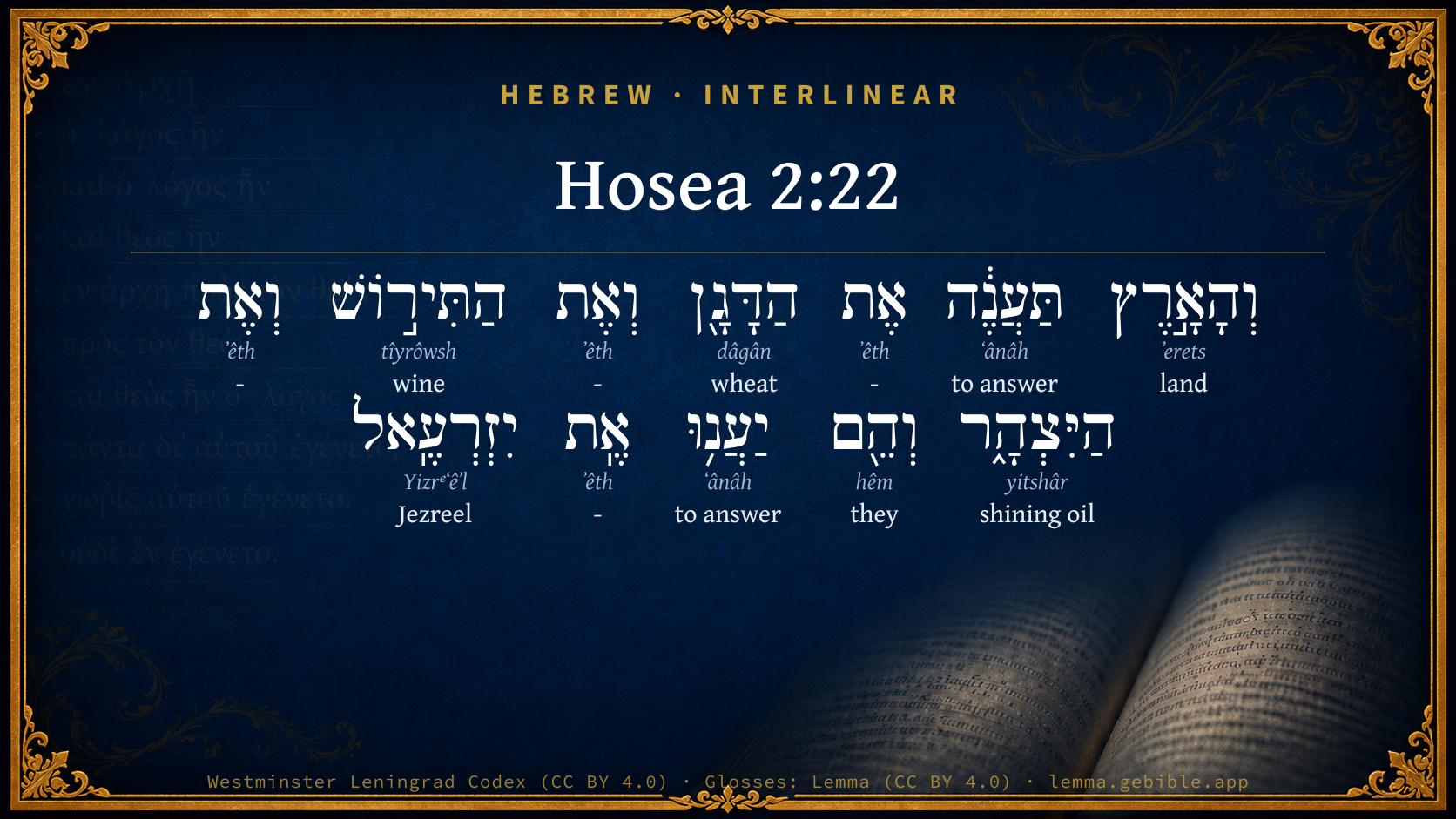
Hebrew (Westminster Leningrad Codex) Hosea 2:22 appears in the Hebrew Old Testament. The text above is from the Westminster Leningrad Codex. Each word links to its Strong’s number, a concise gloss, and parsing drawn from the Open Scriptures Hebrew Bible morphology. Click any word for its full Brown-Driver-Briggs (BDB) entry.
Download image
Cite this verse

Hosea 2:22 (World English Bible). Public Domain. Lemma interlinear Bible study tool, https://lemma.gebible.app/v/hosea/2/22.

Show BibTeX & RIS
BibTeX
RIS
English Translation
And the earth will respond to the grain, and the new wine, and the oil; And they will respond to Jezreel.
World English Bible · Public Domain
Download a study sheet

One document with this verse’s original text, its word-by-word gloss line, the meaning frame, cross-references with their text, attributed commentary, and full source and license credits — printable, and it pastes into notes with its structure intact.

This verse Autodidact and up

Study sheet (.html) Plain text (.txt)

A passage Seminary Student

Up to 50 verses in one chapter. A passage sheet keeps up to 6 commentary sources and 12 cross-references per verse, in the order this page ranks them, and says so on the sheet whenever that leaves anything out. Ask for a single verse and you get the Autodidact verse sheet above.

Everything on this page stays free to read, with no account — the sheet is a download of what is already on screen, not access to it.

Want to remove ads? Support Godless Engineer
Compare translations 3

The same verse in 3 English versions, stacked beneath the original-language interlinear above. Click any original word for its lexicon entry.

Each is an independent rendering of the whole verse — the interlinear is not word-aligned to these translations.

Highlighted words mark where these versions differ — a whole-verse word diff, not a word-by-word alignment.

  • World English Bible Public Domain
    And the earth will respond to the grain, and the new wine, and the oil; And they will respond to Jezreel.
  • King James Version Public Domain
    And the earth shall hear the corn, and the wine, and the oil; and they shall hear Jezreel.
  • unfoldingWord Literal Text CC BY-SA 4.0
    And the earth will answer the grain and the new wine and the oil, and they will answer Jezreel.

unfoldingWord Literal Text — © unfoldingWord, licensed CC BY-SA 4.0. Word-aligned USFM3 via Door43 (git.door43.org/unfoldingWord/en_ult).

Versions to compare (up to 4)

3 of 4 selected

Show all 18 translations

Every available English version of this verse, each an independent rendering of the whole verse.

  • World English Bible Public Domain
    And the earth will respond to the grain, and the new wine, and the oil; And they will respond to Jezreel.
  • Berean Standard Bible Public Domain
    And the earth will respond to the grain, to the new wine and oil, and they will respond to Jezreel.
  • Majority Standard Bible Public Domain
    And the earth will respond to the grain, to the new wine and oil, and they will respond to Jezreel.
  • King James Version Public Domain
    And the earth shall hear the corn, and the wine, and the oil; and they shall hear Jezreel.
  • American Standard Version (1901) Public Domain
    and the earth shall answer the grain, and the new wine, and the oil; and they shall answer Jezreel.
  • Revised Version (1885) Public Domain
    and the earth shall answer the corn, and the wine, and the oil; and they shall answer Jezreel.
  • Geneva Bible (1599) Public Domain
    And the earth shall heare the corne, and the wine, and the oyle, and they shall heare Izreel.
  • Douay-Rheims (1899) Public Domain
    And the earth shall hear the core, and the wine, and the oil, and these shall hear Jezrahel.
  • Young's Literal Translation Public Domain
    And the earth doth answer the corn, And the new wine, and the oil, And they answer Jezreel.
  • Literal Standard Version CC BY-SA 4.0
    And the earth answers the grain, || And the new wine, and the oil, || And they answer Jezreel.
  • Unlocked Literal Bible CC BY-SA 4.0
    The earth will answer the grain, the new wine and the oil, and they will answer Jezreel.
  • unfoldingWord Literal Text CC BY-SA 4.0
    And the earth will answer the grain and the new wine and the oil, and they will answer Jezreel.
  • Darby Bible Public Domain
    and the earth shall hear the corn, and the new wine, and the oil; and they shall hear Jizreel.
  • World Messianic Bible Public Domain
    and the earth will respond to the grain, and the new wine, and the oil; and they will respond to Jezreel.
  • Webster's Bible Public Domain
    And the earth shall hear the corn, and the wine, and the oil; and they shall hear Jezreel.
  • Free Bible Version CC BY-SA 4.0
    The earth will answer the grain, and the new wine, and the olive oil, and they shall answer, ‘Jezreel’ (God sows).
  • Bible in Basic English Public Domain
    And the earth will give its answer to the grain and the wine and the oil, and they will give an answer to Jezreel;
  • JPS Tanakh (1917) Public Domain
    (2-24) And the earth shall respond to the corn, and the wine, and the oil; and they shall respond to Jezreel.

Literal Standard Version (2020), Covenant Press — licensed CC BY-SA 4.0. Text via the HelloAO Bible API (eBible.org). Unlocked Literal Bible (unfoldingWord) — licensed CC BY-SA 4.0. Text via the HelloAO Bible API (eBible.org). unfoldingWord Literal Text — © unfoldingWord, licensed CC BY-SA 4.0. Word-aligned USFM3 via Door43 (git.door43.org/unfoldingWord/en_ult). Free Bible Version, Dr. Jonathan Gallagher — licensed CC BY-SA 4.0. Text via the HelloAO Bible API (eBible.org).

Word by word

More ways to search: Search by grammar → Find every occurrence → Compare this word →

Practice this passage: Drill this verse → Learn its vocabulary →

הַיִּצְהָ֑ר
yitshâr
H3323
“the · shining oil”
Particle, Definite Article + Noun, Common, Masculine, Singular, Absolute
Part of Speech
Particle + Noun
Type
Common
Gender
Masculine
Number
Singular
State
Absolute
Full BDB Definition

Origin: from H6671

TWOT: 1883c

fresh oil, shining (pure) oil
  1. וְהָאָ֣רֶץ ʼerets H776 “and · the · land” Conjunction + Particle, Definite Article + Noun, Common, Both, Singular, Absolute
  2. תַּעֲנֶ֔ה ʻânâh H6030 “to answer” Verb, Qal, Imperfect, 3rd Person, Feminine, Singular
  3. אֶת ʼêth H853 “-” Particle, Direct Object
  4. הַדָּגָ֖ן dâgân H1715 “the · wheat” Particle, Definite Article + Noun, Common, Masculine, Singular, Absolute
  5. וְאֶת ʼêth H853 “and · -” Conjunction + Particle, Direct Object
  6. הַתִּיר֣וֹשׁ tîyrôwsh H8492 “the · wine” Particle, Definite Article + Noun, Common, Masculine, Singular, Absolute
  7. וְאֶת ʼêth H853 “and · -” Conjunction + Particle, Direct Object
  8. וְהֵ֖ם hêm H1992 “and · they” Conjunction + Pronoun, Personal, 3rd Person, Masculine, Plural
  9. יַעֲנ֥וּ ʻânâh H6030 “to answer” Verb, Qal, Imperfect, 3rd Person, Masculine, Plural
  10. אֶֽת ʼêth H853 “-” Particle, Direct Object
  11. יִזְרְעֶֽאל Yizrᵉʻêʼl H3157 “Jezreel” Noun, Proper

About this verse

These counts appear in no published source. They are computed here, from the morphology-tagged text and Lemma’s own curated glosses. What Lemma adds →

12
words
8
distinct lemmas
Prophets
section

Notable vocabulary

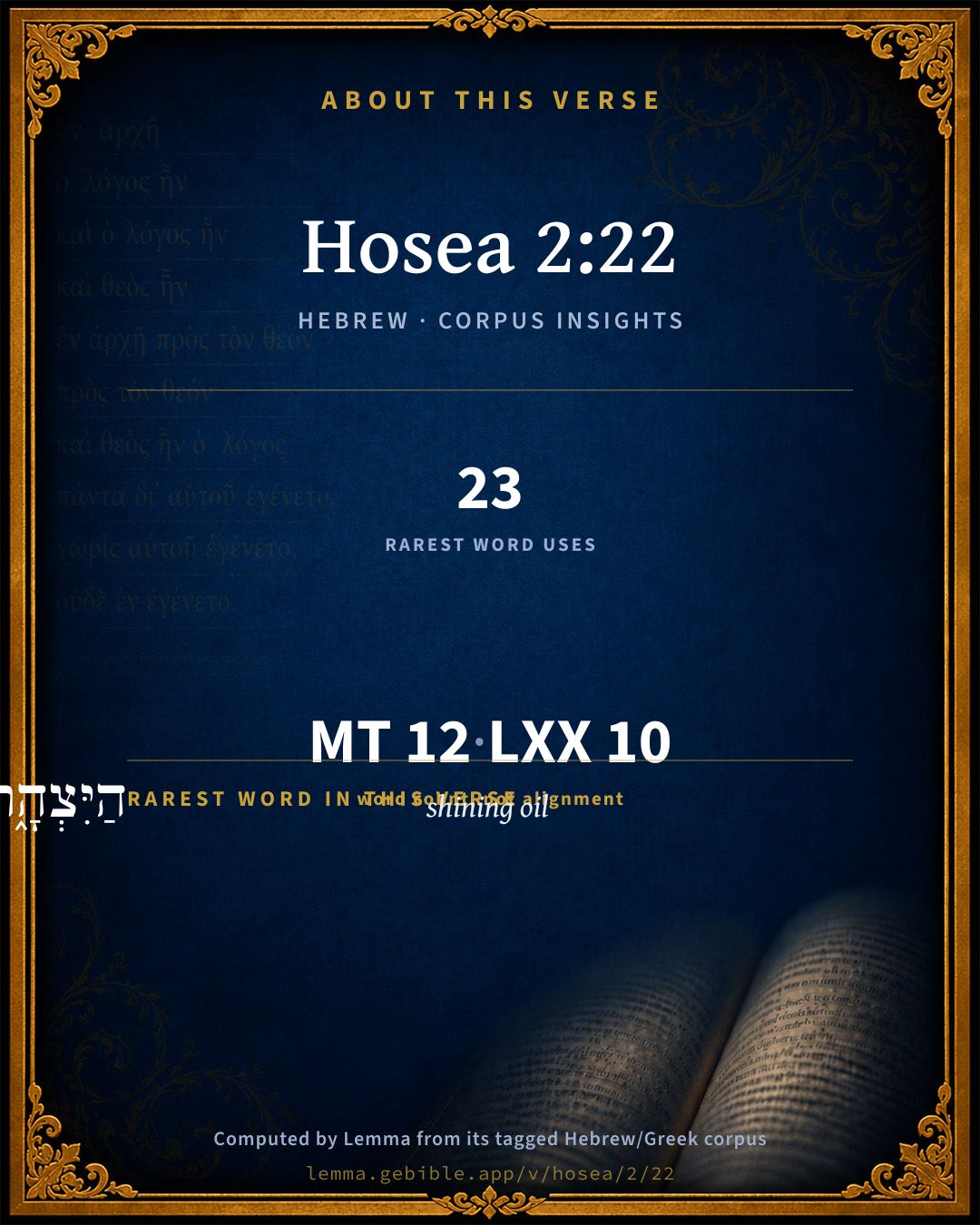
The rarest word here is הַיִּצְהָ֑ר shining oil H3323 — appearing just 23 times in the whole Hebrew Bible.

Shared distinctive vocabulary

הַיִּצְהָ֑ר shining oil H3323 occurs in 23 verses of the Hebrew Bible. Also found in:

Grammatical profile

  • 2 verbs
  • 5 nouns
  • 1 pronoun
  • 4 particles

Verb forms

  • תַּעֲנֶ֔ה Qal · Imperfect
  • יַעֲנ֥וּ Qal · Imperfect

Repetition

A word recurs within this verse — often emphatic in Hebrew:

  • תַּעֲנֶ֔ה to answer H6030 ×2

Hebrew & Septuagint length

In English translation the verse runs 21 words from the Hebrew and 20 from the Septuagint (LXX English) — closely comparable.

A rough comparison of the two English renderings, which tokenize alike — not a word-level alignment.

Word counts can differ between the Hebrew and the Greek without any difference in meaning — e.g. the Hebrew direct-object marker אֵת has no separate Greek word, and Greek often adds the article ὁ.

In the original languages it is 12 Hebrew tokens and 10 Greek tokens — but the two are counted differently (Hebrew bundles its prefixes and suffixes into one token; the Greek is in lemma form), so that isn’t a like-for-like length.

Cross-references

4

Topical passages linked to Hosea 2:22 in the Treasury of Scripture Knowledge — connected by theme and wording, ordered by reader-vote popularity; previews shown in the World English Bible.

  • Joel 2:19 Yahweh answered his people, "Behold, I will send you grain, new wine, and oil, And you will be satisfied with them; And I will no more make you a reproach among the nations.
  • Hosea 1:4 Yahweh said to him, "Call his name Jezreel; for yet a little while, and I will avenge the blood of Jezreel on the house of Jehu, and will cause the kingdom of the house of Israel to cease.
  • Hosea 1:11 The children of Judah and the children of Israel will be gathered together, and they will appoint themselves one head, and will go up from the land; for great will be the day of Jezreel.
  • Jeremiah 31:12 They shall come and sing in the height of Zion, and shall flow to the goodness of Yahweh, to the grain, and to the new wine, and to the oil, and to the young of the flock and of the herd: and their soul shall be as a watered garden; and they shall not sorrow any more at all.

Cross-references courtesy of OpenBible.info (CC BY 4.0).

Hebrew and Greek witnesses Masoretic Hebrew ↔ Greek Septuagint

The same verse in the two great witnesses to the Old Testament, shown verse-for-verse.

These are two independent witnesses, not word-aligned to each other, and the Septuagint is shown in lemma (dictionary) form.

Hebrew Hosea 2:22 Masoretic · Westminster Leningrad Codex

וְהָאָ֣רֶץ תַּעֲנֶ֔ה אֶת הַדָּגָ֖ן וְאֶת הַתִּיר֣וֹשׁ וְאֶת הַיִּצְהָ֑ר וְהֵ֖ם יַעֲנ֥וּ אֶֽת יִזְרְעֶֽאל

And the earth will respond to the grain, and the new wine, and the oil; And they will respond to Jezreel.

World English Bible · Public Domain

Greek LXX Hosea 2:22 Septuagint · lemma form

καί μνηστεύομαι σύ ἐμαυτοῦ ἐν πίστις καί ἐπιγιγνώσκω ὁ κύριος

and the earth shall listen to the corn, and the wine, and the oil; and they shall listen to Jezrael.

LXX2012 (modern English Septuagint) · Public Domain

On this verse, Trapp's Complete Commentary discusses the Septuagint’s reading. Read the note in Commentary ↓

Hebrew: Westminster Leningrad Codex (CC BY 4.0). Greek: Septuagint (public domain); English from LXX2012 (modern English Septuagint) (Public Domain). How the Septuagint differs from the Hebrew →

Targum (Aramaic paraphrase)

1

The Targum is the ancient Jewish Aramaic paraphrase of the Hebrew Scriptures — an interpretive translation, not the Hebrew text itself. Onkelos (literal) and Pseudo-Jonathan (expansive) render the Torah, and Jonathan the Prophets. Coverage is partial: where no permissively-licensed English translation exists for a verse, only the Aramaic is shown. This is verse-level text, not a word-by-word alignment to the Hebrew.

  1. Targum Jonathan Prophets (Joshua–Malachi)
    וֶאֱקַיְמִנְכוֹן קֳדָמַי בְּהֵימָנוּתָא וְתִידְעוּן לְמִדְחַל מִן קֳדָם יְיָ:

    (no public-domain English translation for this verse)

    Targum Jonathan — Aramaic: “Mikraot Gedolot” (public domain). English: “Sefaria Community Translation” (CC0 1.0 (public-domain dedication)); “London "Chaldee Paraphrase," 1871” (public domain). Text via Sefaria.

Commentary

Notes on Hosea 2:22 from classic Christian and Jewish commentators (each source and its license shown beneath its notes). The classic Christian expositions comment on the surrounding passage and are grouped to its opening verse, so a note may address several verses; the Jewish commentaries on the Tanakh (Rashi and others) are per-verse, so they appear only where the commentator wrote on this verse.

Lemma curates 59 commentaries, every one of them public domain or Creative Commons licensed, each selected and text-cleaned for this edition rather than reprinted as found. About our sources →

Trapp's Complete Commentary

John Trapp

Hos 2:22 And the earth shall hear the corn, and the wine, and the oil; and they shall hear Jezreel.

Ver. 22. And the earth shall hear] That is, shall bear great store of grain, wine, and oil ( vinum pendulum, i.e. uvas). New and fresh oil the word signifies, newly expressed, clear and shining, such as is called golden oil, Zec 4:12. God’s dear children shall have the best of the best, Isa 55:1-6. Even the kidneys of wheat, or whatsoever dainties the earth can afford them. They shall suck honey out of the rock; or, if it be but water, yet it shall be to them as sweet as honey, because therein they taste and see the Lord’s goodness, and they have meat to eat that the world knows not of.

And they shall hear Jezreel] That is, they shall answer the pains and prayers of God’s people, who are here called Jezreel still (though the Septuagint read it Israel), not to upbraid them with their former wickedness and calamities thereby procured (which yet was the first reason of that name given them, Hos 1:4), but rather to set forth the riches of his grace imparted to such a graceless people. And in addition to show that nothing could hinder them from partaking of those covenant mercies and that happy communion with God whereto they were now restored. This very name of theirs, once their shame, should now turn to their glory. Of Jezreel, scattered by God (which is one signification of the name), they should become Jezreel, a seed of God (which is another), that they might comfort themselves with the hope of Christ, the promised seed, and know that their posterity should not so degenerate into gentility, but that many of them should embrace Christ and inherit the promises, as did Araunah the Jebusite, who became a famous proselyte, Zec 9:7, {See Trapp on "Zec 9:7"} and as Jether the Ishmeelite, 1Ch 2:17, was for his faith and religion called an Israelite, 2Sa 17:25, and as Christ calleth himself Jesus of Nazareth, as a title of honour, which was once cast upon him as a reproach.

John Trapp, A Commentary or Exposition upon All the Books of the Old and New Testament (1647–1656) — public domain. Text from a community e-Sword module.

Adam Clarke's Commentary

Verse 22. Shall hear the corn, and the wine] When they seem to express a desire to supply the wants of man.

And they shall hear Jezreel.] The destitute people who are in want of the necessaries of life.

This most elegant gradation in the exertion of the influences of nature, for the supply of the wants of man, may be considered thus:-

1. There is a concord, harmony, and mutual influence, which God has established in the parts of created nature, in reference to the support and preservation of the human race.

2. God alone is the author of all this; and unless he give his command, communicate his energetic influence to the different parts of nature, these effects will not, cannot be produced.

3. Jezreel, the people who have been dispersed for their iniquities, and now about to be sown or planted in their own land, will require the most fostering care. See on Ho 2:23.

4. They are heard in desiring oil, wine, and corn. These are necessary to the support and comfort of life; and to those the desire of animal life naturally aspires.

5. These products are looked for from the EARTH. On it, and by it, grass grows for the cattle, and corn for the service of man.

6, The seeds or germs, whence proceed corn, wine, and oil, live and grow in the earth; but cannot come to perfection, unless the earth be impregnated with the dews and rains from the clouds. They are therefore represented as imploring the heavens to collect their clouds, to pour down their fructifying moisture upon it.

7. The clouds, or materials of which they are composed, not being able to arrange themselves, nor aggregate themselves so as to meet those demands, prevent drought, and maintain an effective vegetation, are represented as calling upon the heavens to form, arrange, and supply them with the requisite quantity of moisture.

8. God, who is the author of all being and all bounty, dependent on nothing, comes forward and says, I will hear the heavens, the clouds which are gathered in the atmosphere; he will arrange the particles, saturate those that are light, till they become sufficiently impregnated with the necessary fluid; and then direct them In his providence where to deposit their contents. And,

9. When brought to the proper place, he will shake them with his winds, or strike them with his thunder, so as to cause them to fall down in drops to fertilize the earth with their showers.

Thus then -

1. God works upon the heavens.

2. In them the clouds are collected.

3. The clouds drop their moisture upon the earth.

4. The earth exerts its vegetative influence upon the germs which it contains.

5. They expand, increase, and become matured, under the genial influences of the heavens, sun, air, water, from the clouds, c.

6. Man receives and applies those bounties of Providence, and variously prepares them for the support and comfort of life.

Take all this in still fewer words: -

As Jezreel or the Israelites are here considered as perishing for want of food, all inanimate nature is represented as invoking God in their behalf.

1. The heavens have prayed that they be stored with clouds, that they may drop down fatness upon the earth.

2. The Lord answers the heavens, and clouds are formed.

3. The earth invokes the clouds, that they may drop down their fatness into its bosom.

4. The bottles of heaven are, consequently, unstopped for this purpose.

5. Then the corn, wine, and olive, implore the earth to put forth its vegetative energy.

6. The earth answers and corn, wine, and oil are produced.

7. Jezreel cries for the necessaries of life, and the abundance of the above supplies all his wants.

All these are dependent on each other, as the links are which constitute a chain; and God has the government of the whole; and he manages all for the benefit of man. How wondrous is this providence! How gracious is this GOD!

Here is a series of prosopopoeias together. Corn, wine, oil, the earth, the clouds and their contents, the heavens, sun, moon, c., are all represented as intelligent beings, speaking to and influencing each other. GOD is at one end of the chain, and MAN at the other and by means of the intermediate links the latter is kept in a state of continued dependence upon the former for life, breath, and all things.

Adam Clarke's Commentary on the Bible (1810–1826) — public domain. Text from a community e-Sword/MySword module.

John Calvin's Commentaries

The Prophet used the word, Jezreel, before in a bad sense; for his purpose was to reproach the Israelites with their unfaithfulness: when they boasted of being the seed of Abraham, and always claimed that honorable and noble distinction, the Lord said, ‘Ye are Jezreel, and not Israel.’ It may be that the Prophet wished to show again what they deserved; but he teaches, at the same time, that God would by no means be prevented from showing kindness to the unworthy when reconciled to him. Though, then, they were rather Jezreelites than Israelites, yet their unworthiness would be no impediment, that God should not deal bountifully with them. There may also be an allusion here to a new people; for it follows in the next verse, וזרעתיה, usarotie, and I will sow her; and the word, Jezreel, has an affinity to this verb, it is indeed derived from זרע, saro, which is to sow: and as the Prophet presently adds, that Jezreel is, as it were, the seed of God, I do not disapprove of this supposed allusion. But yet the Prophet seems here to commend the grace of God, when he declares that they were Jezreelites with whom God would deal so kindly as to fructify the earth for their sake.

Let us now again repeat the substance of the whole, The corn, and the wine, and the oil, will hear Jezreel The Israelites were famished, and as it is usual with those in want of food, they cried out, ‘Who will give us bread, and wine, and oil?’ For the stomach, as it is said, has no ears; nor has it reason and judgment: when there is extreme want, men, as if they were distracted, will call for bread, and wine, and oil. God then has regard for these blind instincts of men, which only crave what will gratify them: hence he says, The corn, and wine, and oil, will hear Jezreel, — but when? Even when the earth will supply trees with sap and moisture, and extend to the seed its strength; it is then that the earth will hear the corn, and the wine, and the oil: for these grow not of themselves, but derive supplies from the earth; and hence the earth is said to hear them. But cannot the earth of itself hear the corn, or the wine, or the oil? By no means, except rain descends from heaven. Since, then, the earth itself draws moisture and wetness from heaven, we see that men in vain cry out in famine, except they look up to heaven: and heaven is ruled by the will of God. Let men, therefore, learn to ascend up to God, that they may seek from him their daily bread.

We now, then, see how suitable is this gradation employed by the Prophet, by which God, on account of the rude and weak comprehension of men, leads them up at last to himself. For they turn their thoughts to bread, and wine, and oil; from these they seek food: they are in this matter very stupid. Be it so; God is indulgent to their simplicity and ignorance; for by degrees he proceeds from corn, and wine, and oil, to the earth, and then from the earth to heaven; and he afterwards shows that heaven cannot pour down rain except at his will. It follows at last —

John Calvin's Commentaries (1540-1563) — public domain. Text from the Calvin Translation Society English edition (1840s-50s) via the Christian Classics Ethereal Library (ccel.org). Calvin's coverage is partial (roughly two-thirds of the Bible); uncommented books and verses are honest gaps, never fabricated. The 19th-century editor's footnotes and remarks are omitted so the notes are faithfully Calvin's own voice.

Haydock's Catholic Bible Commentary

Jezrahel. This most fruitful valley shall again be covered with abundant crops. The whole nation of the Jews shall be happy. (Calmet)

George Leo Haydock (1774–1849), Haydock's Catholic Family Bible and Commentary, 1859 edition — public domain. Excludes Psalms (Douay-Rheims chapter numbering differs from Protestant) and Deuterocanonical books (Catholic canon only).

Matthew Poole's English Annotations

In that day, when this new alliance is made, or in the day of gospel grace, I will hear: this general promise God gives us to encourage us to cry to him; he will so hear as to answer. Saith the Lord: this is the seal to the truth and certainty of the things promised.

There is a subordination of causes, all second causes do in their ranks (like wheels in a curious engine) move as moved by the first great spring, and so contribute to the good of such as any way depend on them. Thus here, God, the first and universal cause, will influence the heavens, he will command their dew and showers; they would be as iron over us, if God did not command them to distil their drops on the earth; when this is dry, parched, and barren, it does as it were cry to the heavens for refreshing showers, for fruitful rains; when the seed sown, the vines and olives planted, are at a stand, take no rooting, they do as it were cry to the earth for its kindly influences and fatness, that they may spring up and yield fruit for Jezreel: which may call, and cry, and wait, but never be satisfied, if God do not hear them, and command his blessing of fructifying influences, which God here doth promise to his people on renewing covenant with them. God’s seed, his gathered ones, his espoused church, shall be served to hey comfort by all the creatures. When disobedience, backslidings, idolatries, and such-like sins did provoke God to punish them with famine and scarcity; now their repentance and obedience shall be blessed with plenty, and God will set the frame of heaven and earth in due order to effect this, there shall be a harmony and correspondence between all subordinate causes moved by God the first great cause, whence expected events and fruits shall certainly be produced for their good and comfort.

Matthew Poole's English Annotations on the Holy Bible (1683–1685) — public domain. Text from a community e-Sword/MySword module.

Rashi

Rabbi Shlomo Yitzchaki (Rashi)

And I will betroth you to Me with faith For the reward of the faith, for, while in exile, you believed in the promises through My prophets. [from Mechilta 14:31 with variations]

Rashi on the Tanakh — English translations: “The Judaica Press complete Tanach with Rashi, translated by A. J. Rosenberg” (CC BY 4.0); “Pentateuch with Rashi's commentary by M. Rosenbaum and A.M. Silbermann, 1929-1934” (public domain); “The Metsudah Tanach series, Lakewood, N.J” (CC BY 4.0); and “The Book of Joshua, Metsudah Publications, 1997” (CC BY 4.0). Text via Sefaria.

Lesson kit

Teaching starters — assembled from the data on this page, not authored interpretation. Every prompt links to the verse data it draws on. Edit before teaching.

Hosea, in the Prophets, opens this verse with 12 words (8 distinct Hebrew lemmas). Its most distinctive word is yitshâr (“shining oil”). A historical commentator’s framing appears above. Read the whole chapter for the surrounding context.

Discussion questions

  1. What does “shining oil” (yitshâr) contribute to the verse as a whole?
  2. Numbers 18:12 shares the word «shining oil» with this verse. How do the two illuminate each other?
  3. “to answer” occurs 2× in this one verse. What is the effect of the repetition?
  4. The translations on this page render this verse differently — a whole-verse word diff, not a word-by-word alignment. What might account for the different wordings?
  5. The verb «תַּעֲנֶ֔ה» is Qal Imperfect. How does its form color the action?
  6. Reading how Trapp's Complete Commentary and Adam Clarke's Commentary read this verse, where do the two commentators agree and where do they part?

Things to notice

Reading settings

Reading text

Shown beneath each verse's original-language words.

Old Testament
Old Testament edition

Read the OT as the Masoretic Hebrew (MT) or the Greek Septuagint (LXX).

English shown for the Greek Septuagint (in the Hebrew ↔ Greek comparison).

Comparing translations? Open the Compare panel on any verse page to stack up to four side by side.