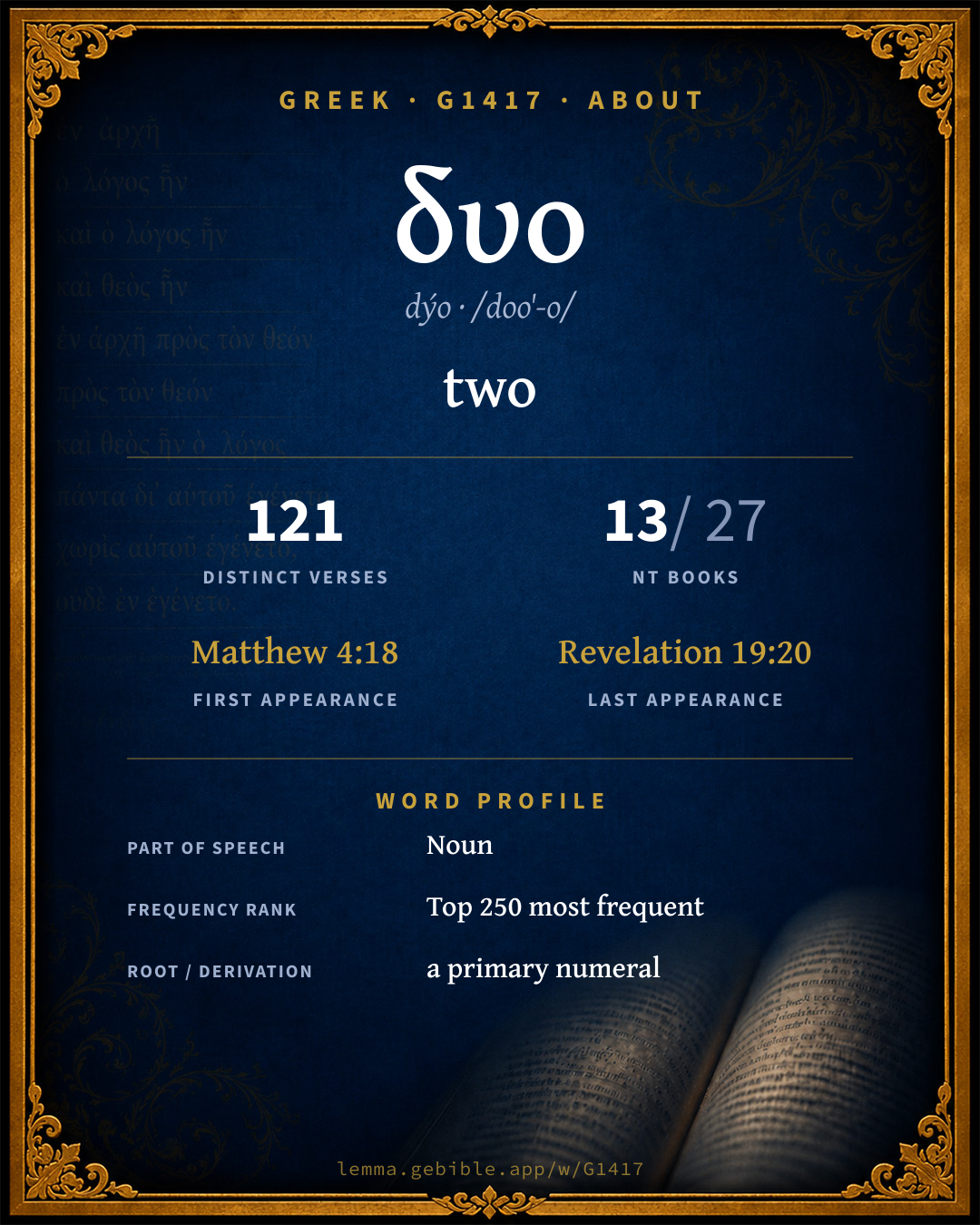
δύο
two
Full lexicon entry — Thayer's Greek Lexicon
From Thayer's Greek Lexicon
Where this word appears
Grammar key — what these labels mean
Part of speech
- Adjective
- A word that describes or qualifies a noun.
Case
- Dative
- The case of the indirect object, means, or location — “to / for / with / in.”
Gender
- Masculine
- Grammatically masculine.
- Feminine
- Grammatically feminine.
Number
- Plural
- More than one.
Every verse where G1417 appears in the Book of Revelation — 9 distinct verses. Click any verse to open its interlinear word-by-word view. Verse text shown in the World English Bible for context — . Each verse’s Greek form is shown with its reference; the English is not keyword-highlighted, since the data carries no word-level English alignment. Use “Compare translations” on any verse to read it across multiple English versions. This concordance covers the Greek New Testament; Septuagint (Greek Old Testament) occurrences of this word are not indexed here.
Revelation
- Revelation 9:12 δύο adj num indecl The first woe is past. Behold, there are still two woes coming after this.
- Revelation 11:2 δύο adj num indecl Leave out the court which is outside of the temple, and don't measure it, for it has been given to the gentiles. They will tread the holy city under foot for forty-two months.
- Revelation 11:3 δυσὶν adj dat pl masc I will give power to my two witnesses, and they will prophesy one thousand two hundred sixty days, clothed in sackcloth."
- Revelation 11:4 δύο δύο adj num indecl adj num indecl These are the two olive trees and the two lampstands, standing before the Lord of the earth.
- Revelation 11:10 δύο adj num indecl Those who dwell on the earth rejoice over them, and they will be glad. They will give gifts to one another, because these two prophets tormented those who dwell on the earth.
- Revelation 12:14 δύο adj num indecl Two wings of the great eagle were given to the woman, that she might fly into the wilderness to her place, so that she might be nourished for a time, and times, and half a time, from the face of the serpent.
- Revelation 13:5 δύο adj num indecl A mouth speaking great things and blasphemy was given to him. Authority to make war for forty-two months was given to him.
- Revelation 13:11 δύο adj num indecl I saw another beast coming up out of the earth. He had two horns like a lamb, and he spoke like a dragon.
- Revelation 19:20 δύο adj num indecl The beast was taken, and with him the false prophet who worked the signs in his sight, with which he deceived those who had received the mark of the beast and those who worshiped his image. These two were thrown alive into the lake of fire that burns with sulfur.
About this entry
At a glance — auto-summarized from this page’s data, not written by a person. Every figure links to its source below. This summary describes the numbers; it doesn’t interpret them.
At its core, δυο (dýo) means “two.” Scripture first uses it in Matthew 4:18. It turns up in 121 verses across 13 books, a common footprint. The word gravitates to Matthew (29%), then Luke and Mark. It shares a root with δευτερος, δις and δωδεκα. Each statement above links to its evidence; the full detail follows below.
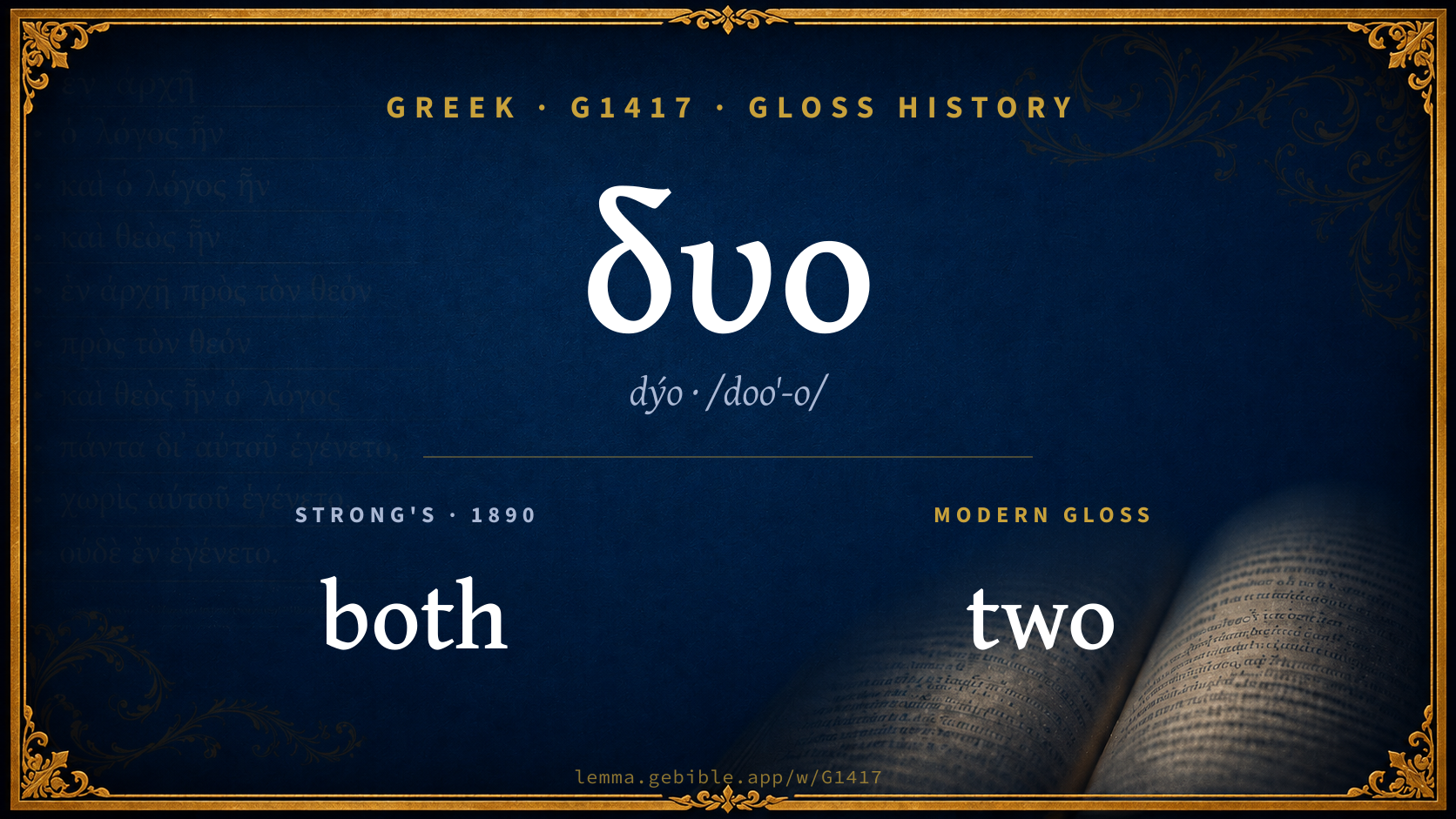
Gloss history
Strong's 1890 vs modern scholarship
About this word
Strong's G1417 catalogs a Greek word from the Greek New Testament.
These counts are not copied from any lexicon or concordance. They are computed here, from the morphology-tagged Greek New Testament. What Lemma adds →
- 121
- distinct verses
- The word appears in 121 distinct verses.
- 13 / 27
- NT books
- The word appears in 13 of 27 New Testament books.
- #126
- by frequency
- Top 250 most frequent Greek words (rank 126 of 5,347 Greek words by occurrence).
View all 121 occurrences in the concordance →
By section of the New Testament
By traditional corpus
Conventional, traditional groupings — biblical authorship is debated, so this is a traditional corpus grouping, not an authorship claim. Some books belong to more than one corpus (Luke is in both the Gospels and the Lukan corpus, and so on), so these shares overlap and need not total 100%. Each figure is a share of the word’s 121 distinct verses.
- Gospels 88 verses · 73%
- Lukan (Luke–Acts) 37 verses · 31%
- Johannine 22 verses · 18%
- Pauline corpus 10 verses · 8%
- Revelation 9 verses · 7%
- Hebrews 2 verses · 2%
How translations render this word
Counts come from each version’s own published word-to-Strong’s tagging or interlinear alignment — an approximate guide to how each version renders this word, not a word-level alignment the data otherwise carries. Because each total is that version’s own tagged count, the per-version totals vary from one another and need not match the appearance or distinct-verse counts above. These counts may also differ from a printed concordance because Lemma counts each distinctly tagged rendering and does not collapse phrase taggings into a single head-word total. This is a fixed set of word-tagged versions (KJV, ASV, BSB, ULT) and does not change with the reading translation you choose elsewhere. Each version’s license is shown beside its name below (and on Sources).
- King James Version: Two 118×, Twain 8×, Both 2×
- American Standard Version: Two 125×
- Berean Standard Bible: Two 124×, Second 3×
- unfoldingWord Literal Text: Two 129×
King James Version Public Domain
Renders G1417 across 135 tagged occurrences — most commonly:
Plus 5 renderings that appear only once — usually multi-word phrases or single function words the recovered tagging swept in, not distinct renderings.
American Standard Version Public Domain
Renders G1417 across 137 tagged occurrences — most commonly:
Plus 12 renderings that appear only once — usually multi-word phrases or single function words the recovered tagging swept in, not distinct renderings.
Berean Standard Bible Public Domain
Renders G1417 across 130 tagged occurrences — most commonly:
Plus 3 renderings that appear only once — usually multi-word phrases or single function words the recovered tagging swept in, not distinct renderings. Not rendered by a distinct English word in 5 further occurrences.
unfoldingWord Literal Text CC BY-SA 4.0
Renders G1417 across 135 tagged occurrences — most commonly:
Plus 6 renderings that appear only once — usually multi-word phrases or single function words the recovered tagging swept in, not distinct renderings. Not rendered by a distinct English word in 4 further occurrences.
Senses in Thayer's
The 1 sense Thayer's distinguishes for this word, in lexicon order (not ranked by frequency or importance). The full entry — with sub-senses — is in the Lexicon Entry tab.
- the two, the twain
Word origin
Origin: a primary numeral
A primary numeral; two : - both twain two.
— Strong’s Exhaustive Concordance (1890), public domain.
Forms in the corpus
The 6 distinct written forms G1417 takes in the Greek New Testament, most frequent first — each parse links to that case’s occurrences in the concordance.
| Form | Parsing | Example | Uses |
|---|---|---|---|
| δύο dýo | Adjective, Numeral (indeclinable) | Matthew 4:18 | 122 |
| δυσὶν dysìn | Adjective, Dative, Plural, Masculine | Mark 16:12 | 5 |
| δυσὶ dysì | Adjective, Dative, Plural, Masculine | Matthew 6:24 | 2 |
| Δύο Dýo | Adjective, Numeral (indeclinable) | Luke 7:41 | 1 |
| δυσί dysí | Adjective, Dative, Plural, Feminine | Acts 21:33 | 1 |
| δυσίν dysín | Adjective, Dative, Plural, Feminine | Acts 12:6 | 1 |
Same root — word family
Other Thayer's entries built from the same root as G1417, grouped by Strong’s listed origin. These share a root / origin per the lexicon — not necessarily a shared meaning. Each links to that word’s own entry.
Derived from this word
Compare all same-root words → They share a root, not necessarily a meaning.
Septuagint usage
The same Greek word δυο appears 555 times in the Greek Old Testament (Septuagint), across 485 verses in 29 books.
- 555
- LXX occurrences
- Tagged occurrences of this Greek word in the Septuagint.
- 485
- verses
- Distinct Septuagint verses containing this word.
- 29 / 39
- OT books
- The word appears in 29 of the 39 Old Testament books.
Sample Septuagint occurrences
- Genesis 1:16 δύο
- Exodus 2:13 δύο
- Leviticus 3:4 δύο
- Numbers 1:33 δύο
- Deuteronomy 3:8 δύο
- Joshua 2:1 δύο
- Judges 7:3 δύο
- Ruth 1:2 δύο
- 1 Samuel 1:2 δύο
- 2 Samuel 1:1 δύο
- 1 Kings 2:5 δύο
- 2 Kings 1:14 δύο
Septuagint occurrences (same lexeme)
Every verse where the same Strong’s number (G1417) appears in the Greek Septuagint — showing the first 50 of 485. Verse text shown in the World English Bible for context; the Greek form is the matched word — the English is not keyword-highlighted.
- Genesis 1:16 δύο God made the two great lights: the greater light to rule the day, and the lesser light to rule the night. He also made the stars.
- Genesis 2:24 δύο Therefore a man will leave his father and his mother, and will join with his wife, and they will be one flesh.
- Genesis 2:25 δύο They were both naked, the man and his wife, and were not ashamed.
- Genesis 3:7 δύο Both of their eyes were opened, and they knew that they were naked. They sewed fig leaves together, and made themselves aprons.
- Genesis 4:19 δύο Lamech took two wives: the name of the one was Adah, and the name of the other Zillah.
- Genesis 5:18 δύο Jared lived one hundred sixty-two years, and became the father of Enoch.
- Genesis 5:20 δύο All the days of Jared were nine hundred sixty-two years, then he died.
- Genesis 5:26 δύο Methuselah lived after he became the father of Lamech seven hundred eighty-two years, and became the father of sons and daughters.
- Genesis 6:19 δύο Of every living thing of all flesh, you shall bring two of every sort into the ark, to keep them alive with you. They shall be male and female.
- Genesis 6:20 δύο Of the birds after their kind, of the cattle after their kind, of every creeping thing of the ground after its kind, two of every sort shall come to you, to keep them alive.
- Genesis 7:2 δύο You shall take seven pairs of every clean animal with you, the male and his female. Of the animals that are not clean, take two, the male and his female.
- Genesis 7:3 δύο Also of the birds of the sky, seven and seven, male and female, to keep seed alive on the surface of all the earth.
- Genesis 7:9 δύο went by pairs to Noah into the ark, male and female, as God commanded Noah.
- Genesis 7:15 δύο They went to Noah into the ark, by pairs of all flesh with the breath of life in them.
- Genesis 9:22 δύο Ham, the father of Canaan, saw the nakedness of his father, and told his two brothers outside.
- Genesis 9:23 δύο Shem and Japheth took a garment, and laid it on both their shoulders, went in backwards, and covered the nakedness of their father. Their faces were backwards, and they didn't see their father's nakedness.
- Genesis 10:25 δύο To Eber were born two sons. The name of the one was Peleg, for in his days was the earth divided. His brother's name was Joktan.
- Genesis 11:20 δύο Reu lived thirty-two years, and became the father of Serug.
- Genesis 19:1 δύο The two angels came to Sodom at evening. Lot sat in the gate of Sodom. Lot saw them, and rose up to meet them. He bowed himself with his face to the earth,
- Genesis 19:8 δύο See now, I have two virgin daughters. Please let me bring them out to you, and do you to them as is good in your eyes. Only don't do anything to these men, because they have come under the shadow of my roof."
- Genesis 19:15 δύο When the morning arose, then the angels hurried Lot, saying, "Arise, take your wife, and your two daughters who are here, lest you be consumed in the iniquity of the city."
- Genesis 19:16 δύο But he lingered; and the men laid hold on his hand, and on the hand of his wife, and on the hand of his two daughters, Yahweh being merciful to him; and they took him out, and set him outside of the city.
- Genesis 19:30 δύο Lot went up out of Zoar, and lived in the mountain, and his two daughters with him; for he was afraid to live in Zoar. He lived in a cave with his two daughters.
- Genesis 19:36 δύο Thus both of Lot's daughters were with child by their father.
- Genesis 22:3 δύο Abraham rose early in the morning, and saddled his donkey, and took two of his young men with him, and Isaac his son. He split the wood for the burnt offering, and rose up, and went to the place of which God had told him.
- Genesis 22:6 δύο Abraham took the wood of the burnt offering and laid it on Isaac his son. He took in his hand the fire and the knife. They both went together.
- Genesis 24:22 δύο It happened, as the camels had done drinking, that the man took a golden ring of half a shekel weight, and two bracelets for her hands of ten shekels weight of gold,
- Genesis 25:23 δύο Yahweh said to her, Two nations are in your womb, Two peoples will be separated from your body. The one people will be stronger than the other people. The elder will serve the younger.
- Genesis 27:9 δύο Go now to the flock, and get me from there two good kids of the goats. I will make them savory food for your father, such as he loves.
- Genesis 27:45 δύο until your brother's anger turn away from you, and he forgets what you have done to him. Then I will send, and get you from there. Why should I be bereaved of you both in one day?"
- Genesis 29:16 δύο Laban had two daughters. The name of the elder was Leah, and the name of the younger was Rachel.
- Genesis 31:33 δύο Laban went into Jacob's tent, into Leah's tent, and into the tent of the two maid-servants; but he didn't find them. He went out of Leah's tent, and entered into Rachel's tent.
- Genesis 31:37 δύο Now that you have felt around in all my stuff, what have you found of all your household stuff? Set it here before my relatives and your relatives, that they may judge between us two.
- Genesis 31:41 δύο These twenty years have I been in your house. I served you fourteen years for your two daughters, and six years for your flock, and you have changed my wages ten times.
- Genesis 32:8 δύο and he said, "If Esau comes to the one company, and strikes it, then the company which is left will escape."
- Genesis 32:11 δύο Please deliver me from the hand of my brother, from the hand of Esau: for I fear him, lest he come and strike me, and the mothers with the children.
- Genesis 32:23 δύο He took them, and sent them over the stream, and sent over that which he had.
- Genesis 33:1 δύο Jacob lifted up his eyes, and looked, and, behold, Esau was coming, and with him four hundred men. He divided the children between Leah, Rachel, and to the two handmaids.
- Genesis 33:2 δύο He put the handmaids and their children in front, Leah and her children after, and Rachel and Joseph at the rear.
- Genesis 34:25 δύο It happened on the third day, when they were sore, that two of Jacob's sons, Simeon and Levi, Dinah's brothers, each took his sword, came upon the unsuspecting city, and killed all the males.
- Genesis 40:2 δύο Pharaoh was angry with his two officers, the chief cupbearer and the chief baker.
- Genesis 41:1 δύο It happened at the end of two full years, that Pharaoh dreamed: and, behold, he stood by the river.
- Genesis 41:50 δύο To Joseph were born two sons before the year of famine came, whom Asenath, the daughter of Potiphera priest of On, bore to him.
- Genesis 42:37 δύο Reuben spoke to his father, saying, "Kill my two sons, if I don't bring him to you. Deliver him into my hand, and I will bring him to you again."
- Genesis 44:27 δύο Your servant, my father, said to us, 'You know that my wife bore me two sons:
- Genesis 48:1 δύο It happened after these things, that someone said to Joseph, "Behold, your father is sick." He took with him his two sons, Manasseh and Ephraim.
- Genesis 48:5 δύο Now your two sons, who were born to you in the land of Egypt before I came to you into Egypt, are mine; Ephraim and Manasseh, even as Reuben and Simeon, will be mine.
- Genesis 48:13 δύο Joseph took them both, Ephraim in his right hand toward Israel's left hand, and Manasseh in his left hand toward Israel's right hand, and brought them near to him.
- Exodus 2:13 δύο He went out the second day, and, behold, two men of the Hebrews were fighting with each other. He said to him who did the wrong, "Why do you strike your fellow?"
- Exodus 4:9 δύο It will happen, if they will not believe even these two signs, neither listen to your voice, that you shall take of the water of the river, and pour it on the dry land. The water which you take out of the river will become blood on the dry land."
These are occurrences of the same Greek lexeme (G1417) in the Septuagint — not a translation of any one Hebrew word. The store carries no word-level Hebrew↔Greek alignment, so no Hebrew original is asserted here. Counts come from the recovered LXX Strong's tagging — high-frequency vocabulary is well covered, while rare or late forms may be untagged — so they reflect tagged occurrences and may slightly undercount.