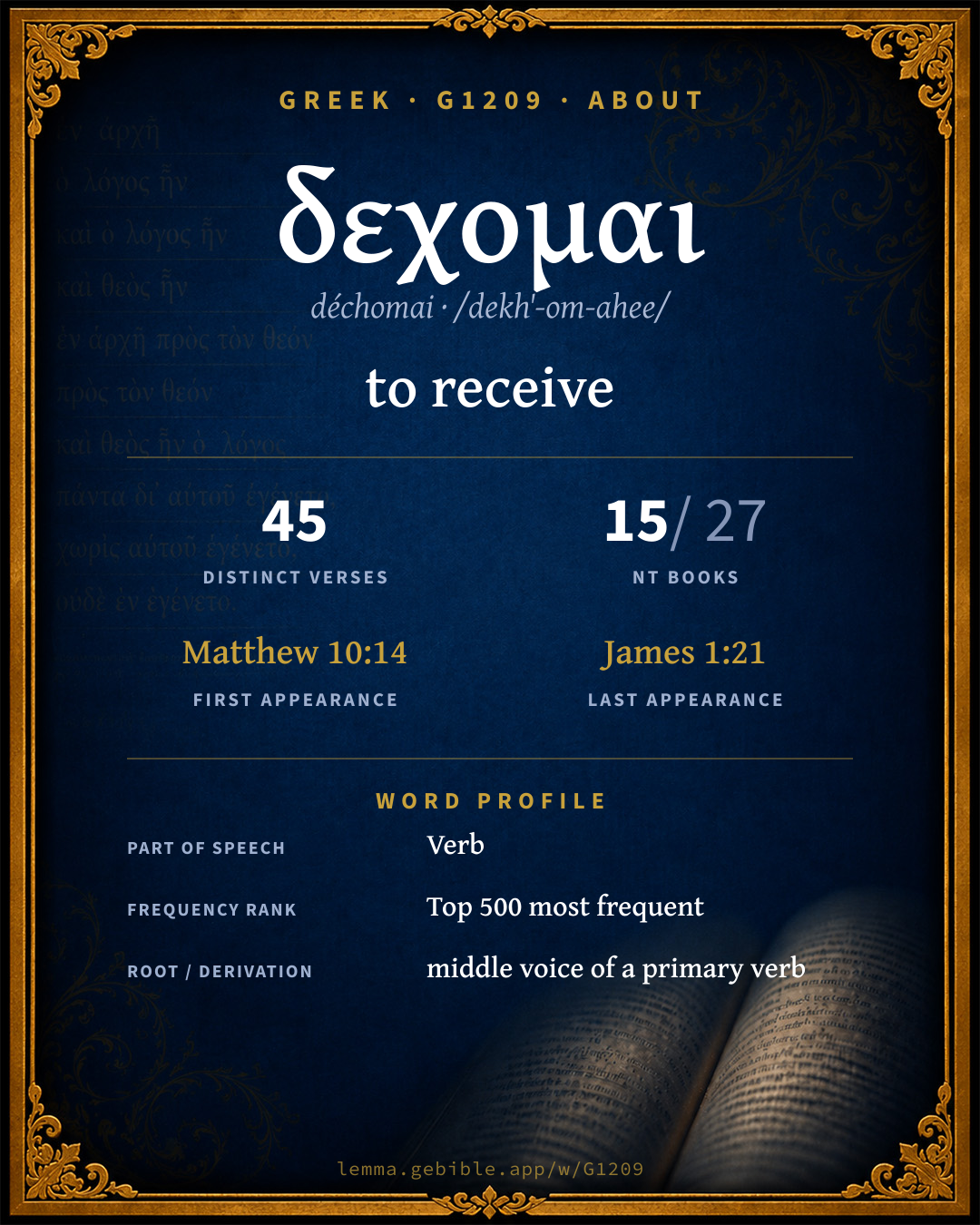
δέχομαι
to receive
‘to receive’ is one of 6 main senses fuller range ↓
Full lexicon entry — Thayer's Greek Lexicon
From Thayer's Greek Lexicon
Where this word appears
Grammar key — what these labels mean
Part of speech
- Verb
- An action or state-of-being word.
Tense
- Aorist
- Action viewed as a simple whole, without regard to duration — often past (perfective aspect).
- Present
- Ongoing or general action in present time (imperfective aspect).
- Perfect
- A completed past action with continuing present results.
Voice
- Middle deponent
- Middle in form but active in meaning.
- Middle or Passive deponent
- Middle/passive in form but active in meaning.
Mood
- Subjunctive
- Expresses probability, purpose, or possibility (the mood of contingency).
- Indicative
- States a fact or asks a factual question (the mood of reality).
- Imperative
- Expresses a command or request.
- Participle
- A verbal adjective (“writing,” “having written”).
- Infinitive
- A verbal noun (“to write”), unmarked for person or number.
Case
- Nominative
- The case of the subject (and the predicate nominative).
Person
- 3rd person
- The one spoken about (“he / she / it / they”).
- 2nd person
- The one addressed (“you”).
- 1st person
- The speaker (“I / we”).
Gender
- Masculine
- Grammatically masculine.
- Feminine
- Grammatically feminine.
Number
- Singular
- One.
- Plural
- More than one.
Every verse where G1209 appears in the Book of 2 Thessalonians — 1 distinct verse. Click any verse to open its interlinear word-by-word view. Verse text shown in the World English Bible for context — . Each verse’s Greek form is shown with its reference; the English is not keyword-highlighted, since the data carries no word-level English alignment. Use “Compare translations” on any verse to read it across multiple English versions. This concordance covers the Greek New Testament; Septuagint (Greek Old Testament) occurrences of this word are not indexed here.
2 Thessalonians
About this entry
At a glance — auto-summarized from this page’s data, not written by a person. Every figure links to its source below. This summary describes the numbers; it doesn’t interpret them.
δεχομαι — transliterated déchomai — is a Greek verb carrying the sense “to receive.” Its English rendering has broadened — “receive” classically, “welcomes” (Berean Standard Bible) in modern versions; see the renderings breakdown. The Greek New Testament uses it across 45 verses — moderately common. More than a quarter of its appearances fall in Luke. Its lexical range runs to 6 senses. See the sense tree, 45-verse concordance, and the renderings breakdown below.
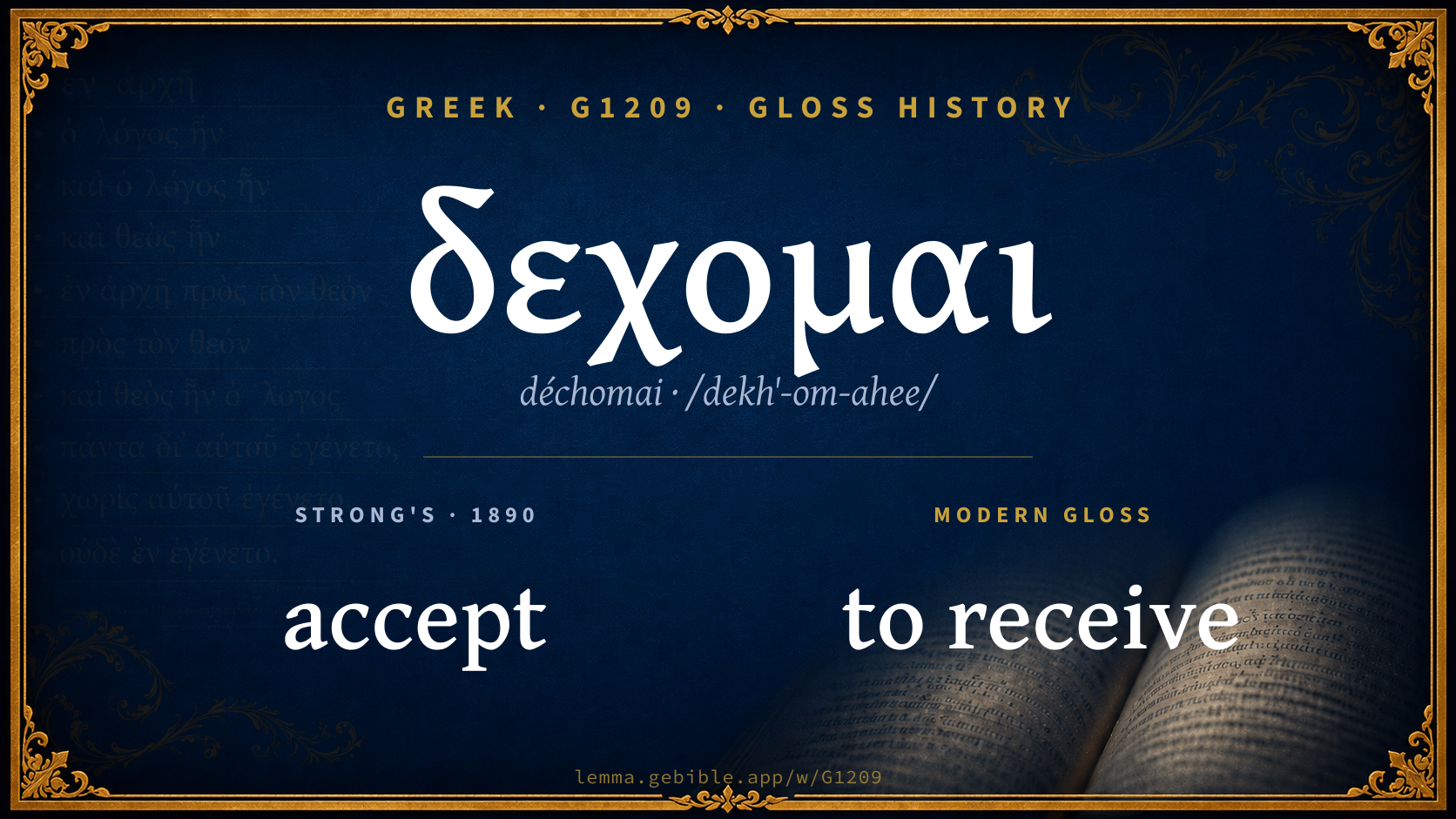
Gloss history
Strong's 1890 vs modern scholarship
About this word
Strong's G1209 catalogs a Greek word from the Greek New Testament.
These counts are not copied from any lexicon or concordance. They are computed here, from the morphology-tagged Greek New Testament. What Lemma adds →
- 45
- distinct verses
- The word appears in 45 distinct verses.
- 15 / 27
- NT books
- The word appears in 15 of 27 New Testament books.
- #286
- by frequency
- Top 500 most frequent Greek words (rank 286 of 5,347 Greek words by occurrence).
View all 45 occurrences in the concordance →
By section of the New Testament
By traditional corpus
Conventional, traditional groupings — biblical authorship is debated, so this is a traditional corpus grouping, not an authorship claim. Some books belong to more than one corpus (Luke is in both the Gospels and the Lukan corpus, and so on), so these shares overlap and need not total 100%. Each figure is a share of the word’s 45 distinct verses.
- Gospels 22 verses · 49%
- Lukan (Luke–Acts) 21 verses · 47%
- Pauline corpus 13 verses · 29%
- Johannine 1 verse · 2%
- Hebrews 1 verse · 2%
- General (Catholic) Epistles 1 verse · 2%
How translations render this word
Counts come from each version’s own published word-to-Strong’s tagging or interlinear alignment — an approximate guide to how each version renders this word, not a word-level alignment the data otherwise carries. Because each total is that version’s own tagged count, the per-version totals vary from one another and need not match the appearance or distinct-verse counts above. These counts may also differ from a printed concordance because Lemma counts each distinctly tagged rendering and does not collapse phrase taggings into a single head-word total. This is a fixed set of word-tagged versions (KJV, ASV, BSB, ULT) and does not change with the reading translation you choose elsewhere. Each version’s license is shown beside its name below (and on Sources).
- King James Version: Receive 14×, Received 7×, Receiveth 7×
- American Standard Version: Receive 16×, Receiveth 8×, Received 6×
- Berean Standard Bible: Welcomes 10×, Receives 6×, Accept 3×
- unfoldingWord Literal Text: Receive 16×, Receives 11×, Does 6×
King James Version Public Domain
Renders G1209 across 68 tagged occurrences — most commonly:
Plus 16 renderings that appear only once — usually multi-word phrases or single function words the recovered tagging swept in, not distinct renderings.
American Standard Version Public Domain
Renders G1209 across 67 tagged occurrences — most commonly:
Plus 14 renderings that appear only once — usually multi-word phrases or single function words the recovered tagging swept in, not distinct renderings.
Berean Standard Bible Public Domain
Renders G1209 across 56 tagged occurrences — most commonly:
Plus 20 renderings that appear only once — usually multi-word phrases or single function words the recovered tagging swept in, not distinct renderings.
unfoldingWord Literal Text CC BY-SA 4.0
Renders G1209 across 71 tagged occurrences — most commonly:
Plus 18 renderings that appear only once — usually multi-word phrases or single function words the recovered tagging swept in, not distinct renderings.
Senses in Thayer's
The 6 senses Thayer's distinguishes for this word, in lexicon order (not ranked by frequency or importance). The full entry — with sub-senses — is in the Lexicon Entry tab.
- to take hold of, take up
- used of a place receiving one
- to receive or grant access to, a visitor, not to refuse intercourse or friendship
- of the thing offered in speaking, teaching, instructing
- to receive. i.e. to take upon one's self, sustain, bear, endure
- to learn
Word origin
Origin: middle voice of a primary verb
Middle voice of a primary verb; to receive (in various applications literally or figuratively): - accept receive take. Compare G2983 .
— Strong’s Exhaustive Concordance (1890), public domain.
Forms in the corpus
The 21 distinct written forms G1209 takes in the Greek New Testament, most frequent first — each parse links to that tense’s occurrences in the concordance.
Same root — word family
Other Thayer's entries built from the same root as G1209, grouped by Strong’s listed origin. These share a root / origin per the lexicon — not necessarily a shared meaning. Each links to that word’s own entry.
Derived from this word
- δεκτος dektós G1184 acceptable
- δεξιος dexiós G1188 right
- δοκος dokós G1385 beam
- δοχη dochḗ G1403 feast
Compare all same-root words → Showing 4 of 5 — not the complete family. They share a root, not necessarily a meaning.
Septuagint usage
The same Greek word δεχομαι appears 48 times in the Greek Old Testament (Septuagint), across 47 verses in 15 books.
- 48
- LXX occurrences
- Tagged occurrences of this Greek word in the Septuagint.
- 47
- verses
- Distinct Septuagint verses containing this word.
- 15 / 39
- OT books
- The word appears in 15 of the 39 Old Testament books.
Sample Septuagint occurrences
- Genesis 4:11 δέχομαι
- Exodus 32:4 δέχομαι
- Leviticus 7:18 δέχομαι
- Deuteronomy 30:1 δέχομαι
- 2 Chronicles 7:7 δέχομαι
- Ezra 8:30 δέχομαι
- Job 2:10 δέχομαι
- Psalms 49:9 δέχομαι
- Proverbs 1:3 δέχομαι
- Isaiah 40:2 δέχομαι
- Jeremiah 2:30 δέχομαι
- Hosea 4:11 δέχομαι
Septuagint occurrences (same lexeme)
Every verse where the same Strong’s number (G1209) appears in the Greek Septuagint. Verse text shown in the World English Bible for context; the Greek form is the matched word — the English is not keyword-highlighted.
- Genesis 4:11 δέχομαι Now you are cursed because of the ground, which has opened its mouth to receive your brother's blood from your hand.
- Genesis 33:10 δέχομαι Jacob said, "Please, no, if I have now found favor in your sight, then receive my present at my hand, because I have seen your face, as one sees the face of God, and you were pleased with me.
- Genesis 50:17 δέχομαι "So you shall tell Joseph, 'Now please forgive the disobedience of your brothers, and their sin, because they did evil to you.' Now, please forgive the disobedience of the servants of the God of your father." Joseph wept when they spoke to him.
- Exodus 32:4 δέχομαι He received what they handed him, and fashioned it with an engraving tool, and made it a molten calf; and they said, "These are your gods, Israel, which brought you up out of the land of Egypt."
- Leviticus 7:18 δέχομαι If any of the flesh of the sacrifice of his peace offerings is eaten on the third day, it will not be accepted, neither shall it be imputed to him who offers it. It will be an abomination, and the soul who eats any of it will bear his iniquity.
- Leviticus 19:7 δέχομαι If it is eaten at all on the third day, it is an abomination. It will not be accepted;
- Leviticus 22:23 δέχομαι Either a bull or a lamb that has any deformity or lacking in his parts, that you may offer for a freewill offering; but for a vow it shall not be accepted.
- Leviticus 22:25 δέχομαι Neither from the hand of a foreigner shall you offer the bread of your God of any of these; because their corruption is in them. There is a blemish in them. They shall not be accepted for you.'"
- Leviticus 22:27 δέχομαι "When a bull, or a sheep, or a goat, is born, then it shall remain seven days with its mother; and from the eighth day and thenceforth it shall be accepted for the offering of an offering made by fire to Yahweh.
- Deuteronomy 30:1 δέχομαι It shall happen, when all these things are come on you, the blessing and the curse, which I have set before you, and you shall call them to mind among all the nations, where Yahweh your God has driven you,
- Deuteronomy 32:11 δέχομαι As an eagle that stirs up her nest, That flutters over her young, He spread abroad his wings, he took them, He bore them on his feathers.
- Deuteronomy 33:3 δέχομαι Yes, he loves the people; All his saints are in your hand: They sat down at your feet; [Everyone] shall receive of your words.
- Deuteronomy 33:11 δέχομαι Bless, Yahweh, his substance, Accept the work of his hands: Smite through the loins of those who rise up against him, Of those who hate him, that they not rise again.
- 2 Chronicles 7:7 δέχομαι Moreover Solomon made the middle of the court holy that was before the house of Yahweh; for there he offered the burnt offerings, and the fat of the peace-offerings, because the brazen altar which Solomon had made was not able to receive the burnt offering, and the meal-offering, and the fat.
- 2 Chronicles 29:16 δέχομαι The priests went in to the inner part of the house of Yahweh, to cleanse it, and brought out all the uncleanness that they found in the temple of Yahweh into the court of the house of Yahweh. The Levites took it, to carry it out abroad to the brook Kidron.
- 2 Chronicles 29:22 δέχομαι So they killed the bulls, and the priests received the blood, and sprinkled it on the altar: and they killed the rams, and sprinkled the blood on the altar: they killed also the lambs, and sprinkled the blood on the altar.
- 2 Chronicles 30:16 δέχομαι They stood in their place after their order, according to the law of Moses the man of God: the priests sprinkled the blood [which they received] of the hand of the Levites.
- Ezra 8:30 δέχομαι So the priests and the Levites received the weight of the silver and the gold, and the vessels, to bring them to Jerusalem to the house of our God.
- Job 2:10 δέχομαι But he said to her, "You speak as one of the foolish women would speak. What? Shall we receive good at the hand of God, and shall we not receive evil?" In all this Job didn't sin with his lips.
- Job 4:12 δέχομαι "Now a thing was secretly brought to me, My ear received a whisper of it.
- Job 8:20 δέχομαι "Behold, God will not cast away a blameless man, Neither will he uphold the evil-doers.
- Job 36:18 δέχομαι Don't let riches entice you to wrath, Neither let the great size of a bribe turn you aside.
- Job 40:24 δέχομαι Shall any take him when he is on the watch, Or pierce through his nose with a snare?
- Psalms 49:9 δέχομαι That he should live on forever, That he should not see corruption.
- Proverbs 1:3 δέχομαι To receive instruction in wise dealing, In righteousness, justice, and equity;
- Proverbs 1:9 δέχομαι For they will be a garland to grace your head, And chains around your neck.
- Proverbs 2:1 δέχομαι My son, if you will receive my words, And store up my commandments within you;
- Proverbs 4:10 δέχομαι Listen, my son, and receive my sayings. The years of your life will be many.
- Proverbs 9:9 δέχομαι Instruct a wise man, and he will be still wiser. Teach a righteous man, and he will increase in learning.
- Proverbs 10:8 δέχομαι The wise in heart accept commandments, But a chattering fool will fall.
- Proverbs 16:13 δέχομαι Righteous lips are the delight of kings. They value one who speaks the truth.
- Proverbs 21:11 δέχομαι When the mocker is punished, the simple gains wisdom; When the wise is instructed, he receives knowledge.
- Proverbs 24:22 δέχομαι For their calamity will rise suddenly; The destruction from them both--who knows?
- Proverbs 30:1 δέχομαι The words of Agur the son of Jakeh, the oracle: The man says to Ithiel, To Ithiel and Ucal:
- Isaiah 40:2 δέχομαι Speak comfortably to Jerusalem; and cry to her, that her warfare is accomplished, that her iniquity is pardoned, that she has received of Yahweh's hand double for all her sins.
- Jeremiah 2:30 δέχομαι In vain have I struck your children; they received no correction: your own sword has devoured your prophets, like a destroying lion.
- Jeremiah 5:3 δέχομαι O Yahweh, don't your eyes look on truth? you have stricken them, but they were not grieved; you have consumed them, but they have refused to receive correction: they have made their faces harder than a rock; they have refused to return.
- Jeremiah 7:28 δέχομαι You shall tell them, This is the nation that has not listened to the voice of Yahweh their God, nor received instruction: truth is perished, and is cut off from their mouth.
- Jeremiah 9:19 δέχομαι For a voice of wailing is heard out of Zion, How are we ruined! we are greatly confounded, because we have forsaken the land, because they have cast down our dwellings.
- Jeremiah 17:23 δέχομαι But they didn't listen, neither turn their ear, but made their neck stiff, that they might not hear, and might not receive instruction.
- Jeremiah 32:15 δέχομαι For thus says Yahweh of Hosts, the God of Israel: Houses and fields and vineyards shall yet again be bought in this land.
- Hosea 4:11 δέχομαι Prostitution, wine, and new wine take away understanding.
- Hosea 10:6 δέχομαι It also will be carried to Assyria for a present to a great king. Ephraim will receive shame, And Israel will be ashamed of his own counsel.
- Amos 5:11 δέχομαι Forasmuch therefore as you trample on the poor, And take taxes from him of wheat: You have built houses of hewn stone, But you will not dwell in them. You have planted pleasant vineyards, But you shall not drink their wine.
- Zephaniah 3:2 δέχομαι She didn't obey the voice. She didn't receive correction. She didn't trust in Yahweh. She didn't draw near to her God.
- Zephaniah 3:7 δέχομαι I said, "Just fear me. Receive correction, so that her dwelling won't be cut off, according to all that I have appointed concerning her." But they rose early and corrupted all their doings.
- Zechariah 1:6 δέχομαι But my words and my decrees, which I commanded my servants the prophets, didn't they overtake your fathers? "Then they repented and said, 'Just as Yahweh of Hosts determined to do to us, according to our ways, and according to our practices, so he has dealt with us.'"
These are occurrences of the same Greek lexeme (G1209) in the Septuagint — not a translation of any one Hebrew word. The store carries no word-level Hebrew↔Greek alignment, so no Hebrew original is asserted here. Counts come from the recovered LXX Strong's tagging — high-frequency vocabulary is well covered, while rare or late forms may be untagged — so they reflect tagged occurrences and may slightly undercount.