
Hosea 4:11

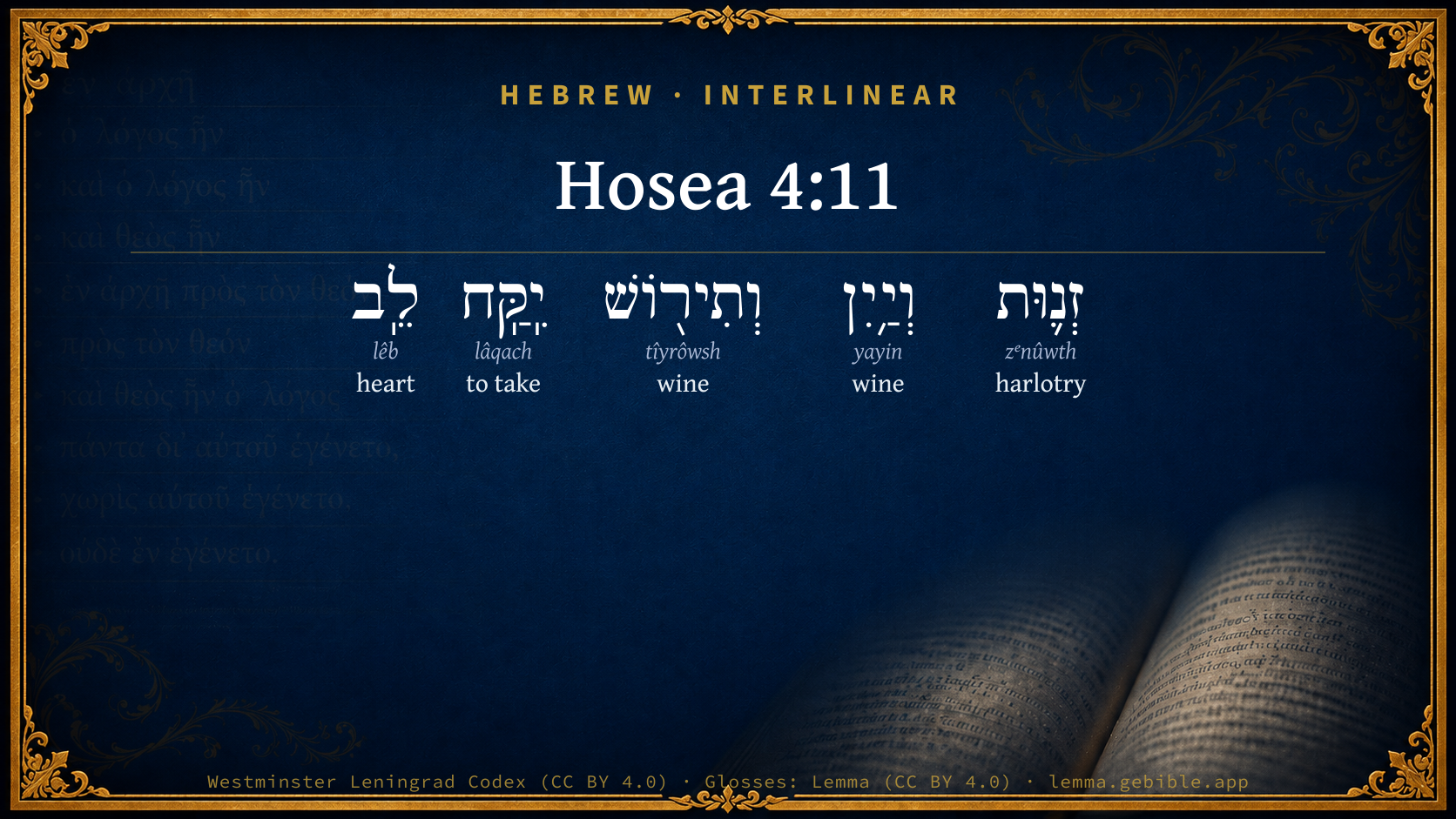
Hebrew (Westminster Leningrad Codex) Hosea 4:11 appears in the Hebrew Old Testament. The text above is from the Westminster Leningrad Codex. Each word links to its Strong’s number, a concise gloss, and parsing drawn from the Open Scriptures Hebrew Bible morphology. Click any word for its full Brown-Driver-Briggs (BDB) entry.
Download image
Cite this verse

Hosea 4:11 (World English Bible). Public Domain. Lemma interlinear Bible study tool, https://lemma.gebible.app/v/hosea/4/11.

Show BibTeX & RIS
BibTeX
RIS
English Translation
Prostitution, wine, and new wine take away understanding.
World English Bible · Public Domain
Download a study sheet

One document with this verse’s original text, its word-by-word gloss line, the meaning frame, cross-references with their text, attributed commentary, and full source and license credits — printable, and it pastes into notes with its structure intact.

This verse Autodidact and up

Study sheet (.html) Plain text (.txt)

A passage Seminary Student

Up to 50 verses in one chapter. A passage sheet keeps up to 6 commentary sources and 12 cross-references per verse, in the order this page ranks them, and says so on the sheet whenever that leaves anything out. Ask for a single verse and you get the Autodidact verse sheet above.

Everything on this page stays free to read, with no account — the sheet is a download of what is already on screen, not access to it.

Want to remove ads? Support Godless Engineer
Compare translations 3

The same verse in 3 English versions, stacked beneath the original-language interlinear above. Click any original word for its lexicon entry.

Each is an independent rendering of the whole verse — the interlinear is not word-aligned to these translations.

Highlighted words mark where these versions differ — a whole-verse word diff, not a word-by-word alignment.

  • World English Bible Public Domain
    Prostitution, wine, and new wine take away understanding.
  • King James Version Public Domain
    Whoredom and wine and new wine take away the heart.
  • unfoldingWord Literal Text CC BY-SA 4.0
    Prostitution and wine and new wine take heart.

unfoldingWord Literal Text — © unfoldingWord, licensed CC BY-SA 4.0. Word-aligned USFM3 via Door43 (git.door43.org/unfoldingWord/en_ult).

Versions to compare (up to 4)

3 of 4 selected

Show all 18 translations

Every available English version of this verse, each an independent rendering of the whole verse.

  • World English Bible Public Domain
    Prostitution, wine, and new wine take away understanding.
  • Berean Standard Bible Public Domain
    Promiscuity, wine, and new wine take away understanding.
  • Majority Standard Bible Public Domain
    to promiscuity, wine, and new wine, which take away understanding.
  • King James Version Public Domain
    Whoredom and wine and new wine take away the heart.
  • American Standard Version (1901) Public Domain
    Whoredom and wine and new wine take away the understanding.
  • Revised Version (1885) Public Domain
    Whoredom and wine and new wine take away the understanding.
  • Geneva Bible (1599) Public Domain
    Whoredome, and wine, and newe wine take away their heart.
  • Douay-Rheims (1899) Public Domain
    Fornication, and wine, and drunkenness take away the understanding.
  • Young's Literal Translation Public Domain
    Whoredom, and wine, and new wine, take the heart,
  • Literal Standard Version CC BY-SA 4.0
    Whoredom, and wine, and new wine, take the heart,
  • Unlocked Literal Bible CC BY-SA 4.0
    They love sexual promiscuity, wine, and new wine, which have taken away their understanding.
  • unfoldingWord Literal Text CC BY-SA 4.0
    Prostitution and wine and new wine take heart.
  • Darby Bible Public Domain
    Fornication, and wine, and new wine take away the heart.
  • World Messianic Bible Public Domain
    Prostitution, wine, and new wine take away understanding.
  • Webster's Bible Public Domain
    Lewdness and wine and new wine take away the heart.
  • Free Bible Version CC BY-SA 4.0
    They destroy their minds with old wine and new wine.
  • Bible in Basic English Public Domain
    Loose ways and new wine take away wisdom.
  • JPS Tanakh (1917) Public Domain
    Harlotry, wine, and new wine take away the heart.

Literal Standard Version (2020), Covenant Press — licensed CC BY-SA 4.0. Text via the HelloAO Bible API (eBible.org). Unlocked Literal Bible (unfoldingWord) — licensed CC BY-SA 4.0. Text via the HelloAO Bible API (eBible.org). unfoldingWord Literal Text — © unfoldingWord, licensed CC BY-SA 4.0. Word-aligned USFM3 via Door43 (git.door43.org/unfoldingWord/en_ult). Free Bible Version, Dr. Jonathan Gallagher — licensed CC BY-SA 4.0. Text via the HelloAO Bible API (eBible.org).

Word by word

More ways to search: Search by grammar → Find every occurrence → Compare this word →

Practice this passage: Drill this verse → Learn its vocabulary →

About this verse

These counts appear in no published source. They are computed here, from the morphology-tagged text and Lemma’s own curated glosses. What Lemma adds →

5
words
5
distinct lemmas
Prophets
section

Notable vocabulary

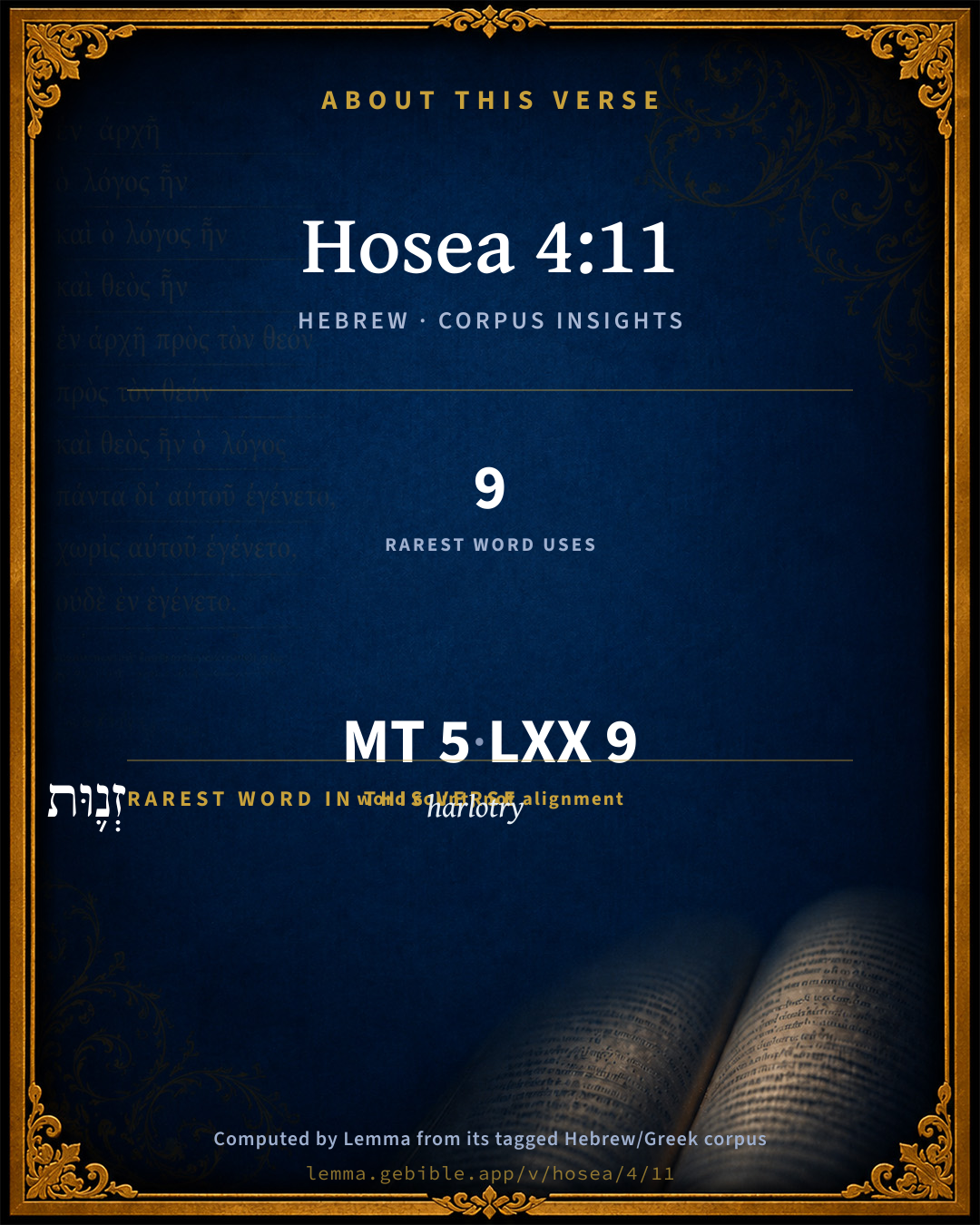
The rarest word here is זְנ֛וּת harlotry H2184 — appearing just 9 times in the whole Hebrew Bible.

Shared distinctive vocabulary

זְנ֛וּת harlotry H2184 occurs in 9 verses of the Hebrew Bible. Also found in:

Grammatical profile

  • 1 verb
  • 4 nouns

Verb forms

  • יִֽקַּֽח Qal · Imperfect

Hebrew & Septuagint length

In English translation the verse runs 8 words from the Hebrew and 15 from the Septuagint (LXX English) — the Septuagint runs noticeably longer here. See the side-by-side →

A rough comparison of the two English renderings, which tokenize alike — not a word-level alignment.

Word counts can differ between the Hebrew and the Greek without any difference in meaning — e.g. the Hebrew direct-object marker אֵת has no separate Greek word, and Greek often adds the article ὁ.

In the original languages it is 5 Hebrew tokens and 9 Greek tokens — but the two are counted differently (Hebrew bundles its prefixes and suffixes into one token; the Greek is in lemma form), so that isn’t a like-for-like length.

Cross-references

9

Topical passages linked to Hosea 4:11 in the Treasury of Scripture Knowledge — connected by theme and wording, ordered by reader-vote popularity; previews shown in the World English Bible.

  • Proverbs 20:1 Wine is a mocker, and beer is a brawler; Whoever is led astray by them is not wise.
  • Luke 21:34 "So be careful, or your hearts will be loaded down with carousing, drunkenness, and cares of this life, and that day will come on you suddenly.
  • Isaiah 28:7 Even these reel with wine, and stagger with strong drink; the priest and the prophet reel with strong drink, they are swallowed up of wine, they stagger with strong drink; they err in vision, they stumble in judgment.
  • Proverbs 6:32 He who commits adultery with a woman is void of understanding. He who does it destroys his own soul.
  • Proverbs 23:27–35 For a prostitute is a deep pit; And a wayward wife is a narrow well.
  • Ecclesiastes 7:7 Surely extortion makes the wise man foolish; and a bribe destroys the understanding.
  • Isaiah 5:12 The harp, lyre, tambourine, and flute, with wine, are at their feasts; But they don't regard the work of Yahweh, Neither have they considered the operation of his hands.
  • Hosea 4:12 My people consult with their wooded idol, And answer to a stick of wood. Indeed the spirit of prostitution has led them astray, And they have been unfaithful to their God.
  • Romans 13:11–14 Do this, knowing the time, that it is already time for you to awaken out of sleep, for salvation is now nearer to us than when we first believed.

Cross-references courtesy of OpenBible.info (CC BY 4.0).

Hebrew and Greek witnesses Masoretic Hebrew ↔ Greek Septuagint

The same verse in the two great witnesses to the Old Testament, shown verse-for-verse.

Here the Septuagint runs noticeably longer than the Hebrew — LXX2012 (modern English Septuagint) 15 words vs World English Bible 8. A rough length comparison of the two English translations, not a word-level alignment — read both below.

These are two independent witnesses, not word-aligned to each other, and the Septuagint is shown in lemma (dictionary) form.

Hebrew Hosea 4:11 Masoretic · Westminster Leningrad Codex

זְנ֛וּת וְיַ֥יִן וְתִיר֖וֹשׁ יִֽקַּֽח לֵֽב

Prostitution, wine, and new wine take away understanding.

World English Bible · Public Domain

Greek LXX Hosea 4:11 Septuagint · lemma form

πορνεία καί οἶνος καί μέθυσμα δέχομαι καρδία λαός ἐγώ

The heart of my people has gladly engaged in fornication and wine and strong drink.

LXX2012 (modern English Septuagint) · Public Domain

Hebrew: Westminster Leningrad Codex (CC BY 4.0). Greek: Septuagint (public domain); English from LXX2012 (modern English Septuagint) (Public Domain). How the Septuagint differs from the Hebrew →

Targum (Aramaic paraphrase)

1

The Targum is the ancient Jewish Aramaic paraphrase of the Hebrew Scriptures — an interpretive translation, not the Hebrew text itself. Onkelos (literal) and Pseudo-Jonathan (expansive) render the Torah, and Jonathan the Prophets. Coverage is partial: where no permissively-licensed English translation exists for a verse, only the Aramaic is shown. This is verse-level text, not a word-by-word alignment to the Hebrew.

  1. Targum Jonathan Prophets (Joshua–Malachi)
    זְנוּתָא וְחַמְרָא וְרַוְיַתָא שָׁלֵיף וּמַטְעֵי יַת לִבְּהוֹן:

    (no public-domain English translation for this verse)

    Targum Jonathan — Aramaic: “Mikraot Gedolot” (public domain). English: “Sefaria Community Translation” (CC0 1.0 (public-domain dedication)); “London "Chaldee Paraphrase," 1871” (public domain). Text via Sefaria.

Commentary

Notes on Hosea 4:11 from classic Christian and Jewish commentators (each source and its license shown beneath its notes). The classic Christian expositions comment on the surrounding passage and are grouped to its opening verse, so a note may address several verses; the Jewish commentaries on the Tanakh (Rashi and others) are per-verse, so they appear only where the commentator wrote on this verse.

Lemma curates 59 commentaries, every one of them public domain or Creative Commons licensed, each selected and text-cleaned for this edition rather than reprinted as found. About our sources →

Trapp's Complete Commentary

John Trapp

Hos 4:11 Whoredom and wine and new wine take away the heart.

Ver. 11. Whoredom and wine and new wine have taken away the heart] i.e. Have robbed my people of themselves, and laid a beast in their room. Any lust allowed and wallowed in will eat out the heart of grace; and, at length, all grace out of the heart. Hence temporizers grow in time so sapless, heatless, and heartless to any good; some unmortifled lust or other there is, that, as a worm, lieth grubbing at the root, and makes all to wither; that, like a drone in a hive, proves a great waster; that, as a moth in fine cloth, consumes all; or, as the light of the sun, puts out the light of the fire: so here. But, above all others, sensual sins and fleshly lusts (such as are here instanced, whoredom and drunkenness) do war against the soul, 1Pe 2:11, do take away the heart; they besot and infatuate a man, they rob him of his reason, and carry away his affections, &c. Grace is seated in the power of nature. Now these carnal sins disable nature; and so set it in a greater distance from grace. They make men, that formerly seemed to give light as a candle, to become as a snuff in a socket, drowned in the tallow; or as a quagmire, which swallows up the seed sown upon it, and yields no increase. Who are void of the Spirit but such as are sensual? Jdg 1:18-19. And who are they that say unto God, Depart from us, but those that dance to the timbrel and harp, &c., Job 21:11. "They saw God, and did eat and drink," Exo 24:11; that is, say some, though they had seen God, yet they turned again to sensual pleasures: as if it had reference to that eating, and drinking, and rising up to play, upon the dedication of their calf, which was presently after. Aristotle writeth of a parcel of ground in Sicily that sendeth forth such a strong smell of fragrant flowers to all the fields and grounds thereabouts, that no hound can hunt there; the scent is so confounded with the sweet smell of the flowers. Let us see to it that the pleasures of sin take not away all scent (and sense too) of heavenly delights; that the flesh, as a siren, befool not Wisdom’s guests, and get them away from her, Pro 9:16; as Aelian tells of a whore that boasted that she could easily get all Socrates’ scholars from him, but he could not recover one again from her. Indeed, none that go unto her return again, saith Solomon, Pro 2:19, for she gets their hearts from them: as David found, and Solomon complained. David was never his own worthy again, after he had fouled himself with that beastly sin. And Solomon, when he gave himself to wine and women (though his mother had sufficiently warned him, Pro 31:3-4), he quickly took hold of folly, Ecc 2:3, his sensualities drew out his spirits and dissolved him, and brought him to so low an ebb in grace, that many question his salvation. Bellarmine reckons him among reprobates: but I like not his judgment. Let ministers of all men (this is spoken of the priests chiefly, as some think) see to it that they flee fleshly lusts: that they exhort the younger women with chastity, as St Paul did Timothy: and drink (if any, yet but) a little wine for their health’s sake: remembering that the sins of teachers are teachers of sins; and that their evil practices flee far upon those two dangerous wings of example and scandal. Ministers should be no winebibbers or ale stakes, 1Ti 3:3, ne magis solliciti de mero quam de vero, magis ament mundi delicias quam Christi divitias, lest being "lovers of pleasure more than lovers of God," that should befall them that Solomon foretelleth, Pro 23:33, thine eyes shall behold strange women, and thine heart shall utter perverse things. Venter aestuans mere spumat in libidinem, a belly filled with wine foameth out filthiness, saith Jerome. Wine is the milk of Venus, saith Aristotle. Vina parant animos Veneri, saith Ovid. Whoredom is usually ushered in by drunkenness: hence they stand so close together in this text.

John Trapp, A Commentary or Exposition upon All the Books of the Old and New Testament (1647–1656) — public domain. Text from a community e-Sword module.

Keil & Delitzsch

C. F. Keil & F. Delitzsch

The allusion to whoredom leads to the description of the idolatrous conduct of the people in the third strophe, Hos 4:11-14, which is introduced with a general sentence. Hos 4:11. "Whoring and wine and new wine take away the heart (the understanding"). Zenūth is licentiousness in the literal sense of the word, which is always connected with debauchery. What is true of this, namely, that it weakens the mental power, shows itself in the folly of idolatry into which the nation has fallen. Hos 4:12. "My nation asks its wood, and its stick prophesies to it: for a spirit of whoredom has seduced, and they go away whoring from under their God." שׁאל בּעצו is formed after בּיהוה, to ask for a divine revelation of the idols made of wood (Jer 10:3; Hab 2:19), namely, the teraphim (cf. Hos 3:4, and Eze 21:26). This reproof is strengthened by the antithesis my nation, i.e., the nation of Jehovah, the living God, and its wood, the wood made into idols by the people. The next clause, "and its stick is showing it," sc. future events (higgı̄d as in Isa 41:22-23, etc.), is supposed by Cyril of Alexandria to refer to the practice of rhabdomancy, which he calls an invention of the Chaldaeans, and describes as consisting in this, that two rods were held upright, and then allowed to fall while forms of incantation were being uttered; and the oracle was inferred from the way in which they fell, whether forwards or backwards, to the right or to the left. The course pursued was probably similar to that connected with the use of the wishing rods.

(Note: According to Herod. iv. 67, this kind of soothsaying was very common among the Scythians (see at Eze 21:26). Another description of rhabdomancy is described by Abarbanel, according to Maimonides and Moses Mikkoz: cf. Marck and Rosenmller on this passage.)

The people do this because a spirit of whoredom has besotted them.

By rūăch zenūnı̄m the whoredom is represented as a demoniacal power, which has seized upon the nation. Zenūnı̄m probably includes both carnal and spiritual whoredom, since idolatry, especially the Asherah-worship, was connected with gross licentiousness. The missing object to התעה may easily be supplied from the context. זנה מתּחת אל, which differs from זנה מאחרי (Hos 1:2), signifies "to whore away from under God," i.e., so as to withdraw from subjection to God.

Keil & Delitzsch — Biblical Commentary on the Old Testament (1861–1891) — public domain (CC PDM 1.0). Text via the HelloAO Bible API. (Old Testament only.)

The Expositor's Bible

THE SIN AGAINST LOVE

Hosea 1-3; Hos_4:11 ff.; Hos_9:10 ff.; Hos_11:8 f.

The Love of God is a terrible thing-that is the last lesson of the Book of Hosea. "My God will cast them away." {Hosea 10}

"My God"-let us remember the right which Hosea had to use these words. Of all the prophets he was the first to break into the full aspect of the Divine Mercy to learn and to proclaim that God is Love. But he was worthy to do so, by the patient love of his own heart towards another who for years had outraged all his trust and tenderness. He had loved, believed and been betrayed; pardoned and waited and yearned, and sorrowed and pardoned again. It is in this long-suffering that his breast beats upon the breast of God with the cry "My God." As He had loved Gomer, so had God loved Israel, past hope, against hate, through ages of ingratitude and apostasy. Quivering with his own pain, Hosea has exhausted all human care and affection for figures to express the Divine tenderness, and he declares Gods love to be deeper than all the passion of men, and broader than all their patience: "How can I give thee up, Ephraim? How can I let thee go, Israel? I will not execute the fierceness of Mine anger. For I am God, and not man." And yet, like poor human affection, this Love of God, too, confesses its failure-"My God shall cast them away." It is Gods sentence of relinquishment upon those who sin against His Love, but the poor human lips which deliver it quiver with an agony of their own, and here, as more explicitly in twenty other passages of the book, declare it to be equally, the doom of those who outrage the love of their fellow men and women.

We have heard it said: "The lives of men are never the same after they have loved; if they are not better, they must be worse." "Be afraid of the love that loves you: it is either your heaven or your hell." "All the discipline of men springs from their love-if they take it not so, then all their sorrow must spring from the same source." "There is a depth of sorrow, which can only be known to a soul that has loved the most perfect thing and beholds itself fallen." These things are true of the Love, both of our brother and of our God. And the eternal interest of the life of Hosea is that he learned how, for strength and weakness, for better or for worse, our human and our Divine loves are inseparably joined.

I.

Most men learn that love is inseparable from pain where Hosea learned it-at home. There it is that we are all reminded that when love is strongest she feels her weakness most. For the anguish which love must bear, as it were from the foundation of the world, is the contradiction at her heart between the largeness of her wishes and the littleness of her power to realize them. A mother feels it, bending over the bed of her child, when its body is racked with pain or its breath spent with coughing. So great is the feeling of her love that it ought to do something, that she will actually feel herself cruel because nothing can be done. Let the sick-bed become the beach of death, and she must feel the helplessness and the anguish still more as the dear life is now plucked from her and now tossed back by the mocking waves, and then drawn slowly out to sea upon the ebb from which there is no returning.

But the pain which disease and death thus cause to love is nothing to the agony that sin inflicts when he takes the game into his unclean hands. We know what pain love brings, if our love be a fair face and a fresh body in which Death brands his sores while we stand by, as if with arms bound. But what if our love be a childlike heart, and a frank expression and honest eyes, and a clean and clever mind. Our powerlessness is just as great and infinitely more tormented when sin comes by and casts his shadow over these. Ah, that is Loves greatest torment when her children, who have run from her to the bosom of sin, look back and their eyes are changed! That is the greatest torment of Love-to pour herself without avail into one of those careless natures which seem capacious and receptive, yet never fill with love, for there is a crack and a leak at the bottom of them. The fields where Love suffers her sorest defeats are not the sick-bed and not deaths margin, not the cold lips and sealed eyes kissed without response; but the changed eyes of children, and the breaking of the "full-orbed face," and the darkening look of growing sons and daughters, and the home the first time the unclean laugh breaks across it. To watch, though unable to soothe, a dear body racked with pain, is peace beside the awful vigil of watching a soul shrink and blacken with vice, and your love unable to redeem it.

Such a clinical study Hosea endured for years. The prophet of God, we are told, brought a dead child to life by taking him in his arms and kissing him. But Hosea with all his love could not make Gomer a true, whole wife again. Love had no power on this woman-no power even at the merciful call to make all things new. Hosea, who had once placed all hope in tenderness, had to admit that Loves moral power is not absolute. Love may retire defeated from the highest issues of life. Sin may conquer Love.

Yet it is in this his triumph that Sin must feel the ultimate revenge. When a man has conquered this weak thing, and beaten her down beneath his feet, God speaks the sentence of abandonment.

There is enough of the whipped dog in all of us to make us dread penalty when we come into conflict with the strong things of life. But it takes us all our days to learn that there is far more condemnation to them who offend the weak things of life, and particularly the weakest of all, its love. It was on sins against the weak that Christ passed His sternest judgments: "Woe unto him that offends one of these little ones; it were better for him that he had never been born." Gods little ones are not only little children, but all things which, like little children, have only love for their strength. They are pure and loving men and women-men with no weapon but their love, women with no shield but their trust. They are the innocent affections of our own hearts-the memories of our childhood, the ideals of our youth, the prayers of our parents, the faith in us of our friends. These are the little ones of whom Christ spake, that he who sins against them had better never have been born. Often may the dear solicitudes of home, a fathers counsels, a mothers prayers, seem foolish things against the challenges of a world calling us to play the man and do as it does; often may the vows and enthusiasms of boyhood seem impertinent against the temptations which are so necessary to manhood: yet let us be true to the weak, for if we betray them, we betray our own souls. We may sin against law and maim or mutilate ourselves, but to sin against love is to be cast out of life altogether. He who violates the purity of the love with which God has filled his heart, he who abuses the love God has sent to meet him in his opening manhood, he who slights any of the affections, whether they be of man or woman, of young or of old, which God lays upon us as the most powerful redemptive forces of our life, next to that of His dear Son-he sinneth against his own soul, and it is of such that Hosea spake: "My God will cast them away."

We talk of breaking law: we can only break ourselves against it. But if we sin against Love, we do destroy her: we take from her the power to redeem and sanctify us. Though in their youth men think Love a quick and careless thing-a servant always at their side, a winged messenger easy of dispatch-let them know that every time they send her on an evil errand she returns with heavier feet and broken wings. When they make her a pander they kill her outright. When she is no more they waken to that which Gomer came to know, that love abused is love lost, and love lost means Hell.

II

This, however, is only the margin from which Hosea beholds an abandonment still deeper. All that has been said of human love and the penalty of outraging it is equally true of the Divine love and the sin against that.

The love of God has the same weakness which we have seen in the love of man. It, too, may fail to redeem; it, too, has stood defeated on some of the highest moral battle-fields of life. God Himself has suffered anguish and rejection from sinful men. "Herein," says a theologian, "is the mystery of this love that God can never by His Almighty Power compel that which is the very highest gift in the life of His creatures-love to Himself, but that He receives it as the free gift of His creatures, and that He is only able to allow men to give it to Him in a free act of their own will." So Hosea also has told us how God does not compel, but allure or "woo," the sinful back to Himself. And it is the deepest anguish of the prophets heart, that this free grace of God may fail through mans apathy or insincerity. The anguish appears in those frequent antitheses in which his torn heart reflects herself in the style of his discourse. "I have redeemed them-yet they have spoken lies against Me. {Hos_7:13} I found Israel like grapes in the wilderness-they went to Baal-Peor. {Hos_9:10} When Israel was a child, then I loved him but they sacrificed to Baalim. {Hos_11:1-2} I taught Ephraim to walk, but they knew not that I healed them. {Hos_9:4} How can I give thee up, Ephraim? how can I let thee go, O Israel? Ephraim compasseth Me with lies, and the house of Israel with deceit." {Hos_11:8; Hos_12:1}

We fear to apply all that we know of the weakness of human love to the love of God. Yet though He be God and not man, it was as man He commended His love to us. He came nearest us, not in the thunders of Sinai, but in Him Who presented Himself to the world with the caresses of a little child; who met men with no angelic majesty or heavenly aureole, but whom when we saw we found nothing that we should desire Him, His visage was so marred more than any man, and his form than the sons of men; Who came to His own and His own received Him not; Who, having loved His own that were in the world, loved them up to the end, and yet at the end was by them deserted and betrayed, -it is of Him that Hosea prophetically says: "I drew them with cords of a man and with bands of love."

We are not bound to God by any unbreakable chain. The strands which draw us upwards to God, to holiness and everlasting life, have the weakness of those which bind us to the earthly souls we love. It is possible for us to break them. We love Christ, not because He has compelled us by any magic, irresistible influence to do so; but, as John in his great simplicity says, "We love Him because He first loved us."

Now this is surely the terror of Gods love-that it can be resisted; that even as it is manifest in Jesus Christ we men have the power, not only to remain as so many do, outside its scope, feeling it to be far-off and vague, but having tasted it to fall away from it, having realized it to refuse it, having allowed it to begin its moral purposes in our lives to baffle and nullify these; to make the glory of Heaven absolutely ineffectual in our own characters; and to give our Savior the anguish of rejection.

Give Him the anguish, yet pass upon ourselves the doom! For, as I read the New Testament, the one unpardonable sin is the sin against our Blessed Redeemers Love as it is brought home to the heart by the power of the Holy Spirit. Every other sin is forgiven to men but to crucify afresh Him who loved us and gave Himself for us. The most terrible of His judgments is "the wail of a heart wounded because its love has been despised": "Jerusalem, Jerusalem! how often would I have gathered thy children as a hen gathereth her chickens, and ye would not. Behold your house is left unto you desolate!"

Men say they cannot believe in hell, because they cannot conceive how God may sentence men to misery for the breaking of laws they were born without power to keep. And one would agree with the inference if God had done any such thing. But for them which are under the law and the sentence of death, Christ died once for all that He might redeem them. Yet this does not make a hell less believable. When we see how Almighty was that Love of God in Christ Jesus, lifting our whole race and sending them forward with a freedom and a power of growth nothing else in history has won for them; when we prove again how weak it is, so that it is possible for millions of characters that have felt it to refuse its eternal influence for the sake of some base and transient passion; nay, when I myself know this power and this weakness of Christs love, so that one day being loyal I am raised beyond the reach of fear and of doubt, beyond the desire of sin and the habit of evil, and the next day finds me capable of putting it aside in preference for some slight enjoyment or ambition-then I know the peril and the terror of this love, that it may be to a man either Heaven or Hell.

Believe then in hell, because you believe in the Love of God-not in a hell to which God condemns men of His will and pleasure, but a hell into which men cast themselves from the very face of His love in Jesus Christ. The place has been painted as a place of fires. But when we contemplate that men come to it with the holiest flames in their nature quenched, we shall justly feel that it is rather a dreary waste of ash and cinder, strewn with snow-some ribbed and frosty Arctic zone, silent in death, for there is no life there, and there is no life there because there is no Love, and no Love because men, in rejecting or abusing her, have slain their own power ever again to feel her presence.

William Robertson Nicoll, ed., The Expositor's Bible (London: Hodder & Stoughton, 1887–1910) — public domain. 65 of 66 books (1 Corinthians is not separately keyed, as that volume carries no machine-parseable verse references); section-level commentary keyed to the opening verse. Introductory and overview sections not keyed to a specific passage are excluded.

Geneva Bible (1599)

Geneva Bible translators

In giving themselves to pleasures, they become like brute beasts.

Geneva Bible (1599) marginal notes — public domain. Text via Bolls.life.

Jamieson, Fausset & Brown

Robert Jamieson, A. R. Fausset & David Brown

A moral truth applicable to all times. The special reference here is to the licentious orgies connected with the Syrian worship, which lured Israel away from the pure worship of God (Isa 28:1, Isa 28:7; Amo 4:1).

take away the heart--that is, the understanding; make men blind to their own true good (Ecc 7:7).

Jamieson, Fausset & Brown — Commentary Critical and Explanatory on the Whole Bible (1871) — public domain (CC PDM 1.0). Text via the HelloAO Bible API.

Adam Clarke's Commentary

Verse 11. Whoredom and wine] These debaucheries go generally together.

Take away the heart.] Darken the understanding, deprave the judgment, pervert the will, debase all the passions, &c.

Adam Clarke's Commentary on the Bible (1810–1826) — public domain. Text from a community e-Sword/MySword module.

John Calvin's Commentaries

The verb לקח lakech, means to take away; and this sense is also admissible that wine and wantonness take possession of the heart; but I take its simpler meaning, to take away. But it is not a general truth as most imagine, who regard it a proverbial saying, that wantonness and wine deprive men of their right mind and understanding: on the contrary, it is to be restricted, I doubt not, to the Israelites; as though the Prophet had said, that they were without a right mind, and like brute animals, because drunkenness and fornication had infatuated or fascinated them. But we may take both in a metaphorical sense; as fornication may be superstition, and so also drunkenness: yet it seems more suitable to the context to consider, that the Prophet here reproaches the Israelites for having petulantly cast aside every instruction through being too much given to their pleasures and too much cloyed. Since then the Israelites had been enriched with great plenty, God had given way to abominable indulgences, the Prophet says, that they were without sense: and this is commonly the case with such men. I will not therefore treat here more at large of drunkenness and fornication.

It is indeed true, that when any one becomes addicted to wantonness, he loses both modesty and a right mind, and also that wine is as it were poisonous, for it is, as one has said, a mixed poison: and the earth, when it sees its own blood drank up intemperately, takes its revenge on men. These things are true; but let us see what the Prophet meant.

Now, as I have said, he simply directs his discourse to the Israelites, and says, that they were sottish and senseless, because the Lord had dealt too liberally with them. For, as I have said, the kingdom of Israel was then very opulent, and full of all kinds of luxury. The Prophet then touches now distinctly on this very thing: “How comes it that ye are now so senseless, that there is not a particle of right understanding among you? Even because ye are given to excesses, because there is among you too large an abundance of all good things: hence it is, that all indulge their own lusts; and these take away your heart.” In short, God means here that the Israelites abused his blessings, and that excesses blinded them. This is the meaning. Let us now go on —

John Calvin's Commentaries (1540-1563) — public domain. Text from the Calvin Translation Society English edition (1840s-50s) via the Christian Classics Ethereal Library (ccel.org). Calvin's coverage is partial (roughly two-thirds of the Bible); uncommented books and verses are honest gaps, never fabricated. The 19th-century editor's footnotes and remarks are omitted so the notes are faithfully Calvin's own voice.

Ellicott's Commentary for English Readers

(11) Heart.—The whole inner life, consumed by these licentious indulgences.

A Bible Commentary for English Readers, edited by Charles John Ellicott (1878–1897) — public domain. Text from a community e-Sword module.

The Cambridge Bible for Schools and Colleges

gen. ed. J. J. S. Perowne

11. Whoredom, &c.] ‘The heart’, not ‘their heart’ (as the Targum and Peshito). It is a moral adage, showing that Hosea was not more inclined than Isaiah to abandon simple moral teaching to the class of ‘wise men’, who ‘sat in the gate’ and conveyed practical lessons in the form of proverbs. It is literal whoredom that is meant, as, even apart from Hos_4:13-14, the juxtaposition with ‘wine and new wine’ shows. The impure rites of nature-worship had destroyed the reverence for the marriage-bond. Heart here means ‘the spiritual understanding’, ‘a heart to know Me’ (Jer_24:7); ‘sons of Belial’ cannot ‘know Jehovah’ (2Sa_2:12). For the drunkenness of Samaria comp. Isa_28:1.

11–14. Thus the priests have led the way, and the people follow. They have lost the spiritual faculty; a wild impulse to the most sensual idolatry has carried them away.

The Cambridge Bible for Schools and Colleges (gen. ed. J. J. S. Perowne; Cambridge University Press, 1878–1918) — public domain. Text from a community e-Sword module.

John Gill's Exposition

Whoredom and wine, and new wine, take away the heart. Uncleanness and intemperance besot men, deprive them of reason and judgment, and even of common sense, make them downright fools, and so stupid as to do the following things; or they take away the heart from following the Lord, and taking heed to him, and lead to idolatry; or they "occupy" (z) the heart, and fill it up, and cause it to prefer sensual lusts and pleasures to the fear and love of God: their stupidity brought on hereby is exposed in the next verse; though it seems chiefly to respect the priests, who erred in vision through wine and strong drink, and stumbled in judgment, Isa 28:7.

(z) "occupant cor", so some in Calvin and Rivet; "occupavit cor", Schmidt.

John Gill's Exposition of the Whole Bible (1746–1763) — public domain (CC PDM 1.0). Text via the HelloAO Bible API.

Albert Barnes' Notes on the Bible

Whoredom and wine and new wine take away the heart - (Literally, “takes away”). Wine and fleshly sin are pictured as blended in one, to deprive man of his affections and reason and understanding, and to leave him brutish and irrational. In all the relations of life toward God and man, reason and will are guided by the affections. And so, in God’s language, the “heart” stands for the “understanding” as well as the “affections,” because it directs the understanding, and the understanding, bereft of true affections, and under the rule of passion, becomes senseless. Besides the perversion of the understanding, each of these sins blunts and dulls the fineness of the intellect; much more, both combined. The stupid sottishness of the confirmed voluptuary is a whole, of which each act of sensual sin worked its part. The Pagan saw this clearly, although, without the grace of God, they did not act on what they saw to be true and right. This, the sottishness of Israel, destroying their understanding, was the ground of their next folly, that they ascribed to “their stock” the office of God. “Corruption of manners and superstition” (it has often been observed) “go hand in hand.”

Albert Barnes' Notes on the Bible (1834–1885) — public domain. Text from a community e-Sword/MySword module.

Haydock's Catholic Bible Commentary

Understanding. Literally, "heart." (Haydock) --- Some sins darken reason more than others; but none so much as spiritual fornication. (Worthington)

George Leo Haydock (1774–1849), Haydock's Catholic Family Bible and Commentary, 1859 edition — public domain. Excludes Psalms (Douay-Rheims chapter numbering differs from Protestant) and Deuterocanonical books (Catholic canon only).

Matthew Poole's English Annotations

Whoredom; unlawful converse with wanton women, the forbidden pleasures of an adulterous bed.

And wine and new wine; excess of drinking, and indeed all immoderate pleasures; one kind being put for all.

Take away the heart; besot men, and deprive them of the right use of their Understanding and judgment. By these courses both priests and people here have disabled themselves to discern aright between good and bad, between safe and dangerous.

Matthew Poole's English Annotations on the Holy Bible (1683–1685) — public domain. Text from a community e-Sword/MySword module.

Whedon's Commentary on the Bible

Daniel D. Whedon

11-14. The religious corruption. In Hos_4:1-2 the prophet emphasizes moral corruption, here religious impurities, though the latter are not and cannot be separated entirely from the former. The section begins with what may be a proverb expressing the thought that sin blinds the spiritual faculties (Isa_5:12; compare Joe_1:5).

11. Whoredom — The juxtaposition of the word with wine shows that it is to be interpreted literally.

Wine… new wine — The former is a general term; on the latter see on Joe_1:5; Joe_1:10. Heart [“understanding”] — See on Joe_2:12. The weakening of the understanding manifests itself in the conduct described in the following verses.

Daniel D. Whedon (gen. ed.), Commentary on the Old and New Testaments (1874–1909) — public domain. Text from a community e-Sword module.

The Pulpit Commentary

It makes no great difference whether we regard this verse as concluding the foregoing or commencing a new paragraph, though we prefer the latter mode of connecting it. It states the debasing influence which debauchery and drunkenness are known to exercise over both head and heart: they dull the faculties of the former and deaden the affections of the latter. The heart is not only the seat of the affections, as with us; it comprises also the, intellect and hill; while the word tQyi is not so much to take away as to captivate the heart, Rashi gives the former sense: The whoredom and drunkenness to which they are devoted take away their heart from me." Kimchi"s explanation is judicious: "The whoredom to which they surrender themselves and the constant drunkenness which they practice take their heart, so that they have no understanding to perceive what is the way of goodness along which they should go." He further distinguishes the tirosh from the yayin, remarking that the former is the new wine which takes the heart and suddenly intoxicates. The prophet, having had occasion to mention the sin of whoredom in ver. 10, makes a general statement about the consequences of that sin combined with drunkenness in ver. 10, as not only debasing, but depriving men of the right use of their reason and the proper exercise of their natural affections. The following verses afford abundant evidence of all this in the insensate conduct of Israel at the time referred to.

Vers. 11-14. Faults in the life breed errors in the brain, and errors the brain produce in turn faults in the life.

Thus it was with Israel. Debauchery and drunkenness, and this to an extreme degree, had darkened the understanding, hardened the heart, paralyzed the will, and seared the conscience. In this enfeebled state of their intellectual and moral powers, they had recourse, in cases of doubt or difficulty, not to the high priest, or prophets of God, or Divine Word, for guidance and direction, but to their images of wood or idolatrous divining staff.

I SIN LEADS TO SIN. If sorrows love a train, sins like a series. How often the culprit endeavors to conceal his guilt by lying, and thus adds one sin to another! Lewdness and intemperance, as here intimated, frequently go hand in hand. Since, then, sins are so linked to each other, our safety as well as our duty is to resist the very beginnings and buddings of evil in the soul. Every time sin is indulged the power of resistance is weakened, until men become the prey of the evil one, and, after a few weak wrestlings of the spirit against the flesh, the heart is easily taken captive. An effectual way of avoiding vice or any vicious course is to practice the opposite virtues. This is vastly more than forming a theory of virtue in one"s thoughts; for, as Butler has shown, "from our very faculty of habits passive impressions, by being repeated, grow weaker," but "practical habits are formed and strengthened by repeated acts.

II THE FOLLY OF SIN. The stupidity of which Israel gave evidence is traced to a spirit of whoredoms. The ruach, or spirit, in this passage somewhat resembles the personification of Ate by the Greeks, which in Homer denotes the infatuation or spirit of error that prompts to crime, then the crime committed, and also the punishment that overtakes crime. In the allegoric representation of Ate by Homer she has different and apparently contradictory attributes: as infatuation, taking possession of the mind; and blinding its faculties through passion. She has tender feet, does not tread on the ground, but moves gently and noiselessly over men"s heads, surprising them in their unguarded moments, to their unspeakable injury. Again, in the commission of crime her gait is marked by strength of body and firmness of step and strong excitement, while in the punishment of crime the retribution is sudden, powerful, and certain. In these two capacities, that is to say, the perpetration of crime and its punishment, she is vigorous and firm of step. To the spirit of whoredom as an evil spirit of infatuation, like this Greek Ate, bewilderingly misleading men to the perpetration of evil and making them obnoxious to punishment, the prophet traces Israel"s stupidity in consulting idols and similar means of divination on the one hand, and their sin in departing from God, the loving Husband and rightful Head of his people, on the other. Thus the spirit of whoredoms may be compared with similar Scripture expressions, such as a spirit of jealousy, a lying spirit, an unclean spirit; or it may denote the vehement spirit with which men, bent on idolatry and adultery adultery both in the spiritual and carnal sense were hurried along; while the faithlessness of the adulteress fitly represents the spiritual infidelity of Israel.

III ZEAL CONTRARY TO KNOWLEDGE. The people of Israel fancied that they were worshipping God on the high hills and under the tall trees; but this was ignorant will-worship, or worse. God had appointed Jerusalem as the place of his worship, and had commanded sacrifices and incense to be offered there, and nowhere else.

1. The multiplication of altars and memorials elsewhere, however praiseworthy Israel might imagine it, was really a violation of the Divine command; and so God regarded it, for "behold, to obey is better than sacrifice, and to hearken than the fat of rams? Will-worship may have a show of wisdom in it, and may be well meaning, yet it is will-worship all the same. If we will worship God acceptably, then it must be in the place he has appointed and in the manner he has himself prescribed. Mountains have often been associated with sacred service and sacred scenes. Thus the sacrifice of Isaac was to be on a mountain; the giving of the Law was on a mountain; the temple was erected on a mountain; the transfiguration, the crucifixion, and the ascension, were each on a mountain. But mountains became scenes of idolatry and sin, and therefore God, when he forbade such worship, forbade the scenes thereof.

2. Israel"s zeal was worthy of a better cause. That zeal characterized their sacrifices, for it is the intensive form of the verb that is usedyezabbeehu (Piel), not yizbechu (Qal); it distinguished their burning of incense, for again it is first yeqatteru, not yaqteru. "The words express," says Pusey, "that this which God forbade they did diligently; they sacrificed much and diligently; they burned incense much and diligently." Nor was this all. They performed with equal diligence both the important parts of the service the sacrifice and the burning of incense.

3. The blood of the sacrifice signified atonement; the pleasant smell of the incense typified service acceptably offered. "Incense, being fragrant, represented that which is pleasing, and which has in it acceptability; and when offered along with prayer, praise, or any feeling of the soul, exhibited a type of the merits of the Surety enveloping his people"s services.

IV MEN"S OWN SINS ARE OFTEN MADE THEIR SCOURGES. Never did the great poet of human nature give expression to a truer sentiment than that"The gods are just, and of our pleasant ricer Make instruments to scourge us.

This was eminently the case with Israel. They had committed spiritual adultery, renouncing their subjection to him by violation of the marriage covenant, and thereby forfeiting that protection secured to them by the conditions of that covenant. "They," says an old writer," who commit idolatry, and follow false religions, and so do renounce subjection to God, and put themselves from under his directions, do also put themselves from under his protection; for in both these respects it is true that Israel went a-whoring from under their God." They prostituted themselves to idols, and withdrew from under God"s authority, casting off the obedience they owed him and the reverence which was his due. Nay, more, fathers of families and husbands at the head of households were not only guilty of spiritual whoredom or idolatry; they were guilty of carnal whoredom with those vile priestesses to abominable idols and prostitutes to the worshipers devotee-harlots who had consecrated themselves to a life of sin, as though such shameful desecration of themselves were consecration to Divine service. Now they are in turn disgraced and distressed by the whoredom of their daughters and the adultery of their wives; nor are they allowed to comfort themselves by the hope of a speedy cessation of such corruption, for, unchecked by chastisement, the licentiousness continues, prosperity in sin tempting to perseverance. "So," says Pusey, "through their own disgrace and bitter griefs, in the persons of those whose honor they most cherished, they should learn how ill they themselves had done, in departing from him who is the Father and Husband of every soul. The sins of the fathers descend very often to the children, both in the way of nature, that the children inherit strong temptations to their parents" sin, and by way of example, that they greedily imitate, often exaggerate them."

The Pulpit Commentary (1880–1919), ed. H.D.M. Spence-Jones & Joseph S. Exell — public domain. Text from a community e-Sword module.

John Wesley's Explanatory Notes

Take away the heart - Deprive men of their understanding and judgment.

John Wesley, Explanatory Notes Upon the Whole Bible (1754–1765) — public domain. Text via the GEBible commentary corpus.

Kretzmann's Popular Commentary

Paul E. Kretzmann

The Second Part of the Accusation

v. 11. Whoredom, the general immorality just referred to, and wine and new wine, drunken debauchery in every form, as practiced in those days in connection with the Syrian idol-worship, take away the heart, the understanding, making men perverse and stupid in every respect.

v. 12. My people ask counsel at their stocks, from their wooden idols, and their staff declareth unto them, the reference being to the practice of setting up two rods, with proper incantations, the oracle depending upon the direction in which the rods fell; for the spirit of whoredoms, which has made them so stupid, hath caused them to err, to become addicted to such foolishness as they would despise under normal conditions of mind, and they have gone a-whoring from under their God, their idolatry causing them to forsake the subjection which was their natural relation to the true God.

v. 13. They sacrifice upon the tops of the mountains, after the manner which they had taken over from the heathen Canaanites, and burn incense upon the hills, in a form of worship which should have been reserved for the true God alone, under oaks and poplars and elms, or terebinths, because the shadow thereof is good, green and pleasant, a fact which made this nature worship appeal to them; therefore your daughters shall commit whoredom, and your spouses, young brides, or daughters-in-law, shall commit adultery, for such lewdness was connected with the cult of the gods of nature, with the worship of Baal and Astarte.

v. 14. I will not punish your daughters when they commit whoredom, nor your spouses when they commit adultery, as just set forth; for themselves, the fathers and husbands, are separated with whores, going aside to be alone with them in their lewd practices, and they sacrifice with harlots, with the temple-girls, who freely sold themselves to the worshipers; therefore the people, that doth not understand, being dense with impudence and shamelessness, shall fall, being destroyed as a consequence of such conditions. The Lord therefore adds a warning lest Judah join Israel in this idolatry and shameless conduct.

v. 15. Though thou, Israel, play the harlot, in such blasphemous adultery and idolatry, yet let not Judah offend, for the members of this nation were still trying to maintain the Lord’s worship; and come not ye unto Gilgal, a place southwest of Shiloh, neither go ye up to Bethaven, or Bethel, on the southern boundary of Israel, the shrines at these two places being devoted to idol-worship, nor swear, The Lord liveth, for an oath by the life of Jehovah in idolatrous service was a further insult to His majesty.

v. 16. For Israel slideth back as a backsliding heifer, stubborn and unbroken; now the Lord will feed them as a lamb in a large place, by removing them to a distant and large country, where they would be far removed from those with whom they associated in their idolatry.

v. 17. Ephraim, the northern kingdom, is joined to idols, so linked with idolatrous worship as to make it impossible for them to leave it alone at this time; let him alone, for it would be useless to try to take him from his idolatry; he is utterly stubborn.

v. 18. Their drink is sour, or, "they are abandoned to their carousing"; they have committed whoredom continually, in an excess of lewdness; her rulers with shame do love, Give ye, literally, "loving have loved their shields’ shame," that is, the rulers of the nation, by loving sin, loved also shame, the result of their transgression; in other words, the whole nation, from the highest to the lowest, was corrupt.

v. 19. The wind hath bound her up in her wings, or, "the tempest seizes them with its wings,". and they shall be ashamed because of their sacrifices, for their trust in their idolatrous sacrifices would prove to be a vain hope. Thus the hopes of unbelievers and idolaters will ever be found to be vain and foolish, for there is no salvation outside of the deliverance announced by the one true God.

Paul E. Kretzmann, Popular Commentary of the Bible (1921–1924) — public domain. Text from a community e-Sword module.

unfoldingWord translationNotes

Door43 World Missions Community

Connecting Statement:

Yahweh is talking about Israel.

sexual promiscuity, wine, and new wine, which have taken away their understanding

The people of Israel are pursuing sex outside of marriage and drinking too much wine. In doing these activities they have forgotten Yahweh's commands. These actions are spoken of here as if they were someone who could prevent other people from understanding the importance of obeying Yahweh. (See: Personification)

their walking sticks give them prophecies

Idol worshipers used walking sticks to help them predict the future. The walking sticks are spoken of here as if they were people who spoke prophecies. (See: Personification)

a mind of promiscuity has misled them

Worshiping the idols and sleeping with the temple prostitutes has developed in the people of Israel the desire to always sin against Yahweh in these ways. Here "mind" is spoken of as if it were a separate person who was able to convince the people to disobey Yahweh. (See: Personification)

has misled

has convinced the people to sin (See: Metaphor)

translationWords

sexual immorality

wine

people of God

false god

prophet

God

unfoldingWord translationNotes — © Distant Shores Media and the Door43 World Missions Community, licensed CC BY-SA 4.0. Source: git.door43.org/Door43/en_tn.

Rashi

Rabbi Shlomo Yitzchaki (Rashi)

take away the heart The harlotry and [old] wine and new wine with which they are involved have captured their hearts away from me.

Rashi on the Tanakh — English translations: “The Judaica Press complete Tanach with Rashi, translated by A. J. Rosenberg” (CC BY 4.0); “Pentateuch with Rashi's commentary by M. Rosenbaum and A.M. Silbermann, 1929-1934” (public domain); “The Metsudah Tanach series, Lakewood, N.J” (CC BY 4.0); and “The Book of Joshua, Metsudah Publications, 1997” (CC BY 4.0). Text via Sefaria.

Lesson kit

Teaching starters — assembled from the data on this page, not authored interpretation. Every prompt links to the verse data it draws on. Edit before teaching.

Hosea, in the Prophets, opens this verse with 5 words (5 distinct Hebrew lemmas). Its most distinctive word is zᵉnûwth (“harlotry”). The Greek Septuagint runs longer here. A historical commentator’s framing appears above. Read the whole chapter for the surrounding context.

Discussion questions

  1. What does “harlotry” (zᵉnûwth) contribute to the verse as a whole?
  2. Numbers 14:33 shares the word «harlotry» with this verse. How do the two illuminate each other?
  3. Compared with the Hebrew, the Septuagint runs longer here. What questions does that raise?
  4. These translations render this verse differently. What is at stake in choosing one wording over another?
  5. The verb «יִֽקַּֽח» is Qal Imperfect. How does its form color the action?
  6. Reading how Trapp's Complete Commentary and Keil & Delitzsch read this verse, where do the two commentators agree and where do they part?

Things to notice

Reading settings

Reading text

Shown beneath each verse's original-language words.

Old Testament
Old Testament edition

Read the OT as the Masoretic Hebrew (MT) or the Greek Septuagint (LXX).

English shown for the Greek Septuagint (in the Hebrew ↔ Greek comparison).

Comparing translations? Open the Compare panel on any verse page to stack up to four side by side.